
Chapter 4 Section 2 Part 1 Changes of


- Slides: 12
Chapter 4 Section 2 – Part 1
Changes of State 2 Thermal Energy and Heat Energy • Simply stated, energy is the ability to do work or cause change. • The energy of motion is called kinetic energy.
Changes of State 2 Thermal Energy and Heat Energy • The total kinetic energy of all the particles in a sample of matter is called thermal energy. • Thermal energy, an extensive property, depends on the number of particles in a substance as well as the amount of energy each particle has.
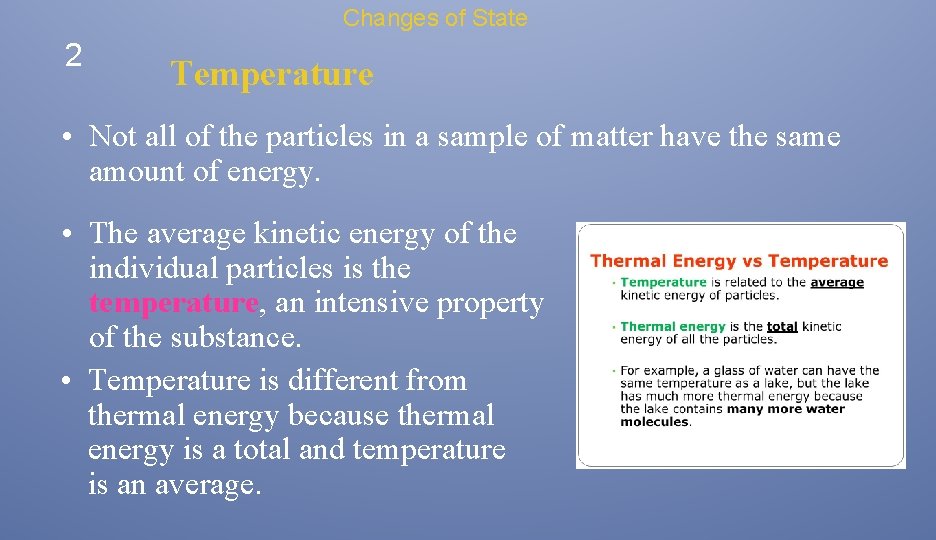
Changes of State 2 Temperature • Not all of the particles in a sample of matter have the same amount of energy. • The average kinetic energy of the individual particles is the temperature, an intensive property of the substance. • Temperature is different from thermal energy because thermal energy is a total and temperature is an average.
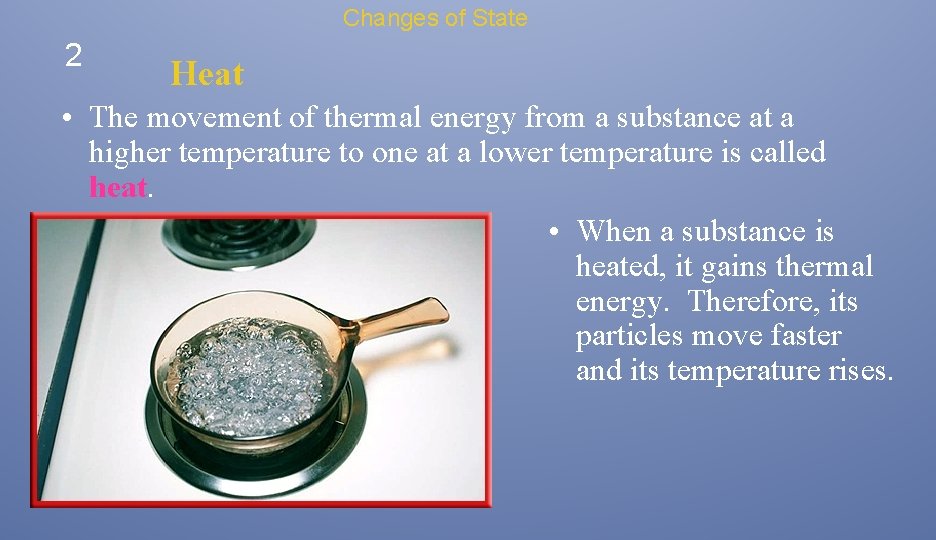
Changes of State 2 Heat • The movement of thermal energy from a substance at a higher temperature to one at a lower temperature is called heat. • When a substance is heated, it gains thermal energy. Therefore, its particles move faster and its temperature rises.
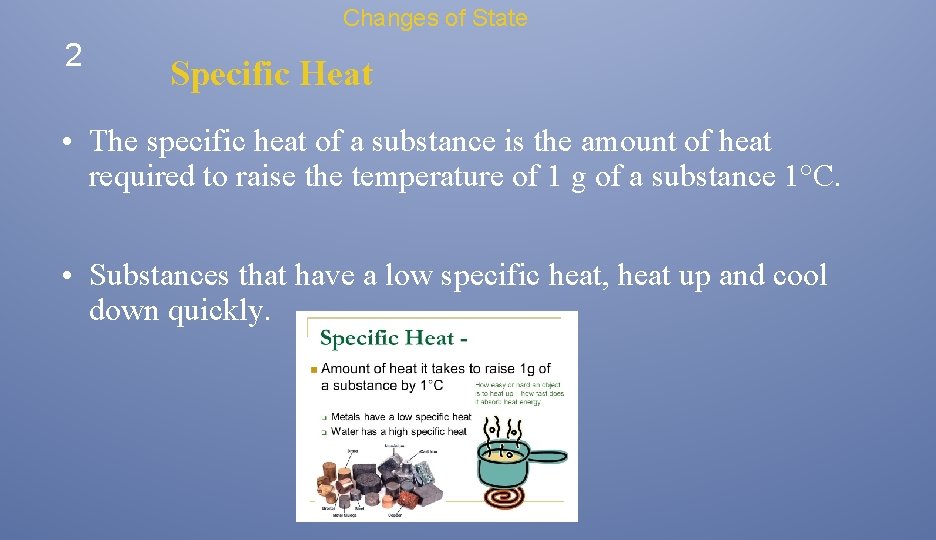
Changes of State 2 Specific Heat • The specific heat of a substance is the amount of heat required to raise the temperature of 1 g of a substance 1°C. • Substances that have a low specific heat, heat up and cool down quickly.
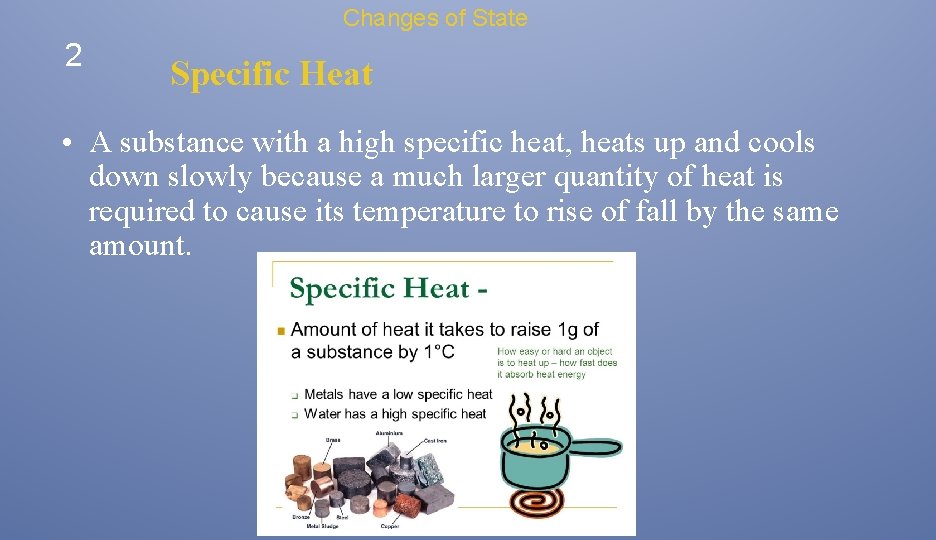
Changes of State 2 Specific Heat • A substance with a high specific heat, heats up and cools down slowly because a much larger quantity of heat is required to cause its temperature to rise of fall by the same amount.
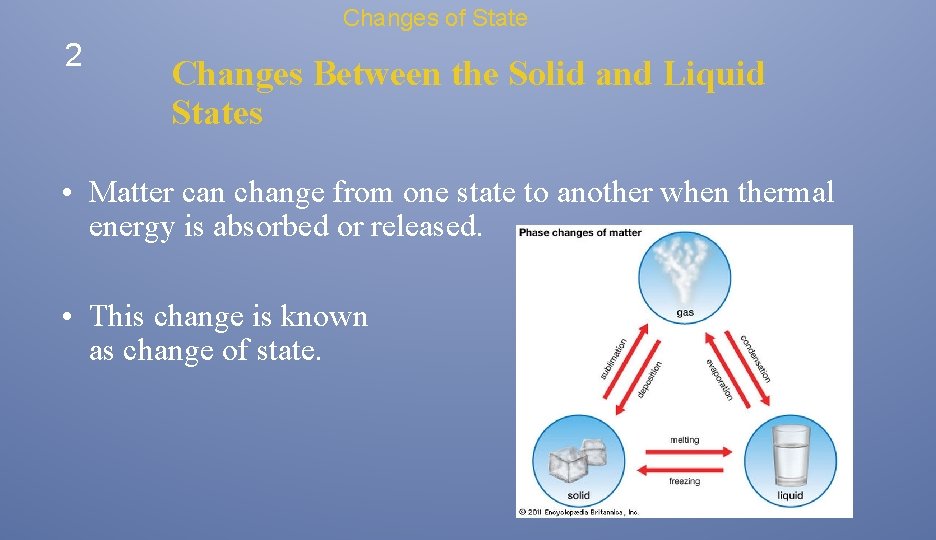
Changes of State 2 Changes Between the Solid and Liquid States • Matter can change from one state to another when thermal energy is absorbed or released. • This change is known as change of state.
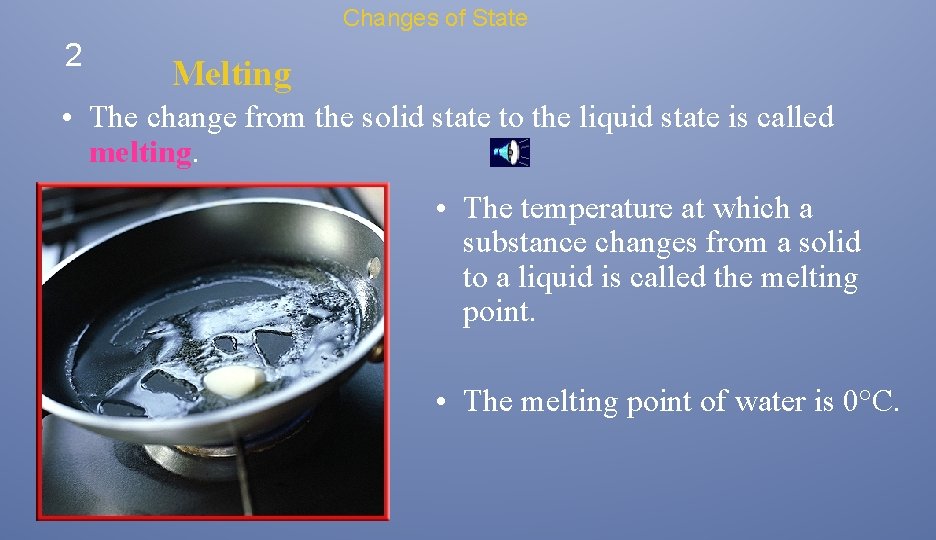
Changes of State 2 Melting • The change from the solid state to the liquid state is called melting. • The temperature at which a substance changes from a solid to a liquid is called the melting point. • The melting point of water is 0°C.
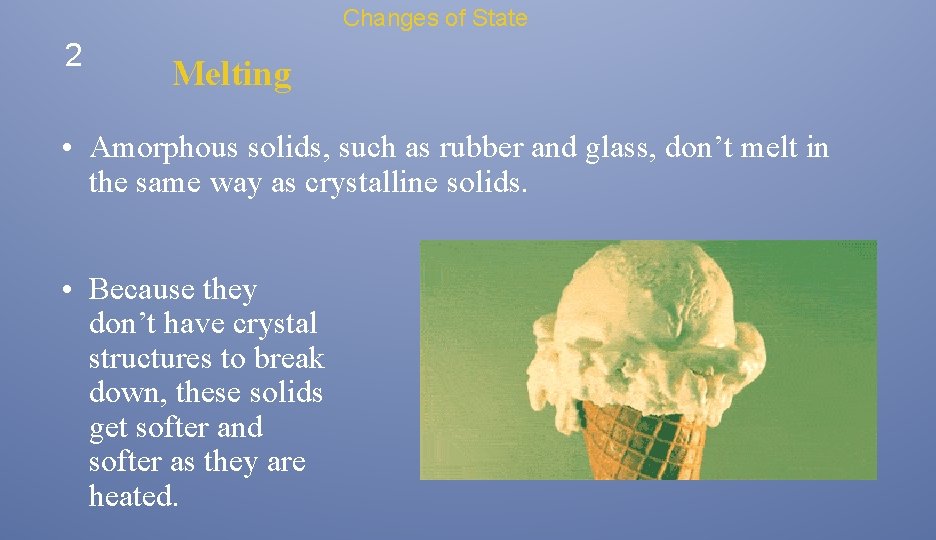
Changes of State 2 Melting • Amorphous solids, such as rubber and glass, don’t melt in the same way as crystalline solids. • Because they don’t have crystal structures to break down, these solids get softer and softer as they are heated.
Changes of State 2 Freezing • The change from the liquid state to the solid state is called freezing. • The temperature at which a substance changes from the liquid state to the solid state is called the freezing point.
Changes of State 2 Freezing • During freezing, the temperature of a substance remains constant while the particles in the liquid form a crystalline solid. • Energy is released during freezing. • After all of the liquid has become a solid, the temperature begins to decrease again.