
Chapter 4 Section 2 Active Transport Objectives Compare
Chapter 4 Section 2 Active Transport Objectives • Compare active transport with passive transport. • Describe the importance of the sodium-potassium pump. • Distinguish between endocytosis and exocytosis. • Identify three ways that receptor proteins can change the activity of a cell. Chapter menu Resources Copyright © by Holt, Rinehart and Winston. All rights reserved.
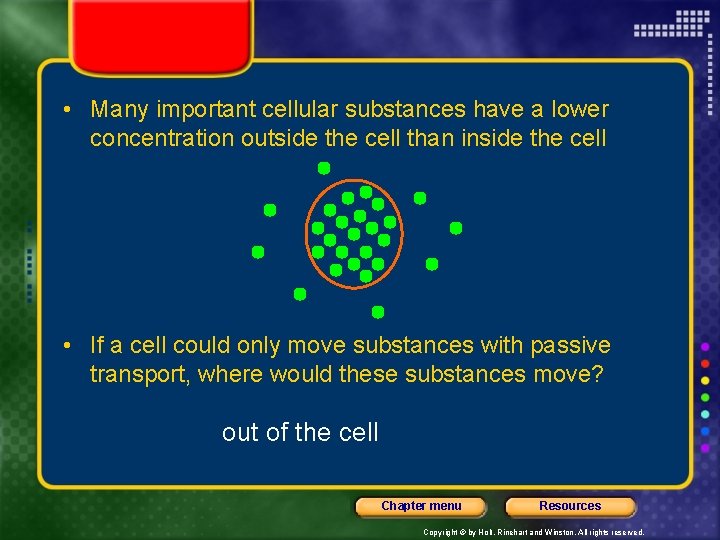
• Many important cellular substances have a lower concentration outside the cell than inside the cell • If a cell could only move substances with passive transport, where would these substances move? out of the cell Chapter menu Resources Copyright © by Holt, Rinehart and Winston. All rights reserved.
Chapter 4 Section 2 Active Transport Movement Against a Concentration Gradient • To move certain substances into the cell, they must have a way to move substances _____ against the concentration gradient… low high – That is from a _____ to ______ concentration energy – This type of transport requires ______ so it active is called _______ transport – It is similar to how you need energy to swim against the flow of a river ______ • Most often, the energy needed for active transport is supplied directly or indirectly by _____. ATP Chapter menu Resources Copyright © by Holt, Rinehart and Winston. All rights reserved.
carrier • Some active transport processes use _____ proteins, like those used in facilitated diffusion • So let’s review… – A carrier protein… binds • _____ to a substance carries it across the membrane • _____ releases it on the other side • _____ • However, in active transport, carrier proteins move low high substances from a ____ to _____ “pump” concentration, acting like a membrane _____ Chapter menu Resources Copyright © by Holt, Rinehart and Winston. All rights reserved.
Chapter 4 Section 2 Active Transport • One of the most important membrane pumps in animal cells is a carrier protein called the potassium pump. ______ sodium - _____ • In a complete cycle, the sodium-potassium pump out of transports _____ sodium ions, Na+, ______ three into the cell. a cell and two potassium ions, K+, _____ Chapter menu Resources Copyright © by Holt, Rinehart and Winston. All rights reserved.
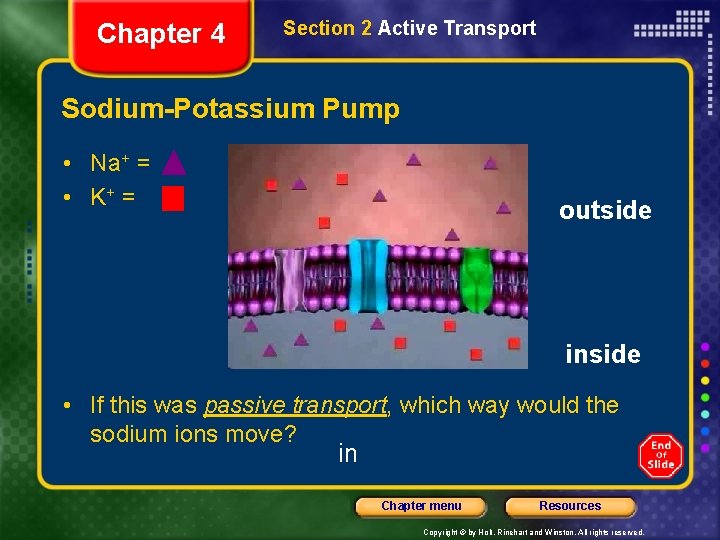
Chapter 4 Section 2 Active Transport Sodium-Potassium Pump • Na+ = • K+ = outside inside • If this was passive transport, which way would the sodium ions move? in Chapter menu Resources Copyright © by Holt, Rinehart and Winston. All rights reserved.
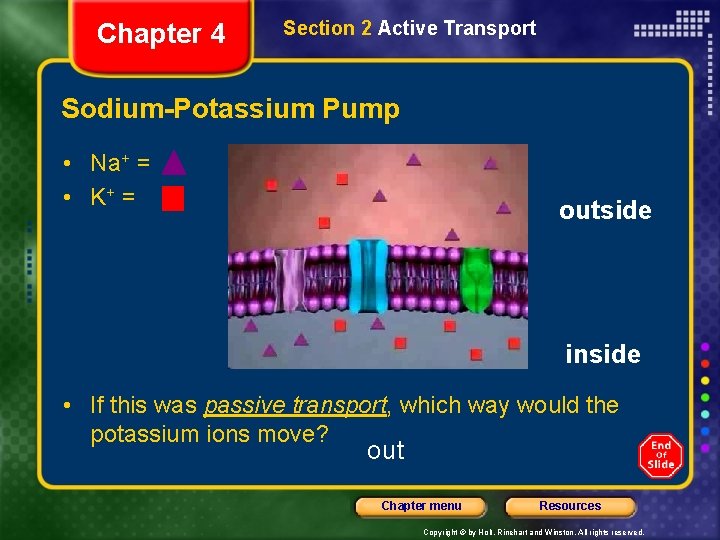
Chapter 4 Section 2 Active Transport Sodium-Potassium Pump • Na+ = • K+ = outside inside • If this was passive transport, which way would the potassium ions move? out Chapter menu Resources Copyright © by Holt, Rinehart and Winston. All rights reserved.
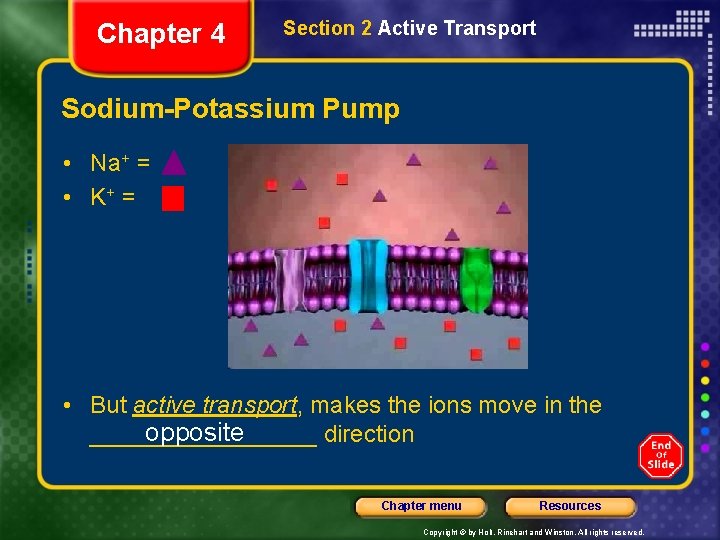
Chapter 4 Section 2 Active Transport Sodium-Potassium Pump • Na+ = • K+ = • But active transport, makes the ions move in the opposite _________ direction Chapter menu Resources Copyright © by Holt, Rinehart and Winston. All rights reserved.
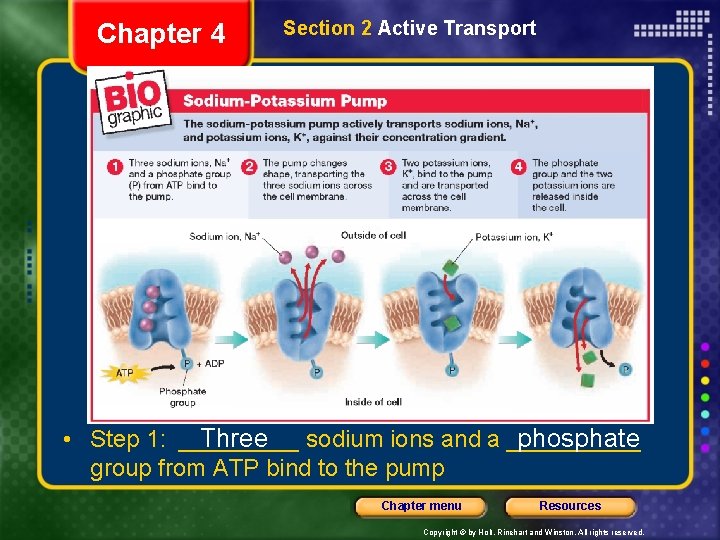
Chapter 4 Section 2 Active Transport • Step 1: _____ Three sodium ions and a _____ phosphate group from ATP bind to the pump Chapter menu Resources Copyright © by Holt, Rinehart and Winston. All rights reserved.
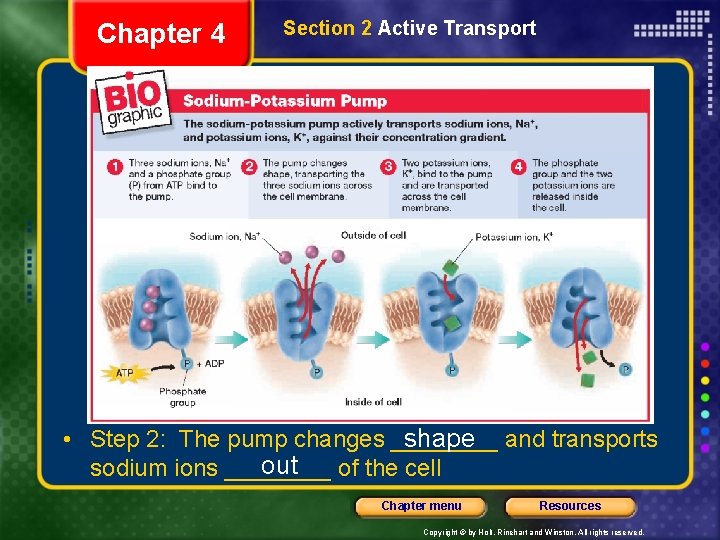
Chapter 4 Section 2 Active Transport • Step 2: The pump changes ____ shape and transports out sodium ions ____ of the cell Chapter menu Resources Copyright © by Holt, Rinehart and Winston. All rights reserved.
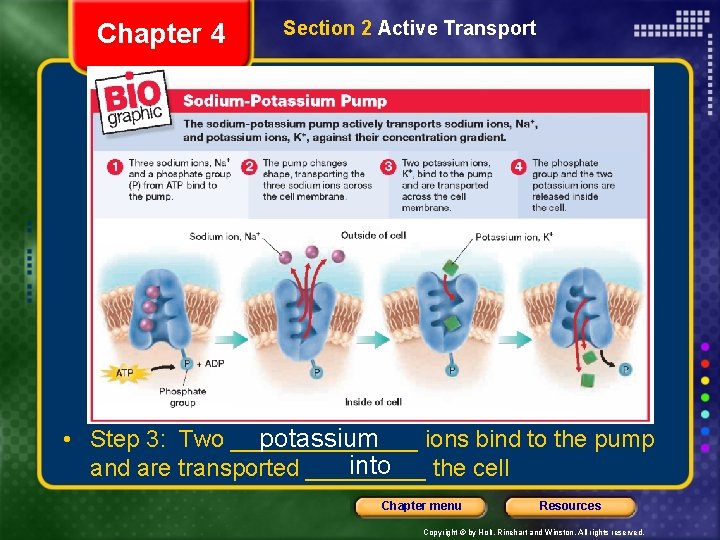
Chapter 4 Section 2 Active Transport • Step 3: Two _______ ions bind to the pump potassium into and are transported _____ the cell Chapter menu Resources Copyright © by Holt, Rinehart and Winston. All rights reserved.
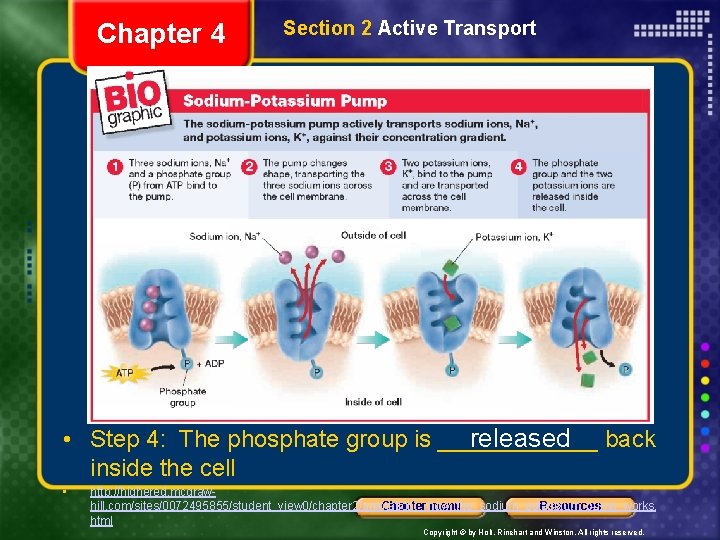
Chapter 4 Section 2 Active Transport • Step 4: The phosphate group is ______ released back inside the cell • http: //highered. mcgraw. Chapter menu Resources hill. com/sites/0072495855/student_view 0/chapter 2/animation__how_the_sodium_potassium_pump_works. html Copyright © by Holt, Rinehart and Winston. All rights reserved.

• The sodium-potassium pump is important for animal bursting cells because it prevents them from ______ – Sodium ions naturally diffuse into the cell through ion channels – if they couldn’t get out, which way would water move to balance out the particles? inside Chapter menu Resources Copyright © by Holt, Rinehart and Winston. All rights reserved.

• Some simpler organisms have a different “pump” contractile called a _______ vacuole push water out of • It expands and contracts to _____ the cell • This is important because it lives in a watery hypotonic environment, which would be a _______ solution paramecium Chapter menu Resources Copyright © by Holt, Rinehart and Winston. All rights reserved.

Chapter 4 Section 2 Active Transport Movement in Vesicles proteins and • Many substances, such as _______ large to be transported __________, polysaccharides are too _____ by carrier proteins. • These substances are moved across the cell membrane by vesicles ________. • The movement of a substance into a cell by a vesicle is called endocytosis _________ – Think “en” is like “in” • The movement of a substance by a vesicle to the outside of a exocytosis cell is called __________. – Think “ex” is like exit Chapter menu Resources Copyright © by Holt, Rinehart and Winston. All rights reserved.
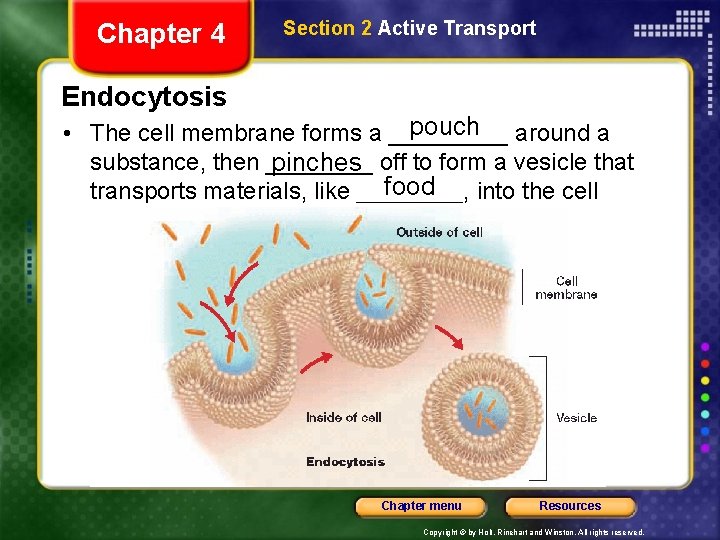
Chapter 4 Section 2 Active Transport Endocytosis pouch around a • The cell membrane forms a _____ substance, then ____ pinches off to form a vesicle that food transports materials, like ____, into the cell Chapter menu Resources Copyright © by Holt, Rinehart and Winston. All rights reserved.
• There are two types of endocytosis solid – Phagocytosis = engulfing _____ particles like food • http: //highered. mcgrawhill. com/sites/0072495855/student_view 0/chapt liquid er 2/animation__phagocytosis. html – Pinocytosis = engulfing ______ particles Chapter menu Resources Copyright © by Holt, Rinehart and Winston. All rights reserved.
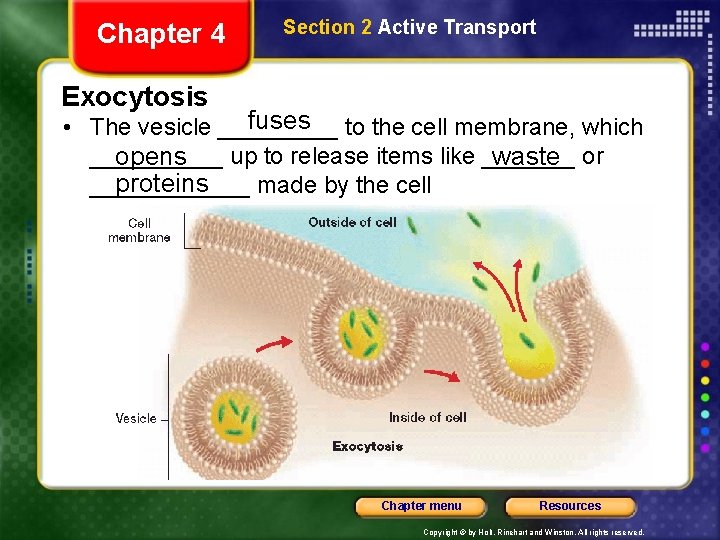
Chapter 4 Section 2 Active Transport Exocytosis fuses to the cell membrane, which • The vesicle __________ up to release items like _______ opens waste or proteins ______ made by the cell Chapter menu Resources Copyright © by Holt, Rinehart and Winston. All rights reserved.
Chapter 4 Section 2 Active Transport Membrane Receptor Proteins communicate with each other to • Cells must _______ coordinate your growth, metabolism, and other activities signal • To do so, some cells release ______ molecules that carry information or ________________ to nearby cells messages • Cells can receive the messages because the cell membrane contains specialized proteins, called receptor _______ proteins, that bind to these signal molecules. Chapter menu Resources Copyright © by Holt, Rinehart and Winston. All rights reserved.
Chapter 4 Section 2 Active Transport • When signal molecules bind to receptor proteins, they may cause three different changes in the cell… permeability – Changes in ____________ second – Triggering the formation of a _____ messenger _______ enzymes – Activating ________ Chapter menu Resources Copyright © by Holt, Rinehart and Winston. All rights reserved.
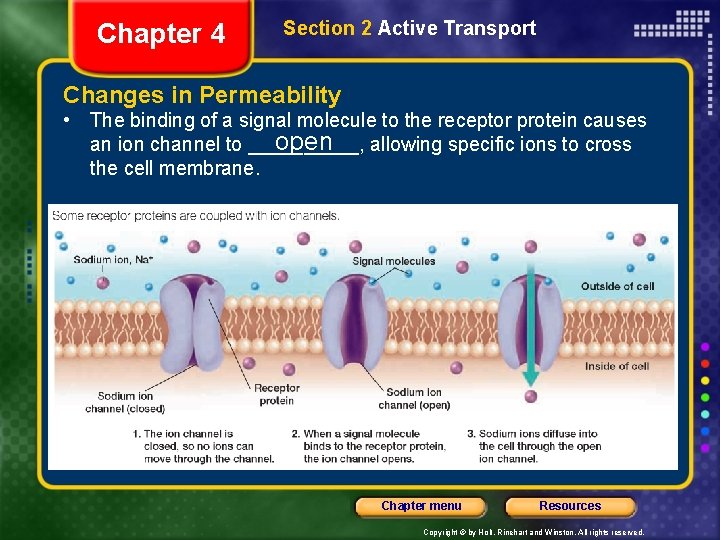
Chapter 4 Section 2 Active Transport Changes in Permeability • The binding of a signal molecule to the receptor protein causes open allowing specific ions to cross an ion channel to _____, the cell membrane. Chapter menu Resources Copyright © by Holt, Rinehart and Winston. All rights reserved.
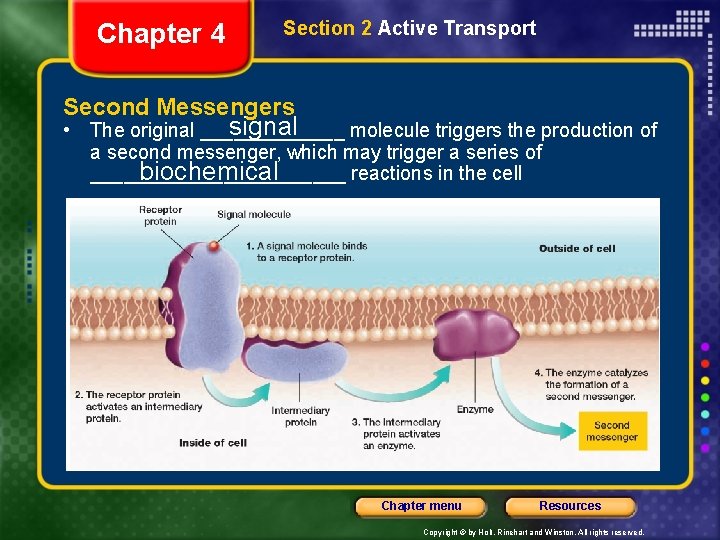
Chapter 4 Section 2 Active Transport Second Messengers signal • The original _______ molecule triggers the production of a second messenger, which may trigger a series of biochemical ____________ reactions in the cell Chapter menu Resources Copyright © by Holt, Rinehart and Winston. All rights reserved.
Chapter 4 Section 2 Active Transport Enzyme Action • When a signal molecule binds to the receptor protein, the receptor enzyme speeding up chemical protein may act as an ______, reactions inside the cell. Chapter menu Resources Copyright © by Holt, Rinehart and Winston. All rights reserved.
drugs • Many _____ affect the binding of signal molecules to receptor proteins, affecting the function of the cell – Examples… imitates • The illegal drug heroin _______ a signal molecule and binds to receptor proteins beta • Prescribed drugs called ____ blockers _______ prevent or block signal molecules from binding to receptor proteins in heart ______ cells, which _____ slows down the heart rate of patients with rapid heart beats Chapter menu Resources Copyright © by Holt, Rinehart and Winston. All rights reserved.
Question 1 • Which molecule provides energy for active transport to occur? A. chlorophyll B. ATP C. Carbon dioxide D. Signal molecule Chapter menu Resources Copyright © by Holt, Rinehart and Winston. All rights reserved.
Question 2 • In the sodium potassium pump, which substances get released inside of the cell? A. Sodium ions B. Potassium ions C. Phosphate groups D. Both B and C Chapter menu Resources Copyright © by Holt, Rinehart and Winston. All rights reserved.
Question 3 • Which substance would a cell take in through endocytosis? A. Sodium ions B. polysaccharides C. Amino acids D. monosaccharides Chapter menu Resources Copyright © by Holt, Rinehart and Winston. All rights reserved.
Question 4 • What type of membrane protein interacts with signal molecules? A. Cell surface marker B. Receptor protein C. Transport protein D. enzymes Chapter menu Resources Copyright © by Holt, Rinehart and Winston. All rights reserved.
Question 5 Which type of transport may occur in dead cells…passive or active? passive Chapter menu Resources Copyright © by Holt, Rinehart and Winston. All rights reserved.
- Slides: 29