
Chapter 4 Section 1 Radioactivity Discovering Radioactivity An
- Slides: 11
Chapter 4 Section 1 Radioactivity Discovering Radioactivity • An Unexpected Result Henri Becquerel discovered that radium gave off a form of radiation. • Naming the Unexpected Marie Curie, a scientist working with Becquerel, named the process by which some nuclei give off nuclear radiation. She named the process radioactivity, which is also called radioactive decay.
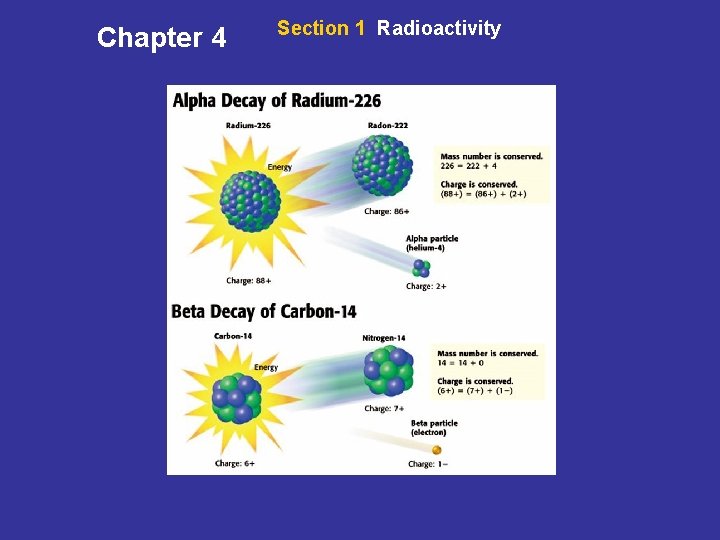
Chapter 4 Section 1 Radioactivity Kinds of Radioactive Decay • Alpha Decay The release of an alpha particle from a nucleus is called alpha decay. An alpha particle is made up of two protons and two neutrons. • Conservation in Decay In radioactive decay, the mass number is conserved, and the charge is conserved. • Beta Decay The release of a beta particle from a nucleus is called beta decay. A beta particle can be an electron or a positron.
Chapter 4 Section 1 Radioactivity
Chapter 4 Section 1 Radioactivity Kinds of Radioactive Decay, continued • Two Types of Beta Decay A carbon-14 nucleus undergoes beta decay. During this kind of decay, a neutron breaks into a proton and an electron. Not all isotopes of an element decay in the same way. A carbon-11 nucleus undergoes beta decay when a proton breaks into a positron and a neutron. • Gamma Decay Energy is also given off during alpha decay and beta decay. Some of this energy is in the form of light that has very high energy called gamma rays.
Chapter 4 Section 1 Radioactivity The Penetrating Power of Radiation • Effects of Radiation on Matter Atoms that are hit by nuclear radiation can give up electrons. Chemical bonds between atoms can break when hit by nuclear radiation. • Damage to Living Matter When an organism absorbs radiation, its cells can be damaged. A single large exposure to radiation can lead to radiation sickness.
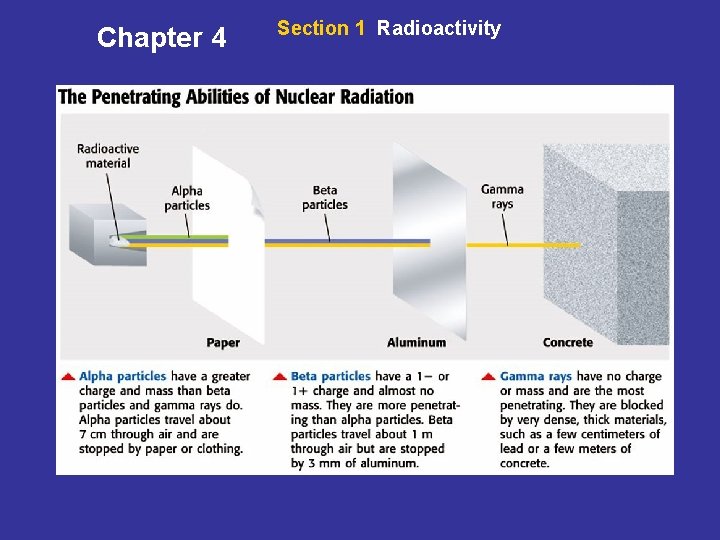
Chapter 4 Section 1 Radioactivity The Penetrating Power of Radiation, continued • Damage to Nonliving Matter Radiation can also damage nonliving matter. When metal atoms lose electrons, the metal is weakened. • Damage at Different Depths Gamma rays go through matter easily. They can cause damage deep within matter. The penetrating powers of different forms of radiation can be seen on the next slide.
Chapter 4 Section 1 Radioactivity
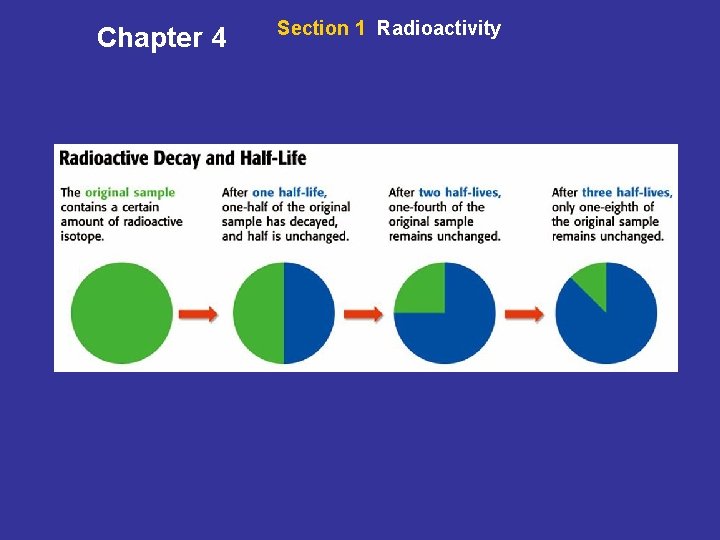
Chapter 4 Section 1 Radioactivity Finding a Date by Decay • Carbon-14—It’s in You! During an organism’s life, the percentage of carbon-14 in the organism stays about the same. But when an organism dies, over time the level of carbon-14 in the remains drops because of radioactive decay. • A Steady Rate of Decay A half-life is the amount of time it takes one-half of the nuclei of a radioactive isotope to decay. The next slide models this process.
Chapter 4 Section 1 Radioactivity
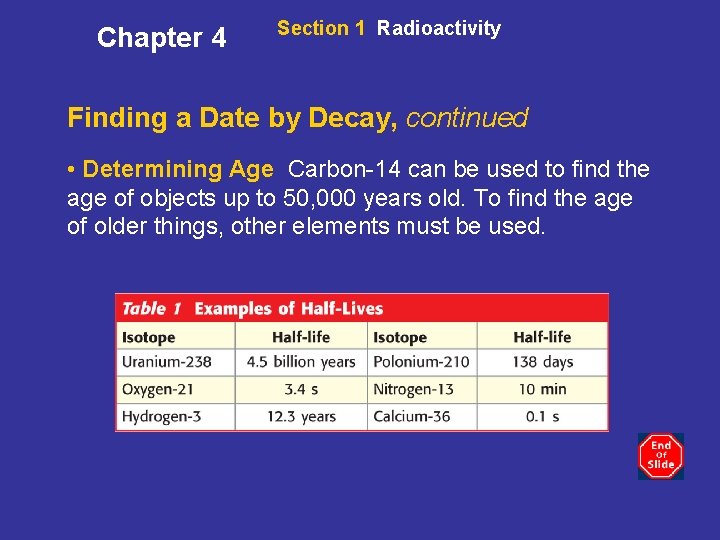
Chapter 4 Section 1 Radioactivity Finding a Date by Decay, continued • Determining Age Carbon-14 can be used to find the age of objects up to 50, 000 years old. To find the age of older things, other elements must be used.
Chapter 4 Section 1 Radioactivity Uses of Radioactivity • Radioactivity in Healthcare Doctors use tracers to help diagnose medical problems. Radioactive tracers that have short half-lives are fed to or injected into a patient. Then, a detector is used to follow the tracer as it moves through the body. • Radioactivity in Industry Radioactive isotopes can also help detect defects in structures. Some space probes have been powered by radioactive materials.