
Chapter 4 Sampling Design How do we gather


- Slides: 33
Chapter 4 Sampling Design
How do we gather data? • • Surveys Opinion polls Interviews Studies – Observational – Retrospective (past) – Prospective (future) • Experiments
Population • the entire group of individuals that we want information about
Census • a complete count of the population
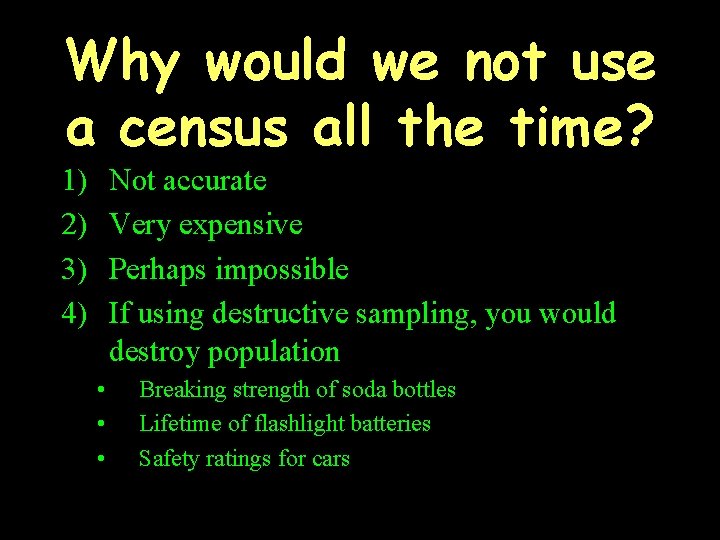
Why would we not use a census all the time? 1) 2) 3) 4) Not accurate Very expensive Perhaps impossible If using destructive sampling, you would destroy population • • • Breaking strength of soda bottles Lifetime of flashlight batteries Safety ratings for cars
Sample • A part of the population that we actually examine in order to gather information • Use sample to generalize to population
Sampling design • refers to the method used to choose the sample from the population
Sampling frame • a list of every individual in the population
Simple Random Sample (SRS) • consist of n individuals from the population chosen in such a way that – every individual has an equal chance of being selected – every set of n individuals has an equal chance of being selected
SRS • Advantages • Disadvantages – Unbiased – Easy – Large variance – May not be representative – Must have sampling frame (list of population)
Stratified random sample • population is divided into homogeneous groups called strata • SRS’s are pulled from each strata
Stratified • Advantages • Disadvantages – More precise unbiased estimator than SRS – Less variability – Cost reduced if strata already exists – Difficult to do if you must divide stratum – Formulas for SD & confidence intervals are more complicated – Need sampling frame
Systematic random sample • select sample by following a systematic approach • randomly select where to begin
Systematic Random Sample • Advantages • Disadvantages – Unbiased – Don’t need sampling frame – Ensure that the sample is spread across population – More efficient, cheaper, etc. – Large variance – Can be confounded by trend or cycle – Formulas are complicated
Cluster Sample • based upon location • randomly pick a location & sample all there
Cluster Samples • Advantages • Disadvantages – Unbiased – Clusters may – Cost is not be reduced representative – Sampling of population frame may – Formulas are not be complicated available (not needed)
Multistage sample • select successively smaller groups within the population in stages • SRS used at each stage
Identify the sampling design 1)The Educational Testing Service (ETS) needed a sample of colleges. ETS first divided all colleges into groups of similar types (small public, small private, etc. ) Then they randomly selected 3 colleges from each group. Stratified random sample
Identify the sampling design 2) A county commissioner wants to survey people in her district to determine their opinions on a particular law up for adoption. She decides to randomly select blocks in her district and then survey all who live on those blocks. Cluster sampling
Identify the sampling design 3) A local restaurant manager wants to survey customers about the service they receive. Each night the manager randomly chooses a number between 1 & 10. He then gives a survey to that customer, and to every 10 th customer after them, to fill it out before they leave. Systematic random sampling
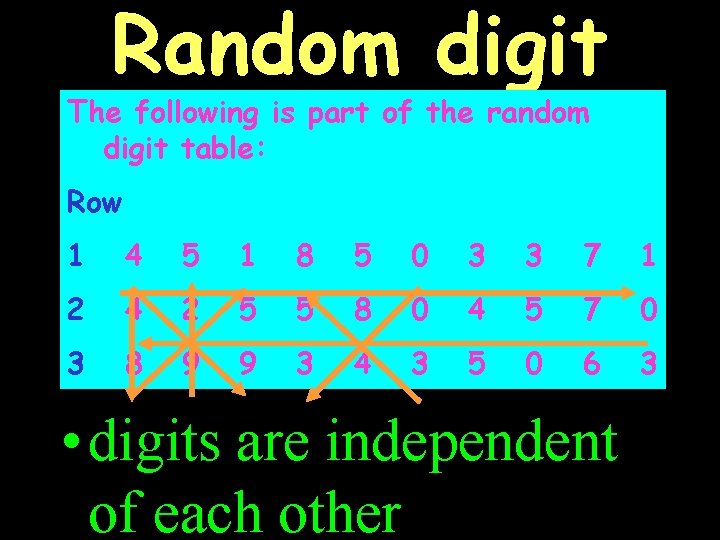
Random digit table The following is part of the random digit table: • each entry is equally 1 4 5 1 8 5 0 3 3 7 likely to be any of the 2 4 2 5 5 8 0 4 5 7 3 10 8 digits 9 9 3 4 3 5 0 6 • digits are independent of each other Row 1 0 3
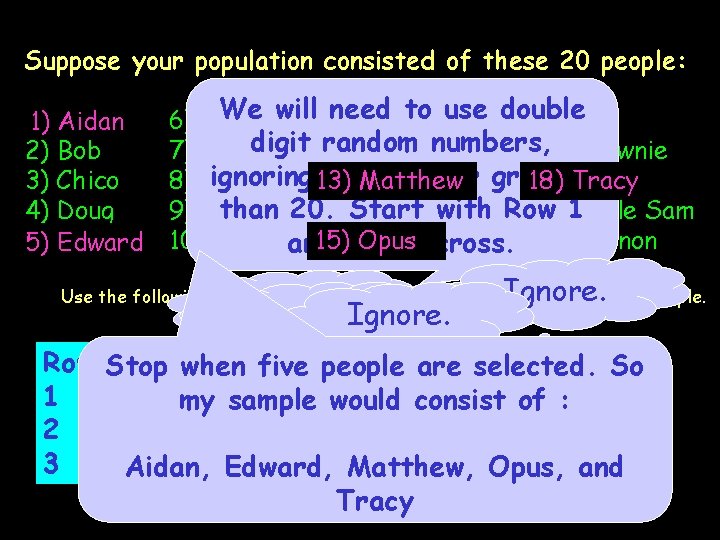
Suppose your population consisted of these 20 people: 1) 1) Aidan 2) Bob 3) Chico 4) Doug 5) Edward We will 11) need to use double 6) Fred Kathy 16) Paul digit 12) random 7) Gloria Lori numbers, 17) Shawnie ignoring 13) any number greater 8) Hannah Matthew 13) Matthew 18) Tracy than 20. 9) Israel 14)Start Nan with Row 19) 1 Uncle Sam 10) Jung and 15)read Opus across. 20) Vernon Ignore. Use the following random digits to select a sample of five from these people. Row Stop when five people are selected. So 1 4 5 my 1 sample 8 0 would 5 consist 1 3 of 7 : 1 2 0 1 5 5 8 0 1 5 7 0 3 8 Aidan, 9 9 Edward, 3 4 Matthew, 3 5 0 Opus, 6 3 and Tracy
Bias • A systematic error in measuring the estimate • favors certain outcomes • Anything that causes the data to be wrong! It might be attributed to the researchers, the respondent, or to the sampling method!
Sources of Bias • things that can cause bias in your sample • cannot do anything with bad data
Voluntary response • People chose to respond • Usually only people with very strong opinions respond
Convenience sampling • Ask people who are easy to ask • Produces bias results
Undercoverage • some groups of population are left out of the sampling process
Nonresponse • occurs when an individual chosen for the sample can’t be contacted or refuses to cooperate • telephone surveys 70% nonresponse
Response bias • occurs when the behavior of respondent or interviewer causes bias in the sample • wrong answers
Wording of the Questions • wording can influence the answers that are given • connotation of words • use of “big” words or technical words
Source of Bias? 1) Before the presidential election of 1936, FDR against Republican ALF Landon, the magazine Literary Digest predicting Landon winning the election in a 3 -to-2 victory. A survey of 2. 8 million people. George Gallup surveyed only 50, 000 people and predicted that Roosevelt would win. The Digest’s survey came from magazine subscribers, car owners, telephone directories, etc.
2) Suppose that you want to estimate the total amount of money spent by students on textbooks each semester at SMU. You collect register receipts for students as they leave the bookstore during lunch one day.
3) To find the average value of a home in Plano, one averages the price of homes that are listed for sale with a realtor.