
Chapter 4 Salads and Garnishing Copyright 2011 by
Chapter 4 Salads and Garnishing © Copyright 2011 by the National Restaurant Association Educational Foundation (NRAEF) and published by Pearson Education, Inc. All rights reserved.
Ingredients and Parts of a Salad § The three keys to ensuring a quality salad are: § 1. § 2. § 3. Kinds of salad greens: _____: most popular salad green ____: crisp texture, main ingredient in Caesar salad ______: red or green, mild flavor ____: eaten alone or mixed with other greens _____: pungent flavor 4. 1 Chapter 4 | Salads and Garnishing 2
Salad cont. § The four basic parts to most salads are: 1. Base: usually a layer of salad greens that __________________ 2. Body: _______________ 3. Garnish: __________________ 4. Salad dressings: __________________ 3
Types of Salad § Wearing _____ is critical when preparing salads. § The five main types of salad are: 1. The two types of green salad are _____ and _______ P. 225 2. ______ salad: ingredients such as meat, poultry, fish, egg, or starch such as potato, pasta, or rice and bound with mayo. 3. Vegetable salad: cooked and/or raw vegetables ___________________ 4. Fruit salad: using a slightly _______dressing to enhance the flavor; fruit must be coated with ______to prevent discoloring 5. _________ salad: incorporates a combination of any of the four salad types. 4. 1 Chapter 4 | Salads and Garnishing 4
Salads and Service § Salads can be used in five ways during the service courses: 1. Starter salad, ________________ 2. Accompaniment salad: also called ________________________ 3. Main course salads: ________________________ 4. Intermezzo salad: intended to be a ________after a rich dinner and before dessert; ______ of dressing cleans palate 5. ________salads are usually sweet and often contain fruits, sweetened gelatin, nuts, cream, and whipped cream (_____________) 4. 1 Chapter 4 | Salads and Garnishing 5
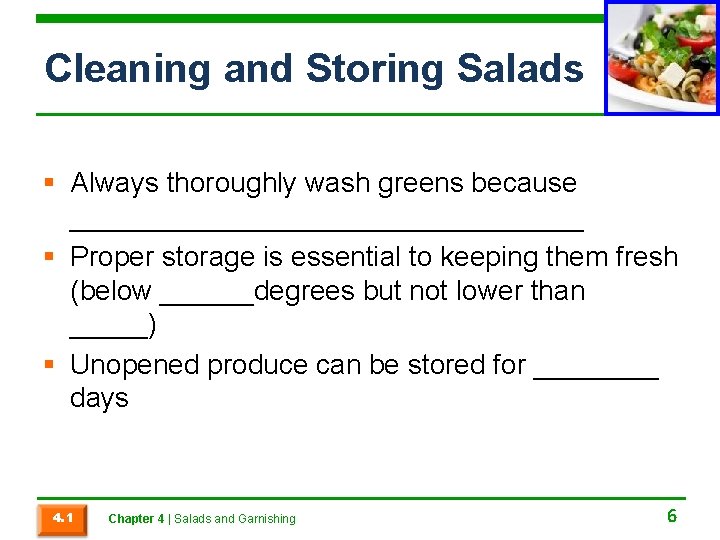
Cleaning and Storing Salads § Always thoroughly wash greens because _________________ § Proper storage is essential to keeping them fresh (below ______degrees but not lower than _____) § Unopened produce can be stored for ____ days 4. 1 Chapter 4 | Salads and Garnishing 6
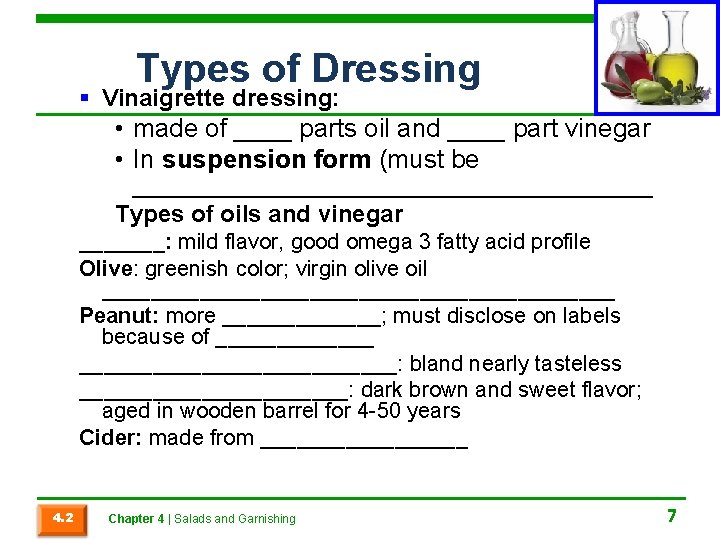
Types of Dressing § Vinaigrette dressing: • made of ____ parts oil and ____ part vinegar • In suspension form (must be __________________ Types of oils and vinegar _______: mild flavor, good omega 3 fatty acid profile Olive: greenish color; virgin olive oil _____________________ Peanut: more _______; must disclose on labels because of ____________________: bland nearly tasteless ___________: dark brown and sweet flavor; aged in wooden barrel for 4 -50 years Cider: made from _________ 4. 2 Chapter 4 | Salads and Garnishing 7
Dressings cont. § ___________: An emulsion is a mixture of ingredients that permanently stays together, unlike a suspension that eventually separates (addition of egg forms emulsion); thicker than vinaigrette and coats ingredients more heavily § Mayonnaise-based dressings are typically creamy dressings, such as ____________ § Mayonnaise: most _______emulsified dressing. It contains a higher ratio of ____ to vinegar and a greater quantity of ________than is required for emulsified vinaigrette. 8
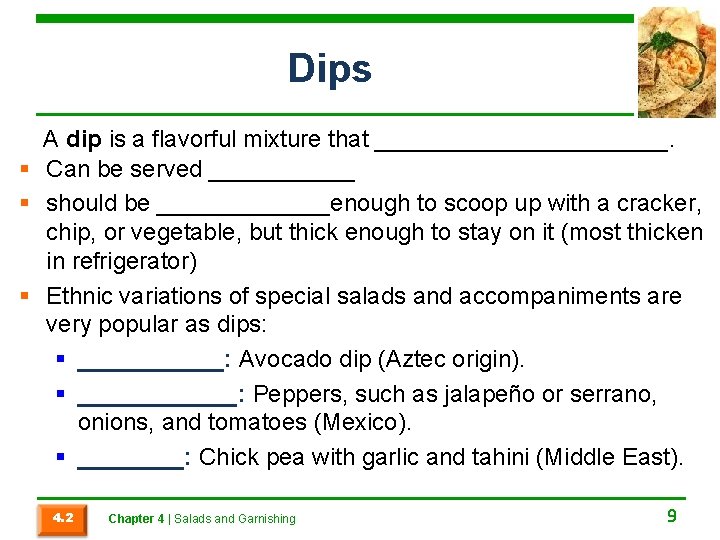
Dips A dip is a flavorful mixture that ___________. § Can be served ______ § should be _______enough to scoop up with a cracker, chip, or vegetable, but thick enough to stay on it (most thicken in refrigerator) § Ethnic variations of special salads and accompaniments are very popular as dips: § ______: Avocado dip (Aztec origin). § ______: Peppers, such as jalapeño or serrano, onions, and tomatoes (Mexico). § ____: Chick pea with garlic and tahini (Middle East). 4. 2 Chapter 4 | Salads and Garnishing 9
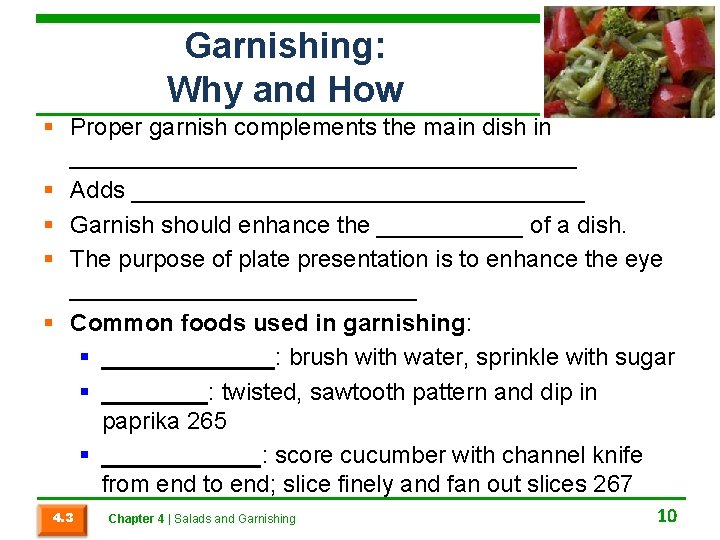
Garnishing: Why and How § Proper garnish complements the main dish in ___________________ § Adds _________________ § Garnish should enhance the ______ of a dish. § The purpose of plate presentation is to enhance the eye _____________ § Common foods used in garnishing: § _______: brush with water, sprinkle with sugar § ____: twisted, sawtooth pattern and dip in paprika 265 § ______: score cucumber with channel knife from end to end; slice finely and fan out slices 267 4. 3 Chapter 4 | Salads and Garnishing 10
Classical French Garnishes § § § § Bouquetiere: __________ Crecy: ______ Dubarry: ________ Fermiere: ___________ Florentine: ______ Jardiniere: _________ Lyonnaise: _______ Provencale: _____________ 11
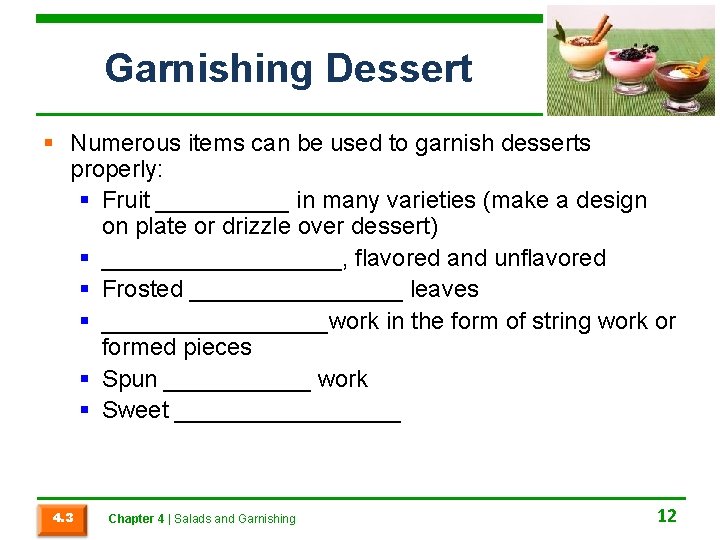
Garnishing Dessert § Numerous items can be used to garnish desserts properly: § Fruit _____ in many varieties (make a design on plate or drizzle over dessert) § _________, flavored and unflavored § Frosted ________ leaves § _________work in the form of string work or formed pieces § Spun ______ work § Sweet _________ 4. 3 Chapter 4 | Salads and Garnishing 12
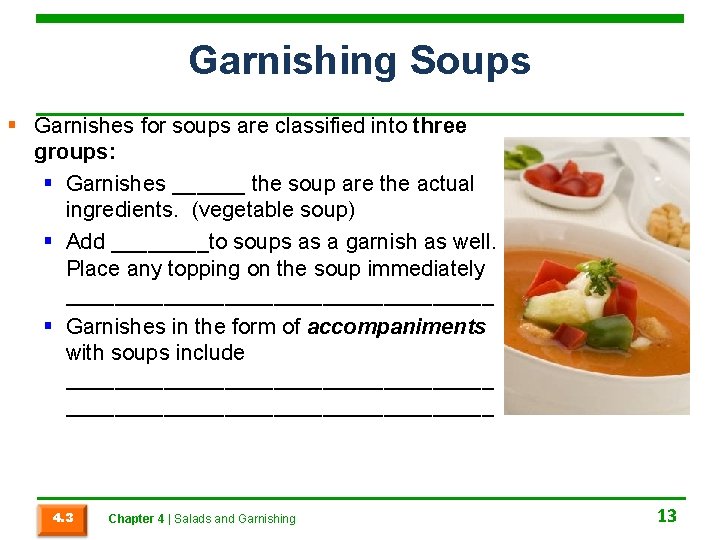
Garnishing Soups § Garnishes for soups are classified into three groups: § Garnishes ______ the soup are the actual ingredients. (vegetable soup) § Add ____to soups as a garnish as well. Place any topping on the soup immediately __________________ § Garnishes in the form of accompaniments with soups include ___________________________________ 4. 3 Chapter 4 | Salads and Garnishing 13
- Slides: 13