
Chapter 4 Review of Software Process Models Please
- Slides: 9
Chapter 4 Review of Software Process Models Please answer the seven Blue Questions in the following slides. Bring the answers to class on Monday June 13
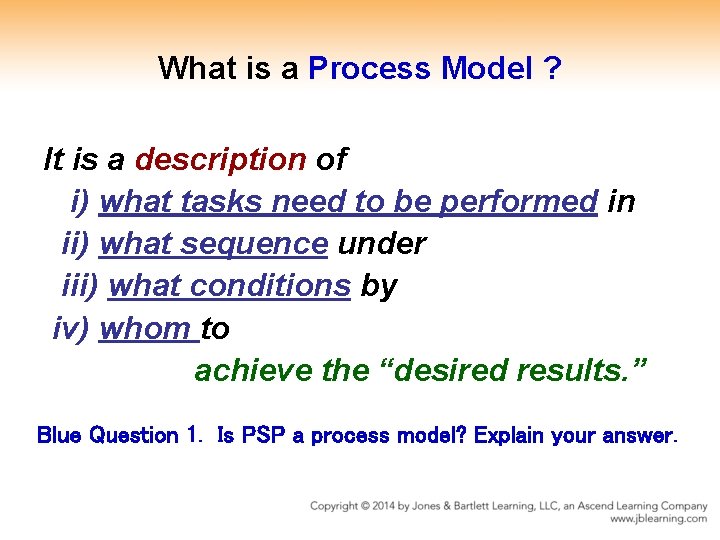
What is a Process Model ? It is a description of i) what tasks need to be performed in ii) what sequence under iii) what conditions by iv) whom to achieve the “desired results. ” Blue Question 1. Is PSP a process model? Explain your answer.
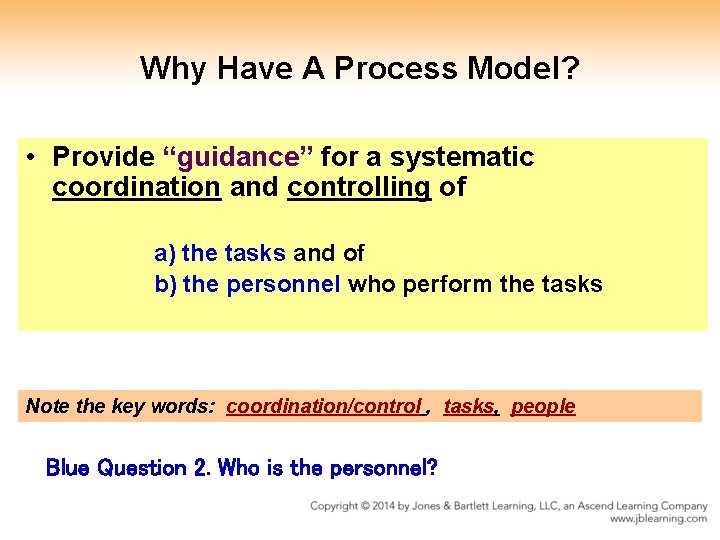
Why Have A Process Model? • Provide “guidance” for a systematic coordination and controlling of a) the tasks and of b) the personnel who perform the tasks Note the key words: coordination/control , tasks, people Blue Question 2. Who is the personnel?
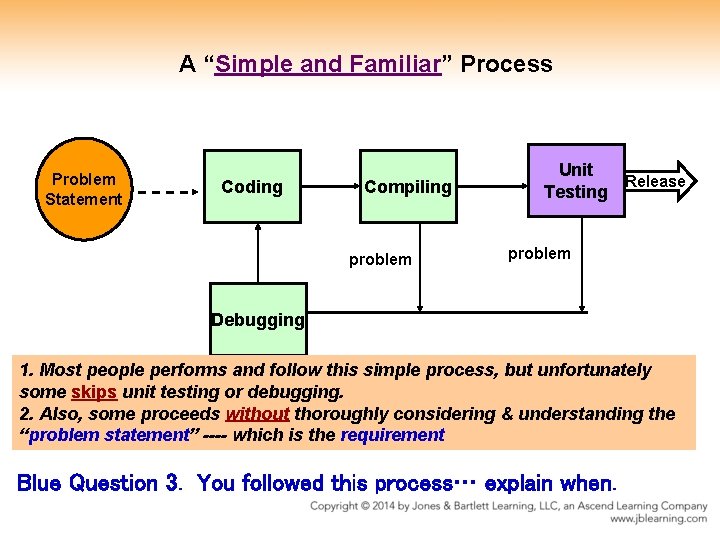
A “Simple and Familiar” Process Problem Statement Coding Compiling problem Unit Release Testing problem Debugging 1. Most people performs and follow this simple process, but unfortunately some skips unit testing or debugging. 2. Also, some proceeds without thoroughly considering & understanding the “problem statement” ---- which is the requirement Blue Question 3. You followed this process… explain when.
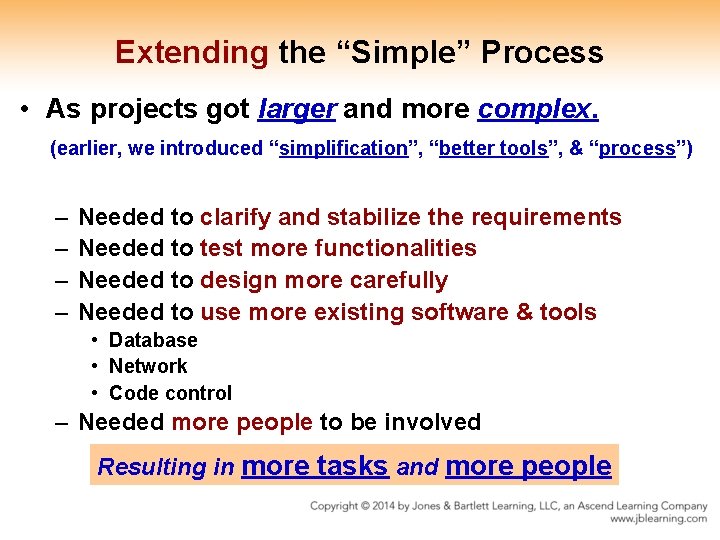
Extending the “Simple” Process • As projects got larger and more complex. (earlier, we introduced “simplification”, “better tools”, & “process”) – – Needed to clarify and stabilize the requirements Needed to test more functionalities Needed to design more carefully Needed to use more existing software & tools • Database • Network • Code control – Needed more people to be involved Resulting in more tasks and more people
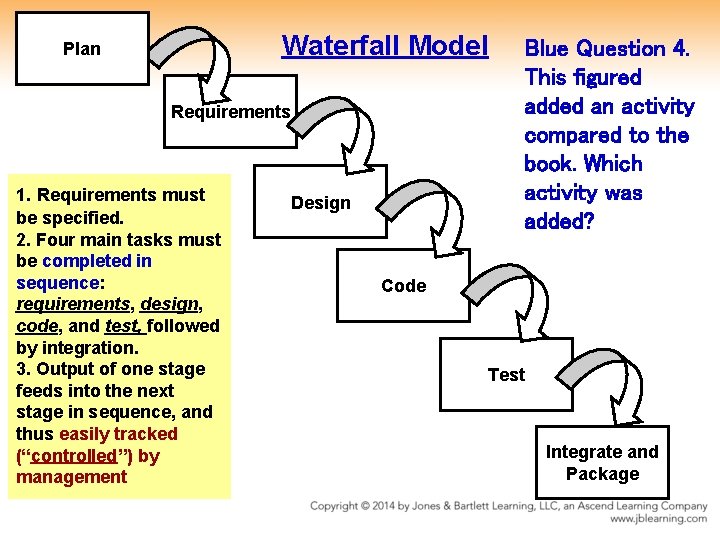
Waterfall Model Plan Requirements 1. Requirements must be specified. 2. Four main tasks must be completed in sequence: requirements, design, code, and test, followed by integration. 3. Output of one stage feeds into the next stage in sequence, and thus easily tracked (“controlled”) by management Design Blue Question 4. This figured added an activity compared to the book. Which activity was added? Code Test Integrate and Package
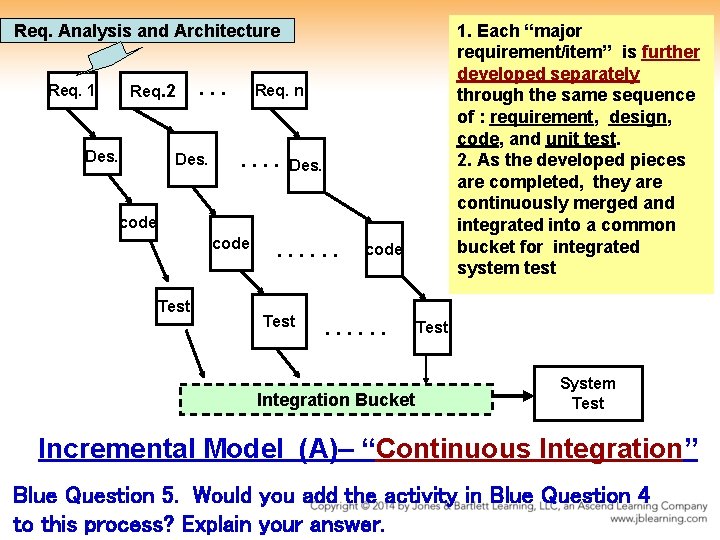
1. Each “major requirement/item” is further developed separately through the same sequence of : requirement, design, code, and unit test. 2. As the developed pieces are completed, they are continuously merged and integrated into a common bucket for integrated system test Req. Analysis and Architecture Req. 1 Req. 2 Des. Req. n . . Des. code Test . . . Test code . . . Integration Bucket Test System Test Incremental Model (A)– “Continuous Integration” Blue Question 5. Would you add the activity in Blue Question 4 to this process? Explain your answer.
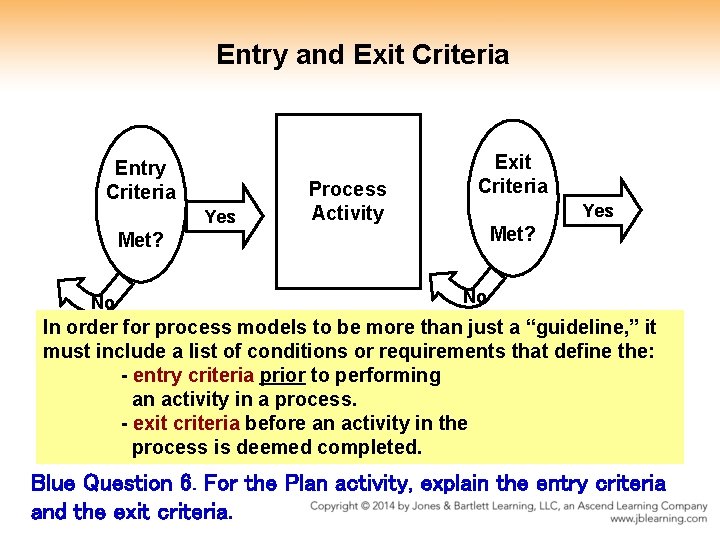
Entry and Exit Criteria Entry Criteria Yes Process Activity Exit Criteria Yes Met? No No In order for process models to be more than just a “guideline, ” it must include a list of conditions or requirements that define the: - entry criteria prior to performing an activity in a process. - exit criteria before an activity in the process is deemed completed. Blue Question 6. For the Plan activity, explain the entry criteria and the exit criteria.
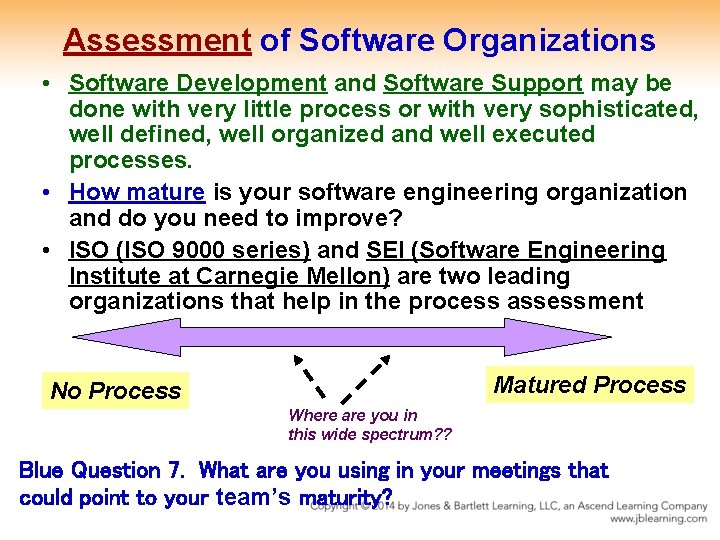
Assessment of Software Organizations • Software Development and Software Support may be done with very little process or with very sophisticated, well defined, well organized and well executed processes. • How mature is your software engineering organization and do you need to improve? • ISO (ISO 9000 series) and SEI (Software Engineering Institute at Carnegie Mellon) are two leading organizations that help in the process assessment Matured Process No Process Where are you in this wide spectrum? ? Blue Question 7. What are you using in your meetings that could point to your team’s maturity?