
Chapter 4 Reproduction And Growth 4 1 Gamete





- Slides: 81
Chapter 4 Reproduction And Growth 4. 1 Gamete Formation ITeach – Biology Form 5
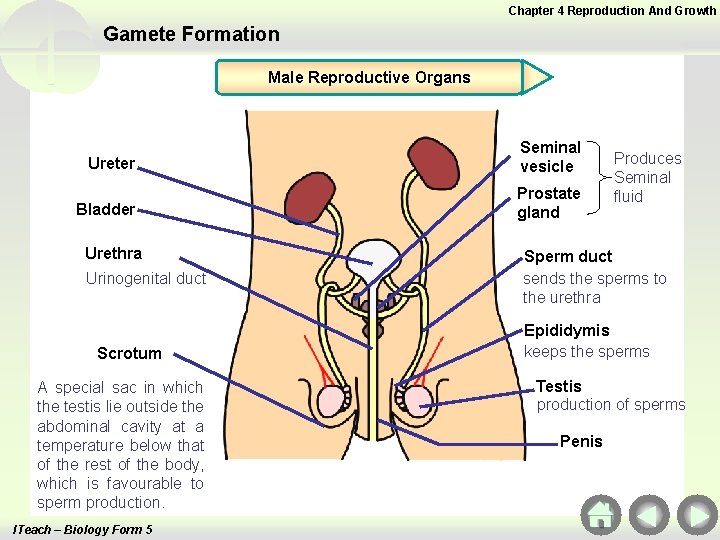
Chapter 4 Reproduction And Growth Gamete Formation Male Reproductive Organs Ureter Seminal vesicle Bladder Prostate gland Urethra Urinogenital duct Scrotum A special sac in which the testis lie outside the abdominal cavity at a temperature below that of the rest of the body, which is favourable to sperm production. ITeach – Biology Form 5 Produces Seminal fluid Sperm duct sends the sperms to the urethra Epididymis keeps the sperms Testis production of sperms Penis
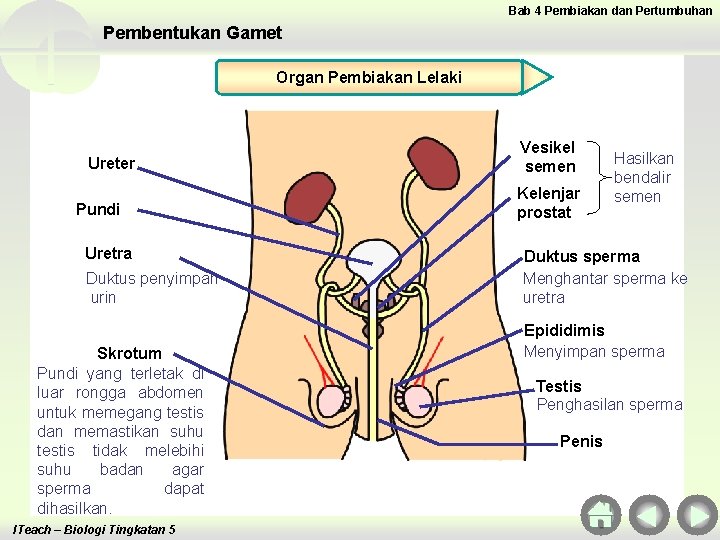
Bab 4 Pembiakan dan Pertumbuhan Pembentukan Gamet Organ Pembiakan Lelaki Ureter Pundi Uretra Duktus penyimpan urin Skrotum Pundi yang terletak di luar rongga abdomen untuk memegang testis dan memastikan suhu testis tidak melebihi suhu badan agar sperma dapat dihasilkan. ITeach – Biologi Tingkatan 5 Vesikel semen Kelenjar prostat Hasilkan bendalir semen Duktus sperma Menghantar sperma ke uretra Epididimis Menyimpan sperma Testis Penghasilan sperma Penis
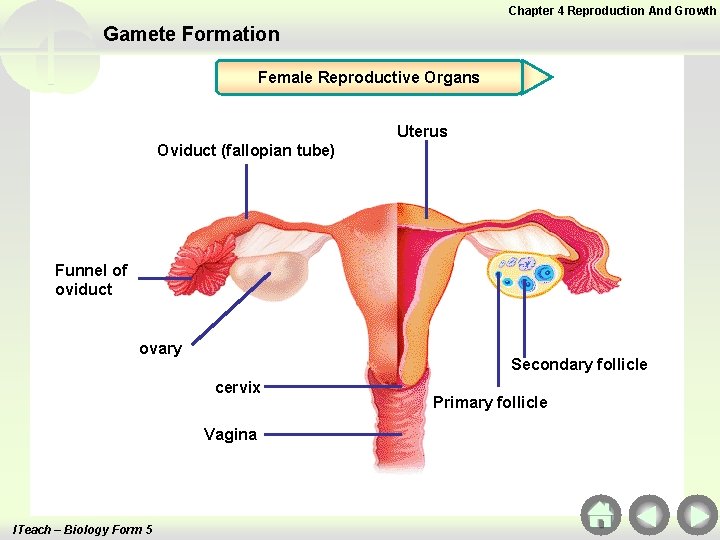
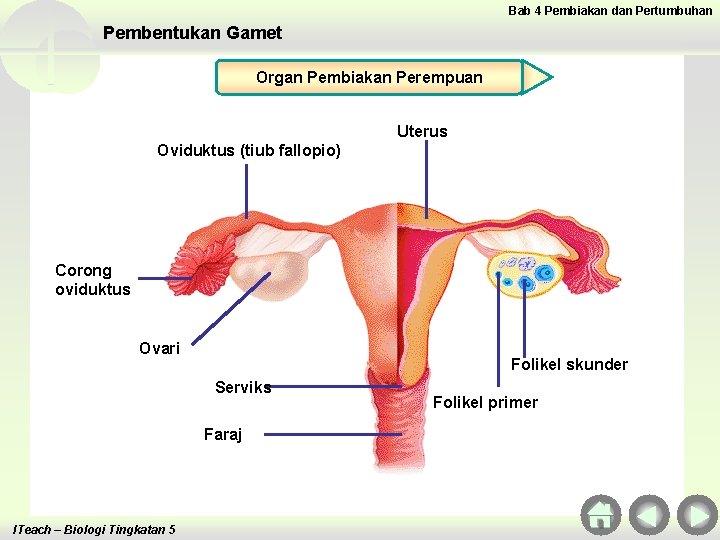
Chapter 4 Reproduction And Growth Gamete Formation Female Reproductive Organs Uterus Oviduct (fallopian tube) Funnel of oviduct ovary Secondary follicle cervix Vagina ITeach – Biology Form 5 Primary follicle
Bab 4 Pembiakan dan Pertumbuhan Pembentukan Gamet Organ Pembiakan Perempuan Uterus Oviduktus (tiub fallopio) Corong oviduktus Ovari Folikel skunder Serviks Faraj ITeach – Biologi Tingkatan 5 Folikel primer
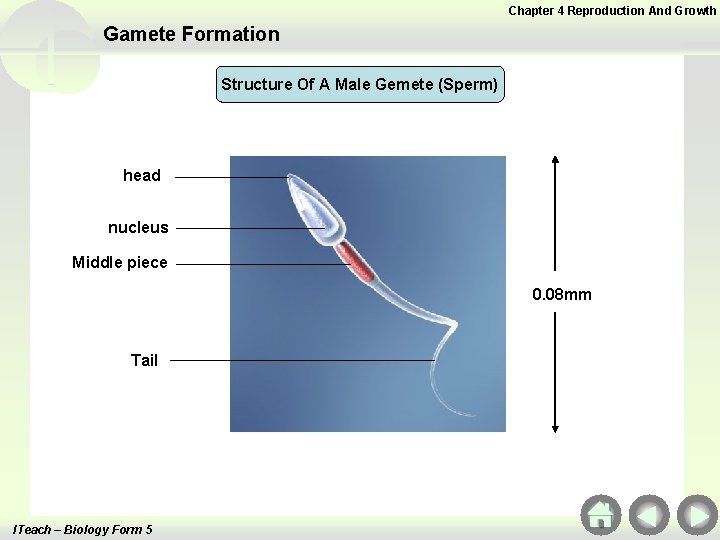
Chapter 4 Reproduction And Growth Gamete Formation Structure Of A Male Gemete (Sperm) head nucleus Middle piece 0. 08 mm Tail ITeach – Biology Form 5
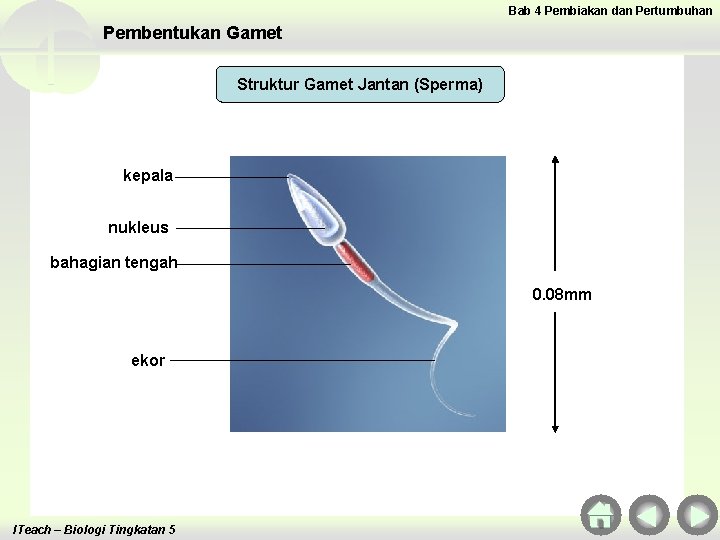
Bab 4 Pembiakan dan Pertumbuhan Pembentukan Gamet Struktur Gamet Jantan (Sperma) kepala nukleus bahagian tengah 0. 08 mm ekor ITeach – Biologi Tingkatan 5
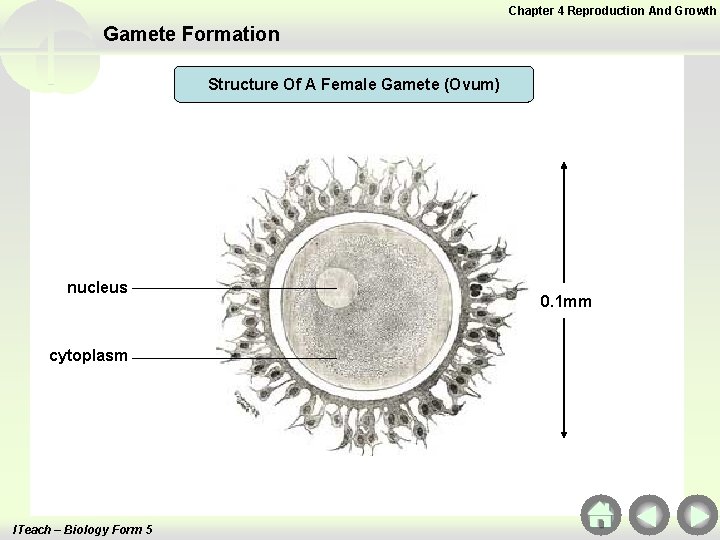
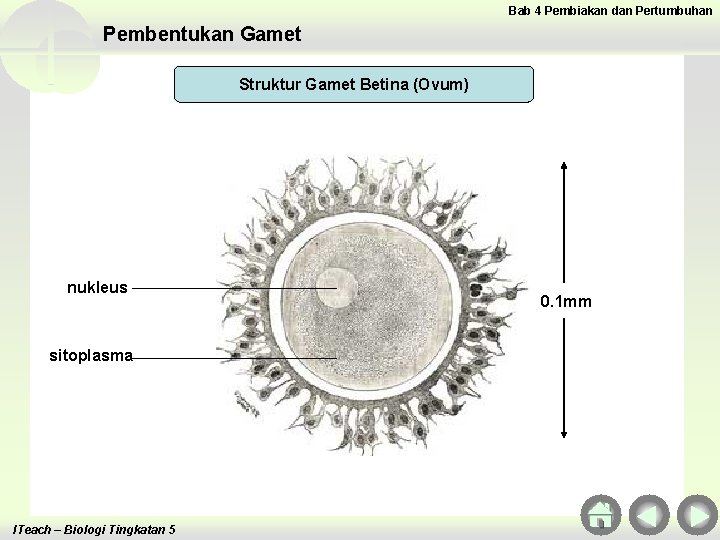
Chapter 4 Reproduction And Growth Gamete Formation Structure Of A Female Gamete (Ovum) nucleus cytoplasm ITeach – Biology Form 5 0. 1 mm
Bab 4 Pembiakan dan Pertumbuhan Pembentukan Gamet Struktur Gamet Betina (Ovum) nukleus sitoplasma ITeach – Biologi Tingkatan 5 0. 1 mm
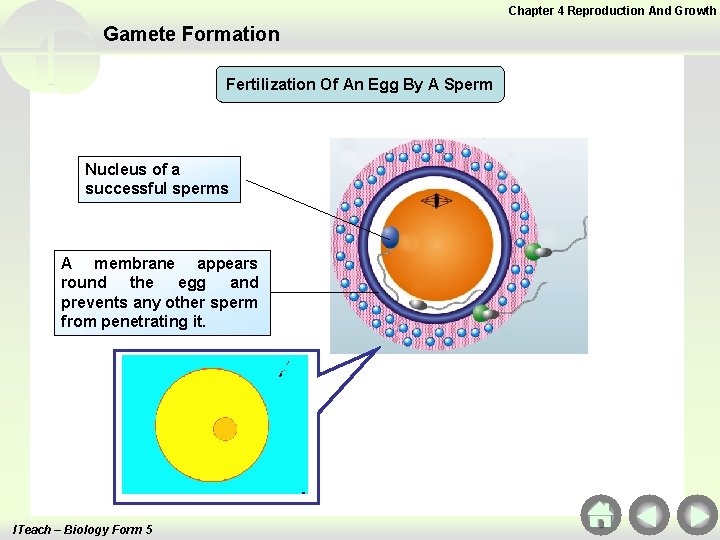
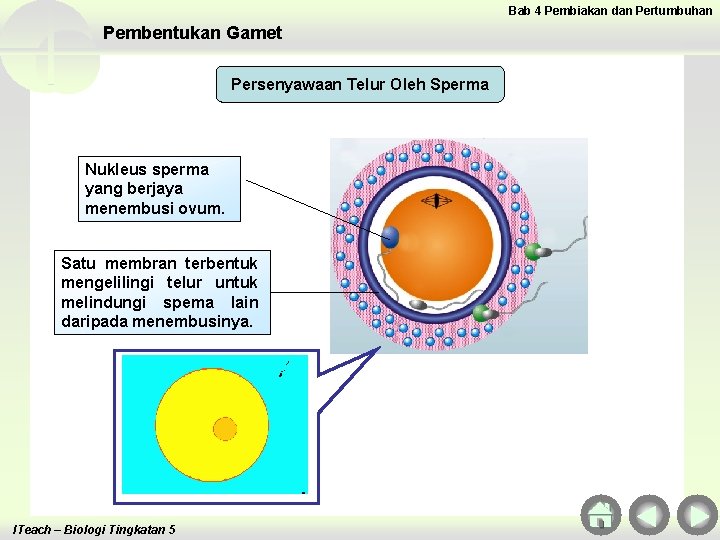
Chapter 4 Reproduction And Growth Gamete Formation Fertilization Of An Egg By A Sperm Nucleus of a successful sperms A membrane appears round the egg and prevents any other sperm from penetrating it. ITeach – Biology Form 5
Bab 4 Pembiakan dan Pertumbuhan Pembentukan Gamet Persenyawaan Telur Oleh Sperma Nukleus sperma yang berjaya menembusi ovum. Satu membran terbentuk mengelilingi telur untuk melindungi spema lain daripada menembusinya. ITeach – Biologi Tingkatan 5
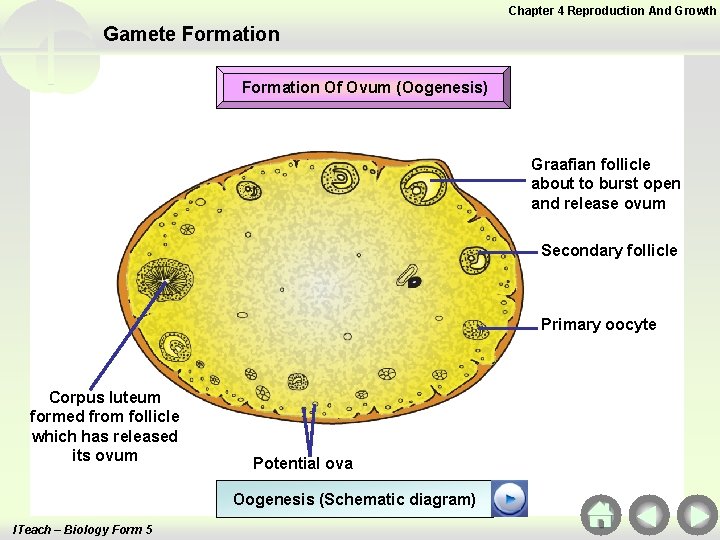
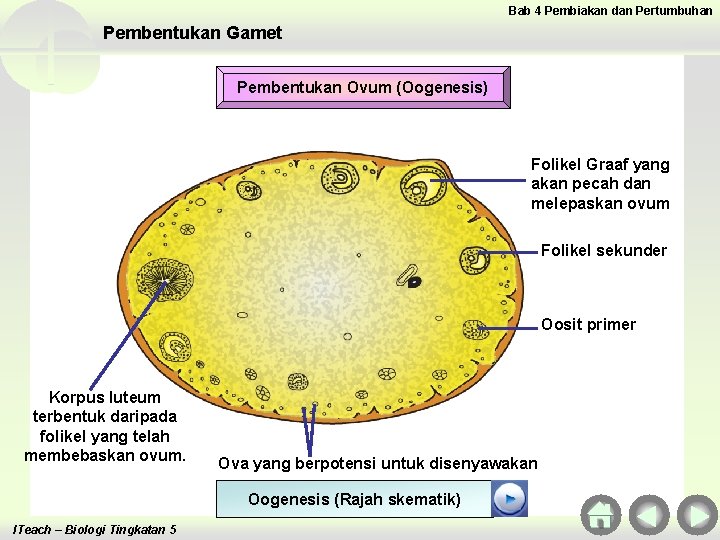
Chapter 4 Reproduction And Growth Gamete Formation Of Ovum (Oogenesis) Graafian follicle about to burst open and release ovum Secondary follicle Primary oocyte Corpus luteum formed from follicle which has released its ovum Potential ova Oogenesis (Schematic diagram) ITeach – Biology Form 5
Bab 4 Pembiakan dan Pertumbuhan Pembentukan Gamet Pembentukan Ovum (Oogenesis) Folikel Graaf yang akan pecah dan melepaskan ovum Folikel sekunder Oosit primer Korpus luteum terbentuk daripada folikel yang telah membebaskan ovum. Ova yang berpotensi untuk disenyawakan Oogenesis (Rajah skematik) ITeach – Biologi Tingkatan 5
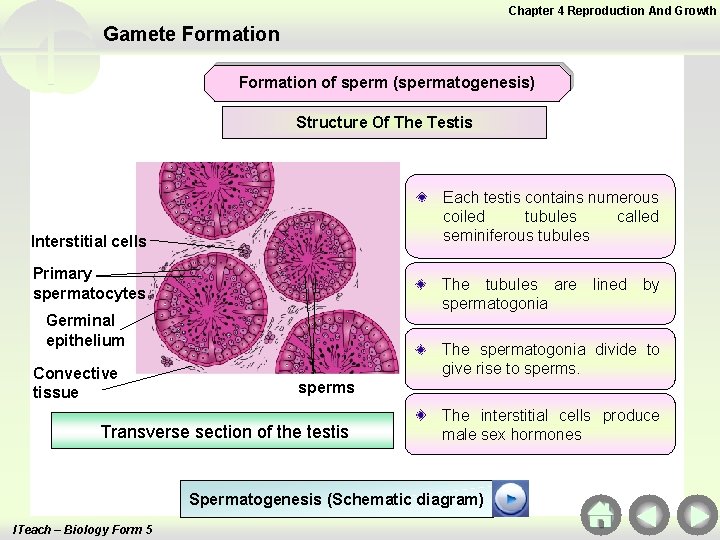
Chapter 4 Reproduction And Growth Gamete Formation of sperm (spermatogenesis) Structure Of The Testis Each testis contains numerous coiled tubules called seminiferous tubules Interstitial cells Primary spermatocytes The tubules are spermatogonia Germinal epithelium Convective tissue by The spermatogonia divide to give rise to sperms Transverse section of the testis The interstitial cells produce male sex hormones Spermatogenesis (Schematic diagram) ITeach – Biology Form 5 lined
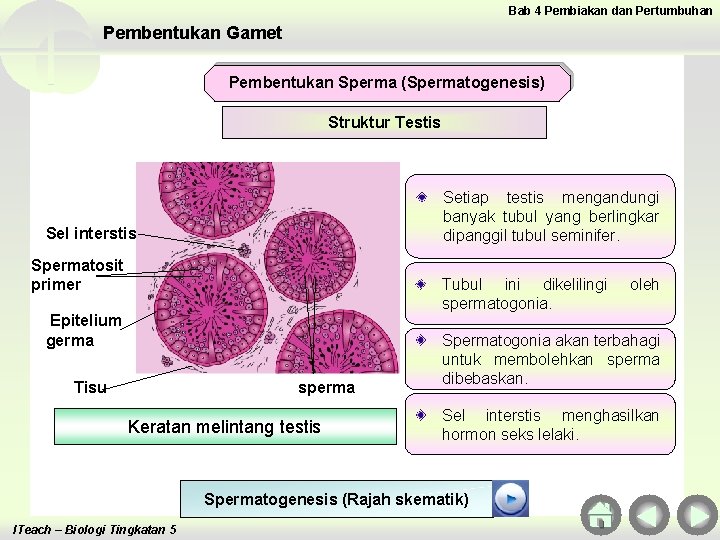
Bab 4 Pembiakan dan Pertumbuhan Pembentukan Gamet Pembentukan Sperma (Spermatogenesis) Struktur Testis Setiap testis mengandungi banyak tubul yang berlingkar dipanggil tubul seminifer. Sel interstis Spermatosit primer Tubul ini dikelilingi spermatogonia. Epitelium germa Tisu sperma Keratan melintang testis Spermatogonia akan terbahagi untuk membolehkan sperma dibebaskan. Sel interstis menghasilkan hormon seks lelaki. Spermatogenesis (Rajah skematik) ITeach – Biologi Tingkatan 5 oleh
Chapter 4 Reproduction And Growth 4. 2 Role Of Hormones In The Menstrual Cycle ITeach – Biology Form 5
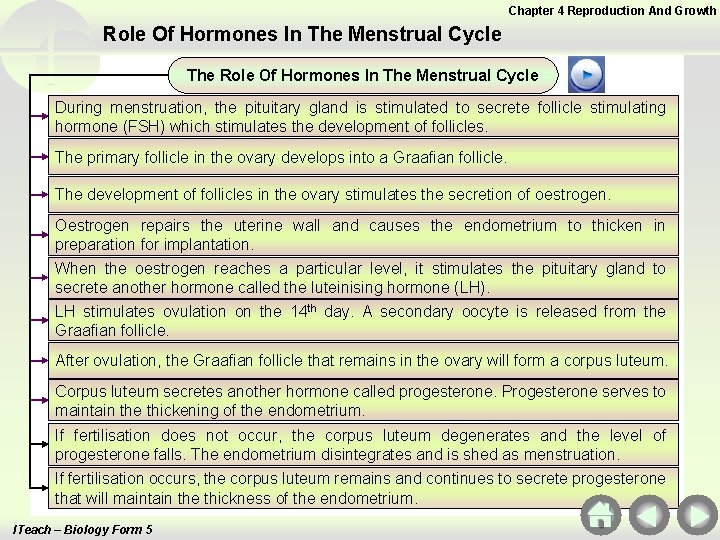
Chapter 4 Reproduction And Growth Role Of Hormones In The Menstrual Cycle The Role Of Hormones In The Menstrual Cycle During menstruation, the pituitary gland is stimulated to secrete follicle stimulating hormone (FSH) which stimulates the development of follicles. The primary follicle in the ovary develops into a Graafian follicle. The development of follicles in the ovary stimulates the secretion of oestrogen. Oestrogen repairs the uterine wall and causes the endometrium to thicken in preparation for implantation. When the oestrogen reaches a particular level, it stimulates the pituitary gland to secrete another hormone called the luteinising hormone (LH). LH stimulates ovulation on the 14 th day. A secondary oocyte is released from the Graafian follicle. After ovulation, the Graafian follicle that remains in the ovary will form a corpus luteum. Corpus luteum secretes another hormone called progesterone. Progesterone serves to maintain the thickening of the endometrium. If fertilisation does not occur, the corpus luteum degenerates and the level of progesterone falls. The endometrium disintegrates and is shed as menstruation. If fertilisation occurs, the corpus luteum remains and continues to secrete progesterone that will maintain the thickness of the endometrium. ITeach – Biology Form 5
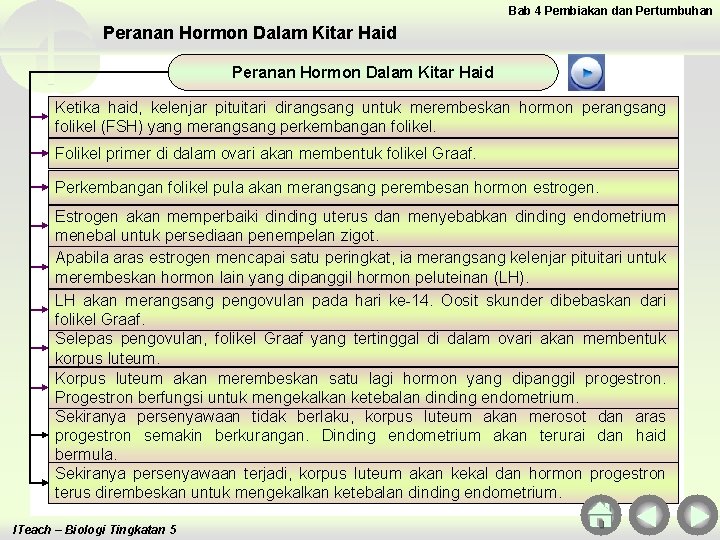
Bab 4 Pembiakan dan Pertumbuhan Peranan Hormon Dalam Kitar Haid Ketika haid, kelenjar pituitari dirangsang untuk merembeskan hormon perangsang folikel (FSH) yang merangsang perkembangan folikel. Folikel primer di dalam ovari akan membentuk folikel Graaf. Perkembangan folikel pula akan merangsang perembesan hormon estrogen. Estrogen akan memperbaiki dinding uterus dan menyebabkan dinding endometrium menebal untuk persediaan penempelan zigot. Apabila aras estrogen mencapai satu peringkat, ia merangsang kelenjar pituitari untuk merembeskan hormon lain yang dipanggil hormon peluteinan (LH). LH akan merangsang pengovulan pada hari ke-14. Oosit skunder dibebaskan dari folikel Graaf. Selepas pengovulan, folikel Graaf yang tertinggal di dalam ovari akan membentuk korpus luteum. Korpus luteum akan merembeskan satu lagi hormon yang dipanggil progestron. Progestron berfungsi untuk mengekalkan ketebalan dinding endometrium. Sekiranya persenyawaan tidak berlaku, korpus luteum akan merosot dan aras progestron semakin berkurangan. Dinding endometrium akan terurai dan haid bermula. Sekiranya persenyawaan terjadi, korpus luteum akan kekal dan hormon progestron terus dirembeskan untuk mengekalkan ketebalan dinding endometrium. ITeach – Biologi Tingkatan 5
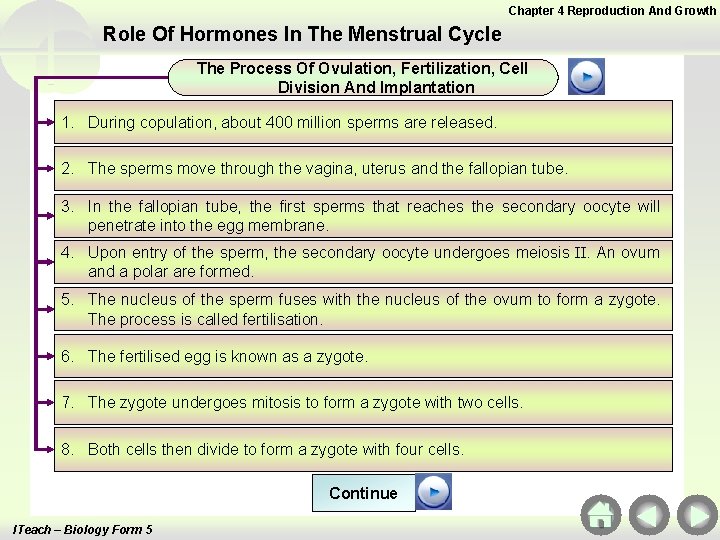
Chapter 4 Reproduction And Growth Role Of Hormones In The Menstrual Cycle The Process Of Ovulation, Fertilization, Cell Division And Implantation 1. During copulation, about 400 million sperms are released. 2. The sperms move through the vagina, uterus and the fallopian tube. 3. In the fallopian tube, the first sperms that reaches the secondary oocyte will penetrate into the egg membrane. 4. Upon entry of the sperm, the secondary oocyte undergoes meiosis II. An ovum and a polar are formed. 5. The nucleus of the sperm fuses with the nucleus of the ovum to form a zygote. The process is called fertilisation. 6. The fertilised egg is known as a zygote. 7. The zygote undergoes mitosis to form a zygote with two cells. 8. Both cells then divide to form a zygote with four cells. Continue ITeach – Biology Form 5
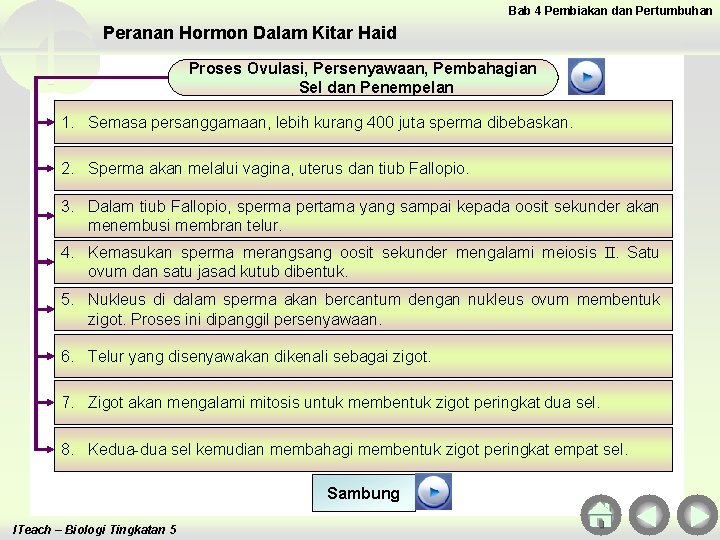
Bab 4 Pembiakan dan Pertumbuhan Peranan Hormon Dalam Kitar Haid Proses Ovulasi, Persenyawaan, Pembahagian Sel dan Penempelan 1. Semasa persanggamaan, lebih kurang 400 juta sperma dibebaskan. 2. Sperma akan melalui vagina, uterus dan tiub Fallopio. 3. Dalam tiub Fallopio, sperma pertama yang sampai kepada oosit sekunder akan menembusi membran telur. 4. Kemasukan sperma merangsang oosit sekunder mengalami meiosis II. Satu ovum dan satu jasad kutub dibentuk. 5. Nukleus di dalam sperma akan bercantum dengan nukleus ovum membentuk zigot. Proses ini dipanggil persenyawaan. 6. Telur yang disenyawakan dikenali sebagai zigot. 7. Zigot akan mengalami mitosis untuk membentuk zigot peringkat dua sel. 8. Kedua-dua sel kemudian membahagi membentuk zigot peringkat empat sel. Sambung ITeach – Biologi Tingkatan 5
Chapter 4 Reproduction And Growth 4. 3 Early Development Of A Zygote In Humans ITeach – Biology Form 5
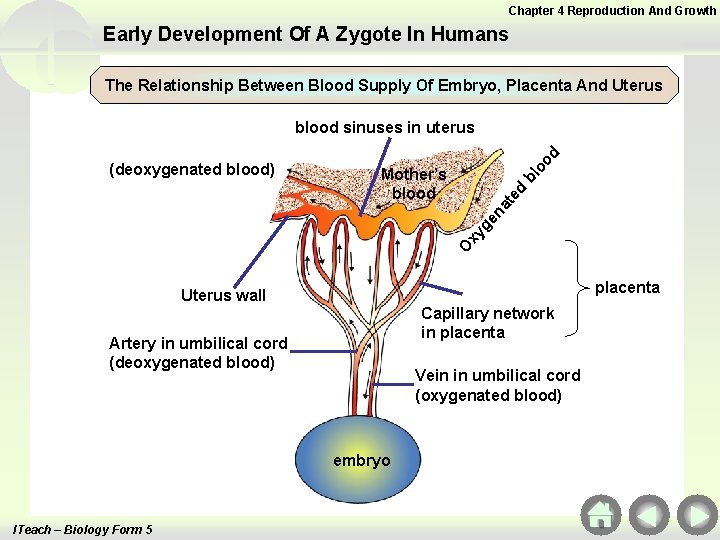
Chapter 4 Reproduction And Growth Early Development Of A Zygote In Humans The Relationship Between Blood Supply Of Embryo, Placenta And Uterus at ed Mother’s blood O xy ge n (deoxygenated blood) bl oo d blood sinuses in uterus placenta Uterus wall Capillary network in placenta Artery in umbilical cord (deoxygenated blood) Vein in umbilical cord (oxygenated blood) embryo ITeach – Biology Form 5
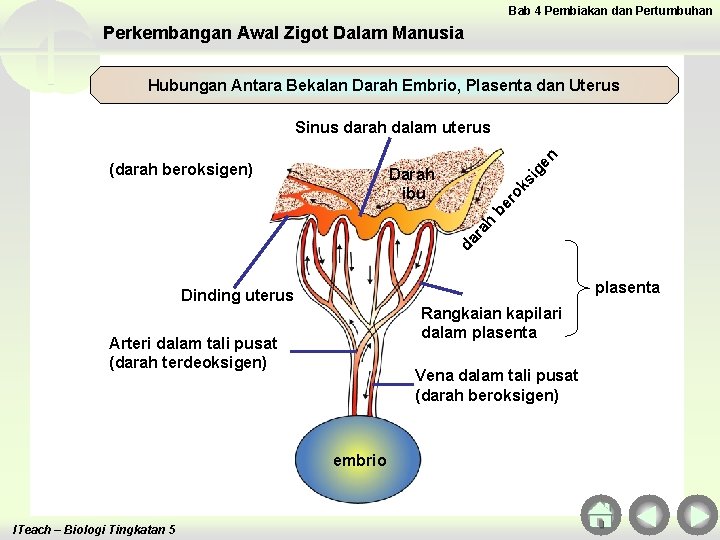
Bab 4 Pembiakan dan Pertumbuhan Perkembangan Awal Zigot Dalam Manusia Hubungan Antara Bekalan Darah Embrio, Plasenta dan Uterus (darah beroksigen) en Sinus darah dalam uterus da ra h be r ok s ig Darah ibu plasenta Dinding uterus Rangkaian kapilari dalam plasenta Arteri dalam tali pusat (darah terdeoksigen) Vena dalam tali pusat (darah beroksigen) embrio ITeach – Biologi Tingkatan 5
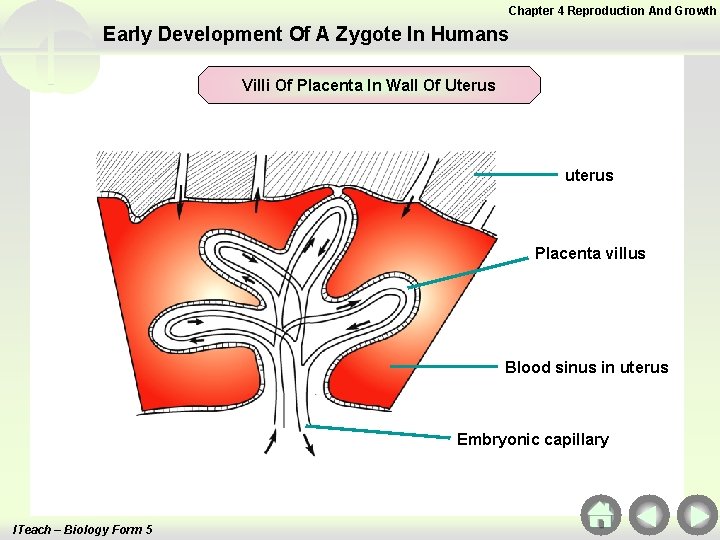
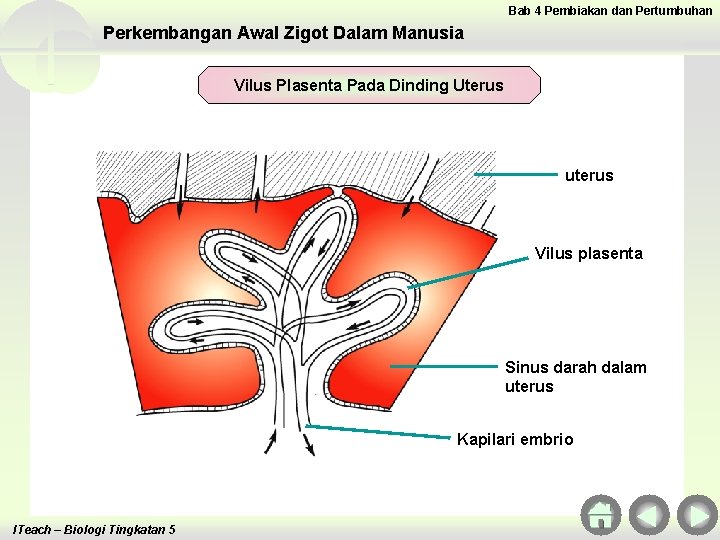
Chapter 4 Reproduction And Growth Early Development Of A Zygote In Humans Villi Of Placenta In Wall Of Uterus uterus Placenta villus Blood sinus in uterus Embryonic capillary ITeach – Biology Form 5
Bab 4 Pembiakan dan Pertumbuhan Perkembangan Awal Zigot Dalam Manusia Vilus Plasenta Pada Dinding Uterus uterus Vilus plasenta Sinus darah dalam uterus Kapilari embrio ITeach – Biologi Tingkatan 5
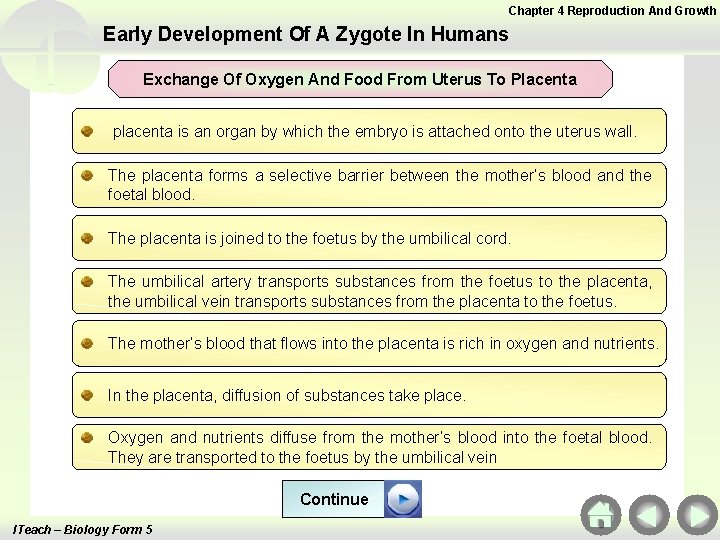
Chapter 4 Reproduction And Growth Early Development Of A Zygote In Humans Exchange Of Oxygen And Food From Uterus To Placenta placenta is an organ by which the embryo is attached onto the uterus wall. The placenta forms a selective barrier between the mother’s blood and the foetal blood. The placenta is joined to the foetus by the umbilical cord. The umbilical artery transports substances from the foetus to the placenta, the umbilical vein transports substances from the placenta to the foetus. The mother’s blood that flows into the placenta is rich in oxygen and nutrients. In the placenta, diffusion of substances take place. Oxygen and nutrients diffuse from the mother’s blood into the foetal blood. They are transported to the foetus by the umbilical vein Continue ITeach – Biology Form 5
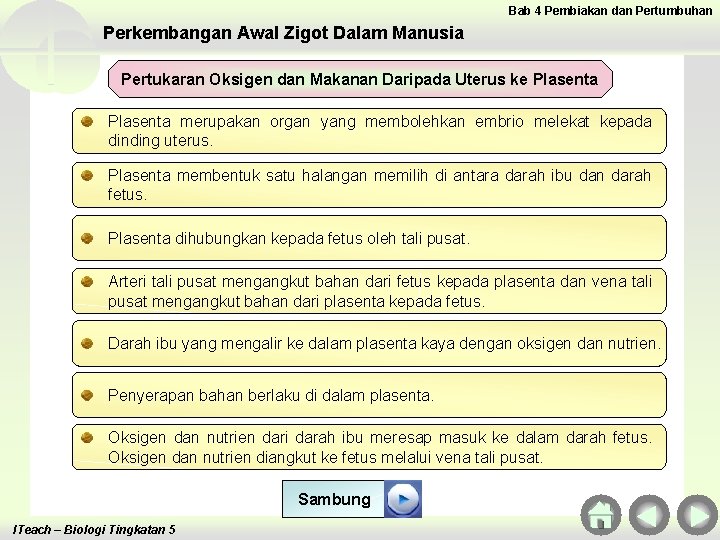
Bab 4 Pembiakan dan Pertumbuhan Perkembangan Awal Zigot Dalam Manusia Pertukaran Oksigen dan Makanan Daripada Uterus ke Plasenta merupakan organ yang membolehkan embrio melekat kepada dinding uterus. Plasenta membentuk satu halangan memilih di antara darah ibu dan darah fetus. Plasenta dihubungkan kepada fetus oleh tali pusat. Arteri tali pusat mengangkut bahan dari fetus kepada plasenta dan vena tali pusat mengangkut bahan dari plasenta kepada fetus. Darah ibu yang mengalir ke dalam plasenta kaya dengan oksigen dan nutrien. Penyerapan bahan berlaku di dalam plasenta. Oksigen dan nutrien dari darah ibu meresap masuk ke dalam darah fetus. Oksigen dan nutrien diangkut ke fetus melalui vena tali pusat. Sambung ITeach – Biologi Tingkatan 5
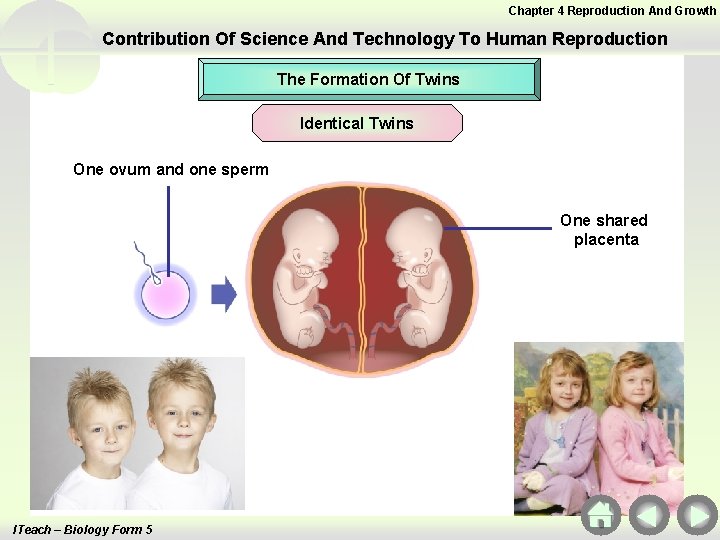
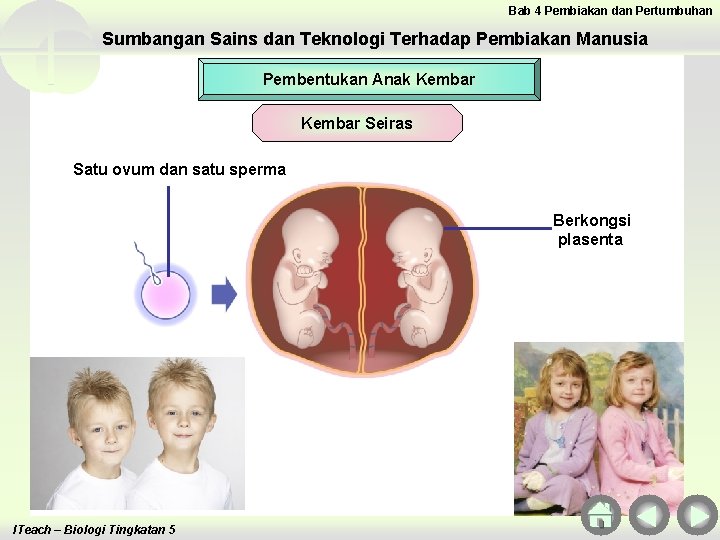
Chapter 4 Reproduction And Growth Contribution Of Science And Technology To Human Reproduction The Formation Of Twins Identical Twins One ovum and one sperm One shared placenta ITeach – Biology Form 5
Bab 4 Pembiakan dan Pertumbuhan Sumbangan Sains dan Teknologi Terhadap Pembiakan Manusia Pembentukan Anak Kembar Seiras Satu ovum dan satu sperma Berkongsi plasenta ITeach – Biologi Tingkatan 5
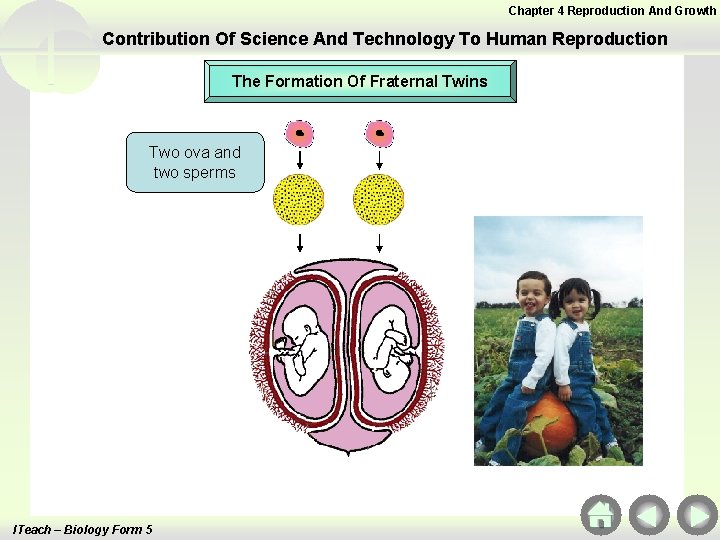
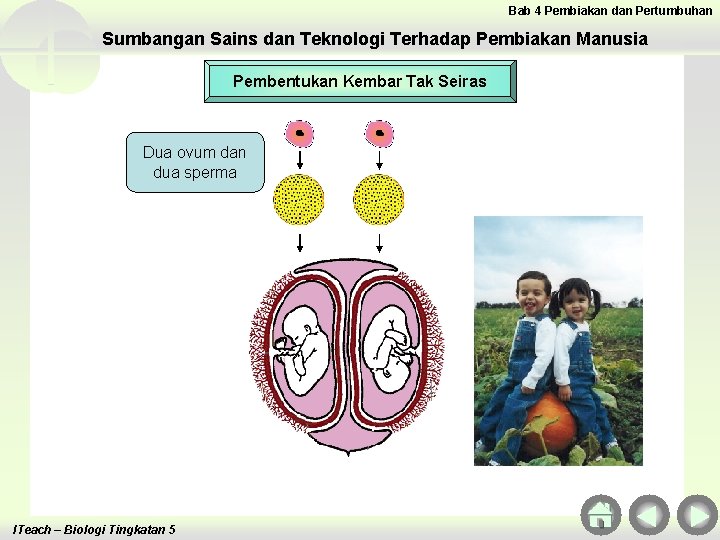
Chapter 4 Reproduction And Growth Contribution Of Science And Technology To Human Reproduction The Formation Of Fraternal Twins Two ova and two sperms ITeach – Biology Form 5
Bab 4 Pembiakan dan Pertumbuhan Sumbangan Sains dan Teknologi Terhadap Pembiakan Manusia Pembentukan Kembar Tak Seiras Dua ovum dan dua sperma ITeach – Biologi Tingkatan 5
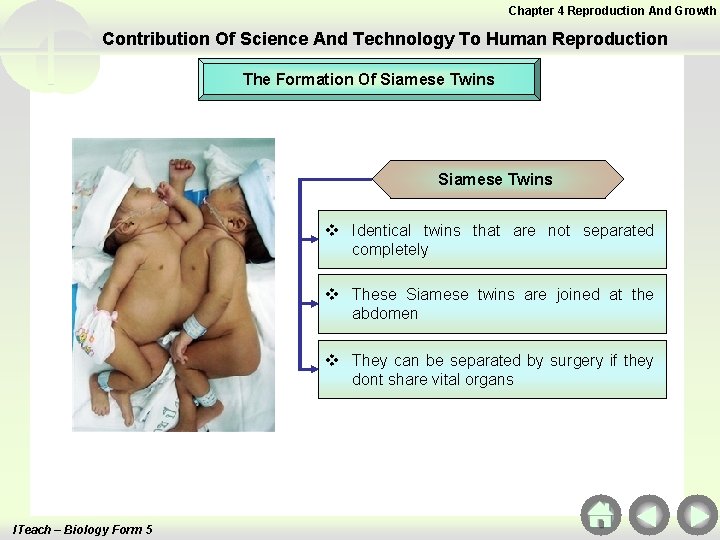
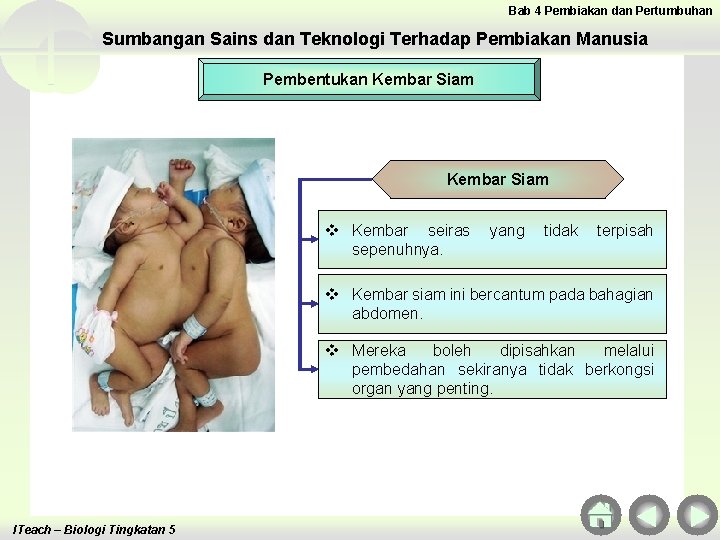
Chapter 4 Reproduction And Growth Contribution Of Science And Technology To Human Reproduction The Formation Of Siamese Twins v Identical twins that are not separated completely v These Siamese twins are joined at the abdomen v They can be separated by surgery if they dont share vital organs ITeach – Biology Form 5
Bab 4 Pembiakan dan Pertumbuhan Sumbangan Sains dan Teknologi Terhadap Pembiakan Manusia Pembentukan Kembar Siam v Kembar seiras sepenuhnya. yang tidak terpisah v Kembar siam ini bercantum pada bahagian abdomen. v Mereka boleh dipisahkan melalui pembedahan sekiranya tidak berkongsi organ yang penting. ITeach – Biologi Tingkatan 5
Chapter 4 Reproduction And Growth 4. 4 Contribution Of Science And Technology To Human Reproduction ITeach – Biology Form 5
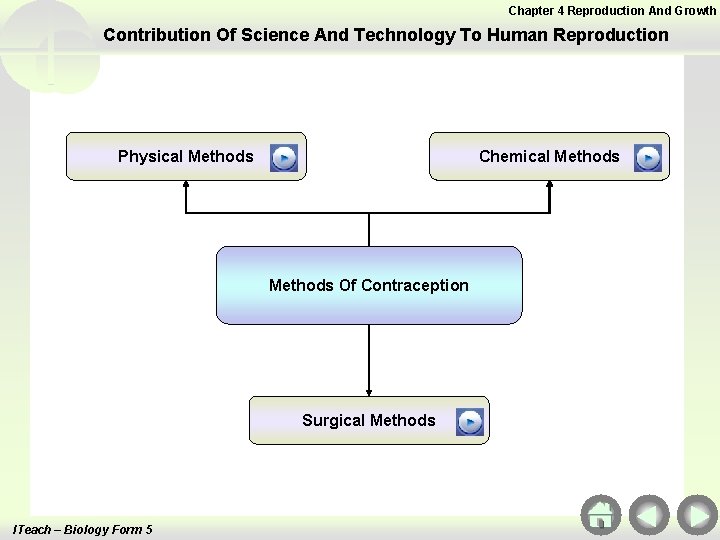
Chapter 4 Reproduction And Growth Contribution Of Science And Technology To Human Reproduction Physical Methods Chemical Methods Of Contraception Surgical Methods ITeach – Biology Form 5
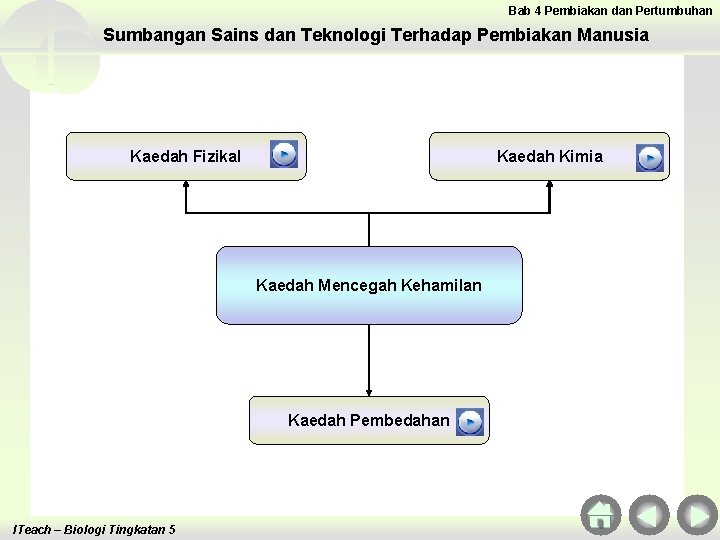
Bab 4 Pembiakan dan Pertumbuhan Sumbangan Sains dan Teknologi Terhadap Pembiakan Manusia Kaedah Fizikal Kaedah Kimia Kaedah Mencegah Kehamilan Kaedah Pembedahan ITeach – Biologi Tingkatan 5
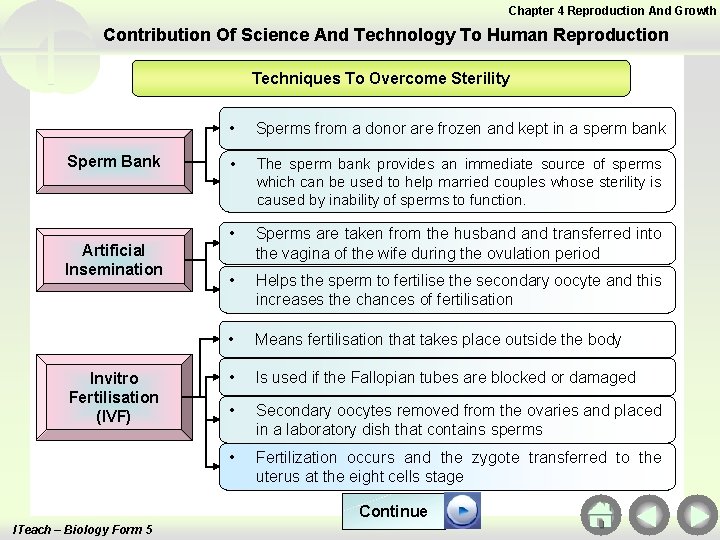
Chapter 4 Reproduction And Growth Contribution Of Science And Technology To Human Reproduction Techniques To Overcome Sterility Sperm Bank Artificial Insemination Invitro Fertilisation (IVF) • Sperms from a donor are frozen and kept in a sperm bank • The sperm bank provides an immediate source of sperms which can be used to help married couples whose sterility is caused by inability of sperms to function. • Sperms are taken from the husband transferred into the vagina of the wife during the ovulation period • Helps the sperm to fertilise the secondary oocyte and this increases the chances of fertilisation • Means fertilisation that takes place outside the body • Is used if the Fallopian tubes are blocked or damaged • Secondary oocytes removed from the ovaries and placed in a laboratory dish that contains sperms • Fertilization occurs and the zygote transferred to the uterus at the eight cells stage Continue ITeach – Biology Form 5
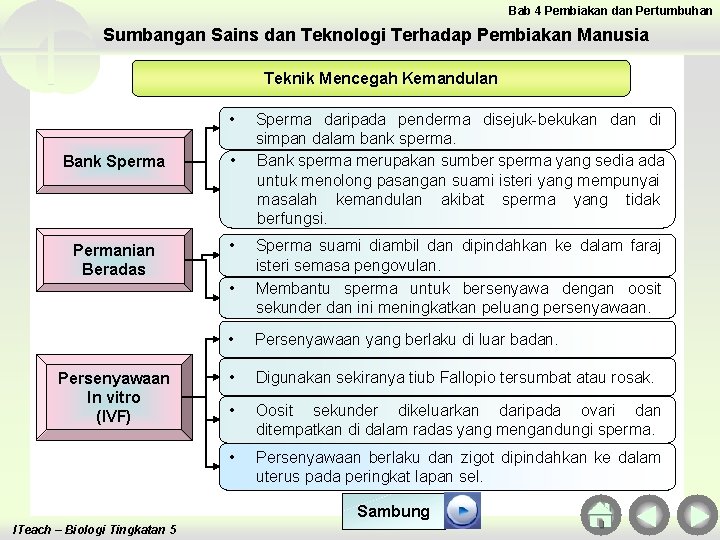
Bab 4 Pembiakan dan Pertumbuhan Sumbangan Sains dan Teknologi Terhadap Pembiakan Manusia Teknik Mencegah Kemandulan • Bank Sperma • Permanian Beradas • • Persenyawaan In vitro (IVF) Sperma daripada penderma disejuk-bekukan di simpan dalam bank sperma. Bank sperma merupakan sumber sperma yang sedia ada untuk menolong pasangan suami isteri yang mempunyai masalah kemandulan akibat sperma yang tidak berfungsi. Sperma suami diambil dan dipindahkan ke dalam faraj isteri semasa pengovulan. Membantu sperma untuk bersenyawa dengan oosit sekunder dan ini meningkatkan peluang persenyawaan. • Persenyawaan yang berlaku di luar badan. • Digunakan sekiranya tiub Fallopio tersumbat atau rosak. • Oosit sekunder dikeluarkan daripada ovari dan ditempatkan di dalam radas yang mengandungi sperma. • Persenyawaan berlaku dan zigot dipindahkan ke dalam uterus pada peringkat lapan sel. Sambung ITeach – Biologi Tingkatan 5
Chapter 4 Reproduction And Growth 4. 5 Sexual Reproduction In Flowering Plants ITeach – Biology Form 5
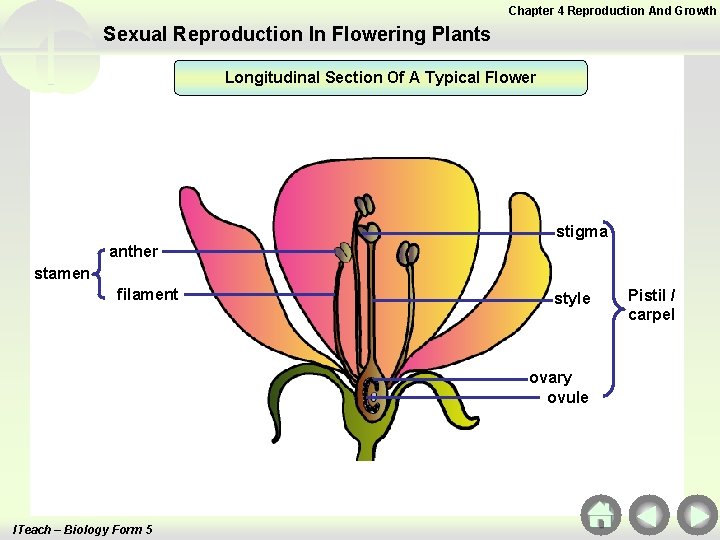
Chapter 4 Reproduction And Growth Sexual Reproduction In Flowering Plants Longitudinal Section Of A Typical Flower stigma anther stamen filament style ovary ovule ITeach – Biology Form 5 Pistil / carpel
Bab 4 Pembiakan dan Pertumbuhan Pembiakan Seks Dalam Tumbuhan Berbunga Keratan Membujur Sekuntum Bunga stigma anter stamen filamen stil ovari ovul ITeach – Biologi Tingkatan 5 Pistil / karpel
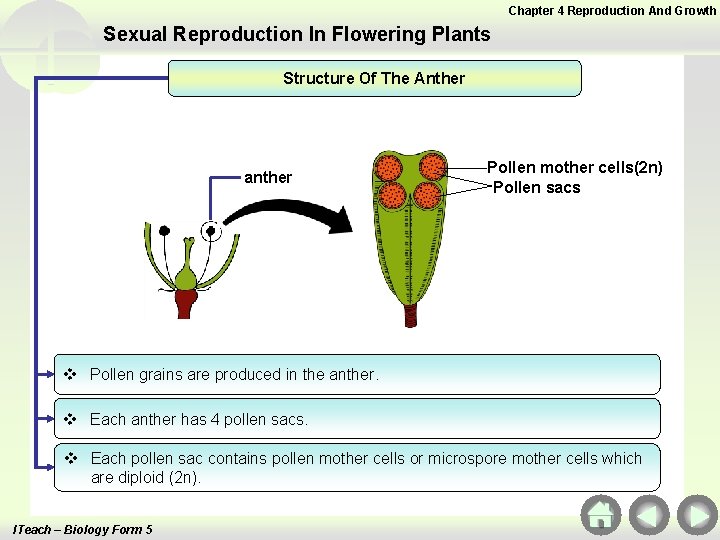
Chapter 4 Reproduction And Growth Sexual Reproduction In Flowering Plants Structure Of The Anther anther Pollen mother cells(2 n) Pollen sacs v Pollen grains are produced in the anther. v Each anther has 4 pollen sacs. v Each pollen sac contains pollen mother cells or microspore mother cells which are diploid (2 n). ITeach – Biology Form 5
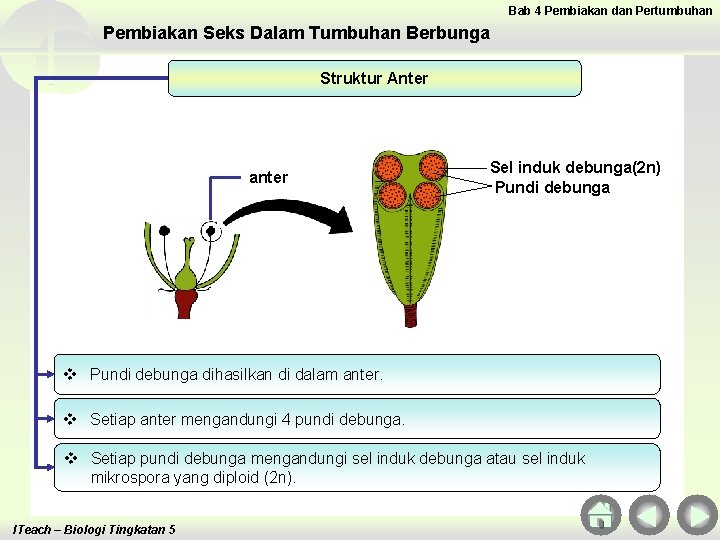
Bab 4 Pembiakan dan Pertumbuhan Pembiakan Seks Dalam Tumbuhan Berbunga Struktur Anter anter Sel induk debunga(2 n) Pundi debunga v Pundi debunga dihasilkan di dalam anter. v Setiap anter mengandungi 4 pundi debunga. v Setiap pundi debunga mengandungi sel induk debunga atau sel induk mikrospora yang diploid (2 n). ITeach – Biologi Tingkatan 5
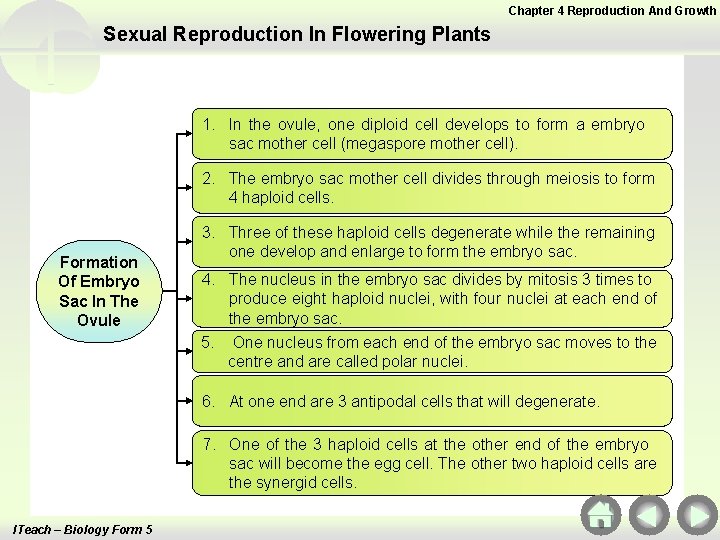
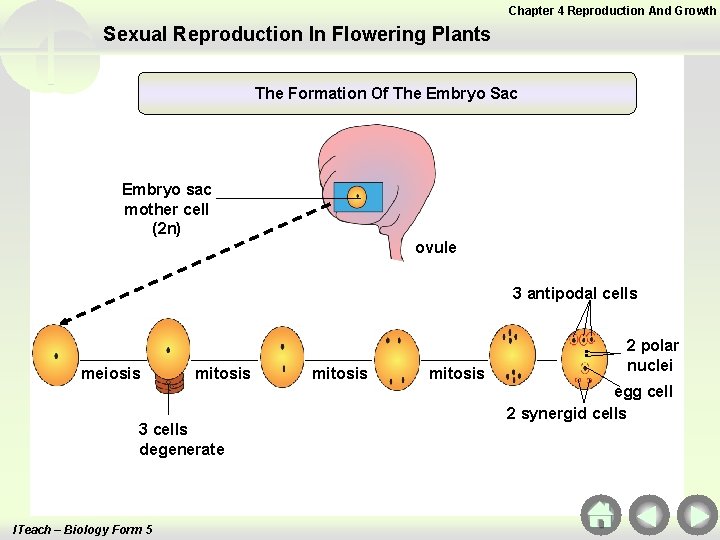
Chapter 4 Reproduction And Growth Sexual Reproduction In Flowering Plants 1. In the ovule, one diploid cell develops to form a embryo sac mother cell (megaspore mother cell). 2. The embryo sac mother cell divides through meiosis to form 4 haploid cells. Formation Of Embryo Sac In The Ovule 3. Three of these haploid cells degenerate while the remaining one develop and enlarge to form the embryo sac. 4. The nucleus in the embryo sac divides by mitosis 3 times to produce eight haploid nuclei, with four nuclei at each end of the embryo sac. 5. One nucleus from each end of the embryo sac moves to the centre and are called polar nuclei. 6. At one end are 3 antipodal cells that will degenerate. 7. One of the 3 haploid cells at the other end of the embryo sac will become the egg cell. The other two haploid cells are the synergid cells. ITeach – Biology Form 5
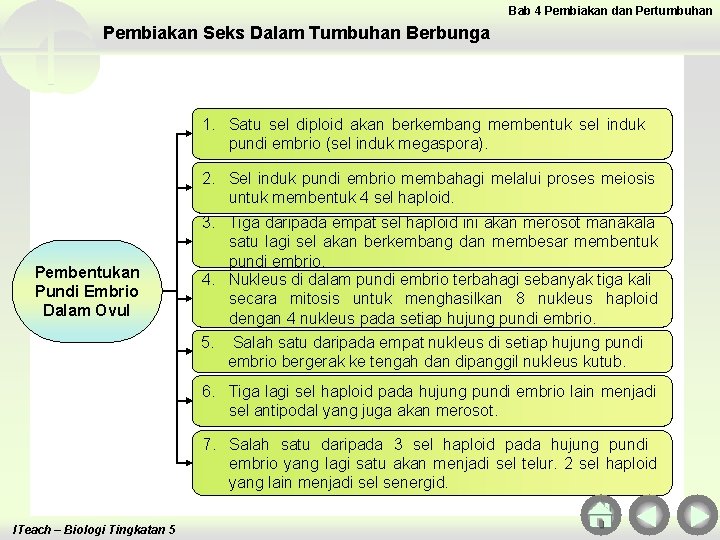
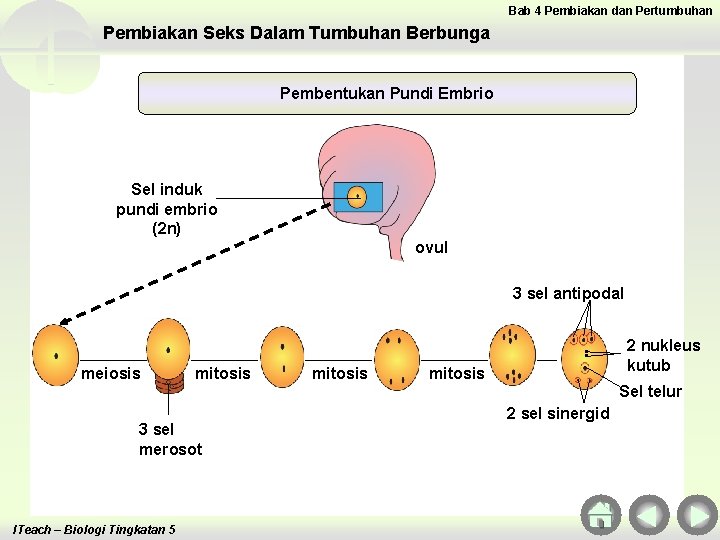
Bab 4 Pembiakan dan Pertumbuhan Pembiakan Seks Dalam Tumbuhan Berbunga 1. Satu sel diploid akan berkembang membentuk sel induk pundi embrio (sel induk megaspora). 2. Sel induk pundi embrio membahagi melalui proses meiosis untuk membentuk 4 sel haploid. Pembentukan Pundi Embrio Dalam Ovul 3. Tiga daripada empat sel haploid ini akan merosot manakala satu lagi sel akan berkembang dan membesar membentuk pundi embrio. 4. Nukleus di dalam pundi embrio terbahagi sebanyak tiga kali secara mitosis untuk menghasilkan 8 nukleus haploid dengan 4 nukleus pada setiap hujung pundi embrio. 5. Salah satu daripada empat nukleus di setiap hujung pundi embrio bergerak ke tengah dan dipanggil nukleus kutub. 6. Tiga lagi sel haploid pada hujung pundi embrio lain menjadi sel antipodal yang juga akan merosot. 7. Salah satu daripada 3 sel haploid pada hujung pundi embrio yang lagi satu akan menjadi sel telur. 2 sel haploid yang lain menjadi sel senergid. ITeach – Biologi Tingkatan 5
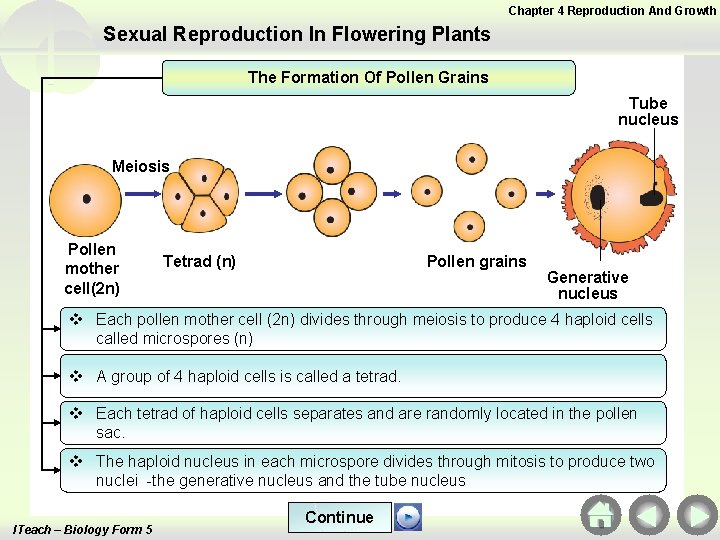
Chapter 4 Reproduction And Growth Sexual Reproduction In Flowering Plants The Formation Of Pollen Grains Tube nucleus Meiosis Pollen mother cell(2 n) Tetrad (n) Pollen grains Generative nucleus v Each pollen mother cell (2 n) divides through meiosis to produce 4 haploid cells called microspores (n) v A group of 4 haploid cells is called a tetrad. v Each tetrad of haploid cells separates and are randomly located in the pollen sac. v The haploid nucleus in each microspore divides through mitosis to produce two nuclei -the generative nucleus and the tube nucleus ITeach – Biology Form 5 Continue
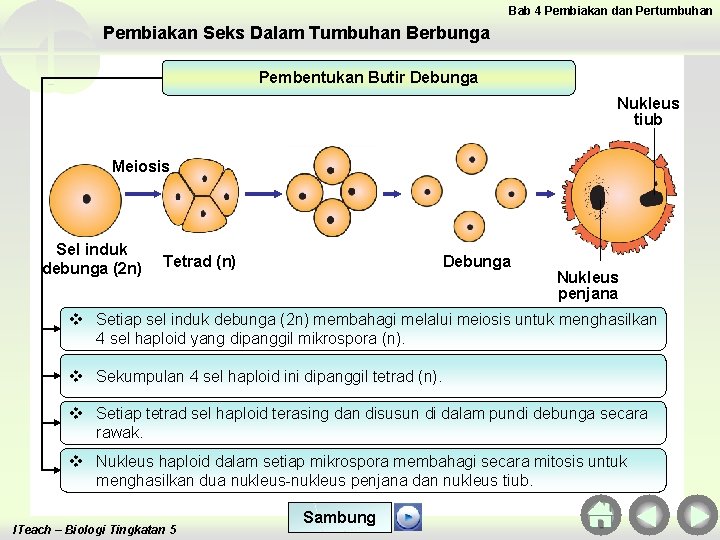
Bab 4 Pembiakan dan Pertumbuhan Pembiakan Seks Dalam Tumbuhan Berbunga Pembentukan Butir Debunga Nukleus tiub Meiosis Sel induk debunga (2 n) Tetrad (n) Debunga Nukleus penjana v Setiap sel induk debunga (2 n) membahagi melalui meiosis untuk menghasilkan 4 sel haploid yang dipanggil mikrospora (n). v Sekumpulan 4 sel haploid ini dipanggil tetrad (n). v Setiap tetrad sel haploid terasing dan disusun di dalam pundi debunga secara rawak. v Nukleus haploid dalam setiap mikrospora membahagi secara mitosis untuk menghasilkan dua nukleus-nukleus penjana dan nukleus tiub. ITeach – Biologi Tingkatan 5 Sambung
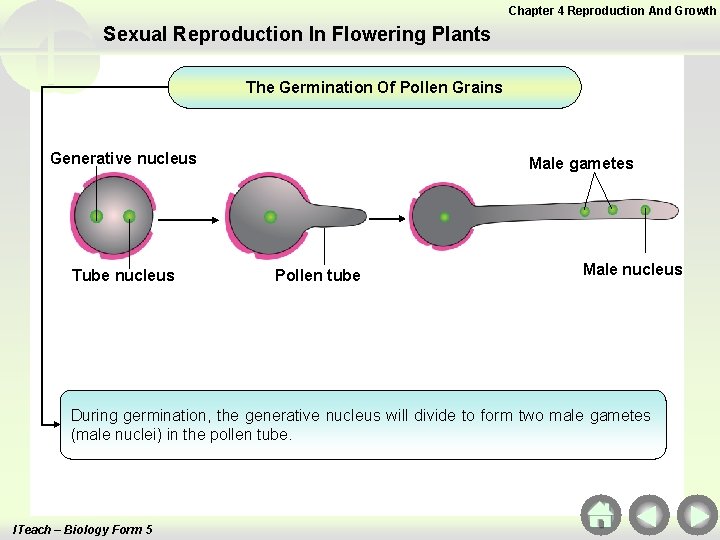
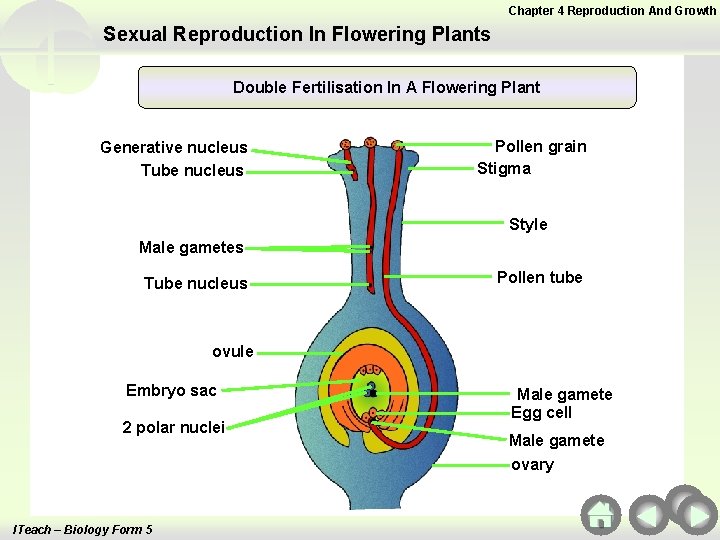
Chapter 4 Reproduction And Growth Sexual Reproduction In Flowering Plants The Germination Of Pollen Grains Generative nucleus Tube nucleus Male gametes Pollen tube Male nucleus During germination, the generative nucleus will divide to form two male gametes (male nuclei) in the pollen tube. ITeach – Biology Form 5
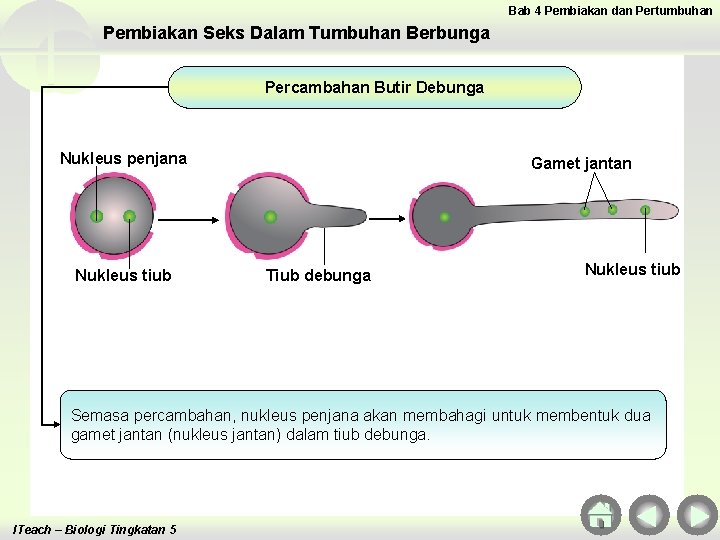
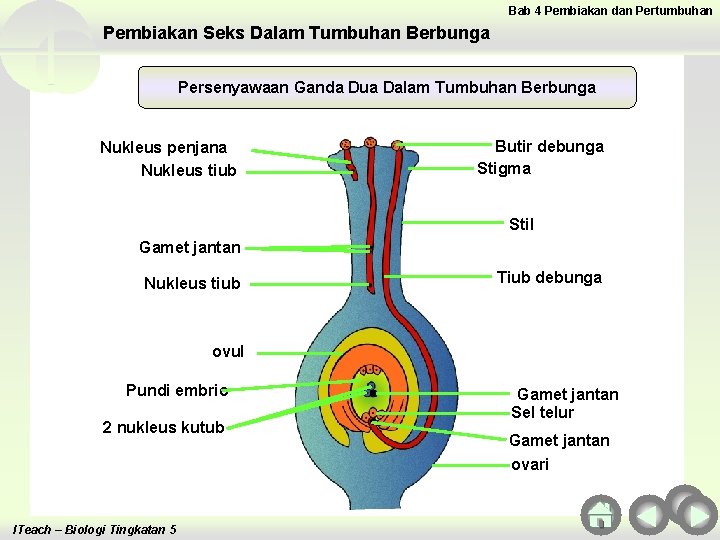
Bab 4 Pembiakan dan Pertumbuhan Pembiakan Seks Dalam Tumbuhan Berbunga Percambahan Butir Debunga Nukleus penjana Nukleus tiub Gamet jantan Tiub debunga Nukleus tiub Semasa percambahan, nukleus penjana akan membahagi untuk membentuk dua gamet jantan (nukleus jantan) dalam tiub debunga. ITeach – Biologi Tingkatan 5
Chapter 4 Reproduction And Growth Sexual Reproduction In Flowering Plants The Formation Of The Embryo Sac Embryo sac mother cell (2 n) ovule 3 antipodal cells . . meiosis mitosis 3 cells degenerate ITeach – Biology Form 5 mitosis 2 polar nuclei egg cell 2 synergid cells
Bab 4 Pembiakan dan Pertumbuhan Pembiakan Seks Dalam Tumbuhan Berbunga Pembentukan Pundi Embrio Sel induk pundi embrio (2 n) ovul 3 sel antipodal . . meiosis mitosis 2 nukleus kutub Sel telur 3 sel merosot ITeach – Biologi Tingkatan 5 2 sel sinergid
Chapter 4 Reproduction And Growth Sexual Reproduction In Flowering Plants Double Fertilisation In A Flowering Plant Generative nucleus Tube nucleus Pollen grain Stigma Style Male gametes Tube nucleus Pollen tube ovule Embryo sac 2 polar nuclei ITeach – Biology Form 5 Male gamete Egg cell Male gamete ovary
Bab 4 Pembiakan dan Pertumbuhan Pembiakan Seks Dalam Tumbuhan Berbunga Persenyawaan Ganda Dua Dalam Tumbuhan Berbunga Nukleus penjana Nukleus tiub Butir debunga Stigma Stil Gamet jantan Nukleus tiub Tiub debunga ovul Pundi embrio 2 nukleus kutub ITeach – Biologi Tingkatan 5 Gamet jantan Sel telur Gamet jantan ovari
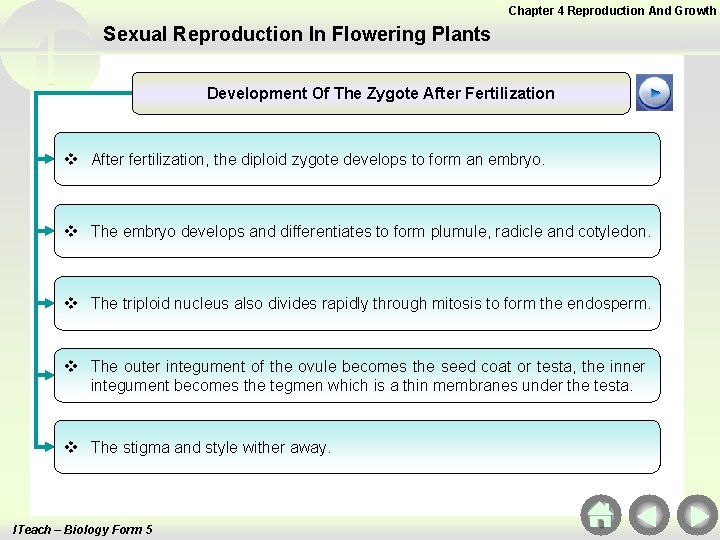
Chapter 4 Reproduction And Growth Sexual Reproduction In Flowering Plants Development Of The Zygote After Fertilization v After fertilization, the diploid zygote develops to form an embryo. v The embryo develops and differentiates to form plumule, radicle and cotyledon. v The triploid nucleus also divides rapidly through mitosis to form the endosperm. v The outer integument of the ovule becomes the seed coat or testa, the inner integument becomes the tegmen which is a thin membranes under the testa. v The stigma and style wither away. ITeach – Biology Form 5
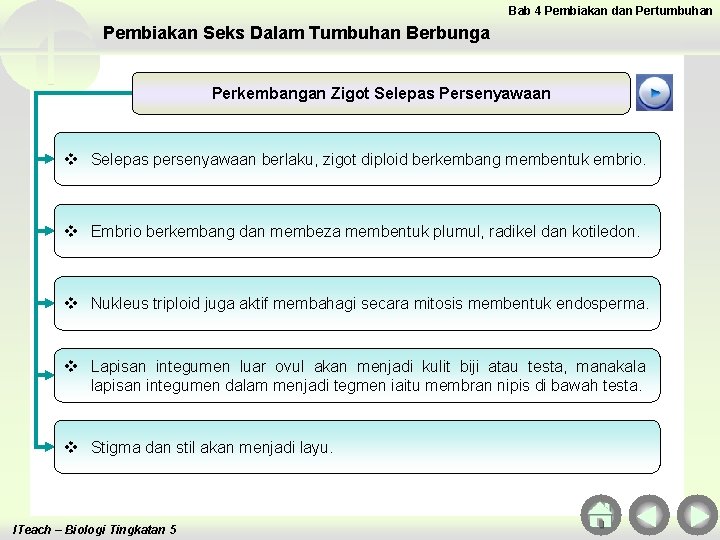
Bab 4 Pembiakan dan Pertumbuhan Pembiakan Seks Dalam Tumbuhan Berbunga Perkembangan Zigot Selepas Persenyawaan v Selepas persenyawaan berlaku, zigot diploid berkembang membentuk embrio. v Embrio berkembang dan membeza membentuk plumul, radikel dan kotiledon. v Nukleus triploid juga aktif membahagi secara mitosis membentuk endosperma. v Lapisan integumen luar ovul akan menjadi kulit biji atau testa, manakala lapisan integumen dalam menjadi tegmen iaitu membran nipis di bawah testa. v Stigma dan stil akan menjadi layu. ITeach – Biologi Tingkatan 5
Chapter 4 Reproduction And Growth 4. 6 Understanding Growth In Multicellular Organisns ITeach – Biology Form 5
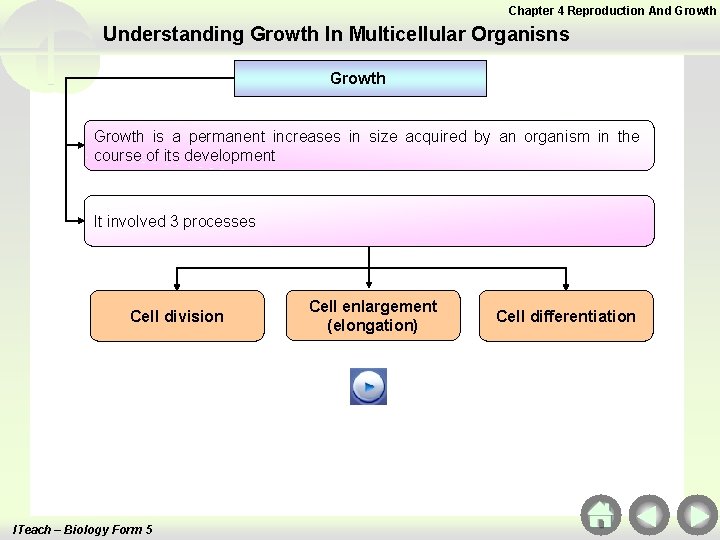
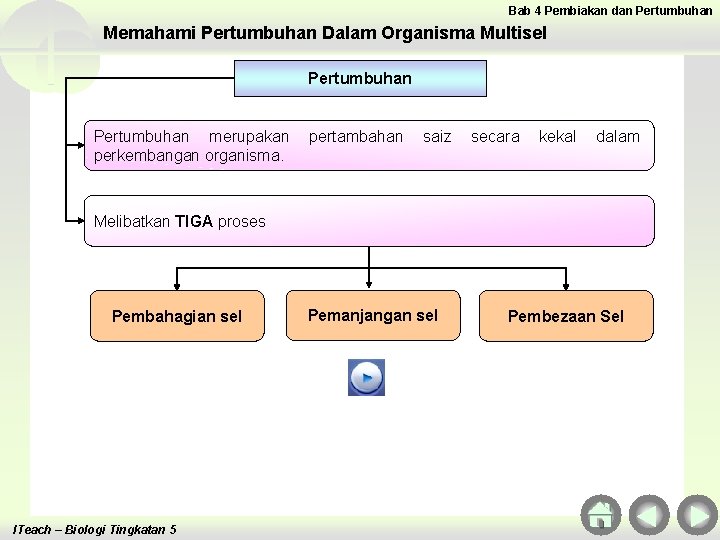
Chapter 4 Reproduction And Growth Understanding Growth In Multicellular Organisns Growth is a permanent increases in size acquired by an organism in the course of its development It involved 3 processes Cell division ITeach – Biology Form 5 Cell enlargement (elongation) Cell differentiation
Bab 4 Pembiakan dan Pertumbuhan Memahami Pertumbuhan Dalam Organisma Multisel Pertumbuhan merupakan perkembangan organisma. pertambahan saiz secara kekal dalam Melibatkan TIGA proses Pembahagian sel ITeach – Biologi Tingkatan 5 Pemanjangan sel Pembezaan Sel
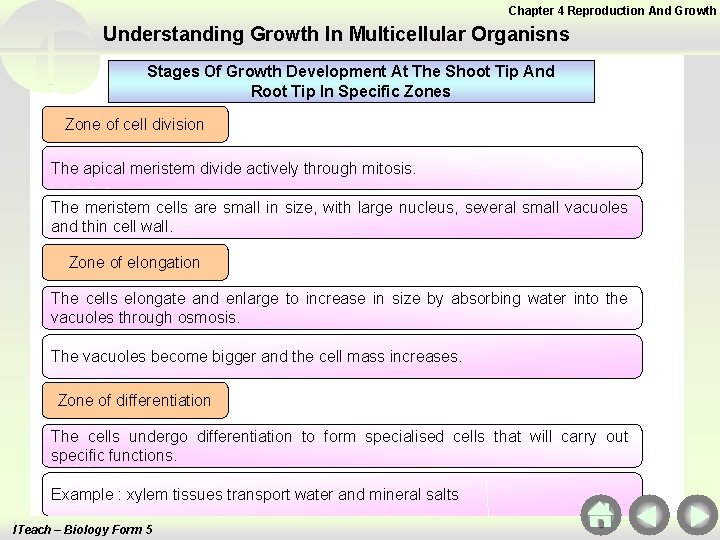
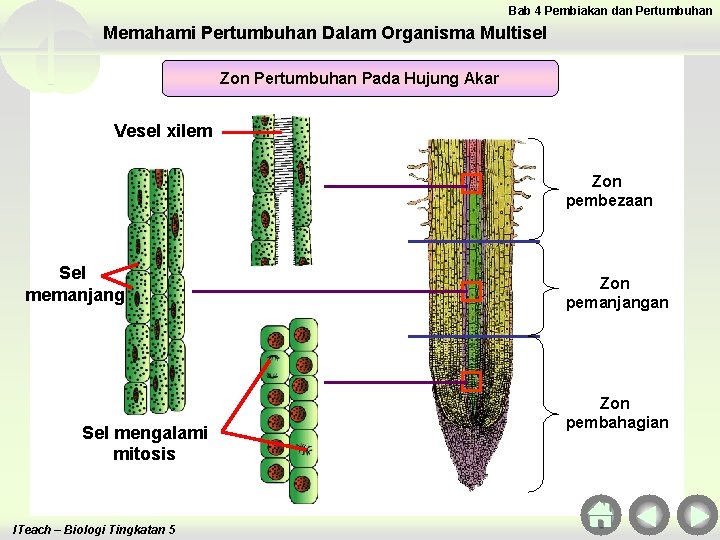
Chapter 4 Reproduction And Growth Understanding Growth In Multicellular Organisns Stages Of Growth Development At The Shoot Tip And Root Tip In Specific Zones Zone of cell division The apical meristem divide actively through mitosis. The meristem cells are small in size, with large nucleus, several small vacuoles and thin cell wall. Zone of elongation The cells elongate and enlarge to increase in size by absorbing water into the vacuoles through osmosis. The vacuoles become bigger and the cell mass increases. Zone of differentiation The cells undergo differentiation to form specialised cells that will carry out specific functions. Example : xylem tissues transport water and mineral salts ITeach – Biology Form 5
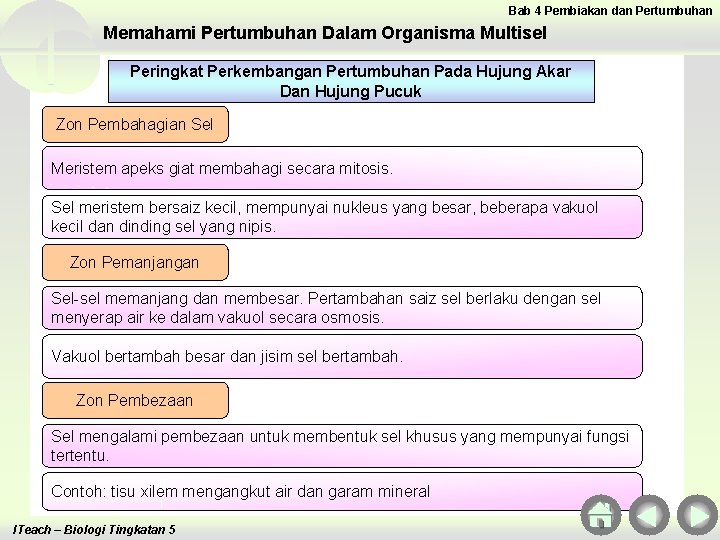
Bab 4 Pembiakan dan Pertumbuhan Memahami Pertumbuhan Dalam Organisma Multisel Peringkat Perkembangan Pertumbuhan Pada Hujung Akar Dan Hujung Pucuk Zon Pembahagian Sel Meristem apeks giat membahagi secara mitosis. Sel meristem bersaiz kecil, mempunyai nukleus yang besar, beberapa vakuol kecil dan dinding sel yang nipis. Zon Pemanjangan Sel-sel memanjang dan membesar. Pertambahan saiz sel berlaku dengan sel menyerap air ke dalam vakuol secara osmosis. Vakuol bertambah besar dan jisim sel bertambah. Zon Pembezaan Sel mengalami pembezaan untuk membentuk sel khusus yang mempunyai fungsi tertentu. Contoh: tisu xilem mengangkut air dan garam mineral ITeach – Biologi Tingkatan 5
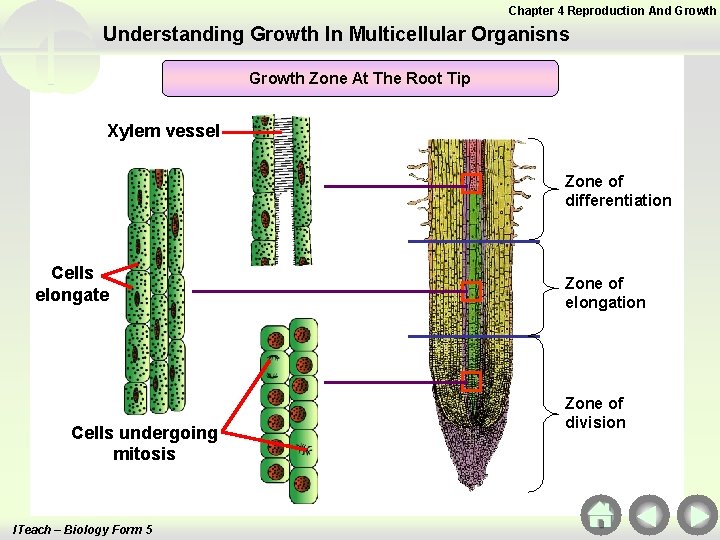
Chapter 4 Reproduction And Growth Understanding Growth In Multicellular Organisns Growth Zone At The Root Tip Xylem vessel Zone of differentiation Cells elongate Cells undergoing mitosis ITeach – Biology Form 5 Zone of elongation Zone of division
Bab 4 Pembiakan dan Pertumbuhan Memahami Pertumbuhan Dalam Organisma Multisel Zon Pertumbuhan Pada Hujung Akar Vesel xilem Zon pembezaan Sel memanjang Sel mengalami mitosis ITeach – Biologi Tingkatan 5 Zon pemanjangan Zon pembahagian
Chapter 4 Reproduction And Growth 4. 7 Understanding The Growth Curve ITeach – Biology Form 5
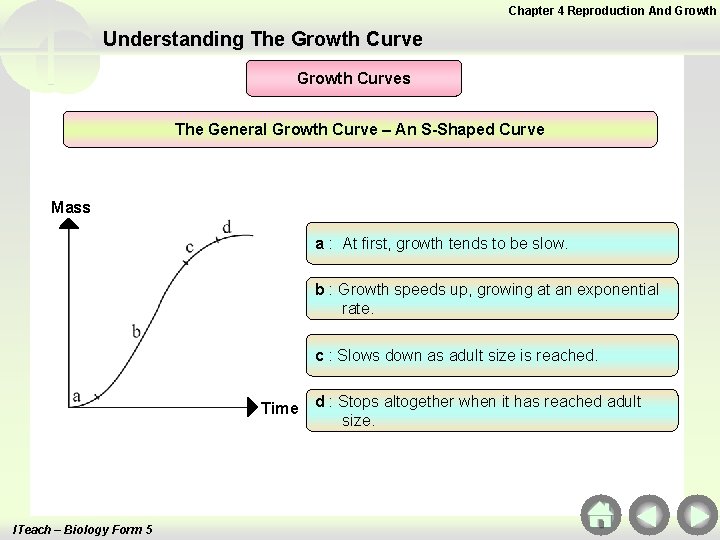
Chapter 4 Reproduction And Growth Understanding The Growth Curves The General Growth Curve – An S-Shaped Curve Mass a : At first, growth tends to be slow. b : Growth speeds up, growing at an exponential rate. c : Slows down as adult size is reached. Time ITeach – Biology Form 5 d : Stops altogether when it has reached adult size.
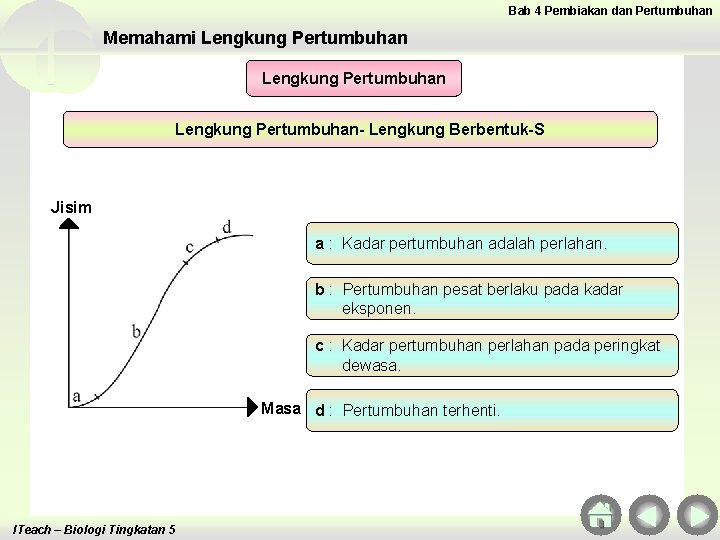
Bab 4 Pembiakan dan Pertumbuhan Memahami Lengkung Pertumbuhan- Lengkung Berbentuk-S Jisim a : Kadar pertumbuhan adalah perlahan. b : Pertumbuhan pesat berlaku pada kadar eksponen. c : Kadar pertumbuhan perlahan pada peringkat dewasa. Masa d : Pertumbuhan terhenti. ITeach – Biologi Tingkatan 5
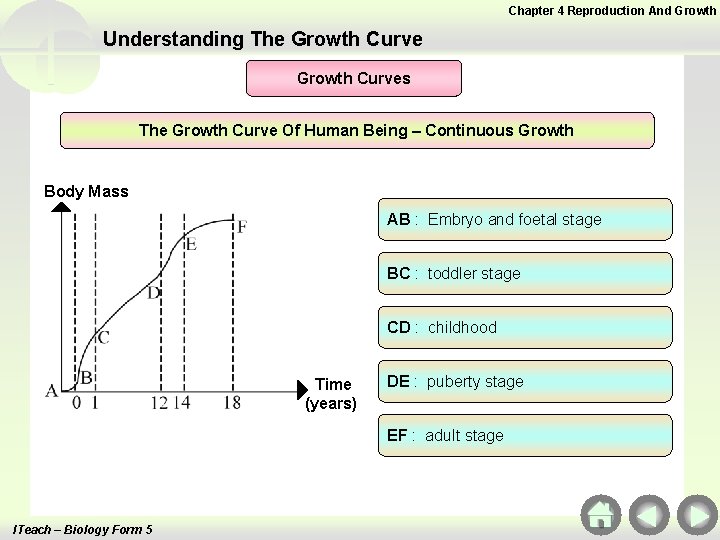
Chapter 4 Reproduction And Growth Understanding The Growth Curves The Growth Curve Of Human Being – Continuous Growth Body Mass AB : Embryo and foetal stage BC : toddler stage CD : childhood Time (years) DE : puberty stage EF : adult stage ITeach – Biology Form 5
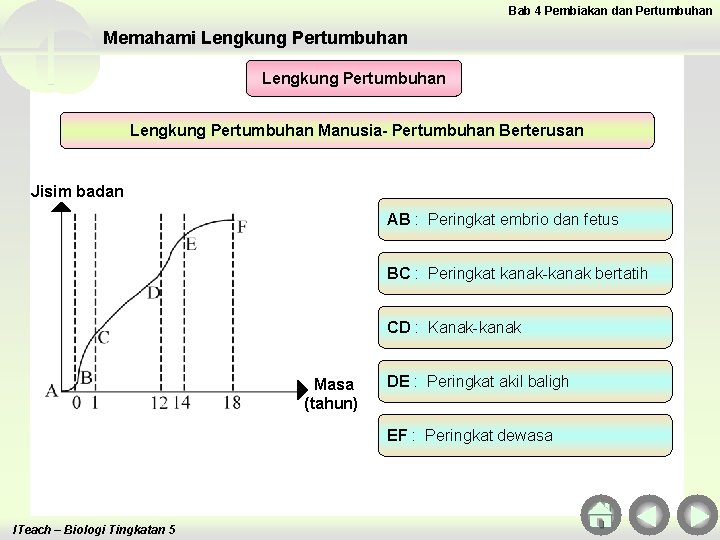
Bab 4 Pembiakan dan Pertumbuhan Memahami Lengkung Pertumbuhan Manusia- Pertumbuhan Berterusan Jisim badan AB : Peringkat embrio dan fetus BC : Peringkat kanak-kanak bertatih CD : Kanak-kanak Masa (tahun) DE : Peringkat akil baligh EF : Peringkat dewasa ITeach – Biologi Tingkatan 5
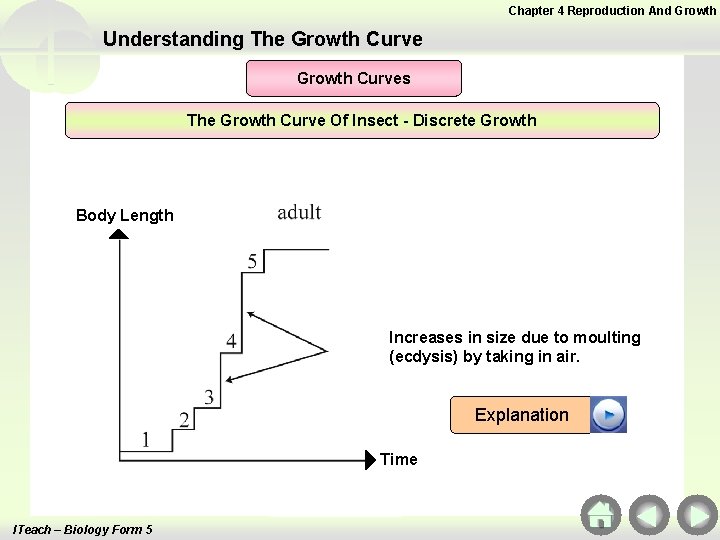
Chapter 4 Reproduction And Growth Understanding The Growth Curves The Growth Curve Of Insect - Discrete Growth Body Length Increases in size due to moulting (ecdysis) by taking in air. Explanation Time ITeach – Biology Form 5
Bab 4 Pembiakan dan Pertumbuhan Memahami Lengkung Pertumbuhan Serangga- Pertumbuhan Diskrit Panjang badan Saiz bertambah disebabkan oleh proses penyalinan rangka luar (ekdisis) secara menyedut udara dengan banyak. Penjelasan Masa ITeach – Biologi Tingkatan 5
Chapter 4 Reproduction And Growth 4. 8 Primary And Secondary Growth In Plants ITeach – Biology Form 5
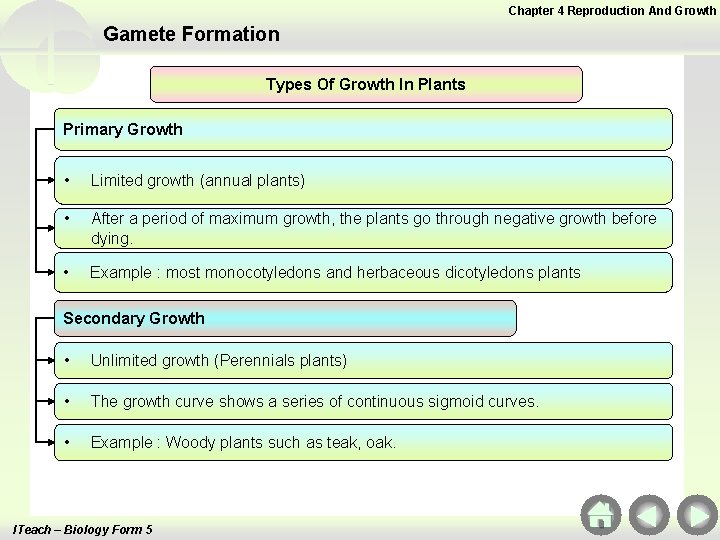
Chapter 4 Reproduction And Growth Gamete Formation Types Of Growth In Plants Primary Growth • Limited growth (annual plants) • After a period of maximum growth, the plants go through negative growth before dying. • Example : most monocotyledons and herbaceous dicotyledons plants Secondary Growth • Unlimited growth (Perennials plants) • The growth curve shows a series of continuous sigmoid curves. • Example : Woody plants such as teak, oak. ITeach – Biology Form 5
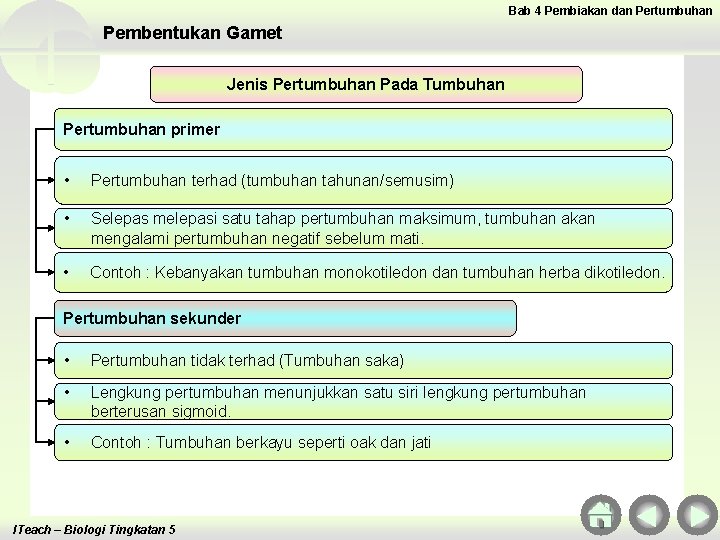
Bab 4 Pembiakan dan Pertumbuhan Pembentukan Gamet Jenis Pertumbuhan Pada Tumbuhan Pertumbuhan primer • Pertumbuhan terhad (tumbuhan tahunan/semusim) • Selepas melepasi satu tahap pertumbuhan maksimum, tumbuhan akan mengalami pertumbuhan negatif sebelum mati. • Contoh : Kebanyakan tumbuhan monokotiledon dan tumbuhan herba dikotiledon. Pertumbuhan sekunder • Pertumbuhan tidak terhad (Tumbuhan saka) • Lengkung pertumbuhan menunjukkan satu siri lengkung pertumbuhan berterusan sigmoid. • Contoh : Tumbuhan berkayu seperti oak dan jati ITeach – Biologi Tingkatan 5
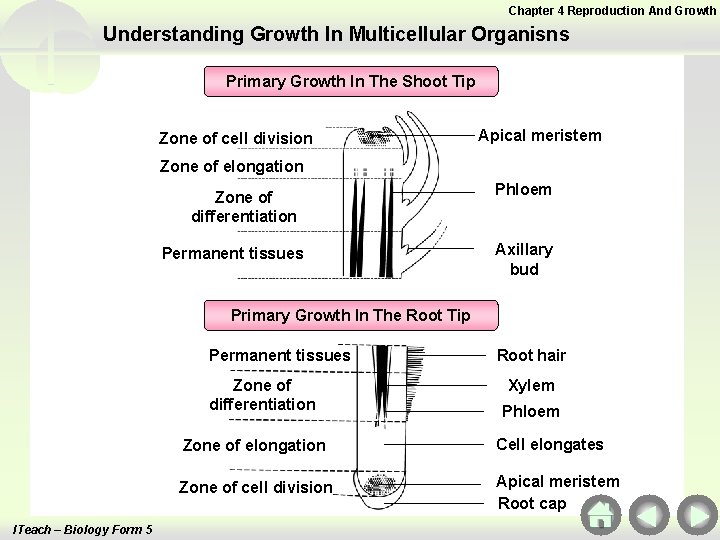
Chapter 4 Reproduction And Growth Understanding Growth In Multicellular Organisns Primary Growth In The Shoot Tip Zone of cell division Apical meristem Zone of elongation Zone of differentiation Permanent tissues Phloem Axillary bud Primary Growth In The Root Tip Permanent tissues Zone of differentiation ITeach – Biology Form 5 Root hair Xylem Phloem Zone of elongation Cell elongates Zone of cell division Apical meristem Root cap
Bab 4 Pembiakan dan Pertumbuhan Memahami Pertumbuhan Dalam Organisma Multisel Pertumbuhan Primer Pada Hujung Pucuk Zon pembahagian sel Meristem apeks Zon pemanjangan Floem Zon pembezaan Tisu kekal Tunas aksil Pertumbuhan Primer Pada Hujung Akar Tisu kekal Zon pembezaan Zon pemanjangan Zon pembahagian sel ITeach – Biologi Tingkatan 5 Rambut akar Xilem Floem Sel memanjang Meristem apeks Jidal akar
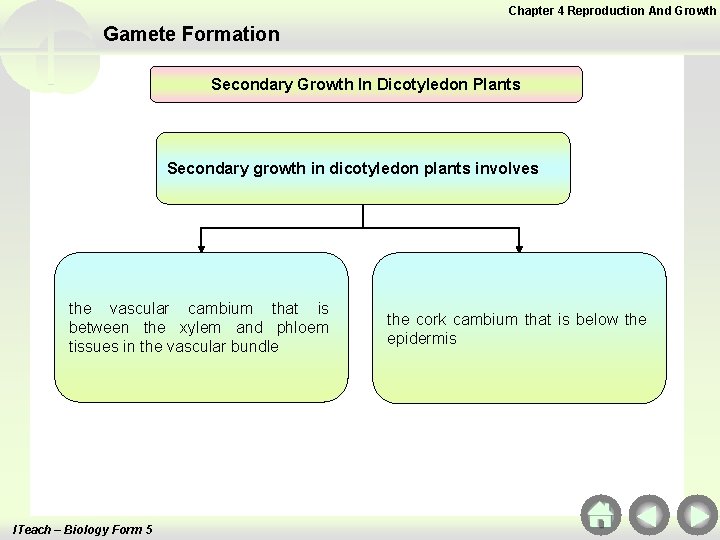
Chapter 4 Reproduction And Growth Gamete Formation Secondary Growth In Dicotyledon Plants Secondary growth in dicotyledon plants involves the vascular cambium that is between the xylem and phloem tissues in the vascular bundle ITeach – Biology Form 5 the cork cambium that is below the epidermis
Bab 4 Pembiakan dan Pertumbuhan Pembentukan Gamet Pertumbuhan Sekunder Pada Tumbuhan Dikotiledon Pertumbuhan sekunder pada tumbuhan dikotiledon melibatkan Kambium vaskular yang terletak diantara tisu xilem dan floem pada berkas vaskular. ITeach – Biologi Tingkatan 5 Kambium gabus yang terletak di bawah epidermis.
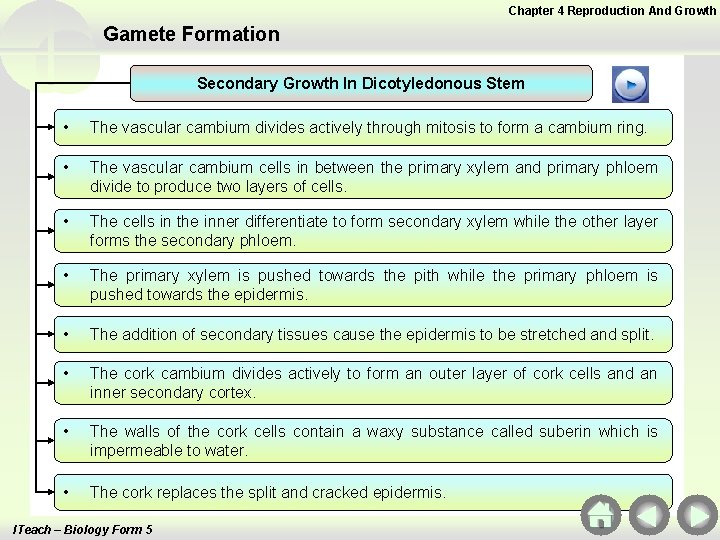
Chapter 4 Reproduction And Growth Gamete Formation Secondary Growth In Dicotyledonous Stem • The vascular cambium divides actively through mitosis to form a cambium ring. • The vascular cambium cells in between the primary xylem and primary phloem divide to produce two layers of cells. • The cells in the inner differentiate to form secondary xylem while the other layer forms the secondary phloem. • The primary xylem is pushed towards the pith while the primary phloem is pushed towards the epidermis. • The addition of secondary tissues cause the epidermis to be stretched and split. • The cork cambium divides actively to form an outer layer of cork cells and an inner secondary cortex. • The walls of the cork cells contain a waxy substance called suberin which is impermeable to water. • The cork replaces the split and cracked epidermis. ITeach – Biology Form 5
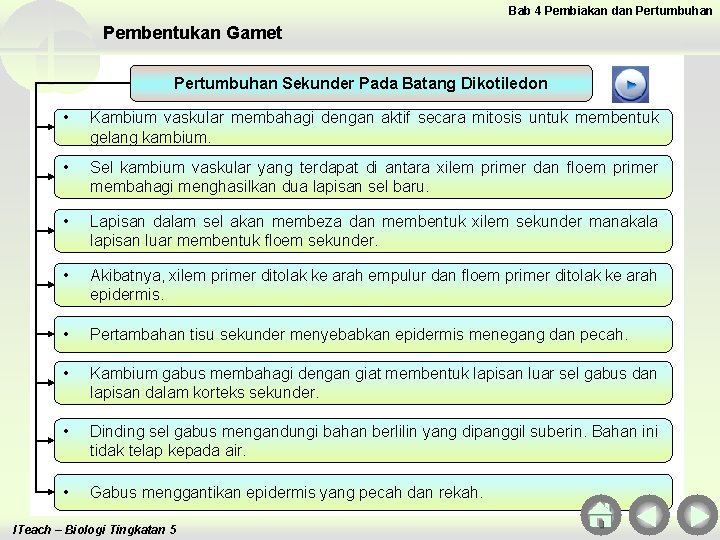
Bab 4 Pembiakan dan Pertumbuhan Pembentukan Gamet Pertumbuhan Sekunder Pada Batang Dikotiledon • Kambium vaskular membahagi dengan aktif secara mitosis untuk membentuk gelang kambium. • Sel kambium vaskular yang terdapat di antara xilem primer dan floem primer membahagi menghasilkan dua lapisan sel baru. • Lapisan dalam sel akan membeza dan membentuk xilem sekunder manakala lapisan luar membentuk floem sekunder. • Akibatnya, xilem primer ditolak ke arah empulur dan floem primer ditolak ke arah epidermis. • Pertambahan tisu sekunder menyebabkan epidermis menegang dan pecah. • Kambium gabus membahagi dengan giat membentuk lapisan luar sel gabus dan lapisan dalam korteks sekunder. • Dinding sel gabus mengandungi bahan berlilin yang dipanggil suberin. Bahan ini tidak telap kepada air. • Gabus menggantikan epidermis yang pecah dan rekah. ITeach – Biologi Tingkatan 5
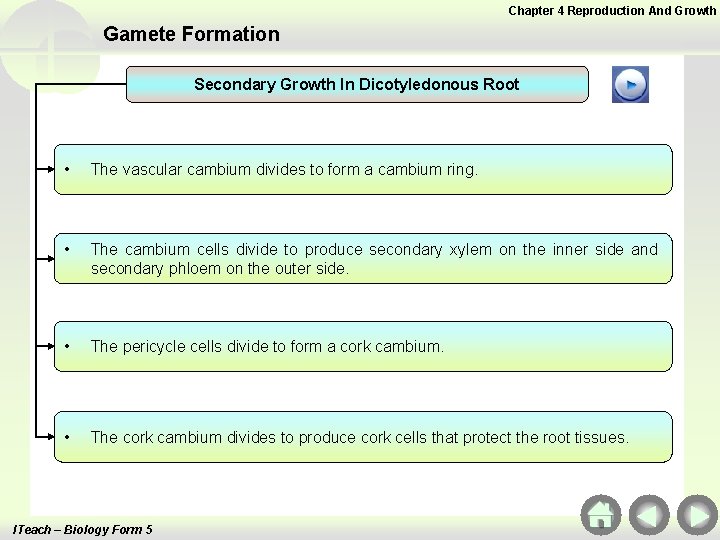
Chapter 4 Reproduction And Growth Gamete Formation Secondary Growth In Dicotyledonous Root • The vascular cambium divides to form a cambium ring. • The cambium cells divide to produce secondary xylem on the inner side and secondary phloem on the outer side. • The pericycle cells divide to form a cork cambium. • The cork cambium divides to produce cork cells that protect the root tissues. ITeach – Biology Form 5
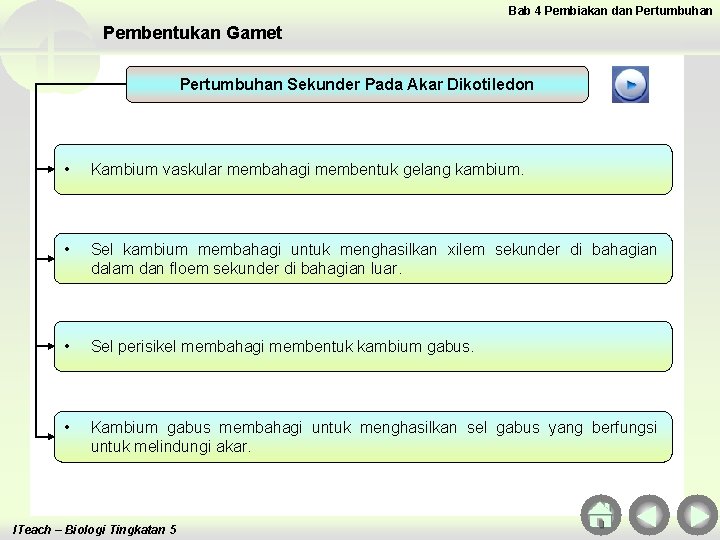
Bab 4 Pembiakan dan Pertumbuhan Pembentukan Gamet Pertumbuhan Sekunder Pada Akar Dikotiledon • Kambium vaskular membahagi membentuk gelang kambium. • Sel kambium membahagi untuk menghasilkan xilem sekunder di bahagian dalam dan floem sekunder di bahagian luar. • Sel perisikel membahagi membentuk kambium gabus. • Kambium gabus membahagi untuk menghasilkan sel gabus yang berfungsi untuk melindungi akar. ITeach – Biologi Tingkatan 5
The End i - Teach