
Chapter 4 ReductionOxidation Reactions Redox Reactions Sodium chloride
- Slides: 25
Chapter 4 Reduction-Oxidation Reactions Redox Reactions
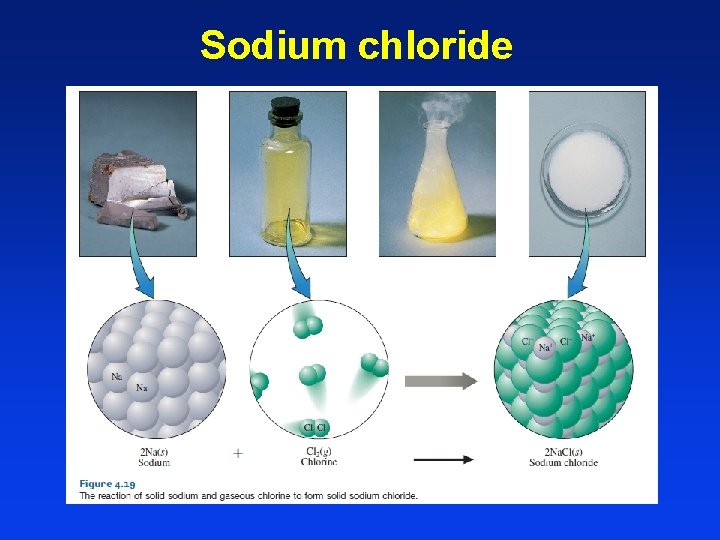
Sodium chloride
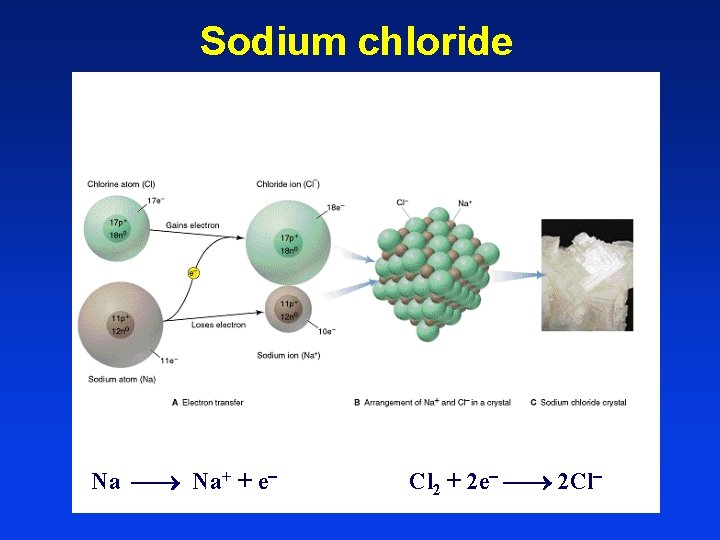
Sodium chloride Na Na+ + e Cl 2 + 2 e 2 Cl
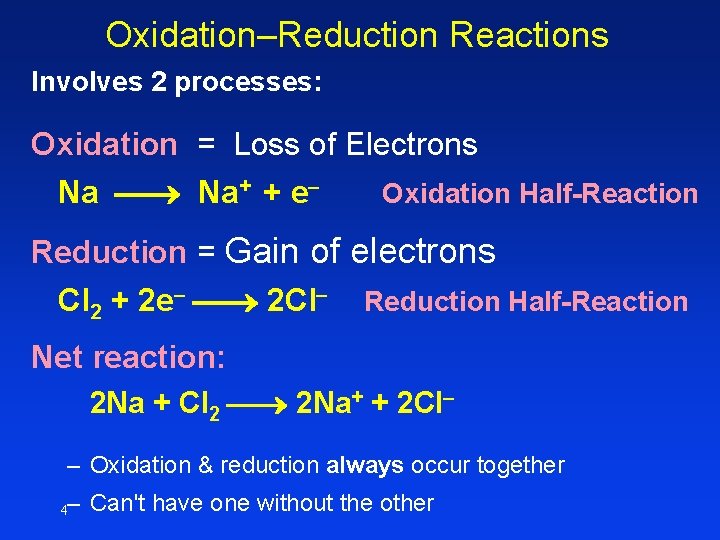
Oxidation–Reduction Reactions Involves 2 processes: Oxidation = Loss of Electrons Na Na+ + e Oxidation Half-Reaction Reduction = Gain of electrons Cl 2 + 2 e 2 Cl Reduction Half-Reaction Net reaction: 2 Na + Cl 2 2 Na+ + 2 Cl – Oxidation & reduction always occur together – Can't have one without the other 4
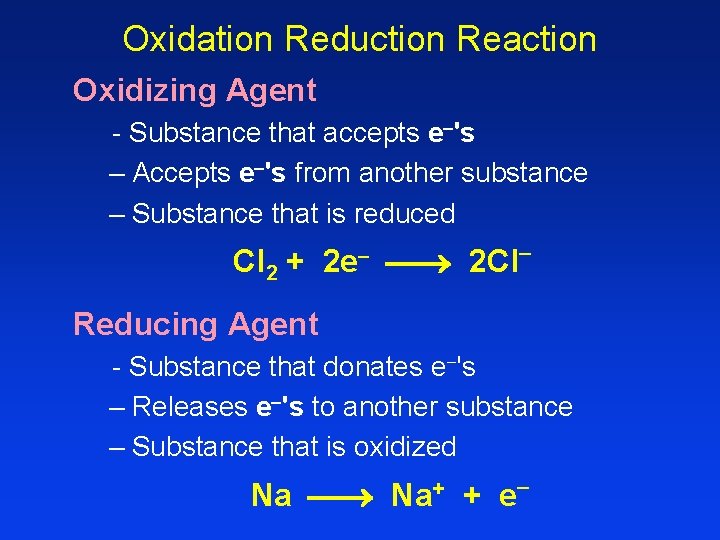
Oxidation Reduction Reaction Oxidizing Agent - Substance that accepts e 's – Accepts e 's from another substance – Substance that is reduced Cl 2 + 2 e 2 Cl – Reducing Agent - Substance that donates e 's – Releases e 's to another substance – Substance that is oxidized Na Na+ + e–
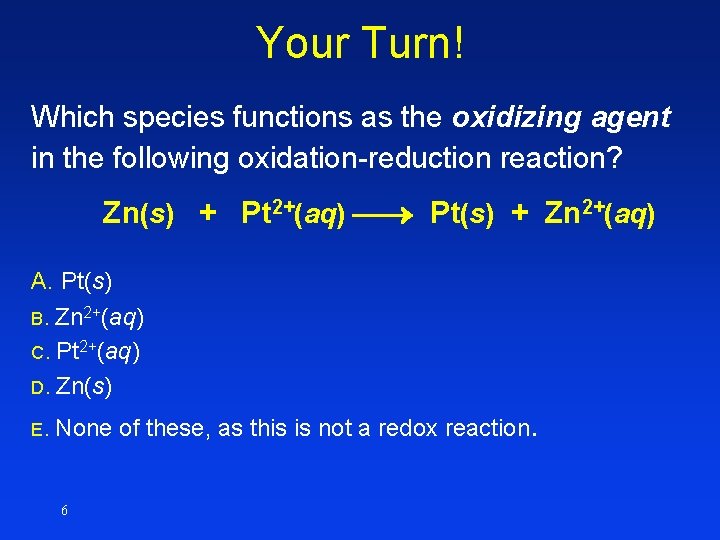
Your Turn! Which species functions as the oxidizing agent in the following oxidation-reduction reaction? Zn(s) + Pt 2+(aq) Pt(s) + Zn 2+(aq) A. Pt(s) Zn 2+(aq) C. Pt 2+(aq) D. Zn(s) B. E. None of these, as this is not a redox reaction. 6
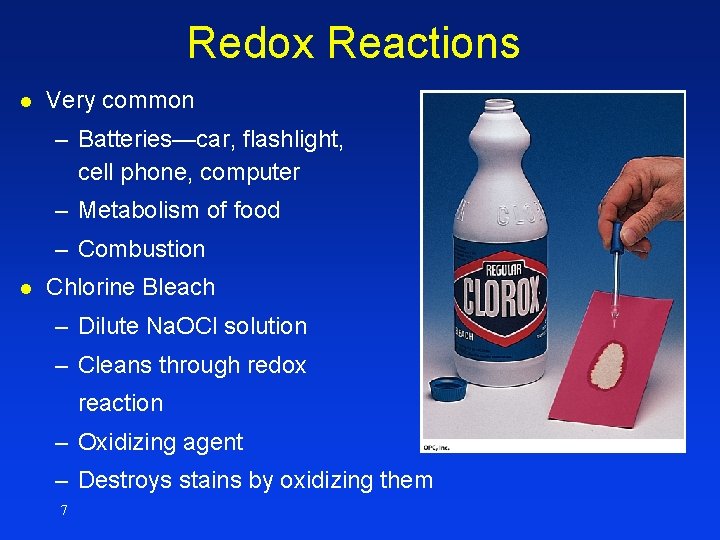
Redox Reactions l Very common – Batteries—car, flashlight, cell phone, computer – Metabolism of food – Combustion l Chlorine Bleach – Dilute Na. OCl solution – Cleans through redox reaction – Oxidizing agent – Destroys stains by oxidizing them 7
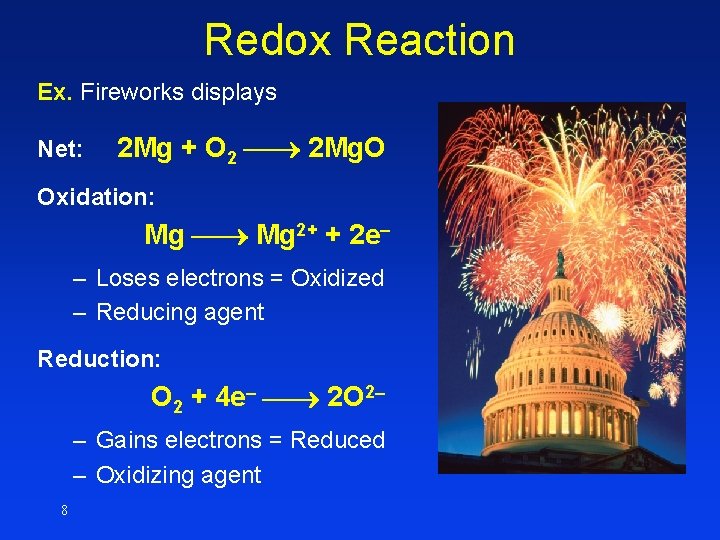
Redox Reaction Ex. Fireworks displays Net: 2 Mg + O 2 2 Mg. O Oxidation: Mg 2+ + 2 e – Loses electrons = Oxidized – Reducing agent Reduction: O 2 + 4 e 2 O 2 – Gains electrons = Reduced – Oxidizing agent 8
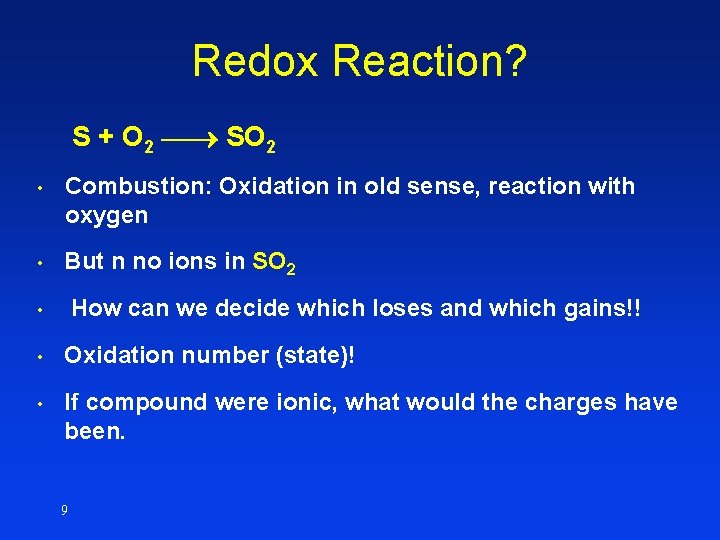
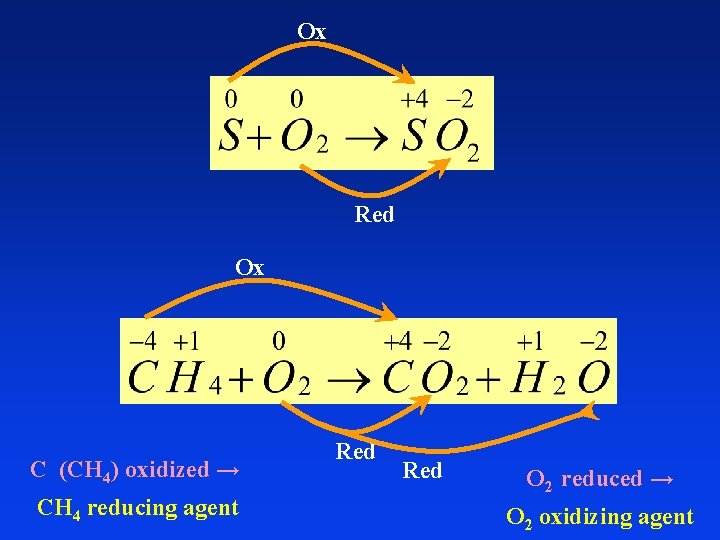
Redox Reaction? S + O 2 SO 2 • Combustion: Oxidation in old sense, reaction with oxygen • But n no ions in SO 2 How can we decide which loses and which gains!! • • Oxidation number (state)! • If compound were ionic, what would the charges have been. 9
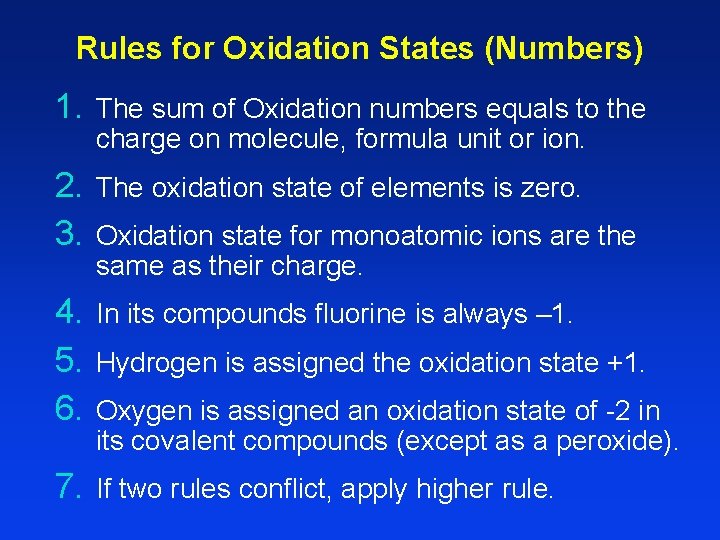
Rules for Oxidation States (Numbers) 1. The sum of Oxidation numbers equals to the charge on molecule, formula unit or ion. 2. The oxidation state of elements is zero. 3. Oxidation state for monoatomic ions are the same as their charge. 4. In its compounds fluorine is always – 1. 5. Hydrogen is assigned the oxidation state +1. 6. Oxygen is assigned an oxidation state of -2 in its covalent compounds (except as a peroxide). 7. If two rules conflict, apply higher rule.
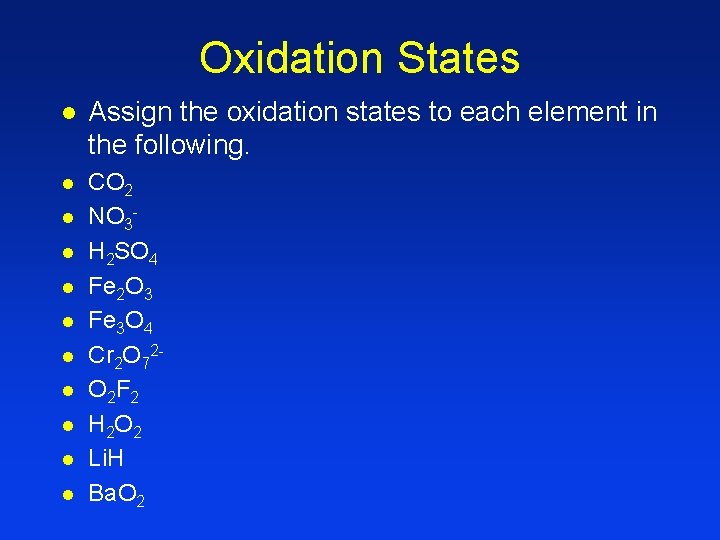
Oxidation States l Assign the oxidation states to each element in the following. l CO 2 NO 3 H 2 SO 4 Fe 2 O 3 Fe 3 O 4 Cr 2 O 72 O 2 F 2 H 2 O 2 Li. H Ba. O 2 l l l l l
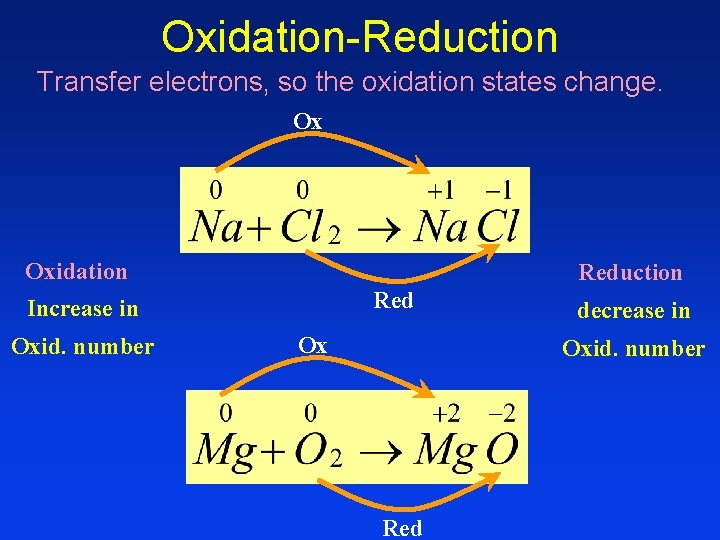
Oxidation-Reduction Transfer electrons, so the oxidation states change. Ox Oxidation Reduction Red Increase in Oxid. number Ox decrease in Oxid. number Red
Ox Red Ox C (CH 4) oxidized → CH 4 reducing agent Red O 2 reduced → O 2 oxidizing agent
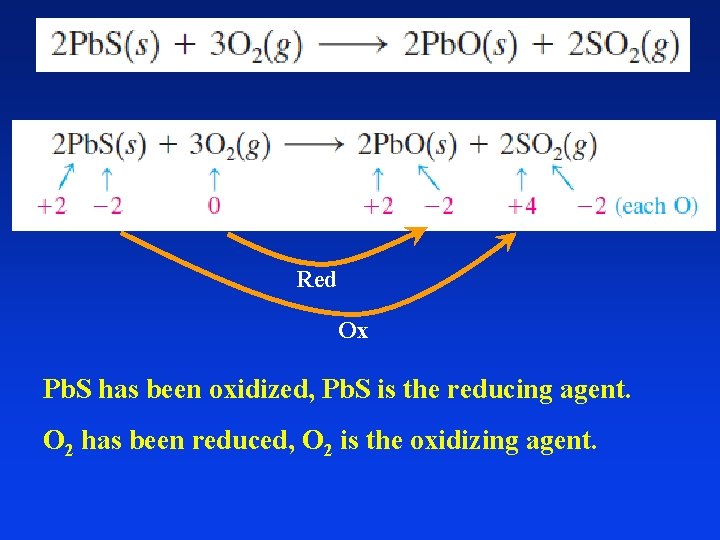
Red Ox Pb. S has been oxidized, Pb. S is the reducing agent. O 2 has been reduced, O 2 is the oxidizing agent.
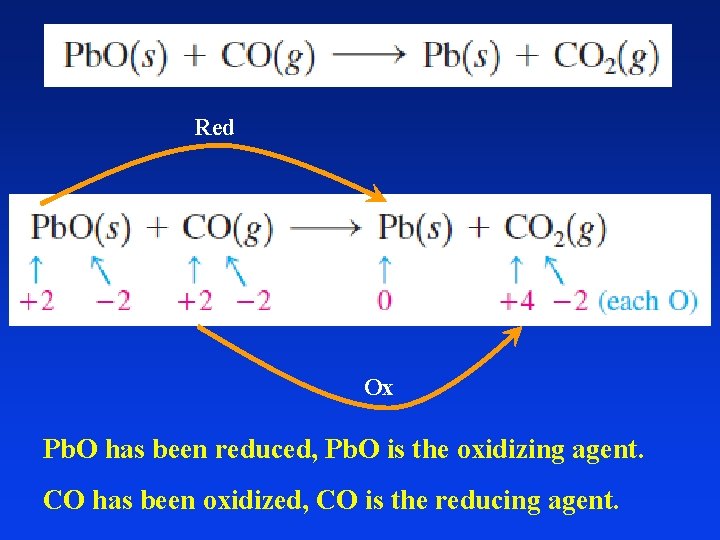
Red Ox Pb. O has been reduced, Pb. O is the oxidizing agent. CO has been oxidized, CO is the reducing agent.
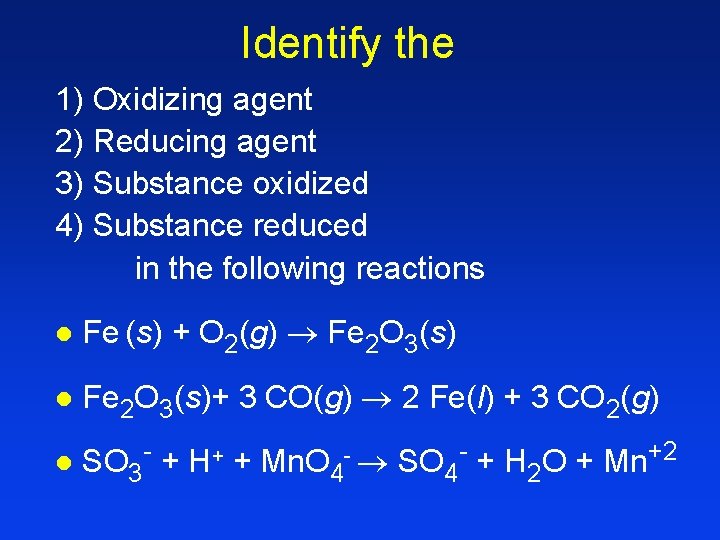
Identify the 1) Oxidizing agent 2) Reducing agent 3) Substance oxidized 4) Substance reduced in the following reactions l Fe (s) + O 2(g) ® Fe 2 O 3(s) l Fe 2 O 3(s)+ 3 CO(g) ® 2 Fe(l) + 3 CO 2(g) l SO 3 - + H+ + Mn. O 4 - ® SO 4 - + H 2 O + Mn+2
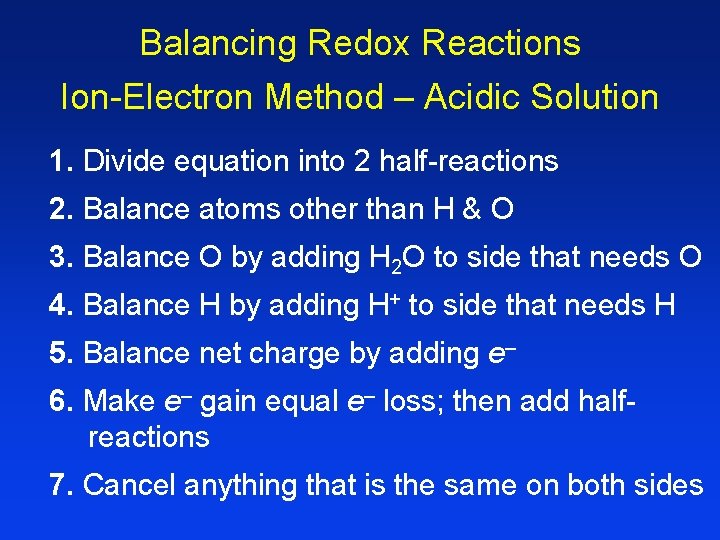
Balancing Redox Reactions Ion-Electron Method – Acidic Solution 1. Divide equation into 2 half-reactions 2. Balance atoms other than H & O 3. Balance O by adding H 2 O to side that needs O 4. Balance H by adding H+ to side that needs H 5. Balance net charge by adding e– 6. Make e– gain equal e– loss; then add halfreactions 7. Cancel anything that is the same on both sides
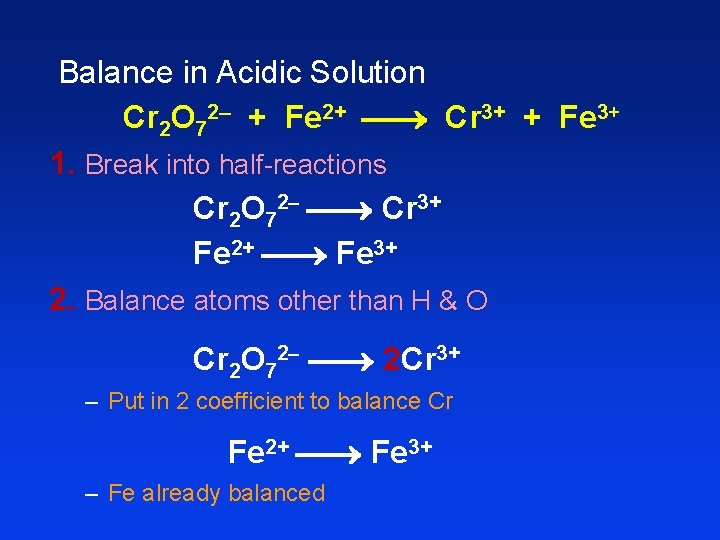
Balance in Acidic Solution Cr 2 O 72– + Fe 2+ Cr 3+ + Fe 3+ 1. Break into half-reactions Cr 2 O 72 Cr 3+ Fe 2+ Fe 3+ 2. Balance atoms other than H & O Cr 2 O 72 2 Cr 3+ – Put in 2 coefficient to balance Cr Fe 2+ Fe 3+ – Fe already balanced
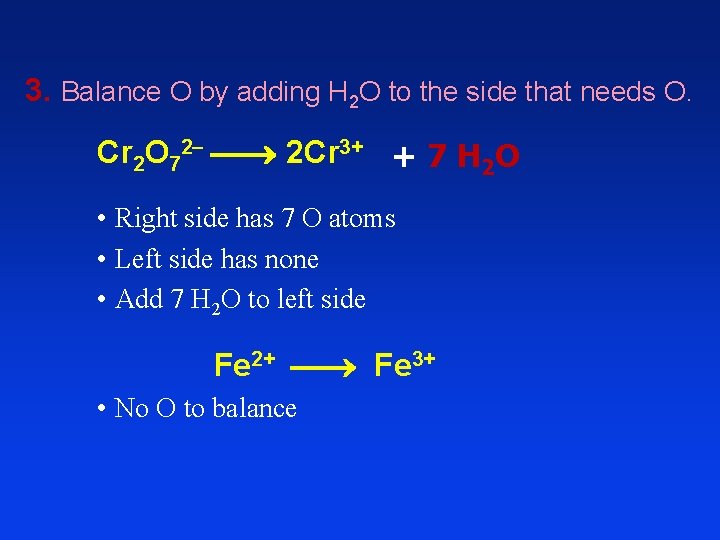
3. Balance O by adding H 2 O to the side that needs O. Cr 2 O 72 2 Cr 3+ + 7 H 2 O • Right side has 7 O atoms • Left side has none • Add 7 H 2 O to left side Fe 2+ Fe 3+ • No O to balance
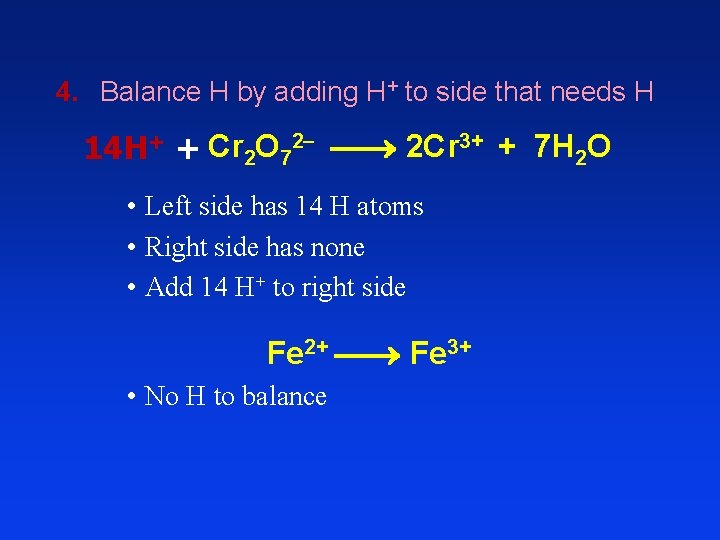
4. Balance H by adding H+ to side that needs H 14 H+ + Cr 2 O 72 2 Cr 3+ + 7 H 2 O • Left side has 14 H atoms • Right side has none • Add 14 H+ to right side Fe 2+ Fe 3+ • No H to balance
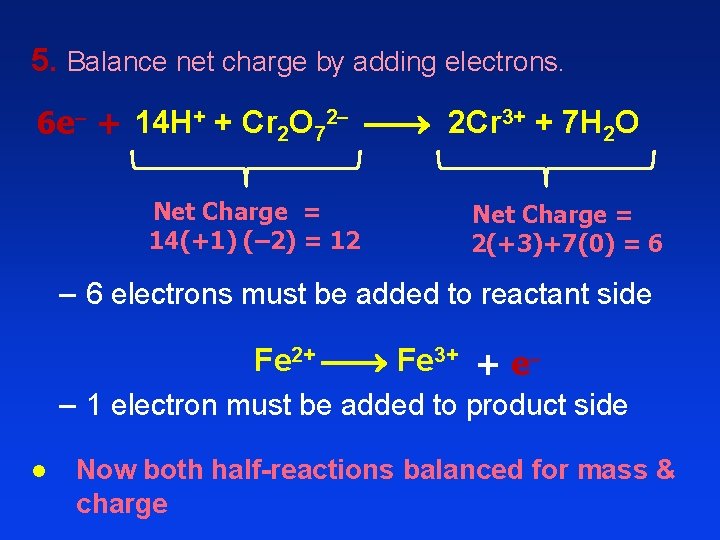
5. Balance net charge by adding electrons. 6 e + 14 H+ + Cr 2 O 72 2 Cr 3+ + 7 H 2 O Net Charge = 14(+1) (– 2) = 12 Net Charge = 2(+3)+7(0) = 6 – 6 electrons must be added to reactant side Fe 2+ Fe 3+ + e – 1 electron must be added to product side l Now both half-reactions balanced for mass & charge
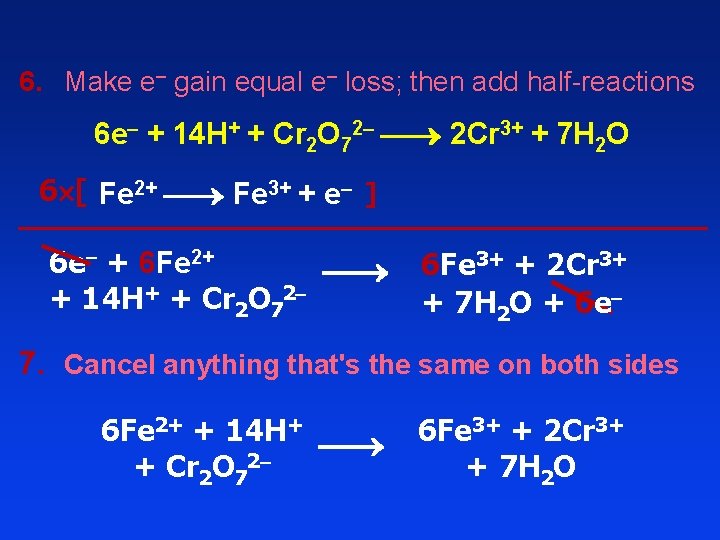
6. Make e– gain equal e– loss; then add half-reactions 6 e + 14 H+ + Cr 2 O 72– 2 Cr 3+ + 7 H 2 O 6 [ Fe 2+ Fe 3+ + e ] 6 e + 6 Fe 2+ + 14 H+ + Cr 2 O 72 6 Fe 3+ + 2 Cr 3+ + 7 H 2 O + 6 e 7. Cancel anything that's the same on both sides 6 Fe 2+ + 14 H+ + Cr 2 O 72 6 Fe 3+ + 2 Cr 3+ + 7 H 2 O
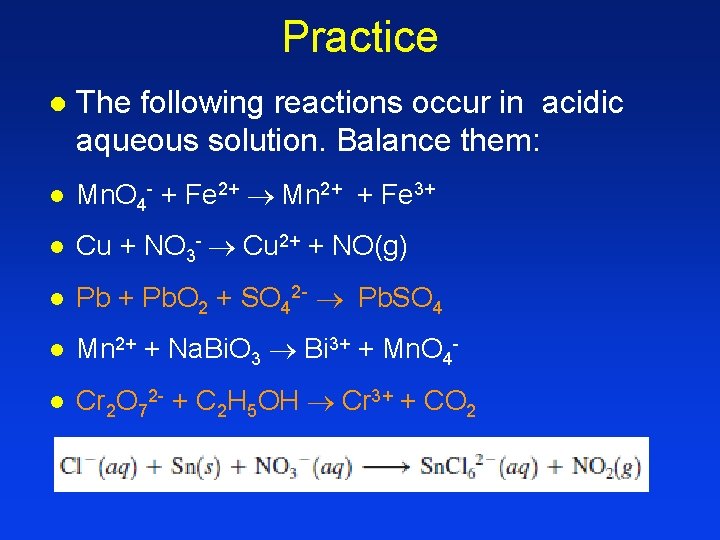
Practice l The following reactions occur in acidic aqueous solution. Balance them: l Mn. O 4 - + Fe 2+ ® Mn 2+ + Fe 3+ l Cu + NO 3 - ® Cu 2+ + NO(g) l Pb + Pb. O 2 + SO 42 - ® Pb. SO 4 l Mn 2+ + Na. Bi. O 3 ® Bi 3+ + Mn. O 4 - l Cr 2 O 72 - + C 2 H 5 OH ® Cr 3+ + CO 2
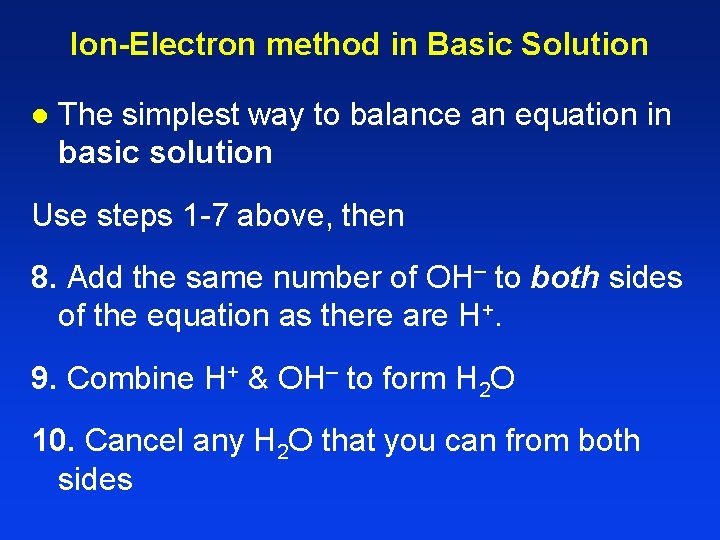
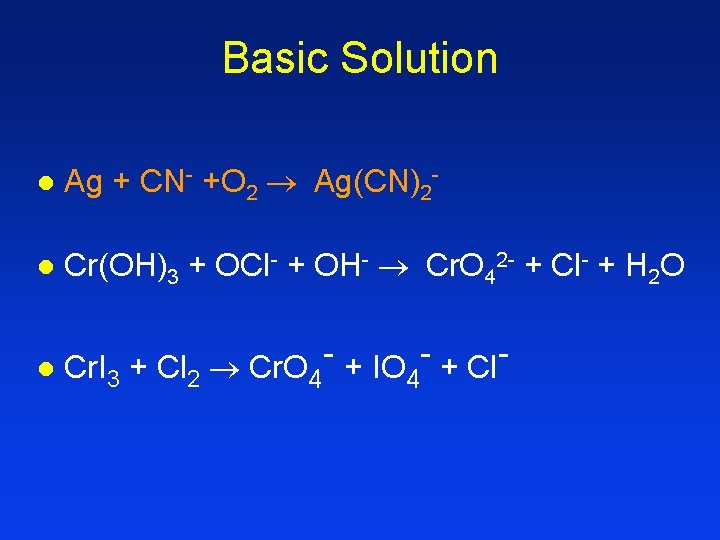
Ion-Electron method in Basic Solution l The simplest way to balance an equation in basic solution Use steps 1 -7 above, then 8. Add the same number of OH– to both sides of the equation as there are H+. 9. Combine H+ & OH– to form H 2 O 10. Cancel any H 2 O that you can from both sides
Basic Solution l Ag + CN- +O 2 ® Ag(CN)2 - l Cr(OH)3 + OCl- + OH- ® Cr. O 42 - + Cl- + H 2 O l Cr. I 3 + Cl 2 ® Cr. O 4 + IO 4 + Cl