
Chapter 4 Recruitment and Selection 1 International Sales

- Slides: 55
Chapter 4 Recruitment and Selection 1 International Sales Management Dr. Senem SÖNMEZ SELÇUK
THE IMPORTANCE OF SELECTION �In attempting to recruit and select a new sales representative, sales managers find themselves in an unaccustomed role. �Instead of being a seller they for once take on the role of buyer. �It is crucial that this transition is carried out effectively because the future success of the salesforce depends upon the infusion of highcalibre personnel. 2 International Sales Management
�There a number of facts that emphasise the importance of effective salesforce selection: selection 1. There is wide variability in the effectiveness of salespeople. 3 In the Institute of Marketing commissioned study into salesforce practice, the following question was asked of sales managers: ‘If you were to put your most successful salesperson into the territory of one of your average salespeople, and made no other changes, what increases in sales would you expect after, say, two years? ’ The most commonly expected increase was 16– 20 per cent and one-fifth of all sales managers said they would expect an increase of 30 per cent or more. It must be emphasised that the comparison was between the top and average salesperson, salesperson not International Sales Management top and worst salesperson Clearly, the quality of the sales representatives which sales managers
2. Salespeople are very costly. 4 If a company decides to employ extra sales personnel, the cost will be much higher than just basic salary (and commission). Most companies provide a car if travel is required and travel expenses will also be paid. The special skills necessary to make a sale, rather than to receive an order, imply that training will be required. No company will want to incur all of these costs in order to International Sales Management employ a poor performer.
3. Other important determinants of success, such as training and motivation, are heavily dependent on the intrinsic qualities of the recruit. 5 Although sales effectiveness can be improved by training, it is limited by innate ability. Like other activities where skill is required, such as cricket, football and athletics, ultimate achievement in selling is highly associated with personal characteristics. Similarly, motivational techniques may stimulate salespeople to achieve higher sales but they can do only so much. A lot will be dependent on the inborn motivation of the International Sales Management salesperson to complete a difficult sale or visit
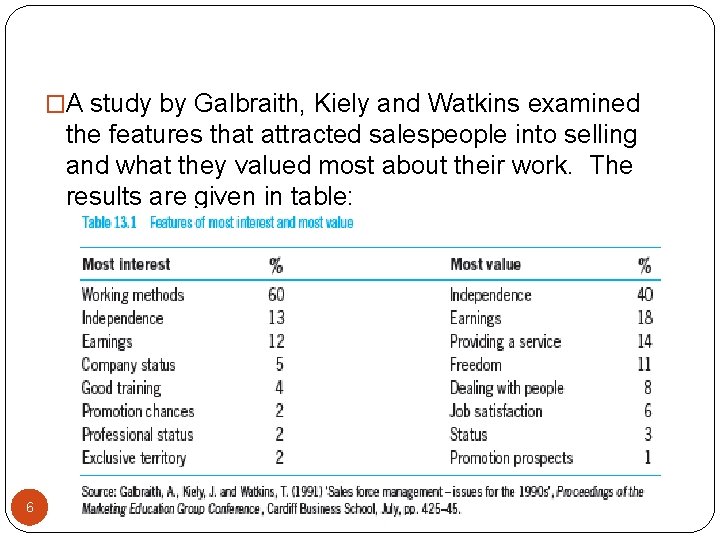
�A study by Galbraith, Kiely and Watkins examined the features that attracted salespeople into selling and what they valued most about their work. The results are given in table: 6
�Table shows that working methods and 7 independence are more important than earnings as the attraction for entering selling. �This challenges the assumption made by many companies that money is the main reason for embarking on a sales career. �Independence is also highly valued when doing the selling job. �The implication of these findings is that sales management should understand the reasons why people are attracted to selling in their industry to International Sales Management develop effective recruitment strategies. They
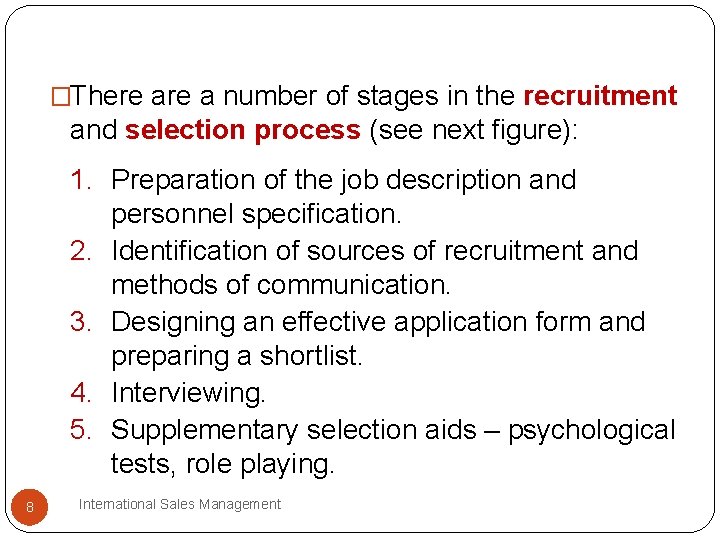
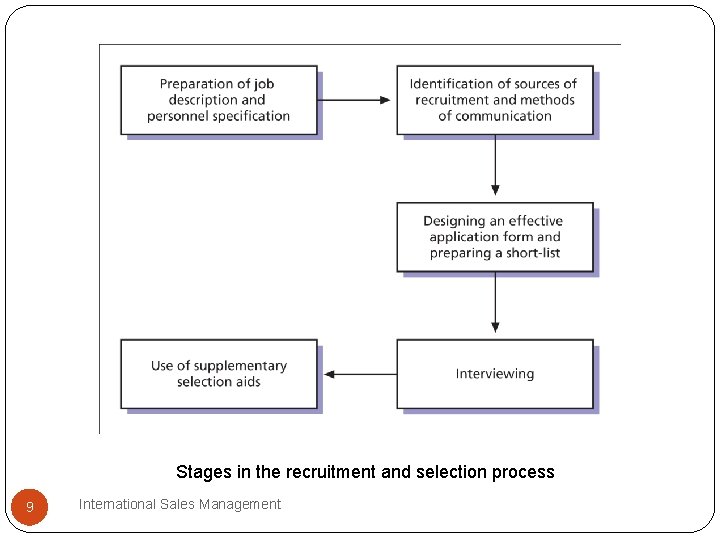
�There a number of stages in the recruitment and selection process (see next figure): 1. Preparation of the job description and personnel specification. 2. Identification of sources of recruitment and methods of communication. 3. Designing an effective application form and preparing a shortlist. 4. Interviewing. 5. Supplementary selection aids – psychological tests, role playing. 8 International Sales Management
Stages in the recruitment and selection process 9 International Sales Management
1. PREPARATION OF THE JOB DESCRIPTION AND SPECIFICATION �The production of an accurate job 10 description should prove of little difficulty for the sales manager. �They have intimate knowledge of what is required, having been a salesperson and out on the road with salespeople during training and evaluation exercises. International Sales Management
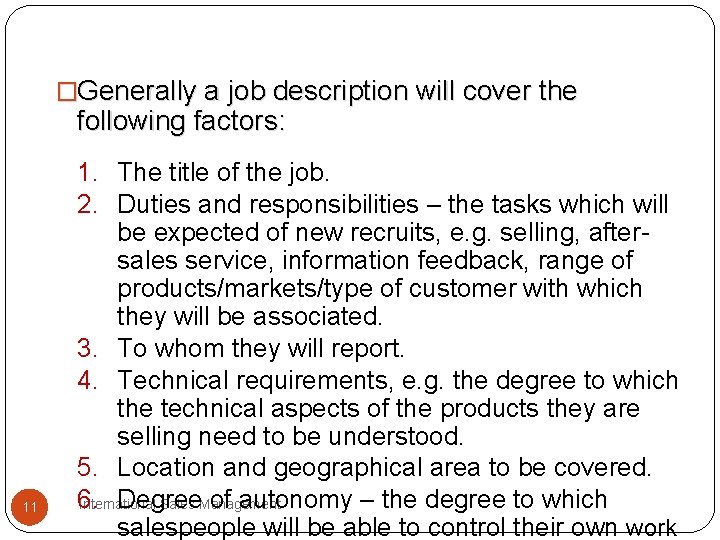
�Generally a job description will cover the following factors: 11 1. The title of the job. 2. Duties and responsibilities – the tasks which will be expected of new recruits, e. g. selling, aftersales service, information feedback, range of products/markets/type of customer with which they will be associated. 3. To whom they will report. 4. Technical requirements, e. g. the degree to which the technical aspects of the products they are selling need to be understood. 5. Location and geographical area to be covered. 6. Degree of autonomy – the degree to which International Sales Management salespeople will be able to control their own work
�Once generated, the job description will act as 12 the blueprint for the personnel specification which outlines the type of applicant the company is seeking. �The technical requirements of the job, for example, and the nature of the customers which the salespeople will meet, will be factors which influence the level of education and possibly the age of the required recruit. �The construction of the personnel specification International Sales Management is more difficult than the job description for the
�Some of the questions posed lead to highly subjective responses. �Must the recruit have selling experience? �Should such experience be within the markets that the company serves? � Is it essential that the salesperson holds certain technical qualifications? �If the answer to all of these question is yes, then the number of possible applicants who qualify is reduced. 13 International Sales Management
�The danger is that applicants of high potential in 14 selling may be excluded. �Graduates at universities often complain that jobs they are confident they are capable of doing well are denied them because of the ‘two years’ experience in selling’ clause in the advertisements. �The implications of this are that the job specification should be drawn up bearing in mind the type of person who would be excluded from applying if conditions are laid down with International Sales Management regard to such factors as previous experience.
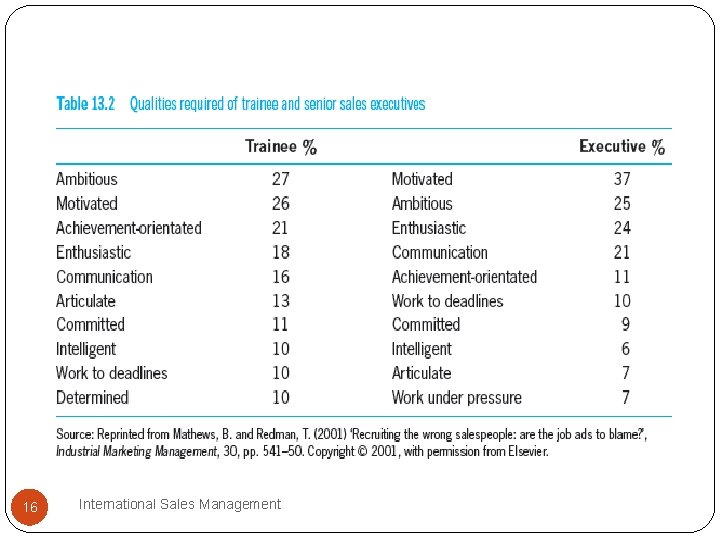
�Another aspect of the personnel specification is 15 the determination of qualities looked for in the new salesperson. �This is a much more nebulous concept than the level of technical qualifications, age or previous experience. �The qualities themselves may depend on the nature of the job, the personal prejudices of the sales manager (a good rule of thumb is that many managers favour people like themselves), or be based on more objective research which International Sales Management has been conducted into attributes associated
16 International Sales Management
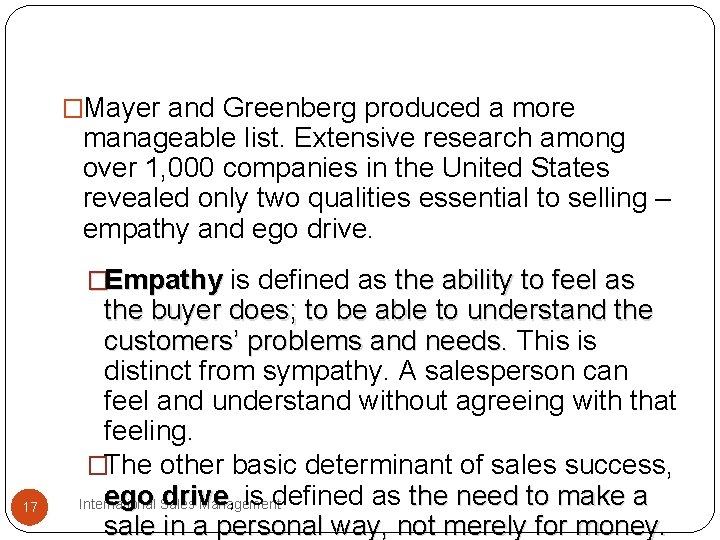
�Mayer and Greenberg produced a more manageable list. Extensive research among over 1, 000 companies in the United States revealed only two qualities essential to selling – empathy and ego drive. �Empathy is defined as the ability to feel as 17 the buyer does; to be able to understand the customers’ problems and needs. This is distinct from sympathy. A salesperson can feel and understand without agreeing with that feeling. �The other basic determinant of sales success, ego Sales drive, is defined as the need to make a drive International Management sale in a personal way, not merely for money.
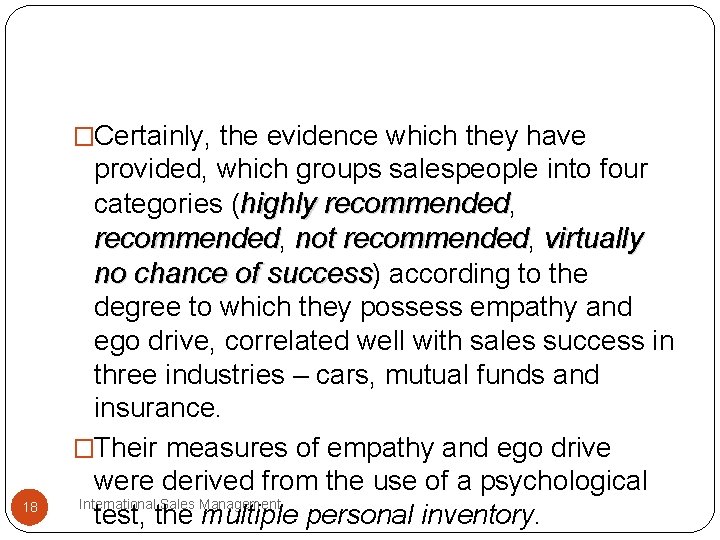
�Certainly, the evidence which they have 18 provided, which groups salespeople into four categories (highly recommended, not recommended, virtually no chance of success) according to the degree to which they possess empathy and ego drive, correlated well with sales success in three industries – cars, mutual funds and insurance. �Their measures of empathy and ego drive were derived from the use of a psychological International Sales Management test, the multiple personal inventory.
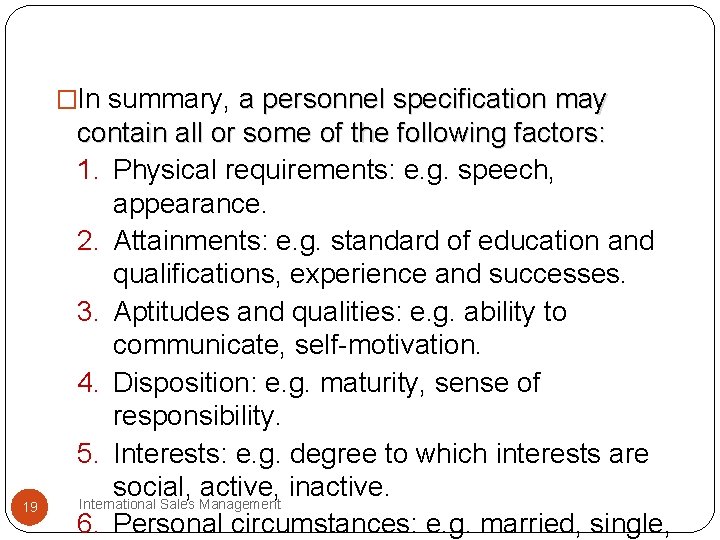
�In summary, a personnel specification may 19 contain all or some of the following factors: 1. Physical requirements: e. g. speech, appearance. 2. Attainments: e. g. standard of education and qualifications, experience and successes. 3. Aptitudes and qualities: e. g. ability to communicate, self-motivation. 4. Disposition: e. g. maturity, sense of responsibility. 5. Interests: e. g. degree to which interests are social, active, inactive. International Sales Management 6. Personal circumstances: e. g. married, single,
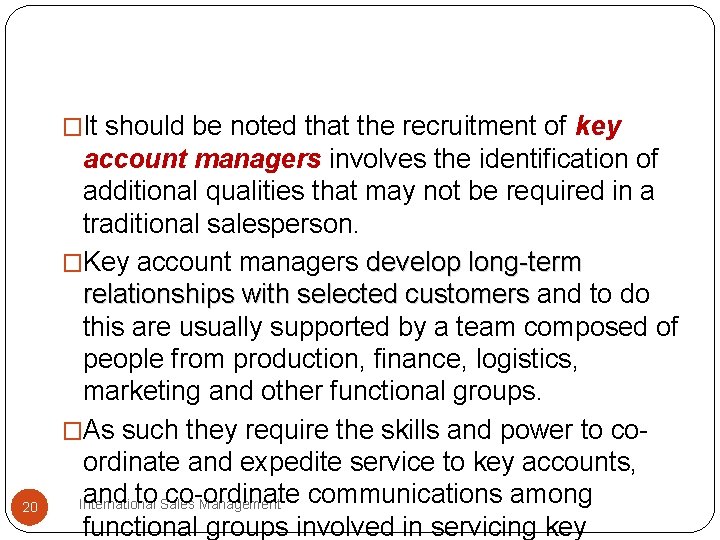
�It should be noted that the recruitment of key 20 account managers involves the identification of additional qualities that may not be required in a traditional salesperson. �Key account managers develop long-term relationships with selected customers and to do this are usually supported by a team composed of people from production, finance, logistics, marketing and other functional groups. �As such they require the skills and power to coordinate and expedite service to key accounts, and to Sales co-ordinate communications among International Management functional groups involved in servicing key
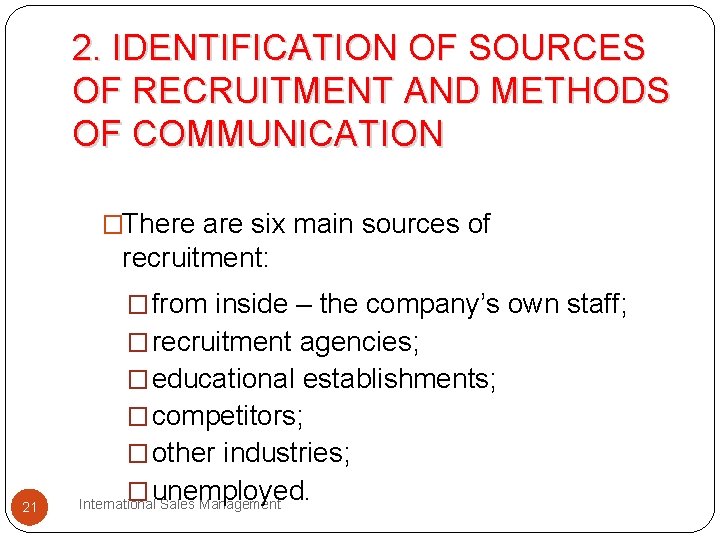
2. IDENTIFICATION OF SOURCES OF RECRUITMENT AND METHODS OF COMMUNICATION �There are six main sources of recruitment: � from inside – the company’s own staff; � recruitment agencies; � educational establishments; � competitors; � other industries; 21 � unemployed. International Sales Management
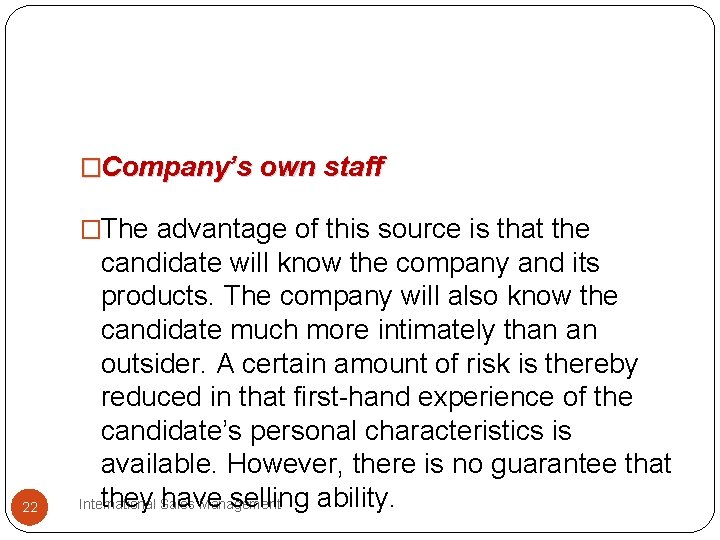
�Company’s own staff �The advantage of this source is that the 22 candidate will know the company and its products. The company will also know the candidate much more intimately than an outsider. A certain amount of risk is thereby reduced in that first-hand experience of the candidate’s personal characteristics is available. However, there is no guarantee that they Sales have selling ability. International Management
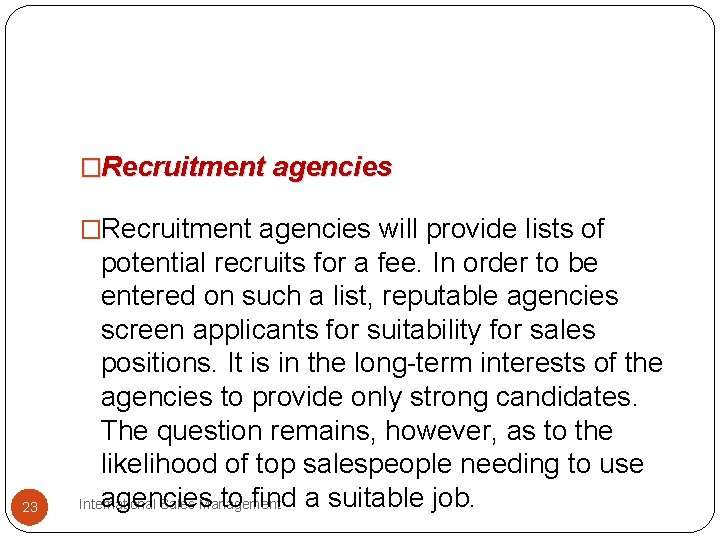
�Recruitment agencies will provide lists of 23 potential recruits for a fee. In order to be entered on such a list, reputable agencies screen applicants for suitability for sales positions. It is in the long-term interests of the agencies to provide only strong candidates. The question remains, however, as to the likelihood of top salespeople needing to use agencies to find a suitable job. International Sales Management
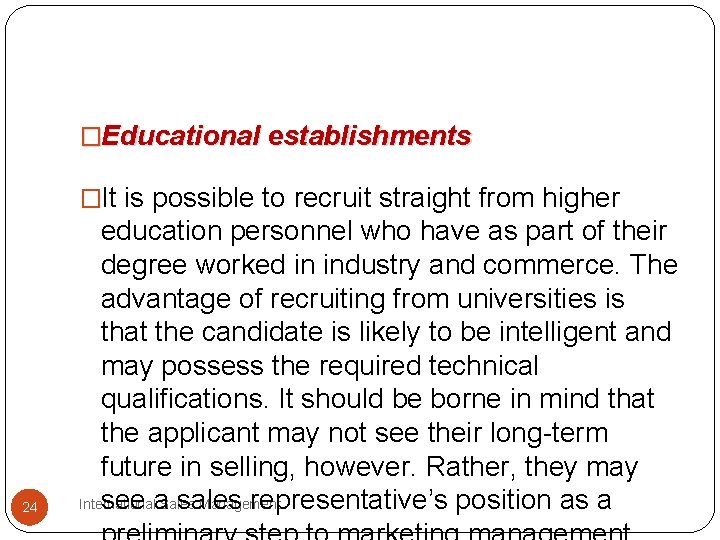
�Educational establishments �It is possible to recruit straight from higher 24 education personnel who have as part of their degree worked in industry and commerce. The advantage of recruiting from universities is that the candidate is likely to be intelligent and may possess the required technical qualifications. It should be borne in mind that the applicant may not see their long-term future in selling, however. Rather, they may International Management see a. Sales sales representative’s position as a
�Competitors �The advantage of this source is that the salesperson knows the market and its customers. The ability of the salesperson may be known to the recruiting company, thus reducing risk. �Other industries and unemployed �Both these categories may provide applicants 25 with sales experience. Obviously careful screening will need to take place in order to International Sales Management assess sales ability.
�Communication �Although some sales positions are filled as a result of 26 personal contact, the bulk of recruitment uses advertisements as the major communication tool. There is a wide selection of national and regional newspapers for the advertiser to consider when placing an advertisement. A major problem with such classified recruitment advertising is impact One method of achieving impact is size The other component of impact is the content of the advertisement The headline is the most important ingredient simply because if it does not attract and is not read, then it is very unlikely that any of the advertisement will be read. Finally, if imagination is International Sales Management low and funds are high, it is worth considering
3. DESIGNING AN EFFECTIVE APPLICATION FORM AND PREPARING A SHORTLIST �The application form is a quick and inexpensive 27 method of screening out applicants in order to produce a shortlist of candidates for interview. �The questions on the form should enable the sales manager to check if the applicant is qualified vis-àvis the personnel specification. �Questions relating to age, education, previous work experience and leisure interests are often included. �Besides giving such factual information, the application form also reveals defects such as an inability to spell, poor grammar or carelessness in International Sales Management following instructions.
�The application form can reveal much about 28 the person who is applying. �Some applicants may be inveterate jobhoppers; others may have inadequate educational qualifications. �Whatever the criteria, the application form will often be the initial screening device used to produce a shortlist. �Its careful design should, therefore, be a high International Sales Management priority for those involved in selection.
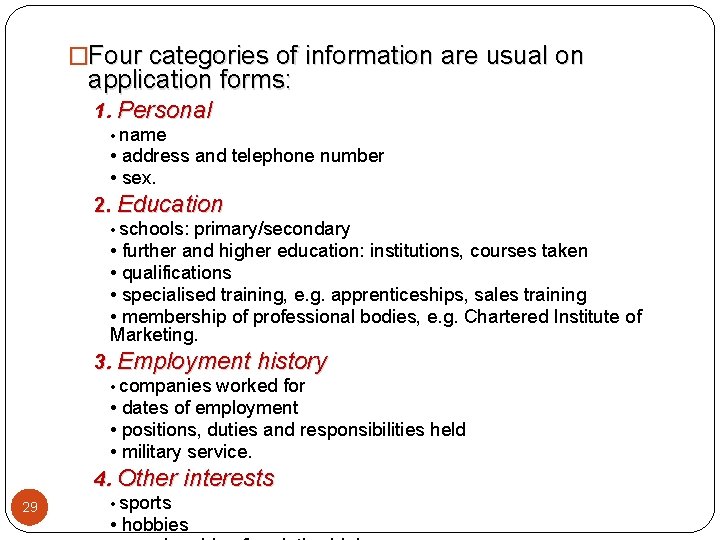
�Four categories of information are usual on application forms: 1. Personal • name • address and telephone number • sex. 2. Education • schools: primary/secondary • further and higher education: institutions, courses taken • qualifications • specialised training, e. g. apprenticeships, sales training • membership of professional bodies, e. g. Chartered Institute of Marketing. 3. Employment history • companies worked for • dates of employment • positions, duties and responsibilities held • military service. 4. Other interests 29 • sports • hobbies
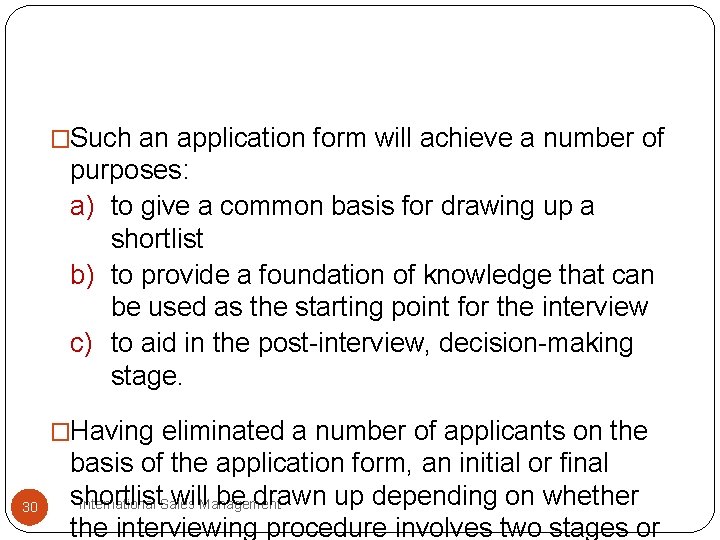
�Such an application form will achieve a number of purposes: a) to give a common basis for drawing up a shortlist b) to provide a foundation of knowledge that can be used as the starting point for the interview c) to aid in the post-interview, decision-making stage. �Having eliminated a number of applicants on the 30 basis of the application form, an initial or final shortlist will. Management be drawn up depending on whether International Sales the interviewing procedure involves two stages or
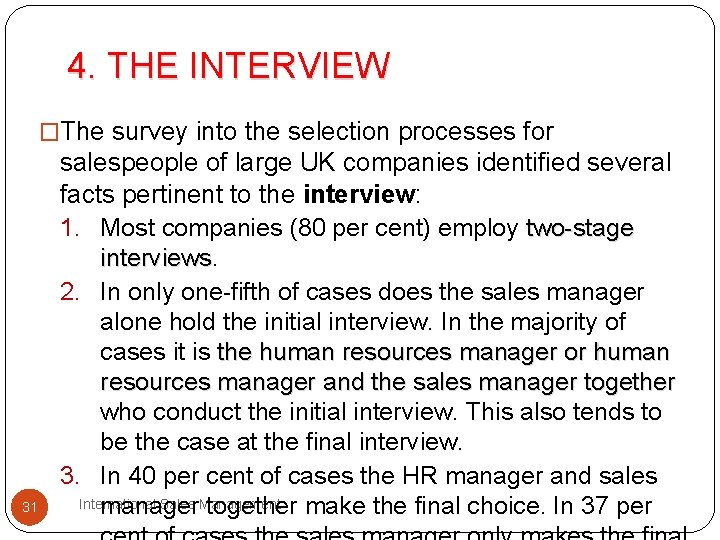
4. THE INTERVIEW �The survey into the selection processes for 31 salespeople of large UK companies identified several facts pertinent to the interview: 1. Most companies (80 per cent) employ two-stage interviews 2. In only one-fifth of cases does the sales manager alone hold the initial interview. In the majority of cases it is the human resources manager or human resources manager and the sales manager together who conduct the initial interview. This also tends to be the case at the final interview. 3. In 40 per cent of cases the HR manager and sales International Sales Management manager together make the final choice. In 37 per
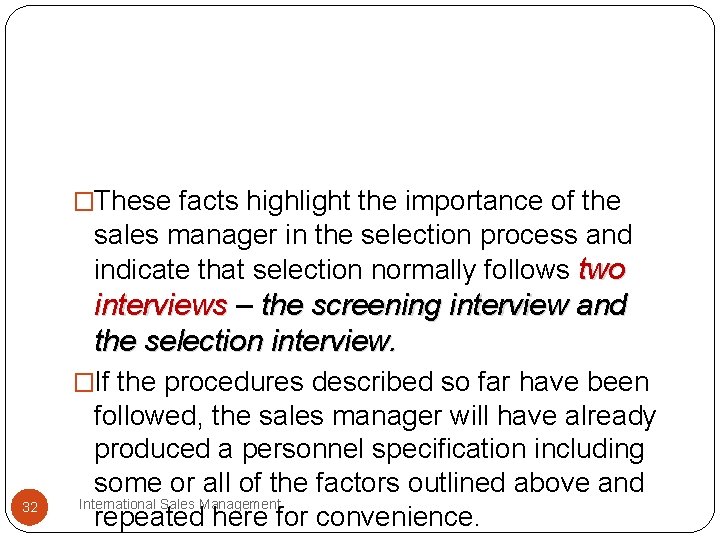
�These facts highlight the importance of the sales manager in the selection process and indicate that selection normally follows two interviews – the screening interview and the selection interview. �If the procedures described so far have been 32 followed, the sales manager will have already produced a personnel specification including some or all of the factors outlined above and International Sales Management repeated here for convenience.
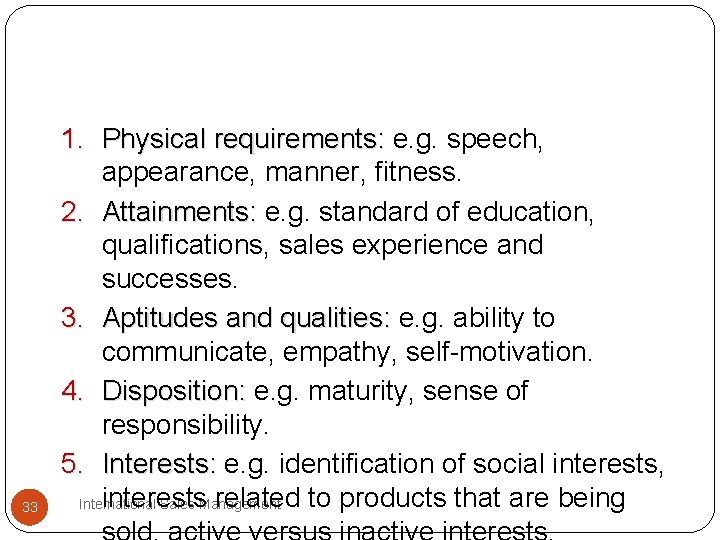
33 1. Physical requirements: e. g. speech, appearance, manner, fitness. 2. Attainments: e. g. standard of education, qualifications, sales experience and successes. 3. Aptitudes and qualities: e. g. ability to communicate, empathy, self-motivation. 4. Disposition: e. g. maturity, sense of responsibility. 5. Interests: e. g. identification of social interests, interests related to products that are being International Sales Management
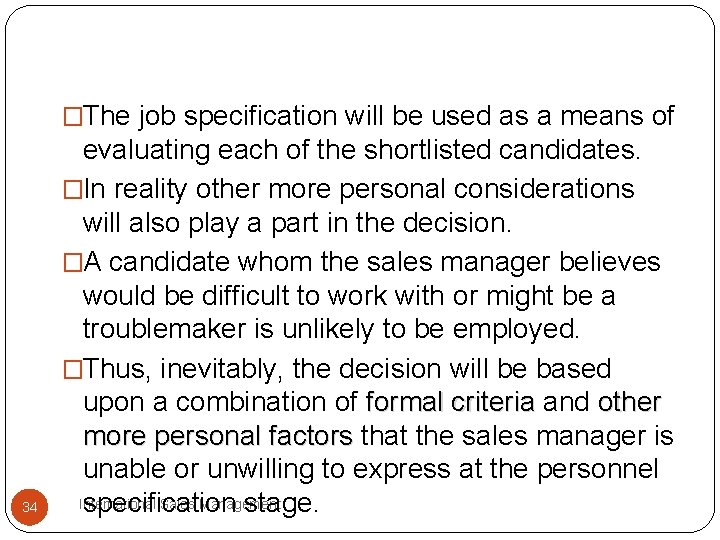
�The job specification will be used as a means of 34 evaluating each of the shortlisted candidates. �In reality other more personal considerations will also play a part in the decision. �A candidate whom the sales manager believes would be difficult to work with or might be a troublemaker is unlikely to be employed. �Thus, inevitably, the decision will be based upon a combination of formal criteria and other more personal factors that the sales manager is unable or unwilling to express at the personnel International Sales Management specification stage.
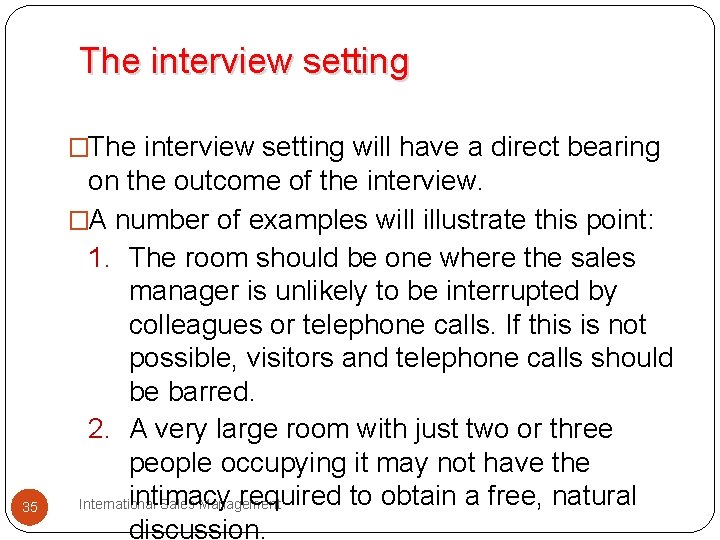
The interview setting �The interview setting will have a direct bearing 35 on the outcome of the interview. �A number of examples will illustrate this point: 1. The room should be one where the sales manager is unlikely to be interrupted by colleagues or telephone calls. If this is not possible, visitors and telephone calls should be barred. 2. A very large room with just two or three people occupying it may not have the intimacy required to obtain a free, natural International Sales Management discussion.
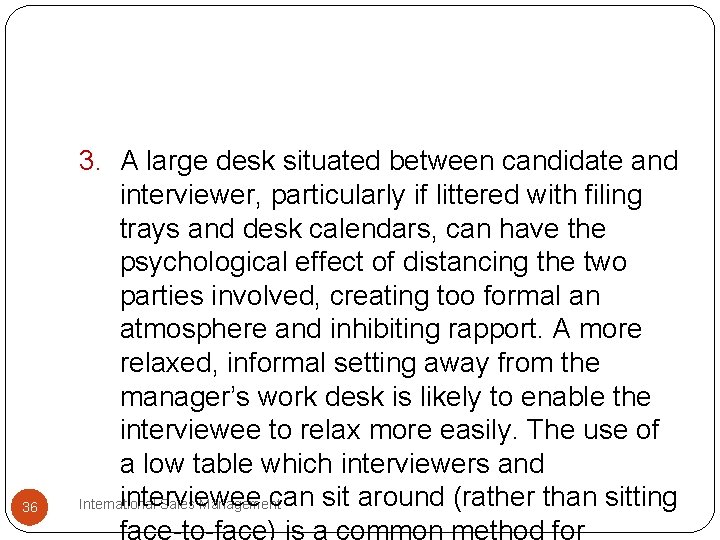
36 3. A large desk situated between candidate and interviewer, particularly if littered with filing trays and desk calendars, can have the psychological effect of distancing the two parties involved, creating too formal an atmosphere and inhibiting rapport. A more relaxed, informal setting away from the manager’s work desk is likely to enable the interviewee to relax more easily. The use of a low table which interviewers and interviewee can sit around (rather than sitting International Sales Management
37 International Sales Management
Conducting the interview �Most interviewees are naturally anxious before 38 the interview and when they first enter the interview setting. �They may feel embarrassed or be worried about exposing weaknesses. They may feel inadequate and lack confidence. Above all they may feel worried about rejection. �These anxieties are compounded by the fact that the candidate may not have met their interviewers before and thus be uncertain about how aggressive International Sales Management they will be, the degree of pressure that will be applied and the types of
�The objective of the interview is to get to know 39 the candidate in terms of the criteria laid down in the personnel specification, or ‘profile’ as it is sometimes called. �In order to do this candidates must be encouraged to talk about themselves. �If sales ability under stress is to be tested, role playing can be used as part of the selection procedure. �There a number of guidelines which, if followed, should reduce anxiety and establish International Sales Management rapport:
40 1. One of the interviewers (preferably the sales manager) should bring the candidate into the room, rather than the candidate being sent for through a secretary or junior administrator. This reduces status differentials and hence encourages rapport. 2. Open the conversation with a few easy-to-answer questions, which although not directly pertinent to the job, allow the candidate to talk to the interviewers and gain confidence. 3. Interviewers should appear relaxed and adopt a friendly, easy manner. Management 4. International They Sales should be courteous and appear interested
41 5. Questions early in the interview should be, if possible, open-ended rather than closed. Openended questions allow the applicant scope for talking at some length on the topic, e. g. ‘Can you tell me about your experiences selling pharmaceuticals? ’ Closed questions, on the other hand, invite a short answer, e. g. ‘Can you tell me how long you worked for Beechams? ’ Some closed questions are inevitable, but a series of them makes it difficult for the candidate to relax and gain confidence. Indeed, such questions may give the impression that the applicant is uncommunicative, when really the International Sales Management problem lies with the interviewer.
�Having successfully established rapport and 42 reduced anxiety, the interviewer will wish to encourage candidates to talk about themselves, their experiences, attitudes, behaviour and expectations. To do this the interviewer not only needs to develop the art of being a good listener but also needs to develop skills in making people talk. �The skills required in the needs analysis stage International Sales Management of the selling process may be used in an
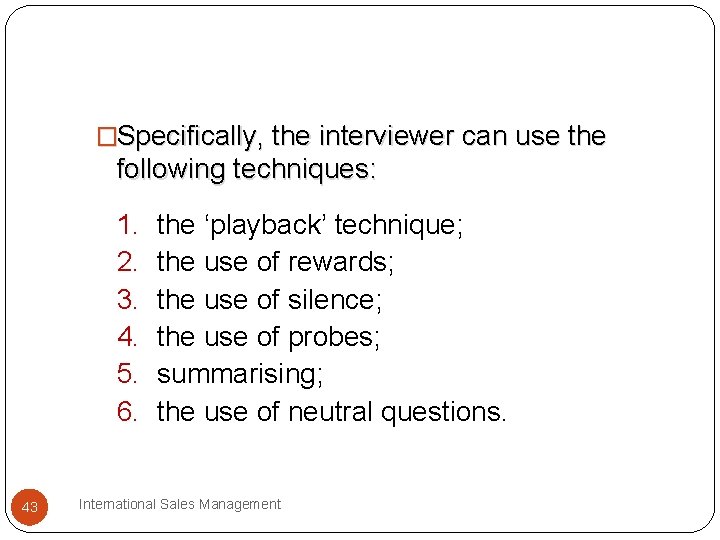
�Specifically, the interviewer can use the following techniques: 1. 2. 3. 4. 5. 6. 43 the ‘playback’ technique; the use of rewards; the use of silence; the use of probes; summarising; the use of neutral questions. International Sales Management
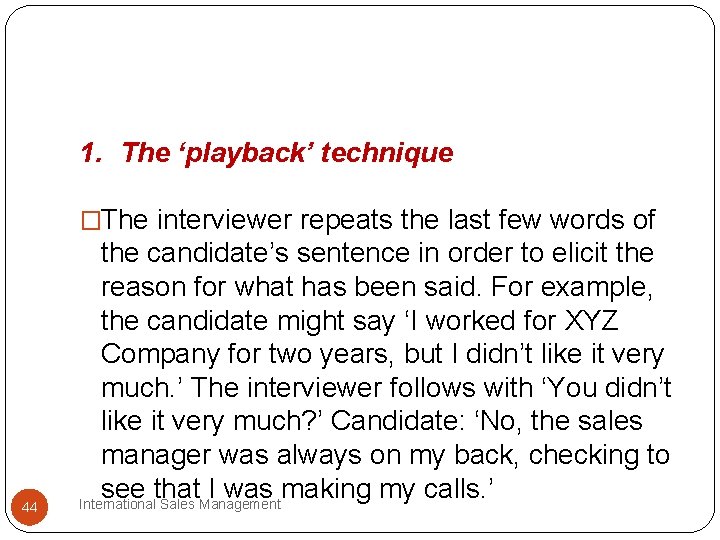
1. The ‘playback’ technique �The interviewer repeats the last few words of 44 the candidate’s sentence in order to elicit the reason for what has been said. For example, the candidate might say ‘I worked for XYZ Company for two years, but I didn’t like it very much. ’ The interviewer follows with ‘You didn’t like it very much? ’ Candidate: ‘No, the sales manager was always on my back, checking to see that I was making my calls. ’ International Sales Management
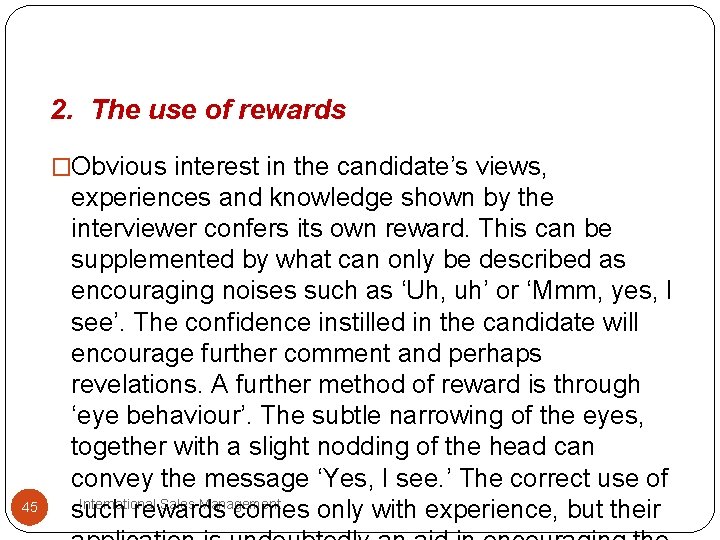
2. The use of rewards �Obvious interest in the candidate’s views, 45 experiences and knowledge shown by the interviewer confers its own reward. This can be supplemented by what can only be described as encouraging noises such as ‘Uh, uh’ or ‘Mmm, yes, I see’. The confidence instilled in the candidate will encourage further comment and perhaps revelations. A further method of reward is through ‘eye behaviour’. The subtle narrowing of the eyes, together with a slight nodding of the head can convey the message ‘Yes, I see. ’ The correct use of International Sales Management such rewards comes only with experience, but their
3. The use of silence � Silence can be a very powerful ally of the interviewer. 46 However, silence must be used with discretion, otherwise rapport may be lost and candidates may raise their barriers to open expression. Its most common use is after the candidate has given a neutral, uninformative reply to an important question. A candidate, eager to impress, will feel uncomfortable and interpret silence as an indication that the interview is not going well. In such a situation they will normally attempt to fill the void, and it may be that the only way they can do this is by revealing attitudes or behaviour patterns which otherwise they would have been happy to have kept International Management hidden. Sales Alternatively, the pause may allow the candidate
4. The use of probes �The salesperson who is adept at needs analysis 47 will be well acquainted with the use of probes. In an interview, comments will be made which require further explanation. For example, the applicant might say, ‘The time I spent on a sales training course was a waste of time, ’ to which the interviewer might say ‘Why do you think that was? ’ or ‘That’s interesting, why do you say that? ’ or ‘Can you explain a little more why you think that? ’ Such phrases are to be preferred to International Sales‘Why? ’ Management and are really alternatives to the blunt
5. Summarising � During an interview, the interviewer will inevitably be attempting to draw together points which have been made by the applicant at various times in order to come to some opinion about the person under scrutiny. A useful device for checking if these impressions are valid in the subject’s eyes is to summarise them and ask for their corroboration. � After a period of questioning and probing, the interviewer might say: ‘So, as I understand it, your first period in sales was not a success because the firm you worked for produced poor quality products, inferior in terms of technical specifications compared to competition and you felt inexperienced. But your second job, working with a larger, better-known company, was more satisfactory, having received proper sales training and having the advantage of selling a recognised high-quality product International Salesyou Management line. Would say that this was a fair summary? ’ Having 48 obtained agreement, the interviewer can then move to
6. The use of neutral questions �A basic principle of good interviewing is to use 49 neutral rather than leading questions. The question ‘Can you tell me about the sales training you received at your previous employer? ’ is likely to lead to rather different, less biased responses than, ‘I’m sure you learnt a lot from your sales training courses, didn’t you? ’ Again, ‘What do you feel about dealing with the type of customer we have? ’ is more. Sales neutral than, ‘I’m sure you wouldn’t have International Management
�Other considerations � There are other considerations which an interviewer is wise to bear in mind. � First, they must not talk too much. The object is for most of the time spent interviewing to be used to evaluate the candidates. � Second, part of the interview will be a selling task in order to ensure that the chosen applicant accepts. The balance between evaluation and selling is largely based upon judgement and no hard and fast rules apply, but obviously the competitive situation and the strength of the candidate will be two factors that affect the decision. � Third, the interviewer must discreetly control the interview. A certain amount of time will be allocated to each candidate and 50 it is. International Sales Management the interviewer’s responsibility to ensure that all salient
5. SUPPLEMENTARY SELECTION AIDS �Although success at the interview is always an important determinant of selection, some firms employ supplementary techniques to provide a valid measure of potential. �A number of large firms use psychological tests in this way. However, care has to be taken when using these tests and a trained psychologist is usually needed to administer and interpret the results. 51 International Sales Management
Psychological tests �There a number of criticisms which have been levelled at the tests: 1. It is easy to cheat. The applicant, having an idea of the type of person who is likely to be successful at selling, does not respond truly but ‘fakes’ the test in order to give a ‘correct’ profile. For example, in response to a question such as ‘Who is of more value to society – the practical man or the thinker? ’ they answer ‘the practical man’ no matter what their true convictions may be. 52 International Sales Management
2. Many tests measure interest rather than sales ability. The sales manager knows the interests of successful salespeople and uses tests to discover if potential new recruits have similar interest patterns. The assumption here is that sales success can be predicted by the types of interests a person has. 3. Tests have been used to identify individual personality traits which may not be associated with sales success. Factors such as how sociable, dominant, friendly and loyal a person is have been measured in order to predict sales success. While some of these factors may be useful attributes for a International Sales Management 53 salesperson to possess, they have failed to
Role playing �Another aid in the selection of salespeople is the use of role playing in order to gauge the selling potential of candidates. �This involves placing them individually in selling situations and assessing how well they perform. �The problem with this technique is that, at best, it measures sales ability at that moment. This may depend, among other things, on previous sales experience. Correct assessment of salespeople, however, should be measuring potential. �Further, role playing cannot assess the candidate’s ability to establish and handle long-term relationships International Sales Management 54 with buyers and so is more applicable to those selling
Conclusions �The selection of salespeople, while of obvious importance to the long-term future of the business, is a task which does not always receive the attention it should from sales managers. �All too often, the ‘person profile’ is ill-defined and the selection procedure designed for maximum convenience rather than optimal choice. �The assumption is that the right candidate should emerge whatever procedure is used. �Consequently the interview is poorly handled, the smooth gets the job and another mediocre International talker Sales Management 55