
Chapter 4 Reactions in Aqueous Solution Reactions Between
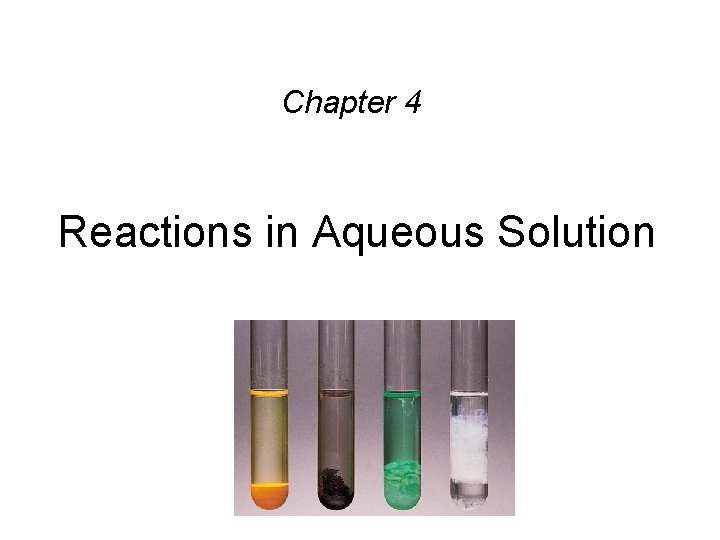
Chapter 4 Reactions in Aqueous Solution

Reactions Between Ions in Aqueous Solutions General properties of aqueous solution A solution is a homogeneous mixture of 2 or more substances = solute dissovled in solvent The solute is(are) the substance(s) present in the smaller amount(s) The solvent is the substance present in the larger amount Solution Solvent Solute Soft drink (l) H 2 O Sugar, CO 2 Air (g) N 2 O 2, Ar, CH 4
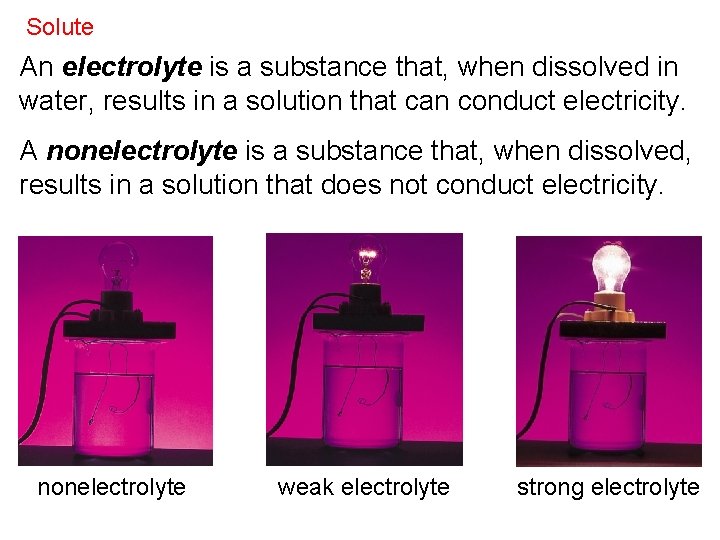
Solute An electrolyte is a substance that, when dissolved in water, results in a solution that can conduct electricity. A nonelectrolyte is a substance that, when dissolved, results in a solution that does not conduct electricity. nonelectrolyte weak electrolyte strong electrolyte
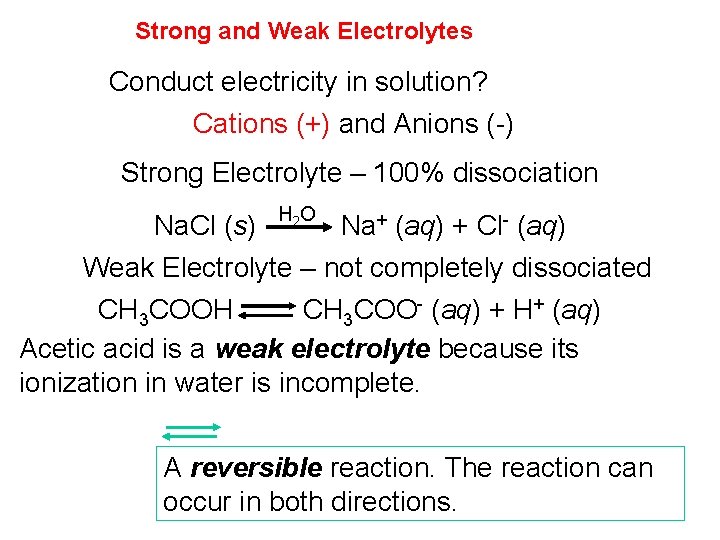
Strong and Weak Electrolytes Conduct electricity in solution? Cations (+) and Anions (-) Strong Electrolyte – 100% dissociation Na. Cl (s) H 2 O Na+ (aq) + Cl- (aq) Weak Electrolyte – not completely dissociated CH 3 COOH CH 3 COO- (aq) + H+ (aq) Acetic acid is a weak electrolyte because its ionization in water is incomplete. A reversible reaction. The reaction can occur in both directions.
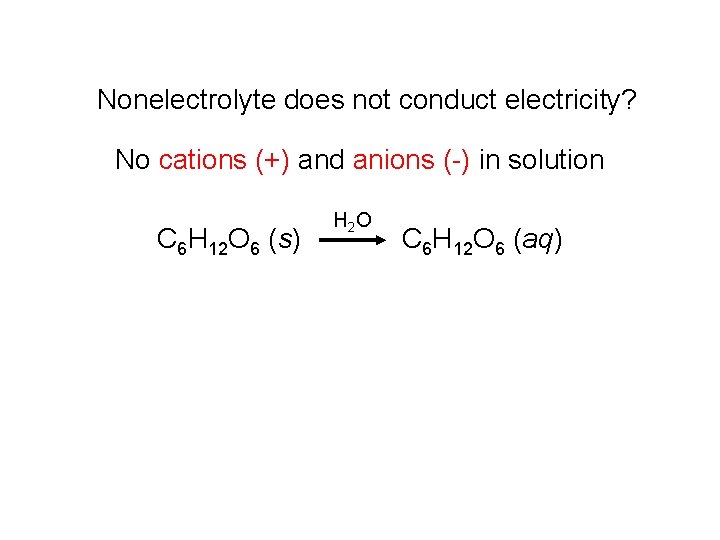
Nonelectrolyte does not conduct electricity? No cations (+) and anions (-) in solution C 6 H 12 O 6 (s) H 2 O C 6 H 12 O 6 (aq)
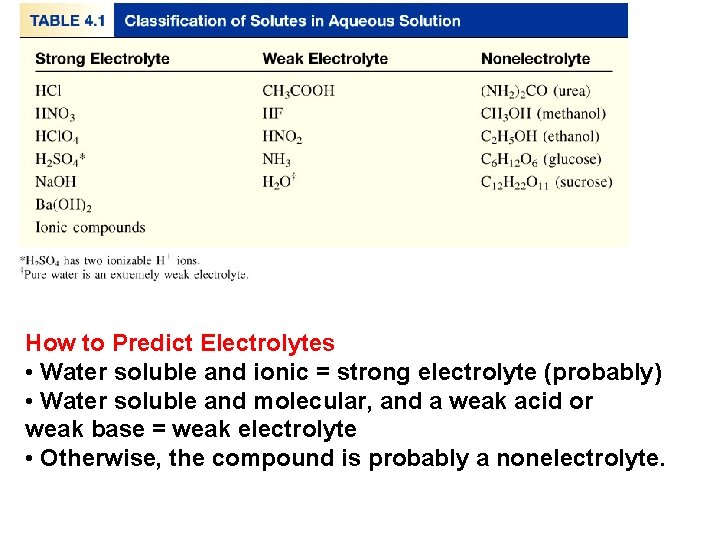
How to Predict Electrolytes • Water soluble and ionic = strong electrolyte (probably) • Water soluble and molecular, and a weak acid or weak base = weak electrolyte • Otherwise, the compound is probably a nonelectrolyte.
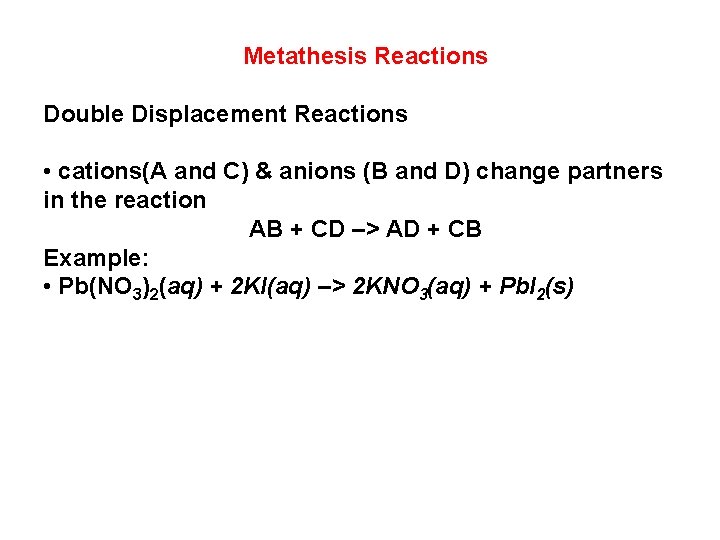
Metathesis Reactions Double Displacement Reactions • cations(A and C) & anions (B and D) change partners in the reaction AB + CD –> AD + CB Example: • Pb(NO 3)2(aq) + 2 KI(aq) –> 2 KNO 3(aq) + Pb. I 2(s)
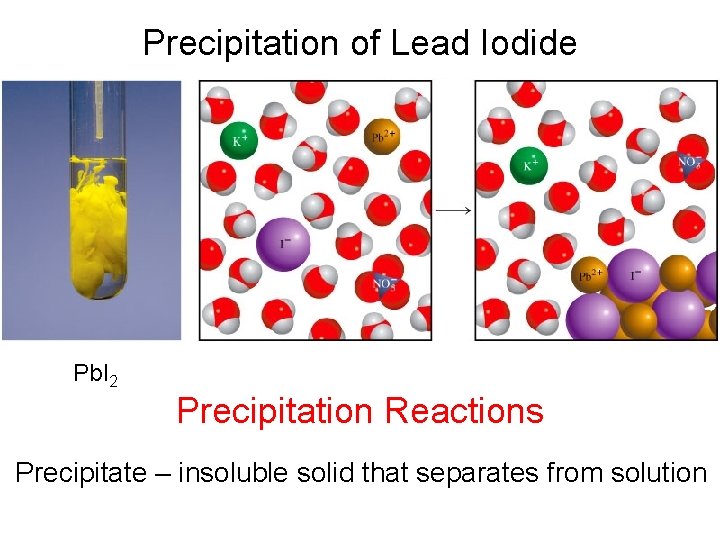
Precipitation of Lead Iodide Pb. I 2 Precipitation Reactions Precipitate – insoluble solid that separates from solution
Solubility is the maximum amount of solute that will dissolve in a given quantity of solvent at a specific temperature. Most K+ , Na+ and NO 3 - salts are soluble
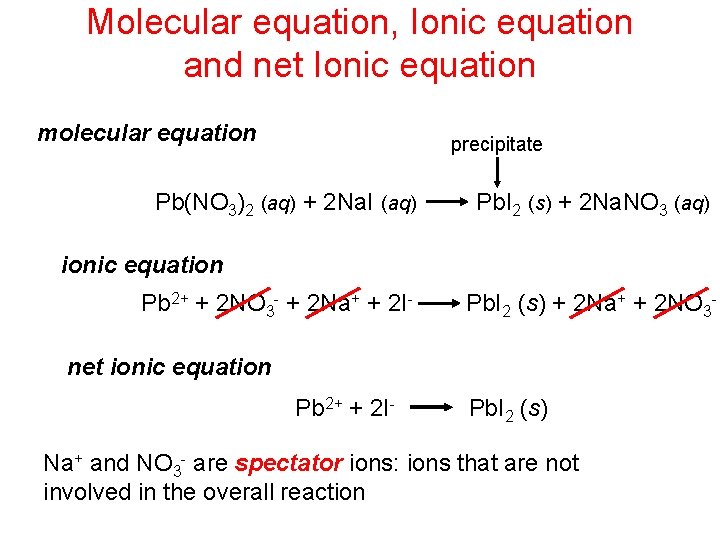
Molecular equation, Ionic equation and net Ionic equation molecular equation precipitate Pb(NO 3)2 (aq) + 2 Na. I (aq) Pb. I 2 (s) + 2 Na. NO 3 (aq) ionic equation Pb 2+ + 2 NO 3 - + 2 Na+ + 2 I- Pb. I 2 (s) + 2 Na+ + 2 NO 3 - net ionic equation Pb 2+ + 2 I- Pb. I 2 (s) Na+ and NO 3 - are spectator ions: ions that are not involved in the overall reaction
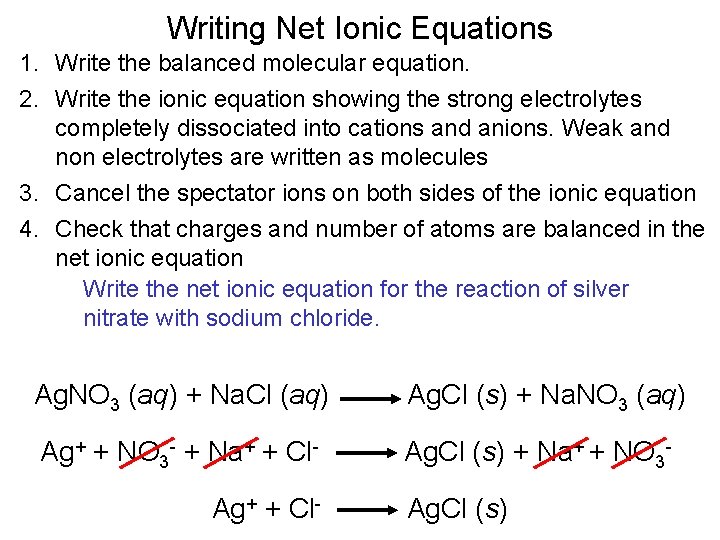
Writing Net Ionic Equations 1. Write the balanced molecular equation. 2. Write the ionic equation showing the strong electrolytes completely dissociated into cations and anions. Weak and non electrolytes are written as molecules 3. Cancel the spectator ions on both sides of the ionic equation 4. Check that charges and number of atoms are balanced in the net ionic equation Write the net ionic equation for the reaction of silver nitrate with sodium chloride. Ag. NO 3 (aq) + Na. Cl (aq) Ag. Cl (s) + Na. NO 3 (aq) Ag+ + NO 3 - + Na+ + Cl- Ag. Cl (s) + Na+ + NO 3 - Ag+ + Cl- Ag. Cl (s)
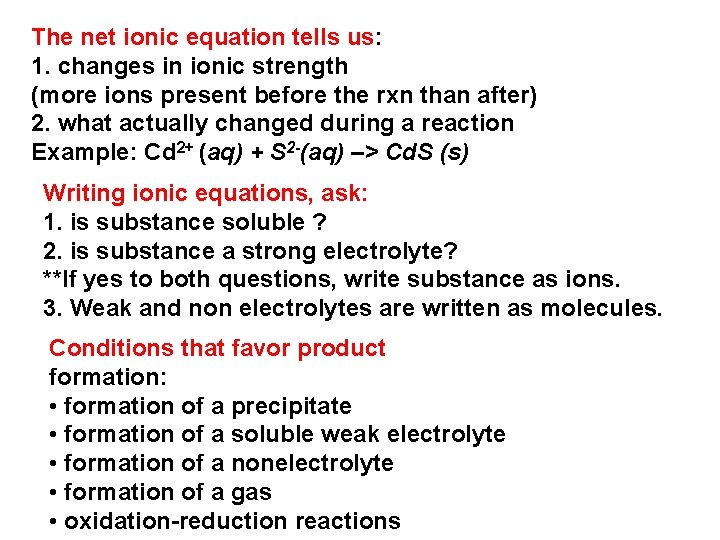
The net ionic equation tells us: 1. changes in ionic strength (more ions present before the rxn than after) 2. what actually changed during a reaction Example: Cd 2+ (aq) + S 2 -(aq) –> Cd. S (s) Writing ionic equations, ask: 1. is substance soluble ? 2. is substance a strong electrolyte? **If yes to both questions, write substance as ions. 3. Weak and non electrolytes are written as molecules. Conditions that favor product formation: • formation of a precipitate • formation of a soluble weak electrolyte • formation of a nonelectrolyte • formation of a gas • oxidation-reduction reactions
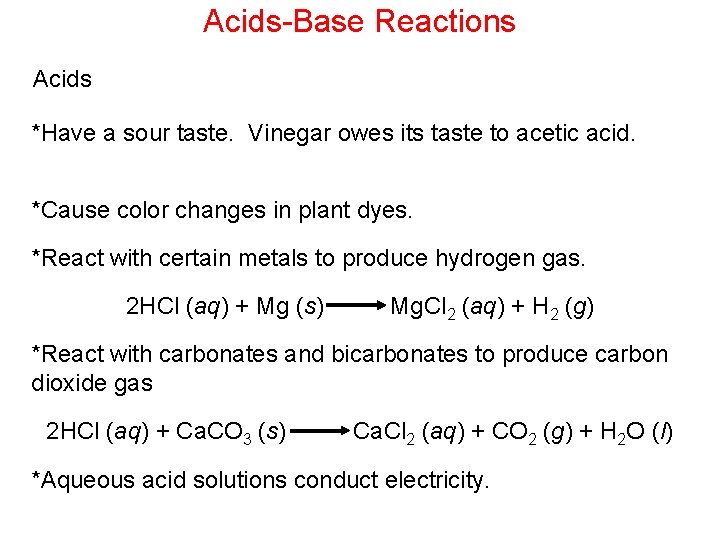
Acids-Base Reactions Acids *Have a sour taste. Vinegar owes its taste to acetic acid. *Cause color changes in plant dyes. *React with certain metals to produce hydrogen gas. 2 HCl (aq) + Mg (s) Mg. Cl 2 (aq) + H 2 (g) *React with carbonates and bicarbonates to produce carbon dioxide gas 2 HCl (aq) + Ca. CO 3 (s) Ca. Cl 2 (aq) + CO 2 (g) + H 2 O (l) *Aqueous acid solutions conduct electricity.
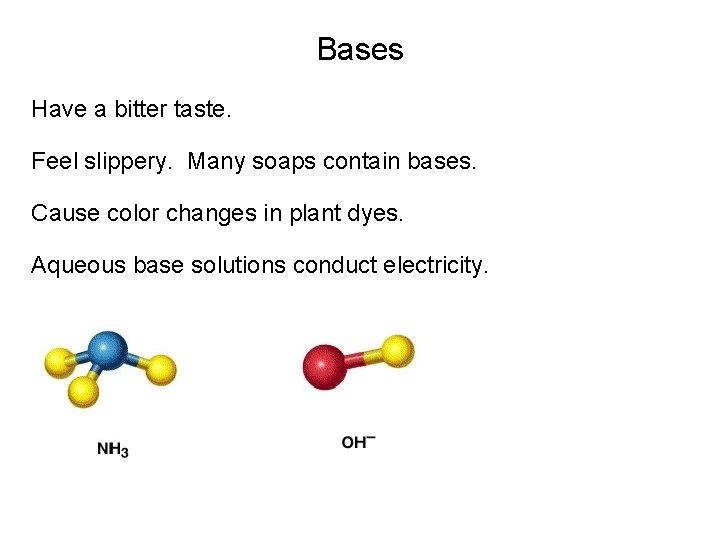
Bases Have a bitter taste. Feel slippery. Many soaps contain bases. Cause color changes in plant dyes. Aqueous base solutions conduct electricity.
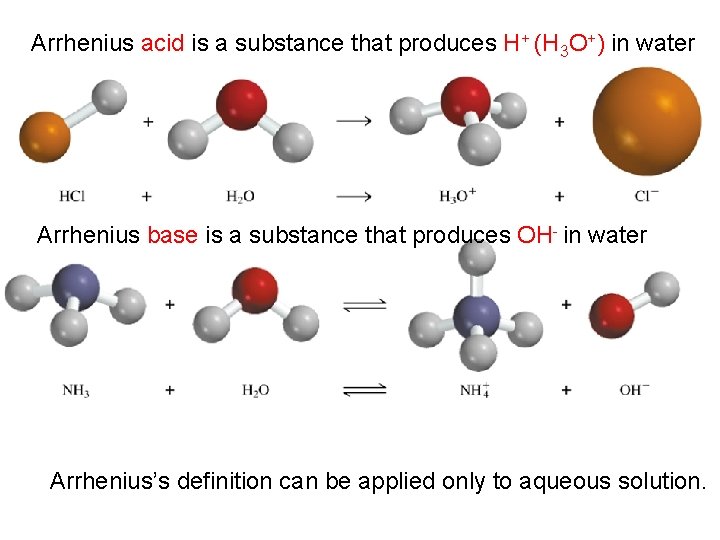
Arrhenius acid is a substance that produces H+ (H 3 O+) in water Arrhenius base is a substance that produces OH- in water Arrhenius’s definition can be applied only to aqueous solution.
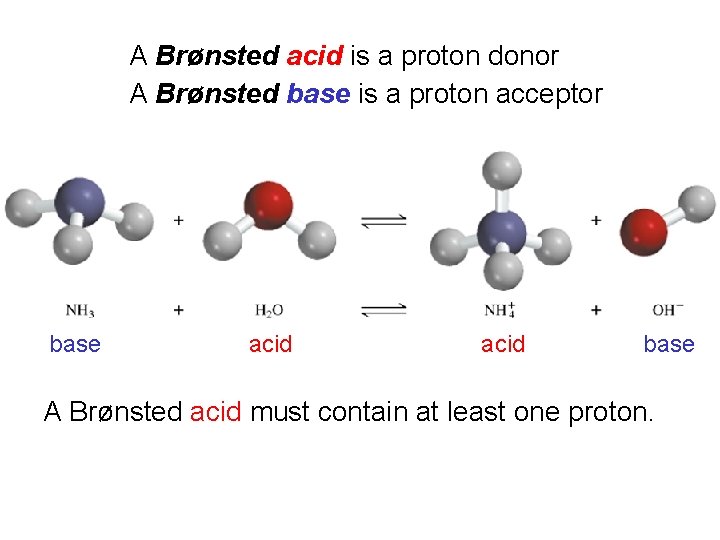
A Brønsted acid is a proton donor A Brønsted base is a proton acceptor base acid base A Brønsted acid must contain at least one proton.
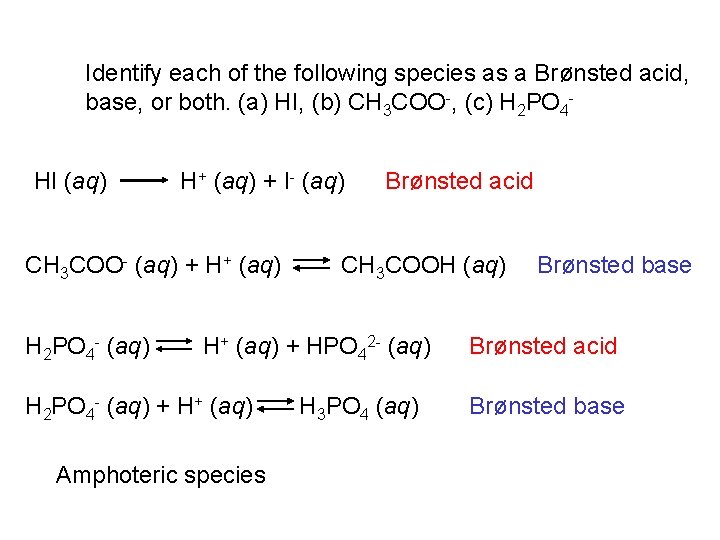
Identify each of the following species as a Brønsted acid, base, or both. (a) HI, (b) CH 3 COO-, (c) H 2 PO 4 HI (aq) H+ (aq) + I- (aq) CH 3 COO- (aq) + H+ (aq) H 2 PO 4 - (aq) Brønsted acid CH 3 COOH (aq) H+ (aq) + HPO 42 - (aq) H 2 PO 4 - (aq) + H+ (aq) Amphoteric species H 3 PO 4 (aq) Brønsted base Brønsted acid Brønsted base
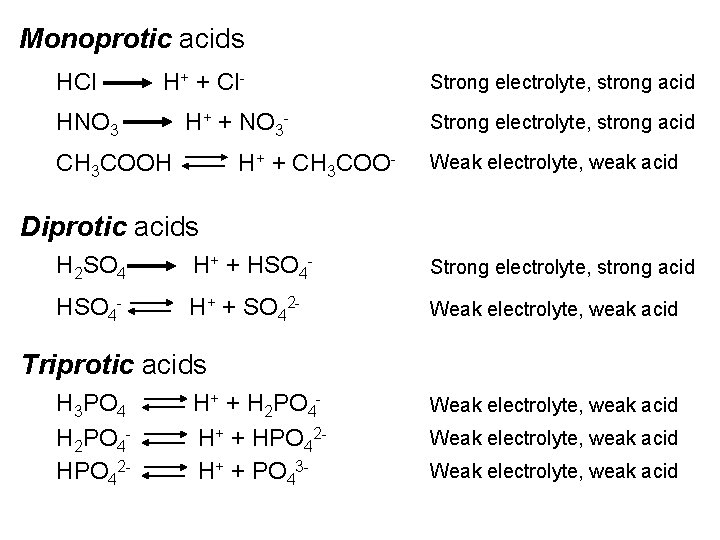
Monoprotic acids HCl H+ + Cl- HNO 3 H+ + NO 3 - CH 3 COOH H+ + CH 3 COO- Strong electrolyte, strong acid Weak electrolyte, weak acid Diprotic acids H 2 SO 4 H+ + HSO 4 - Strong electrolyte, strong acid HSO 4 - H+ + SO 42 - Weak electrolyte, weak acid Triprotic acids H 3 PO 4 H 2 PO 4 HPO 42 - H+ + H 2 PO 4 H+ + HPO 42 H+ + PO 43 - Weak electrolyte, weak acid

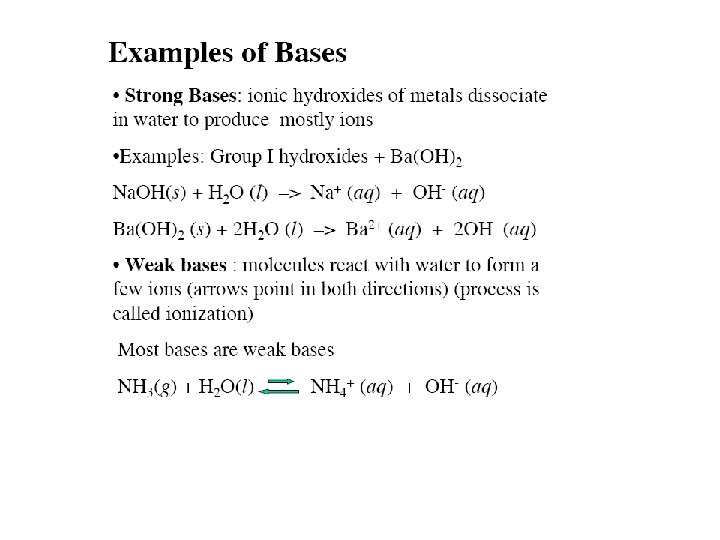
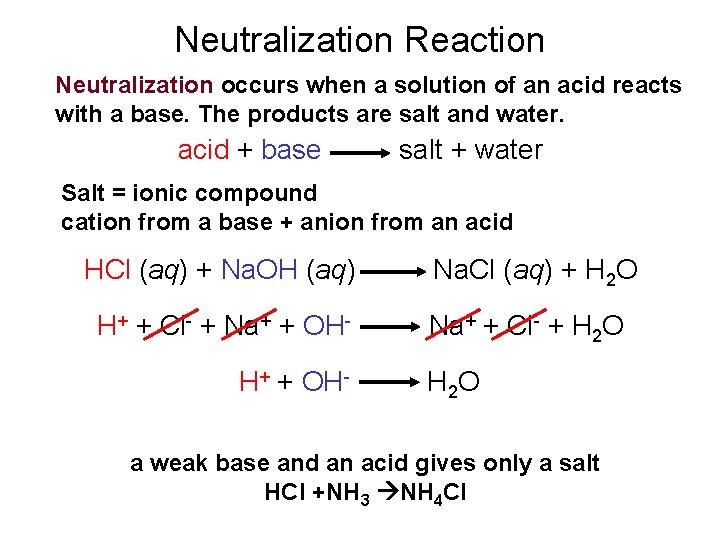
Neutralization Reaction Neutralization occurs when a solution of an acid reacts with a base. The products are salt and water. acid + base salt + water Salt = ionic compound cation from a base + anion from an acid HCl (aq) + Na. OH (aq) H+ + Cl- + Na+ + OHH+ + OH- Na. Cl (aq) + H 2 O Na+ + Cl- + H 2 O a weak base and an acid gives only a salt HCl +NH 3 NH 4 Cl
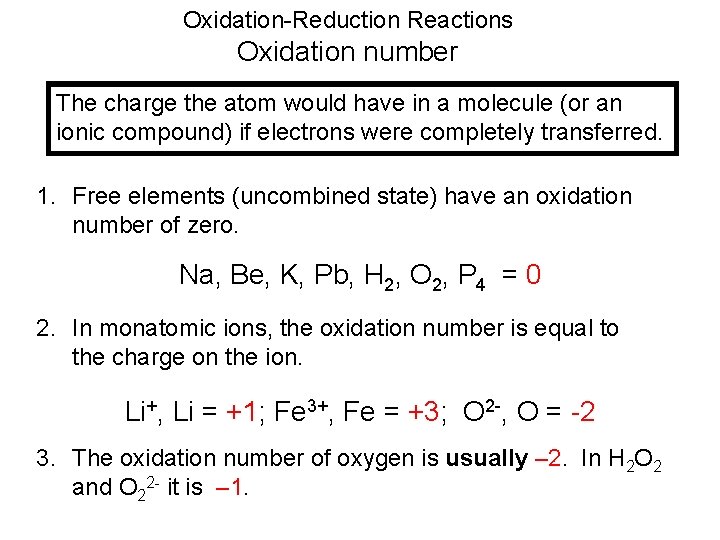
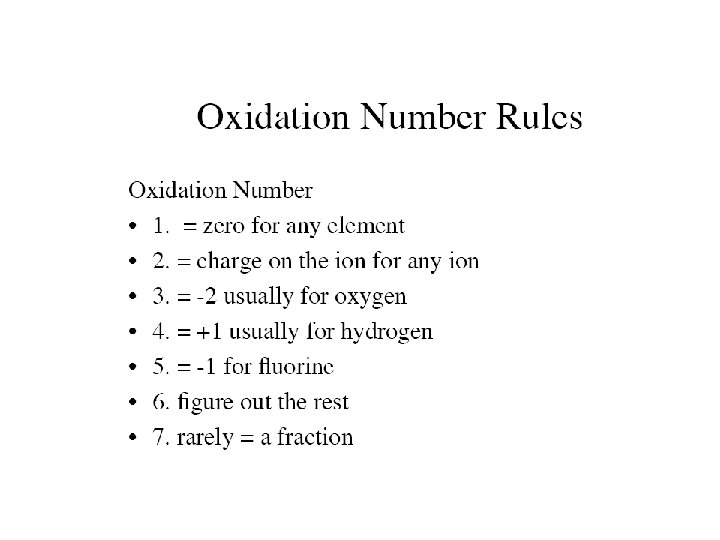
Oxidation-Reduction Reactions Oxidation number The charge the atom would have in a molecule (or an ionic compound) if electrons were completely transferred. 1. Free elements (uncombined state) have an oxidation number of zero. Na, Be, K, Pb, H 2, O 2, P 4 = 0 2. In monatomic ions, the oxidation number is equal to the charge on the ion. Li+, Li = +1; Fe 3+, Fe = +3; O 2 -, O = -2 3. The oxidation number of oxygen is usually – 2. In H 2 O 2 and O 22 - it is – 1.
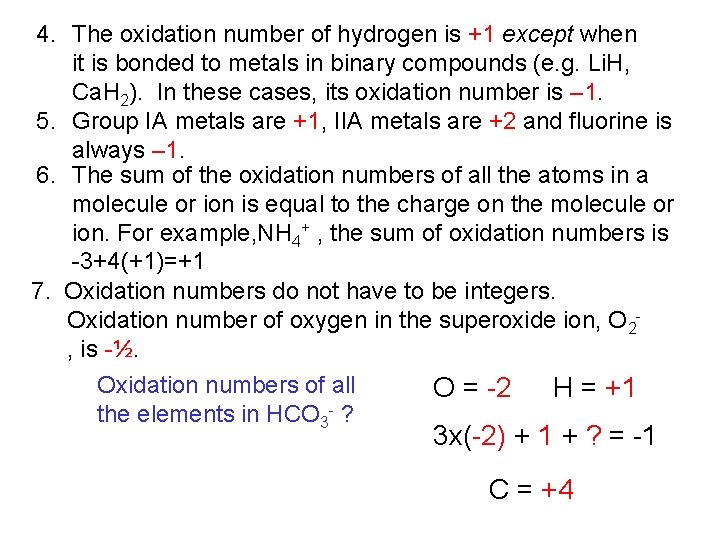
4. The oxidation number of hydrogen is +1 except when it is bonded to metals in binary compounds (e. g. Li. H, Ca. H 2). In these cases, its oxidation number is – 1. 5. Group IA metals are +1, IIA metals are +2 and fluorine is always – 1. 6. The sum of the oxidation numbers of all the atoms in a molecule or ion is equal to the charge on the molecule or ion. For example, NH 4+ , the sum of oxidation numbers is -3+4(+1)=+1 7. Oxidation numbers do not have to be integers. Oxidation number of oxygen in the superoxide ion, O 2, is -½. Oxidation numbers of all O = -2 H = +1 the elements in HCO 3 - ? 3 x(-2) + 1 + ? = -1 C = +4
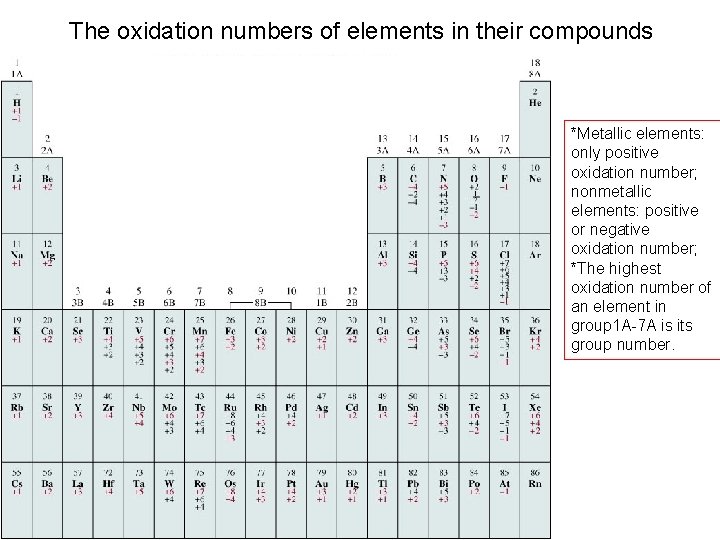
The oxidation numbers of elements in their compounds *Metallic elements: only positive oxidation number; nonmetallic elements: positive or negative oxidation number; *The highest oxidation number of an element in group 1 A-7 A is its group number.
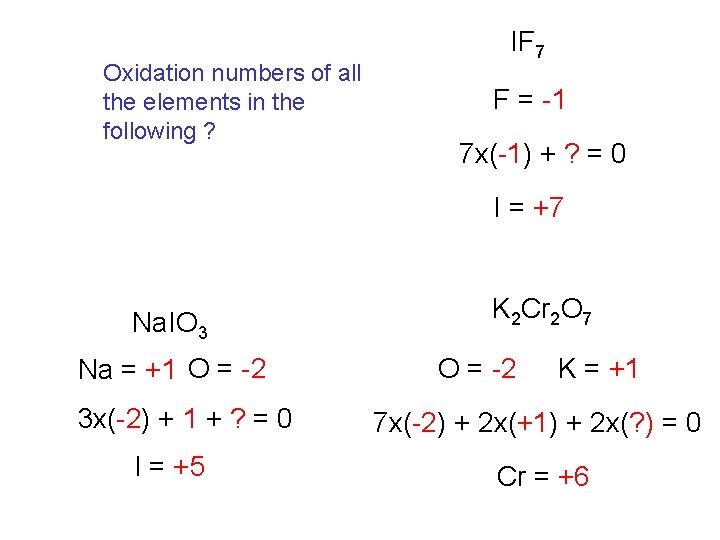
Oxidation numbers of all the elements in the following ? IF 7 F = -1 7 x(-1) + ? = 0 I = +7 Na. IO 3 Na = +1 O = -2 3 x(-2) + 1 + ? = 0 I = +5 K 2 Cr 2 O 7 O = -2 K = +1 7 x(-2) + 2 x(+1) + 2 x(? ) = 0 Cr = +6
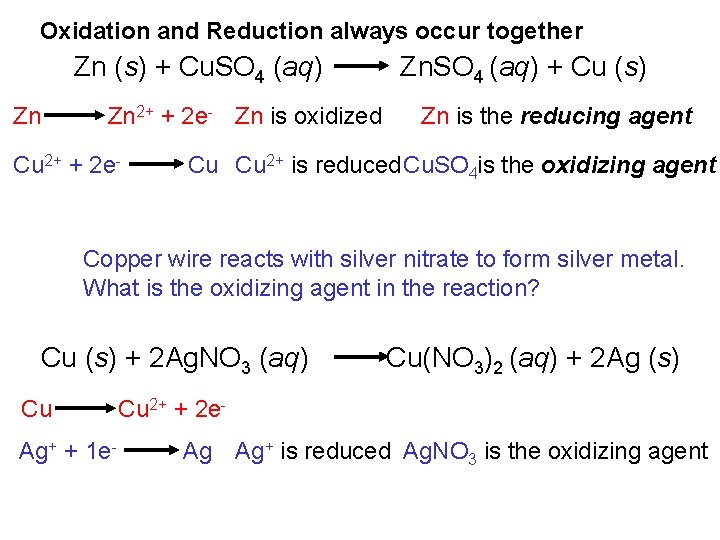
Oxidation and Reduction always occur together Zn (s) + Cu. SO 4 (aq) Zn Zn 2+ + 2 e- Zn is oxidized Cu 2+ + 2 e- Zn. SO 4 (aq) + Cu (s) Zn is the reducing agent Cu Cu 2+ is reduced Cu. SO 4 is the oxidizing agent Copper wire reacts with silver nitrate to form silver metal. What is the oxidizing agent in the reaction? Cu (s) + 2 Ag. NO 3 (aq) Cu Ag+ + 1 e- Cu(NO 3)2 (aq) + 2 Ag (s) Cu 2+ + 2 e. Ag Ag+ is reduced Ag. NO 3 is the oxidizing agent
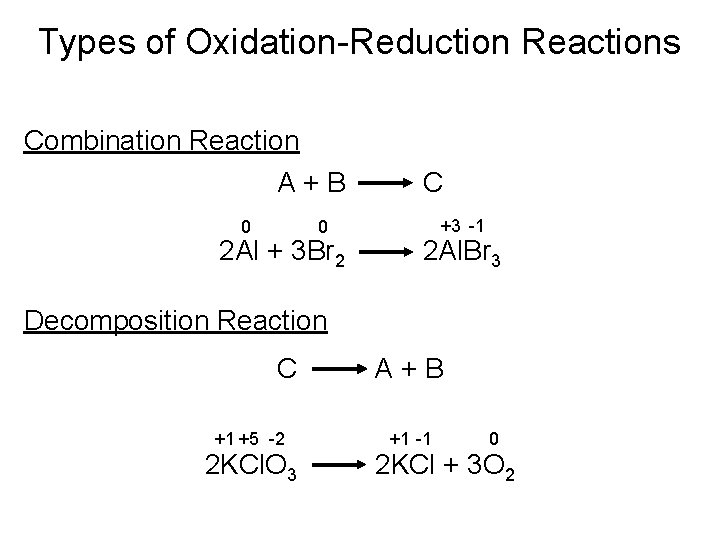
Types of Oxidation-Reduction Reactions Combination Reaction A+B 0 0 2 Al + 3 Br 2 C +3 -1 2 Al. Br 3 Decomposition Reaction C +1 +5 -2 2 KCl. O 3 A+B +1 -1 0 2 KCl + 3 O 2
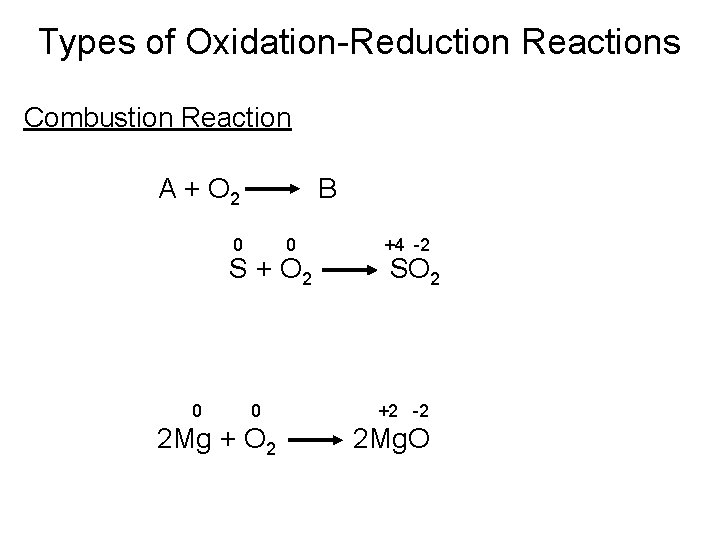
Types of Oxidation-Reduction Reactions Combustion Reaction A + O 2 B 0 0 S + O 2 0 0 2 Mg + O 2 +4 -2 SO 2 +2 -2 2 Mg. O
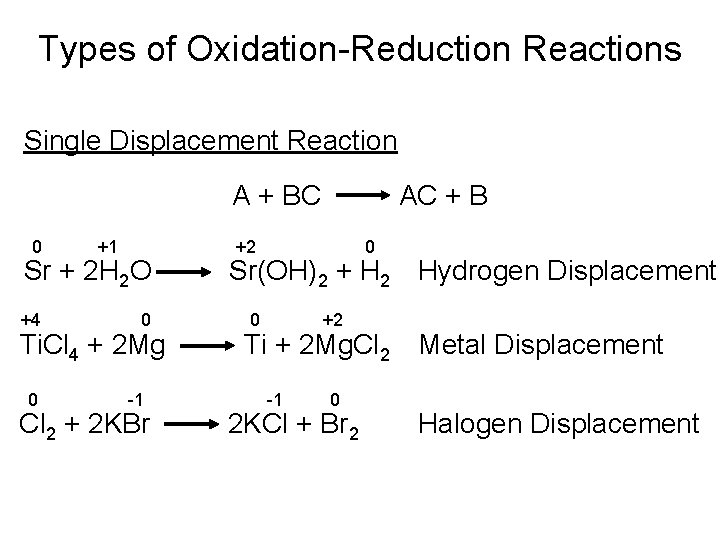
Types of Oxidation-Reduction Reactions Single Displacement Reaction A + BC 0 +1 Sr + 2 H 2 O +4 0 Ti. Cl 4 + 2 Mg 0 -1 Cl 2 + 2 KBr AC + B +2 0 Sr(OH)2 + H 2 Hydrogen Displacement 0 +2 Ti + 2 Mg. Cl 2 Metal Displacement -1 0 2 KCl + Br 2 Halogen Displacement
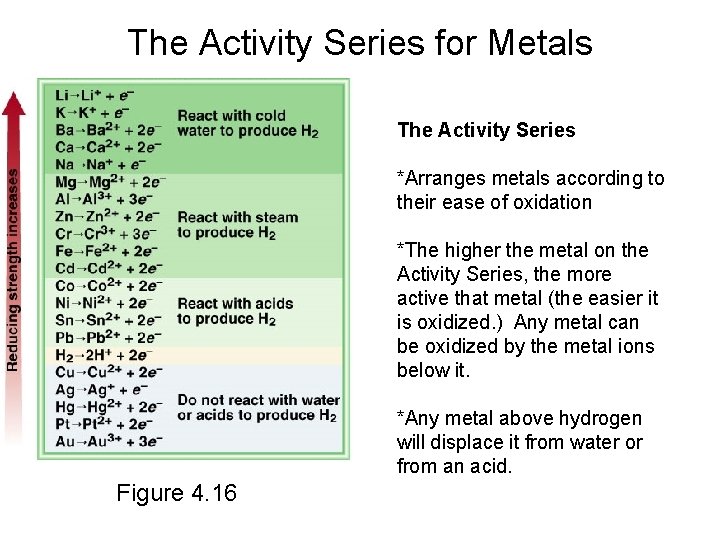
The Activity Series for Metals The Activity Series *Arranges metals according to their ease of oxidation *The higher the metal on the Activity Series, the more active that metal (the easier it is oxidized. ) Any metal can be oxidized by the metal ions below it. *Any metal above hydrogen will displace it from water or from an acid. Figure 4. 16
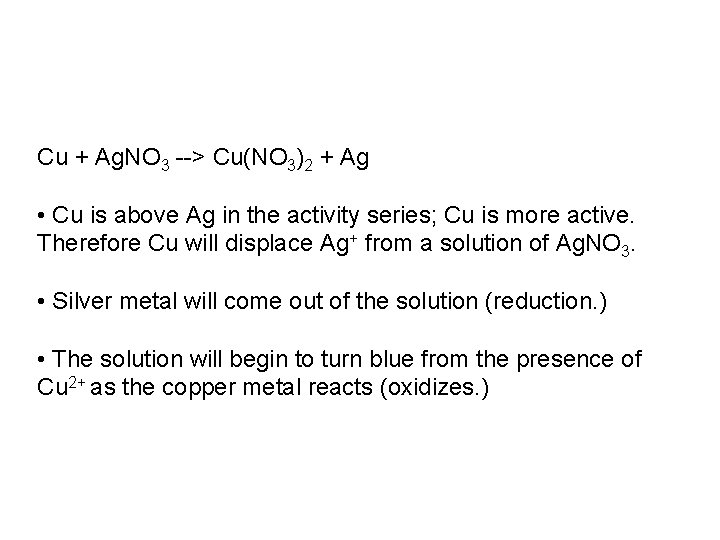
Cu + Ag. NO 3 --> Cu(NO 3)2 + Ag • Cu is above Ag in the activity series; Cu is more active. Therefore Cu will displace Ag+ from a solution of Ag. NO 3. • Silver metal will come out of the solution (reduction. ) • The solution will begin to turn blue from the presence of Cu 2+ as the copper metal reacts (oxidizes. )
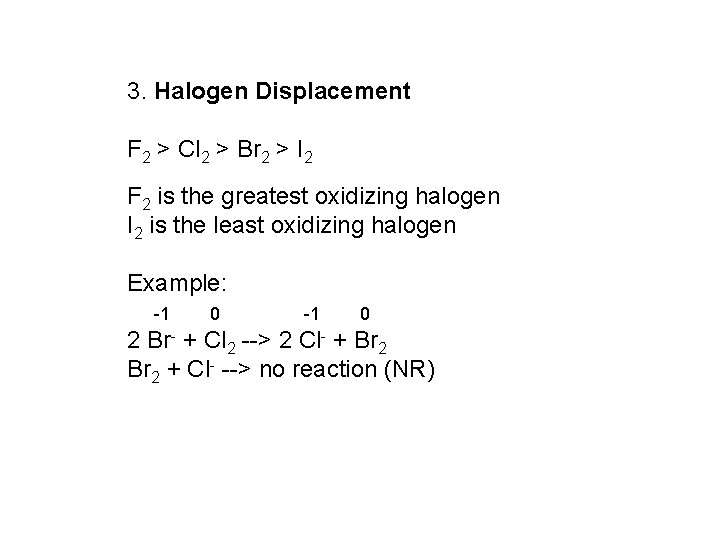
3. Halogen Displacement F 2 > Cl 2 > Br 2 > I 2 F 2 is the greatest oxidizing halogen I 2 is the least oxidizing halogen Example: -1 0 2 Br- + Cl 2 --> 2 Cl- + Br 2 + Cl- --> no reaction (NR)
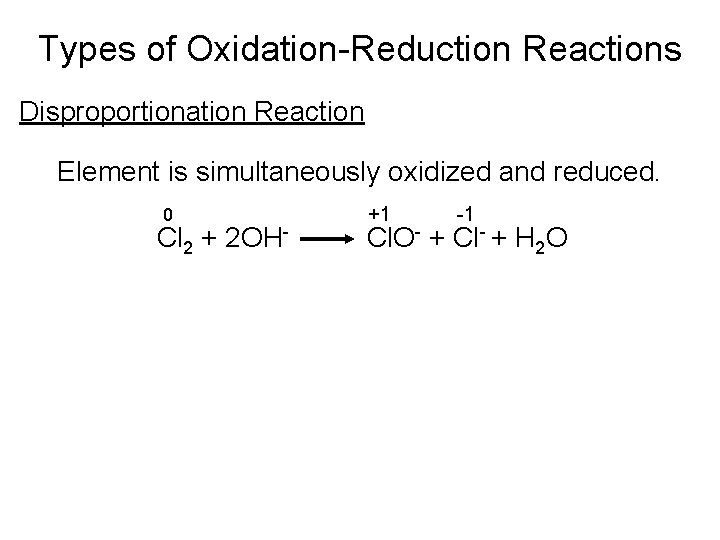
Types of Oxidation-Reduction Reactions Disproportionation Reaction Element is simultaneously oxidized and reduced. 0 Cl 2 + 2 OH- +1 -1 Cl. O- + Cl- + H 2 O
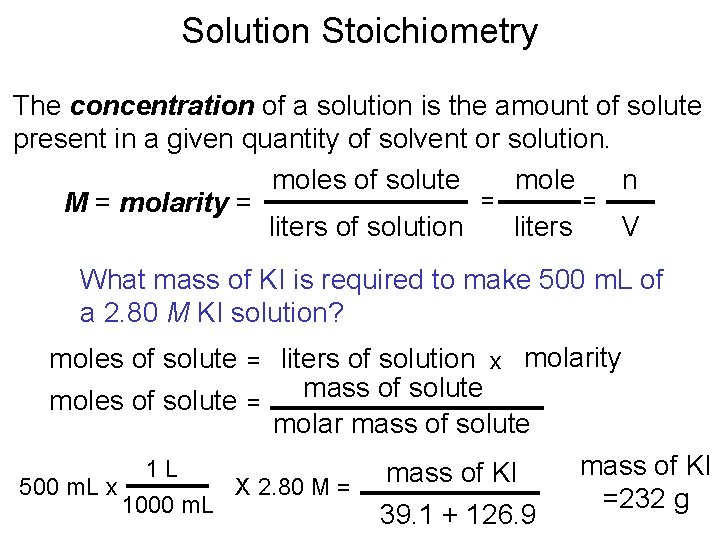
Solution Stoichiometry The concentration of a solution is the amount of solute present in a given quantity of solvent or solution. moles of solute mole n = = M = molarity = liters of solution liters V What mass of KI is required to make 500 m. L of a 2. 80 M KI solution? moles of solute = liters of solution x molarity mass of solute moles of solute = molar mass of solute mass of KI 1 L mass of KI 500 m. L x X 2. 80 M = =232 g 1000 m. L 39. 1 + 126. 9
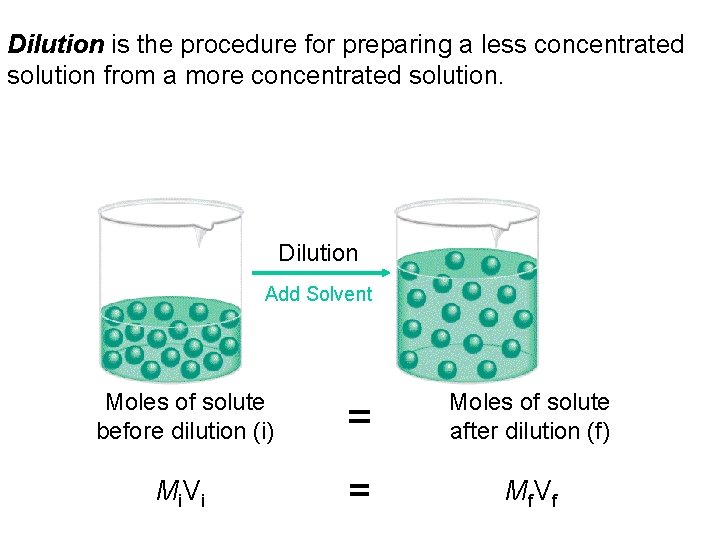
Dilution is the procedure for preparing a less concentrated solution from a more concentrated solution. Dilution Add Solvent Moles of solute before dilution (i) = Moles of solute after dilution (f) Mi V i = Mf V f
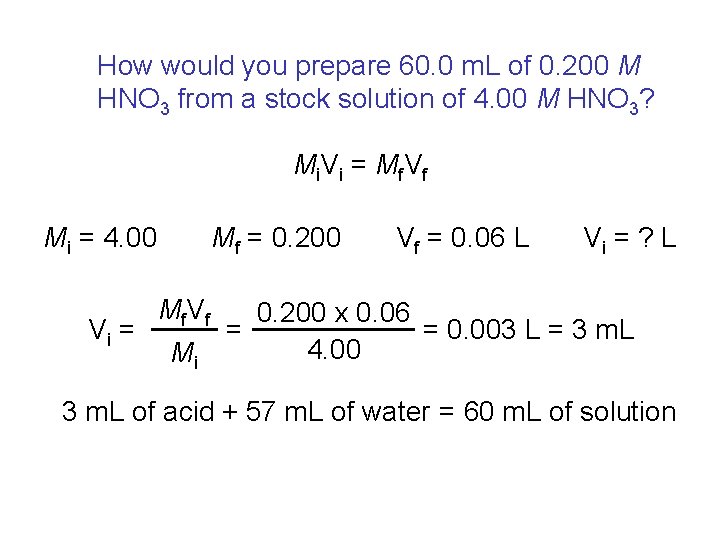
How would you prepare 60. 0 m. L of 0. 200 M HNO 3 from a stock solution of 4. 00 M HNO 3? Mi V i = Mf V f Mi = 4. 00 Vi = Mf = 0. 200 Mf V f Mi Vf = 0. 06 L Vi = ? L 0. 200 x 0. 06 = 0. 003 L = 3 m. L = 4. 00 3 m. L of acid + 57 m. L of water = 60 m. L of solution
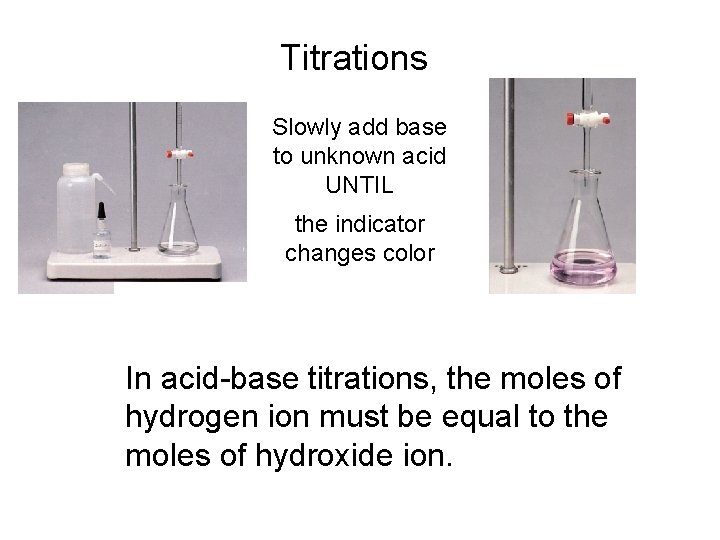
Titrations Slowly add base to unknown acid UNTIL the indicator changes color In acid-base titrations, the moles of hydrogen ion must be equal to the moles of hydroxide ion.
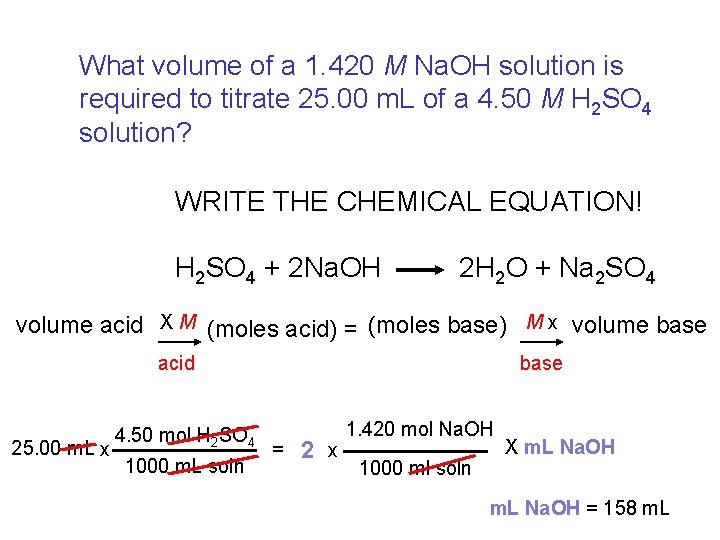
What volume of a 1. 420 M Na. OH solution is required to titrate 25. 00 m. L of a 4. 50 M H 2 SO 4 solution? WRITE THE CHEMICAL EQUATION! H 2 SO 4 + 2 Na. OH 2 H 2 O + Na 2 SO 4 volume acid X M (moles acid) = (moles base) M x volume base acid 25. 00 m. L x 4. 50 mol H 2 SO 4 1000 m. L soln base = 2 x 1. 420 mol Na. OH 1000 ml soln X m. L Na. OH = 158 m. L
- Slides: 39