
Chapter 4 Reactions in Aqueous Solution 2015 Pearson

- Slides: 39
Chapter 4 Reactions in Aqueous Solution © 2015 Pearson Education, Inc.
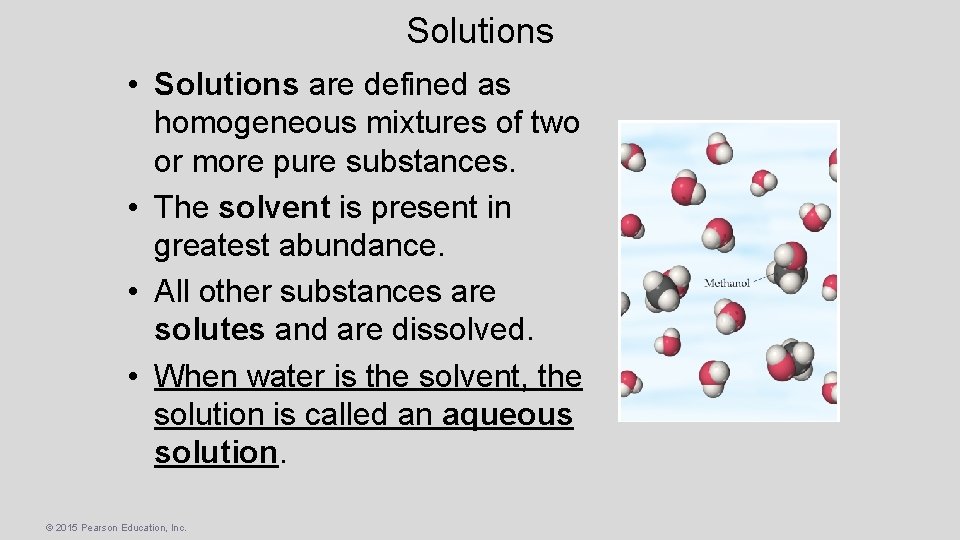
Solutions • Solutions are defined as homogeneous mixtures of two or more pure substances. • The solvent is present in greatest abundance. • All other substances are solutes and are dissolved. • When water is the solvent, the solution is called an aqueous solution. © 2015 Pearson Education, Inc.
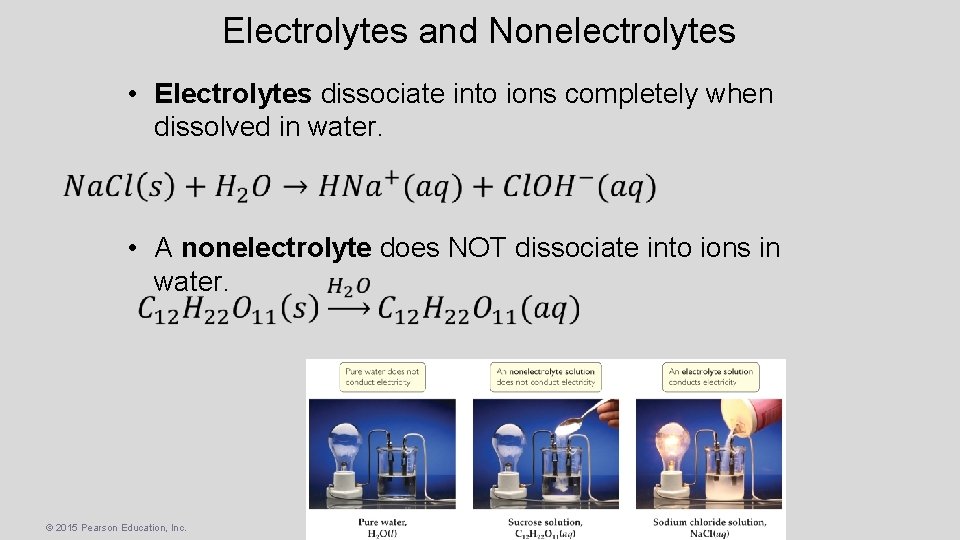
Electrolytes and Nonelectrolytes • Electrolytes dissociate into ions completely when dissolved in water. • A nonelectrolyte does NOT dissociate into ions in water. © 2015 Pearson Education, Inc.
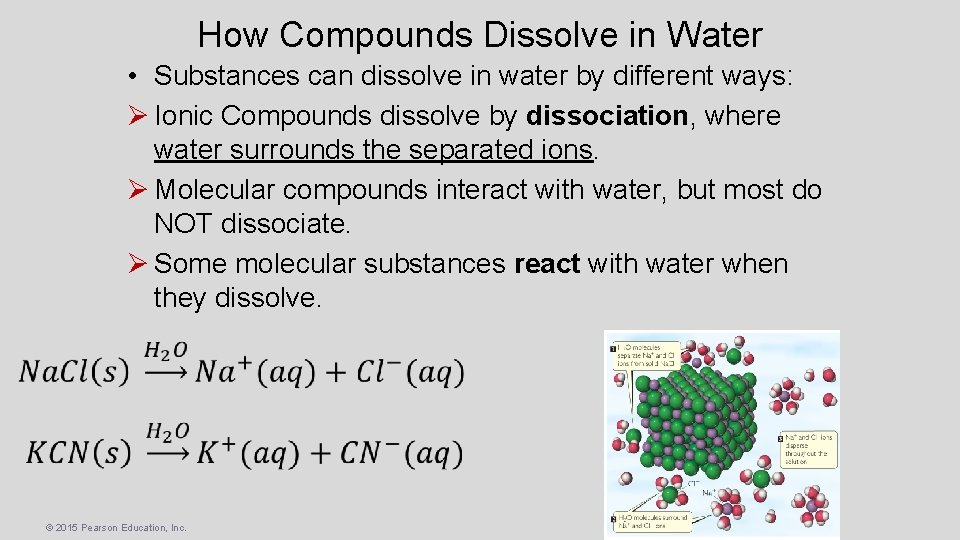
How Compounds Dissolve in Water • Substances can dissolve in water by different ways: Ø Ionic Compounds dissolve by dissociation, where water surrounds the separated ions. Ø Molecular compounds interact with water, but most do NOT dissociate. Ø Some molecular substances react with water when they dissolve. © 2015 Pearson Education, Inc.
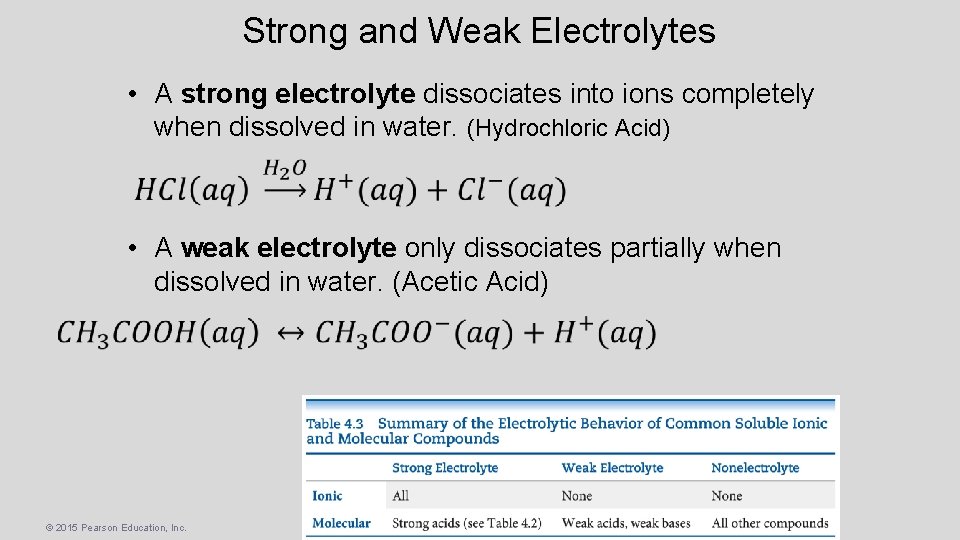
Strong and Weak Electrolytes • A strong electrolyte dissociates into ions completely when dissolved in water. (Hydrochloric Acid) • A weak electrolyte only dissociates partially when dissolved in water. (Acetic Acid) © 2015 Pearson Education, Inc.
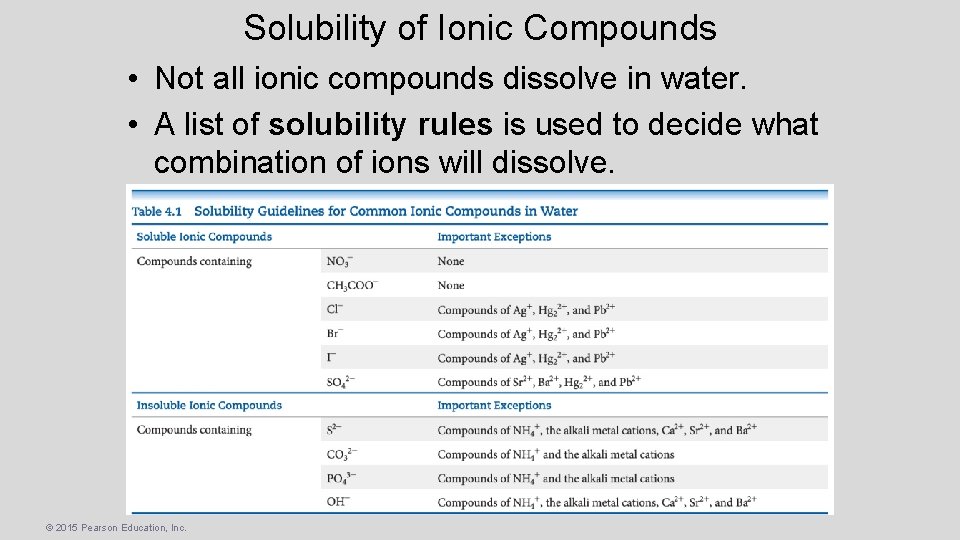
Solubility of Ionic Compounds • Not all ionic compounds dissolve in water. • A list of solubility rules is used to decide what combination of ions will dissolve. © 2015 Pearson Education, Inc.
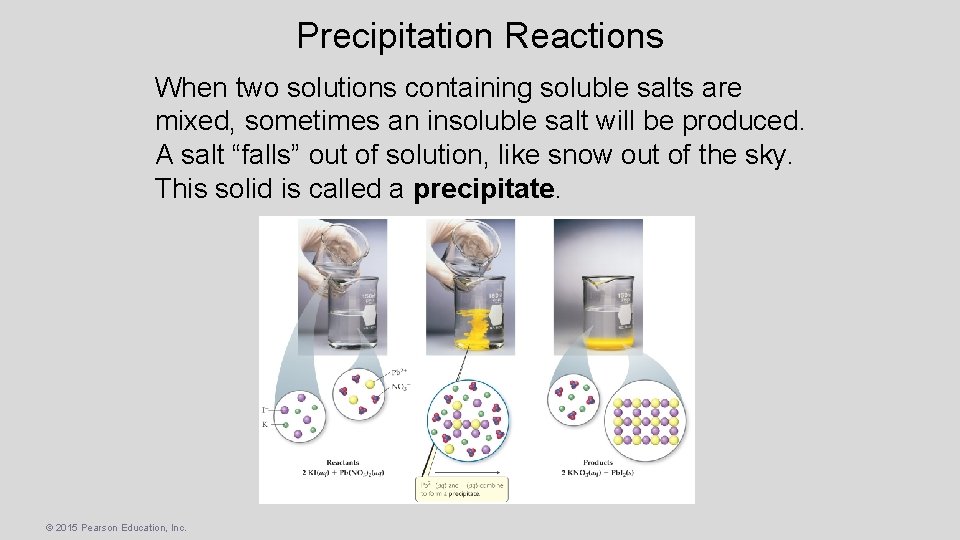
Precipitation Reactions When two solutions containing soluble salts are mixed, sometimes an insoluble salt will be produced. A salt “falls” out of solution, like snow out of the sky. This solid is called a precipitate. © 2015 Pearson Education, Inc.
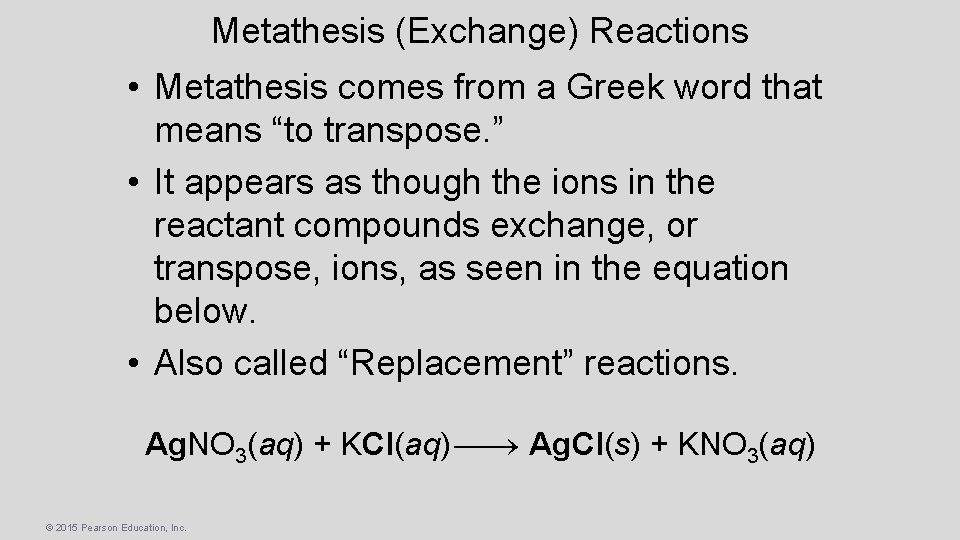
Metathesis (Exchange) Reactions • Metathesis comes from a Greek word that means “to transpose. ” • It appears as though the ions in the reactant compounds exchange, or transpose, ions, as seen in the equation below. • Also called “Replacement” reactions. Ag. NO 3(aq) + KCl(aq) Ag. Cl(s) + KNO 3(aq) © 2015 Pearson Education, Inc.
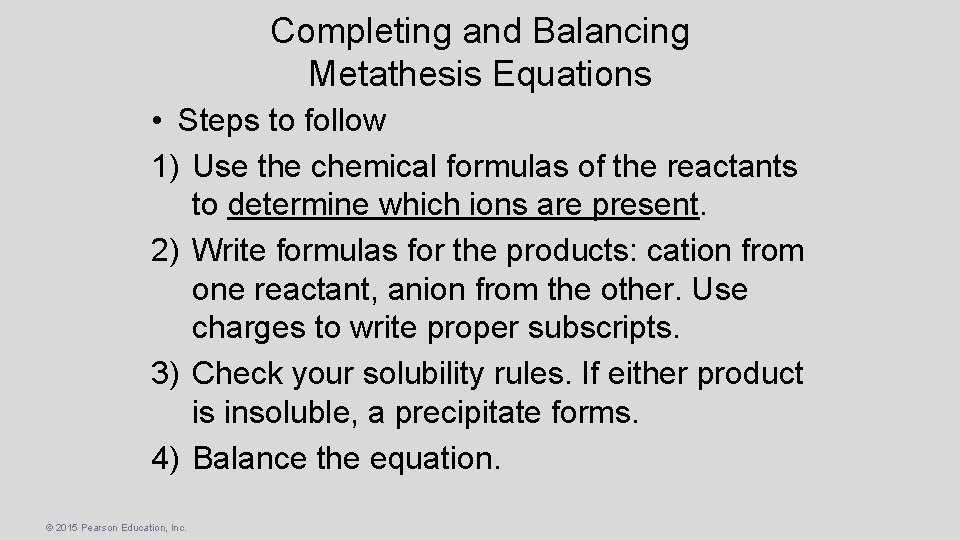
Completing and Balancing Metathesis Equations • Steps to follow 1) Use the chemical formulas of the reactants to determine which ions are present. 2) Write formulas for the products: cation from one reactant, anion from the other. Use charges to write proper subscripts. 3) Check your solubility rules. If either product is insoluble, a precipitate forms. 4) Balance the equation. © 2015 Pearson Education, Inc.
Ways to Write Metathesis Reactions 1)Molecular equation 2)Complete ionic equation 3)Net ionic equation © 2015 Pearson Education, Inc.
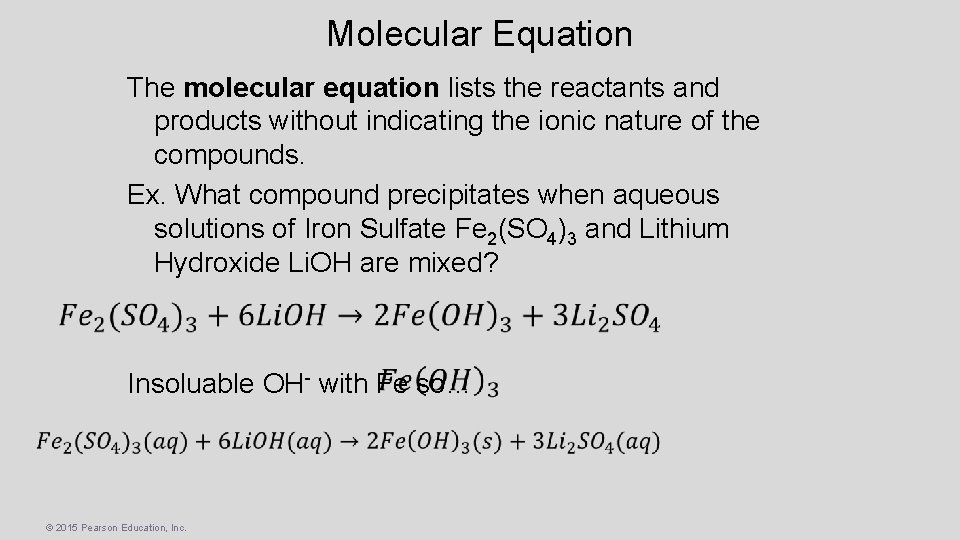
Molecular Equation The molecular equation lists the reactants and products without indicating the ionic nature of the compounds. Ex. What compound precipitates when aqueous solutions of Iron Sulfate Fe 2(SO 4)3 and Lithium Hydroxide Li. OH are mixed? Insoluable OH- with Fe so… © 2015 Pearson Education, Inc.
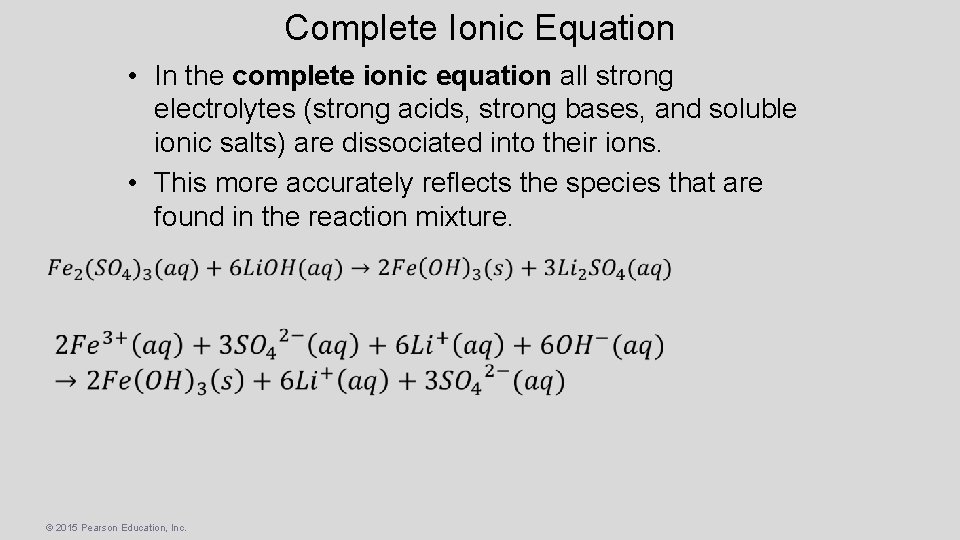
Complete Ionic Equation • In the complete ionic equation all strong electrolytes (strong acids, strong bases, and soluble ionic salts) are dissociated into their ions. • This more accurately reflects the species that are found in the reaction mixture. © 2015 Pearson Education, Inc.
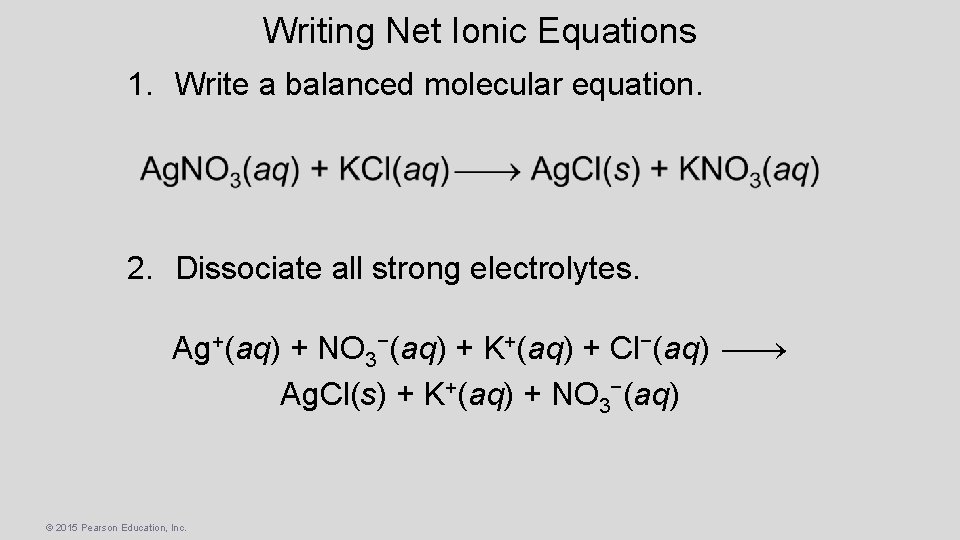
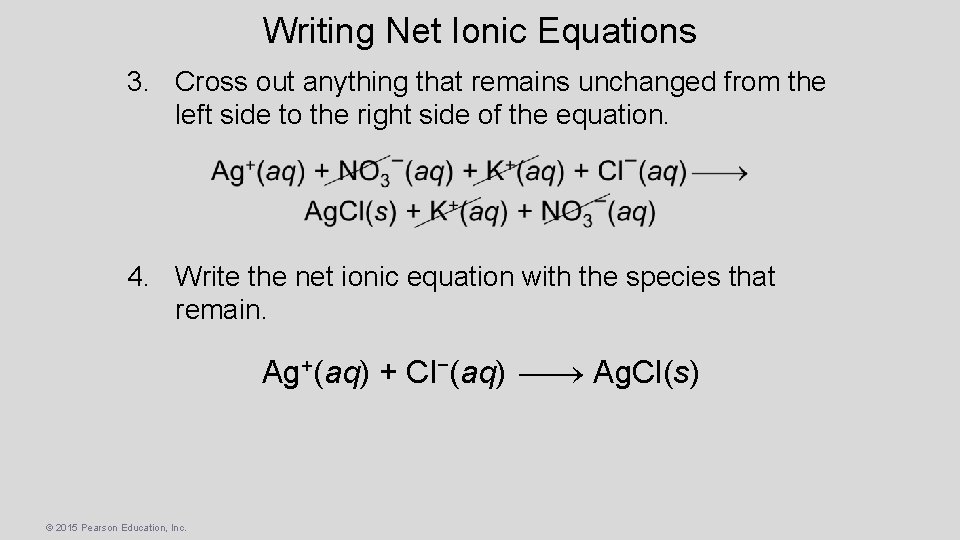
Writing Net Ionic Equations 1. Write a balanced molecular equation. 2. Dissociate all strong electrolytes. Ag+(aq) + NO 3−(aq) + K+(aq) + Cl−(aq) Ag. Cl(s) + K+(aq) + NO 3−(aq) © 2015 Pearson Education, Inc.
Writing Net Ionic Equations 3. Cross out anything that remains unchanged from the left side to the right side of the equation. 4. Write the net ionic equation with the species that remain. Ag+(aq) + Cl−(aq) Ag. Cl(s) © 2015 Pearson Education, Inc.
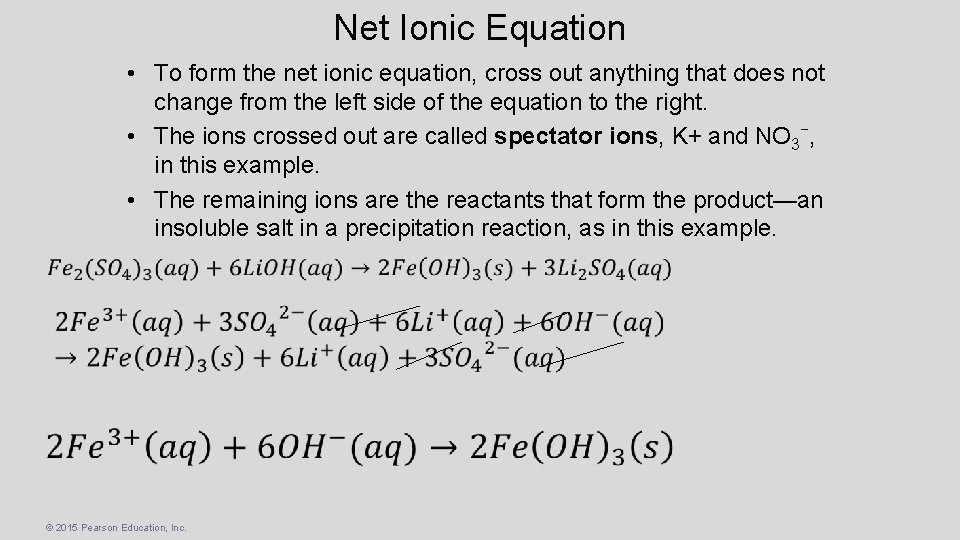
Net Ionic Equation • To form the net ionic equation, cross out anything that does not change from the left side of the equation to the right. • The ions crossed out are called spectator ions, K+ and NO 3−, in this example. • The remaining ions are the reactants that form the product—an insoluble salt in a precipitation reaction, as in this example. © 2015 Pearson Education, Inc.
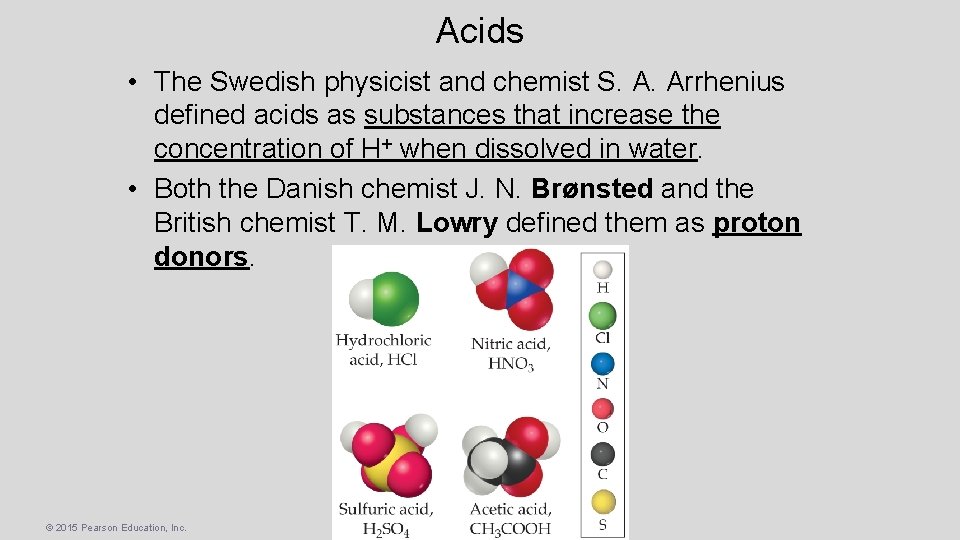
Acids • The Swedish physicist and chemist S. A. Arrhenius defined acids as substances that increase the concentration of H+ when dissolved in water. • Both the Danish chemist J. N. Brønsted and the British chemist T. M. Lowry defined them as proton donors. © 2015 Pearson Education, Inc.
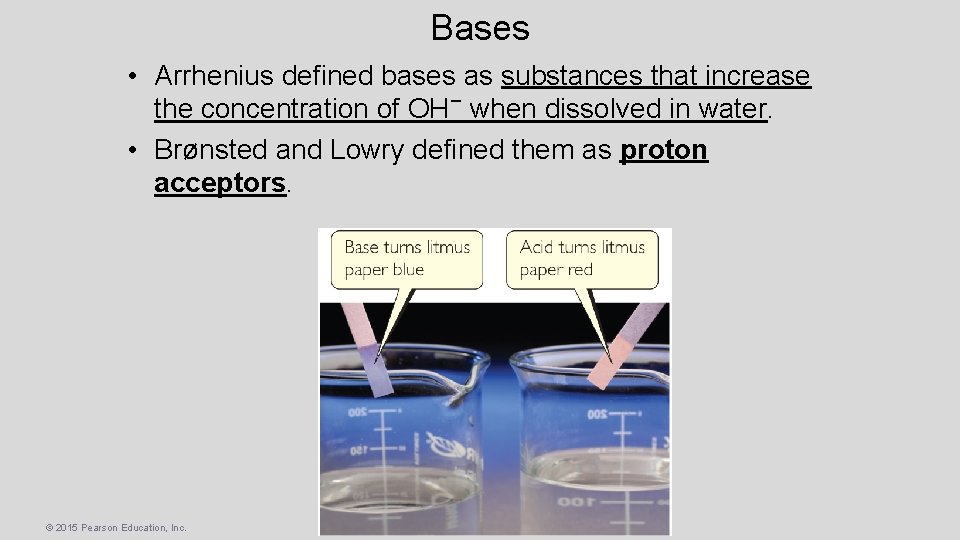
Bases • Arrhenius defined bases as substances that increase the concentration of OH− when dissolved in water. • Brønsted and Lowry defined them as proton acceptors. © 2015 Pearson Education, Inc.
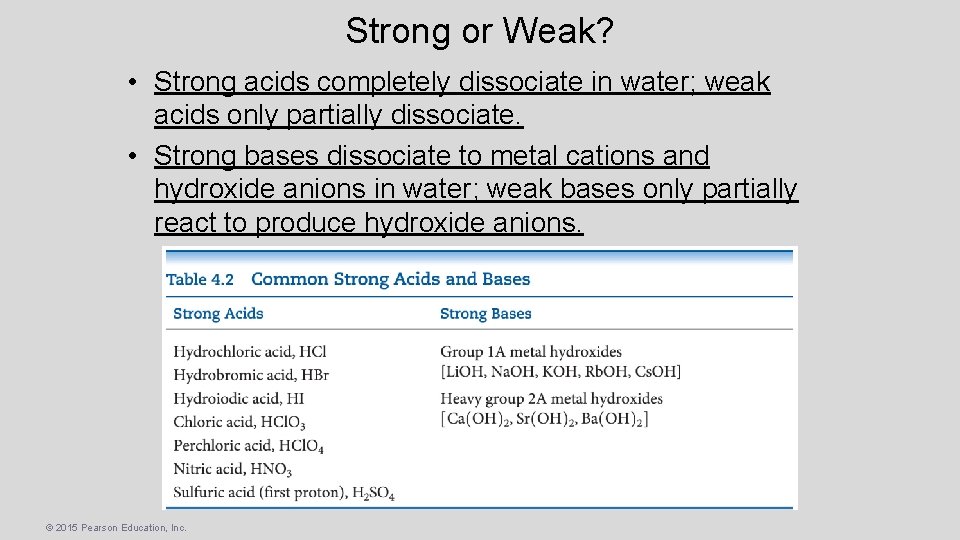
Strong or Weak? • Strong acids completely dissociate in water; weak acids only partially dissociate. • Strong bases dissociate to metal cations and hydroxide anions in water; weak bases only partially react to produce hydroxide anions. © 2015 Pearson Education, Inc.
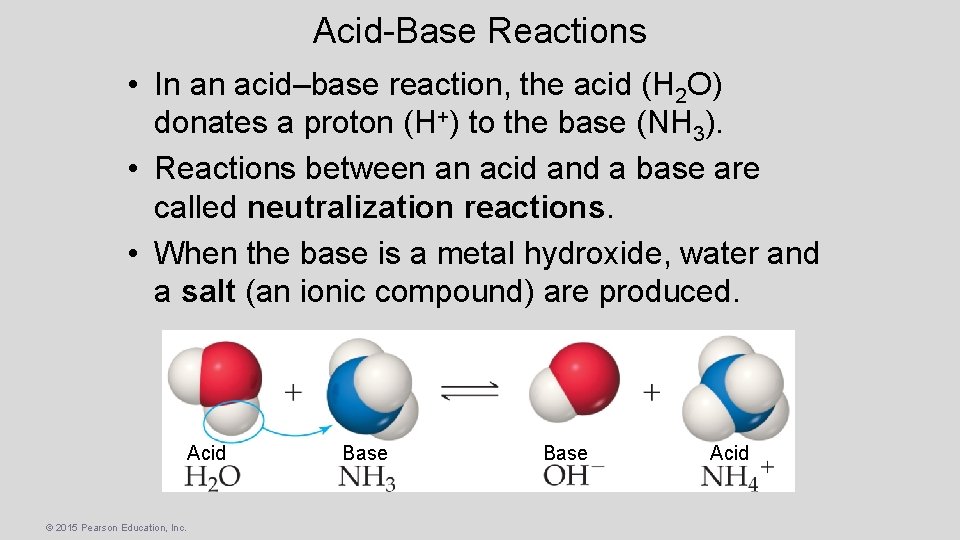
Acid-Base Reactions • In an acid–base reaction, the acid (H 2 O) donates a proton (H+) to the base (NH 3). • Reactions between an acid and a base are called neutralization reactions. • When the base is a metal hydroxide, water and a salt (an ionic compound) are produced. Acid © 2015 Pearson Education, Inc. Base Acid
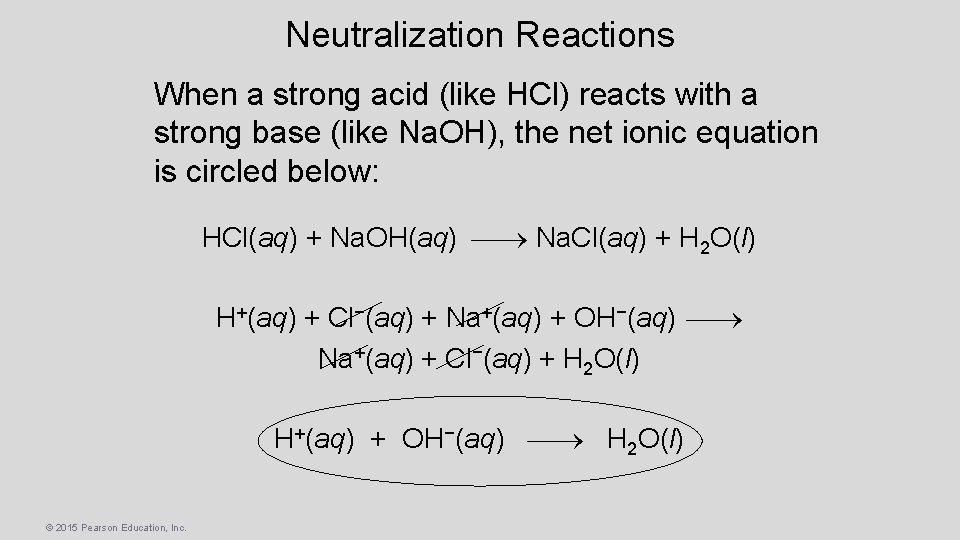
Neutralization Reactions When a strong acid (like HCl) reacts with a strong base (like Na. OH), the net ionic equation is circled below: HCl(aq) + Na. OH(aq) Na. Cl(aq) + H 2 O(l) H+(aq) + Cl−(aq) + Na+(aq) + OH−(aq) Na+(aq) + Cl−(aq) + H 2 O(l) H+(aq) + OH−(aq) H 2 O(l) © 2015 Pearson Education, Inc.
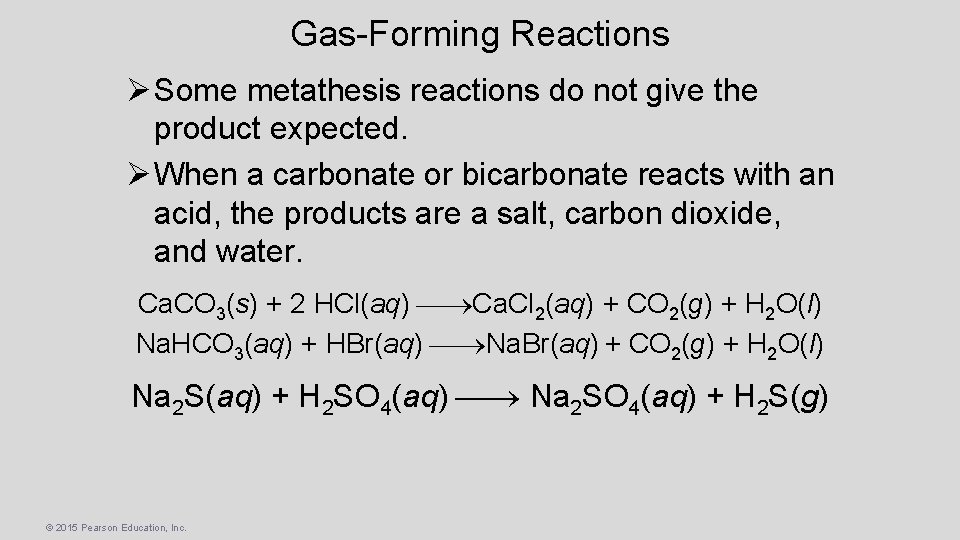
Gas-Forming Reactions Ø Some metathesis reactions do not give the product expected. Ø When a carbonate or bicarbonate reacts with an acid, the products are a salt, carbon dioxide, and water. Ca. CO 3(s) + 2 HCl(aq) Ca. Cl 2(aq) + CO 2(g) + H 2 O(l) Na. HCO 3(aq) + HBr(aq) Na. Br(aq) + CO 2(g) + H 2 O(l) Na 2 S(aq) + H 2 SO 4(aq) Na 2 SO 4(aq) + H 2 S(g) © 2015 Pearson Education, Inc.
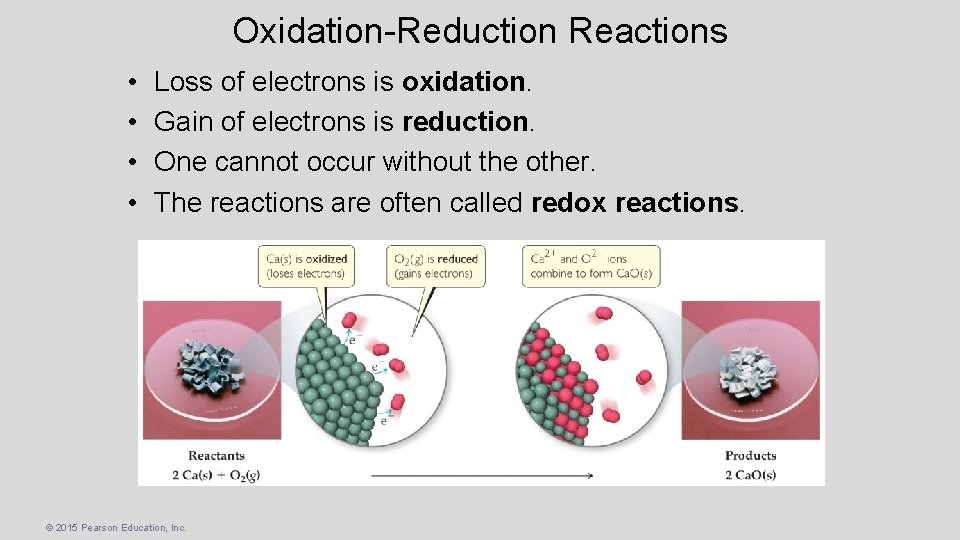
Oxidation-Reduction Reactions • • Loss of electrons is oxidation. Gain of electrons is reduction. One cannot occur without the other. The reactions are often called redox reactions. © 2015 Pearson Education, Inc.
Oxidation Numbers To determine if an oxidation–reduction reaction has occurred, we assign an oxidation number to each element in a neutral compound or charged entity. • Elements in their elemental form have an oxidation number of zero. • The oxidation number of a monatomic ion is the same as its charge. (Na is +1, Br is -1, etc) © 2015 Pearson Education, Inc.
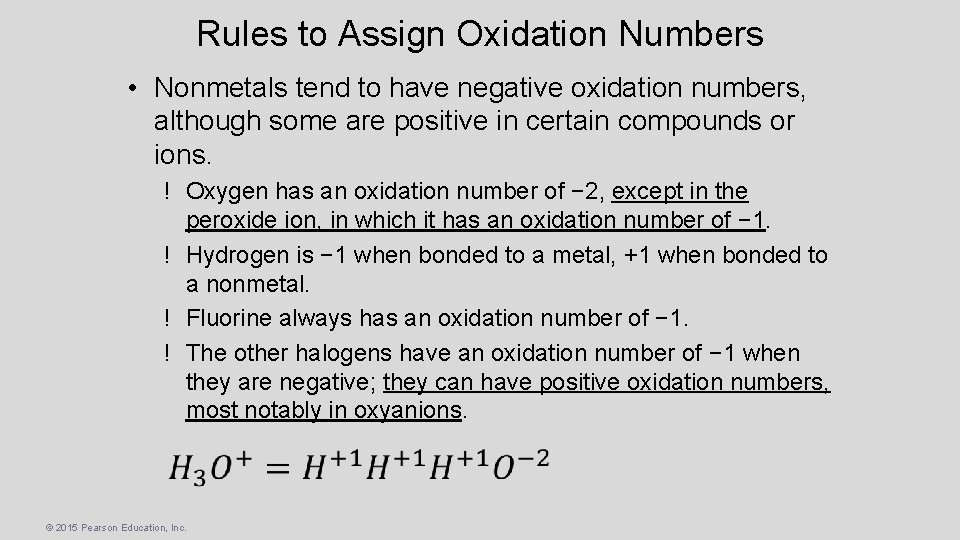
Rules to Assign Oxidation Numbers • Nonmetals tend to have negative oxidation numbers, although some are positive in certain compounds or ions. ! Oxygen has an oxidation number of − 2, except in the peroxide ion, in which it has an oxidation number of − 1. ! Hydrogen is − 1 when bonded to a metal, +1 when bonded to a nonmetal. ! Fluorine always has an oxidation number of − 1. ! The other halogens have an oxidation number of − 1 when they are negative; they can have positive oxidation numbers, most notably in oxyanions. © 2015 Pearson Education, Inc.
Rules to Assign Oxidation Numbers ! The sum of the oxidation numbers in a neutral compound is zero. ! The sum of the oxidation numbers in a polyatomic ion is the charge on the ion. © 2015 Pearson Education, Inc.
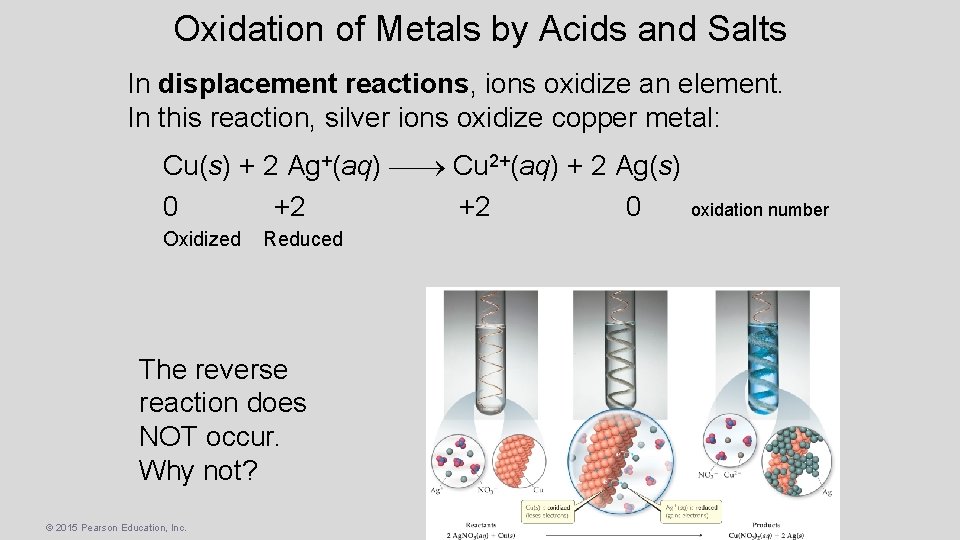
Oxidation of Metals by Acids and Salts In displacement reactions, ions oxidize an element. In this reaction, silver ions oxidize copper metal: Cu(s) + 2 Ag+(aq) Cu 2+(aq) + 2 Ag(s) 0 +2 +2 0 Oxidized Reduced The reverse reaction does NOT occur. Why not? © 2015 Pearson Education, Inc. oxidation number
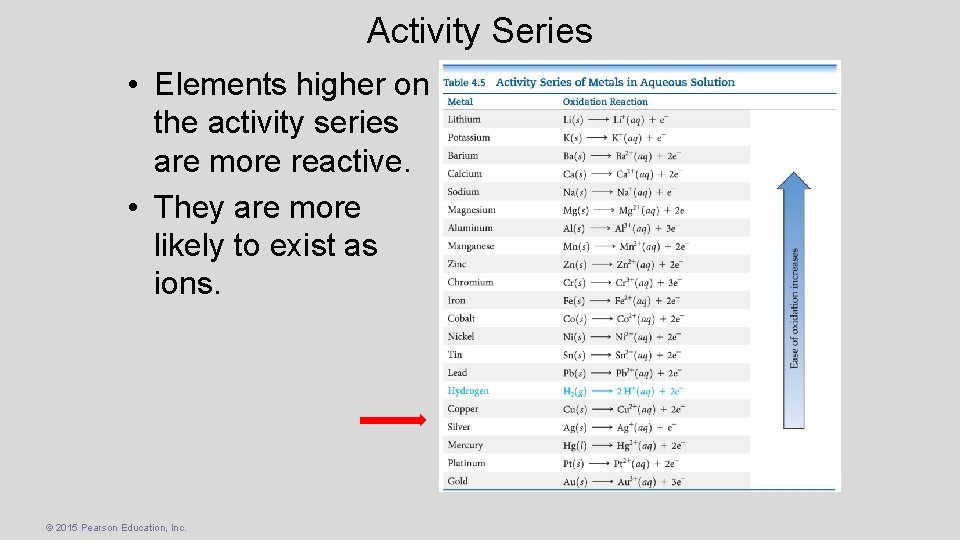
Activity Series • Elements higher on the activity series are more reactive. • They are more likely to exist as ions. © 2015 Pearson Education, Inc.
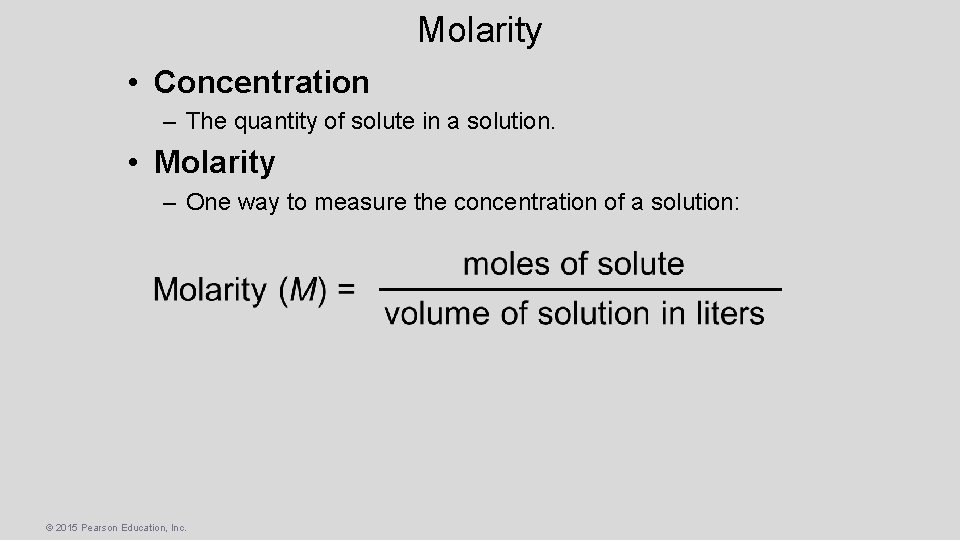
Molarity • Concentration – The quantity of solute in a solution. • Molarity – One way to measure the concentration of a solution: © 2015 Pearson Education, Inc.
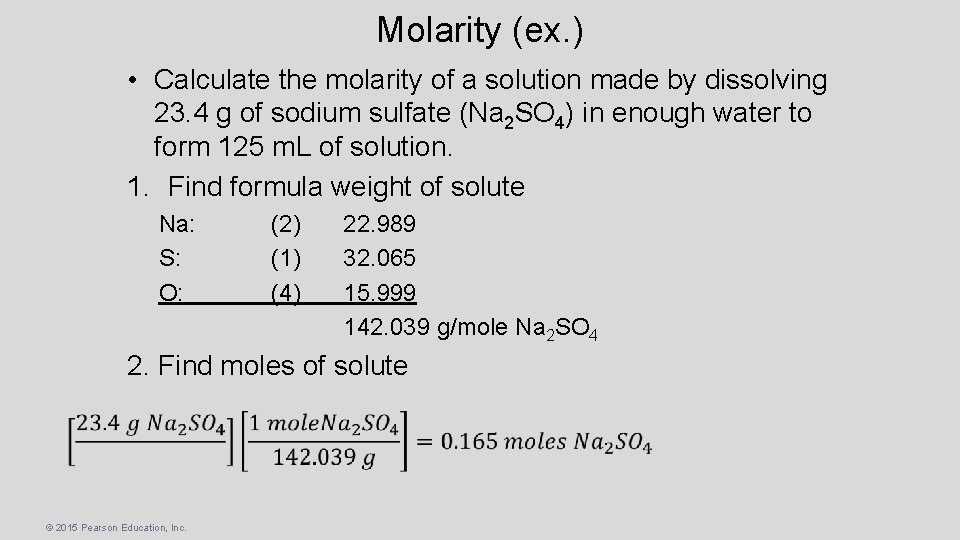
Molarity (ex. ) • Calculate the molarity of a solution made by dissolving 23. 4 g of sodium sulfate (Na 2 SO 4) in enough water to form 125 m. L of solution. 1. Find formula weight of solute Na: S: O: (2) (1) (4) 22. 989 32. 065 15. 999 142. 039 g/mole Na 2 SO 4 2. Find moles of solute © 2015 Pearson Education, Inc.
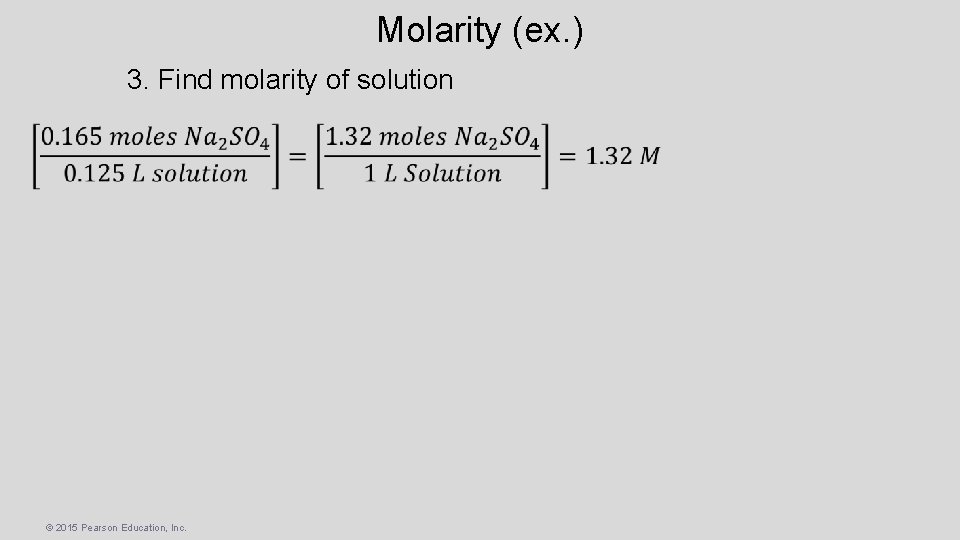
Molarity (ex. ) 3. Find molarity of solution © 2015 Pearson Education, Inc.
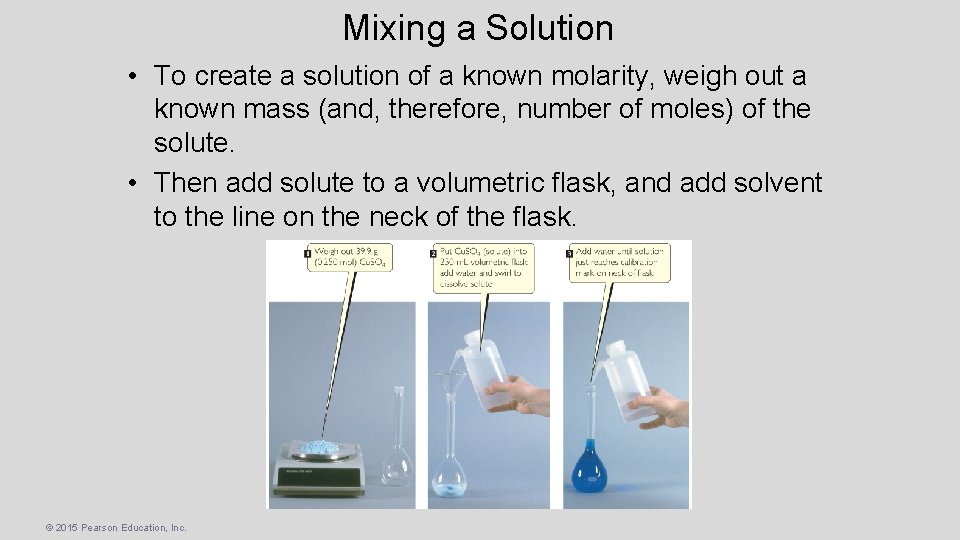
Mixing a Solution • To create a solution of a known molarity, weigh out a known mass (and, therefore, number of moles) of the solute. • Then add solute to a volumetric flask, and add solvent to the line on the neck of the flask. © 2015 Pearson Education, Inc.
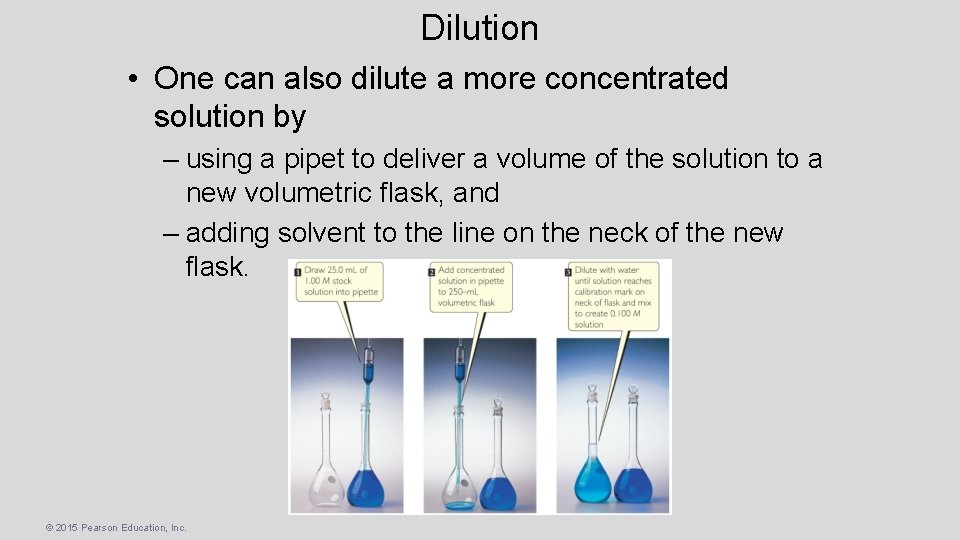
Dilution • One can also dilute a more concentrated solution by – using a pipet to deliver a volume of the solution to a new volumetric flask, and – adding solvent to the line on the neck of the new flask. © 2015 Pearson Education, Inc.
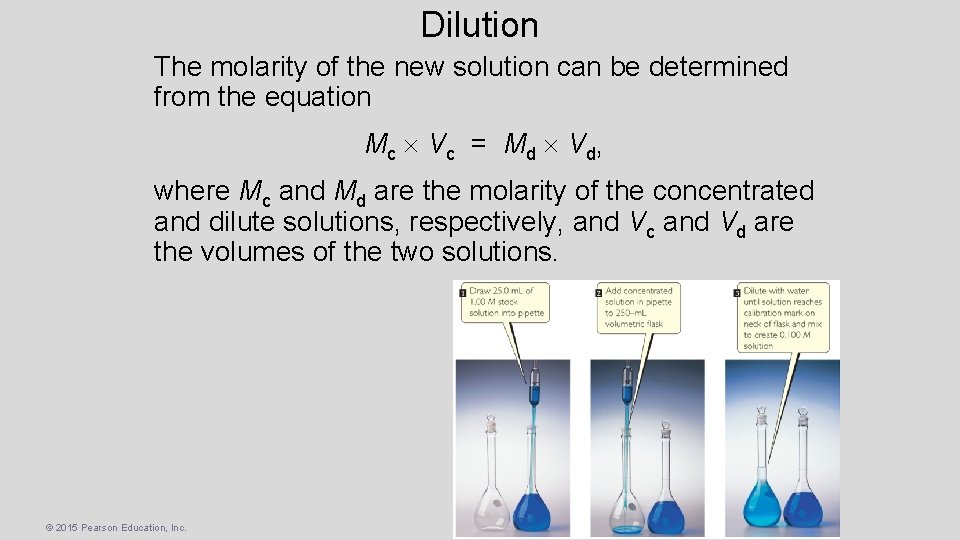
Dilution The molarity of the new solution can be determined from the equation Mc V c = Md V d , where Mc and Md are the molarity of the concentrated and dilute solutions, respectively, and Vc and Vd are the volumes of the two solutions. © 2015 Pearson Education, Inc.
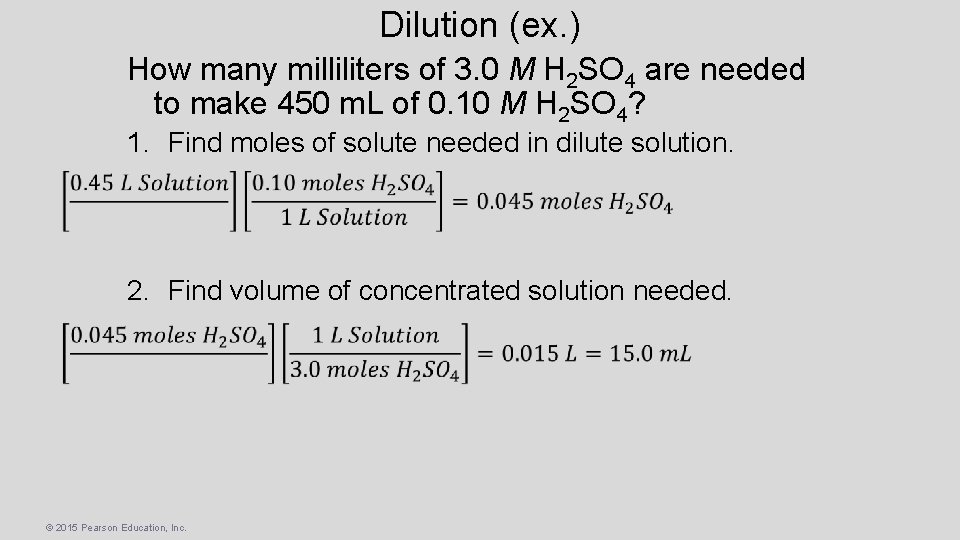
Dilution (ex. ) How many milliliters of 3. 0 M H 2 SO 4 are needed to make 450 m. L of 0. 10 M H 2 SO 4? 1. Find moles of solute needed in dilute solution. 2. Find volume of concentrated solution needed. © 2015 Pearson Education, Inc.
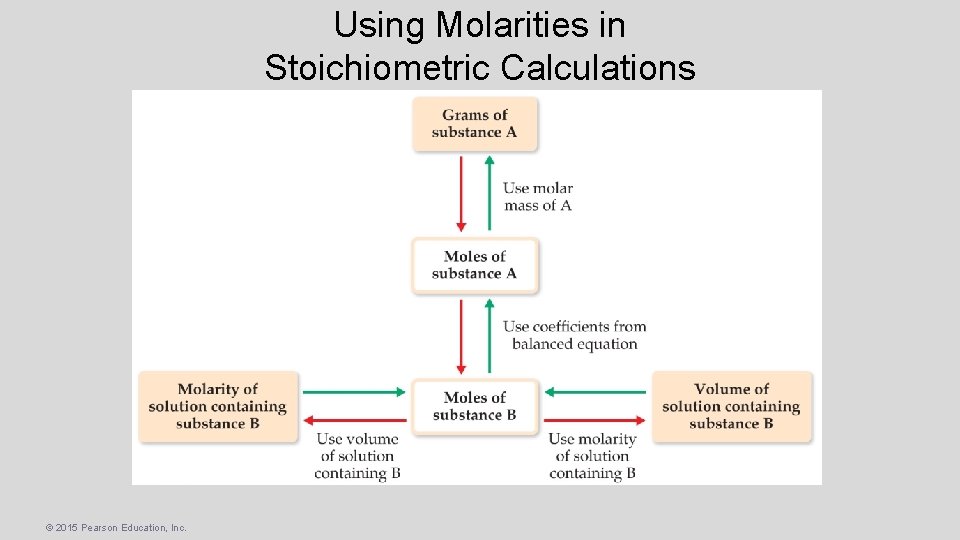
Using Molarities in Stoichiometric Calculations © 2015 Pearson Education, Inc.
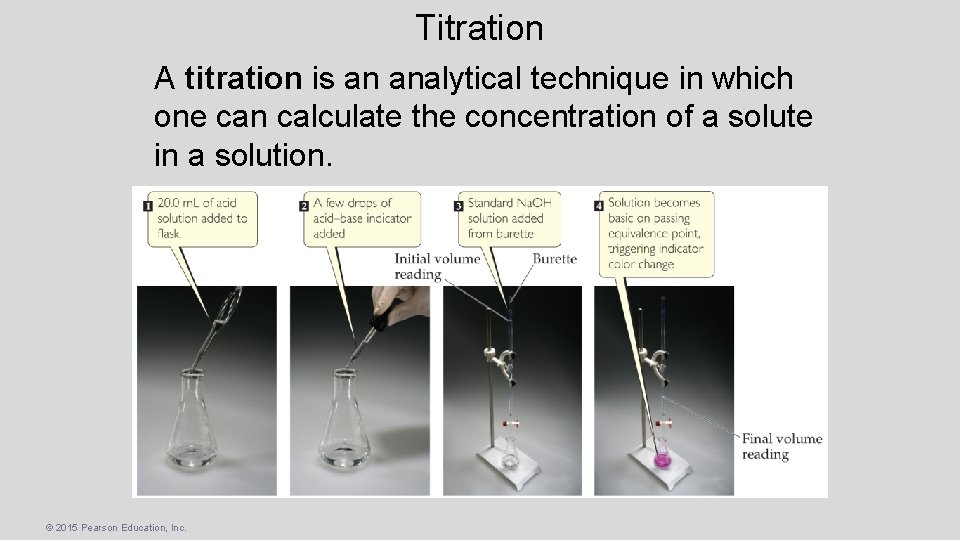
Titration A titration is an analytical technique in which one can calculate the concentration of a solute in a solution. © 2015 Pearson Education, Inc.
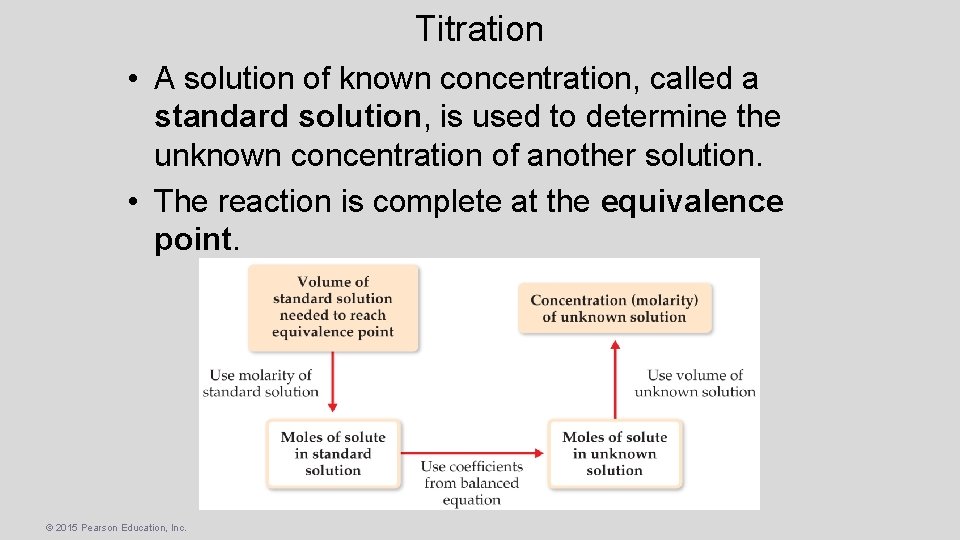
Titration • A solution of known concentration, called a standard solution, is used to determine the unknown concentration of another solution. • The reaction is complete at the equivalence point. © 2015 Pearson Education, Inc.
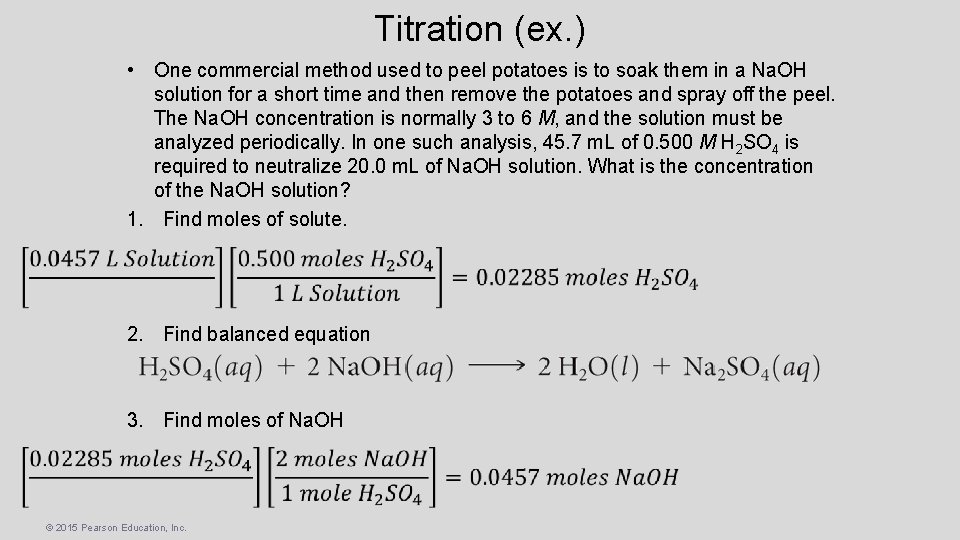
Titration (ex. ) • One commercial method used to peel potatoes is to soak them in a Na. OH solution for a short time and then remove the potatoes and spray off the peel. The Na. OH concentration is normally 3 to 6 M, and the solution must be analyzed periodically. In one such analysis, 45. 7 m. L of 0. 500 M H 2 SO 4 is required to neutralize 20. 0 m. L of Na. OH solution. What is the concentration of the Na. OH solution? 1. Find moles of solute. 2. Find balanced equation 3. Find moles of Na. OH © 2015 Pearson Education, Inc.
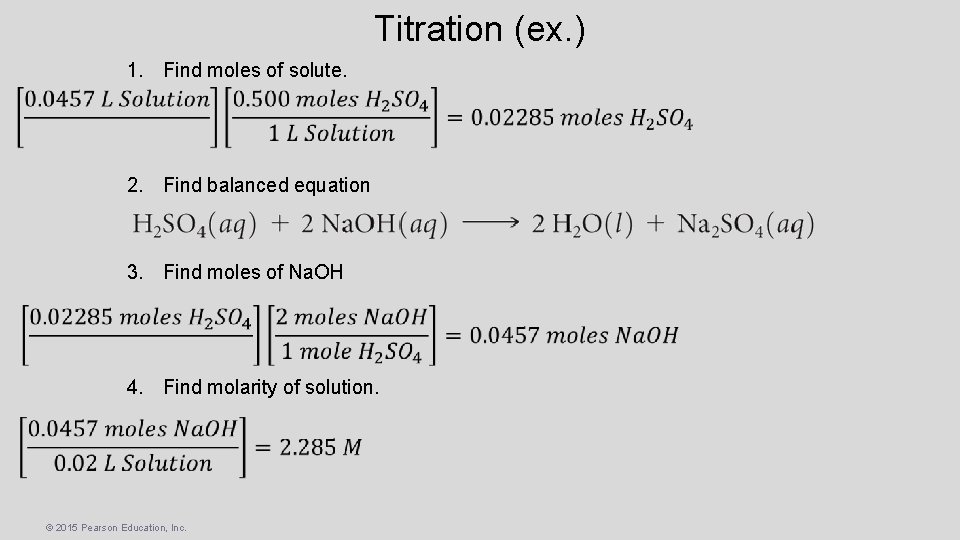
Titration (ex. ) 1. Find moles of solute. 2. Find balanced equation 3. Find moles of Na. OH 4. Find molarity of solution. © 2015 Pearson Education, Inc.