
Chapter 4 Process design Source Joe Schwarz www
- Slides: 44
Chapter 4 Process design Source: Joe Schwarz, www. joyrides. com Slack, Chambers and Johnston, Operations Management 5 th Edition © Nigel Slack, Stuart Chambers, and Robert Johnston 2007
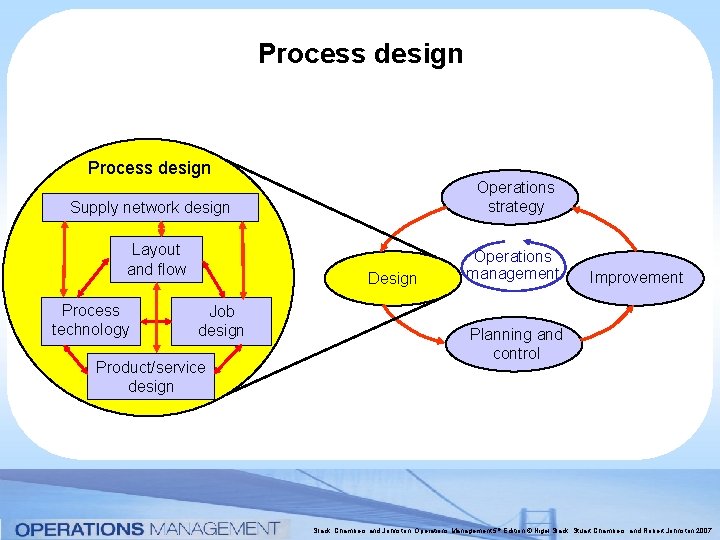
Process design Operations strategy Supply network design Layout and flow Process technology Design Job design Product/service design Operations management Improvement Planning and control Slack, Chambers and Johnston, Operations Management 5 th Edition © Nigel Slack, Stuart Chambers, and Robert Johnston 2007
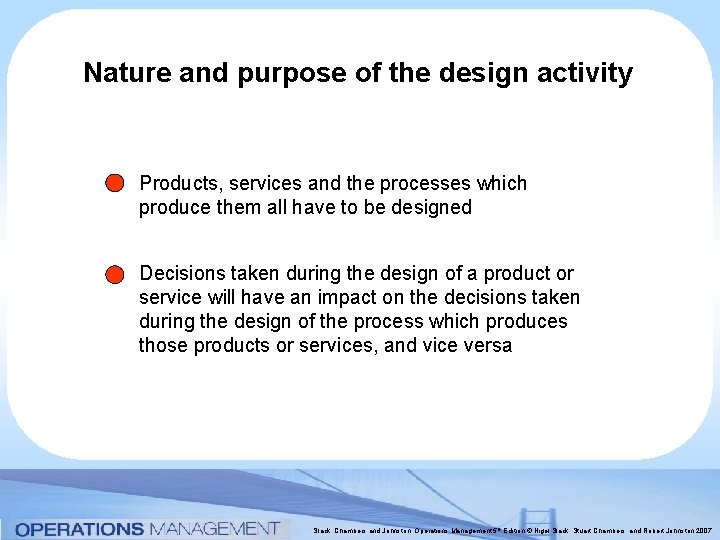
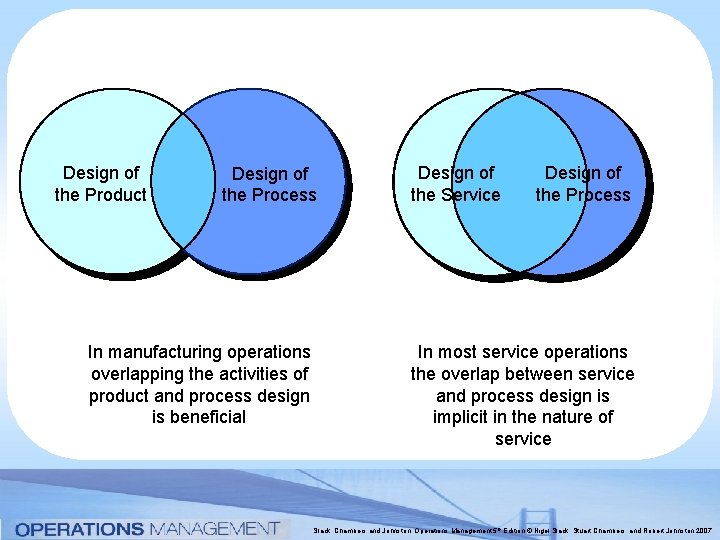
Nature and purpose of the design activity Products, services and the processes which produce them all have to be designed Decisions taken during the design of a product or service will have an impact on the decisions taken during the design of the process which produces those products or services, and vice versa Slack, Chambers and Johnston, Operations Management 5 th Edition © Nigel Slack, Stuart Chambers, and Robert Johnston 2007
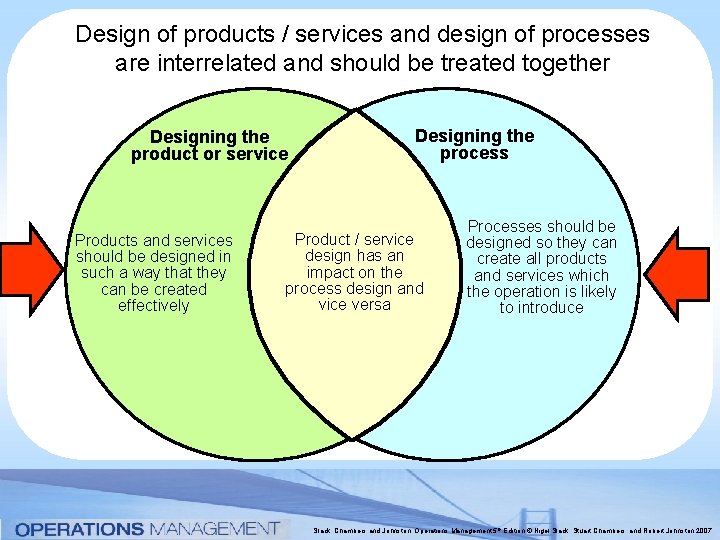
Design of products / services and design of processes are interrelated and should be treated together Designing the product or service Products and services should be designed in such a way that they can be created effectively Designing the process Product / service design has an impact on the process design and vice versa Processes should be designed so they can create all products and services which the operation is likely to introduce Slack, Chambers and Johnston, Operations Management 5 th Edition © Nigel Slack, Stuart Chambers, and Robert Johnston 2007
Design of the Product Design of the Process In manufacturing operations overlapping the activities of product and process design is beneficial Design of the Service Design of the Process In most service operations the overlap between service and process design is implicit in the nature of service Slack, Chambers and Johnston, Operations Management 5 th Edition © Nigel Slack, Stuart Chambers, and Robert Johnston 2007
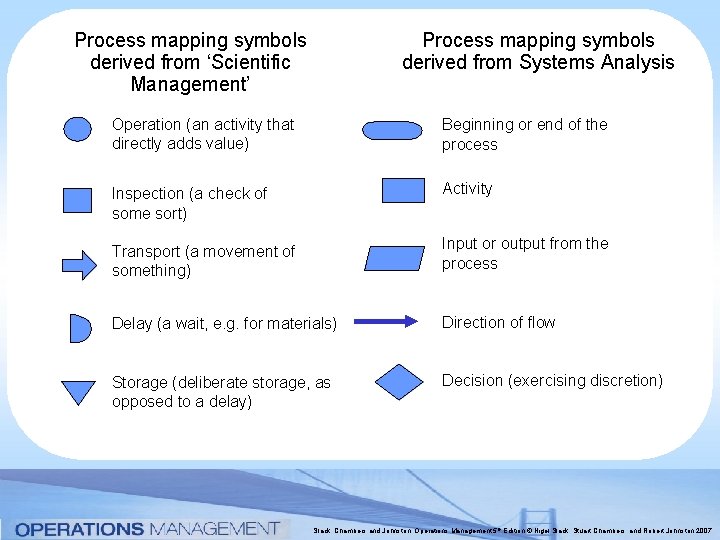
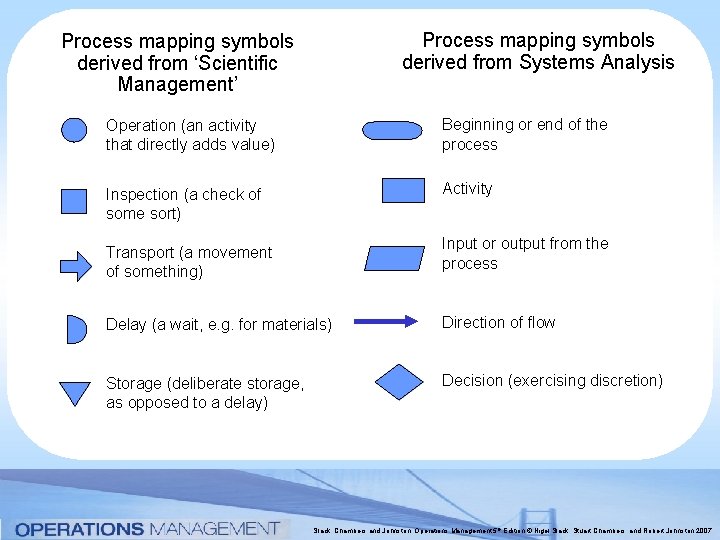
Process mapping symbols derived from ‘Scientific Management’ Process mapping symbols derived from Systems Analysis Operation (an activity that directly adds value) Beginning or end of the process Inspection (a check of some sort) Activity Transport (a movement of something) Input or output from the process Delay (a wait, e. g. for materials) Direction of flow Storage (deliberate storage, as opposed to a delay) Decision (exercising discretion) Slack, Chambers and Johnston, Operations Management 5 th Edition © Nigel Slack, Stuart Chambers, and Robert Johnston 2007
Designing processes There are different ‘process types’ Process types are defined by the volume and variety of ‘items’ they process Process types go by different names depending on whether they produce products or services Slack, Chambers and Johnston, Operations Management 5 th Edition © Nigel Slack, Stuart Chambers, and Robert Johnston 2007
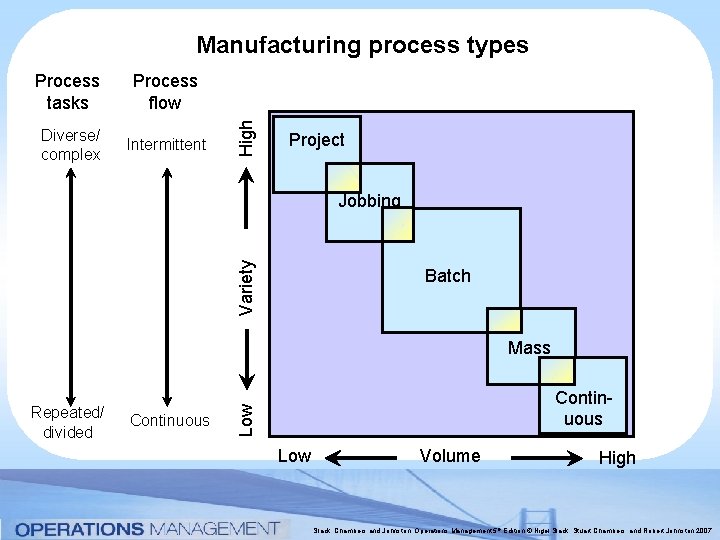
Process tasks Process flow Diverse/ complex Intermittent High Manufacturing process types Project Variety Jobbing Batch Mass Continuous Low Repeated/ divided Continuous Low Volume High Slack, Chambers and Johnston, Operations Management 5 th Edition © Nigel Slack, Stuart Chambers, and Robert Johnston 2007
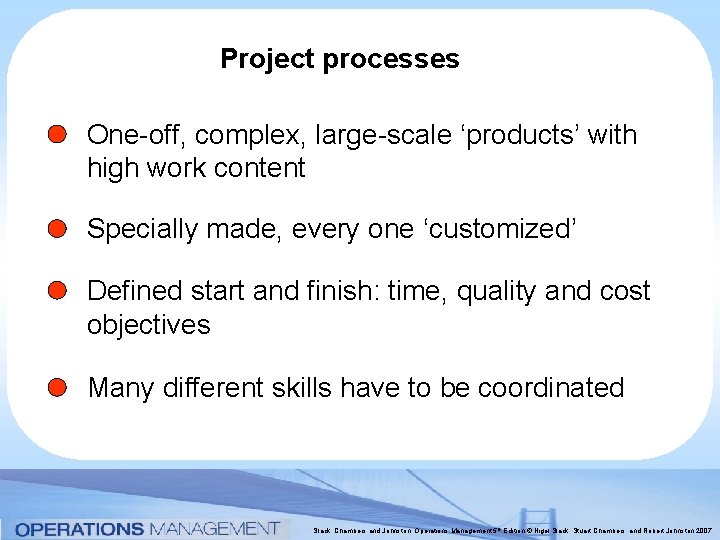
Project processes One-off, complex, large-scale ‘products’ with high work content Specially made, every one ‘customized’ Defined start and finish: time, quality and cost objectives Many different skills have to be coordinated Slack, Chambers and Johnston, Operations Management 5 th Edition © Nigel Slack, Stuart Chambers, and Robert Johnston 2007
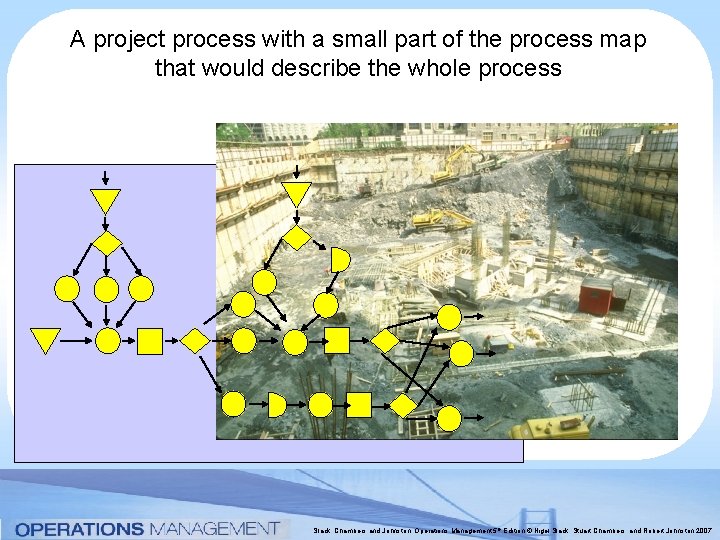
A project process with a small part of the process map that would describe the whole process Slack, Chambers and Johnston, Operations Management 5 th Edition © Nigel Slack, Stuart Chambers, and Robert Johnston 2007
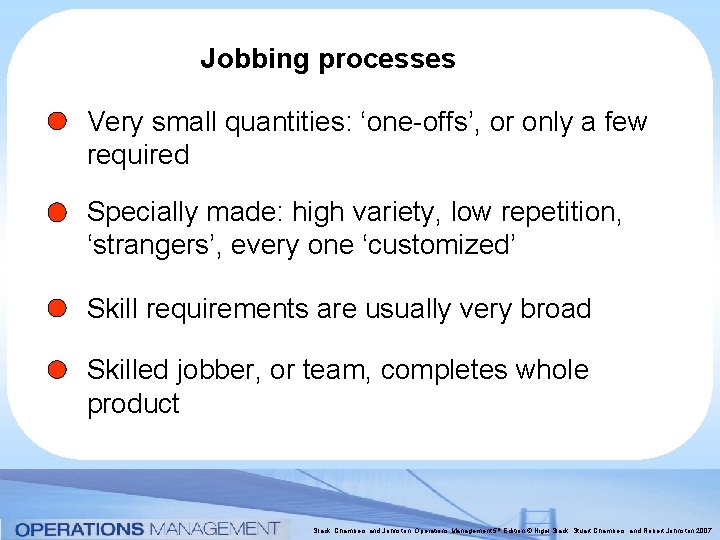
Jobbing processes Very small quantities: ‘one-offs’, or only a few required Specially made: high variety, low repetition, ‘strangers’, every one ‘customized’ Skill requirements are usually very broad Skilled jobber, or team, completes whole product Slack, Chambers and Johnston, Operations Management 5 th Edition © Nigel Slack, Stuart Chambers, and Robert Johnston 2007
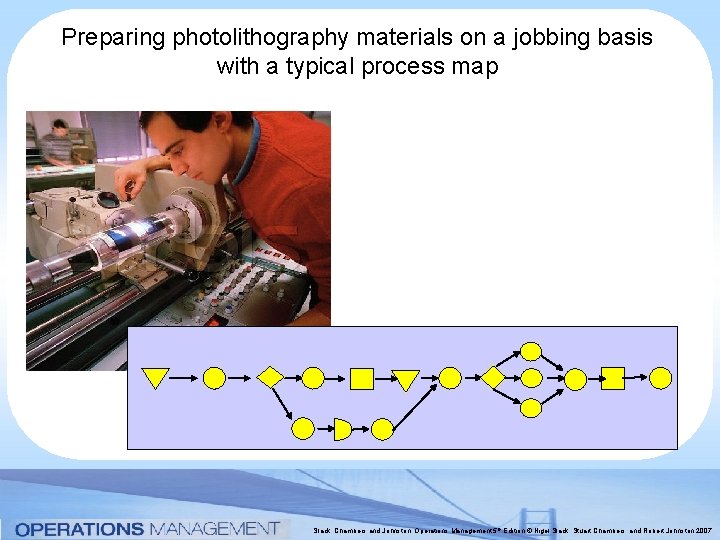
Preparing photolithography materials on a jobbing basis with a typical process map Slack, Chambers and Johnston, Operations Management 5 th Edition © Nigel Slack, Stuart Chambers, and Robert Johnston 2007
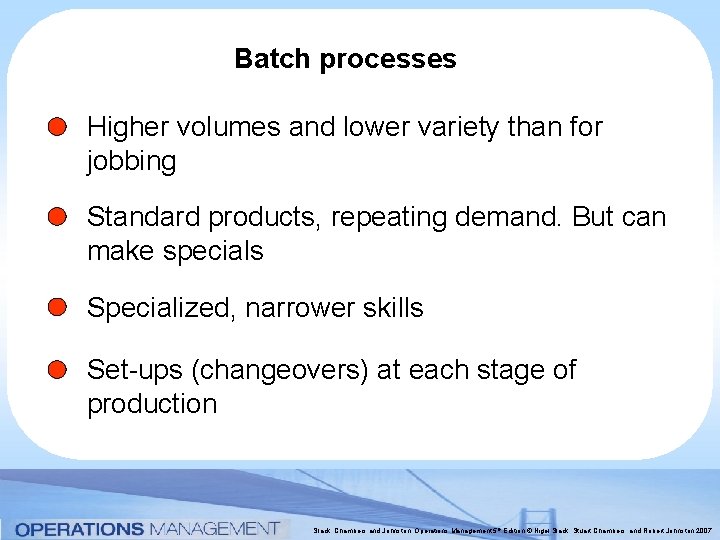
Batch processes Higher volumes and lower variety than for jobbing Standard products, repeating demand. But can make specials Specialized, narrower skills Set-ups (changeovers) at each stage of production Slack, Chambers and Johnston, Operations Management 5 th Edition © Nigel Slack, Stuart Chambers, and Robert Johnston 2007
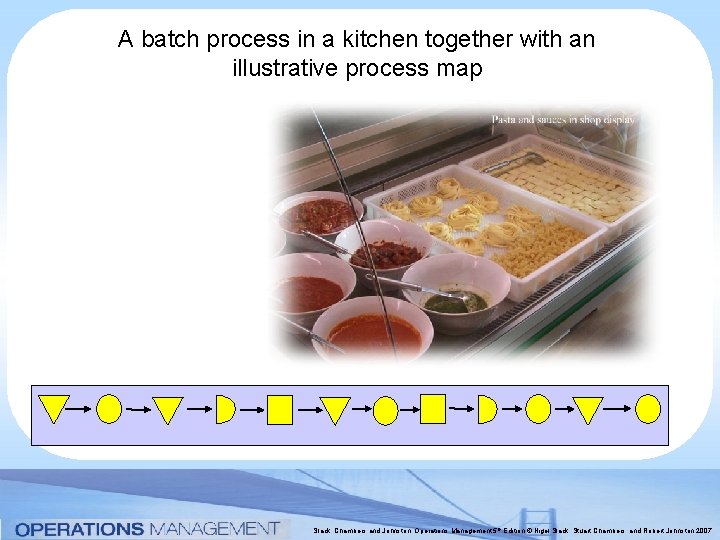
A batch process in a kitchen together with an illustrative process map Slack, Chambers and Johnston, Operations Management 5 th Edition © Nigel Slack, Stuart Chambers, and Robert Johnston 2007
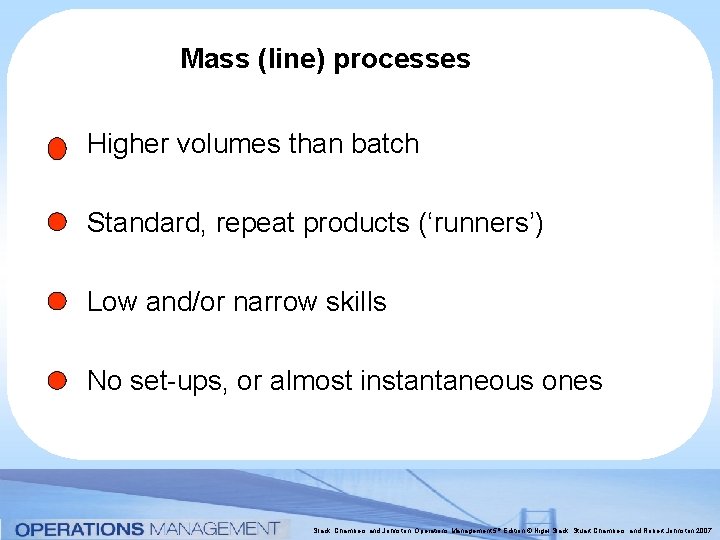
Mass (line) processes Higher volumes than batch Standard, repeat products (‘runners’) Low and/or narrow skills No set-ups, or almost instantaneous ones Slack, Chambers and Johnston, Operations Management 5 th Edition © Nigel Slack, Stuart Chambers, and Robert Johnston 2007
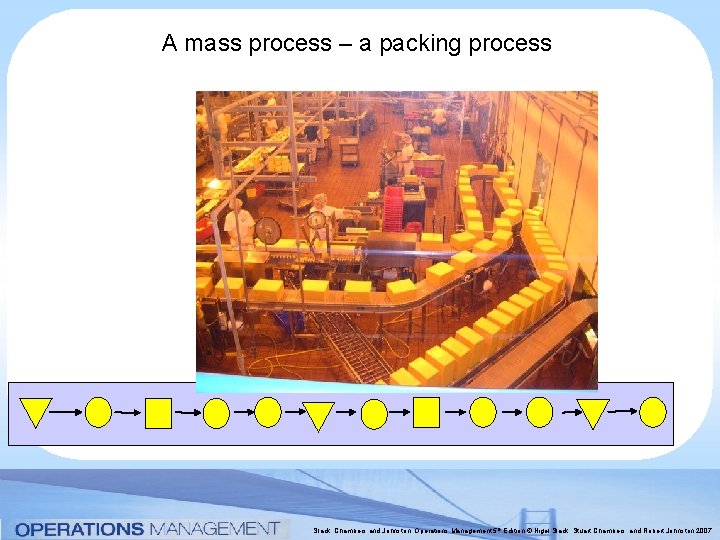
A mass process – a packing process Slack, Chambers and Johnston, Operations Management 5 th Edition © Nigel Slack, Stuart Chambers, and Robert Johnston 2007
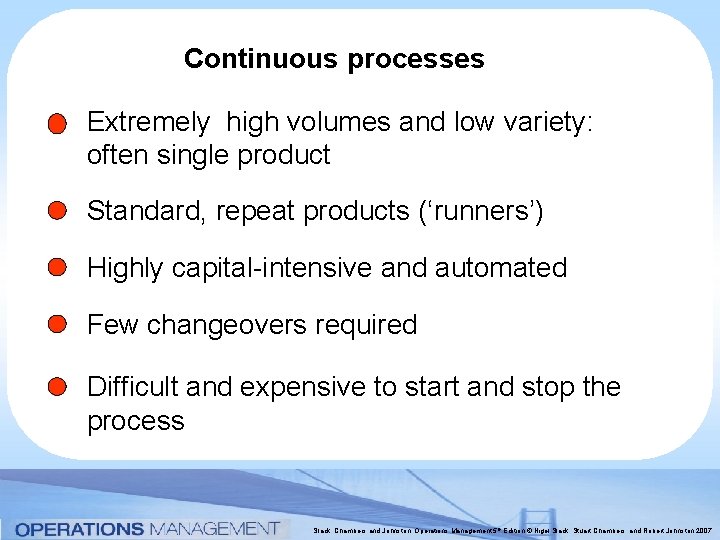
Continuous processes Extremely high volumes and low variety: often single product Standard, repeat products (‘runners’) Highly capital-intensive and automated Few changeovers required Difficult and expensive to start and stop the process Slack, Chambers and Johnston, Operations Management 5 th Edition © Nigel Slack, Stuart Chambers, and Robert Johnston 2007
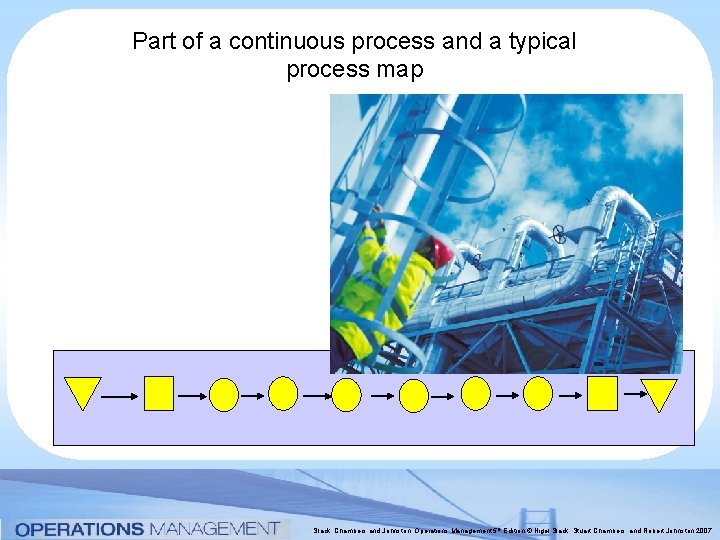
Part of a continuous process and a typical process map Slack, Chambers and Johnston, Operations Management 5 th Edition © Nigel Slack, Stuart Chambers, and Robert Johnston 2007
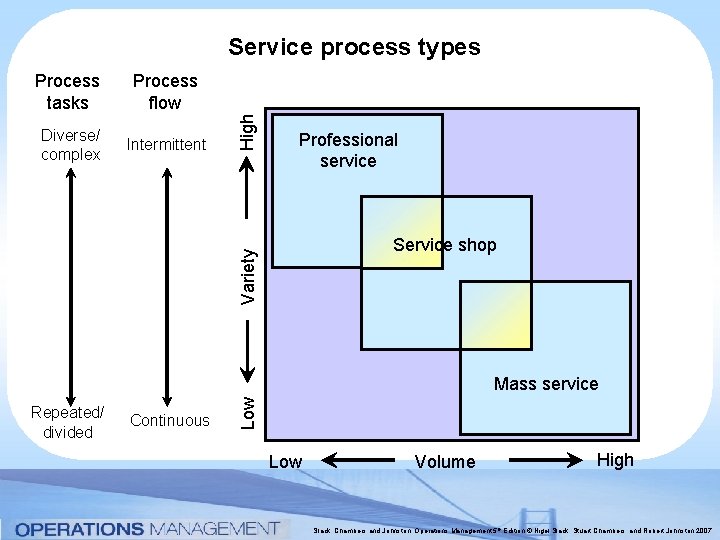
Process flow Diverse/ complex Intermittent Professional service Service shop Variety Process tasks High Service process types Repeated/ divided Continuous Low Mass service Low Volume High Slack, Chambers and Johnston, Operations Management 5 th Edition © Nigel Slack, Stuart Chambers, and Robert Johnston 2007
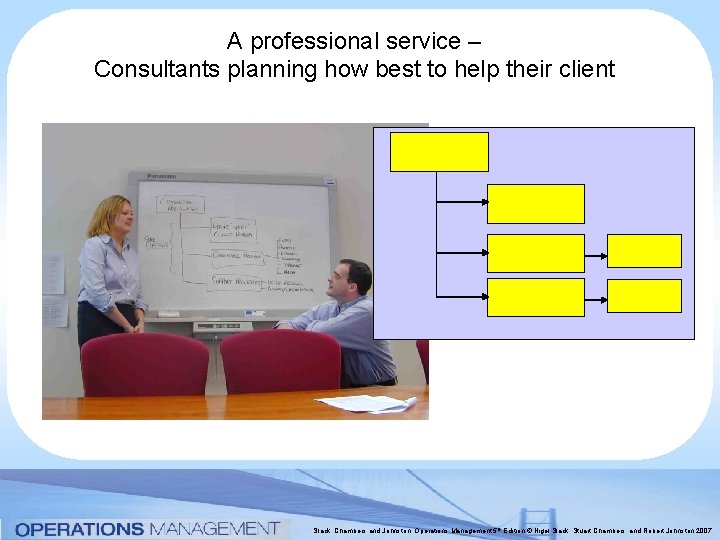
A professional service – Consultants planning how best to help their client Slack, Chambers and Johnston, Operations Management 5 th Edition © Nigel Slack, Stuart Chambers, and Robert Johnston 2007
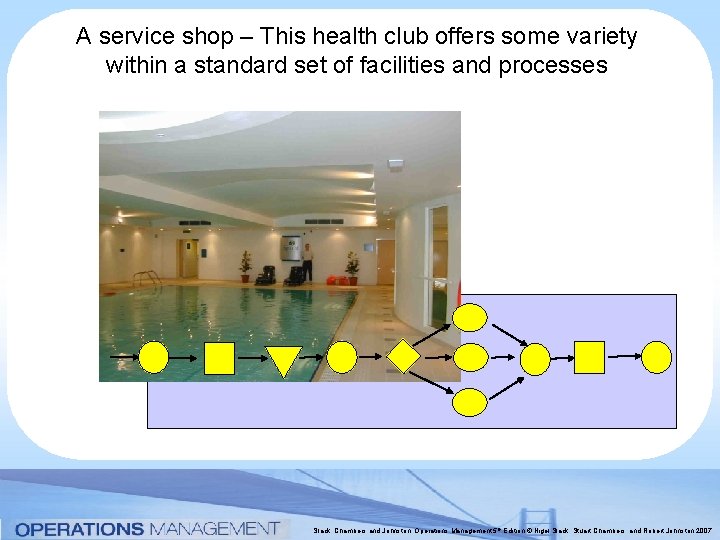
A service shop – This health club offers some variety within a standard set of facilities and processes Slack, Chambers and Johnston, Operations Management 5 th Edition © Nigel Slack, Stuart Chambers, and Robert Johnston 2007
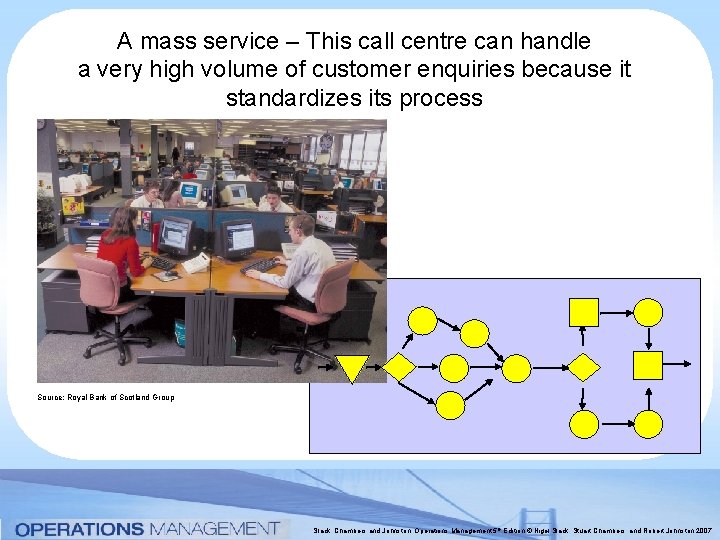
A mass service – This call centre can handle a very high volume of customer enquiries because it standardizes its process Source: Royal Bank of Scotland Group Slack, Chambers and Johnston, Operations Management 5 th Edition © Nigel Slack, Stuart Chambers, and Robert Johnston 2007
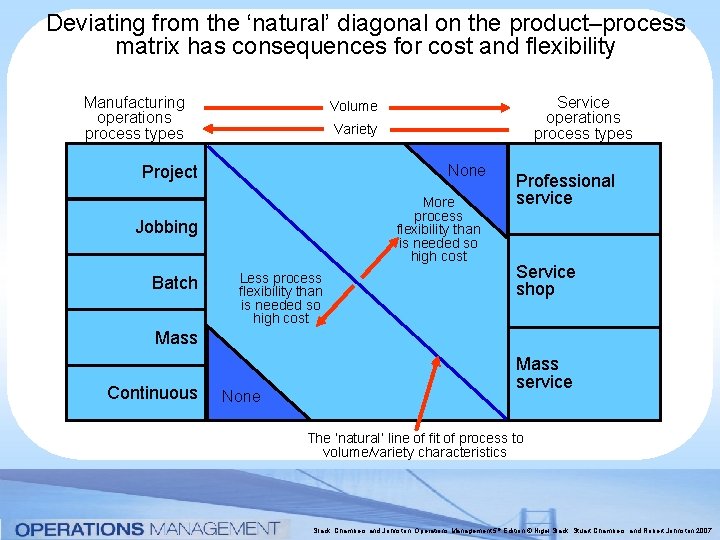
Deviating from the ‘natural’ diagonal on the product–process matrix has consequences for cost and flexibility Manufacturing operations process types Variety None Project More process flexibility than is needed so high cost Jobbing Batch Service operations process types Volume Less process flexibility than is needed so high cost Professional service Service shop Mass Continuous None Mass service The ‘natural’ line of fit of process to volume/variety characteristics Slack, Chambers and Johnston, Operations Management 5 th Edition © Nigel Slack, Stuart Chambers, and Robert Johnston 2007
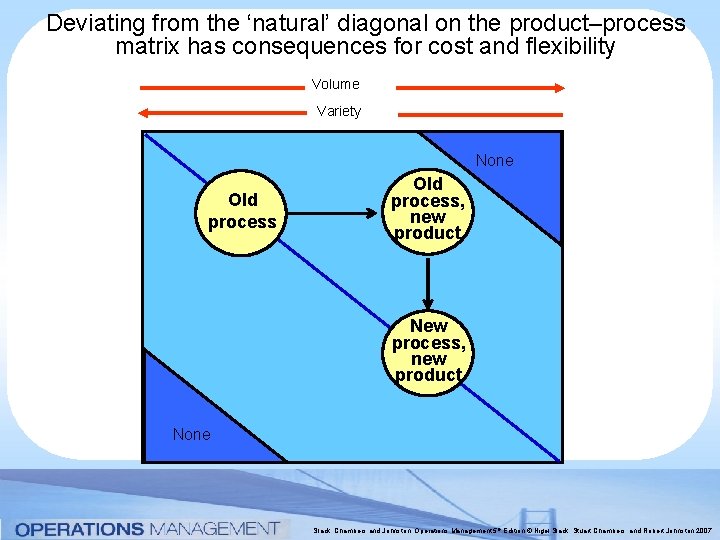
Deviating from the ‘natural’ diagonal on the product–process matrix has consequences for cost and flexibility Volume Variety None Old process, new product New process, new product None Slack, Chambers and Johnston, Operations Management 5 th Edition © Nigel Slack, Stuart Chambers, and Robert Johnston 2007
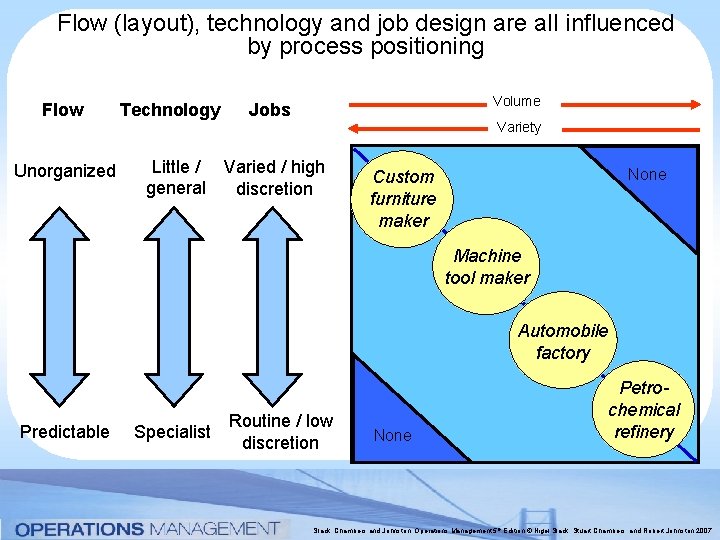
Flow (layout), technology and job design are all influenced by process positioning Flow Unorganized Technology Little / general Volume Jobs Variety Varied / high discretion None Custom furniture maker Machine tool maker Automobile factory Predictable Specialist Routine / low discretion None Petrochemical refinery Slack, Chambers and Johnston, Operations Management 5 th Edition © Nigel Slack, Stuart Chambers, and Robert Johnston 2007
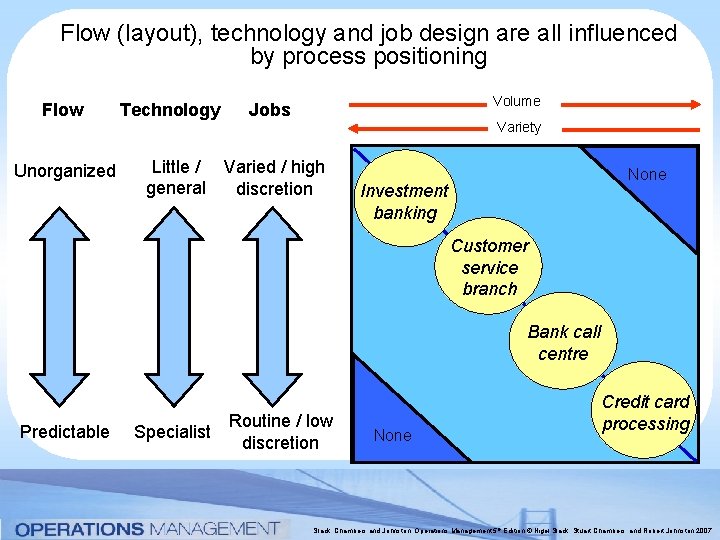
Flow (layout), technology and job design are all influenced by process positioning Flow Unorganized Technology Little / general Volume Jobs Variety Varied / high discretion None Investment banking Customer service branch Bank call centre Predictable Specialist Routine / low discretion None Credit card processing Slack, Chambers and Johnston, Operations Management 5 th Edition © Nigel Slack, Stuart Chambers, and Robert Johnston 2007
Process mapping symbols derived from Systems Analysis Process mapping symbols derived from ‘Scientific Management’ Operation (an activity that directly adds value) Beginning or end of the process Inspection (a check of some sort) Activity Input or output from the process Transport (a movement of something) Delay (a wait, e. g. for materials) Direction of flow Storage (deliberate storage, as opposed to a delay) Decision (exercising discretion) Slack, Chambers and Johnston, Operations Management 5 th Edition © Nigel Slack, Stuart Chambers, and Robert Johnston 2007
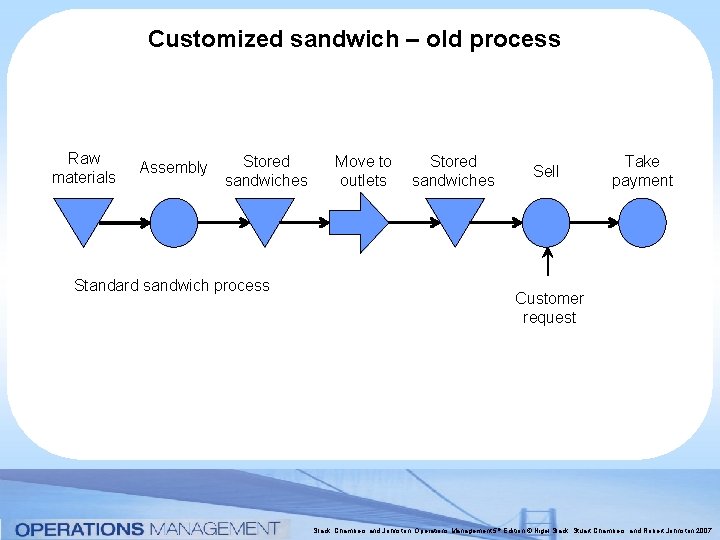
Customized sandwich – old process Raw materials Assembly Stored sandwiches Standard sandwich process Move to outlets Stored sandwiches Sell Take payment Customer request Slack, Chambers and Johnston, Operations Management 5 th Edition © Nigel Slack, Stuart Chambers, and Robert Johnston 2007
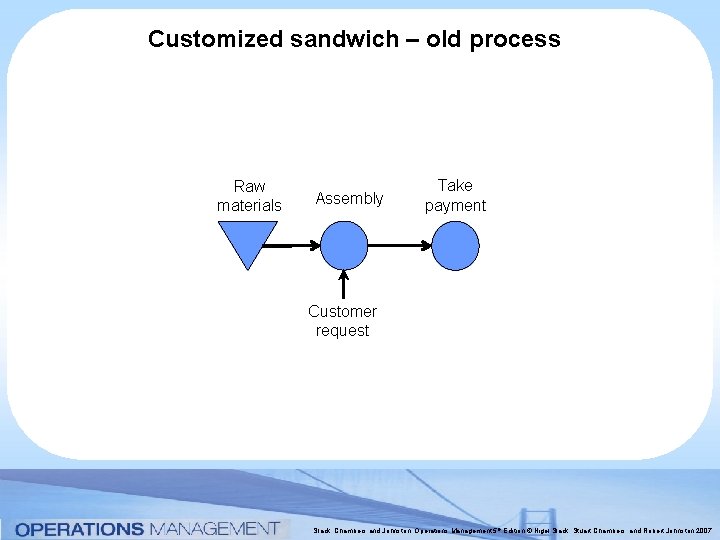
Customized sandwich – old process Raw materials Assembly Take payment Customer request Slack, Chambers and Johnston, Operations Management 5 th Edition © Nigel Slack, Stuart Chambers, and Robert Johnston 2007
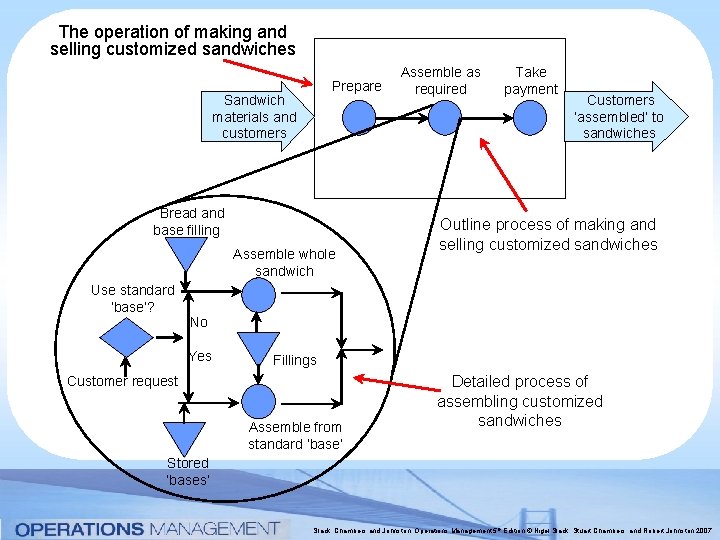
The operation of making and selling customized sandwiches Prepare Sandwich materials and customers Bread and base filling Assemble whole sandwich Use standard ‘base’? Assemble as required Take payment Customers ‘assembled’ to sandwiches Outline process of making and selling customized sandwiches No Yes Fillings Customer request Assemble from standard ‘base’ Detailed process of assembling customized sandwiches Stored ‘bases’ Slack, Chambers and Johnston, Operations Management 5 th Edition © Nigel Slack, Stuart Chambers, and Robert Johnston 2007
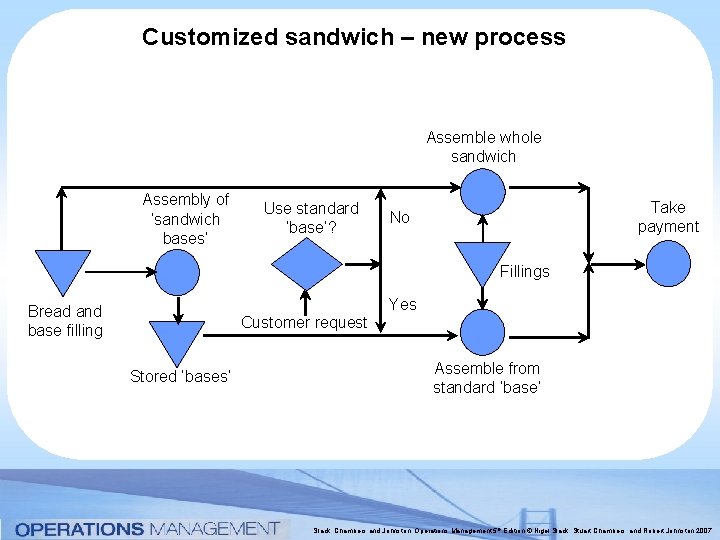
Customized sandwich – new process Assemble whole sandwich Assembly of ‘sandwich bases’ Use standard ‘base’? Take payment No Fillings Yes Bread and base filling Customer request Stored ‘bases’ Assemble from standard ‘base’ Slack, Chambers and Johnston, Operations Management 5 th Edition © Nigel Slack, Stuart Chambers, and Robert Johnston 2007
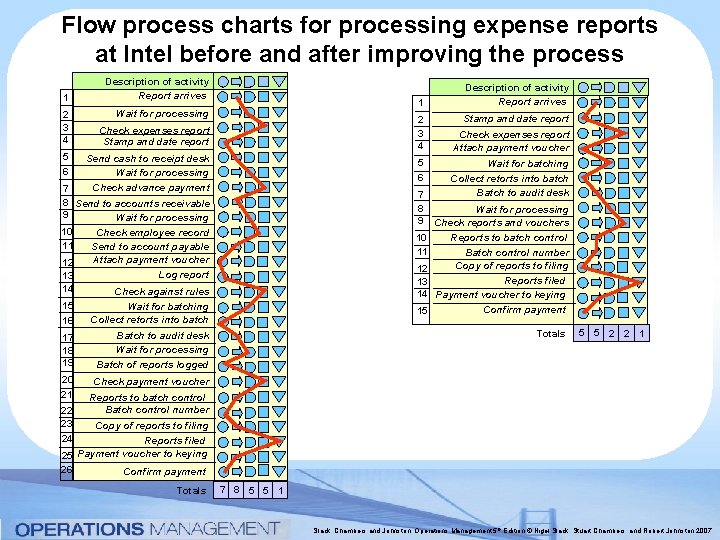
Flow process charts for processing expense reports at Intel before and after improving the process 1 2 3 4 5 6 Description of activity Report arrives 1 Wait for processing Check expenses report Stamp and date report 2 3 4 Send cash to receipt desk Wait for processing 5 6 Check advance payment 7 8 Send to accounts receivable 9 Wait for processing 10 Check employee record 11 Send to account payable Attach payment voucher 12 Check against rules 15 16 Wait for batching Collect retorts into batch 17 18 19 Batch to audit desk Wait for processing 22 23 24 Stamp and date report Check expenses report Attach payment voucher Wait for batching Collect retorts into batch Batch to audit desk Wait for processing Check reports and vouchers Reports to batch control 10 11 Batch control number Copy of reports to filing 12 Reports filed 13 14 Payment voucher to keying Log report 13 14 20 21 7 8 9 Description of activity Report arrives 15 Confirm payment Totals 5 5 2 2 1 Batch of reports logged Check payment voucher Reports to batch control Batch control number Copy of reports to filing Reports filed 25 Payment voucher to keying 26 Confirm payment Totals 7 8 5 5 1 Slack, Chambers and Johnston, Operations Management 5 th Edition © Nigel Slack, Stuart Chambers, and Robert Johnston 2007
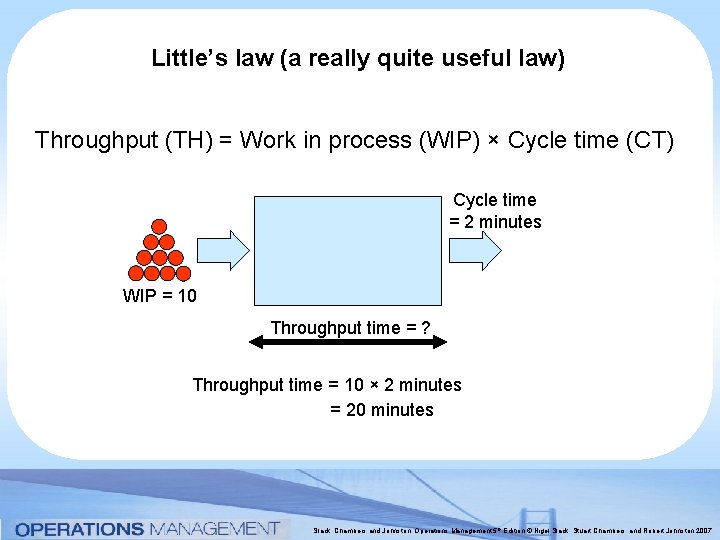
Little’s law (a really quite useful law) Throughput (TH) = Work in process (WIP) × Cycle time (CT) Cycle time = 2 minutes WIP = 10 Throughput time = ? Throughput time = 10 × 2 minutes = 20 minutes Slack, Chambers and Johnston, Operations Management 5 th Edition © Nigel Slack, Stuart Chambers, and Robert Johnston 2007
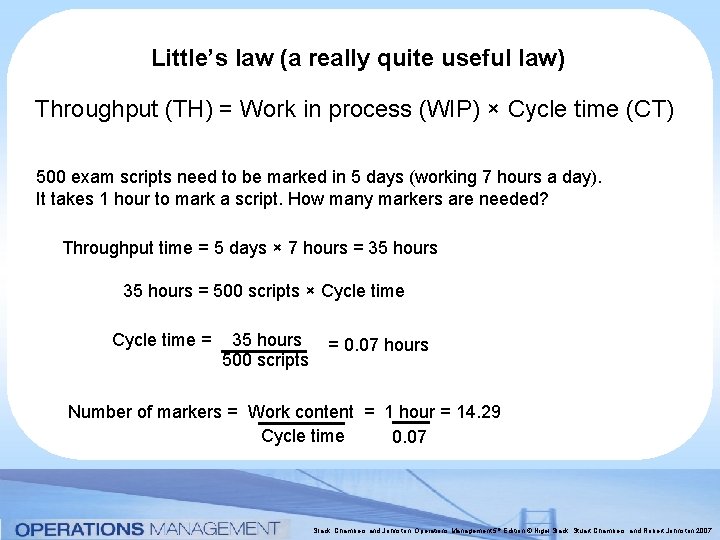
Little’s law (a really quite useful law) Throughput (TH) = Work in process (WIP) × Cycle time (CT) 500 exam scripts need to be marked in 5 days (working 7 hours a day). It takes 1 hour to mark a script. How many markers are needed? Throughput time = 5 days × 7 hours = 35 hours = 500 scripts × Cycle time = 35 hours 500 scripts = 0. 07 hours Number of markers = Work content = 1 hour = 14. 29 Cycle time 0. 07 Slack, Chambers and Johnston, Operations Management 5 th Edition © Nigel Slack, Stuart Chambers, and Robert Johnston 2007
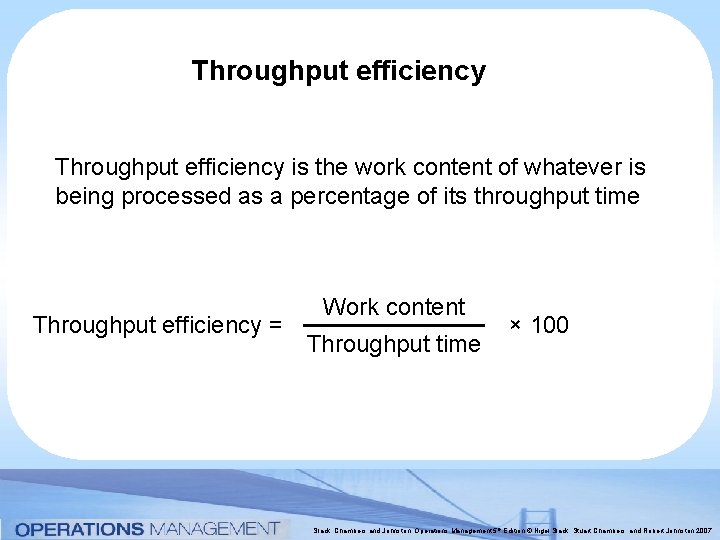
Throughput efficiency is the work content of whatever is being processed as a percentage of its throughput time Throughput efficiency = Work content Throughput time × 100 Slack, Chambers and Johnston, Operations Management 5 th Edition © Nigel Slack, Stuart Chambers, and Robert Johnston 2007
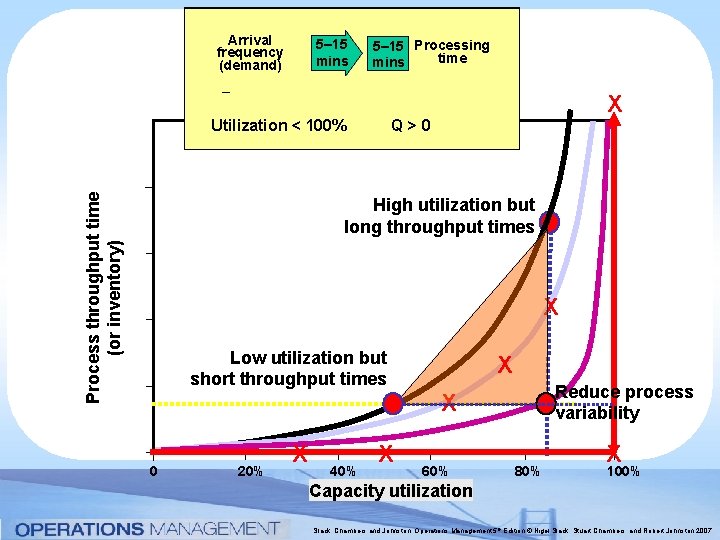
Arrival 30 9 5– 15 105– 15 20 10 Processing frequency time mins (demand) mins Utilization 33. 33 50 100 % % %% Utilization==<100 100% X QQ Q== Q >=0 infinity 00 Process time Average throughput length of queue (or inventory) High utilization but long throughput times X Low utilization but short throughput times X Reduce process variability X Low 0 20% X 40% X 60% 80% X 100% Capacity utilization Slack, Chambers and Johnston, Operations Management 5 th Edition © Nigel Slack, Stuart Chambers, and Robert Johnston 2007
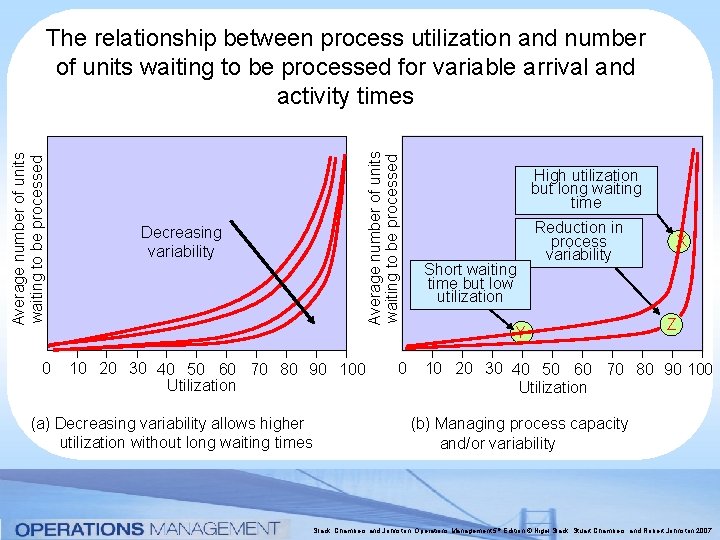
0 Decreasing variability Average number of units waiting to be processed The relationship between process utilization and number of units waiting to be processed for variable arrival and activity times 10 20 30 40 50 60 70 80 90 100 Utilization (a) Decreasing variability allows higher utilization without long waiting times 0 High utilization but long waiting time Short waiting time but low utilization Reduction in process variability Y X Z 10 20 30 40 50 60 70 80 90 100 Utilization (b) Managing process capacity and/or variability Slack, Chambers and Johnston, Operations Management 5 th Edition © Nigel Slack, Stuart Chambers, and Robert Johnston 2007
Key Terms Test Throughput time The time for a unit to move through a process. Utilization The ratio of the actual output from a process or facility to its design capacity. Life cycle analysis A technique that analyzes all the production inputs, the life cycle use of a product and its final disposal in terms of total energy used and wastes emitted. Slack, Chambers and Johnston, Operations Management 5 th Edition © Nigel Slack, Stuart Chambers, and Robert Johnston 2007
Key Terms Test Process types Terms that are used to describe a particular general approach to managing processes. In manufacturing these are generally held to be project, jobbing, batch, mass and continuous processes; in services they are held to be professional services, service shops and mass services. Project processes Processes that deal with discrete, usually highly customized, products. Jobbing processes Processes that deal with high variety and low volumes, although there may be some repetition of flow and activities. Slack, Chambers and Johnston, Operations Management 5 th Edition © Nigel Slack, Stuart Chambers, and Robert Johnston 2007
Key Terms Test Batch processes Processes that treat batches of products together, and where each batch has its own process route. Continuous processes Processes that are high volume and low variety; usually products made on continuous processes are produced in an endless flow, such as petrochemicals or electricity. Professional services Service processes that are devoted to producing knowledgebased or advice-based services, usually involving high customer contact and high customization. Examples include management consultants, lawyers, architects, etc. Slack, Chambers and Johnston, Operations Management 5 th Edition © Nigel Slack, Stuart Chambers, and Robert Johnston 2007
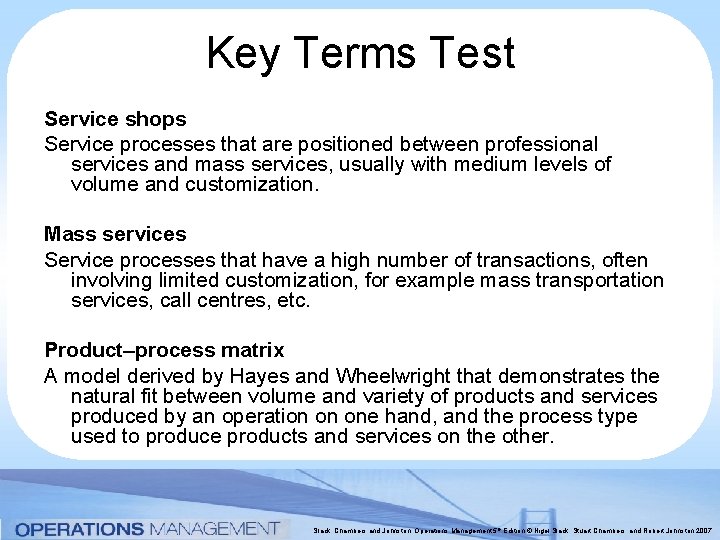
Key Terms Test Service shops Service processes that are positioned between professional services and mass services, usually with medium levels of volume and customization. Mass services Service processes that have a high number of transactions, often involving limited customization, for example mass transportation services, call centres, etc. Product–process matrix A model derived by Hayes and Wheelwright that demonstrates the natural fit between volume and variety of products and services produced by an operation on one hand, and the process type used to produce products and services on the other. Slack, Chambers and Johnston, Operations Management 5 th Edition © Nigel Slack, Stuart Chambers, and Robert Johnston 2007
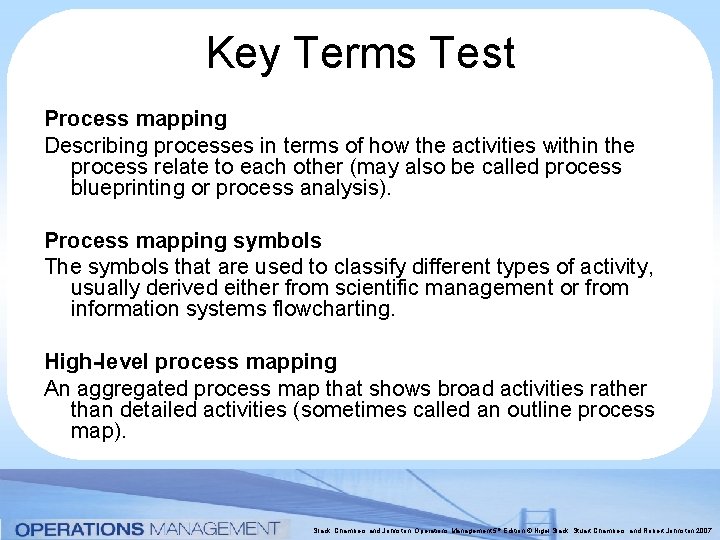
Key Terms Test Process mapping Describing processes in terms of how the activities within the process relate to each other (may also be called process blueprinting or process analysis). Process mapping symbols The symbols that are used to classify different types of activity, usually derived either from scientific management or from information systems flowcharting. High-level process mapping An aggregated process map that shows broad activities rather than detailed activities (sometimes called an outline process map). Slack, Chambers and Johnston, Operations Management 5 th Edition © Nigel Slack, Stuart Chambers, and Robert Johnston 2007
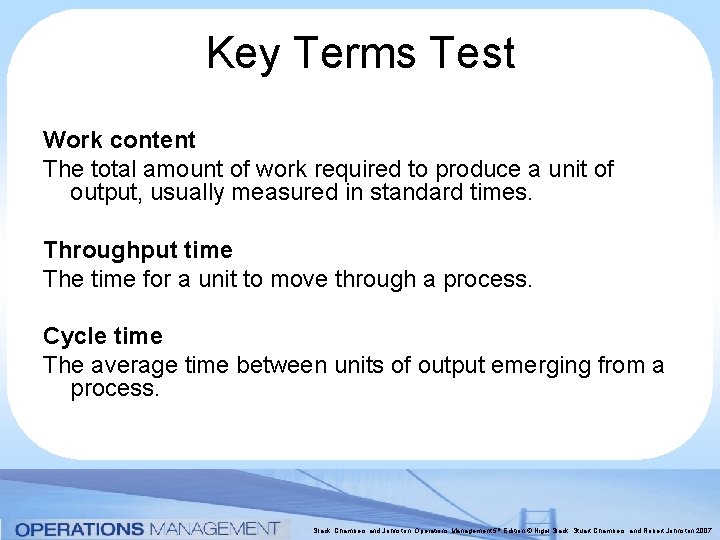
Key Terms Test Work content The total amount of work required to produce a unit of output, usually measured in standard times. Throughput time The time for a unit to move through a process. Cycle time The average time between units of output emerging from a process. Slack, Chambers and Johnston, Operations Management 5 th Edition © Nigel Slack, Stuart Chambers, and Robert Johnston 2007
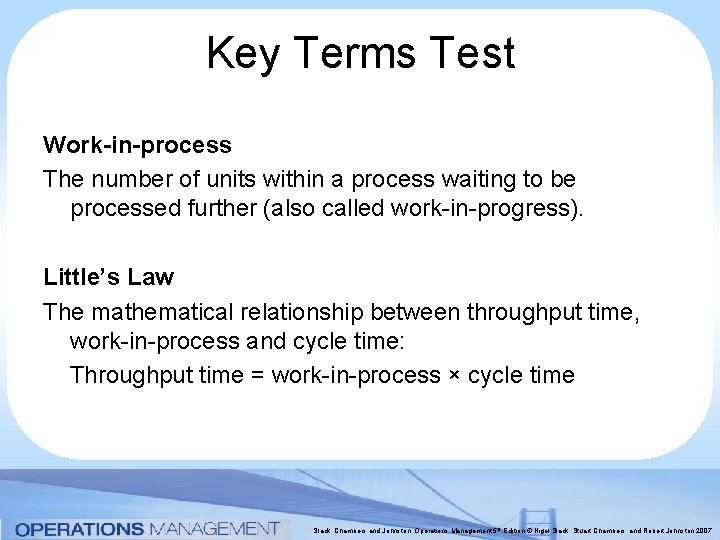
Key Terms Test Work-in-process The number of units within a process waiting to be processed further (also called work-in-progress). Little’s Law The mathematical relationship between throughput time, work-in-process and cycle time: Throughput time = work-in-process × cycle time Slack, Chambers and Johnston, Operations Management 5 th Edition © Nigel Slack, Stuart Chambers, and Robert Johnston 2007