
Chapter 4 Probability Statistics Section 4 1 Counting
Chapter 4: Probability & Statistics Section 4. 1: Counting, Factorials, Permutations & Combinations APPLIED MATHEMATICS, FOURTH EDITION, MATOVINA & YATES
Fundamental Counting Principle Many times we are presented with a multi-part event and we want – or need – to count the total possible outcomes. One possible way to count them is to list them all out. For example, how many different ways can the letters A, B, C & D be arranged? ABCD, ABDC, ACBD, ACDB, ADBC, ADCB, BACD, BADC, … There is a MUCH better way. Fundamental Counting Principle To find the total number of options for a multi-part event, find the number of options for each part and multiply those numbers together. Example: How many different ways can the letters A, B, C & D be arranged? There are 4 choices for the first letter: A, B, C, & D. Since one of the letters was taken for the first one, there are 3 choices for the second letter. 2 choices for the third letter, and 1 left for the last. There are (4)(3)(2)(1) = 24 ways to arrange the letters A, B, C, & D. APPLIED MATHEMATICS, FOURTH EDITION, MATOVINA & YATES
Fundamental Counting Principle - Examples: Telephone area codes are made up of 3 -digit numbers. If the first number cannot be a 1 or a 0, how many area codes are possible? (8)(10) = 800 If the first digit cannot be a 1 or a 0, the second digit can be anything except a 9, and there are no restrictions on the last digit, how many area codes are possible? (8)(9)(10) = 720 Example: Olive Garden offers a special lunch menu where diners choose an appetizer that is a soup or a salad, one of six different sandwiches, and one of three different desserts. How many different appetizer-sandwich-dessert meals are possible? (2)(6)(3) = 36 different meals APPLIED MATHEMATICS, FOURTH EDITION, MATOVINA & YATES
Factorials The product of all the numbers from n down to 1 is called n factorial and is written n!. n! = n × (n – 1) × (n – 2) × … × 3 × 2 × 1 Example: Find 6! 6! = 6 × 5 × 4 × 3 × 2 × 1 = 720 Example: Simplify: 9!/6! = (9 × 8 × 7 × 6!)/(6!) = 9 × 8 × 7 = 504 IMPORTANT CONCEPT 0! = 1 APPLIED MATHEMATICS, FOURTH EDITION, MATOVINA & YATES
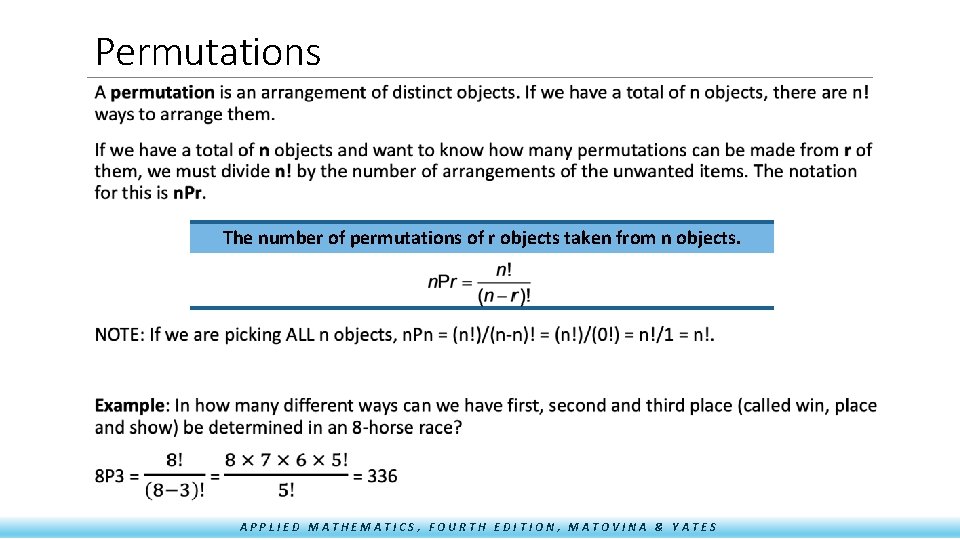
Permutations The number of permutations of r objects taken from n objects. APPLIED MATHEMATICS, FOURTH EDITION, MATOVINA & YATES
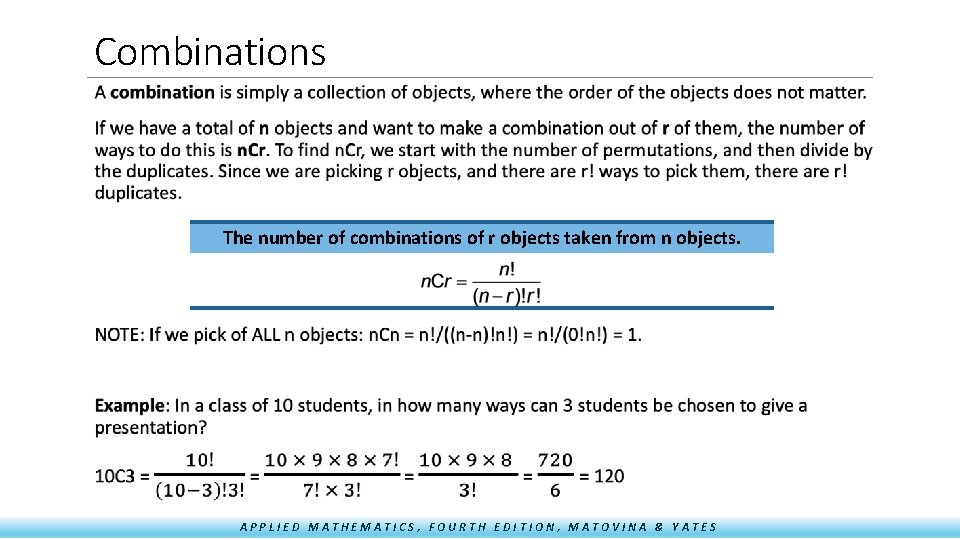
Combinations The number of combinations of r objects taken from n objects. APPLIED MATHEMATICS, FOURTH EDITION, MATOVINA & YATES
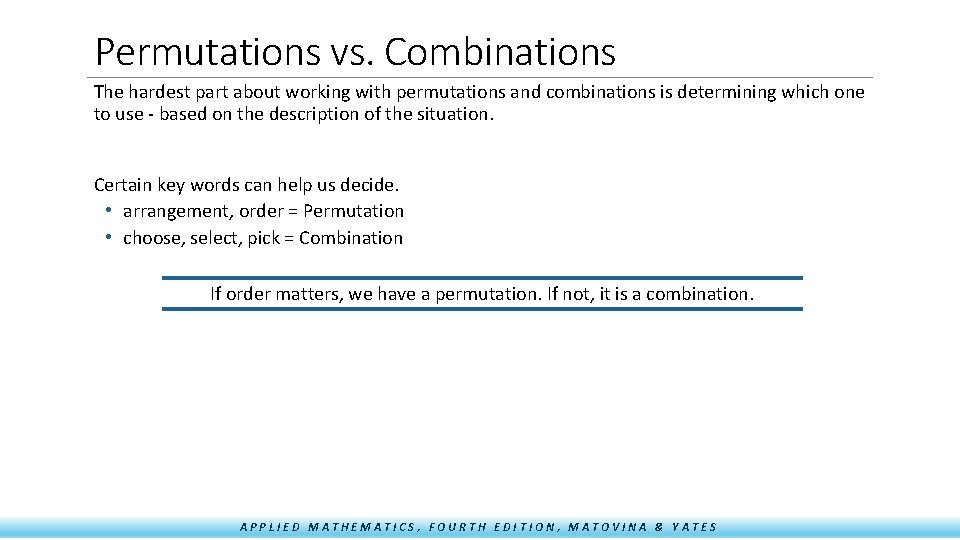
Permutations vs. Combinations The hardest part about working with permutations and combinations is determining which one to use - based on the description of the situation. Certain key words can help us decide. • arrangement, order = Permutation • choose, select, pick = Combination If order matters, we have a permutation. If not, it is a combination. APPLIED MATHEMATICS, FOURTH EDITION, MATOVINA & YATES
- Slides: 7