
Chapter 4 Probability and Counting Rules Copyright 2012
Chapter 4 Probability and Counting Rules Copyright © 2012 The Mc. Graw-Hill Companies, Inc. Permission required for reproduction or display. 1
4 CHAPTER Probability and Counting Rules Outline 4 -1 Sample Spaces and Probability 4 -2 The Addition Rules for Probability 4 -3 The Multiplication Rules and Conditional Probability 4 -4 Counting Rules 4 -5 Probability and Counting Rules
4 CHAPTER Probability and Counting Rules Objectives 1 2 3 4 Determine sample spaces and find the probability of an event, using classical probability or empirical probability. Find the probability of compound events, using the addition rules. Find the probability of compound events, using the multiplication rules. Find the conditional probability of an event.
4 CHAPTER Probability and Counting Rules Objectives 5 6 7 8 Find the total number of outcomes in a sequence of events, using the fundamental counting rule. Find the number of ways that r objects can be selected from n objects, using the permutation rule. Find the number of ways that r objects can be selected from n objects without regard to order, using the combination rule. Find the probability of an event, using the counting rules.
Probability n. Probability can be defined as the chance of an event occurring. It can be used to quantify what the “odds” are that a specific event will occur. Some examples of how probability is used everyday would be weather forecasting, “ 75% chance of snow” or for setting insurance rates. Bluman Chapter 4 5
4 -1 Sample Spaces and Probability n A probability experiment is a chance process that leads to well-defined results called outcomes. n An outcome is the result of a single trial of a probability experiment. n A sample space is the set of all possible outcomes of a probability experiment. n An event consists of outcomes. Bluman Chapter 4 6
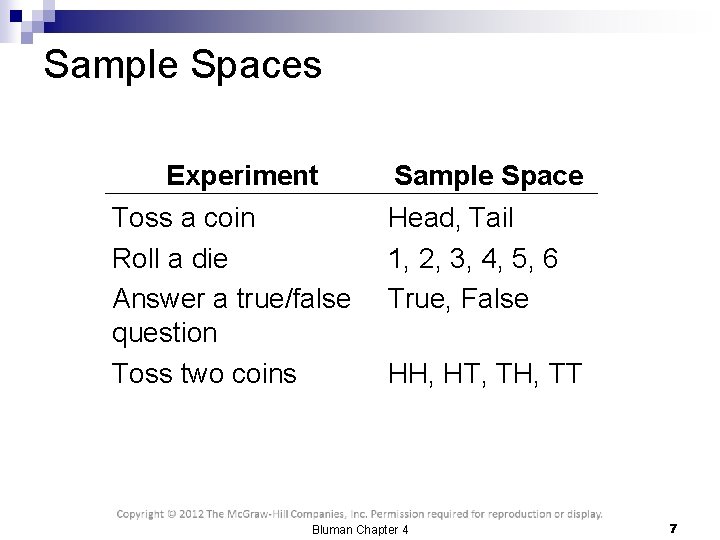
Sample Spaces Experiment Toss a coin Roll a die Answer a true/false question Toss two coins Sample Space Head, Tail 1, 2, 3, 4, 5, 6 True, False HH, HT, TH, TT Bluman Chapter 4 7
Chapter 4 Probability and Counting Rules Section 4 -1 Example 4 -1 Page #183 Bluman Chapter 4 8
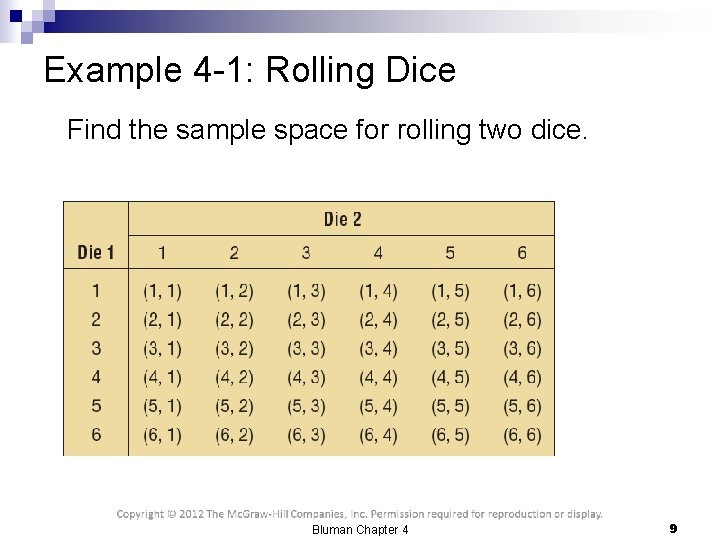
Example 4 -1: Rolling Dice Find the sample space for rolling two dice. Bluman Chapter 4 9
Chapter 4 Probability and Counting Rules Section 4 -1 Example 4 -3 Page #184 Bluman Chapter 4 10
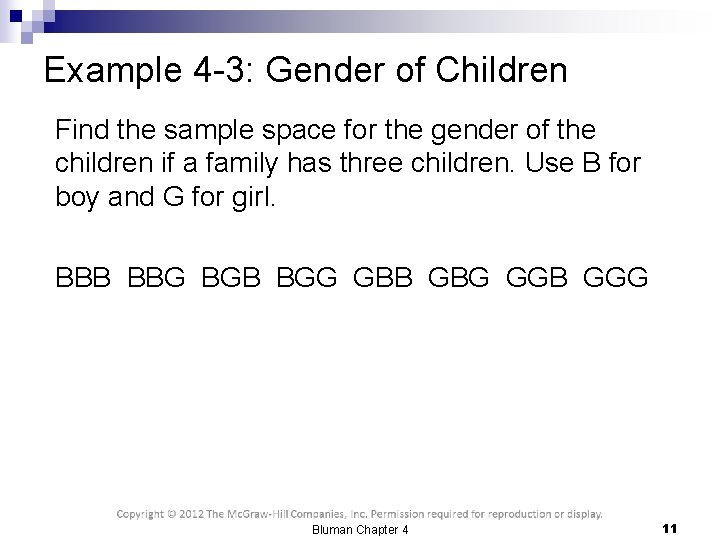
Example 4 -3: Gender of Children Find the sample space for the gender of the children if a family has three children. Use B for boy and G for girl. BBB BBG BGB BGG GBB GBG GGB GGG Bluman Chapter 4 11
Chapter 4 Probability and Counting Rules Section 4 -1 Example 4 -4 Page #185 Bluman Chapter 4 12
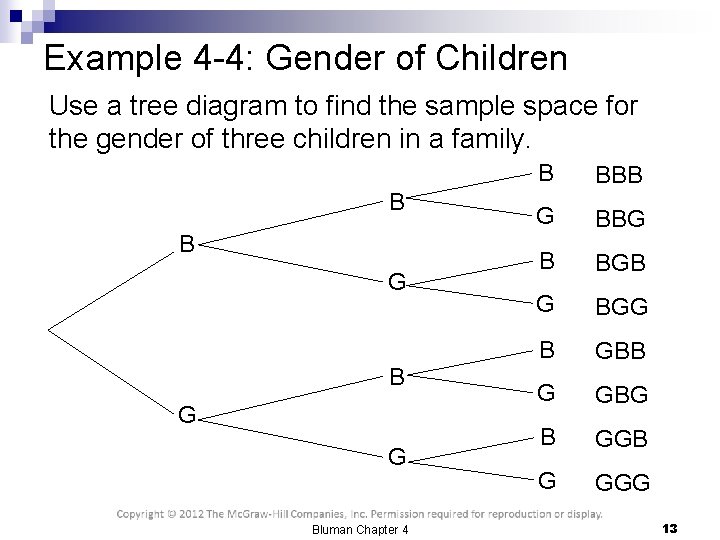
Example 4 -4: Gender of Children Use a tree diagram to find the sample space for the gender of three children in a family. B B G G Bluman Chapter 4 B BBB G BBG B BGB G BGG B GBB G GBG B GGB G GGG 13
Sample Spaces and Probability There are three basic interpretations of probability: n. Classical probability n. Empirical probability n. Subjective probability Bluman Chapter 4 14
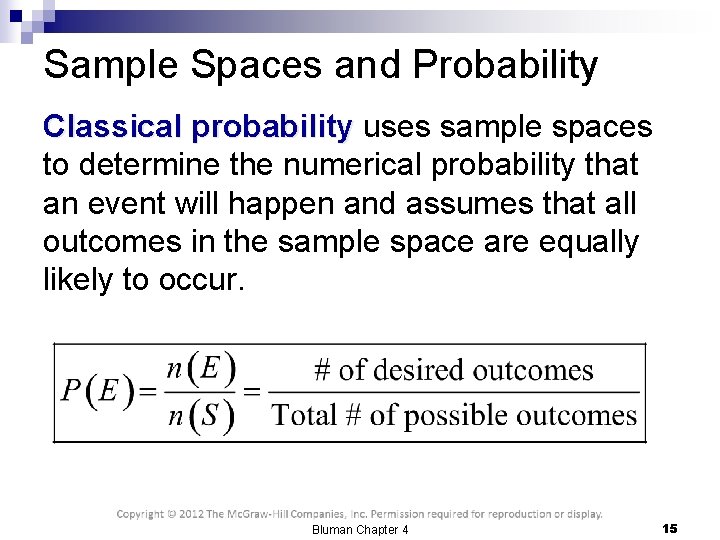
Sample Spaces and Probability Classical probability uses sample spaces to determine the numerical probability that an event will happen and assumes that all outcomes in the sample space are equally likely to occur. Bluman Chapter 4 15
Sample Spaces and Probability Rounding Rule for Probabilities should be expressed as reduced fractions or rounded to two or three decimal places. When the probability of an event is an extremely small decimal, it is permissible to round the decimal to the first nonzero digit after the decimal point. Bluman Chapter 4 16
Chapter 4 Probability and Counting Rules Section 4 -1 Example 4 -6 Page #187 Bluman Chapter 4 17
Example 4 -6: Gender of Children If a family has three children, find the probability that two of the three children are girls. Sample Space: BBB BBG BGB BGG GBB GBG GGB GGG Three outcomes (BGG, GBG, GGB) have two girls. The probability of having two of three children being girls is 3/8. Bluman Chapter 4 18
Probability Rule 1 The probability of any event E is a number (either a fraction or decimal) between and including 0 and 1. This is denoted by 0 P(E) 1.
Probability Rule 2 If an event E cannot occur (i. e. , the event contains no members in the sample space), its probability is 0.
Probability Rule 3 If an event E is certain, then the probability of E is 1.
Probability Rule 4 The sum of the probabilities of all the outcomes in the sample space is 1.
Chapter 4 Probability and Counting Rules Section 4 -1 Exercise 4 -9 Page #189 Bluman Chapter 4 23
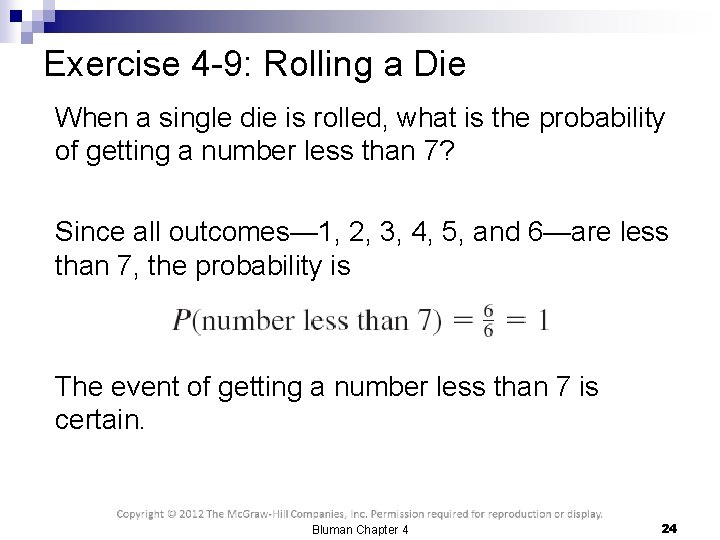
Exercise 4 -9: Rolling a Die When a single die is rolled, what is the probability of getting a number less than 7? Since all outcomes— 1, 2, 3, 4, 5, and 6—are less than 7, the probability is The event of getting a number less than 7 is certain. Bluman Chapter 4 24
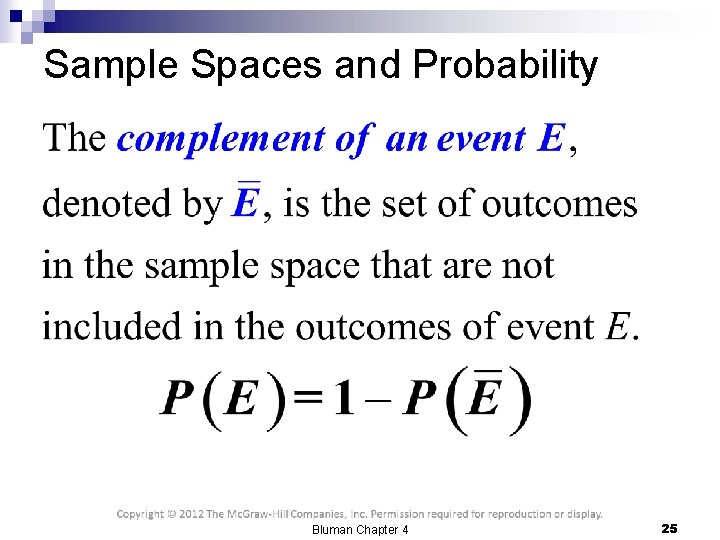
Sample Spaces and Probability Bluman Chapter 4 25
Chapter 4 Probability and Counting Rules Section 4 -1 Example 4 -10 Page #189 Bluman Chapter 4 26
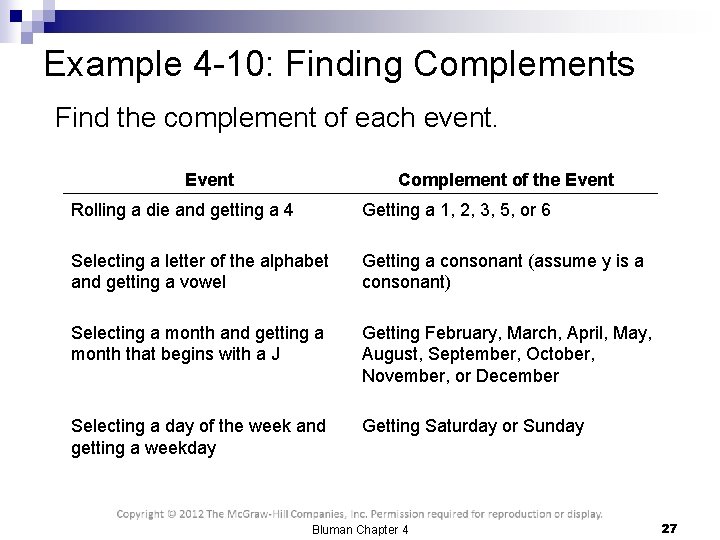
Example 4 -10: Finding Complements Find the complement of each event. Event Complement of the Event Rolling a die and getting a 4 Getting a 1, 2, 3, 5, or 6 Selecting a letter of the alphabet and getting a vowel Getting a consonant (assume y is a consonant) Selecting a month and getting a month that begins with a J Getting February, March, April, May, August, September, October, November, or December Selecting a day of the week and getting a weekday Getting Saturday or Sunday Bluman Chapter 4 27
Chapter 4 Probability and Counting Rules Section 4 -1 Example 4 -11 Page #190 Bluman Chapter 4 28
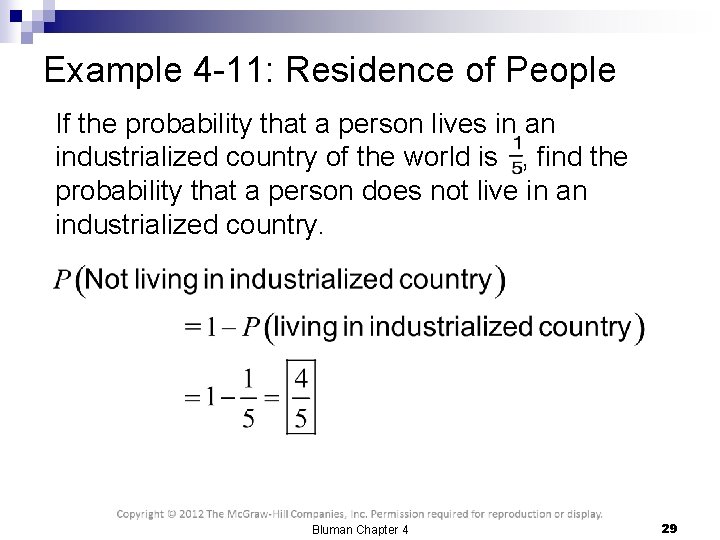
Example 4 -11: Residence of People If the probability that a person lives in an industrialized country of the world is , find the probability that a person does not live in an industrialized country. Bluman Chapter 4 29
Sample Spaces and Probability There are three basic interpretations of probability: n. Classical probability n. Empirical probability n. Subjective probability Bluman Chapter 4 30
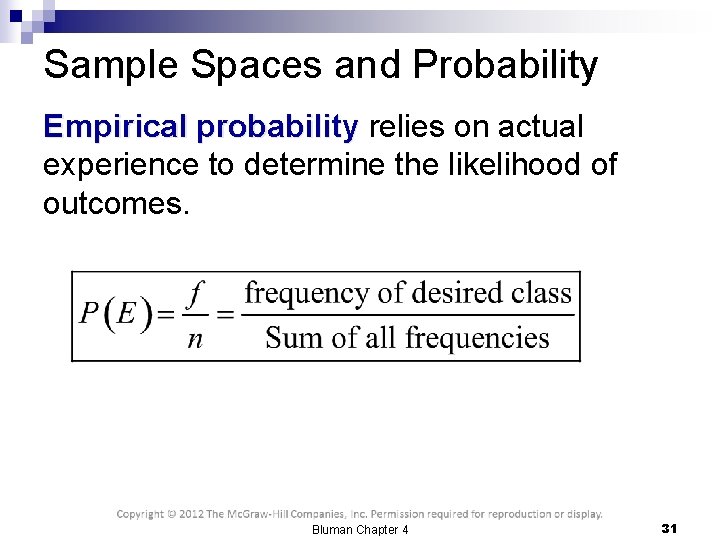
Sample Spaces and Probability Empirical probability relies on actual experience to determine the likelihood of outcomes. Bluman Chapter 4 31
Chapter 4 Probability and Counting Rules Section 4 -1 Example 4 -13 Page #192 Bluman Chapter 4 32
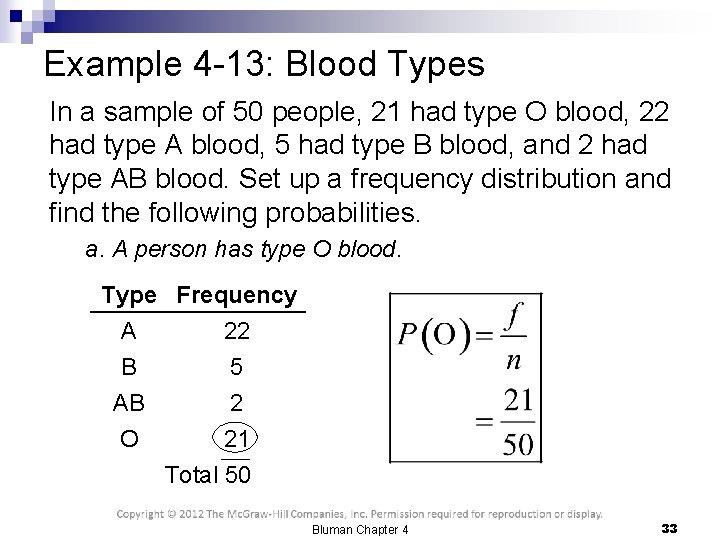
Example 4 -13: Blood Types In a sample of 50 people, 21 had type O blood, 22 had type A blood, 5 had type B blood, and 2 had type AB blood. Set up a frequency distribution and find the following probabilities. a. A person has type O blood. Type Frequency A 22 B 5 AB 2 O 21 Total 50 Bluman Chapter 4 33
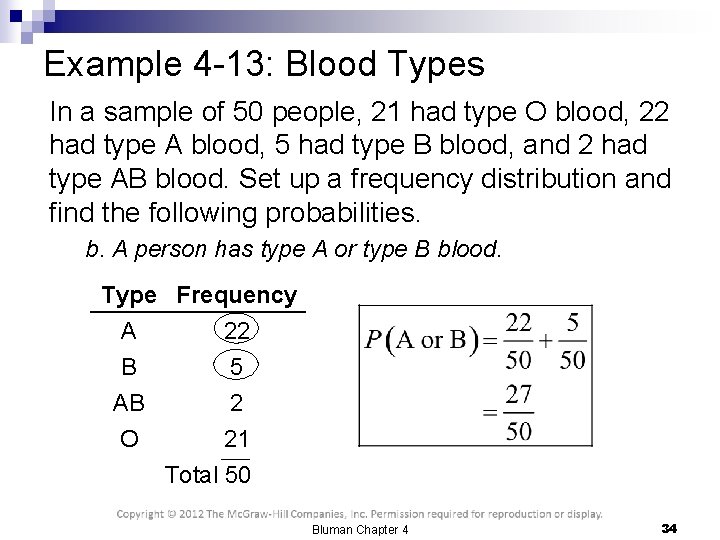
Example 4 -13: Blood Types In a sample of 50 people, 21 had type O blood, 22 had type A blood, 5 had type B blood, and 2 had type AB blood. Set up a frequency distribution and find the following probabilities. b. A person has type A or type B blood. Type Frequency A 22 B 5 AB 2 O 21 Total 50 Bluman Chapter 4 34
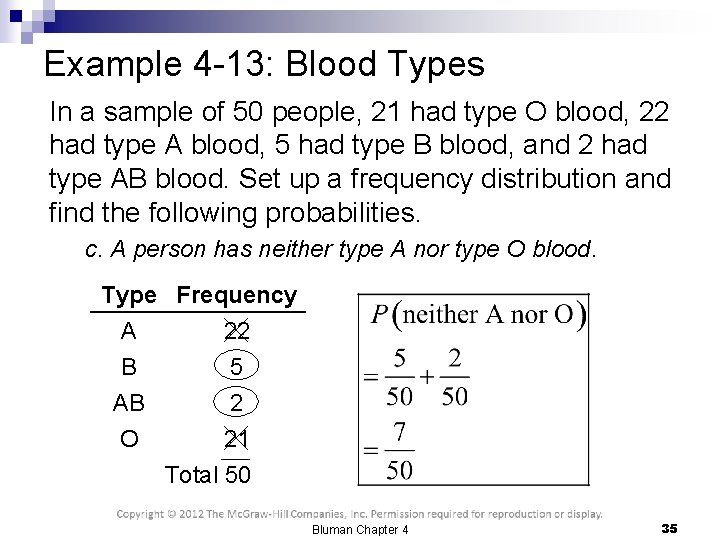
Example 4 -13: Blood Types In a sample of 50 people, 21 had type O blood, 22 had type A blood, 5 had type B blood, and 2 had type AB blood. Set up a frequency distribution and find the following probabilities. c. A person has neither type A nor type O blood. Type Frequency A 22 B 5 AB 2 O 21 Total 50 Bluman Chapter 4 35
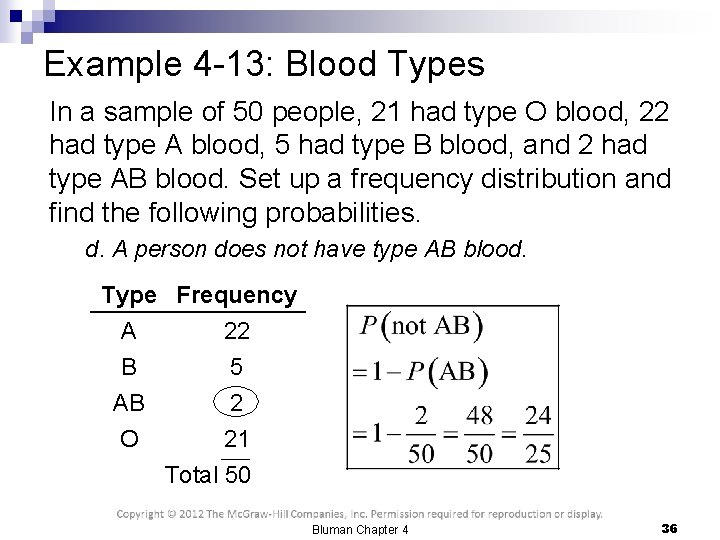
Example 4 -13: Blood Types In a sample of 50 people, 21 had type O blood, 22 had type A blood, 5 had type B blood, and 2 had type AB blood. Set up a frequency distribution and find the following probabilities. d. A person does not have type AB blood. Type Frequency A 22 B 5 AB 2 O 21 Total 50 Bluman Chapter 4 36
Sample Spaces and Probability There are three basic interpretations of probability: n. Classical probability n. Empirical probability n. Subjective probability Bluman Chapter 4 37
Sample Spaces and Probability Subjective probability uses a probability value based on an educated guess or estimate, employing opinions and inexact information. Examples: weather forecasting, predicting outcomes of sporting events Bluman Chapter 4 38
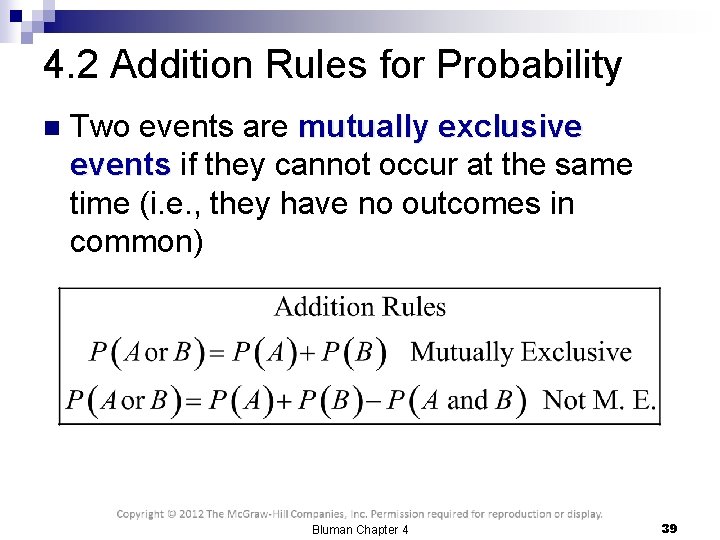
4. 2 Addition Rules for Probability n Two events are mutually exclusive events if they cannot occur at the same time (i. e. , they have no outcomes in common) Bluman Chapter 4 39
Chapter 4 Probability and Counting Rules Section 4 -2 Example 4 -15 Page #200 Bluman Chapter 4 40
Example 4 -15: Rolling a Die Determine which events are mutually exclusive and which are not, when a single die is rolled. a. Getting an odd number and getting an even number Getting an odd number: 1, 3, or 5 Getting an even number: 2, 4, or 6 Mutually Exclusive Bluman Chapter 4 41
Example 4 -15: Rolling a Die Determine which events are mutually exclusive and which are not, when a single die is rolled. b. Getting a 3 and getting an odd number Getting a 3: 3 Getting an odd number: 1, 3, or 5 Not Mutually Exclusive Bluman Chapter 4 42
Example 4 -15: Rolling a Die Determine which events are mutually exclusive and which are not, when a single die is rolled. c. Getting an odd number and getting a number less than 4 Getting an odd number: 1, 3, or 5 Getting a number less than 4: 1, 2, or 3 Not Mutually Exclusive Bluman Chapter 4 43
Example 4 -15: Rolling a Die Determine which events are mutually exclusive and which are not, when a single die is rolled. d. Getting a number greater than 4 and getting a number less than 4 Getting a number greater than 4: 5 or 6 Getting a number less than 4: 1, 2, or 3 Mutually Exclusive Bluman Chapter 4 44
Chapter 4 Probability and Counting Rules Section 4 -2 Example 4 -18 Page #201 Bluman Chapter 4 45
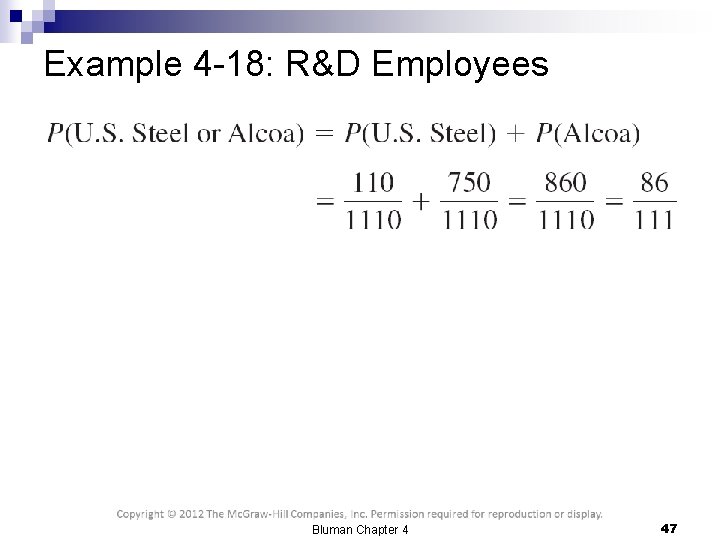
Example 4 -18: R&D Employees The corporate research and development centers for three local companies have the following number of employees: U. S. Steel 110 Alcoa 750 Bayer Material Science 250 If a research employee is selected at random, find the probability that the employee is employed by U. S. Steel or Alcoa. Bluman Chapter 4 46
Example 4 -18: R&D Employees Bluman Chapter 4 47
Chapter 4 Probability and Counting Rules Section 4 -2 Example 4 -21 Page #202 Bluman Chapter 4 48
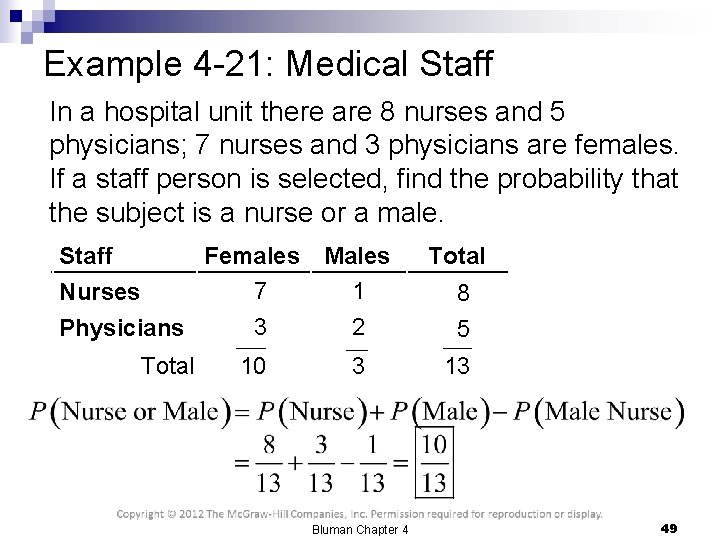
Example 4 -21: Medical Staff In a hospital unit there are 8 nurses and 5 physicians; 7 nurses and 3 physicians are females. If a staff person is selected, find the probability that the subject is a nurse or a male. Staff Females 7 Nurses 3 Physicians Total 10 Males 1 2 Total 3 13 Bluman Chapter 4 8 5 49
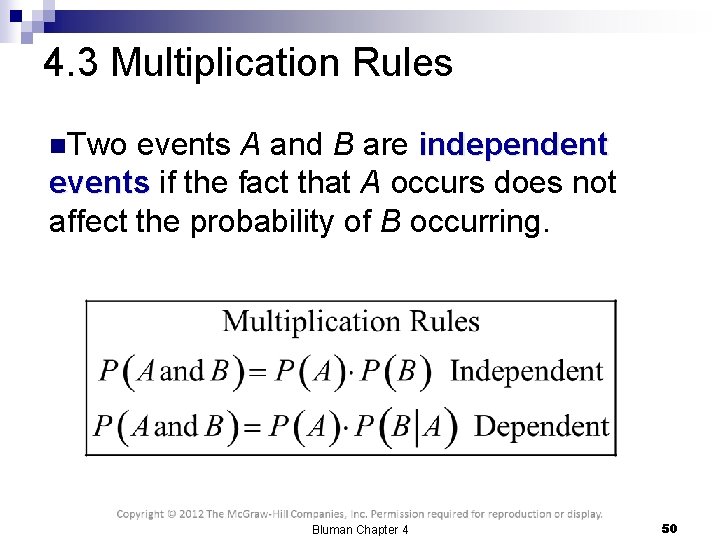
4. 3 Multiplication Rules n. Two events A and B are independent events if the fact that A occurs does not affect the probability of B occurring. Bluman Chapter 4 50
Chapter 4 Probability and Counting Rules Section 4 -3 Example 4 -23 Page #211 Bluman Chapter 4 51
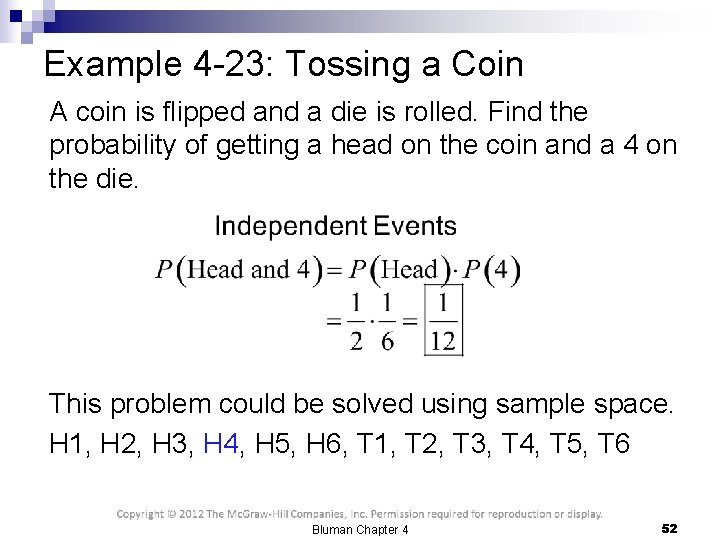
Example 4 -23: Tossing a Coin A coin is flipped and a die is rolled. Find the probability of getting a head on the coin and a 4 on the die. This problem could be solved using sample space. H 1, H 2, H 3, H 4, H 5, H 6, T 1, T 2, T 3, T 4, T 5, T 6 Bluman Chapter 4 52
Chapter 4 Probability and Counting Rules Section 4 -3 Example 4 -26 Page #212 Bluman Chapter 4 53
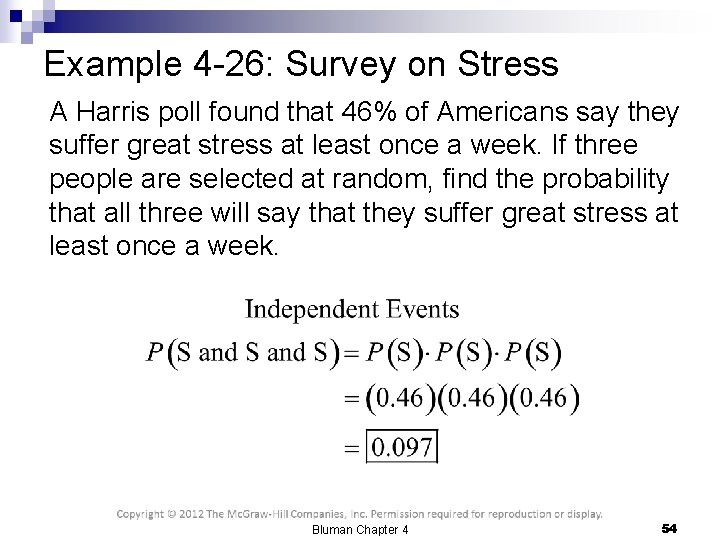
Example 4 -26: Survey on Stress A Harris poll found that 46% of Americans say they suffer great stress at least once a week. If three people are selected at random, find the probability that all three will say that they suffer great stress at least once a week. Bluman Chapter 4 54
Chapter 4 Probability and Counting Rules Section 4 -3 Example 4 -28 Page #214 Bluman Chapter 4 55
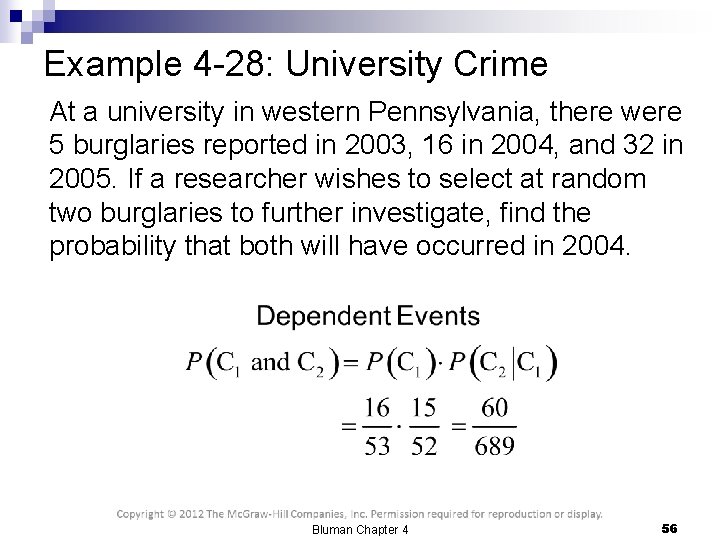
Example 4 -28: University Crime At a university in western Pennsylvania, there were 5 burglaries reported in 2003, 16 in 2004, and 32 in 2005. If a researcher wishes to select at random two burglaries to further investigate, find the probability that both will have occurred in 2004. Bluman Chapter 4 56
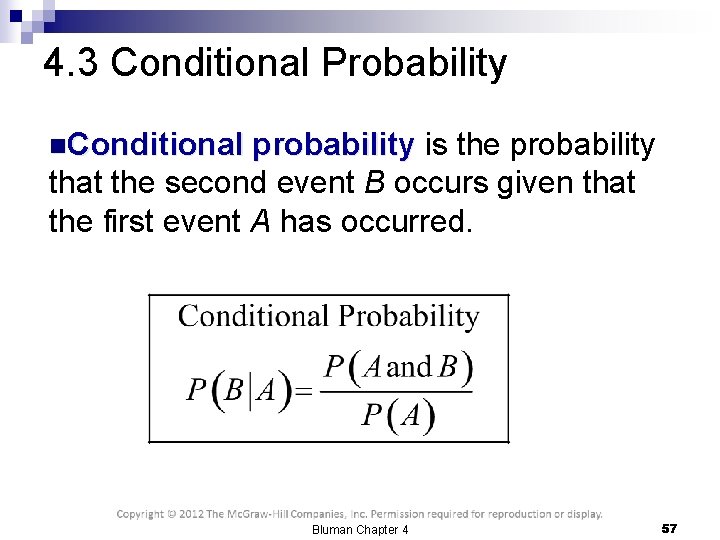
4. 3 Conditional Probability n. Conditional probability is the probability that the second event B occurs given that the first event A has occurred. Bluman Chapter 4 57
Chapter 4 Probability and Counting Rules Section 4 -3 Example 4 -33 Page #217 Bluman Chapter 4 58
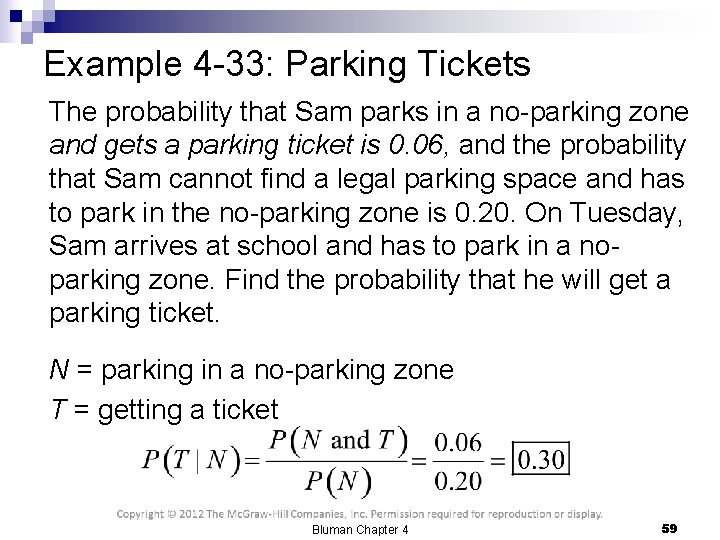
Example 4 -33: Parking Tickets The probability that Sam parks in a no-parking zone and gets a parking ticket is 0. 06, and the probability that Sam cannot find a legal parking space and has to park in the no-parking zone is 0. 20. On Tuesday, Sam arrives at school and has to park in a noparking zone. Find the probability that he will get a parking ticket. N = parking in a no-parking zone T = getting a ticket Bluman Chapter 4 59
Chapter 4 Probability and Counting Rules Section 4 -3 Example 4 -34 Page #217 Bluman Chapter 4 60
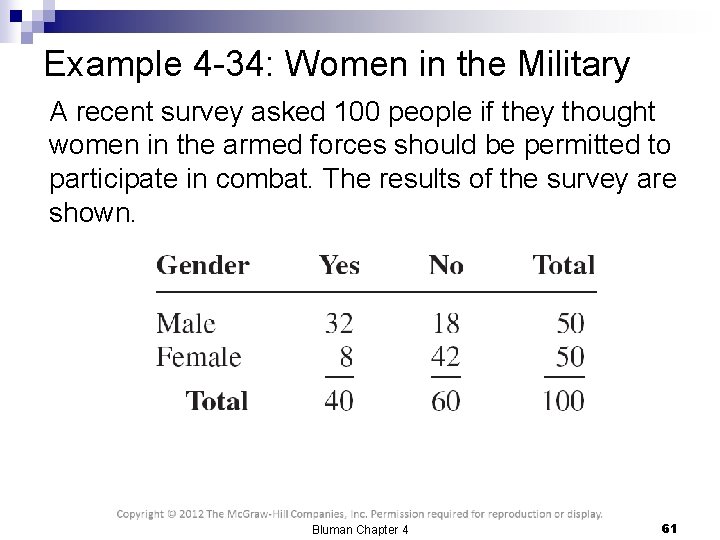
Example 4 -34: Women in the Military A recent survey asked 100 people if they thought women in the armed forces should be permitted to participate in combat. The results of the survey are shown. Bluman Chapter 4 61
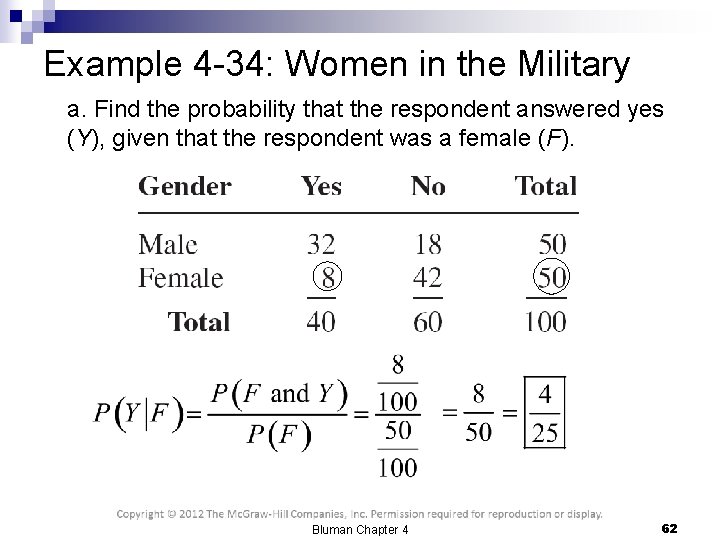
Example 4 -34: Women in the Military a. Find the probability that the respondent answered yes (Y), given that the respondent was a female (F). Bluman Chapter 4 62
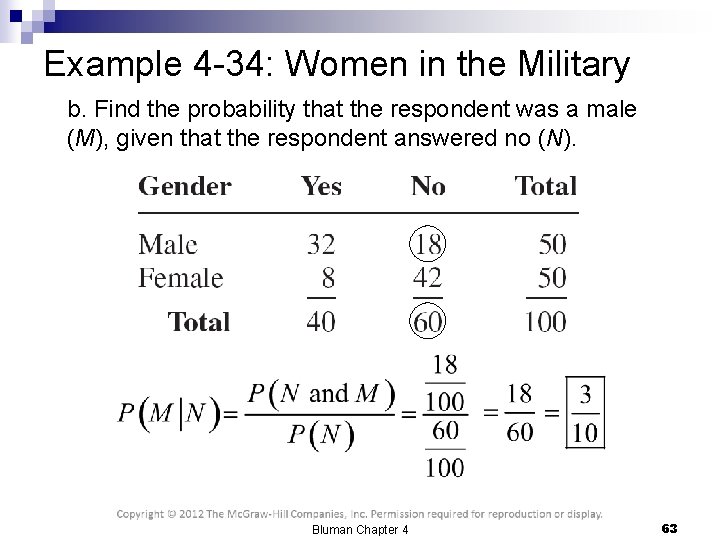
Example 4 -34: Women in the Military b. Find the probability that the respondent was a male (M), given that the respondent answered no (N). Bluman Chapter 4 63
Chapter 4 Probability and Counting Rules Section 4 -3 Example 4 -37 Page #219 Bluman Chapter 4 64
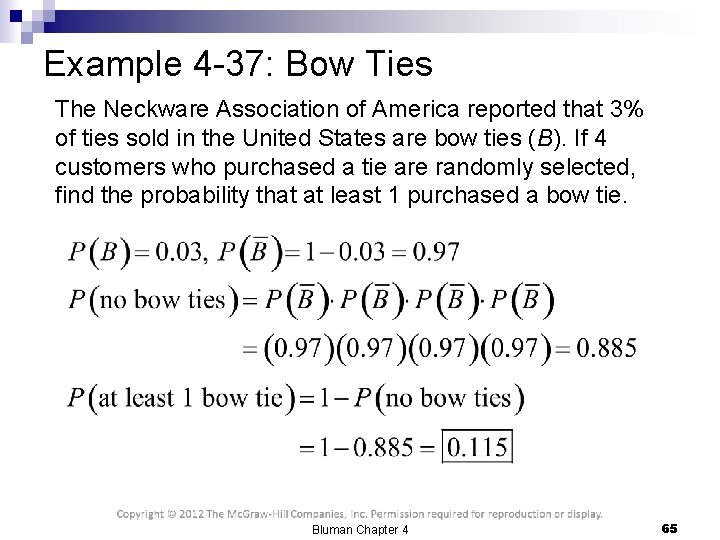
Example 4 -37: Bow Ties The Neckware Association of America reported that 3% of ties sold in the United States are bow ties (B). If 4 customers who purchased a tie are randomly selected, find the probability that at least 1 purchased a bow tie. Bluman Chapter 4 65
4. 4 Counting Rules n. The fundamental counting rule is also called the multiplication of choices n. In a sequence of n events in which the first one has k 1 possibilities and the second event has k 2 and the third has k 3, and so forth, the total number of possibilities of the sequence will be k 1 · k 2 · k 3 · · · kn Bluman Chapter 4 66
Chapter 4 Probability and Counting Rules Section 4 -4 Example 4 -39 Page #225 Bluman Chapter 4 67
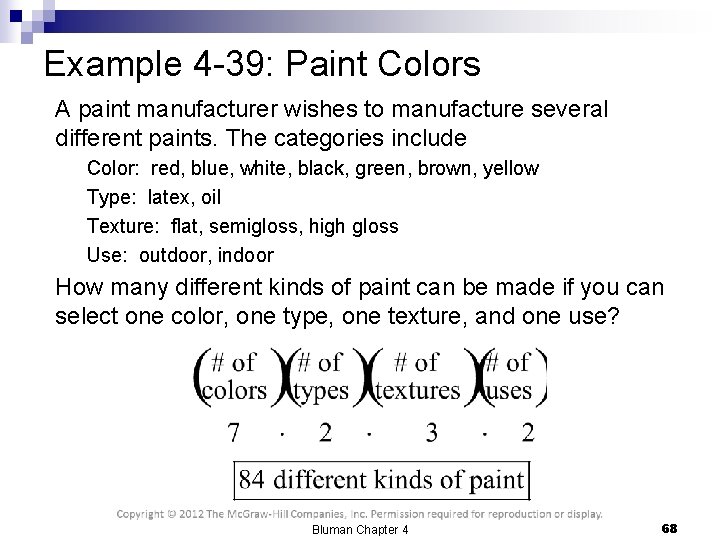
Example 4 -39: Paint Colors A paint manufacturer wishes to manufacture several different paints. The categories include Color: red, blue, white, black, green, brown, yellow Type: latex, oil Texture: flat, semigloss, high gloss Use: outdoor, indoor How many different kinds of paint can be made if you can select one color, one type, one texture, and one use? Bluman Chapter 4 68
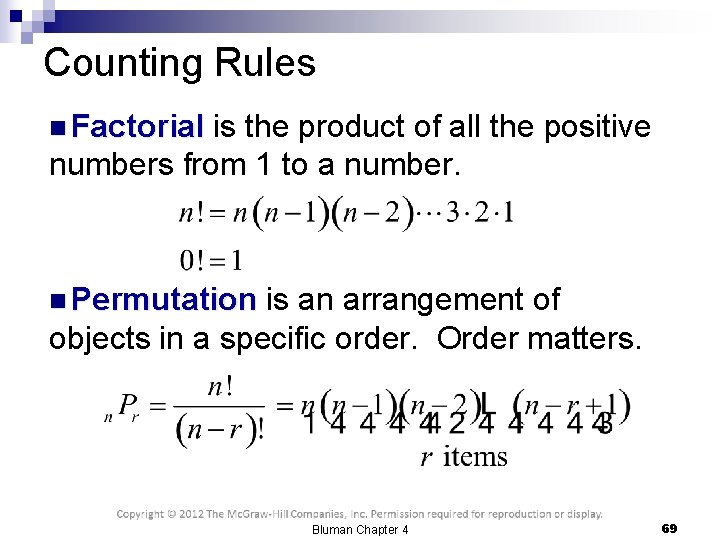
Counting Rules n Factorial is the product of all the positive numbers from 1 to a number. n Permutation is an arrangement of objects in a specific order. Order matters. Bluman Chapter 4 69
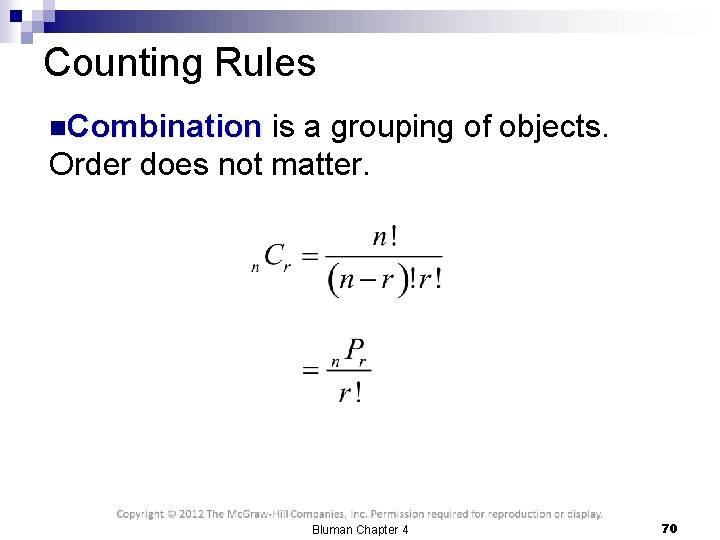
Counting Rules n. Combination is a grouping of objects. Order does not matter. Bluman Chapter 4 70
Chapter 4 Probability and Counting Rules Section 4 -4 Example 4 -42/4 -43 Page #227 Bluman Chapter 4 71
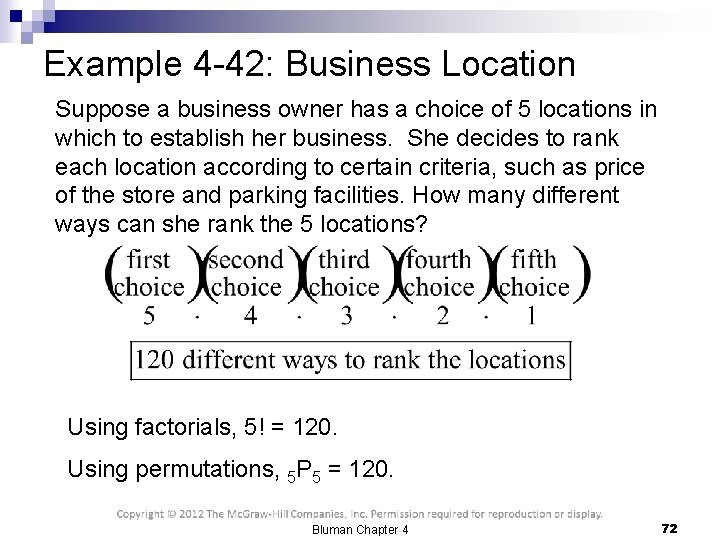
Example 4 -42: Business Location Suppose a business owner has a choice of 5 locations in which to establish her business. She decides to rank each location according to certain criteria, such as price of the store and parking facilities. How many different ways can she rank the 5 locations? Using factorials, 5! = 120. Using permutations, 5 P 5 = 120. Bluman Chapter 4 72
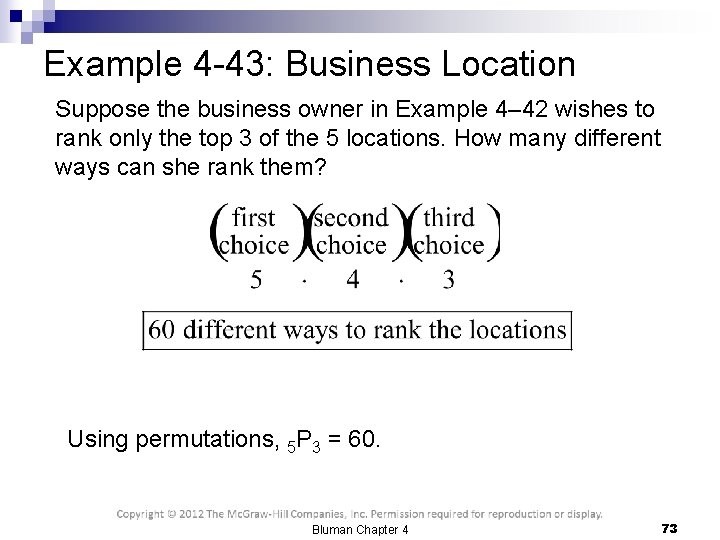
Example 4 -43: Business Location Suppose the business owner in Example 4– 42 wishes to rank only the top 3 of the 5 locations. How many different ways can she rank them? Using permutations, 5 P 3 = 60. Bluman Chapter 4 73
Chapter 4 Probability and Counting Rules Section 4 -4 Example 4 -44 Page #229 Bluman Chapter 4 74
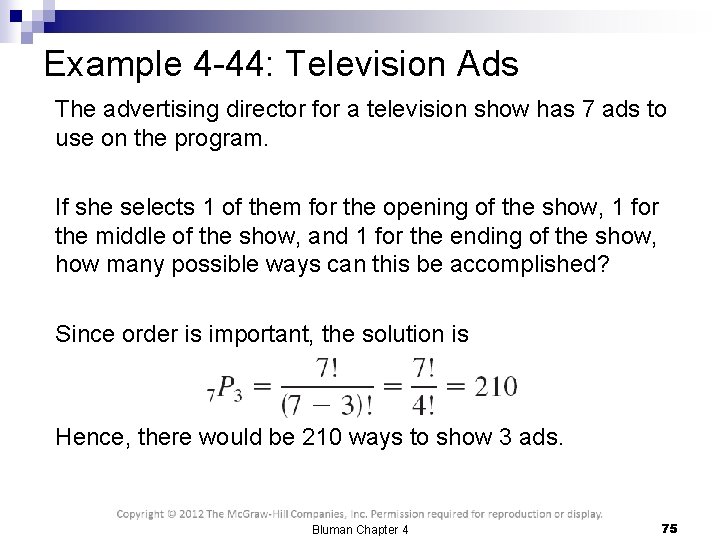
Example 4 -44: Television Ads The advertising director for a television show has 7 ads to use on the program. If she selects 1 of them for the opening of the show, 1 for the middle of the show, and 1 for the ending of the show, how many possible ways can this be accomplished? Since order is important, the solution is Hence, there would be 210 ways to show 3 ads. Bluman Chapter 4 75
Chapter 4 Probability and Counting Rules Section 4 -4 Example 4 -45 Page #229 Bluman Chapter 4 76
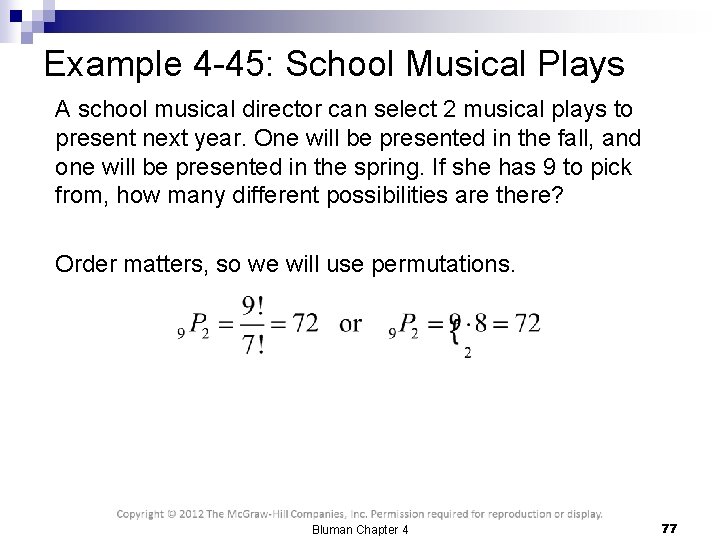
Example 4 -45: School Musical Plays A school musical director can select 2 musical plays to present next year. One will be presented in the fall, and one will be presented in the spring. If she has 9 to pick from, how many different possibilities are there? Order matters, so we will use permutations. Bluman Chapter 4 77
Chapter 4 Probability and Counting Rules Section 4 -4 Example 4 -48 Page #231 Bluman Chapter 4 78
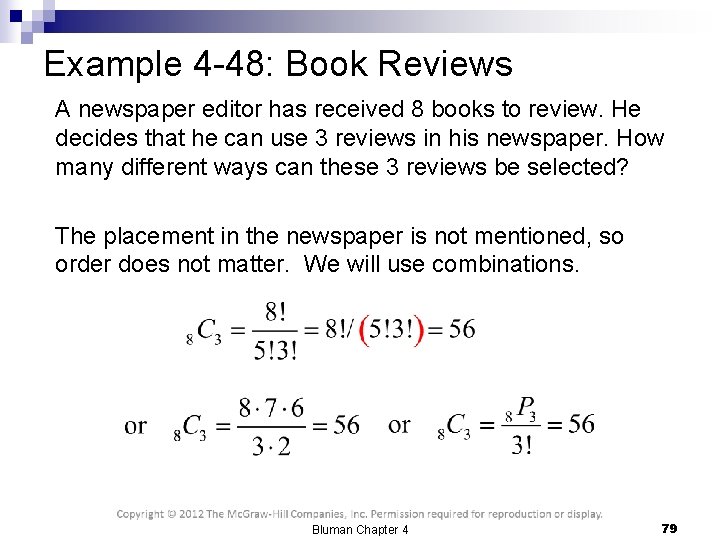
Example 4 -48: Book Reviews A newspaper editor has received 8 books to review. He decides that he can use 3 reviews in his newspaper. How many different ways can these 3 reviews be selected? The placement in the newspaper is not mentioned, so order does not matter. We will use combinations. Bluman Chapter 4 79
Chapter 4 Probability and Counting Rules Section 4 -4 Example 4 -49 Page #231 Bluman Chapter 4 80
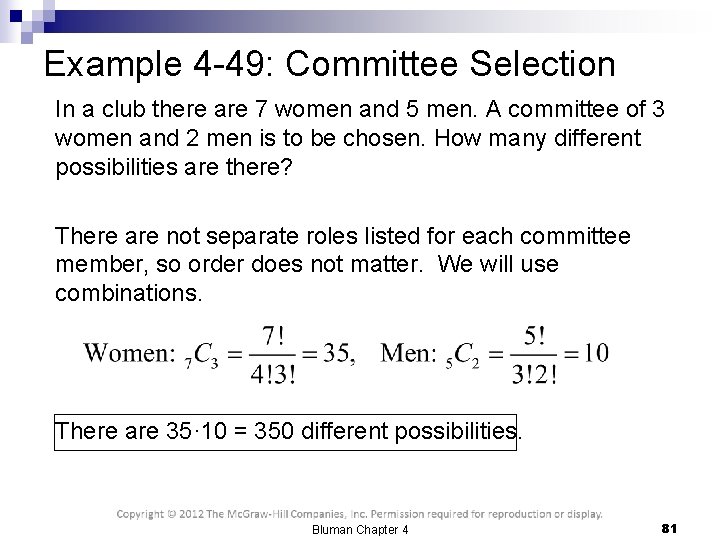
Example 4 -49: Committee Selection In a club there are 7 women and 5 men. A committee of 3 women and 2 men is to be chosen. How many different possibilities are there? There are not separate roles listed for each committee member, so order does not matter. We will use combinations. There are 35· 10 = 350 different possibilities. Bluman Chapter 4 81
4. 5 Probability and Counting Rules The counting rules can be combined with the probability rules in this chapter to solve many types of probability problems. By using the fundamental counting rule, the permutation rules, and the combination rule, you can compute the probability of outcomes of many experiments, such as getting a full house when 5 cards are dealt or selecting a committee of 3 women and 2 men from a club consisting of 10 women and 10 men. Bluman Chapter 4 82
Chapter 4 Probability and Counting Rules Section 4 -5 Example 4 -52 Page #238 Bluman Chapter 4 83
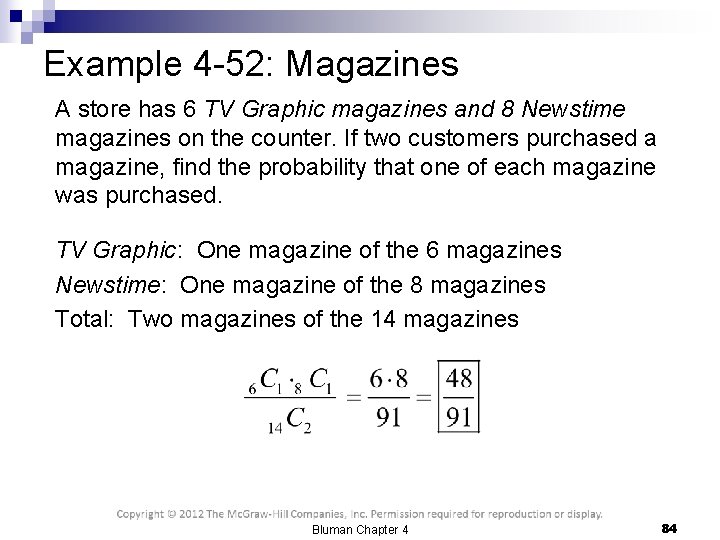
Example 4 -52: Magazines A store has 6 TV Graphic magazines and 8 Newstime magazines on the counter. If two customers purchased a magazine, find the probability that one of each magazine was purchased. TV Graphic: One magazine of the 6 magazines Newstime: One magazine of the 8 magazines Total: Two magazines of the 14 magazines Bluman Chapter 4 84
Chapter 4 Probability and Counting Rules Section 4 -5 Example 4 -53 Page #239 Bluman Chapter 4 85
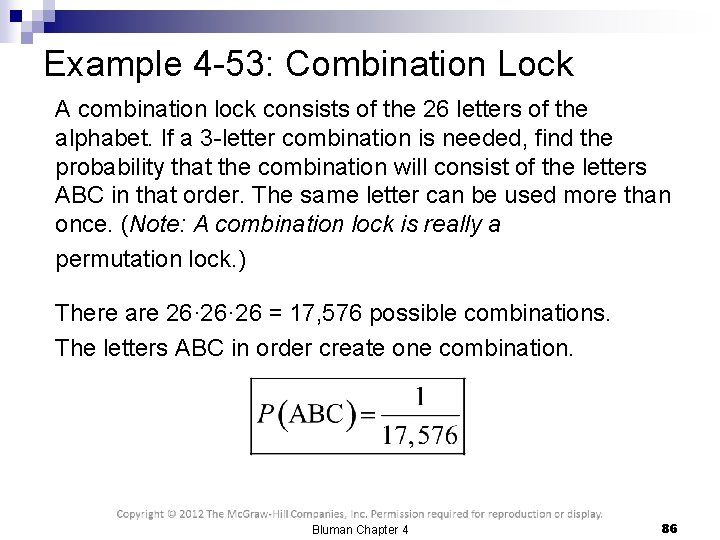
Example 4 -53: Combination Lock A combination lock consists of the 26 letters of the alphabet. If a 3 -letter combination is needed, find the probability that the combination will consist of the letters ABC in that order. The same letter can be used more than once. (Note: A combination lock is really a permutation lock. ) There are 26· 26 = 17, 576 possible combinations. The letters ABC in order create one combination. Bluman Chapter 4 86
- Slides: 86