
Chapter 4 Principles of Infection Prevention and Control
- Slides: 38
Chapter 4 Principles of Infection Prevention and Control
Learning Objectives Define health care associated infections and state how often they occur. Describe why infection prevention is important in respiratory care. Identify and describe three elements that must be present for transmission of infection within a health care setting. List the factors associated with an increased risk of a patient acquiring a nosocomial infection. State three major routes for transmission of human sources of pathogens in the health care environment. by lsevier Inc.
Learning Objectives (cont. ) Describe strategies to control the spread of infection in the hospital. Describe how to select and apply chemical disinfectants for processing respiratory care equipment. Describe equipment handling procedures that help prevent the spread of pathogens. State when and to use general barrier measures during patient care. Describe surveillance with regard to infection control. by lsevier Inc.
Infection Control Introduction Hospital-acquired infections (HAIs) account for 1. 7 million infections & 99, 000 excess deaths annually About 5% of patients admitted develop an HAI About 25% of mechanically ventilated patients develop pneumonia, & 30% (of those 25%) will die by lsevier Inc.
Infection Control (cont. ) Infection control procedures aim to: Eliminate the sources of infectious agents Create barriers to their transmission Monitor the effectiveness of control All health care workers must take responsibility & follow procedures carefully Infection prevention is an ongoing responsibility of all respiratory therapists by lsevier Inc.
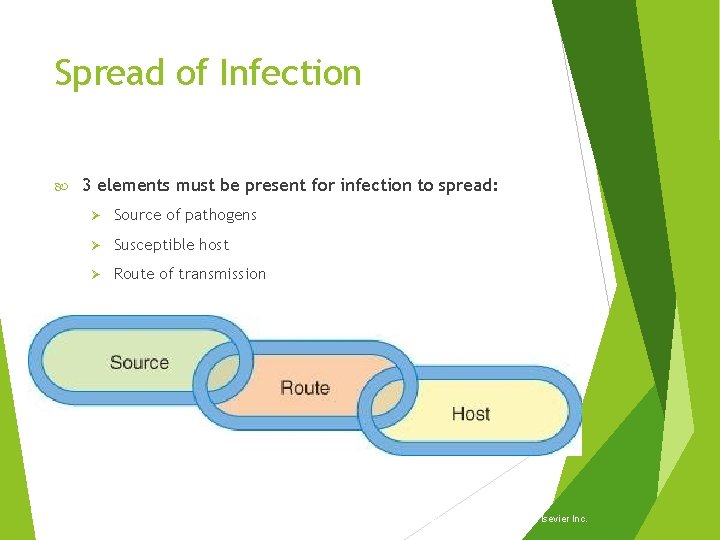
Spread of Infection 3 elements must be present for infection to spread: Source of pathogens Susceptible host Route of transmission by lsevier Inc.
Spread of Infection (cont. ) Susceptible hosts Resistance to infection varies greatly from one person to next Host factors increasing chance of infection are: Poorly controlled diabetes Increased age Chemotherapy Placement of tubes & catheters by lsevier Inc.
Spread of Infection (cont. ) Sources of infectious agents: Humans are primary source Inanimate objects (e. g. , contaminated medical equipment) can spread infection Individuals in hospital capable of being source include: �Workers �Visitors �Patients by lsevier Inc.
Spread of Infection (cont. ) Hospital-acquired or nosocomial infections acquired in hospital The high incidence of nosocomial gram-negative bacterial pneumoniais associated with factors that promote colonization of the pharynx with these organisms. Gram-negative colonization dramatically increases in critically ill patients. Patients with history of chronic obstructive pulmonary disease (COPD), cigarette smoking, or obesity & those with advanced age have greatest risk for nosocomial pneumonia following major surgery for example chest or abdominal surgery Patients with artificial airways or immuno-compromised are at higher risk of acquiring nosocomial infections by lsevier Inc.
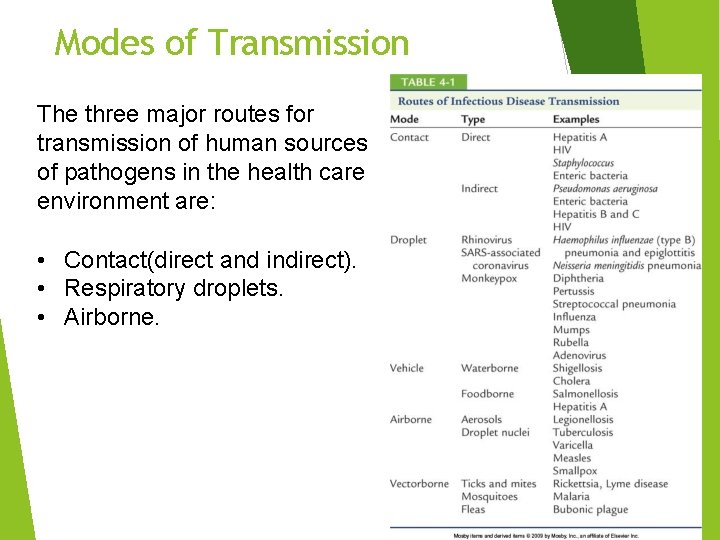
Modes of Transmission The three major routes for transmission of human sources of pathogens in the health care environment are: • Contact(direct and indirect). • Respiratory droplets. • Airborne.
Modes of Transmission (cont. ) � Contact Transmission is the most common route of transmission and is divided into two subgroups: direct and indirect. �Direct contact transmission occurs when a pathogenis transferred directly from one person to another (less frequently than indirect contact. � Indirect contact transmission is the most frequent mode of transmission in the health care environment and involves the transfer of a pathogen through a contaminated intermediate object or person for example unwashed hands of health care personnel that touch an infected site on one patient or a contaminated inanimate object and subsequently touch another patient. 11 by lsevier Inc.
Modes of Transmission (cont. ) � Droplet transmission is a form of contact transmission, organisms that are transmitted by respiratory droplets include influenza. � Respiratory droplets are generated when an infected individual discharges large contaminated liquid droplets into the air by coughing, sneezing, or talking. � Respiratory droplets are also generated during procedures such as suctioning, bronchoscopy. 12 by lsevier Inc.
Modes of Transmission (cont. ) � Airborne Transmission occurs via the spread of airborne droplet nuclei. � These are small particles (≤ 5 μm) of evaporated droplets containing infectious microorganisms that can remain suspended in air for long periods. � Examples of pathogens transmitted via the airborne route include Mycobacterium tuberculosis. 13 by lsevier Inc.
Infection Prevention Strategies Creating a Safe Culture> � Decreasing host susceptibility most difficult and least feasible approach to infection control. : Immunizations & chemoprophylaxis Most HAIs from ventilator associated pneumonia (VAP), catheter related bloodstream infections, & catheter associated UTIs Limit use of devices associated w/ HAIs & assure proper placement & maintainence Prevention bundles: use of multiple evidence-based best practices to prevent device related infection Eliminating source of pathogens It is impossible to eliminate all pathogens from any working environment. Nonetheless, standard infection control procedures always include efforts to eliminate pathogens, and recommended practices for cleaning and disinfecting noncritical surfaces in patient care areas by lsevier Inc.
Infection Prevention Strategies (cont. ) Interrupting routes of transmission Barrier/isolation precautions using both standard & transmission based precautions Disposable equipment Infection prevention programs identify & categorize HAIs & provide guidance to break chain of events Infection prevention programs endorse prevention by assuring that caregivers have appropriate time, equipment, & training to provide best possible care by lsevier Inc.
Infection Prevention Strategies (cont. ) by lsevier Inc.
Eliminating Source of Pathogens General hygiene: Help to keep overall environment clean Aim to reduce number of pathogens to safe level Environmental control of air & water complements efforts Specialized equipment processing: to decontaminate equipment capable of spreading infection involves cleaning, disinfection, & sterilization by lsevier Inc.
Preventing Transmission of Infectious Agents Standard Precautions: combine major features of Universal Precautions & Body Substance Isolation To be applied to patients in all health care settings, all the time Standard precautions apply to: � Blood � All body fluids � Nonintact skin � Mucous membranes by lsevier Inc.
Preventing Transmission of Infectious Agents (cont. ) Personal Protective Equipment (PPE) must be worn at all times Gloves: must be sterile whenever performing invasive procedures Masks: protect mucosal surfaces against splashes or sprays but should not be confused w/ particulate respirators N-95 or higher-level respirator: intended for diseases that could be airborne transmitted Gowns: provide barrier protection & can prevent contamination of clothing & exposed body areas by lsevier Inc.
Preventing Transmission of Infectious Agents (cont. ) Respiratory Hygiene/cough protocol: Education of patients & employees Posted signs Source control measures (covering mouth/nose, or using surgical mask) Hand hygiene Spatial separation (at least 3 feet of space) by lsevier Inc.
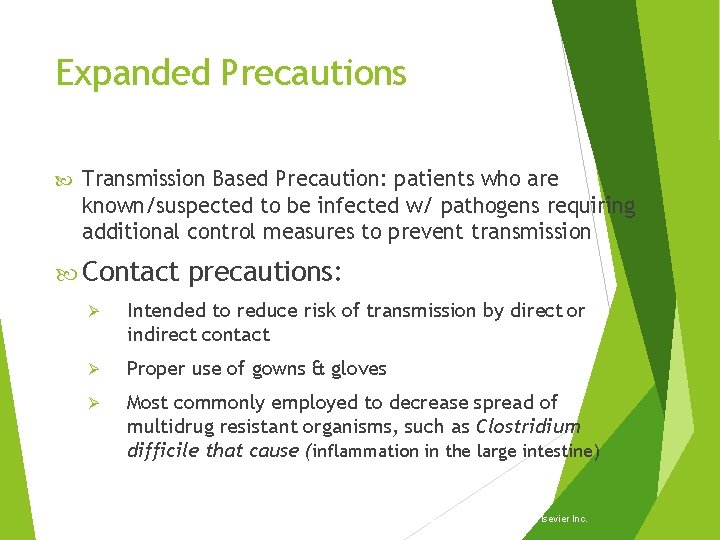
Expanded Precautions Transmission Based Precaution: patients who are known/suspected to be infected w/ pathogens requiring additional control measures to prevent transmission Contact precautions: Intended to reduce risk of transmission by direct or indirect contact Proper use of gowns & gloves Most commonly employed to decrease spread of multidrug resistant organisms, such as Clostridium difficile that cause (inflammation in the large intestine) by lsevier Inc.
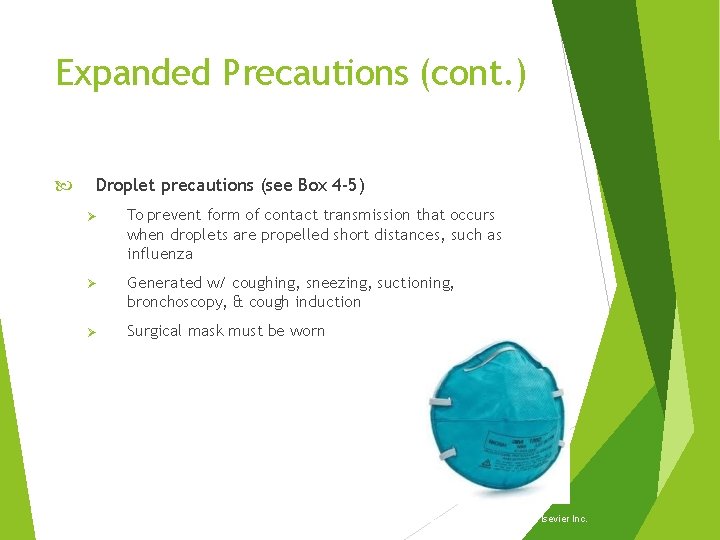
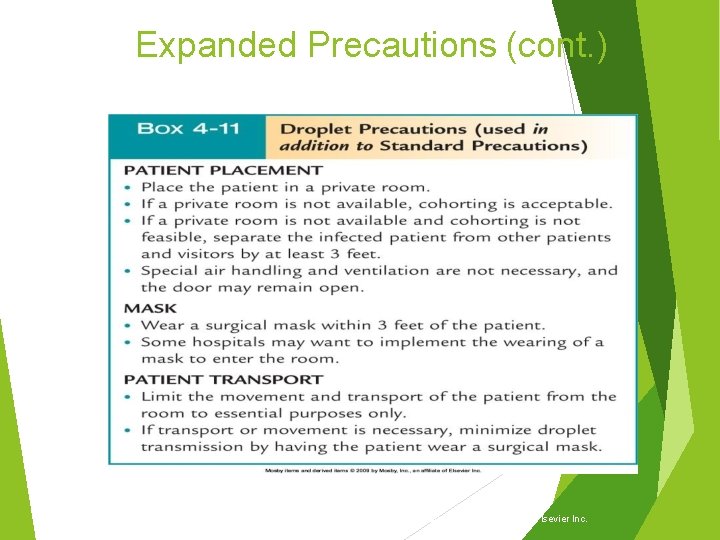
Expanded Precautions (cont. ) Droplet precautions (see Box 4 -5) To prevent form of contact transmission that occurs when droplets are propelled short distances, such as influenza Generated w/ coughing, sneezing, suctioning, bronchoscopy, & cough induction Surgical mask must be worn by lsevier Inc.
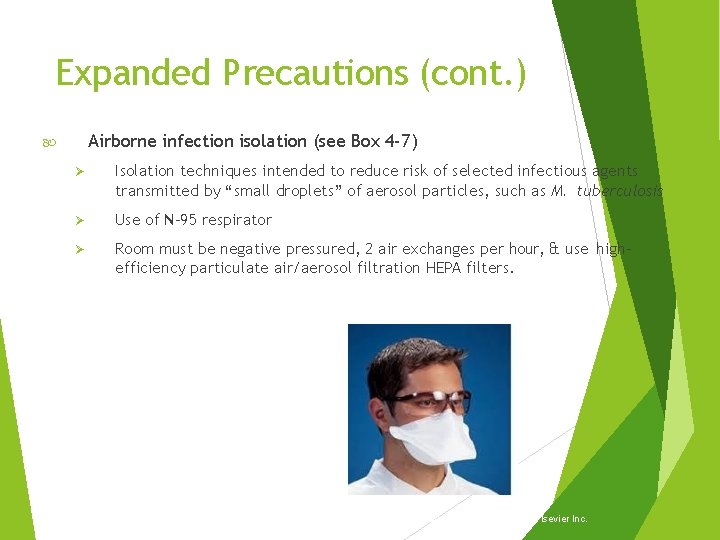
Expanded Precautions (cont. ) Airborne infection isolation (see Box 4 -7) Isolation techniques intended to reduce risk of selected infectious agents transmitted by “small droplets” of aerosol particles, such as M. tuberculosis Use of N-95 respirator Room must be negative pressured, 2 air exchanges per hour, & use highefficiency particulate air/aerosol filtration HEPA filters. by lsevier Inc.
Expanded Precautions (cont. ) by lsevier Inc.
Expanded Precautions (cont. ) Protective environment Specialized engineering approach to protect highly immunocomprised patients Used w/ allogeneic stem cell transplant patient Includes: HEPA filtration of incoming air, directed room air flow, positive room air pressure relative to corridor, well-sealed rooms to prevent infiltration of outside air, ventilation to provide 12 or more air changes per hour, strategies to reduce dust. by lsevier Inc.
Expanded Precautions (cont. ) Patient placement & transport Single occupancy room ideal Cohorting: grouping patients w/ same infection Limit transport of patients w/ contagious diseases During transport: patient needs to wear appropriate barrier protection (masks, gowns, impervious dressings) consistent w/ route & risk for transmission by lsevier Inc.
Disinfection & Sterilization Cleaning is first step in all equipment processing Involves removing dirt & organic material Failure to clean equipment properly can reduce all subsequent processing efforts ineffective. Non-critical items, such as intravenous pumps, & ventilator surfaces, must be thoroughly cleaned & disinfected before use w/ another patient. Medical equipment must be cleaned and maintained according to the manufacturer’s instructions. Complete disassembly helps ensure good exposure to the cleaning agent. Soaps & detergents need to be used. by lsevier Inc.
Disinfection & Sterilization (cont. ) Disinfection destroys vegetative form of all pathogens except bacterial spores Disinfection differs from sterilization by its lack of sporicidal activity. However, a few disinfectants kill spores with prolonged exposure times (hours) and are called chemical sterilants. Disinfection can involve either chemical or physical methods Pasteurization (e. g. autoclaving at lower temperature) is most common physical method by lsevier Inc.
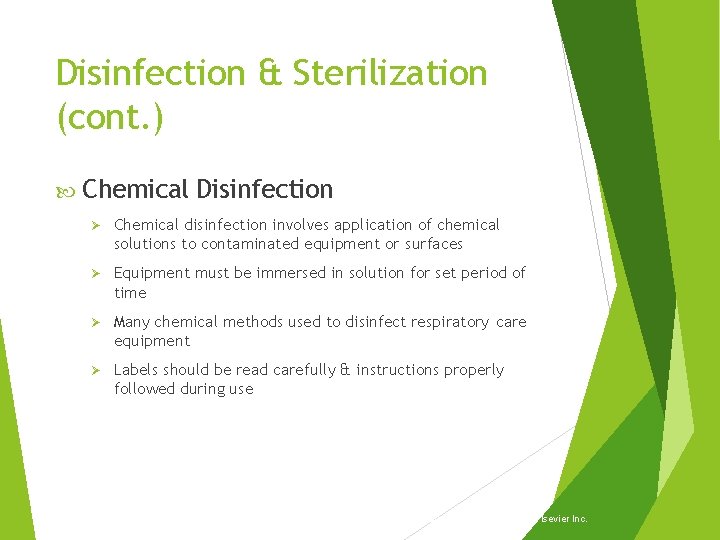
Disinfection & Sterilization (cont. ) Chemical Disinfection Chemical disinfection involves application of chemical solutions to contaminated equipment or surfaces Equipment must be immersed in solution for set period of time Many chemical methods used to disinfect respiratory care equipment Labels should be read carefully & instructions properly followed during use by lsevier Inc.
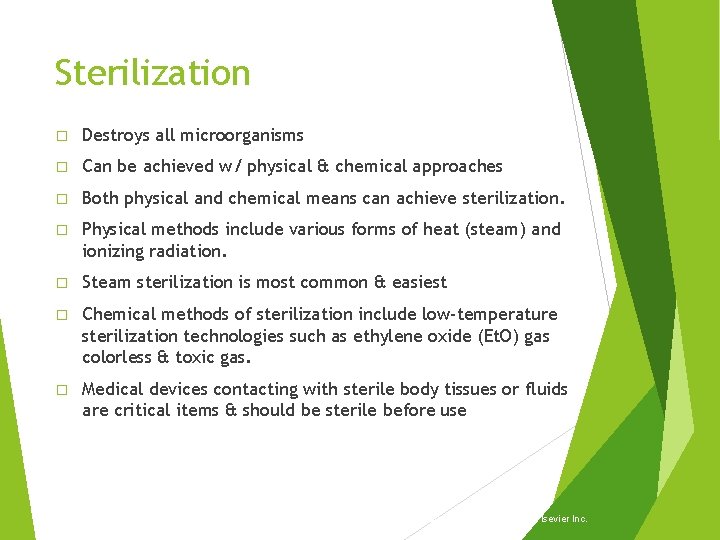
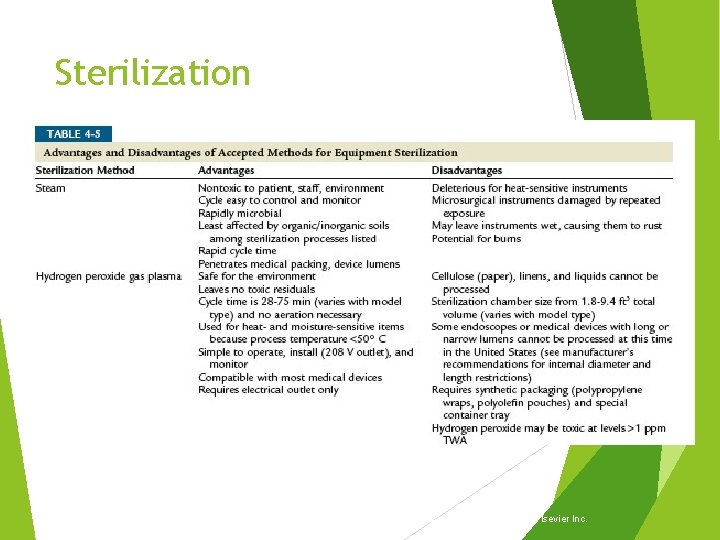
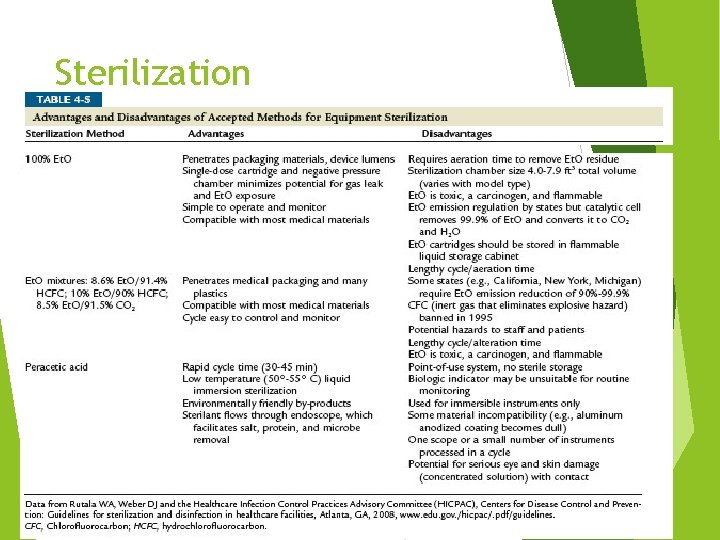
Sterilization � Destroys all microorganisms � Can be achieved w/ physical & chemical approaches � Both physical and chemical means can achieve sterilization. � Physical methods include various forms of heat (steam) and ionizing radiation. � Steam sterilization is most common & easiest � Chemical methods of sterilization include low-temperature sterilization technologies such as ethylene oxide (Et. O) gas colorless & toxic gas. � Medical devices contacting with sterile body tissues or fluids are critical items & should be sterile before use by lsevier Inc.
Sterilization by lsevier Inc.
Sterilization by lsevier Inc.
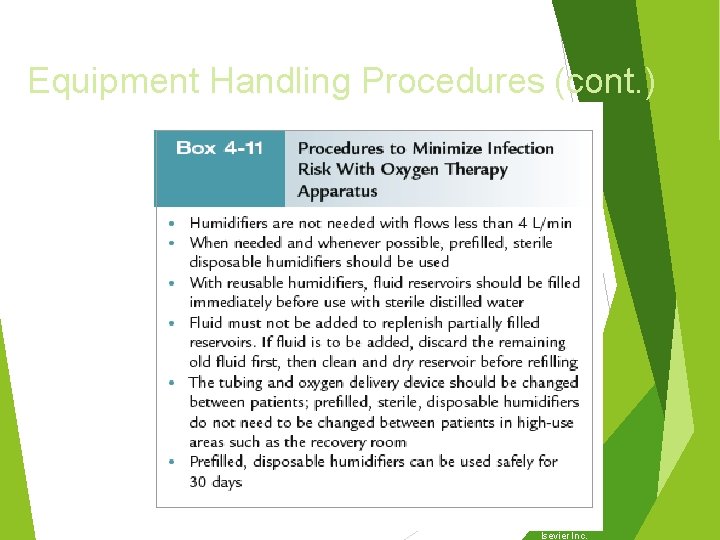
Equipment Handling Procedures Include: Maintenance of in-use equipment Processing of reusable equipment Application of one-patient–use disposables Fluid & medication precautions Respiratory care equipment that can spread pathogens include: nebulizers, ventilator circuits, bag-valve-mask devices (BVMs; manual resuscitators), & suction equipment Oxygen therapy & pulmonary function equipment are also implicated as potential sources of nosocomial infections
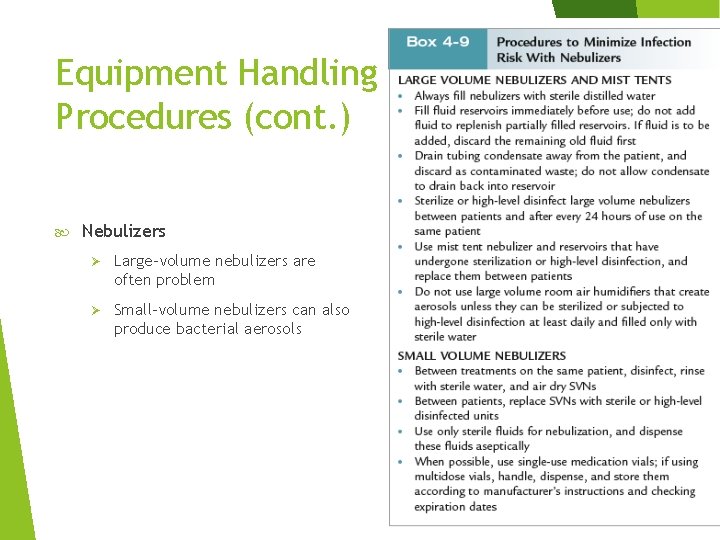
Equipment Handling Procedures (cont. ) Nebulizers Large-volume nebulizers are often problem Small-volume nebulizers can also produce bacterial aerosols
Equipment Handling Procedures (cont. ) Ventilators and Circuits o Circuits have the greatest risk for infection. o High-efficiency particulate air/aerosol (HEPA) filters help reduce endotracheal tube contamination and it can eliminate bacteria from the driving gas and prevent retrograde contamination back into the machine.
Equipment Handling Procedures (cont. ) by lsevier Inc.
Equipment Handling Disposable Equipment Important alternative to continually reprocessing equipment 3 major issues 1. Cost 2. Quality 3. Reuse (raises significant safety concerns)
Surveillance Ongoing process of monitoring patients & personnel for acquisition of infection Infection control committee establishes surveillance policies & infection control expert administers them Common for infection prevention programs to oversee hand hygiene & standard precautions adherence observations