
Chapter 4 Plate Tectonics 4 4 Deforming the
- Slides: 49
Chapter 4 Plate Tectonics 4 -4 Deforming the Earth’s Crust
Essential Questions/Learning Goals: • • How does stress affect the Earth’s crust? Describe three major types of folds.
Science Terms: • Compression • Tension • Folding
Section Introduction: • What is stress? – The amount of force per unit of area on a substance.
Deformation • What is deformation? – Changes in a rock’s shape due to stress • De = “undo” • Form = “shape” • –tion = “process of”
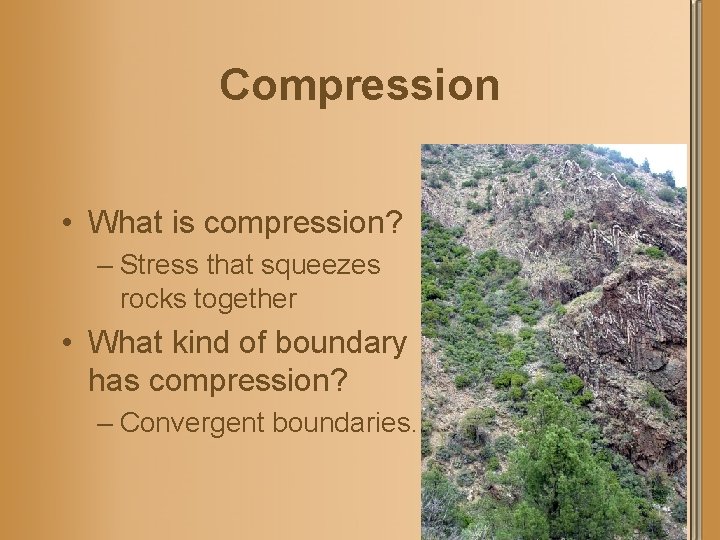
Compression • What is compression? – Stress that squeezes rocks together • What kind of boundary has compression? – Convergent boundaries.
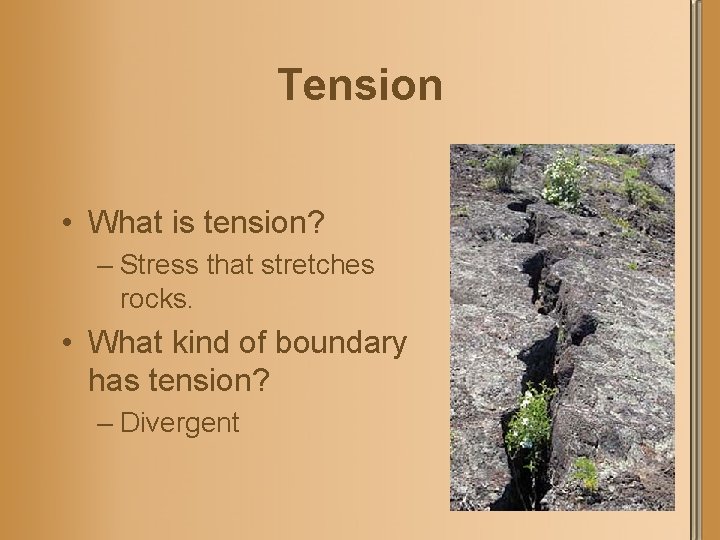
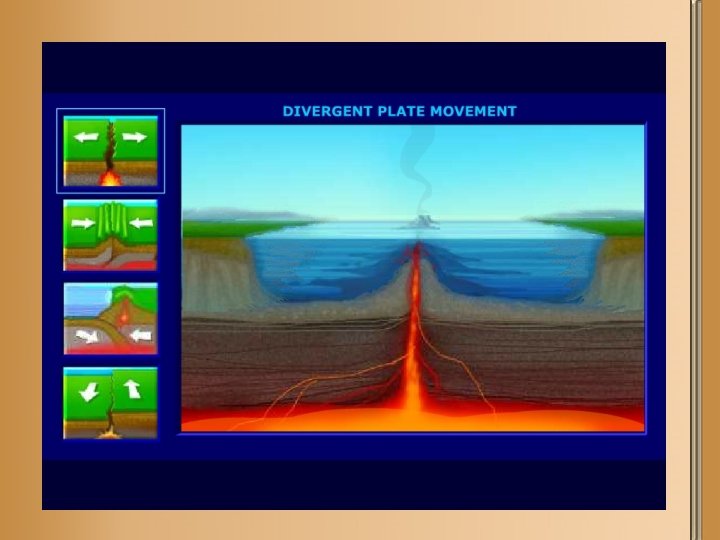
Tension • What is tension? – Stress that stretches rocks. • What kind of boundary has tension? – Divergent
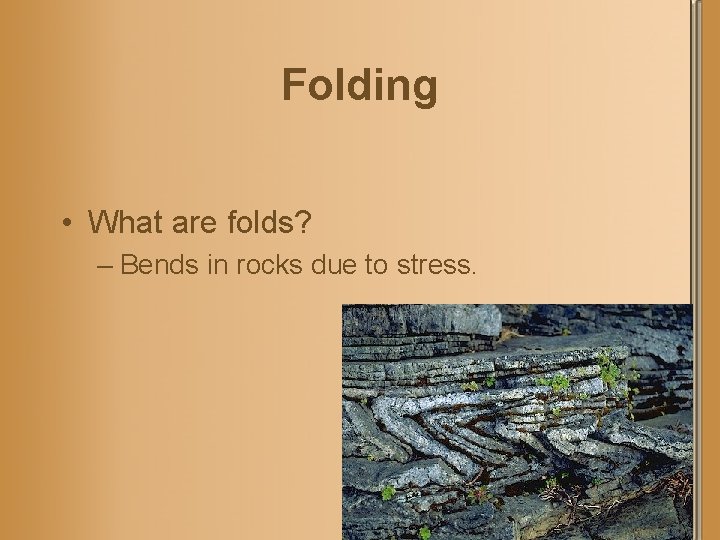
Folding • What are folds? – Bends in rocks due to stress.
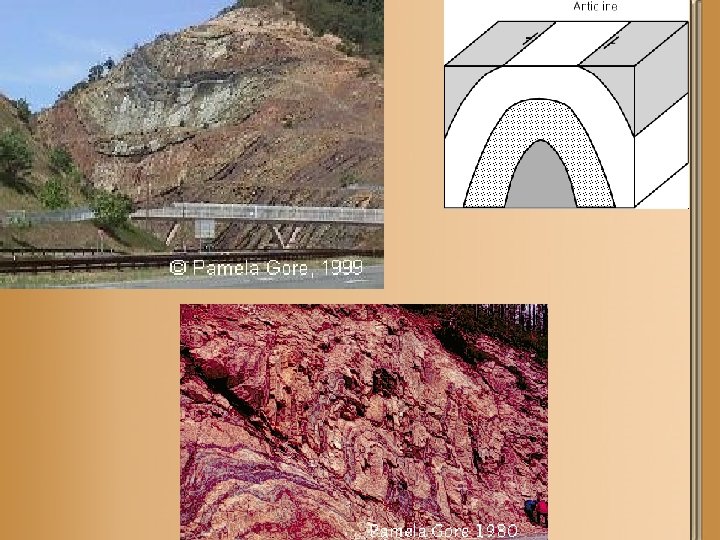
Types of Folds • The two most common types of folds are: – Anticlines: • Upward folds (arches) – Synclines: • Downward folds (troughs)
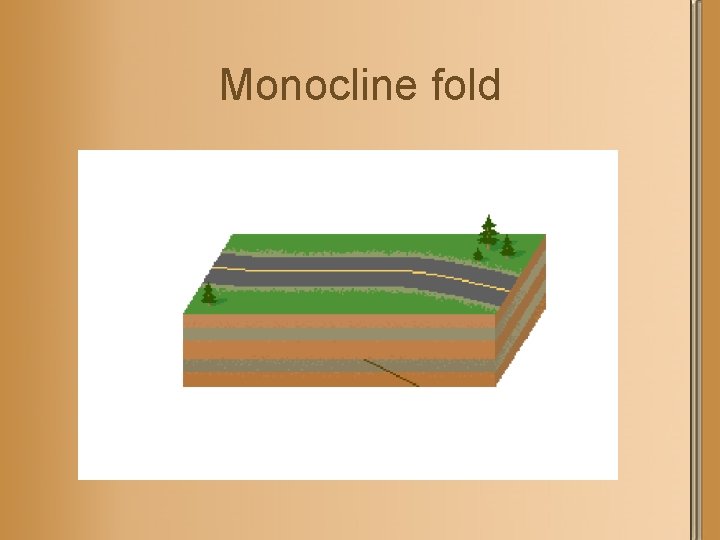
What is a monocline fold? • A fold that has both ends of the fold still horizontal. • There is a middle portion that bends downwards.
Monocline fold
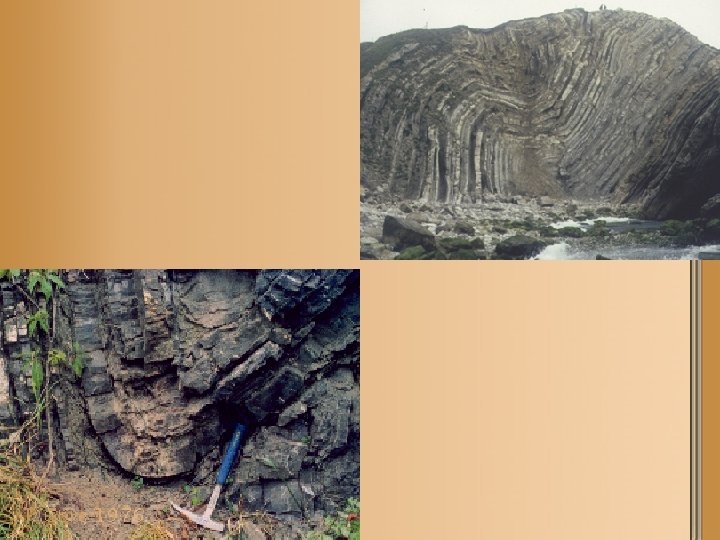
How big are folds? Folds can be as large as mountains Or As small as centimeters
Faulting • Essential Question: – How are three types of faults different from each other? • Science Term Fault
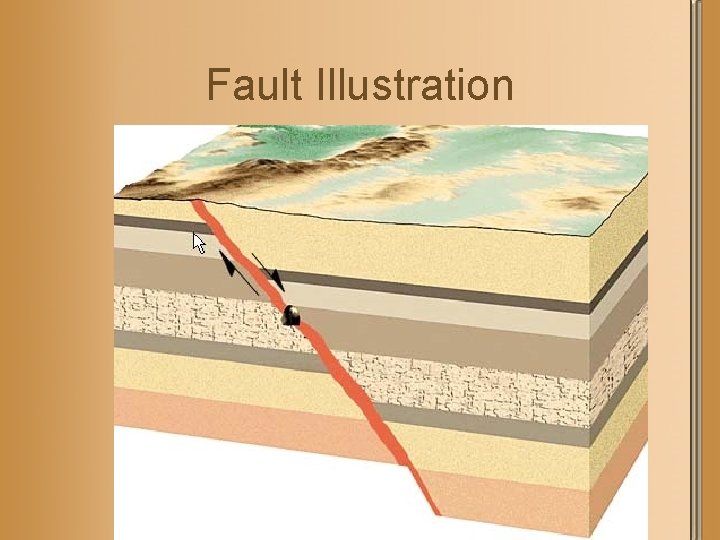
What is a Fault? • A break in rocks where one rock slide past the other
Fault Illustration
• What are the pieces of broken rock on each side of the fault called? – Fault blocks. • Two types: – Footwall – Hanging wall
Footwall • The block of rock beneath the fault – You can climb up the footwall
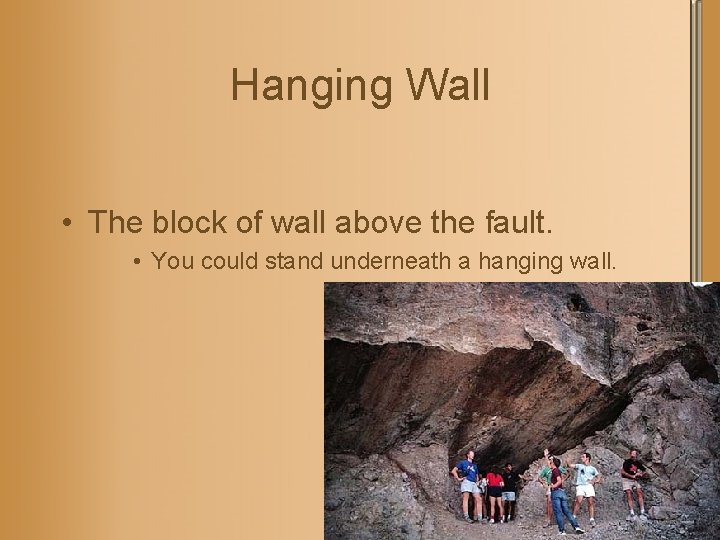
Hanging Wall • The block of wall above the fault. • You could stand underneath a hanging wall.
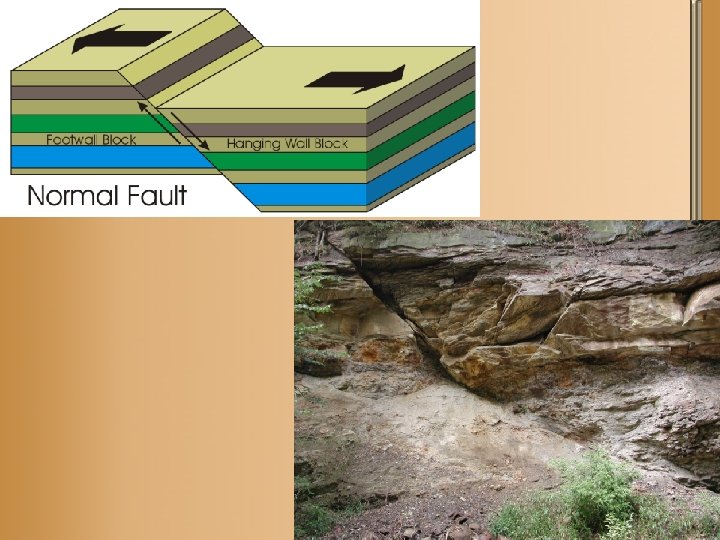
Normal Faults • How do the fault blocks move in a Normal Fault? – The hanging wall slides down the foot wall • What kind of stress makes a Normal Fault? – Tension • What kind of boundary are you likely to find a Normal Fault at? – Divergent Boundary
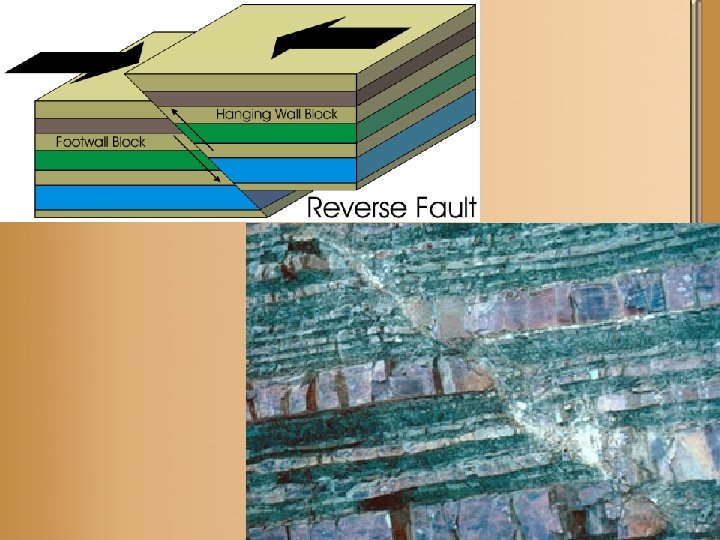
Reverse Faults • How do the fault blocks move in a Reverse Fault? – The hanging wall slides up the footwall • What kind of stress makes a Reverse Fault? – Compression – What kind of boundary are you likely to find a Reverse Fault at? • Convergent
Telling the Difference Between Faults • How can you tell the difference between a normal fault and a reverse fault? – If you look at the rock layers, you can tell how the hanging wall and footwall have moved.
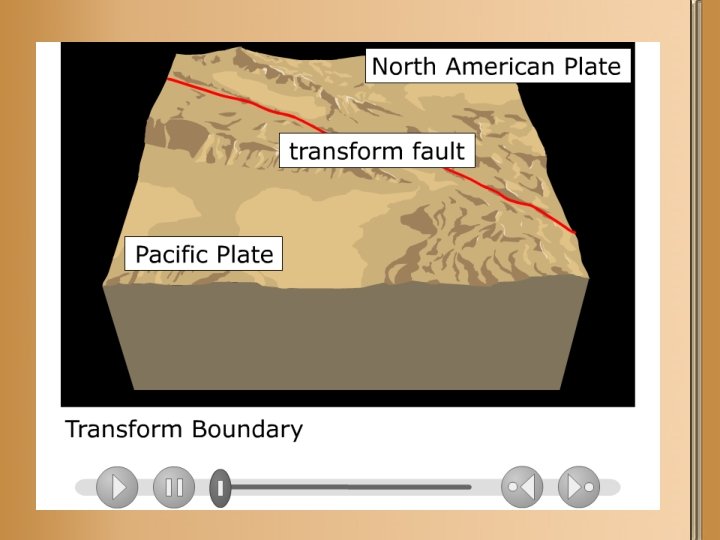
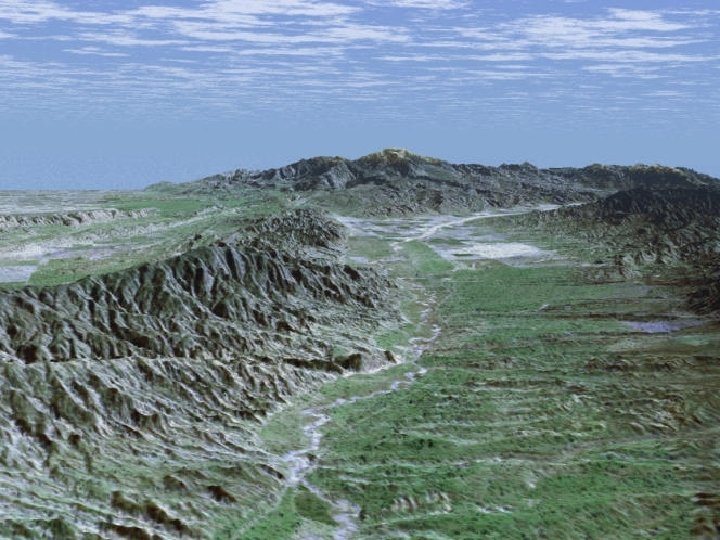
Strike Slip Faults • How do the fault blocks move in a strike slip fault? – The blocks grind and slide past each other horizontally – Example of a strike slip fault • San Andreas Fault
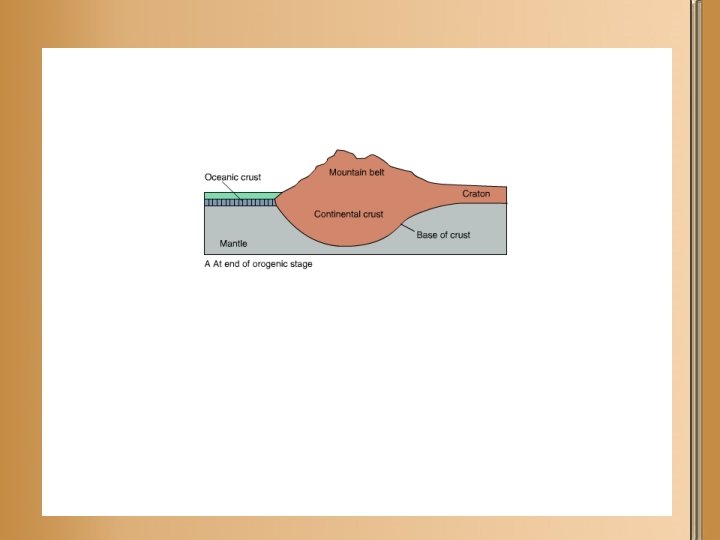
Plate Tectonics and Mountain Building • What kinds of mountains are built by Plate Tectonics? – Folded mountains – Fault-block mountains – Volcanic mountains
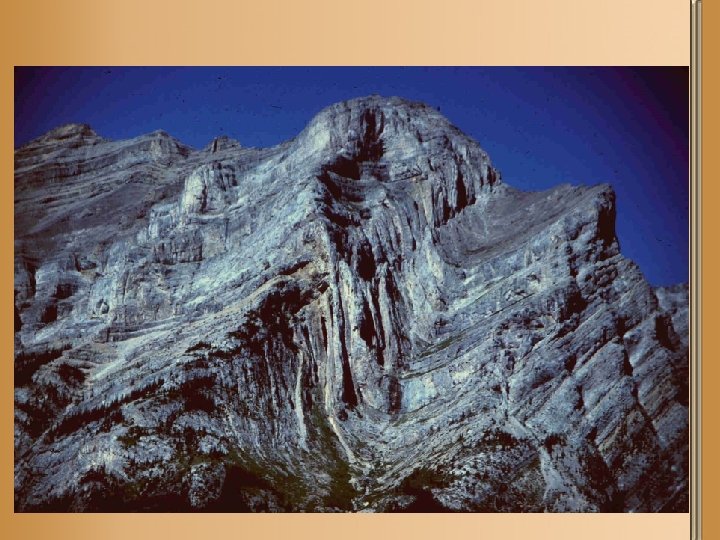
Folded Mountains • How are these mountains formed? – Plates colliding at a… • Convergent boundary – Examples: • Appalachian, Alps, Himalayas.
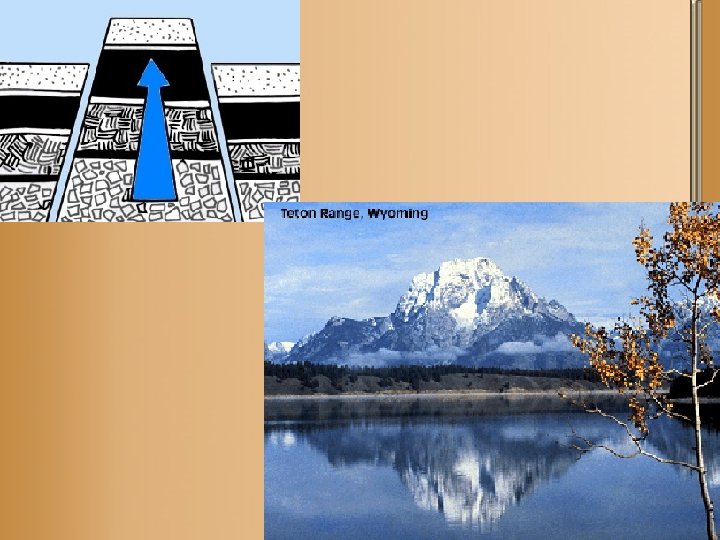
Fault-Block Mountains • How are these mountains formed? – Tension pulling huge blocks of rocks apart. • Gravity causes the hanging wall to slide down the footwall – Normal faulting
Fault-Block Mountains • Shape? – Can be very jagged and sharp looking. • Example: – Tetons in Wyoming
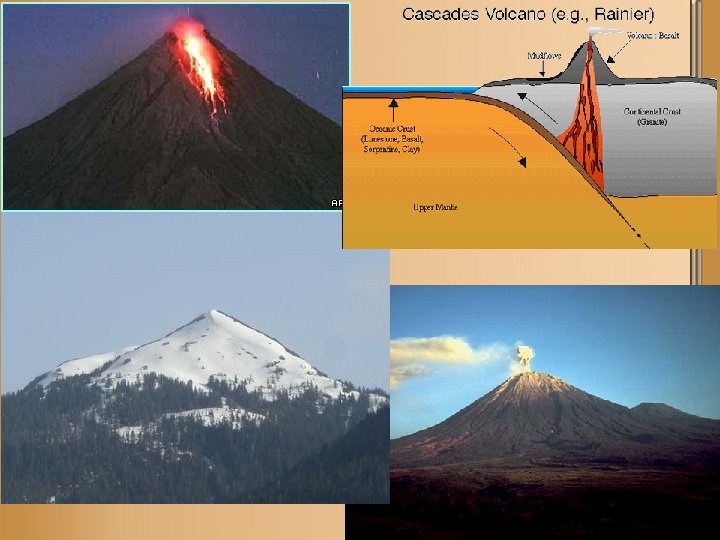
Volcanic Mountains • How are these mountains formed? – When plates collide and one is… • Subducted – The melted crust rises to form volcanic mountains
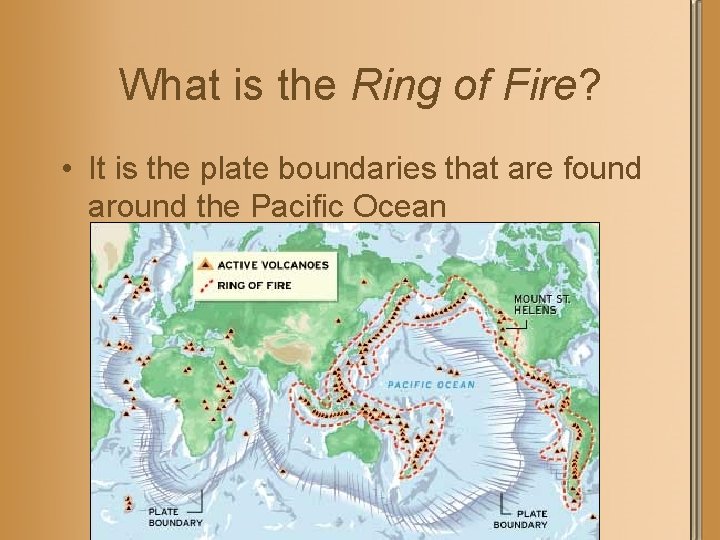
Volcanic Mountains • Where are most volcanic mountains formed? – At plate boundaries such as…. • Subduction zones
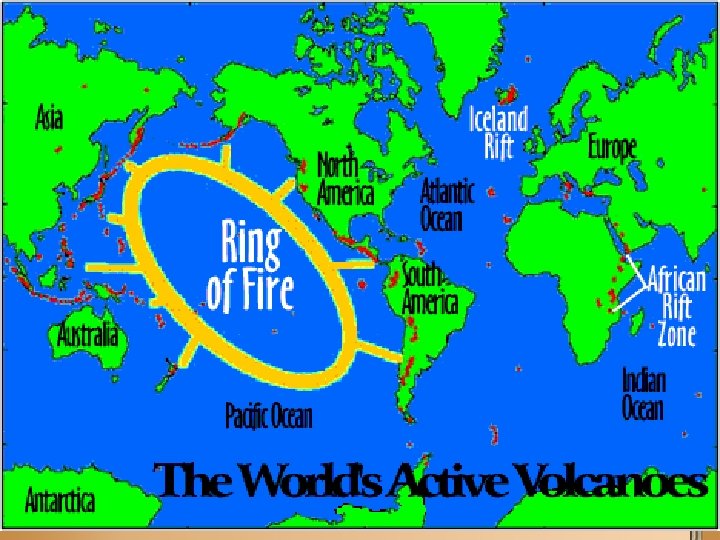
What is the Ring of Fire? • It is the plate boundaries that are found around the Pacific Ocean
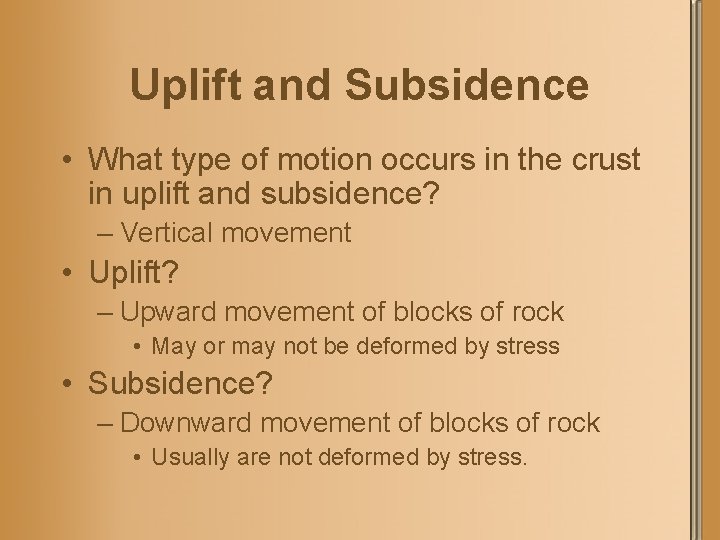
Uplift and Subsidence • What type of motion occurs in the crust in uplift and subsidence? – Vertical movement • Uplift? – Upward movement of blocks of rock • May or may not be deformed by stress • Subsidence? – Downward movement of blocks of rock • Usually are not deformed by stress.
Uplifting of Depressed Rocks • Rocks that have been pushed down by the weight of glaciers will rise upwards after the glacier has melted away. • This is called… – Rebound • Does deformation occur? – No.
Subsidence of Cooler Rocks • As rocks cool, they take up less… – Space or volume • What does this mean for the height of mountains? – They shrink!
Subsidence of Cooler Rocks • Where does this occur? – Mid ocean ridges. • As the rocks get further from the MOR, the rocks cool and become more dense causing the ridges to become lower.
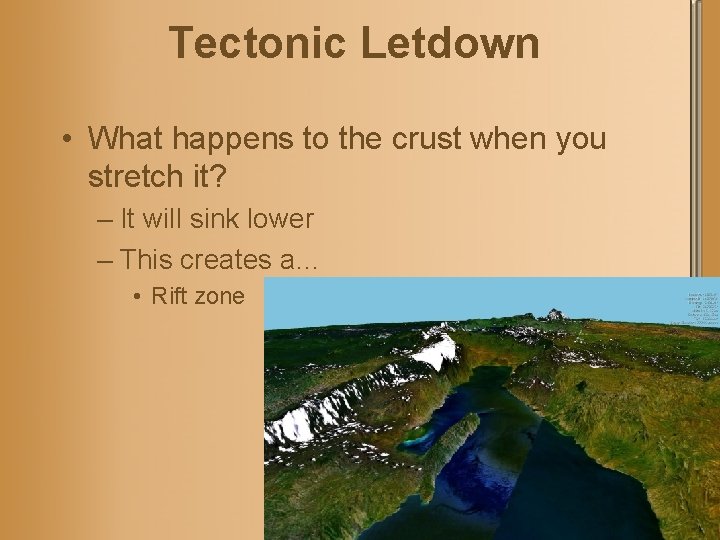
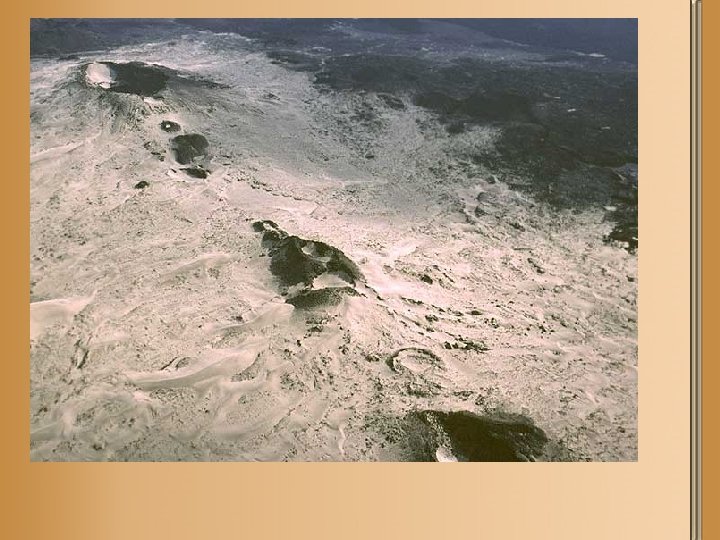
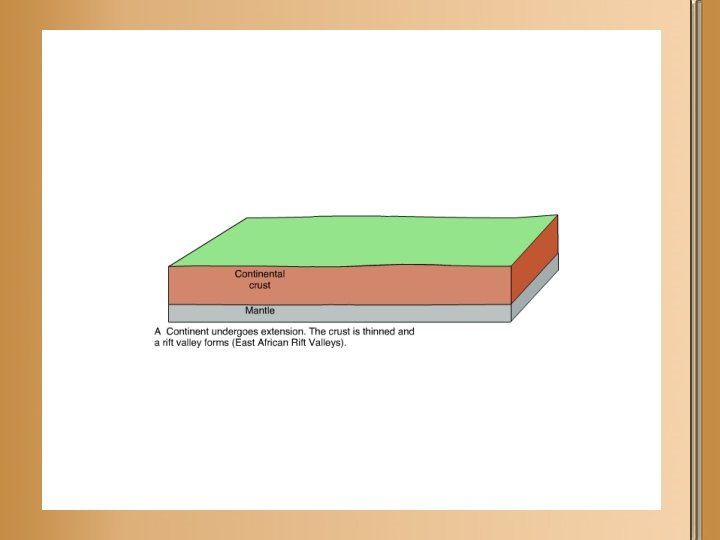
Tectonic Letdown • What happens to the crust when you stretch it? – It will sink lower – This creates a… • Rift zone
Tectonic Letdown • What kind of boundary does this occur at? – A divergent boundary • What kind of fault occurs here? – Normal faults.