
CHAPTER 4 PLANNING THE ASSESSMENT SOUND DESIGN BY
CHAPTER 4 - PLANNING THE ASSESSMENT- SOUND DESIGN BY: LYDIA ADAMS
KEY 3 - SOUND DESIGN • Do assessment methods match learning targets? • Are items, exercises, tasks, and scoring rubrics of high quality? • Does the sample represent learning appropriately? • Does the assessment control for bias? • Do teachers know how to create assessments formative use?
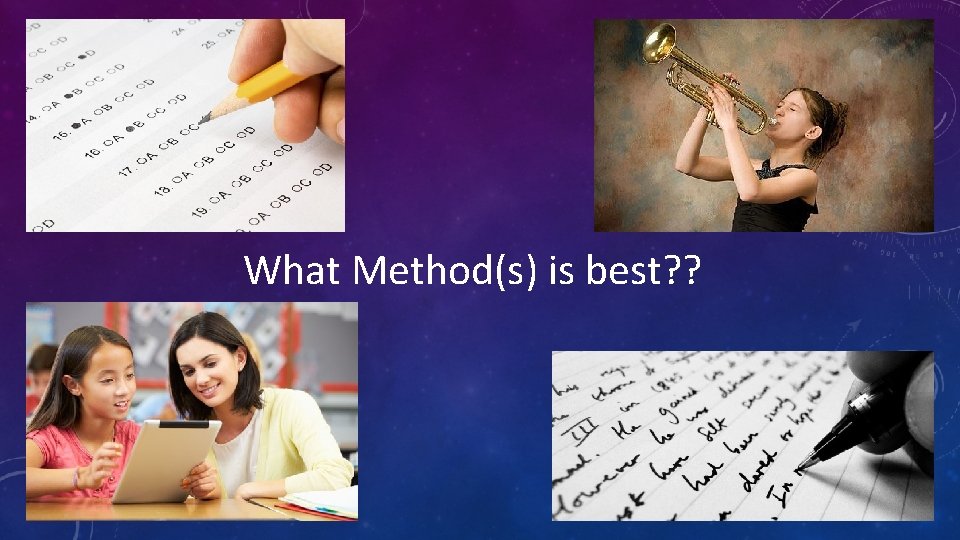
METHOD #1 - SELECTED RESPONSE • • • Multiple choice True/False Matching Fill-in-the-blank questions The students’ scores are based off the number of questions answered correctly.
METHOD #2 - WRITTEN RESPONSE • Require students to construct an answer in response to a question or task rather than selecting an answer from a list. • These include short answer and “essay” response exercises. • Examples of short answer: Describe two differences between fruits and vegetables, list three causes of the Civil War, Describe the water cycle, etc. • Examples of written response: What motivates (the lead character) in a (piece of literature)? , Evaluate two solutions to an environmental problem. Choose which is better, and explain your choice. • Teachers judge correctness of this type of assessment by doing a rubric or giving points for specific pieces of information that are present.
METHOD 3: PERFORMANCE ASSESSMENT Assessment based on observation and judgement Used to judge demonstrations, products, or artifacts that students create Two parts: the task and criteria for judging quality Examples of demonstrations: playing a musical instrument, carrying out the steps in a scientific experiment, reading aloud with fluency, or working productively in a group • Examples of products: Term paper, Lab report, Work of art, or wood shop creation • Teachers judge for specific features that are present, describe levels of quality, or a scoring rubric. • •
METHOD 4: PERSONAL COMMUNICATION • Finding out what students have learned through structured and unstructured interactions • These kinds of classroom assessments lead to immediate insights about student learning. They can usually reveal misunderstandings and trigger timely corrective action • Looked at as formative assessment rather than summative assessment • Can serve as the basis for instructional planning and feedback to guide next steps • Examples: Asking questions during instruction, interviewing students in conferences, listening to students, giving examinations orally, and having students keep journals and logs
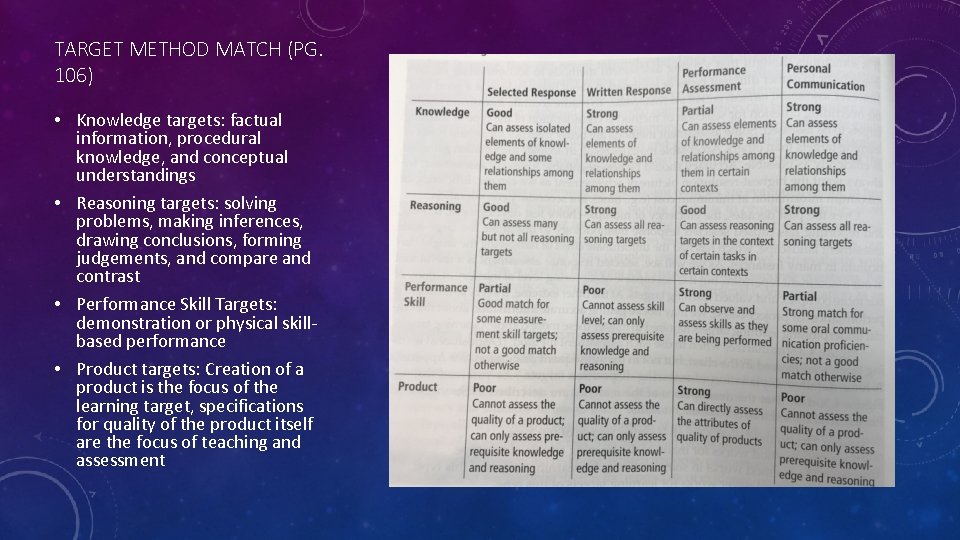
TARGET METHOD MATCH (PG. 106) • Knowledge targets: factual information, procedural knowledge, and conceptual understandings • Reasoning targets: solving problems, making inferences, drawing conclusions, forming judgements, and compare and contrast • Performance Skill Targets: demonstration or physical skillbased performance • Product targets: Creation of a product is the focus of the learning target, specifications for quality of the product itself are the focus of teaching and assessment
SAMPLING LEARNING APPROPRIATELY • Represents larger whole • How much evidence is enough to support the intended use of the information? • Gather as little information to feel confident in the judgement made on it’s basis. • Include sample of possibilities and then generalize the student mastery of the sample • Quality over quantity
4 GUIDELINES OF SAMPLING • The assessment purpose- The sample must be dependable to be sure about the achievement status. • The Nature of the Learning Target- The broader or more complex the learning target is, the larger the sample should be. • The Assessment Method- The more information provided by one assessment item, the fewer items needed to cover the standard • The Students Themselves- Pay attention to your students; know where they are on the achievement continuum.
Planning Stage ASSESSMENT DEVELOPMENT CYCLE (PG. 117) Development Stage Use Stage Determine who will use Develop or select Conduct and score the assessment results items, exercises, tasks, the assessment and how they will use and scoring procedures. them. Identify the learning targets to be assessed. Select the appropriate assessment method or methods. Determine sample size. Review and critique the overall assessment for quality before use. Revise as needed for future use.
What Method(s) is best? ?
STUDENTS SHOULD BE ABLE TO COMPARE AND CONTRAST THE DIFFERENCES BETWEEN RACE AND ETHNICITY. • Written Response
STUDENTS SHOULD BE ABLE TO IDENTIFY THE WESTERN CIVILIZATION VOCABULARY. • Selected Response • Personal Communication • Written Response
STUDENTS SHOULD BE ABLE TO CREATE A MAP OF THEIR CITY OR TOWN. • Performance Assessment
STUDENTS SHOULD BE ABLE TO WORK IN A GROUP PRODUCTIVELY. • Performance Assessment
- Slides: 15