
Chapter 4 Planning Power Point Presentation by Charlie
Chapter 4 Planning Power. Point Presentation by Charlie Cook Copyright © 2005 South-Western. All rights reserved.
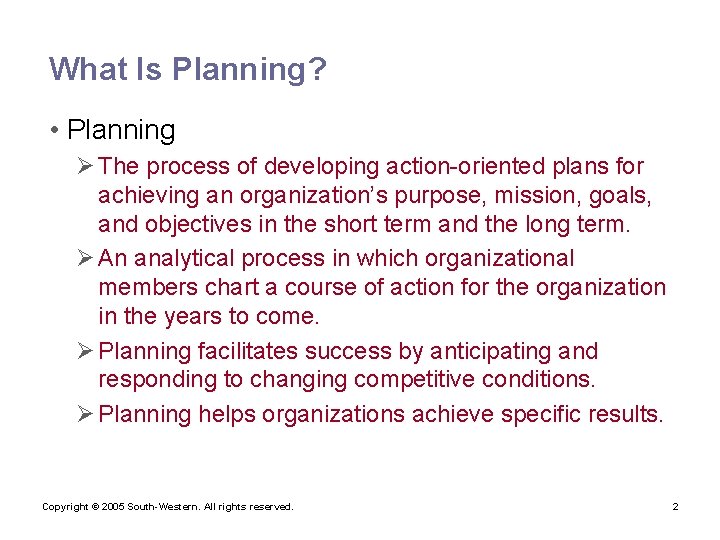
What Is Planning? • Planning Ø The process of developing action-oriented plans for achieving an organization’s purpose, mission, goals, and objectives in the short term and the long term. Ø An analytical process in which organizational members chart a course of action for the organization in the years to come. Ø Planning facilitates success by anticipating and responding to changing competitive conditions. Ø Planning helps organizations achieve specific results. Copyright © 2005 South-Western. All rights reserved. 2
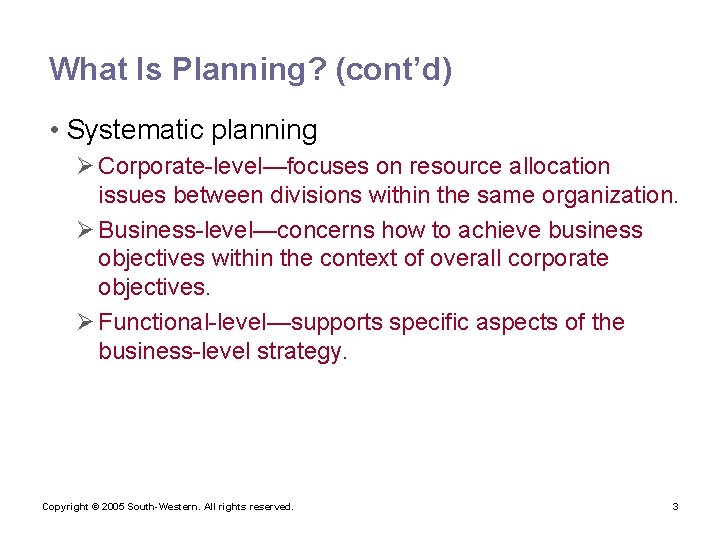
What Is Planning? (cont’d) • Systematic planning Ø Corporate-level—focuses on resource allocation issues between divisions within the same organization. Ø Business-level—concerns how to achieve business objectives within the context of overall corporate objectives. Ø Functional-level—supports specific aspects of the business-level strategy. Copyright © 2005 South-Western. All rights reserved. 3
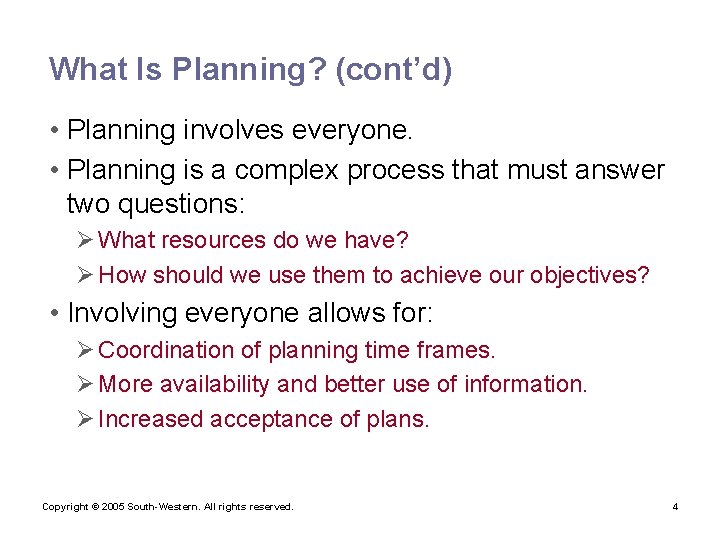
What Is Planning? (cont’d) • Planning involves everyone. • Planning is a complex process that must answer two questions: Ø What resources do we have? Ø How should we use them to achieve our objectives? • Involving everyone allows for: Ø Coordination of planning time frames. Ø More availability and better use of information. Ø Increased acceptance of plans. Copyright © 2005 South-Western. All rights reserved. 4
Why Planning Is Necessary • Cycle time reduction (CTR) Ø The length of time to complete a process and to be ready to begin anew—the economy of time. • Organizational complexity Ø The more products, services, and markets an organization competes in the greater the complexity of managing daily business activities. • Global competition Ø New rivals enter the global economy each year, dramatically affecting existing competition. Copyright © 2005 South-Western. All rights reserved. 5
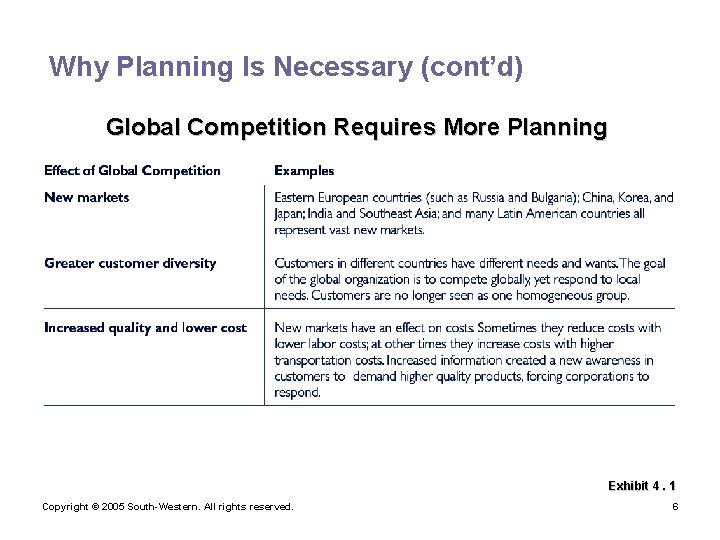
Why Planning Is Necessary (cont’d) Global Competition Requires More Planning Exhibit 4. 1 Copyright © 2005 South-Western. All rights reserved. 6
Benefits of Planning • Planning is beneficial for all organizations because it: Ø Coordinates effort. Ø Identifies priorities and creates action and change. Ø Defines performance standards. Ø Develops managerial skills and talent. Copyright © 2005 South-Western. All rights reserved. 7
Benefits of Planning (cont’d) • Competency-based performance Ø Establishing competency-based performance requires that managers: v Describe the purpose of the job. v Identify job outcomes. v Define performance standards for each outcome. v Identify barriers to meeting performance standards. v Use training to increase performance to standards. v Train to achieve performance standards. Copyright © 2005 South-Western. All rights reserved. 8
Criticisms of Planning • Competition Ø Predicting the actions of competitors is difficult. • Dynamic environment Ø Anticipating the effects of all factors and all variables in the competitive environment is virtually impossible. Copyright © 2005 South-Western. All rights reserved. 9
Types of Planning • Plans vary in three important ways: Ø Scope v Range of activities covered by a plan. Ø Time frame v Period considered by the plan (i. e. , short term, intermediate term, or long term). Ø Level of detail (specificity of the plan) v Plans must be specific enough to direct actual decisions, but contingencies and uncertain futures require some plans to be more general than others. Copyright © 2005 South-Western. All rights reserved. 10
Types of Planning (cont’d) • Strategic planning Ø Is comprehensive, long-term, and relatively general. Ø Focuses on broad, enduring issues for ensuring the organization’s effectiveness and survival over many years. • Tactical planning Ø Is narrow, intermediate-term, and specific. Ø Deals more specifically with a range of options available to implement a strategy. Ø Usually involves short-term methods of implementation. Copyright © 2005 South-Western. All rights reserved. 11

Types of Planning (cont’d) • Operational planning Ø Is focused, short-term, and specific. Ø Translates broad concepts of the tactical plan into clear numbers, specific steps, and measurable objectives for the short term. Copyright © 2005 South-Western. All rights reserved. 12
Types of Planning (cont’d) • Single-use plans Ø Have a clearly specified time frame for their utility. Ø Will include detailed goals and objectives, but plan becomes obsolete when the goal has been achieved. • Standing plans Ø Guide repetitive situations. Ø Make decision making faster, easier, and more consistent from one decision to the next. Copyright © 2005 South-Western. All rights reserved. 13
Types of Planning (cont’d) • Standing plans limit human behavior by using: Ø A policy v Guideline that describes expected behavior in a specific situation, or the rules that guide decision making. Ø Procedures v Often related to policies and help define rules that apply to a specific policy. Ø Method v Describes a particular sequence of activities; a manager can pick one of several methods for accomplishing an activity. Copyright © 2005 South-Western. All rights reserved. 14

Steps in the Planning Process Exhibit 4. 2 Copyright © 2005 South-Western. All rights reserved. 15
Steps in the Planning Process (cont’d) • Step 1: Identify current conditions Ø Current state of organization must be assessed before goals and objectives can be established. Ø Competitive benchmarking sets standards based on achievements of other successful organizations. • Step 2: Determine goals and objectives Ø Goals: future states or conditions that contribute to fulfillment of organization’s mission. Ø Objectives: short-term, specific, measurable targets that must be achieved to accomplish organizational goals. Copyright © 2005 South-Western. All rights reserved. 16
Steps in the Planning Process (cont’d) • Step 2: Determine goals and objectives, cont’d Ø Objectives may need to be prioritized. Ø When conflicts among objectives arise, plans must balance expectations of diverse interest groups. Ø Objectives must be clear, achievable, and measurable; measurements used to quantify objectives include: Profitability objectives Physical and financial objectives Marketing objectives Quality objectives Productivity objectives Copyright © 2005 South-Western. All rights reserved. 17
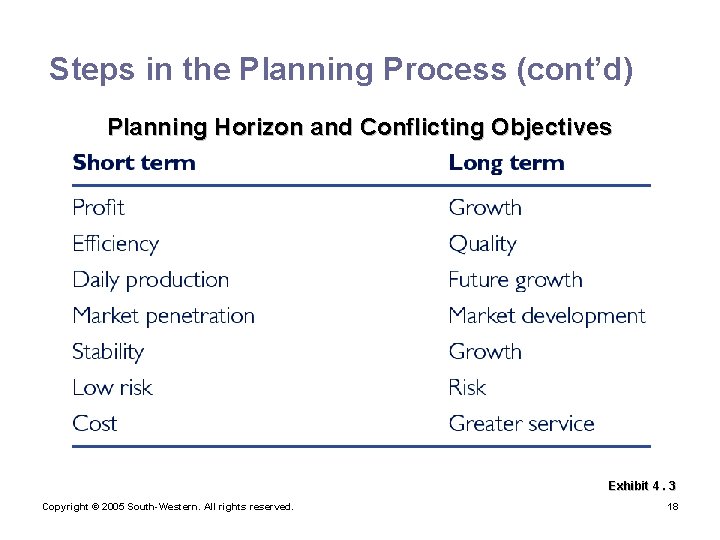
Steps in the Planning Process (cont’d) Planning Horizon and Conflicting Objectives Exhibit 4. 3 Copyright © 2005 South-Western. All rights reserved. 18
Steps in the Planning Process (cont’d) • Step 3: Create action plans Ø Actions: specific, prescribed means that are developed to achieve objectives. Ø Strategies: planned courses of action. Ø Forecasting: the process of using past and current information to predict future events. Copyright © 2005 South-Western. All rights reserved. 19
Steps in the Planning Process (cont’d) • Step 4: Allocate resources Ø Resources: the financial, physical, human, time, or other assets of an organization; also known as factors of production. Ø Budget: an allocation of resources to an activity, account, or unit in the organization. v Recognizes and allocates the needed resources to meet an objective. v Is both a planning technique and a control technique. Copyright © 2005 South-Western. All rights reserved. 20
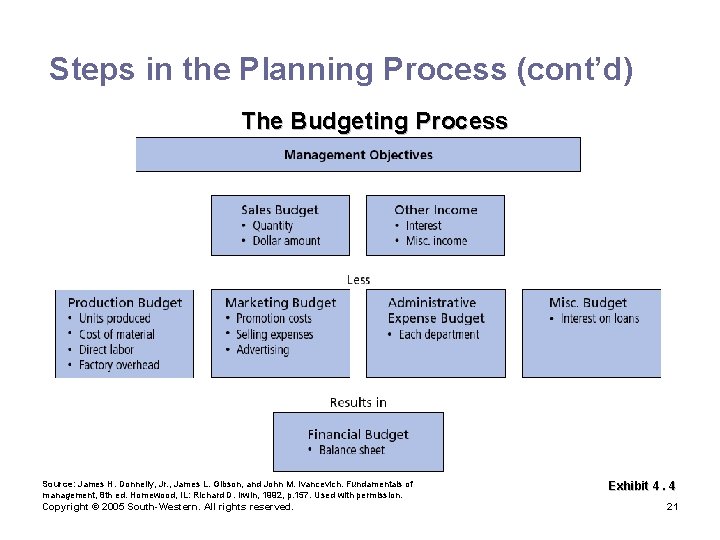
Steps in the Planning Process (cont’d) The Budgeting Process Source: James H. Donnelly, Jr. , James L. Gibson, and John M. Ivancevich. Fundamentals of management, 8 th ed. Homewood, IL: Richard D. Irwin, 1992, p. 157. Used with permission. Copyright © 2005 South-Western. All rights reserved. Exhibit 4. 4 21
Steps in the Planning Process (cont’d) • Step 4: Allocate resources, cont’d Ø Usefulness of financial budgets depends mainly on how flexible they are regarding changes in conditions. Ø Organizations achieve flexibility in two principal ways: v Variable budgeting—provides for the possibility that actual output deviates from planned output. v Moving budgeting—entails the preparation of a budget for a fixed period (one year) with periodic updating at fixed intervals (one month). Ø Major criticism of the budgeting process is its rigidity; budgeting is often inflexible. Copyright © 2005 South-Western. All rights reserved. 22
Steps in the Planning Process (cont’d) • Step 5: Implementing the plan Ø Implementation concerns the activities involved in delegating tasks, taking action, and achieving results. Ø Managers implement plans through others in three ways: v Authority—accompanies the position, not the person. v Persuasion—the process of selling a plan to those who must implement it. v Policies—written statements reflecting a plan’s basic values and providing guidelines for selecting actions to achieve objectives. Copyright © 2005 South-Western. All rights reserved. 23
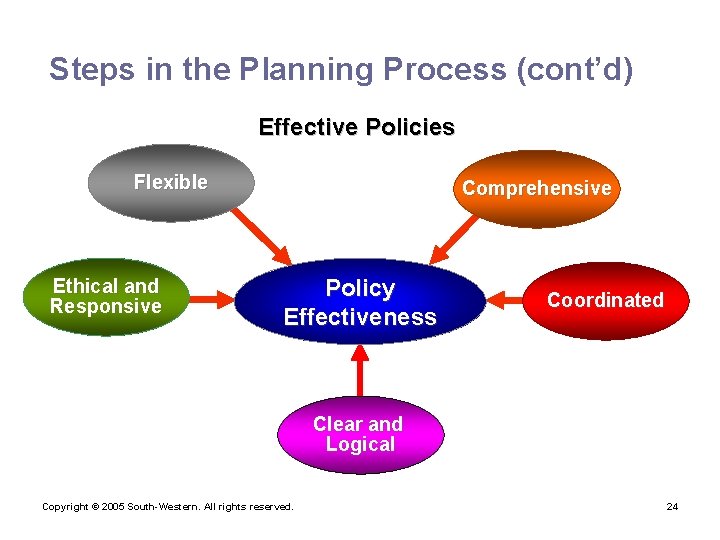
Steps in the Planning Process (cont’d) Effective Policies Flexible Ethical and Responsive Comprehensive Policy Effectiveness Coordinated Clear and Logical Copyright © 2005 South-Western. All rights reserved. 24
Steps in the Planning Process (cont’d) • Step 6: Control Ø Control: includes all managerial activities dedicated to ensuring that actual results conform to planned results. Ø An organization must manage ongoing work activities to ensure that its intended objectives are met or, in some cases, adjusted. Ø Feedback: the process of taking corrective actions based on measurement of actual performance. Copyright © 2005 South-Western. All rights reserved. 25
Quality Approach to Planning • Plan, do, check, act (PDCA) cycle Ø Plan the quality improvement Ø Perform or produce a short version or a small batch of the procedure or product. Ø Check the results of this pilot project for compliance with standards. Ø Implement the tested process. Ø The PDCA cycle is then repeated. Copyright © 2005 South-Western. All rights reserved. 26
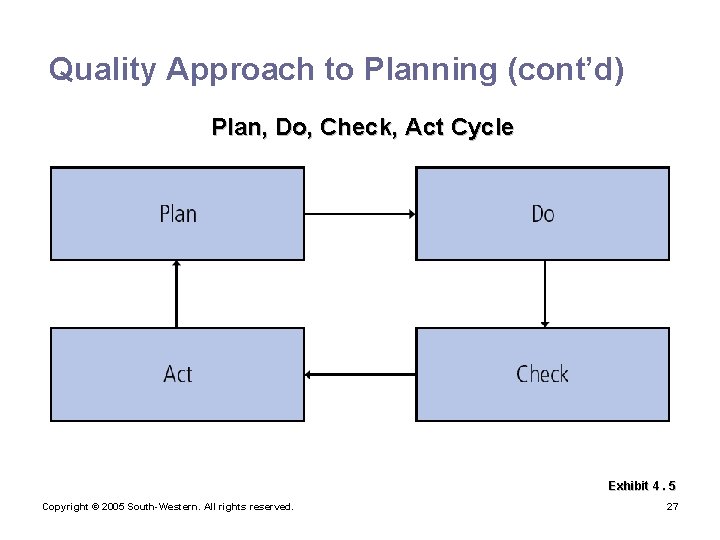
Quality Approach to Planning (cont’d) Plan, Do, Check, Act Cycle Exhibit 4. 5 Copyright © 2005 South-Western. All rights reserved. 27
Quality Approach to Planning (cont’d) • Time-based planning Ø Speed in planning and delivering a product or service can be a strategic competitive advantage. Ø Reengineering: fundamental rethinking and redesign of business processes to achieve improvements in critical, contemporary performance measures. Ø Cycle time reduction (CTR) another time-based initiative; reduces the time to complete processes, reducing costs and increasing customer service. v 3 % rule: only 3% of the time for a process is actually needed to complete the activity. Copyright © 2005 South-Western. All rights reserved. 28
Quality Approach to Planning (cont’d) • Planning for continuous improvement Ø Negative outcomes from ignoring quality in planning include loss of sales, increased costs, threats to society. Ø Tenets of quality planning (Juran): Identify customers, both external and internal. v Determine the customer’s needs. v Develop product features that satisfy customer needs. v Establish quality goals that meet customers’ and suppliers’ needs at a low combined cost. v Develop a process to produce the needed features. v Prove that the process can meet the quality goals under operating conditions (i. e. , prove process capability). v Copyright © 2005 South-Western. All rights reserved. 29
Quality Approach to Planning (cont’d) • Quality planning models Ø Revolutionary planning models implement a massive, one-time change in the production process or product in order to reduce costs or improve the product in a significant way. Ø Evolutionary planning models make gradual and continuous changes based on input from inside and outside the production system. v Improvements typically are not dramatic, but they are consistent and incremental. Copyright © 2005 South-Western. All rights reserved. 30
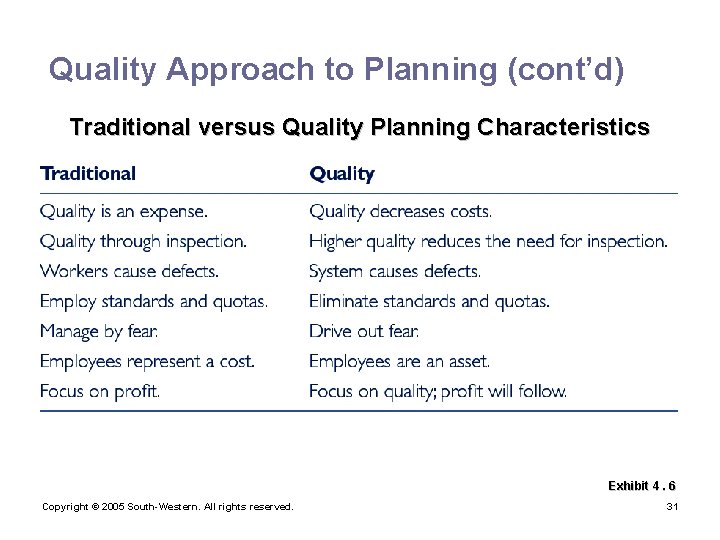
Quality Approach to Planning (cont’d) Traditional versus Quality Planning Characteristics Exhibit 4. 6 Copyright © 2005 South-Western. All rights reserved. 31
- Slides: 31