
CHAPTER 4 Planning and Project Management CHAPTER OBJECTIVES
CHAPTER 4: Planning and Project Management
CHAPTER OBJECTIVES Ø Review the essentials of planning for a data warehouse. Ø Distinguish between data warehouse projects and OLTP system projects. Ø Learn how to adapt the life cycle approach for a data warehouse project. Ø Discuss project team organization, roles, and responsibilities. Ø Consider the warning signs and success factors.
Planning Your Data Warehouse Ø Key Issues Ø Business Requirements, Not Technology The Data Warehouse Project Ø How is it Different? Ø The Life-Cycle Approach Ø The Development Phases The Project Team Ø Organizing the Project Team Ø Roles and Responsibilities Ø Skills and Experience Levels Ø User Participation Project Management Considerations Ø Possible scenarios of failure Ø Warning Signs Ø Success Factors
• Consultant: So, your company is into data warehousing? How many data marts do you have? • Project Manager: Eleven. • Consultant: That’s great. But why so many? • Project Manager: Ten mistakes. Copyright © 2010 Pearson Education, Inc. Publishing as Prentice Hall 6 -3
Planning Your Data Warehouse 1. First, determine if your company really needs a data warehouse. Is it really ready for one? 2. You need to develop criteria for assessing the value expected from your data warehouse. 3. Your company has to decide on the type of data warehouse to be built and where to keep it. 4. You have to ascertain where the data is going to come from and even whether you have all the needed data. 5. You have to establish who will be using the data warehouse, how they will use it, and at what times.
Key Issues Planning for your data warehouse begins with a thorough consideration of the key issues. Answers to the key questions are vital for the proper planning and the successful completion of the project. Therefore, let us consider the pertinent issues, one by one. 1. Value and Expectations 2. Risk Assessment 3. Top-down or Bottom-up 4. Build or Buy 5. Single Vendor or Best-of-Breed
Value and Expectations Some companies jump into data warehousing without assessing the value to be derived from their proposed data warehouse. Ø Will your data warehouse help the executives and managers to do better planning and make better decisions? Ø Is it going to increase market share? Ø If so, by how much? Ø What are the expectations? Ø What does the management want to accomplish through the data warehouse? As part of the overall planning process, make a list of realistic benefits and expectations. This is the starting point.

Risk Assessment Planners generally associate project risks with the cost of the project. If the project fails, how much money will go down the drain? But the assessment of risks is more than calculating the loss from the project costs. Ø What are the risks faced by the company without the benefits derivable from a data warehouse? Ø What losses are likely to be incurred? Ø What opportunities are likely to be missed? Ø Risk assessment is broad and relevant to each business. Use the culture and business conditions of your company to assess the risks. Include this assessment as part of your planning document.
Top-down or Bottom-up In Chapter 2, we discussed the top-down and bottom-up approaches for building a data warehouse. The top-down approach is to start at the enterprise- wide data warehouse, although possibly build it iteratively. Then data from the overall, large enterprisewide data warehouse flows into departmental and subject data marts. The bottom-up approach is to start by building individual data marts, one by one. The conglomerate of these data marts will make up the enterprise data warehouse.
Build or Buy This is a major issue for all organizations. No one builds a data warehouse totally from scratch by in-house programming. There is no need to reinvent the wheel every time. A wide and rich range of third-party tools and solutions are available. The real questions are: Ø How much of your data marts should you build yourselves? Ø How much of these may be composed of ready-made solutions? Ø What type of mix and match must be done? In a data warehouse, there is a large range of functions. Ø Do you want to write more in-house programs for data extraction and data transformation? Ø Do you want to use in-house programs for loading the data warehouse storage? Ø Do want to use vendor tools completely for information delivery? On the other hand, the buy option could lead to quick implementation if managed effectively.
Single Vendor or Best-of-Breed Two major options are: (1) Use the products of a single vendor (2) Use products from more than one vendor, selecting appropriate tools. Choosing a single vendor solution has a few advantages: Ø High level of integration among the tools Ø Constant look and feel Ø Seamless cooperation among components Ø Centrally managed information exchange Ø Overall price negotiable This approach will naturally enable your data warehouse to be well integrated and function coherently. The major advantages of the best-of-breed solution that combines products from multiple vendors: Ø Could build an environment to fit your organization Ø No need to compromise between database and support tools Ø Select products best suited for the function
Business Requirements, Not Technology q Data warehousing is not about technology, it is about solving users’ need for strategic information. q Do not plan to build the data warehouse before understanding the requirements. q Start by focusing on what information is needed and not on how to provide the information. q The basic structure and the architecture to support the user requirements are more important a preliminary survey of requirements. q The outcome of this preliminary survey: 1 - Will help you formulate the overall plan. 2 - Will be crucial to set the scope of the project. 3 - Will assist you in prioritizing and determining the rollout plan for individual data marts.
What types of information must you gather in the preliminary survey? At a minimum, obtain general information on the following from each group of users: Ø Ø Ø Mission and functions of each user group Computer systems used by the group Key performance indicators Factors affecting success of the user group Who the customers are and how they are classified Types of data tracked for the customers, individually and groups Products manufactured or sold Categorization of products and services Locations where business is conducted Levels at which profits are measured—per customer, per product, per district Levels of cost details and revenue Current queries and reports for strategic information
The Data Warehouse Project Data warehouse projects are different from projects building the transaction processing systems.
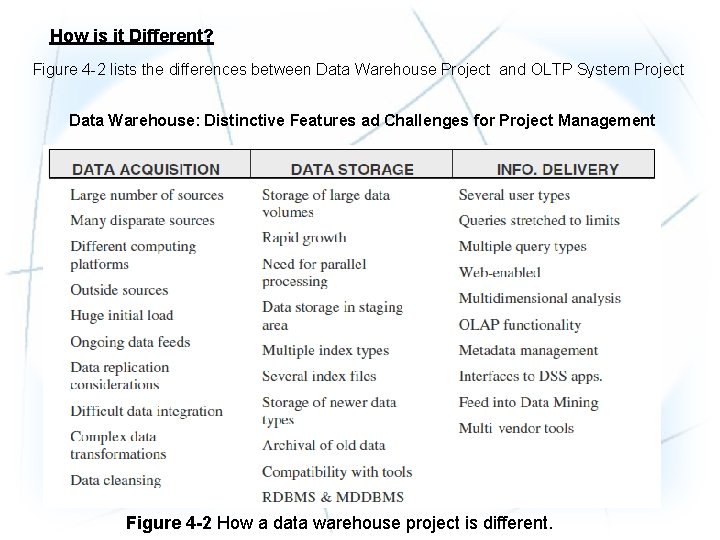
How is it Different? Figure 4 -2 lists the differences between Data Warehouse Project and OLTP System Project Data Warehouse: Distinctive Features ad Challenges for Project Management Figure 4 -2 How a data warehouse project is different.
The Life-Cycle Approach As an IT professional you are all too familiar with the traditional system development life cycle (SDLC). You know how to begin with a project plan, move into the requirements analysis phase, then into the design, construction, and testing phases, and finally into the implementation phase. The life cycle approach accomplishes all the major objectives in the system development process. The life cycle methodology breaks down the project complexity and removes any ambiguity with regard to the responsibilities of project team members. A data warehouse project is complex in terms of tasks, technologies, and team member roles. But a one-size fits- all life cycle approach will not work for a data warehouse project. Adapt the life cycle approach to the special needs of your data warehouse project. Remember that the broad functional components of a data warehouse are data acquisition, data storage, and information delivery. Make sure the phases of your development life cycle wrap around these functional components. Figure 4 -3 shows how to relate the functional components to SDLC.
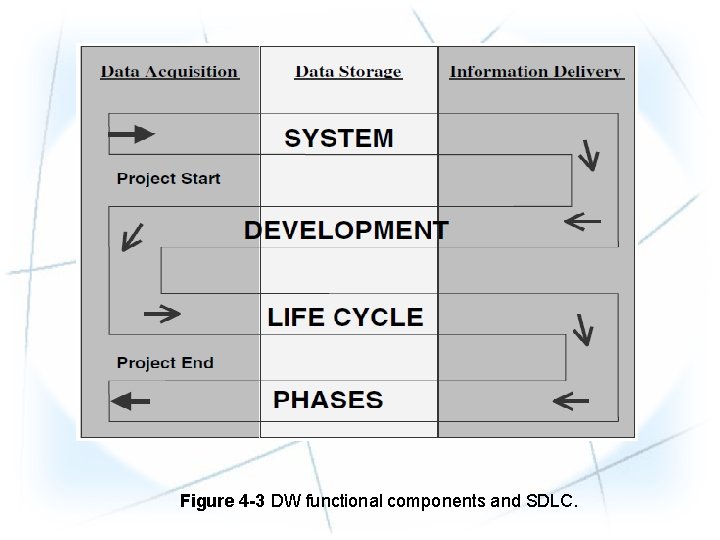
Figure 4 -3 DW functional components and SDLC.
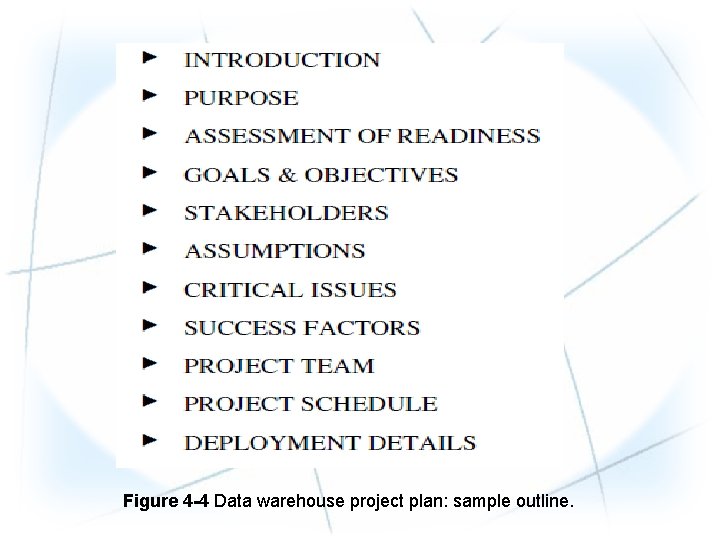
Figure 4 -4 Data warehouse project plan: sample outline.
The Development Phases Refer to Figure 4 -5 and notice three tracks of the development phases. In the development of every data warehouse, these tracks are present with varying sets of tasks. • You may change and adapt the tasks to suit your specific requirements. • You may want to emphasize one track more than the others. • If data quality is a problem in your company, you need to pay special attention to the related phase. The figure shows the broad division of the project life cycle into the traditional phases:
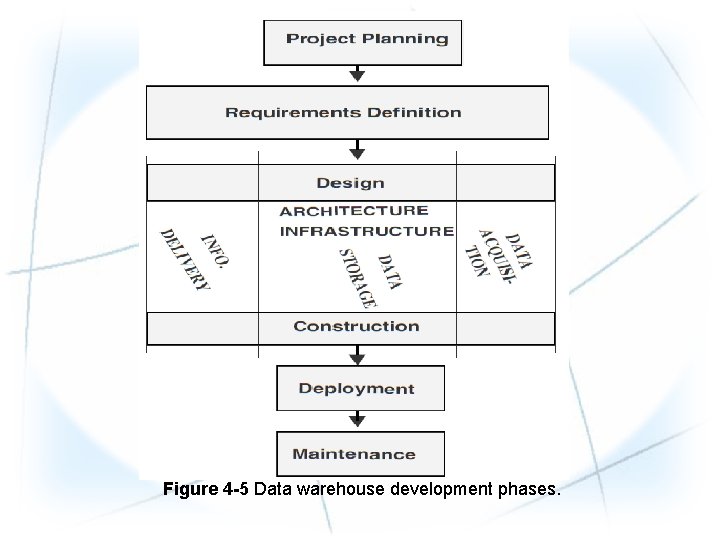
Figure 4 -5 Data warehouse development phases.
- Slides: 20