
Chapter 4 Pg 234 239 Obj Learn how
Chapter 4
� Pg. 234 – 239 � Obj: Learn how to represent mathematical relationships using graphs. � Content Standard: Prepares for F. IF. 4
� Pg. 240 – 245 � Obj: Learn how to identify and represent patterns that describe linear functions. � Content Standards: A. REI. 10 and F. IF. 4
� Dependent Variable – changes in response to another variable � Independent Variable – the variable that determines what happens to the other variable(s) � Inputs – values of the independent variable � Outputs – values of the dependent variable � Function – a relationship that pairs each input value with exactly one output value � Linear Function – a function whose graph is a nonvertical line or part of a nonvertical line
� Pg. 246 – 251 � Obj: Learn how to identify and represent patterns that describe nonlinear functions. � Content Standards: A. REI. 10, and F. IF. 4
� Nonlinear Function – a function whose graph is not a line or part of a line
� Pg. 253 – 259 � Obj: Learn how to graph equations that represent functions. � Content Standards: F. IF. 5, N. Q. 1, and A. REI. 10
� Continuous Graph – a graph that is unbroken � Discrete Graph – composed of distinct isolated points � Graphing a Function Rule �Use a table of values �Input values for x and solve for y �Graph the points and connect
� Pg. 262 – 267 � Obj: Learn how to write equations that represent functions. � Content Standards: N. Q. 2, A. SSE. 1. a, and A. CED. 2
� Pg. 268 – 273 � Obj: Learn how to determine whether a relation is a function, find domain and range, and use function notation. � Content Standards: F. IF. 1 and F. IF. 2
� Relation – a pairing of numbers � Domain – the x values of a function � Range – the y values of a function � Vertical Line Test – if any vertical line passes through more than one point of the graph, then for some domain value there is more than one range value. So the relation is not a function. � Function Notation – f(x) = -3 x + 1
� Pg. 274 – 281 � Obj: Learn how to identify and extend patterns in sequences and represent arithmetic sequences using function notation. � Content Standards: F. IF. 3, A. SSE. 1. a, A. SSE. 1. b, F. BF. 1. a, F. BF. 2, and F. LE. 2
� Sequence - an ordered list of numbers that often form a pattern � Term of a Sequence – each number in the list � Arithmetic Sequence – the difference between consecutive terms is constant � Common Difference – the difference between consecutive terms � Recursive Formula – a function rule that relates each term of a sequence after the first to the ones before it
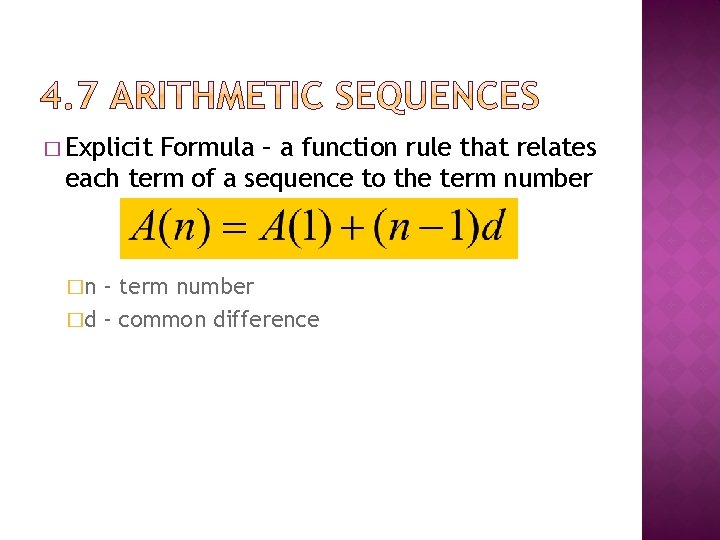
� Explicit Formula – a function rule that relates each term of a sequence to the term number �n – term number �d – common difference
- Slides: 14