
CHAPTER 4 PART 4 I PERCEPTUAL ORGANIZATION Our

- Slides: 9
CHAPTER 4 PART 4
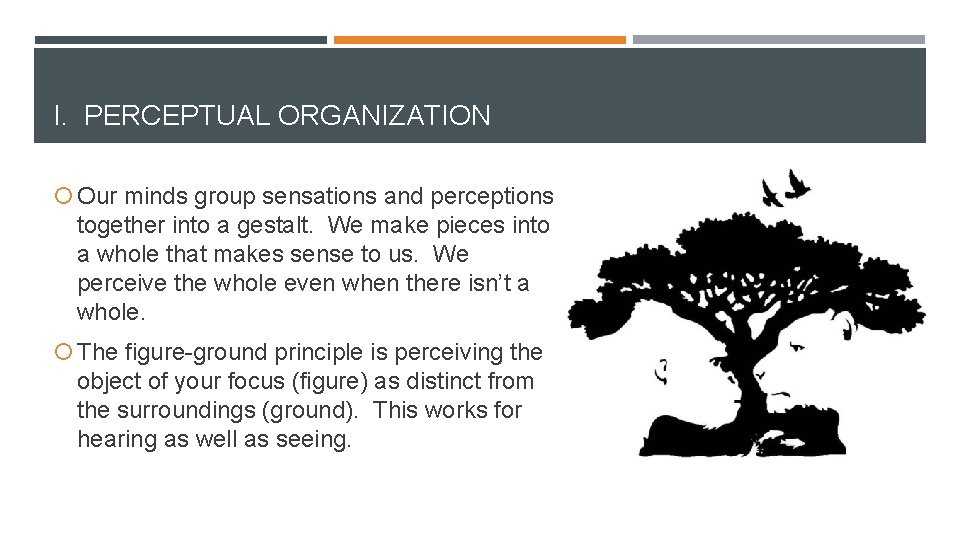
I. PERCEPTUAL ORGANIZATION Our minds group sensations and perceptions together into a gestalt. We make pieces into a whole that makes sense to us. We perceive the whole even when there isn’t a whole. The figure-ground principle is perceiving the object of your focus (figure) as distinct from the surroundings (ground). This works for hearing as well as seeing.
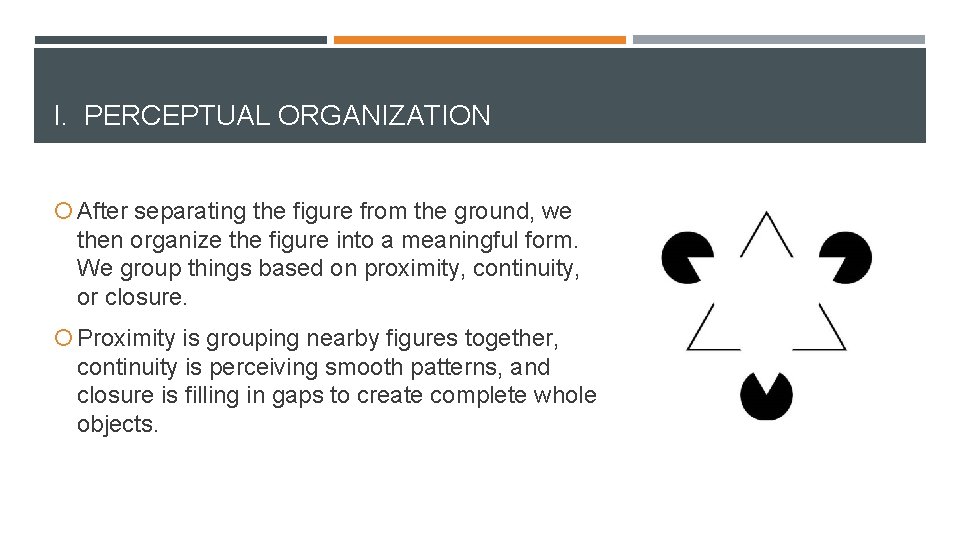
I. PERCEPTUAL ORGANIZATION After separating the figure from the ground, we then organize the figure into a meaningful form. We group things based on proximity, continuity, or closure. Proximity is grouping nearby figures together, continuity is perceiving smooth patterns, and closure is filling in gaps to create complete whole objects.
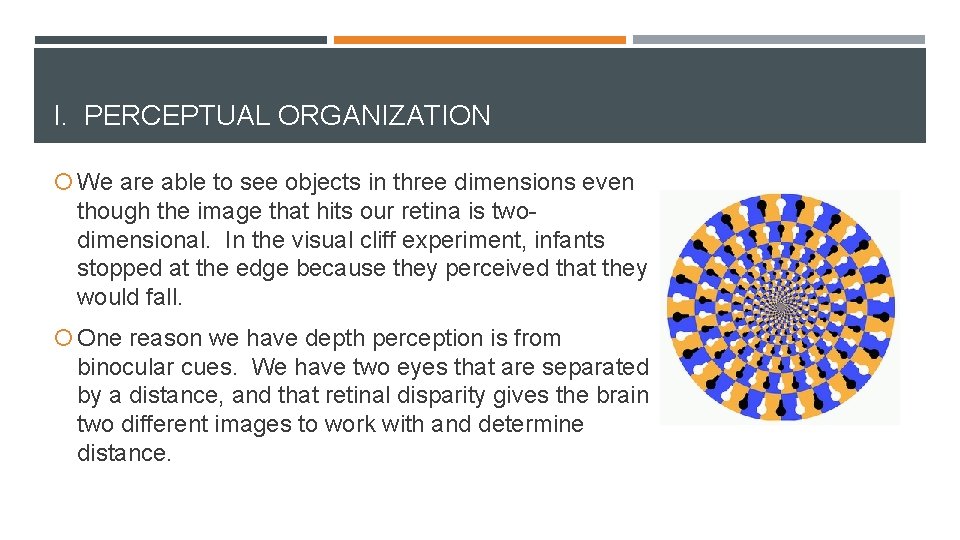
I. PERCEPTUAL ORGANIZATION We are able to see objects in three dimensions even though the image that hits our retina is twodimensional. In the visual cliff experiment, infants stopped at the edge because they perceived that they would fall. One reason we have depth perception is from binocular cues. We have two eyes that are separated by a distance, and that retinal disparity gives the brain two different images to work with and determine distance.
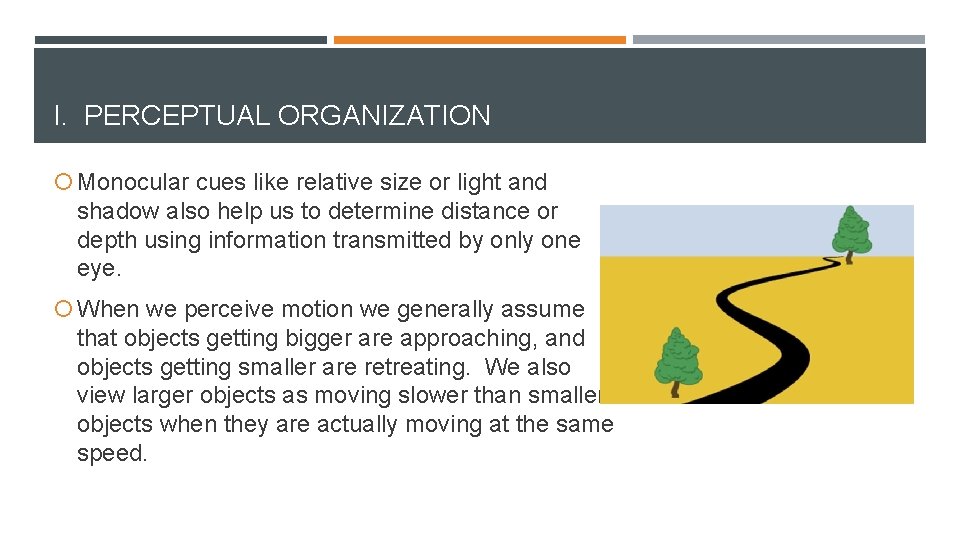
I. PERCEPTUAL ORGANIZATION Monocular cues like relative size or light and shadow also help us to determine distance or depth using information transmitted by only one eye. When we perceive motion we generally assume that objects getting bigger are approaching, and objects getting smaller are retreating. We also view larger objects as moving slower than smaller objects when they are actually moving at the same speed.
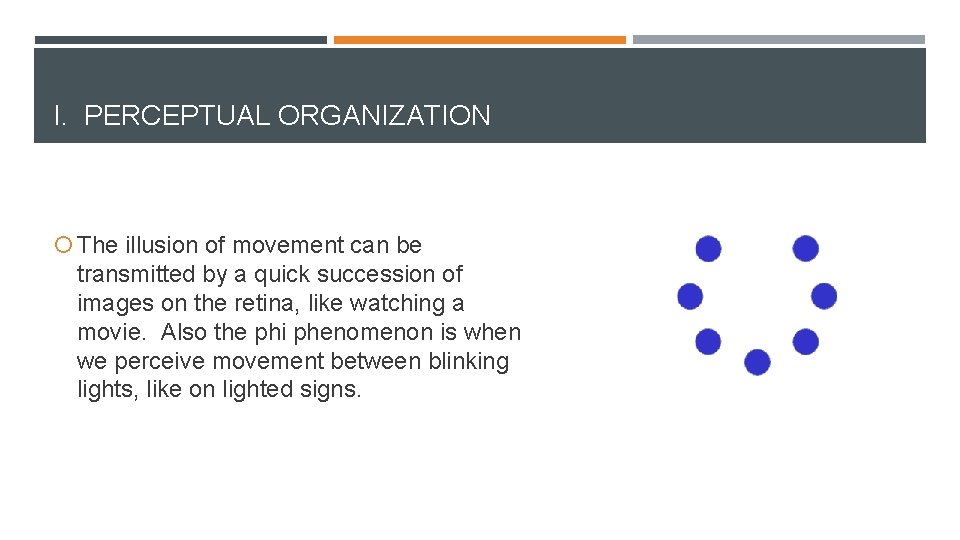
I. PERCEPTUAL ORGANIZATION The illusion of movement can be transmitted by a quick succession of images on the retina, like watching a movie. Also the phi phenomenon is when we perceive movement between blinking lights, like on lighted signs.
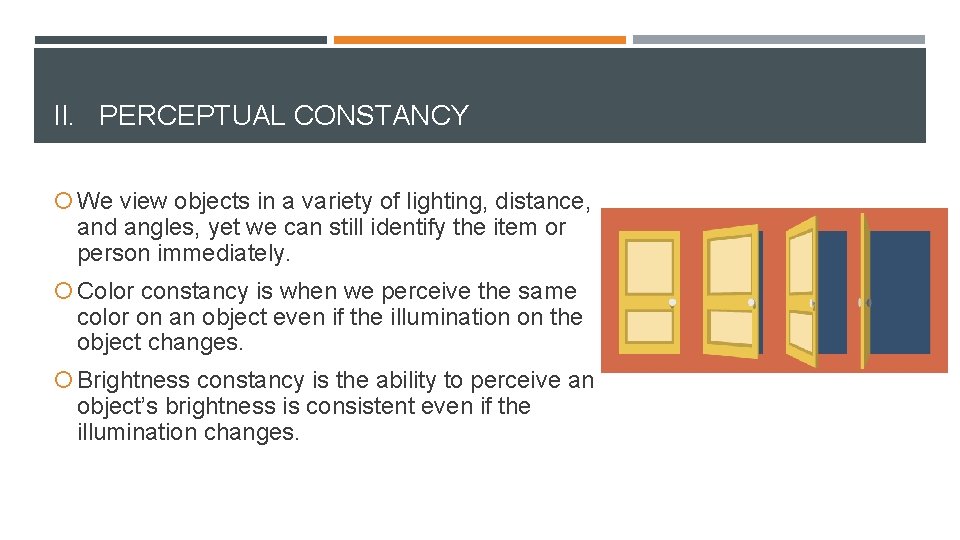
II. PERCEPTUAL CONSTANCY We view objects in a variety of lighting, distance, and angles, yet we can still identify the item or person immediately. Color constancy is when we perceive the same color on an object even if the illumination on the object changes. Brightness constancy is the ability to perceive an object’s brightness is consistent even if the illumination changes.
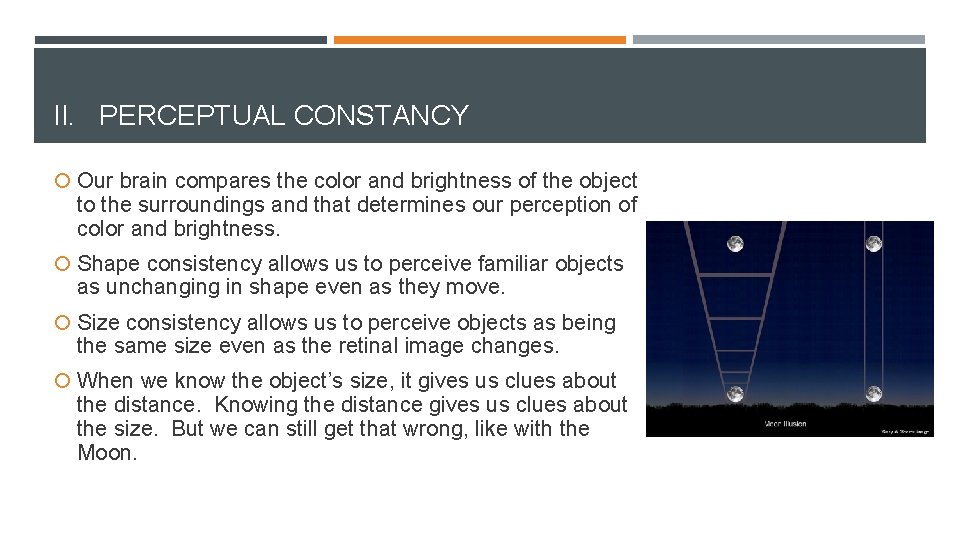
II. PERCEPTUAL CONSTANCY Our brain compares the color and brightness of the object to the surroundings and that determines our perception of color and brightness. Shape consistency allows us to perceive familiar objects as unchanging in shape even as they move. Size consistency allows us to perceive objects as being the same size even as the retinal image changes. When we know the object’s size, it gives us clues about the distance. Knowing the distance gives us clues about the size. But we can still get that wrong, like with the Moon.
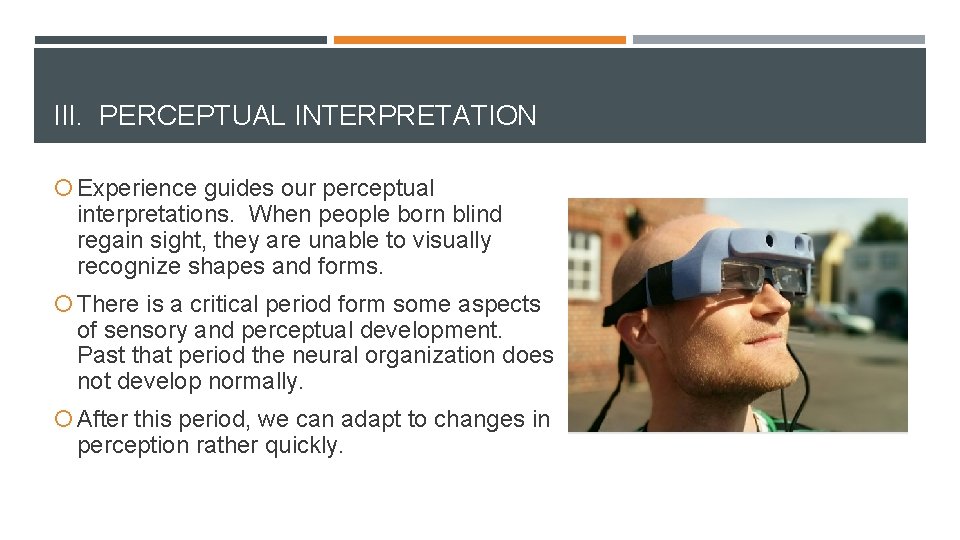
III. PERCEPTUAL INTERPRETATION Experience guides our perceptual interpretations. When people born blind regain sight, they are unable to visually recognize shapes and forms. There is a critical period form some aspects of sensory and perceptual development. Past that period the neural organization does not develop normally. After this period, we can adapt to changes in perception rather quickly.