
Chapter 4 Part 3 Mathematical Reasoning Induction Recursion
- Slides: 28
Chapter 4 (Part 3): Mathematical Reasoning, Induction & Recursion u Recursive Algorithms (4. 4) u. Program Correctness (4. 5) © by Kenneth H. Rosen, Discrete Mathematics & its Applications, Sixth Edition, Mc Graw-Hill, 2007
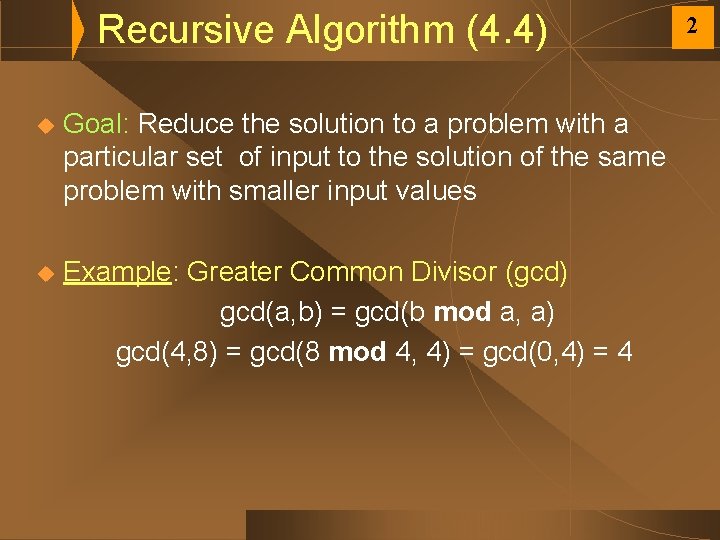
Recursive Algorithm (4. 4) u Goal: Reduce the solution to a problem with a particular set of input to the solution of the same problem with smaller input values u Example: Greater Common Divisor (gcd) gcd(a, b) = gcd(b mod a, a) gcd(4, 8) = gcd(8 mod 4, 4) = gcd(0, 4) = 4 2
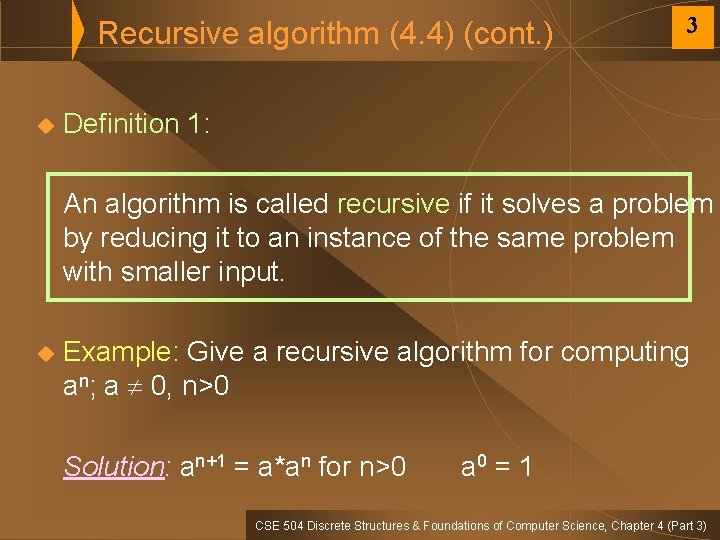
Recursive algorithm (4. 4) (cont. ) u 3 Definition 1: An algorithm is called recursive if it solves a problem by reducing it to an instance of the same problem with smaller input. u Example: Give a recursive algorithm for computing an; a 0, n>0 Solution: an+1 = a*an for n>0 a 0 = 1 CSE 504 Discrete Structures & Foundations of Computer Science, Chapter 4 (Part 3)
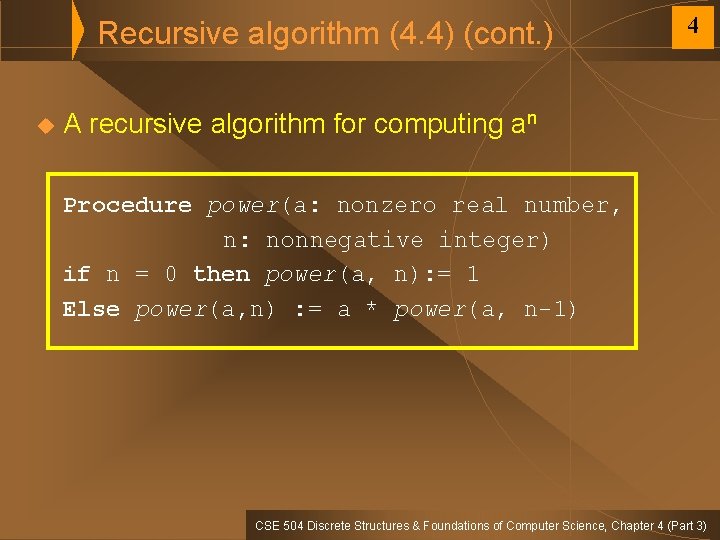
Recursive algorithm (4. 4) (cont. ) u 4 A recursive algorithm for computing an Procedure power(a: nonzero real number, n: nonnegative integer) if n = 0 then power(a, n): = 1 Else power(a, n) : = a * power(a, n-1) CSE 504 Discrete Structures & Foundations of Computer Science, Chapter 4 (Part 3)
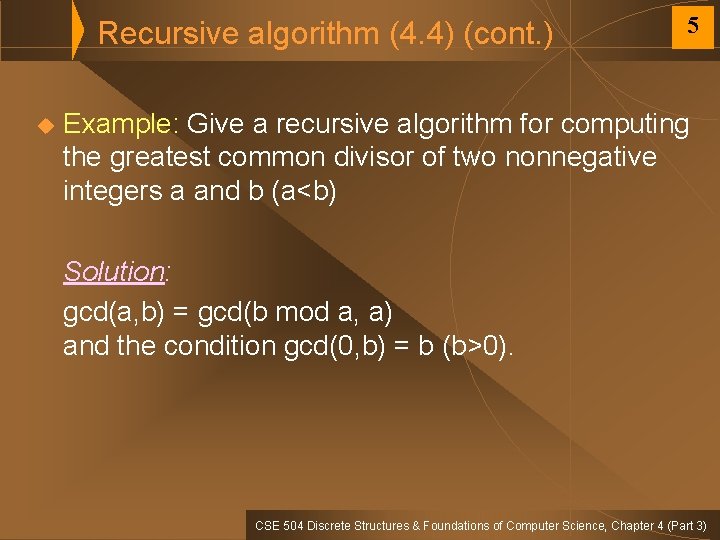
Recursive algorithm (4. 4) (cont. ) u 5 Example: Give a recursive algorithm for computing the greatest common divisor of two nonnegative integers a and b (a<b) Solution: gcd(a, b) = gcd(b mod a, a) and the condition gcd(0, b) = b (b>0). CSE 504 Discrete Structures & Foundations of Computer Science, Chapter 4 (Part 3)
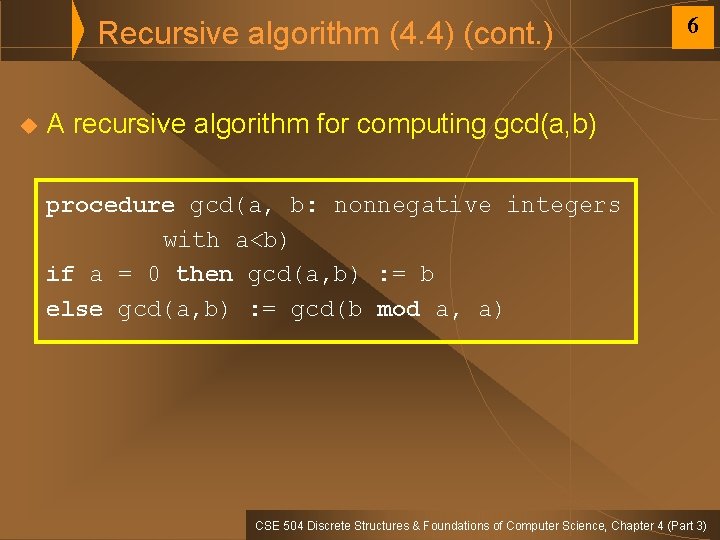
Recursive algorithm (4. 4) (cont. ) u 6 A recursive algorithm for computing gcd(a, b) procedure gcd(a, b: nonnegative integers with a<b) if a = 0 then gcd(a, b) : = b else gcd(a, b) : = gcd(b mod a, a) CSE 504 Discrete Structures & Foundations of Computer Science, Chapter 4 (Part 3)
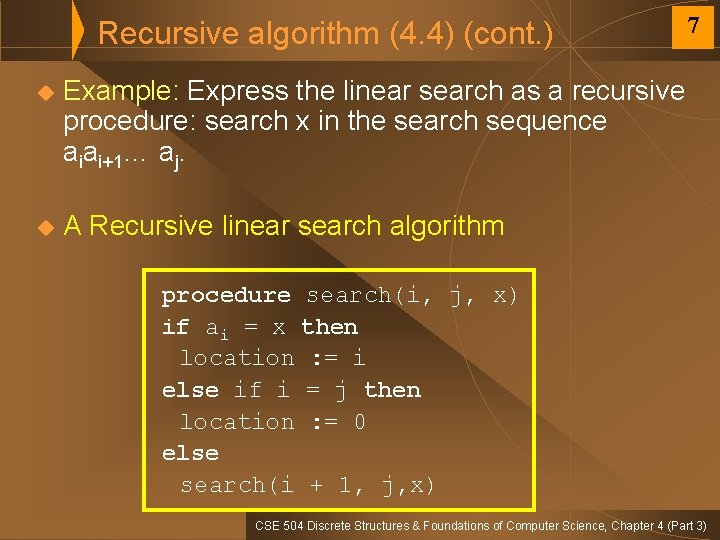
Recursive algorithm (4. 4) (cont. ) u Example: Express the linear search as a recursive procedure: search x in the search sequence aiai+1… aj. u A Recursive linear search algorithm 7 procedure search(i, j, x) if ai = x then location : = i else if i = j then location : = 0 else search(i + 1, j, x) CSE 504 Discrete Structures & Foundations of Computer Science, Chapter 4 (Part 3)
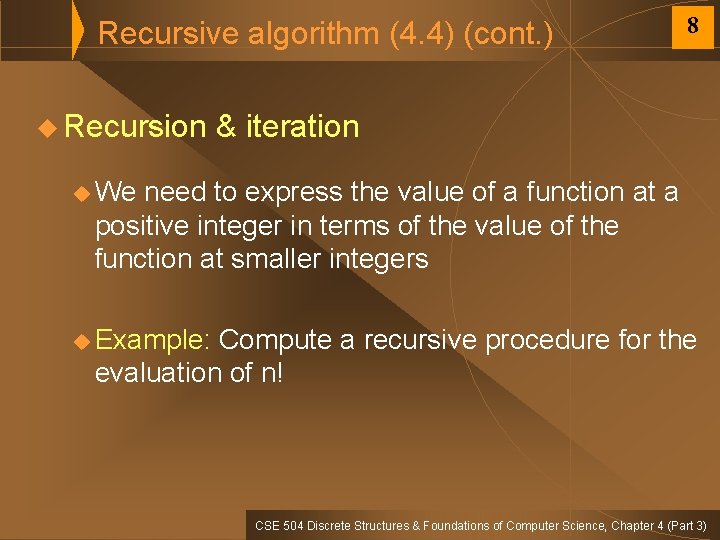
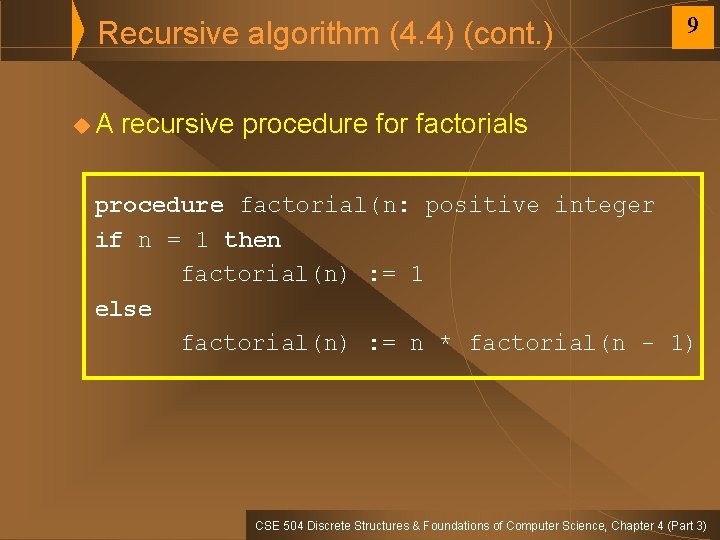
Recursive algorithm (4. 4) (cont. ) u Recursion 8 & iteration u We need to express the value of a function at a positive integer in terms of the value of the function at smaller integers u Example: Compute a recursive procedure for the evaluation of n! CSE 504 Discrete Structures & Foundations of Computer Science, Chapter 4 (Part 3)
Recursive algorithm (4. 4) (cont. ) u. A 9 recursive procedure for factorials procedure factorial(n: positive integer if n = 1 then factorial(n) : = 1 else factorial(n) : = n * factorial(n - 1) CSE 504 Discrete Structures & Foundations of Computer Science, Chapter 4 (Part 3)
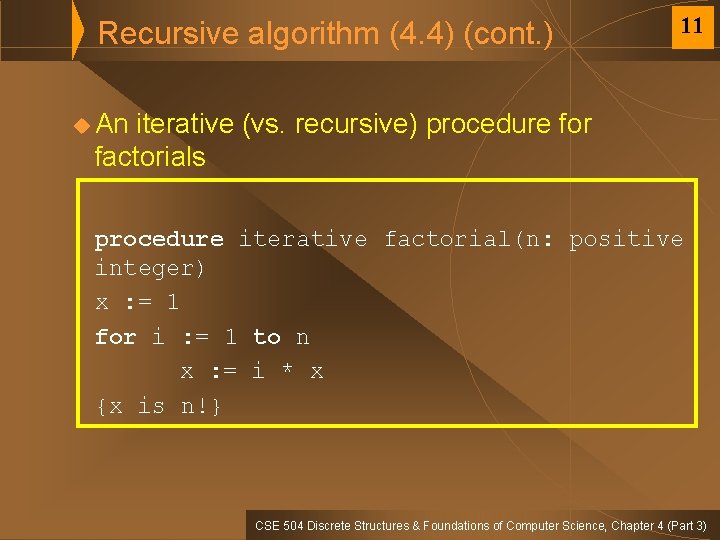
Recursive algorithm (4. 4) (cont. ) u Recursion 10 & iteration (cont. ) u However, instead of reducing the computation to the evaluation of the function at smaller integers, we can start by 1 and explore larger in an iterative way CSE 504 Discrete Structures & Foundations of Computer Science, Chapter 4 (Part 3)
Recursive algorithm (4. 4) (cont. ) 11 u An iterative (vs. recursive) procedure for factorials procedure iterative factorial(n: positive integer) x : = 1 for i : = 1 to n x : = i * x {x is n!} CSE 504 Discrete Structures & Foundations of Computer Science, Chapter 4 (Part 3)
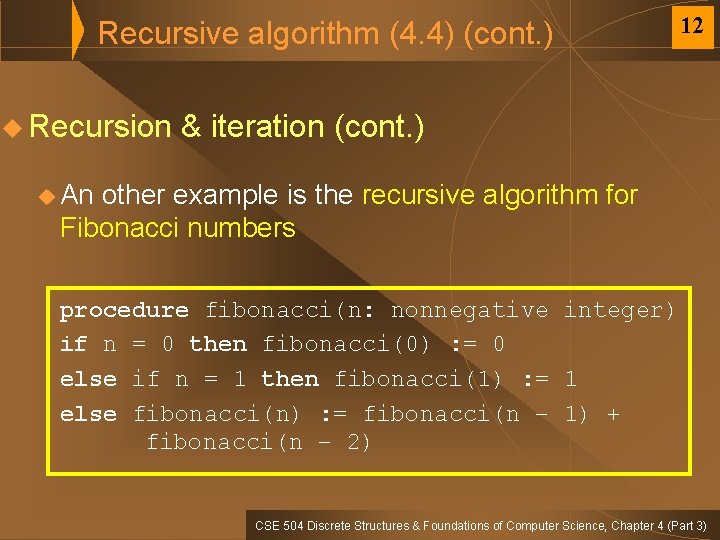
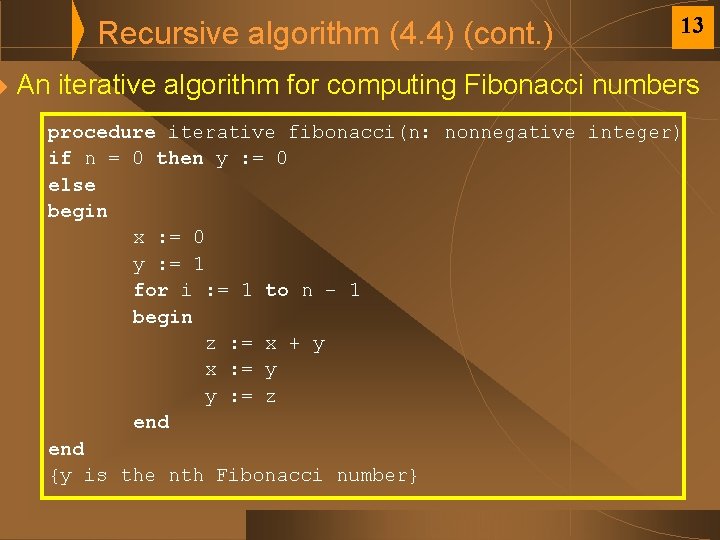
Recursive algorithm (4. 4) (cont. ) u Recursion 12 & iteration (cont. ) u An other example is the recursive algorithm for Fibonacci numbers procedure fibonacci(n: nonnegative integer) if n = 0 then fibonacci(0) : = 0 else if n = 1 then fibonacci(1) : = 1 else fibonacci(n) : = fibonacci(n – 1) + fibonacci(n – 2) CSE 504 Discrete Structures & Foundations of Computer Science, Chapter 4 (Part 3)
u Recursive algorithm (4. 4) (cont. ) 13 An iterative algorithm for computing Fibonacci numbers procedure iterative fibonacci(n: nonnegative integer) if n = 0 then y : = 0 else begin x : = 0 y : = 1 for i : = 1 to n – 1 begin z : = x + y x : = y y : = z end {y is the nth Fibonacci number}
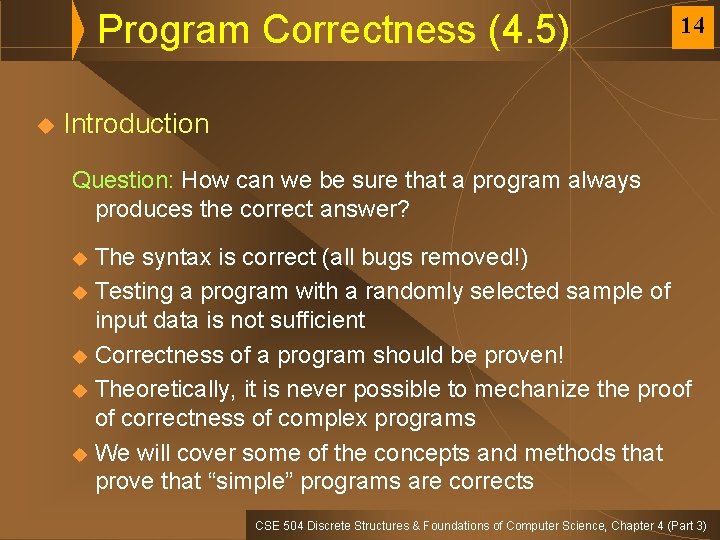
Program Correctness (4. 5) u 14 Introduction Question: How can we be sure that a program always produces the correct answer? The syntax is correct (all bugs removed!) u Testing a program with a randomly selected sample of input data is not sufficient u Correctness of a program should be proven! u Theoretically, it is never possible to mechanize the proof of correctness of complex programs u We will cover some of the concepts and methods that prove that “simple” programs are corrects u CSE 504 Discrete Structures & Foundations of Computer Science, Chapter 4 (Part 3)
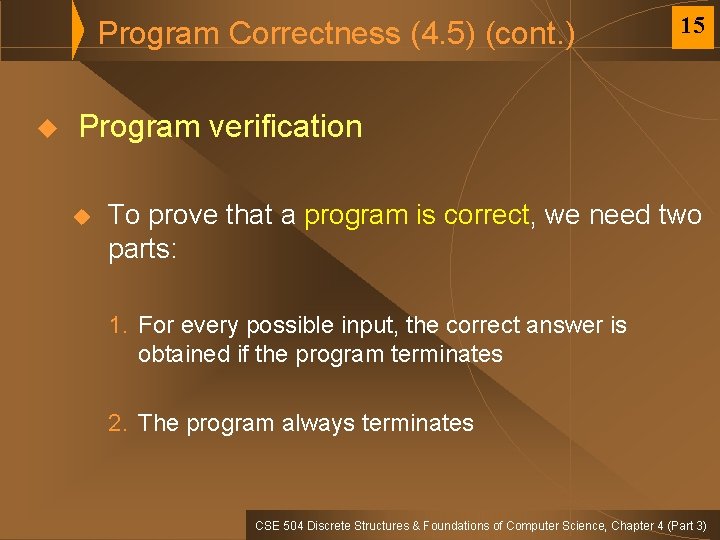
Program Correctness (4. 5) (cont. ) u 15 Program verification u To prove that a program is correct, we need two parts: 1. For every possible input, the correct answer is obtained if the program terminates 2. The program always terminates CSE 504 Discrete Structures & Foundations of Computer Science, Chapter 4 (Part 3)
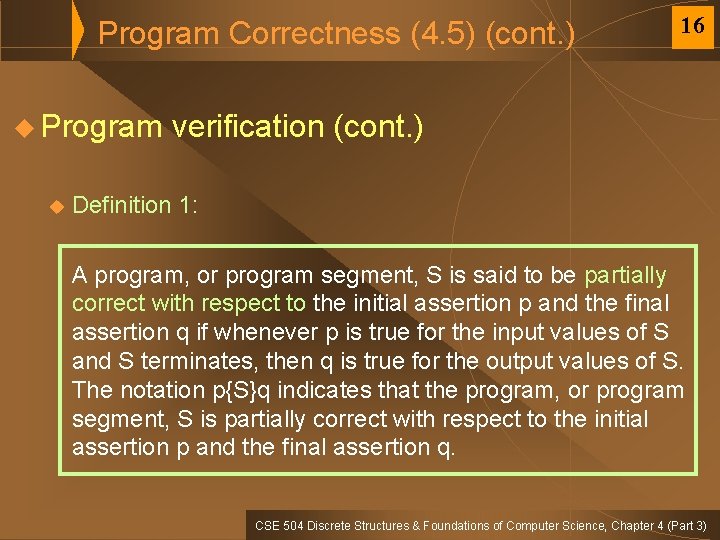
Program Correctness (4. 5) (cont. ) u Program u 16 verification (cont. ) Definition 1: A program, or program segment, S is said to be partially correct with respect to the initial assertion p and the final assertion q if whenever p is true for the input values of S and S terminates, then q is true for the output values of S. The notation p{S}q indicates that the program, or program segment, S is partially correct with respect to the initial assertion p and the final assertion q. CSE 504 Discrete Structures & Foundations of Computer Science, Chapter 4 (Part 3)
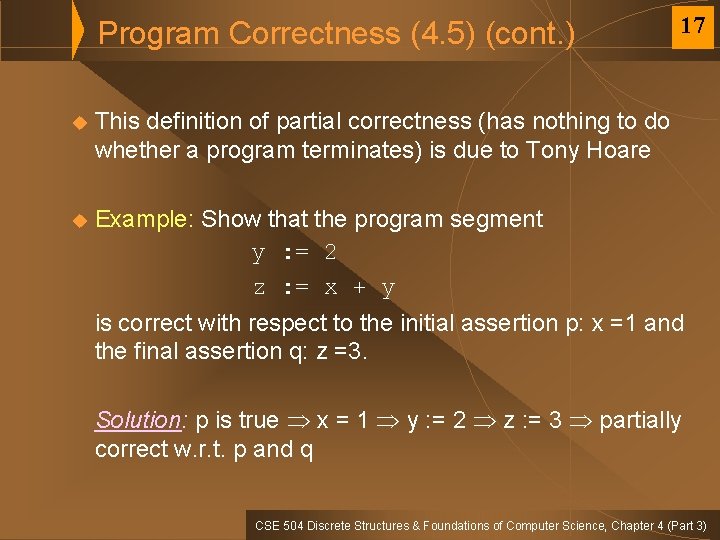
Program Correctness (4. 5) (cont. ) u This definition of partial correctness (has nothing to do whether a program terminates) is due to Tony Hoare u Example: Show that the program segment y : = 2 z : = x + y 17 is correct with respect to the initial assertion p: x =1 and the final assertion q: z =3. Solution: p is true x = 1 y : = 2 z : = 3 partially correct w. r. t. p and q CSE 504 Discrete Structures & Foundations of Computer Science, Chapter 4 (Part 3)
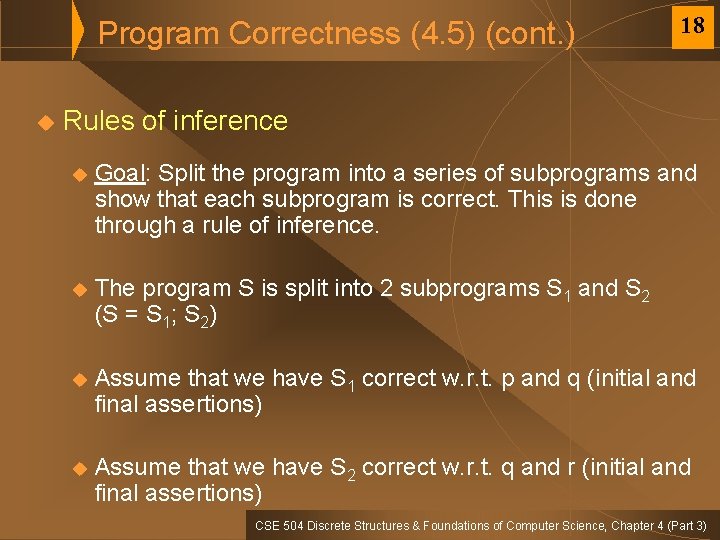
Program Correctness (4. 5) (cont. ) u 18 Rules of inference u Goal: Split the program into a series of subprograms and show that each subprogram is correct. This is done through a rule of inference. u The program S is split into 2 subprograms S 1 and S 2 (S = S 1; S 2) u Assume that we have S 1 correct w. r. t. p and q (initial and final assertions) u Assume that we have S 2 correct w. r. t. q and r (initial and final assertions) CSE 504 Discrete Structures & Foundations of Computer Science, Chapter 4 (Part 3)
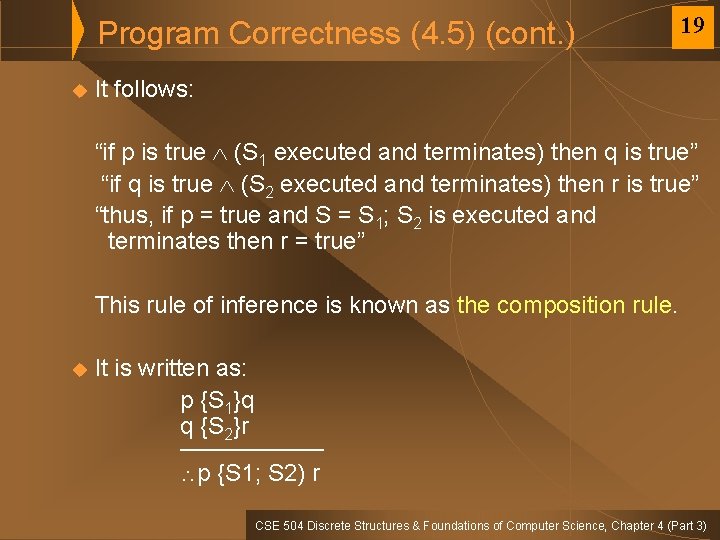
Program Correctness (4. 5) (cont. ) u 19 It follows: “if p is true (S 1 executed and terminates) then q is true” “if q is true (S 2 executed and terminates) then r is true” “thus, if p = true and S = S 1; S 2 is executed and terminates then r = true” This rule of inference is known as the composition rule. u It is written as: p {S 1}q q {S 2}r p {S 1; S 2) r CSE 504 Discrete Structures & Foundations of Computer Science, Chapter 4 (Part 3)
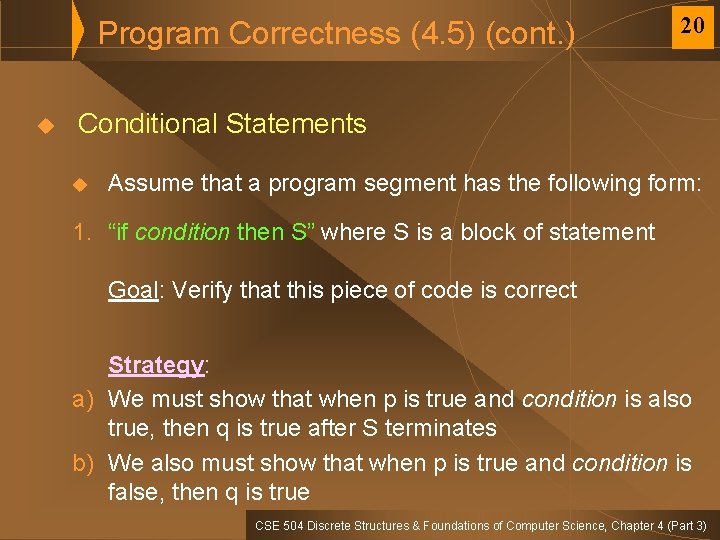
Program Correctness (4. 5) (cont. ) u 20 Conditional Statements u Assume that a program segment has the following form: 1. “if condition then S” where S is a block of statement Goal: Verify that this piece of code is correct Strategy: a) We must show that when p is true and condition is also true, then q is true after S terminates b) We also must show that when p is true and condition is false, then q is true CSE 504 Discrete Structures & Foundations of Computer Science, Chapter 4 (Part 3)
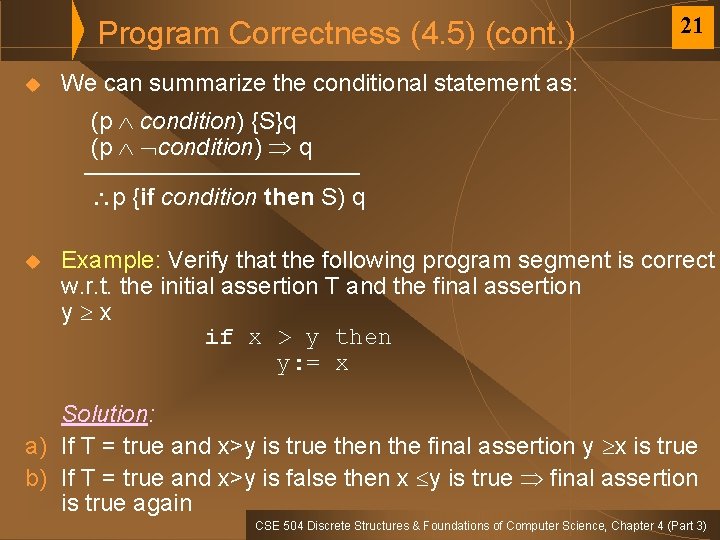
Program Correctness (4. 5) (cont. ) u 21 We can summarize the conditional statement as: (p condition) {S}q (p condition) q p {if condition then S) q u Example: Verify that the following program segment is correct w. r. t. the initial assertion T and the final assertion y x if x > y then y: = x Solution: a) If T = true and x>y is true then the final assertion y x is true b) If T = true and x>y is false then x y is true final assertion is true again CSE 504 Discrete Structures & Foundations of Computer Science, Chapter 4 (Part 3)
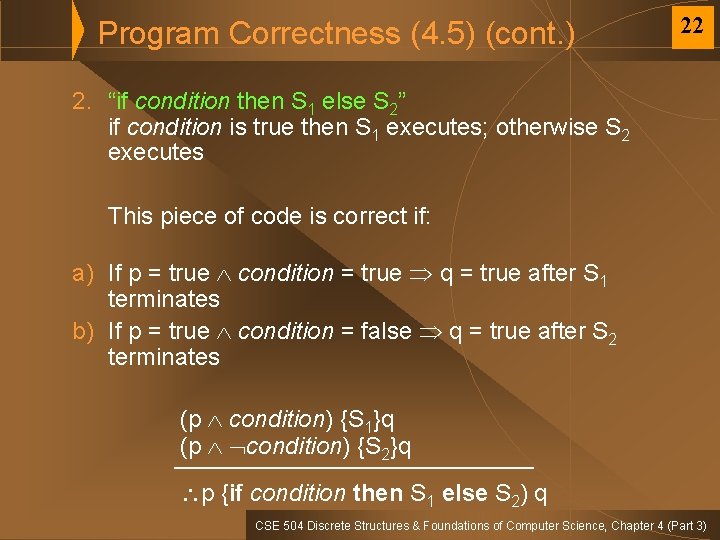
Program Correctness (4. 5) (cont. ) 22 2. “if condition then S 1 else S 2” if condition is true then S 1 executes; otherwise S 2 executes This piece of code is correct if: a) If p = true condition = true q = true after S 1 terminates b) If p = true condition = false q = true after S 2 terminates (p condition) {S 1}q (p condition) {S 2}q p {if condition then S 1 else S 2) q CSE 504 Discrete Structures & Foundations of Computer Science, Chapter 4 (Part 3)
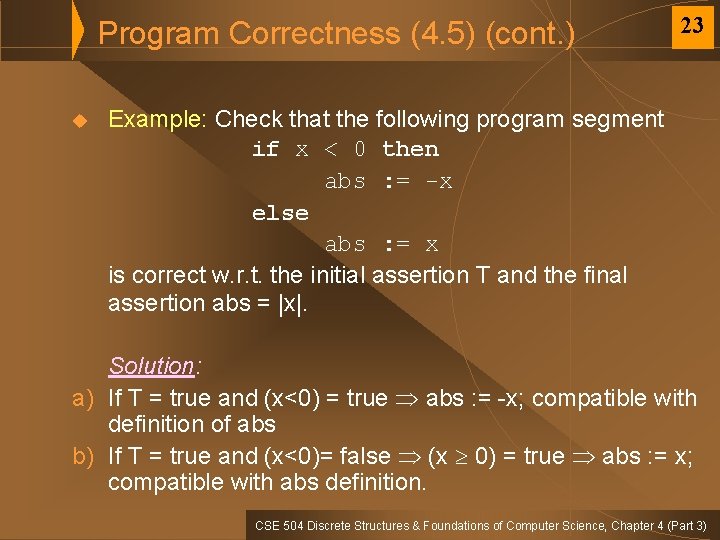
Program Correctness (4. 5) (cont. ) u 23 Example: Check that the following program segment if x < 0 then abs : = -x else abs : = x is correct w. r. t. the initial assertion T and the final assertion abs = |x|. Solution: a) If T = true and (x<0) = true abs : = -x; compatible with definition of abs b) If T = true and (x<0)= false (x 0) = true abs : = x; compatible with abs definition. CSE 504 Discrete Structures & Foundations of Computer Science, Chapter 4 (Part 3)
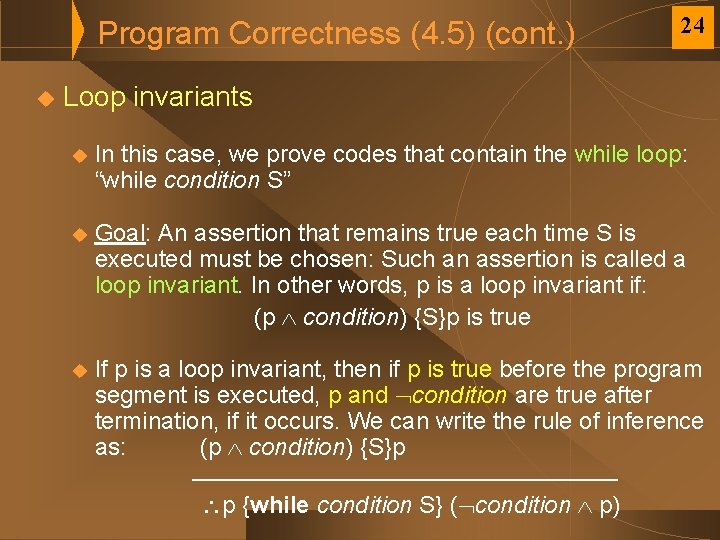
Program Correctness (4. 5) (cont. ) u 24 Loop invariants u In this case, we prove codes that contain the while loop: “while condition S” u Goal: An assertion that remains true each time S is executed must be chosen: Such an assertion is called a loop invariant. In other words, p is a loop invariant if: (p condition) {S}p is true u If p is a loop invariant, then if p is true before the program segment is executed, p and condition are true after termination, if it occurs. We can write the rule of inference as: (p condition) {S}p p {while condition S} ( condition p)
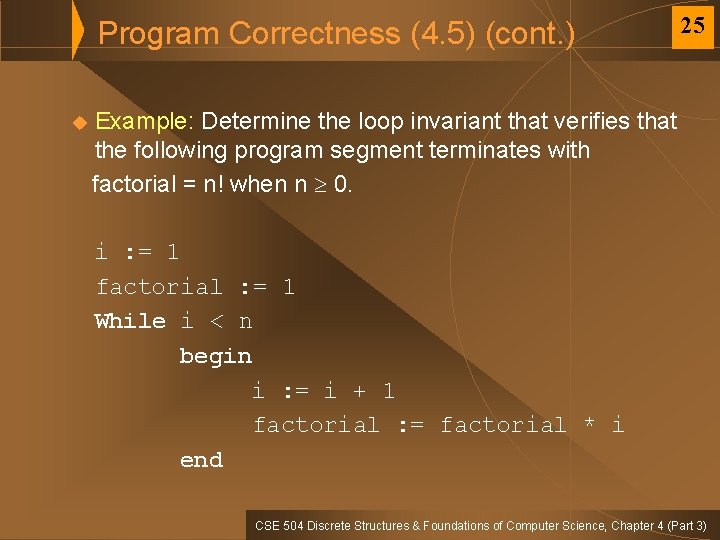
Program Correctness (4. 5) (cont. ) u 25 Example: Determine the loop invariant that verifies that the following program segment terminates with factorial = n! when n 0. i : = 1 factorial : = 1 While i < n begin i : = i + 1 factorial : = factorial * i end CSE 504 Discrete Structures & Foundations of Computer Science, Chapter 4 (Part 3)
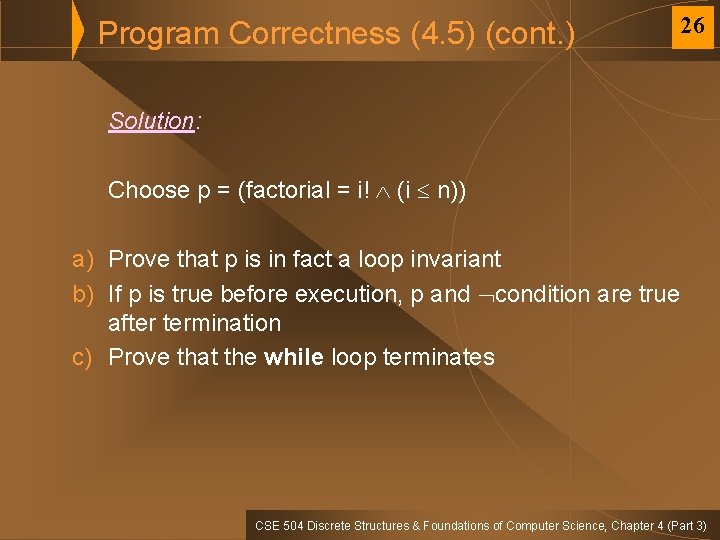
Program Correctness (4. 5) (cont. ) 26 Solution: Choose p = (factorial = i! (i n)) a) Prove that p is in fact a loop invariant b) If p is true before execution, p and condition are true after termination c) Prove that the while loop terminates CSE 504 Discrete Structures & Foundations of Computer Science, Chapter 4 (Part 3)
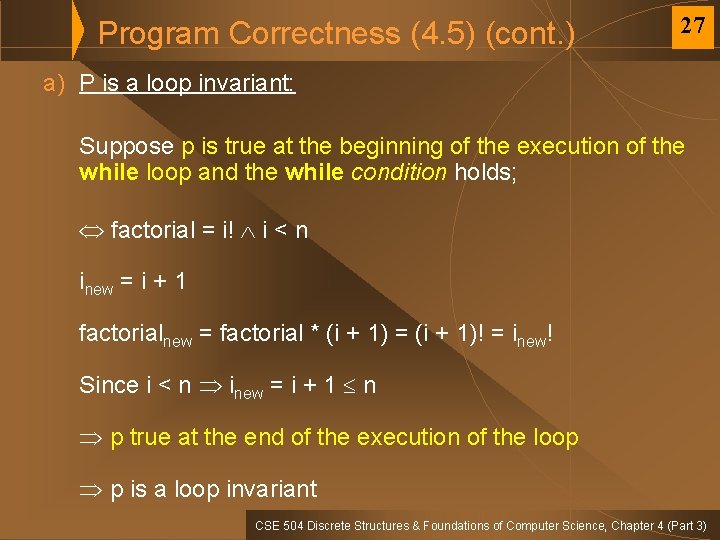
Program Correctness (4. 5) (cont. ) 27 a) P is a loop invariant: Suppose p is true at the beginning of the execution of the while loop and the while condition holds; factorial = i! i < n inew = i + 1 factorialnew = factorial * (i + 1) = (i + 1)! = inew! Since i < n inew = i + 1 n p true at the end of the execution of the loop p is a loop invariant CSE 504 Discrete Structures & Foundations of Computer Science, Chapter 4 (Part 3)
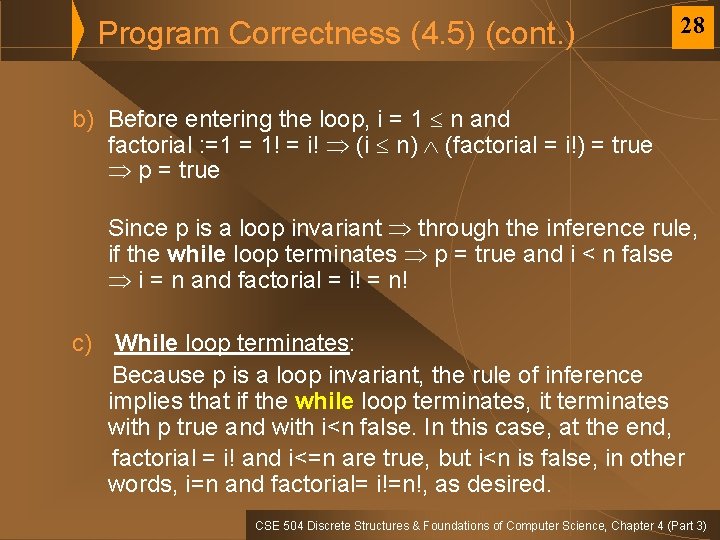
Program Correctness (4. 5) (cont. ) 28 b) Before entering the loop, i = 1 n and factorial : =1 = 1! = i! (i n) (factorial = i!) = true p = true Since p is a loop invariant through the inference rule, if the while loop terminates p = true and i < n false i = n and factorial = i! = n! c) While loop terminates: Because p is a loop invariant, the rule of inference implies that if the while loop terminates, it terminates with p true and with i<n false. In this case, at the end, factorial = i! and i<=n are true, but i<n is false, in other words, i=n and factorial= i!=n!, as desired. CSE 504 Discrete Structures & Foundations of Computer Science, Chapter 4 (Part 3)