
Chapter 4 Other IO Bus SCSI SCSI Small
Chapter 4 Other I/O Bus
SCSI • SCSI (Small Computer System Interface) is an intelligent interface. • SCSI is a peripheral interface: up to 8 or 16 devices can be attached in series (daisy chain) in a single bus. • is a buffered interface: it uses hand shake signals between devices; SCSI is a peer to peer interface, no need to have a computer. • can transfer up to 160 MB/second, more than the PCI bus can deliver. • system is built around a central controller, called the host adapter. • advantage of SCSI is the intelligent protocol which manages the devices and ensures optimal data transfer
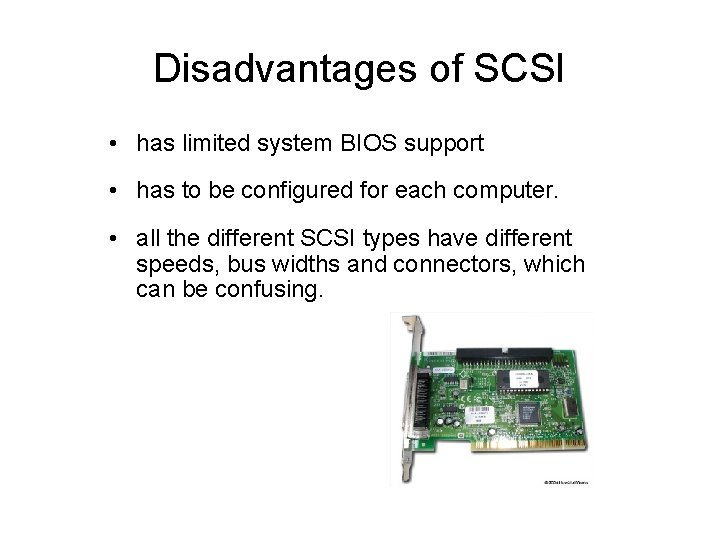
Disadvantages of SCSI • has limited system BIOS support • has to be configured for each computer. • all the different SCSI types have different speeds, bus widths and connectors, which can be confusing.
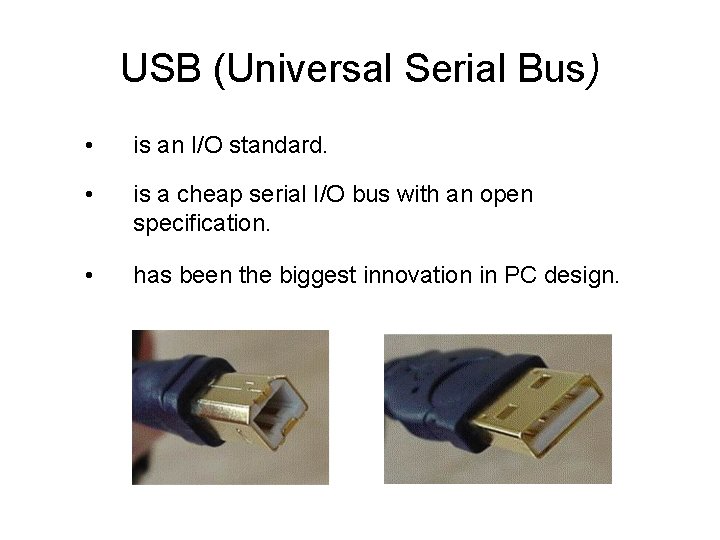
USB (Universal Serial Bus) • is an I/O standard. • is a cheap serial I/O bus with an open specification. • has been the biggest innovation in PC design.
USB Features • is backwards compatible. Older devices can be connected using the new connector. • can also supply power to the devices up to 0. 5 A at 5 volts. • Individual USB cables can run as long as 5 meters; with hubs, devices can be up to 30 meters (six cables' worth) away from the host. • has two wires for power (+5 volts and ground) and a twisted pair of wires to carry the data. • Up to 127 USB devices can be connected to the PC using USB hubs. There are no IRQ’s to be configured or terminators. • It is "hot-swappable" i. e. devices can be attach or remove to your PC an time.
How USB port work • Whenever a device is plugged in – The host senses voltage differences in the USB network and proceeds to query the device for type, vendor, functionality and bandwidth required. – Then the device is assigned a unique address ID. – Once query is complete, the appropriate device driver is loaded by the operating system (O/S) and the user will be prompted for the driver disk if necessary. – All argument of the devices is handled by the host (computer) and by the software residing on the host. • When devices are detached (unplugged) – The host computer detects the detachment, alerts the appropriate application and Unloads the drivers.
IEEE 1394 (Firewire) • A digital interface - no need to convert signal. • A physically small thin shielded twisted-pair serial cable that can be up to 4. 5 meters in length; up to maximum 72 meters. Uses a sixwire, 2 wires for power, 2 wires for data and 2 wires for clock. • Easy to use - no need for terminators • Hot pluggable - devices can be added and removed while the bus is active. • Scalable - can support the multiple speeds on a single bus. • Flexible - supports freeform daisy chaining and branching for peerto-peer implementations. • Fast, guaranteed bandwidth - supports guaranteed delivery of time critical data which enables smaller buffers (lower cost) • It supports a daisy-chained topology, allowing up to 63 devices.
Advantages of IEEE 1394 • uses a "Peer-to-Peer" Interface. Data can be transferred between two units without the PC. • Real-time data transfer for multimedia applications. • It added in support for asynchronous streaming, 100, 200, and 400 Mbps data rates currently; 800 Mbps and multi-Gbps upgrade path. • Live connection/disconnection without data loss or interruption. • Automatic configuration supporting Plug and Play. • Guaranteed bandwidth assignments for real-time applications. • Fire. Wire has a 64 bit address bus. Compared to SCSI, it does not need a unique ID, no need to be terminated and simpler than SCSI. They are dynamically configured "on the fly".
- Slides: 8