
CHAPTER 4 Organizational and Managerial Issues in Logistics



- Slides: 45
CHAPTER 4 Organizational and Managerial Issues in Logistics Copyright © 2015 Pearson Education, Inc.
Learning Objectives • To examine organizational structure for logistics • To learn about traditional and contemporary organizational design for logistics • To explore productivity issues in logistics • To explore quality issues in logistics • To learn about ways to manage theft and pilferage Copyright © 2015 Pearson Education, Inc. 4 -2
Learning Objectives • To introduce you to the concept of logistics social responsibility • To discuss issues associated with reverse logistics • To describe programs designed to lessen the impact of terrorism on logistics systems Copyright © 2015 Pearson Education, Inc. 4 -3
Organizational and Managerial Issues in Logistics Key Terms • “C-level” position • Centralized logistics organization • Container Security Initiative (CSI) • Customs Trade Partnership Against Terrorism (C-TPAT) • Decentralized logistics organization • Excess capacity • Fragmented logistics structure • Importer Security Filing (ISF) rule Copyright © 2015 Pearson Education, Inc. 4 -4
Organizational and Managerial Issues in Logistics Key Terms • ISO 9000 • Lean Six Sigma • Logistics service quality • Logistics social responsibility • Logistics uncertainty pyramid model • Malcolm Baldrige National Quality Award • Pilferage • Productivity • Reverse Logistics • Tachograph • Theft Copyright © 2015 Pearson Education, Inc. 4 -5
Organizational and Managerial Issues in Logistics Key Terms • Transportation Worker Identification Credential (TWIC) • Unified logistics structure Copyright © 2015 Pearson Education, Inc. 4 -6
Organizing Logistics within the Firm • Two key organizational logistics topics – Organizational structure – Organizational design Copyright © 2015 Pearson Education, Inc. 4 -6
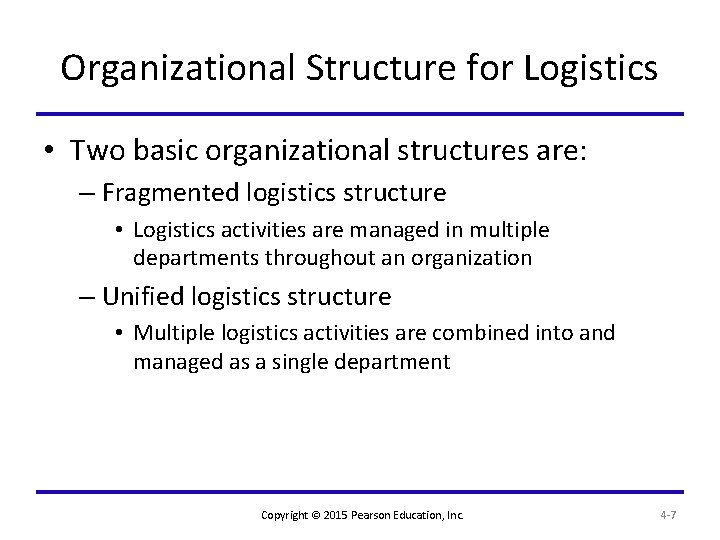
Organizational Structure for Logistics • Two basic organizational structures are: – Fragmented logistics structure • Logistics activities are managed in multiple departments throughout an organization – Unified logistics structure • Multiple logistics activities are combined into and managed as a single department Copyright © 2015 Pearson Education, Inc. 4 -7
Organizational Structure for Logistics • Two basic organizational structures for logistics departments are: – Centralized logistics organization • Company maintains a single logistics department that administers the related activities for the entire company from the home office – Decentralized logistics organization • Logistics-related decisions are made separately at the divisional or product group level and often in different geographic regions Copyright © 2015 Pearson Education, Inc. 4 -8
Organizational Structure for Logistics • Job title or corporate rank – Leading edge organizations tend to head the logistics department by senior-level personnel – Generally excluded from holding a “C-level” position Copyright © 2015 Pearson Education, Inc. 4 -10
Organizational Design for Logistics • Three primary types of organizational design include: – Hierarchical (functional) • Top-down flow – Matrix • Cross-functional responsibilities – Network • Process philosophy focused on combining tasks into value-creating products and activities Copyright © 2015 Pearson Education, Inc. 4 -11
Organizational Design for Logistics • Network organizational design is manifested in terms of: – Relevancy • Refers to satisfying current and emerging customer needs • Facilitated by developing mutually beneficial relationships with key customers • At a minimum, these relationships should provide an understanding of customer needs and wants Copyright © 2015 Pearson Education, Inc. 4 -12
Organizational Design for Logistics • Network organizational design is manifested in terms of: – Responsiveness • Reflects the degree to which an organization can accommodate unique or unplanned customer requests • Achieved when the appropriate decision markers are provided with both relevant information and the authority to address unique or unplanned requests Copyright © 2015 Pearson Education, Inc. 4 -13
Organizational Design for Logistics • Network organizational design is manifested in terms of: – Flexibility • Is an organization’s ability to address unexpected operational situations • Predicated on avoiding early commitment to an irreversible course of action Copyright © 2015 Pearson Education, Inc. 4 -14
Managerial Issues in Logistics • • • Productivity Quality Risk Sustainability Complexity © 2008 Prentice Hall 13 -15
Productivity • Can be defined as the amount of output divided by the amount of input • Provides insight into the efficiency with which corporate resources are being utilized Copyright © 2015 Pearson Education, Inc. 4 -16
Three Ways to Improve Productivity • Reduce the amount of input while holding output constant • Increase the amount of output while holding input constant • Increase output while decreasing input Copyright © 2015 Pearson Education, Inc. 4 -17
Worker Productivity • Warehousing and transportation are heavily dependent on human labor • Human labor is an input (i. e. workers receive wages or salaries) • Productivity improvement efforts in logistics are often directed toward increasing the amount of output while holding input constant (workers resistant to suggestions regarding reduced wages or salaries) Copyright © 2015 Pearson Education, Inc. 4 -18
Worker Productivity • Logistics-operating employees are unionized in some areas • Warehousing facilities have specific work rules • Warehouse employees can be monitored by direct supervision • Transportation employees (truck drivers) can be monitored through technology, i. e. tachograph Copyright © 2015 Pearson Education, Inc. 4 -19
Asset Productivity • Asset-related productivity concerns include: – Space utilization • Excess capacity – Unused available space – Can be unproductive as it may result in the purchase of additional equipment or facilities which adds costs (input), but may not yield additional output resulting in a productivity decline – Improving the output from existing assets • Increases productivity as inputs remain constant, but output is increased Copyright © 2015 Pearson Education, Inc. 4 -20
Quality • Logistics service quality – Relates to a firm’s ability to deliver products, material and services without defects or errors to both internal and external customers 1 1 E. A. Morash, C. Droge, and S. Vickery, “Strategic Logistics Capabilities for Competitive Advantage and Firm Success, ” Journal of Business Logistics 17, no. 1 (1996): 1 -22. Copyright © 2015 Pearson Education, Inc. 4 -21
Quality • Quality in logistics involves trade-offs – If inferior logistic service quality, customers may perceive lower value – If superior logistic service quality than expected or required, organization may be adding unnecessary cost • Organizations must try to match the quality levels of the logistic services they provide with the expectations of their customers and the landscape in which they operate. Copyright © 2015 Pearson Education, Inc. 4 -22
Quality • Vendors are expected to have quality programs • Vendors can demonstrate commitment to quality to potential buyers through achieving and maintaining quality program certification • ISO (International Standards Organization) 9000 certification is an example of a quality program certification 1 E. A. Copyright © 2015 Pearson Education, Inc. Morash, C. Droge, and S. Vickery, “Strategic Logistics Capabilities for Competitive Advantage and Firm 4 -23
Quality • ISO 9000 – Is a set of generic standards used to document, implement, and demonstrate quality management and assurance systems – Is applicable to both manufacturing and service firms – Standards are intended to help companies build quality into every core process in each department Copyright © 2015 Pearson Education, Inc. 4 -24
Quality • ISO 9000 – Firms demonstrating commitment to quality through training, reviews, and continuous improvement achieve initial ISO 9000 certification – Once certification is obtained, audits are conducted annually and organizations can be recertified every 3 years – Certification is credited with • an increase in customer service • improved order accuracy • enabling enhanced costs analysis 1 1 Paul D. Larson and Stephen G. Kerr, “ISO and ABC: Complements or Competitors? ” International Journal of Logistics Management 13, no. 2 (2002): 91– 100. Copyright © 2015 Pearson Education, Inc. 4 -25
Quality • Six Sigma (or six standard deviations) – Is a quality focused methodology that emphasizes the virtual elimination of business errors – Area covered under a normal curve is by six standard deviations is 99. 999% – Approach suggests that there will be 3. 4 defects, deficiencies, or errors per one million opportunities – Can be applied to various logistics activities such as order picking Copyright © 2015 Pearson Education, Inc. 4 -26
Quality • Six Sigma (or six standard deviations) – Benefits • Reduced costs • Reduced errors and waste • Reduced cycle time – Drawbacks • Overcoming business cultural barriers • Investing required resources (both human and money) • Gaining top management commitment Copyright © 2015 Pearson Education, Inc. 4 -27
Quality • Lean Six Sigma – Is a quality focused methodology that integrates Six Sigma with the Lean approach – Integrates the goals and methods of these two approaches in pursuit of quality – Unique because it recognizes that organizations cannot focus only on quality or speed – Emphasizes an organizational focus on improving quality as it relates to responsiveness Copyright © 2015 Pearson Education, Inc. 4 -28
Quality • Malcolm Baldrige National Quality Award – Recognizes organizations for their achievements in quality and performance – Established in the late 1980’s – Restricted to firms headquartered in the United States – Eligibility initially limited to: • Manufactures, services, and small businesses – Eligibility expanded to include: • Health care and educational institutions Copyright © 2015 Pearson Education, Inc. 4 -29
Risk • Can be viewed as susceptibility to disruptions that could lead to a loss for a firm • Can take a variety of forms as it relates to logistics management activities – Regularly occurring (or operational) risks, i. e. variability in demand or potential for a damaged shipment – Catastrophic risks, i. e. earthquakes or terrorist attacks Copyright © 2015 Pearson Education, Inc. 4 -30
Risk • Logistics Uncertainty Pyramid Model – Established to identify uncertainty sources that can affect the risk exposure for logistics activities – Identifies several types of uncertainty including shipper, customer, carrier, control systems, and external Copyright © 2015 Pearson Education, Inc. 4 -31
Risk • Terrorism is an example of catastrophic risk • Terrorism can be defined as “an illegal use of or threat of force or violence made by a group or individual against a person, a company, or someone’s property with a goal of menacing the target, often grounded in politics or ideology. ” 1 Source: Terrorism, The American Heritage® Dictionary of the English Language, 4 th ed. (n. d. ). Retrieved from Dictionary. com website: http: //dictionary. reference. com/browse/terrorism. 1 Copyright © 2015 Pearson Education, Inc. 4 -32
Risk • September 11 terrorist attacks have impacted logistics practices on a worldwide basis • Greater attention given to: – Processes – Procedures – Activities Copyright © 2015 Pearson Education, Inc. 4 -33
Risk • Creation of the Department of Homeland Security (DHS) – Federal agency – Goals are • To prevent terrorist attacks in the U. S. • To reduce the vulnerability of the U. S. to terrorism Copyright © 2015 Pearson Education, Inc. 4 -34
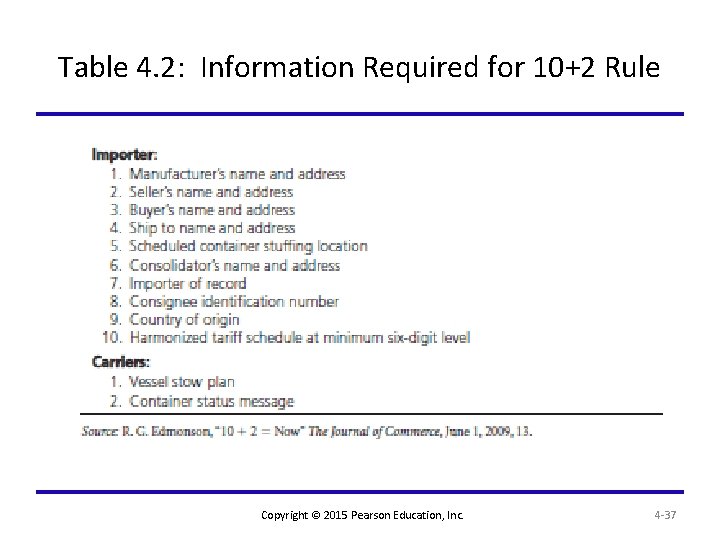
Risk • 22 separate government entities were incorporated into DHS – Transportation Security Administration (TSA) • Transportation Worker Identification Credential (TWIC) – Customs and Border Protection (CBP) • Container Security Initiative (CSI) • Customs Trade Partnership Against Terrorism (C-TPAT) • Importer Security Filing (ISF) rule also known as “ 10+2” (example in Table 4. 2) Copyright © 2015 Pearson Education, Inc. 4 -35
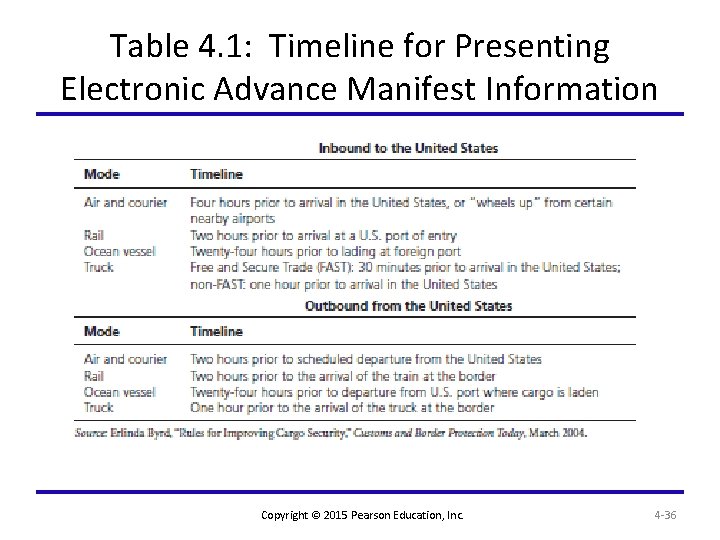
Table 4. 1: Timeline for Presenting Electronic Advance Manifest Information Copyright © 2015 Pearson Education, Inc. 4 -36
Table 4. 2: Information Required for 10+2 Rule Copyright © 2015 Pearson Education, Inc. 4 -37
Risk • Theft is an example of an operational risk • Theft (stealing) can be defined as the taking and removing of personal property with the intent to deprive the rightful owner of it. 1 1 www. m-w. com/dictionary Copyright © 2015 Pearson Education, Inc. 4 -38
Risk • Thoughts regarding theft – Insurance companies may reimburse for loss, but time and costs tend not to be covered – Theft results in the planned flow of goods being interrupted which can lead to stockouts – Theft can factor into facility location decisions Copyright © 2015 Pearson Education, Inc. 4 -39
Risk • Thoughts regarding pilferage (employee theft) – Transportation and warehousing operations are particularly vulnerable to pilferage – Managing pilferage begins with the hiring process – Zero tolerance pilferage policy – Keep goods moving through the system – Recent increase in pirate attacks Copyright © 2015 Pearson Education, Inc. 4 -40
Sustainability • Logistics Social Responsibility – Corporate social responsibility issues that relate directly to logistics Source: Craig R. Carter and Marianne M. Jennings, “Logistics Social Responsibility: An Integrative Framework, ” Journal of Business Logistics 23, no. 2 (2002): 145 -180. • Potential dimensions include: – – – – Environment Ethics Diversity Safety Philanthropy Human rights Others Copyright © 2015 Pearson Education, Inc. 4 -41
Sustainability • Reverse logistics – Is the process of managing return goods – Exceeds $100 billion in U. S. alone – Can be 4 -5 times more expensive than forward logistics – Process can take 12 times as many steps as forward logistics Copyright © 2015 Pearson Education, Inc. 4 -42
Sustainability • Reverse logistics process focuses on: – Why products are returned – How to optimize reverse logistics – Whether reverse logistics should be managed internally or outsourced to a third party 1 1 John Paul Quinn, “Are There Ever Any Happy Returns? ” Logistics Management, June 2005, 63– 66. Copyright © 2015 Pearson Education, Inc. 4 -43
Complexity • Network complexity – Is the growing number of nodes and the associated changes to the links in logistics systems • Process complexity – Centers on the haphazard development of processes, additions and modifications to processes over time, and/or changing process requirements • Range complexity – Centers on the implications associated with the increasing number of products that most companies continue to face in an effort to differentiate themselves with their customers Copyright © 2015 Pearson Education, Inc. 4 -44
Copyright Notice All rights reserved. No part of this publication may be reproduced, stored in a retrieval system, or transmitted, in any form or by any means, electronic, mechanical, photocopying, recording, or otherwise, without the prior written permission of the publisher. Copyright © 2015 Pearson Education, Inc. 4 -45