
Chapter 4 Obstacle Restriction and Removal 12222021 ICAO
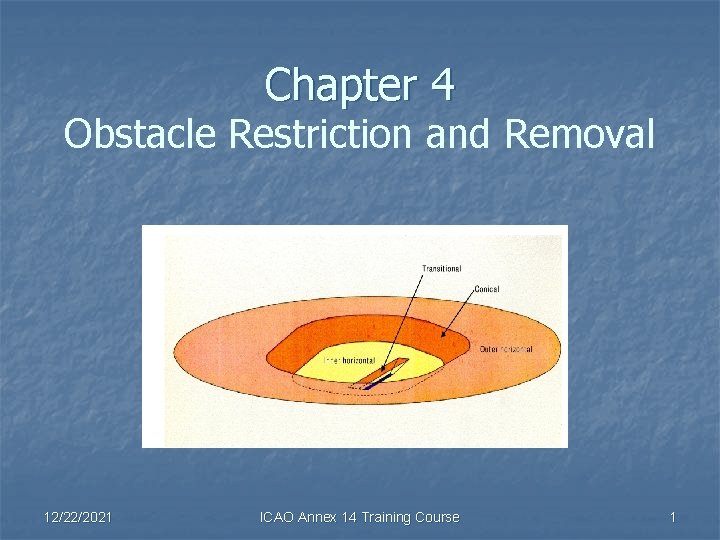
Chapter 4 Obstacle Restriction and Removal 12/22/2021 ICAO Annex 14 Training Course 1
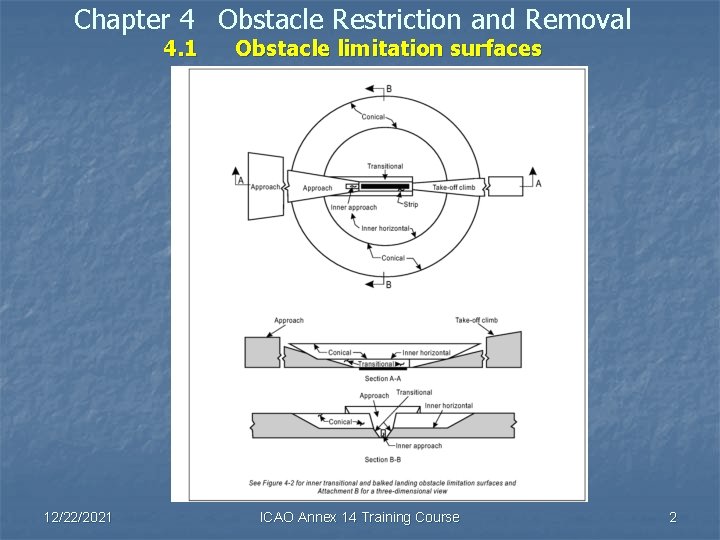
Chapter 4 Obstacle Restriction and Removal 4. 1 12/22/2021 Obstacle limitation surfaces ICAO Annex 14 Training Course 2
Chapter 4 Obstacle Restriction and Removal 4. 1 Obstacle limitation surfaces Outer horizontal surface Need of Outer horizontal surface: 1. Safety implications: Erection of high masts or other skeletal structures in areas suitable for use by aircrafts on wide visual circuits, on arrival routes towards the airport or circuit, or on departure or missed approach climb paths. 2. Efficiency implications: Due to presence of tall structures it may need to be adopted increased procedure heights for instrument approach procedures. Tall structures can be considered to be of possible significance if they are both: Higher than 30 m above local ground level; and Higher than 150 m above aerodrome elevation within a radius of 15000 m of the centre ( ARP) of the airport where runway code number is 3 or 4. 12/22/2021 ICAO Annex 14 Training Course 3

Chapter 4 Obstacle Restriction and Removal 4. 1 Obstacle limitation surfaces Conical surface Description. A surface sloping upwards and outwards from the periphery of the inner hori zontal surface. Characteristics. The limits of the conical surface shall comprise: a) a lower edge coincident with the periphery of the inner horizontal surface; and b) an upper edge located at a specified height above the inner horizontal surface. Ø The slope of the conical surface shall be measured in a vertical plane perpendicular to the periphery of the inner horizontal surface. 12/22/2021 ICAO Annex 14 Training Course 4
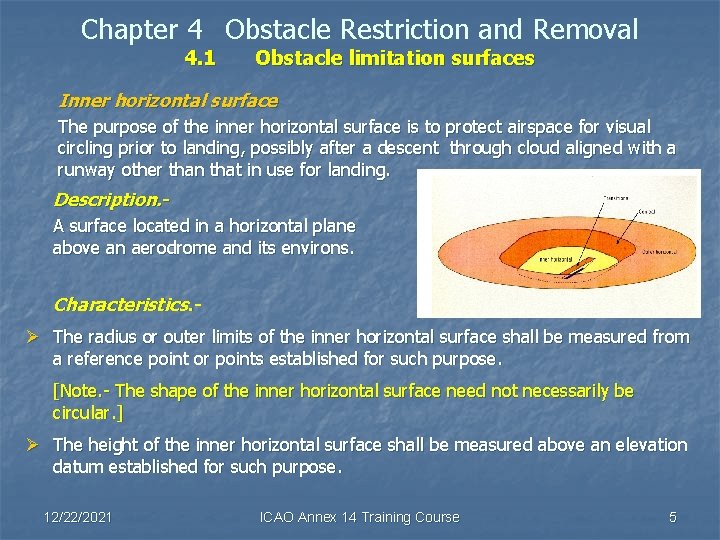
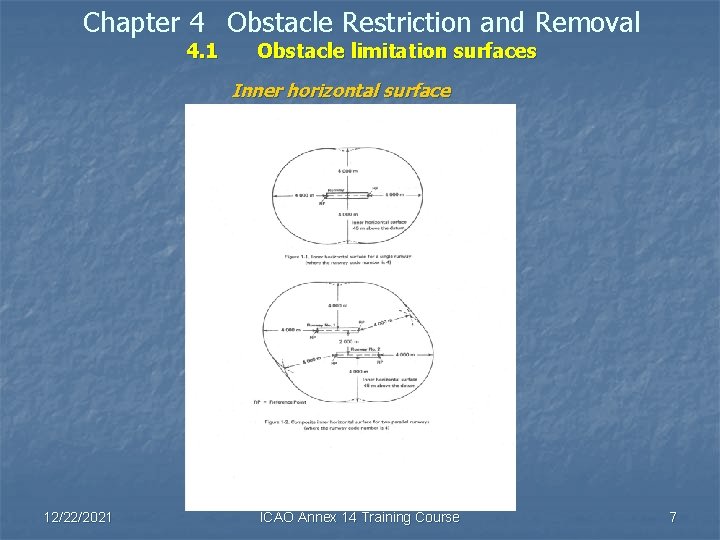
Chapter 4 Obstacle Restriction and Removal 4. 1 Obstacle limitation surfaces Inner horizontal surface The purpose of the inner horizontal surface is to protect airspace for visual circling prior to landing, possibly after a descent through cloud aligned with a runway other than that in use for landing. Description. A surface located in a horizontal plane above an aerodrome and its environs. Characteristics. Ø The radius or outer limits of the inner horizontal surface shall be measured from a reference point or points established for such purpose. [Note. The shape of the inner horizontal surface need not necessarily be circular. ] Ø The height of the inner horizontal surface shall be measured above an elevation datum established for such purpose. 12/22/2021 ICAO Annex 14 Training Course 5
Chapter 4 Obstacle Restriction and Removal 4. 1 Obstacle limitation surfaces Inner horizontal surface 12/22/2021 ICAO Annex 14 Training Course 7
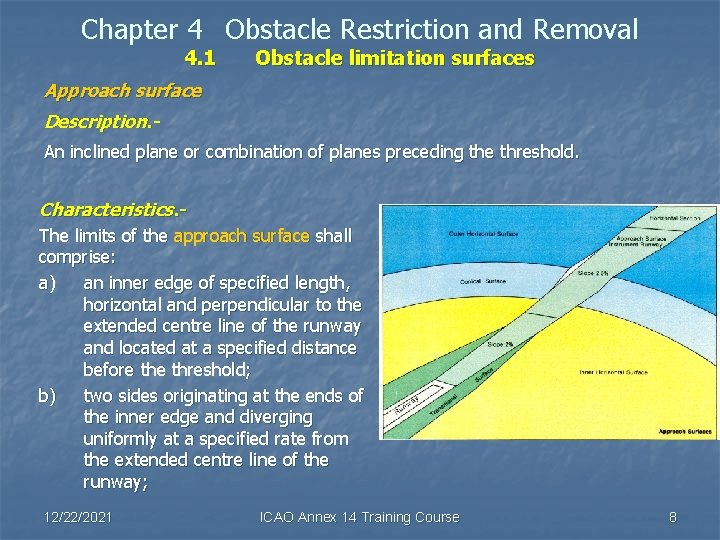
Chapter 4 Obstacle Restriction and Removal 4. 1 Obstacle limitation surfaces Approach surface Description. An inclined plane or combination of planes preceding the threshold. Characteristics. The limits of the approach surface shall comprise: a) an inner edge of specified length, horizontal and perpendicular to the extended centre line of the runway and located at a specified distance before threshold; b) two sides originating at the ends of the inner edge and diverging uniformly at a specified rate from the extended centre line of the runway; 12/22/2021 ICAO Annex 14 Training Course 8
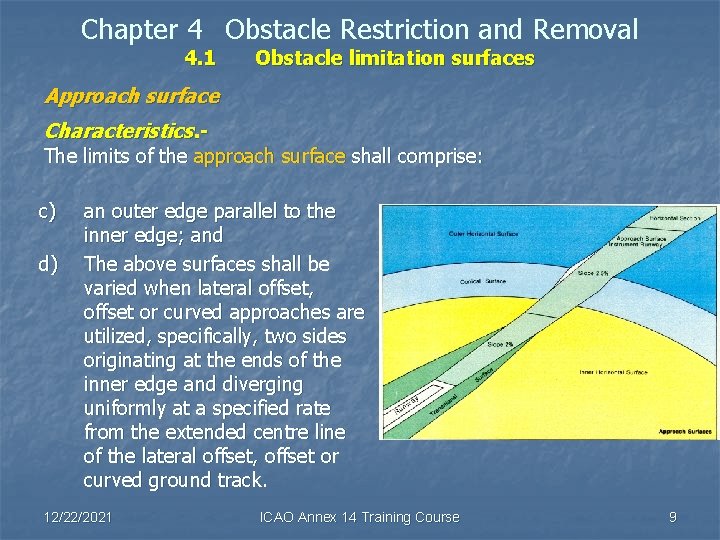
Chapter 4 Obstacle Restriction and Removal 4. 1 Obstacle limitation surfaces Approach surface Characteristics. - The limits of the approach surface shall comprise: c) d) an outer edge parallel to the inner edge; and The above surfaces shall be varied when lateral offset, offset or curved approaches are utilized, specifically, two sides originating at the ends of the inner edge and diverging uniformly at a specified rate from the extended centre line of the lateral offset, offset or curved ground track. 12/22/2021 ICAO Annex 14 Training Course 9
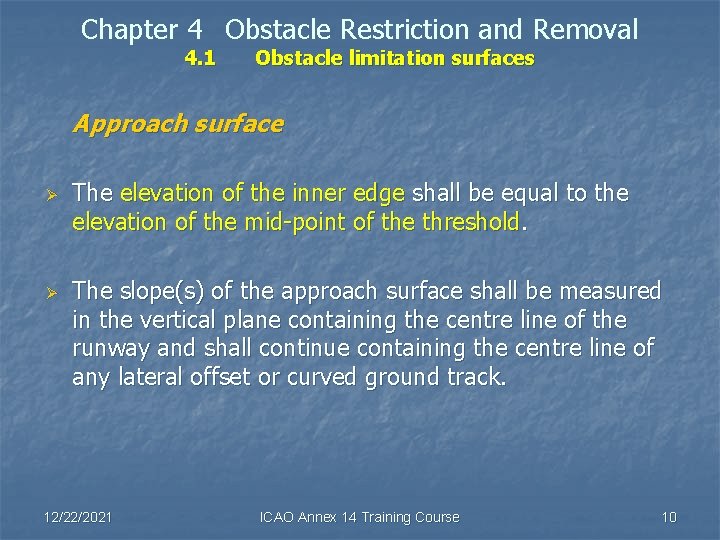
Chapter 4 Obstacle Restriction and Removal 4. 1 Obstacle limitation surfaces Approach surface Ø Ø The elevation of the inner edge shall be equal to the elevation of the mid point of the threshold. The slope(s) of the approach surface shall be measured in the vertical plane containing the centre line of the runway and shall continue containing the centre line of any lateral offset or curved ground track. 12/22/2021 ICAO Annex 14 Training Course 10
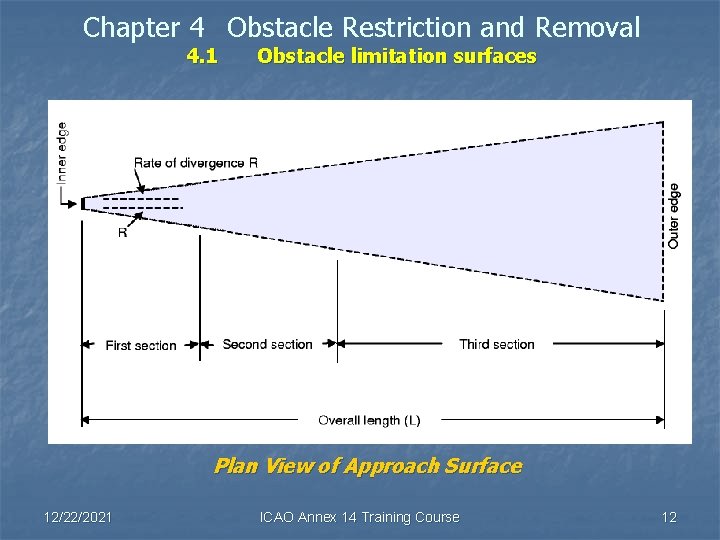
Chapter 4 Obstacle Restriction and Removal 4. 1 Obstacle limitation surfaces Plan View of Approach Surface 12/22/2021 ICAO Annex 14 Training Course 12
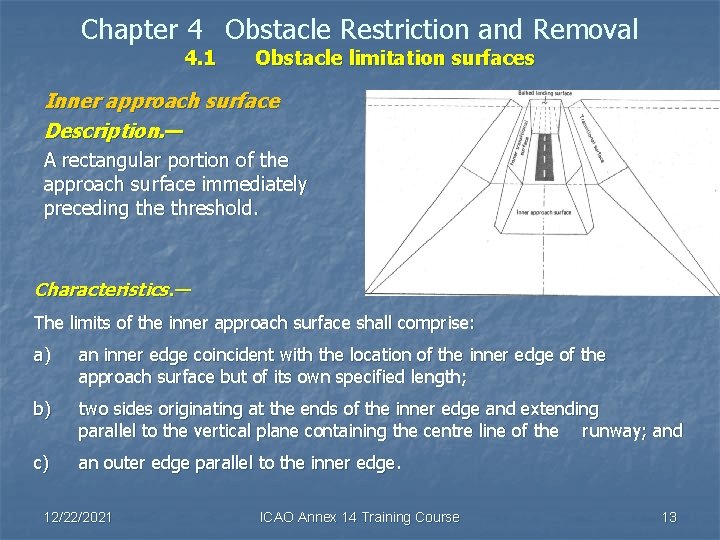
Chapter 4 Obstacle Restriction and Removal 4. 1 Obstacle limitation surfaces Inner approach surface Description. — A rectangular portion of the approach surface immediately preceding the threshold. Characteristics. — The limits of the inner approach surface shall comprise: a) an inner edge coincident with the location of the inner edge of the approach surface but of its own specified length; b) two sides originating at the ends of the inner edge and extending parallel to the vertical plane containing the centre line of the runway; and c) an outer edge parallel to the inner edge. 12/22/2021 ICAO Annex 14 Training Course 13
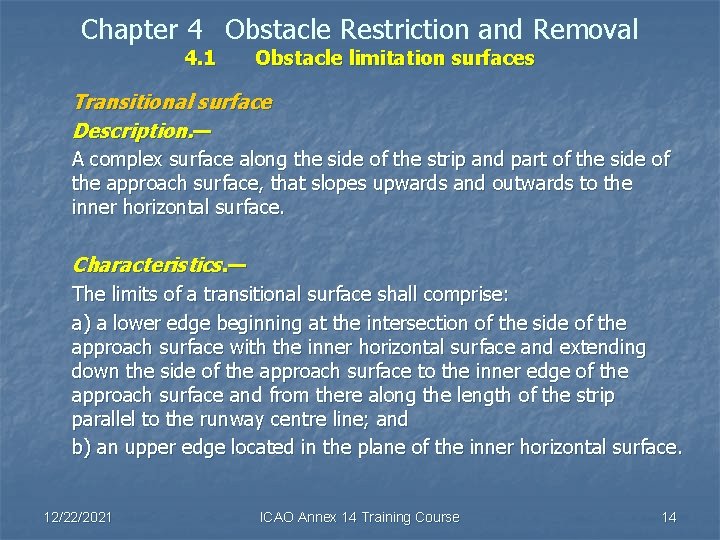
Chapter 4 Obstacle Restriction and Removal 4. 1 Obstacle limitation surfaces Transitional surface Description. — A complex surface along the side of the strip and part of the side of the approach surface, that slopes upwards and outwards to the inner horizontal surface. Characteristics. — The limits of a transitional surface shall comprise: a) a lower edge beginning at the intersection of the side of the approach surface with the inner horizontal surface and extending down the side of the approach surface to the inner edge of the approach surface and from there along the length of the strip parallel to the runway centre line; and b) an upper edge located in the plane of the inner horizontal surface. 12/22/2021 ICAO Annex 14 Training Course 14
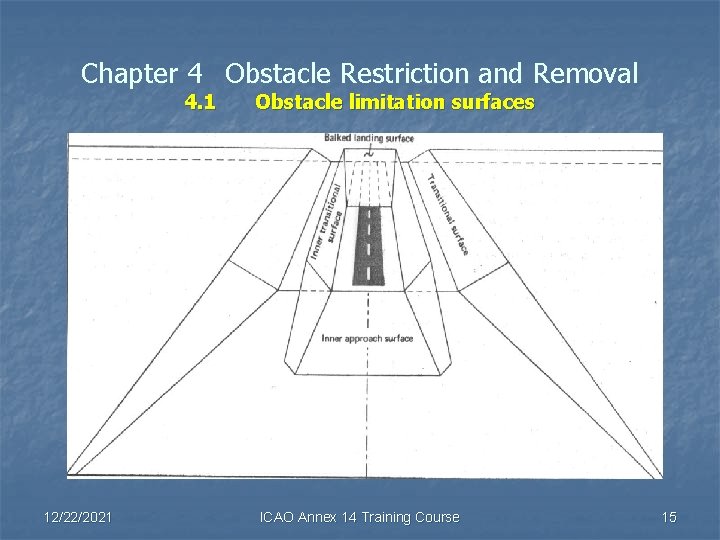
Chapter 4 Obstacle Restriction and Removal 4. 1 12/22/2021 Obstacle limitation surfaces ICAO Annex 14 Training Course 15
Chapter 4 Obstacle Restriction and Removal 4. 1 Obstacle limitation surfaces Transitional surface (continued) Ø The elevation of a point on the lower edge shall be: a) along the side of the approach surface — equal to the elevation of the approach surface at that point; and b) along the strip — equal to the elevation of the nearest point on the centre line of the runway or its extension. [Note. — As a result of b) the transitional surface along the strip will be curved if the runway profile is curved, or a plane if the runway profile is a straight line. The intersection of the transitional surface with the inner horizontal surface will also be a curved or a straight line depending on the runway profile. ] Ø The slope of the transitional surface shall be measured in a vertical plane at right angles to the centre line of the runway. 12/22/2021 ICAO Annex 14 Training Course 16
Chapter 4 Obstacle Restriction and Removal 4. 1 Obstacle limitation surfaces Inner transitional surface Description. — A surface similar to the transitional surface but closer to the runway. Characteristics. — The limits of an inner transitional surface shall comprise: a) a lower edge beginning at the end of the inner approach surface and extending down the side of the inner approach surface to the inner edge of that surface, from there along the strip parallel to the runway centre line to the inner edge of the balked landing surface and from there up the side of the balked landing surface to the point where the side intersects the inner horizontal surface; and b) an upper edge located in the plane of the inner horizontal surface. 12/22/2021 ICAO Annex 14 Training Course 17
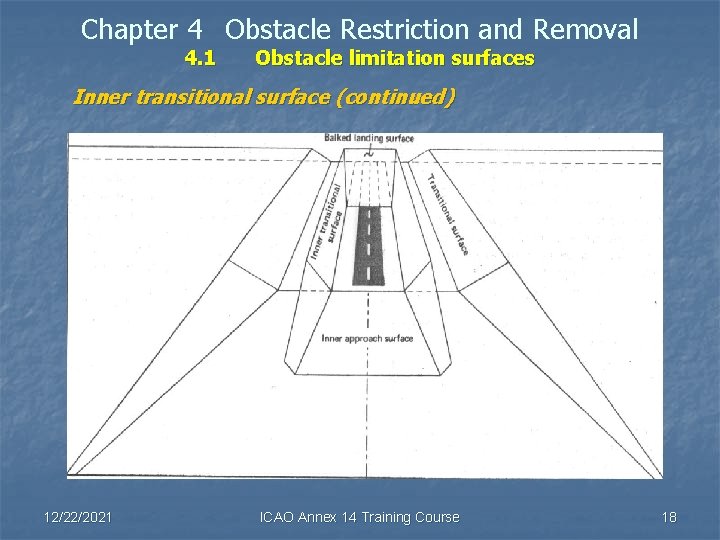
Chapter 4 Obstacle Restriction and Removal 4. 1 Obstacle limitation surfaces Inner transitional surface (continued) 12/22/2021 ICAO Annex 14 Training Course 18
Chapter 4 Obstacle Restriction and Removal 4. 1 Obstacle limitation surfaces Inner transitional surface (continued) Ø The elevation of a point on the lower edge shall be: a) along the side of the inner approach surface and balked landing surface — equal to the elevation of the particular surface at that point; and b) along the strip — equal to the elevation of the nearest point on the centre line of the runway or its extension. [Note. — As a result of b) the inner transitional surface along the strip will be curved if the runway profile is curved or a plane if the runway profile is a straight line. The intersection of the inner transitional surface with the inner horizontal surface will also be a curved or straight line depending on the runway profile. ] Ø The slope of the inner transitional surface shall be measured in a vertical plane at right angles to the centre line of the runway. 12/22/2021 ICAO Annex 14 Training Course 19
Chapter 4 Obstacle Restriction and Removal 4. 1 Obstacle limitation surfaces Balked landing surface Description. — An inclined plane located at a specified distance after the threshold, extending between the inner transitional surface. Characteristics. — The limits of the balked landing surface shall comprise: a) an inner edge horizontal and perpendicular to the centre line of the runway and located at a specified distance after the threshold; b) two sides originating at the ends of the inner edge and diverging uniformly at a specified rate from the vertical plane containing the centre line of the runway; and c) an outer edge parallel to the inner edge and located in the plane of the inner horizontal surface. Ø Ø The elevation of the inner edge shall be equal to the elevation of the runway centre line at the location of the inner edge. The slope of the balked landing surface shall be measured in the vertical plane containing the centre line of the runway. 12/22/2021 ICAO Annex 14 Training Course 20
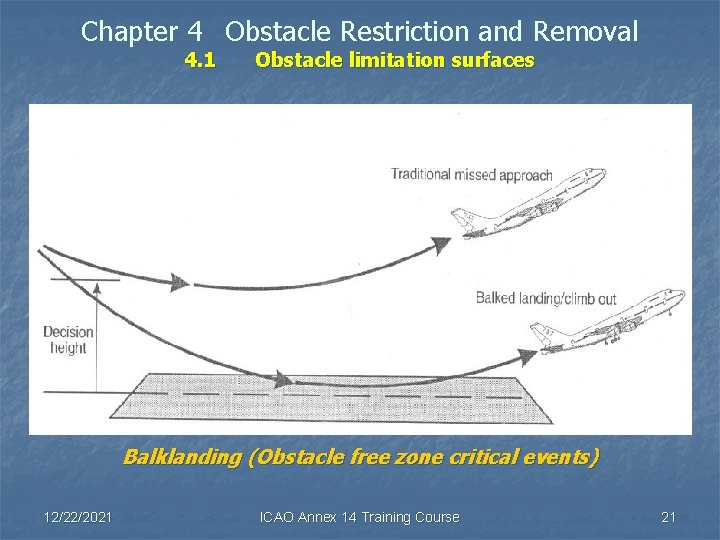
Chapter 4 Obstacle Restriction and Removal 4. 1 Obstacle limitation surfaces Balklanding (Obstacle free zone critical events) 12/22/2021 ICAO Annex 14 Training Course 21
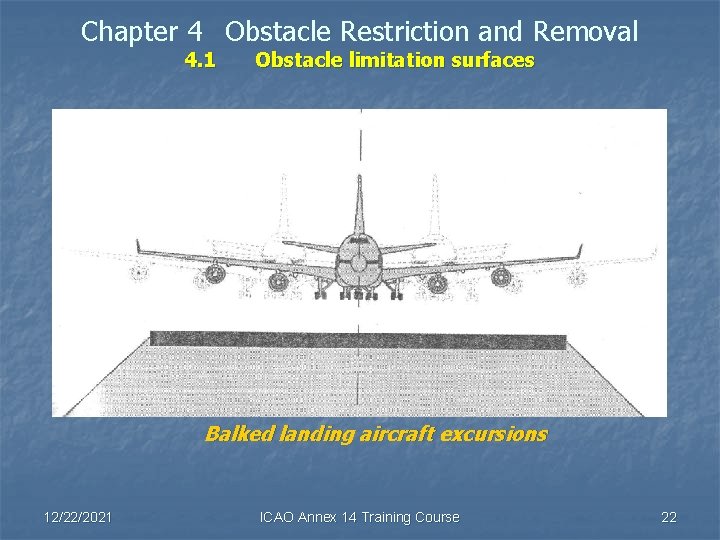
Chapter 4 Obstacle Restriction and Removal 4. 1 Obstacle limitation surfaces Balked landing aircraft excursions 12/22/2021 ICAO Annex 14 Training Course 22
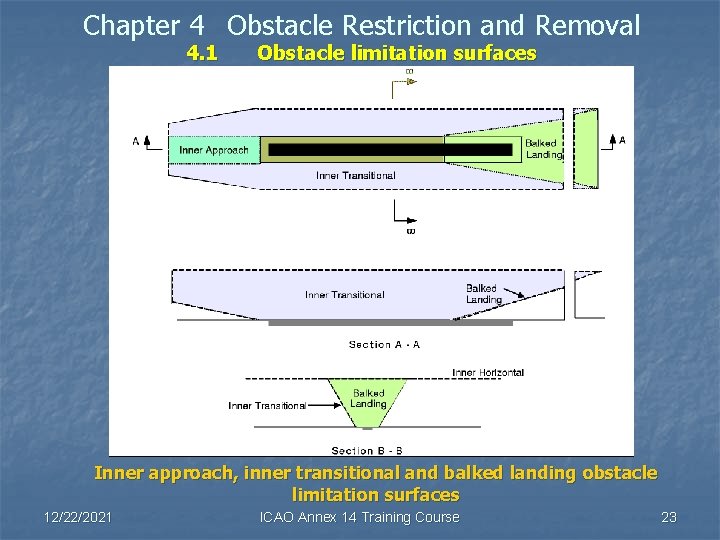
Chapter 4 Obstacle Restriction and Removal 4. 1 Obstacle limitation surfaces Inner approach, inner transitional and balked landing obstacle limitation surfaces 12/22/2021 ICAO Annex 14 Training Course 23
Chapter 4 Obstacle Restriction and Removal 4. 1 Obstacle limitation surfaces Take-off climb surface Description. — An inclined plane or other specified surface beyond the end of a runway or clearway. Characteristics. — The limits of the take off climb surface shall comprise: a) an inner edge horizontal and perpendicular to the centre line of the runway and located either at a specified distance beyond the end of the runway or at the end of the clearway when such is provided and its length exceeds the specified distance; b) two sides originating at the ends of the inner edge, diverging uniformly at a specified rate from the take off track to a specified final width and continuing thereafter at that width for the remainder of the length of the take off climb surface; and c) an outer edge horizontal and perpendicular to the specified take off track. 12/22/2021 ICAO Annex 14 Training Course 24
Chapter 4 Obstacle Restriction and Removal 4. 1 Obstacle limitation surfaces Take-off climb surface (continued) Ø Ø Ø The elevation of the inner edge shall be equal to the highest point on the extended runway centre line between the end of the runway and the inner edge, except that when a clearway is provided the elevation shall be equal to the highest point on the ground on the centre line of the clearway. In the case of a straight take off flight path, the slope of the take off climb surface shall be measured in the vertical plane containing the centre line of the runway. In the case of a take off flight path involving a turn, the take off climb surface shall be a complex surface containing the horizontal normals to its centre line, and the slope of the centre line shall be the same as that for a straight take off flight path. 12/22/2021 ICAO Annex 14 Training Course 25
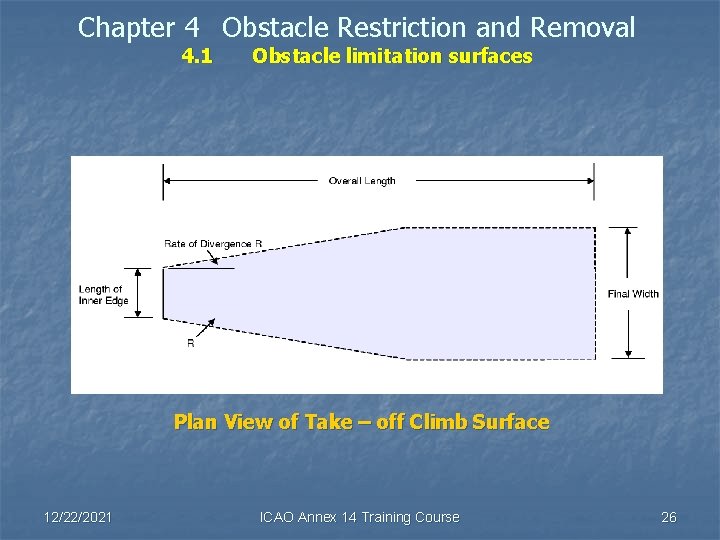
Chapter 4 Obstacle Restriction and Removal 4. 1 Obstacle limitation surfaces Plan View of Take – off Climb Surface 12/22/2021 ICAO Annex 14 Training Course 26
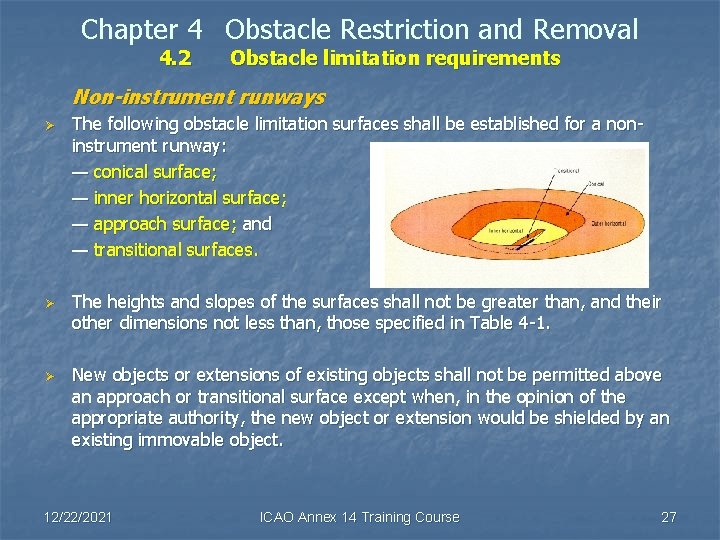
Chapter 4 Obstacle Restriction and Removal 4. 2 Obstacle limitation requirements Non-instrument runways Ø Ø Ø The following obstacle limitation surfaces shall be established for a non instrument runway: — conical surface; — inner horizontal surface; — approach surface; and — transitional surfaces. The heights and slopes of the surfaces shall not be greater than, and their other dimensions not less than, those specified in Table 4 1. New objects or extensions of existing objects shall not be permitted above an approach or transitional surface except when, in the opinion of the appropriate authority, the new object or extension would be shielded by an existing immovable object. 12/22/2021 ICAO Annex 14 Training Course 27
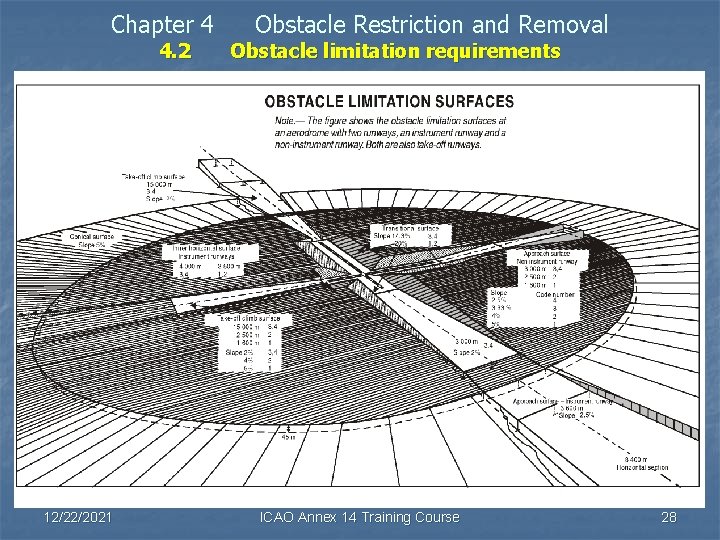
Chapter 4 4. 2 12/22/2021 Obstacle Restriction and Removal Obstacle limitation requirements ICAO Annex 14 Training Course 28
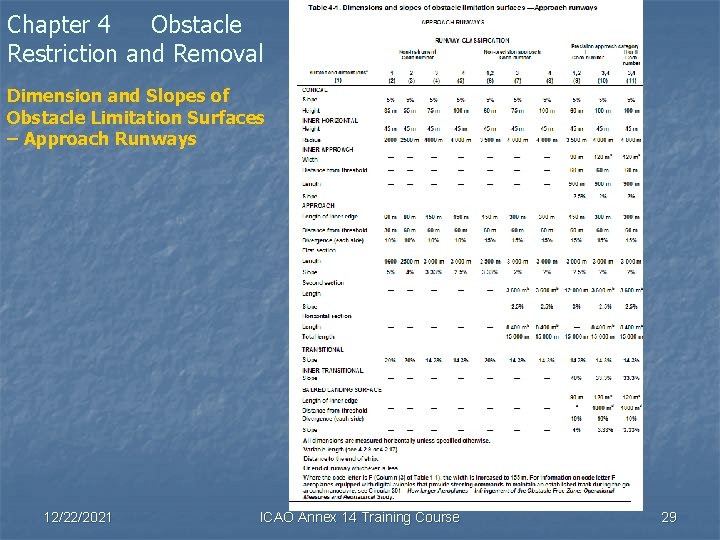
Chapter 4 Obstacle Restriction and Removal Dimension and Slopes of Obstacle Limitation Surfaces – Approach Runways 12/22/2021 ICAO Annex 14 Training Course 29
Chapter 4 4. 2 Obstacle Restriction and Removal Obstacle limitation requirements Dimension and Slopes of Obstacle Limitation Surfaces Approach Runways 12/22/2021 ICAO Annex 14 Training Course 30
Chapter 4 4. 2 Obstacle Restriction and Removal Obstacle limitation requirements Non-instrument runways (continued) Recommendations. — ü ü New objects or extensions of existing objects should not be permitted above the conical surface or inner horizontal surface except when, in the opinion of the appropriate authority, the object would be shielded by an existing immovable object, or after aeronautical study it is determined that the object would not adversely affect the safety or significantly affect the regularity of operations of aero planes. Existing objects above conical, inner horizontal, approach and transitional surfaces should as far as practicable be removed except when, in the opinion of the appropriate authority, the object is shielded by an existing immovable object, or after aeronautical study it is determined that the object would not adversely affect the safety or significantly affect the regularity of operations of aeroplanes. 12/22/2021 ICAO Annex 14 Training Course 31
Chapter 4 4. 2 Obstacle Restriction and Removal Obstacle limitation requirements Non-instrument runways (continued) [Note. — Because of transverse or longitudinal slopes on a strip, in certain cases the inner edge or portions of the inner edge of the approach surface may be below the corresponding elevation of the strip. It is not intended that the strip be graded to conform with the inner edge of the approach surface, nor is it intended that terrain or objects which are above the approach surface beyond the end of the strip, but below the level of the strip, be removed unless it is considered they may endanger aeroplanes. ] Recommendation. — ü In considering proposed construction, account should be taken of the possible future development of an instrument runway and consequent requirement for more stringent obstacle limitation surfaces. 12/22/2021 ICAO Annex 14 Training Course 32
Chapter 4 4. 2 Obstacle Restriction and Removal Obstacle limitation requirements Non-precision approach runways Ø Ø Ø The following obstacle limitation surfaces shall be established for a non precision approach runway: — conical surface; — inner horizontal surface; — approach surface; and — transitional surfaces. The heights and slopes of the surfaces shall not be greater than, and their other dimensions not less than, those specified in Table 4 1, except in the case of the horizontal section of the approach surface (see the following standard). The approach surface shall be horizontal beyond the point at which the 2. 5 per cent slope intersects: a) a horizontal plane 150 m above threshold elevation; or b) the horizontal plane passing through the top of any object that governs the obstacle clearance altitude/height (OCA/H); whichever is the higher. 12/22/2021 ICAO Annex 14 Training Course 33
Chapter 4 4. 2 Obstacle Restriction and Removal Obstacle limitation requirements Non-precision approach runways (continued) Ø New objects or extensions of existing objects shall not be permitted above an approach surface within 3 000 m of the inner edge or above a transitional surface except when, in the opinion of the appropriate authority, the new object or extension would be shielded by an existing immovable object. Recommendations. — ü New objects or extensions of existing objects should not be permitted above the approach surface beyond 3 000 m from the inner edge, the conical surface or inner horizontal surface except when, in the opinion of the appropriate authority, the object would be shielded by an existing immovable object, or after aeronautical study it is determined that the object would not adversely affect the safety or significantly affect the regularity of operations of aeroplanes. 12/22/2021 ICAO Annex 14 Training Course 34
Chapter 4 4. 2 Obstacle Restriction and Removal Obstacle limitation requirements Non-precision approach runways (continued) Recommendations. — ü Existing objects above conical, inner horizontal, approach and transitional surfaces should as far as practicable be removed except when, in the opinion of the appropriate authority, the object is shielded by an existing immovable object, or after aeronautical study it is determined that the object would not adversely affect the safety or significantly affect the regularity of operations of aeroplanes. [Note. — Because of transverse or longitudinal slopes on a strip, in certain cases the inner edge or portions of the inner edge of the approach surface may be below the corresponding elevation of the strip. It is not intended that the strip be graded to conform with the inner edge of the approach surface, nor is it intended that terrain or objects which are above the approach surface beyond the end of the strip, but below the level of the strip, be removed unless it is considered they may endanger aeroplanes. ] 12/22/2021 ICAO Annex 14 Training Course 35
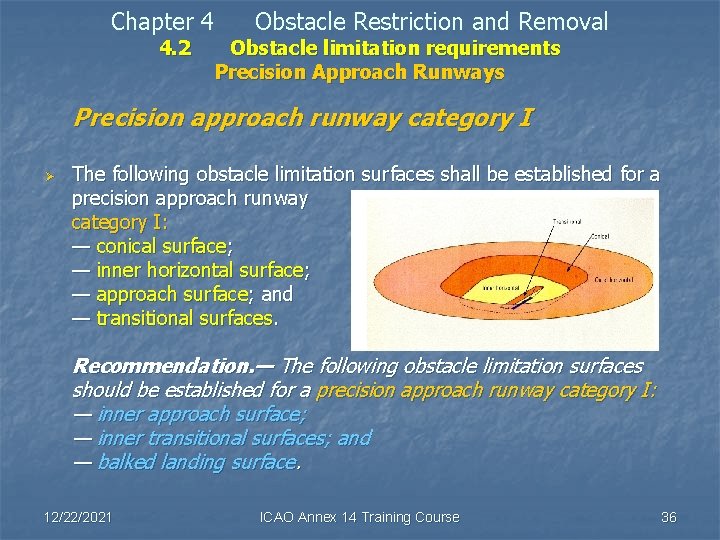
Chapter 4 4. 2 Obstacle Restriction and Removal Obstacle limitation requirements Precision Approach Runways Precision approach runway category I Ø The following obstacle limitation surfaces shall be established for a precision approach runway category I: — conical surface; — inner horizontal surface; — approach surface; and — transitional surfaces. Recommendation. — The following obstacle limitation surfaces should be established for a precision approach runway category I: — inner approach surface; — inner transitional surfaces; and — balked landing surface. 12/22/2021 ICAO Annex 14 Training Course 36
Chapter 4 4. 2 Obstacle Restriction and Removal Obstacle limitation requirements Precision Approach Runways Precision approach runway category II and III Ø The following obstacle limitation surfaces shall be established for a precision approach runway category II or III: — conical surface; — inner horizontal surface; — approach surface and inner approach surface; — transitional surfaces; — inner transitional surfaces; and — balked landing surface. 12/22/2021 ICAO Annex 14 Training Course 37
Chapter 4 4. 2 Obstacle Restriction and Removal Obstacle limitation requirements Precision approach runway Ø Ø The heights and slopes of the surfaces shall not be greater than, and their other dimensions not less than, those specified in Table 4 1, except in the case of the horizontal section of the approach surface (see the following standard). The approach surface shall be horizontal beyond the point at which the 2. 5 per cent slope intersects: a) b) a horizontal plane 150 m above threshold elevation; or the horizontal plane passing through the top of any object that governs the obstacle clearance limit; whichever is the higher. 12/22/2021 ICAO Annex 14 Training Course 38
Chapter 4 Obstacle Restriction and Removal 4. 2 Obstacle limitation requirements Precision approach runway Ø Ø Fixed objects shall not be permitted above the inner approach surface, the inner transitional surface or the balked landing surface , except for frangible objects which because of their function must be located on the strip. Mobile objects shall not be permitted above these surfaces during the use of the runway for landing. New objects or extensions of existing objects shall not be permitted above an approach surface or a transitional surface except when, in the opinion of the appropriate authority, the new object or extension would be shielded by an existing immovable object. 12/22/2021 ICAO Annex 14 Training Course 39
Chapter 4 4. 2 Obstacle Restriction and Removal Obstacle limitation requirements Precision approach runway Recommendations. — ü ü New objects or extensions of existing objects should not be permitted above the conical surface and the inner horizontal surface except when, in the opinion of the appropriate authority, an object would be shielded by an existing immovable object, or after aeronautical study it is determined that the object would not adversely affect the safety or significantly affect the regularity of operations of aeroplanes. Existing objects above an approach surface, a transitional surface, the conical surface and inner horizontal surface should as far as practicable be removed except when, in the opinion of the appropriate authority, an object is shielded by an existing immovable object, or after aeronautical study it is determined that the object would not adversely affect the safety or significantly affect the regularity of operations of aeroplanes. 12/22/2021 ICAO Annex 14 Training Course 40
Chapter 4 4. 2 Obstacle Restriction and Removal Obstacle limitation requirements Runways meant for take-off Ø Ø The following obstacle limitation surface shall be established for a runway meant for take off: — take off climb surface. The dimensions of the surface shall be not less than the dimensions specified in Table 4 2, except that a lesser length may be adopted for the take off climb surface where such lesser length would be consistent with procedural measures adopted to govern the outward flight of aeroplanes. 12/22/2021 ICAO Annex 14 Training Course 41
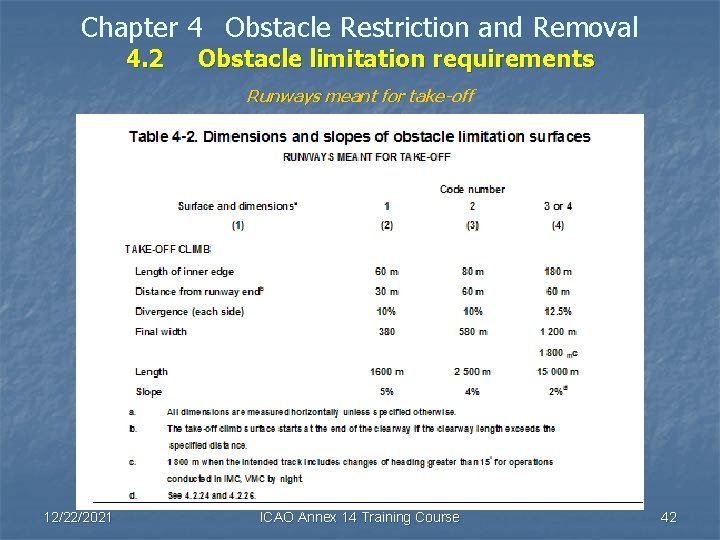
Chapter 4 Obstacle Restriction and Removal 4. 2 Obstacle limitation requirements Runways meant for take-off 12/22/2021 ICAO Annex 14 Training Course 42
Chapter 4 Obstacle Restriction and Removal 4. 2 Obstacle limitation requirements Runways meant for take-off (continued) Recommendation. — The operational characteristics of aeroplanes for which the runway is intended should be examined to see if it is desirable to reduce the slope specified in Table 4 2 when critical operating conditions are to be catered to. If the specified slope is reduced, corresponding adjustment in the length of take off climb surface should be made so as to provide protection to a height of 300 m. [Note. — When local conditions differ widely from sea level standard atmospheric conditions, it may be advisable for the slope specified in Table 4 2 to be reduced. The degree of this reduction depends on the divergence between local conditions and sea level standard atmospheric conditions, and on the performance characteristics and operational requirements of the aeroplanes for which the runway is intended. ] 12/22/2021 ICAO Annex 14 Training Course 43
Chapter 4 Obstacle Restriction and Removal 4. 2 Obstacle limitation requirements Runways meant for take-off (continued) Ø ü ü New objects or extensions of existing objects shall not be permitted above a take off climb surface except when, in the opinion of the appropriate authority, the new object or extension would be shielded by an existing immovable object. Recommendations. — If no object reaches the 2 per cent (1: 50) take off climb surface, new objects should be limited to preserve the existing obstacle free surface or a surface down to a slope of 1. 6 per cent (1: 62. 5). Existing objects that extend above a take off climb surface should as far as practicable be removed except when, in the opinion of the appropriate authority, an object is shielded by an existing immovable object, or after aeronautical study it is determined that the object would not adversely affect the safety or significantly affect the regularity of operations of aeroplanes. 12/22/2021 ICAO Annex 14 Training Course 44
Chapter 4 Obstacle Restriction and Removal 4. 3 Objects outside the obstacle limitation surfaces Recommendations. — ü ü Arrangements should be made to enable the appropriate authority to be consulted concerning proposed construction beyond the limits of the obstacle limitation surfaces that extend above a height established by that authority, in order to permit an aeronautical study of the effect of such construction on the operation of aeroplanes. In areas beyond the limits of the obstacle limitation surfaces, at least those objects which extend to a height of 150 m or more above ground elevation should be regarded as obstacles, unless a special aeronautical study indicates that they do not constitute a hazard to aeroplanes. [Note. — This study may have regard to the nature of operations concerned and may distinguish between day and night operations. ] 12/22/2021 ICAO Annex 14 Training Course 45
Chapter 4 Obstacle Restriction and Removal 4. 4 Other objects Recommendations. — ü ü Objects which do not project through the approach surface but which would nevertheless adversely affect the optimum siting or performance of visual or non visual aids should, as far as practicable, be removed. Anything which may, in the opinion of the appropriate authority after aeronautical study, endanger aeroplanes on the movement area or in the air within the limits of the inner horizontal and conical surfaces should be regarded as an obstacle and should be removed in so far as practicable. [Note. — In certain circumstances, objects that do not project above any of the obstacle limitation surfaces may constitute a hazard to aeroplanes as, for example, where there are one or more isolated objects in the vicinity of an aerodrome. ] 12/22/2021 ICAO Annex 14 Training Course 46
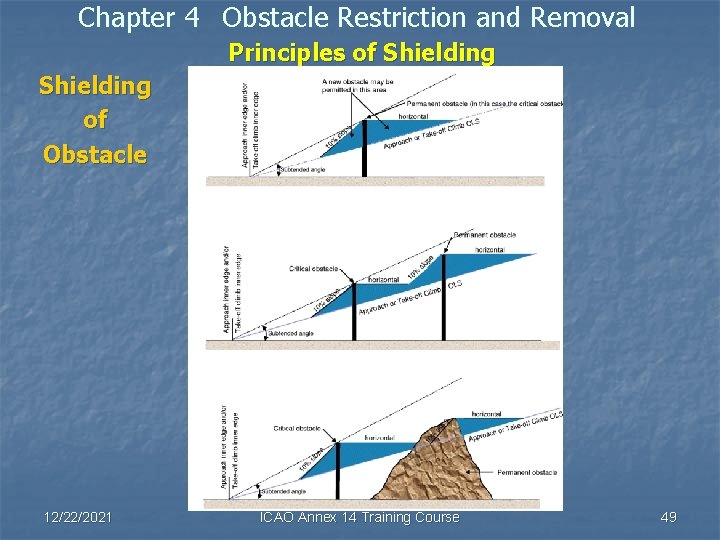
Chapter 4 Obstacle Restriction and Removal Principles of Shielding of Obstacle 12/22/2021 ICAO Annex 14 Training Course 49
- Slides: 45