
Chapter 4 Nouns Speak and write Hebrew Hello
Chapter 4 Nouns
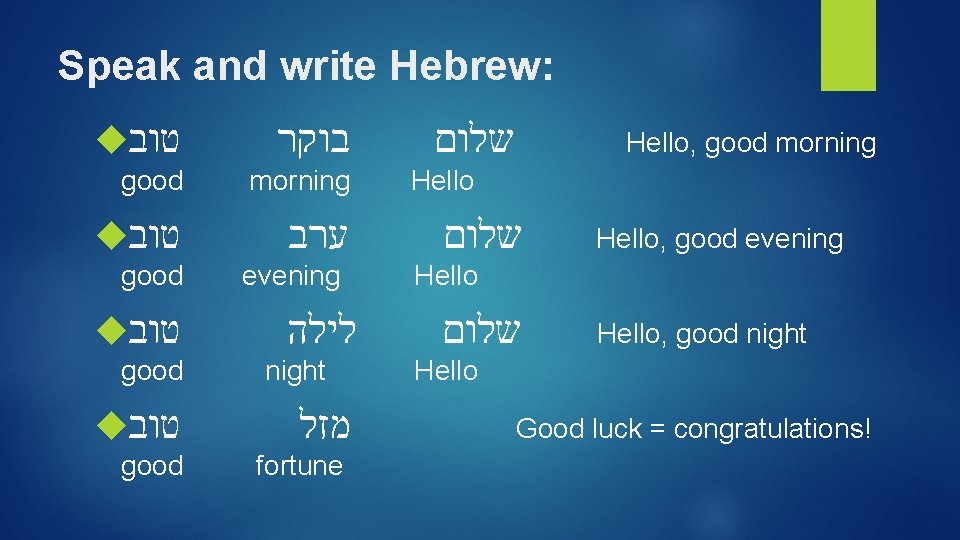
Speak and write Hebrew: טוב בוקר שלום Hello, good morning good morning Hello טוב ערב שלום Hello, good evening good evening Hello טוב לילה שלום Hello, good night good night Hello טוב מזל Good luck = congratulations! good fortune
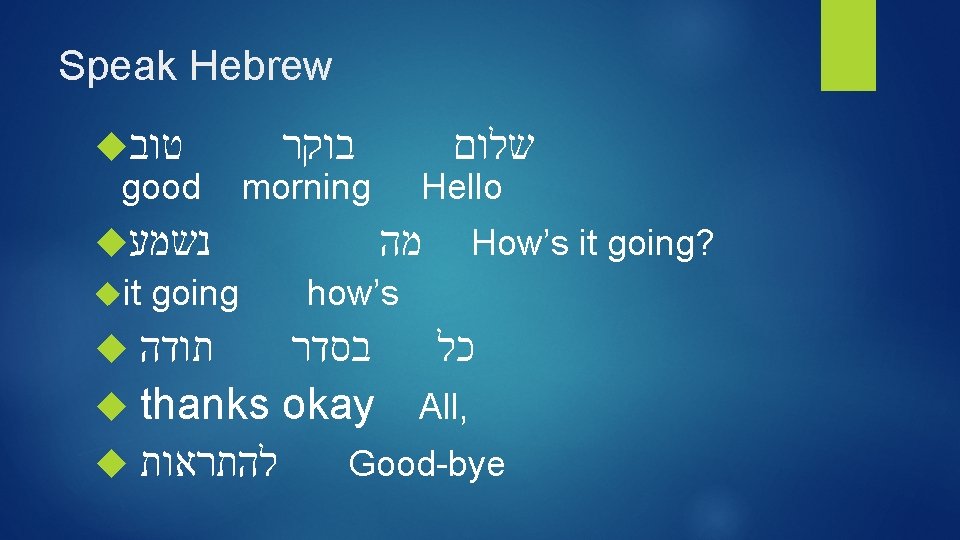
Speak Hebrew טוב בוקר שלום good morning Hello נשמע מה How’s it going? it going how’s תודה בסדר כל thanks okay All, להתראות Good-bye
3. P. Sing: Hinneh Mah Tov (Ps. 133: 1) https: //www. youtube. com/watch? v=l. Zs 9 ld 3 kl. Po&t=0 s&index=1&list=PLn. N Xz. Yj. Qer. Jia_8 y. Ty 8 Or. M 2 K-Bi. N 5 OEup or Search for “Canto Ebraico "Hinei ma tov" Salmo 133” Preformance https: //www. youtube. com/watch? v=l. HNQIs. Zx. DKo&t=34 s&index=44&list=P Ln. NXz. Yj. Qer. Jia_8 y. Ty 8 Or. M 2 K-Bi. N 5 OEup or Search for “Psalm 133: 1, Sung in Hebrew” Dr. David Howard (Bethel Sem. ) (sing as a round—jump into this video at 1: 53 to listen to just the song) https: //www. youtube. com/watch? v=ehn. KHh. J 26 p. Q (single guy with guitar)
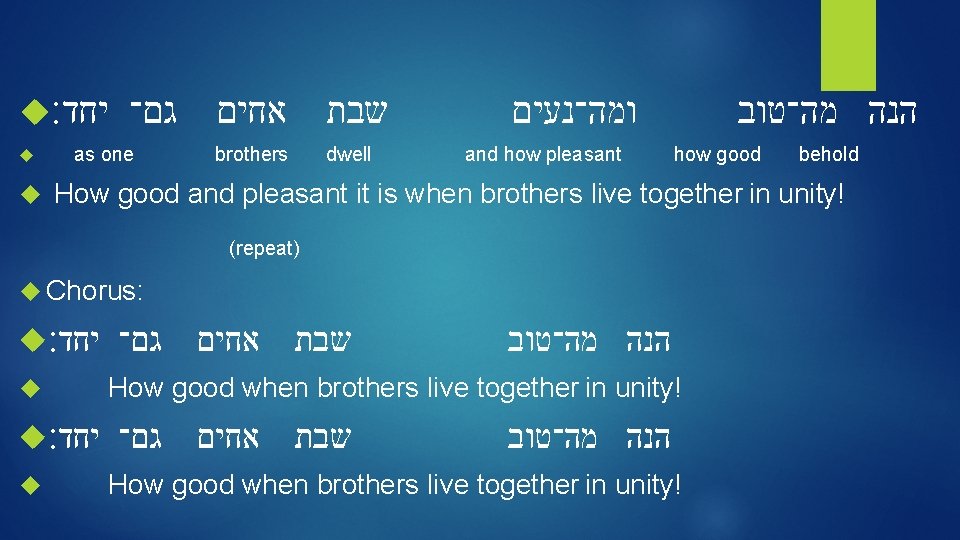
יחד׃ גם־ אחים שבת ומה־נעים מה־טוב הנה as one brothers dwell and how pleasant how good behold How good and pleasant it is when brothers live together in unity! (repeat) Chorus: יחד׃ גם־ אחים שבת מה־טוב הנה How good when brothers live together in unity!
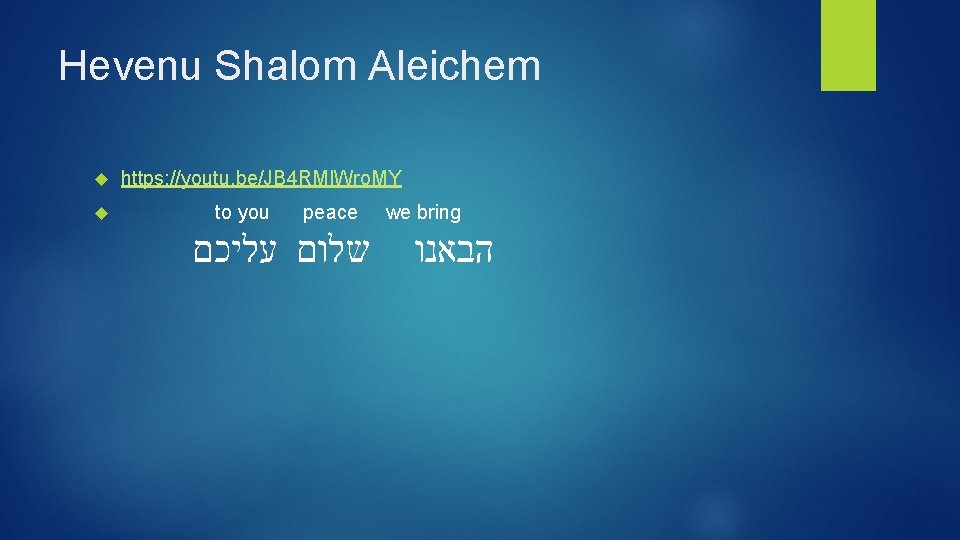
Hevenu Shalom Aleichem https: //youtu. be/JB 4 RMIWro. MY to you peace we bring עליכם שלום הבאנו
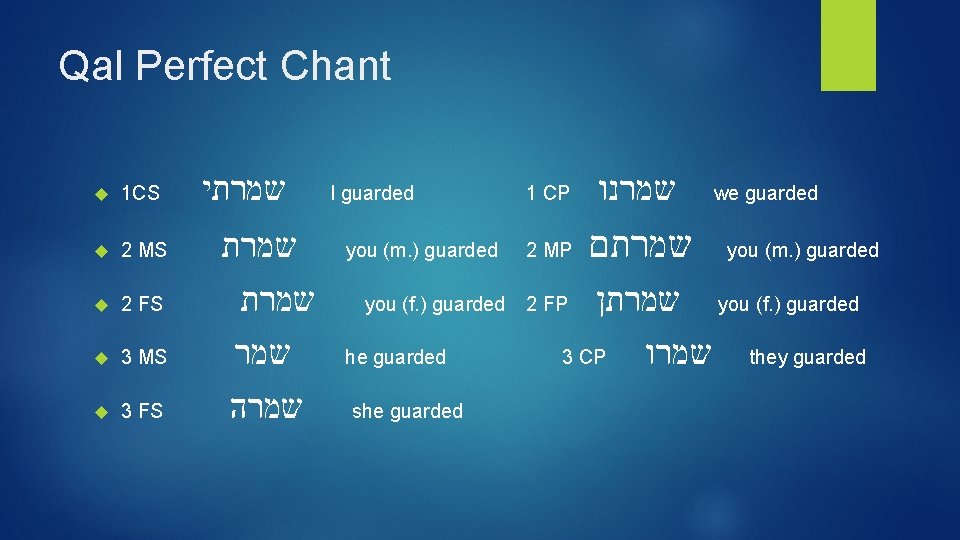
Qal Perfect Chant שמרתי 1 CS 2 MS שמרת I guarded you (m. ) guarded שמרת you (f. ) guarded 3 MS שמר he guarded 3 FS שמרה she guarded 2 FS 1 CP 2 MP שמרנו שמרתם we guarded you (m. ) guarded שמרתן you (f. ) guarded 3 CP שמרו they guarded 2 FP
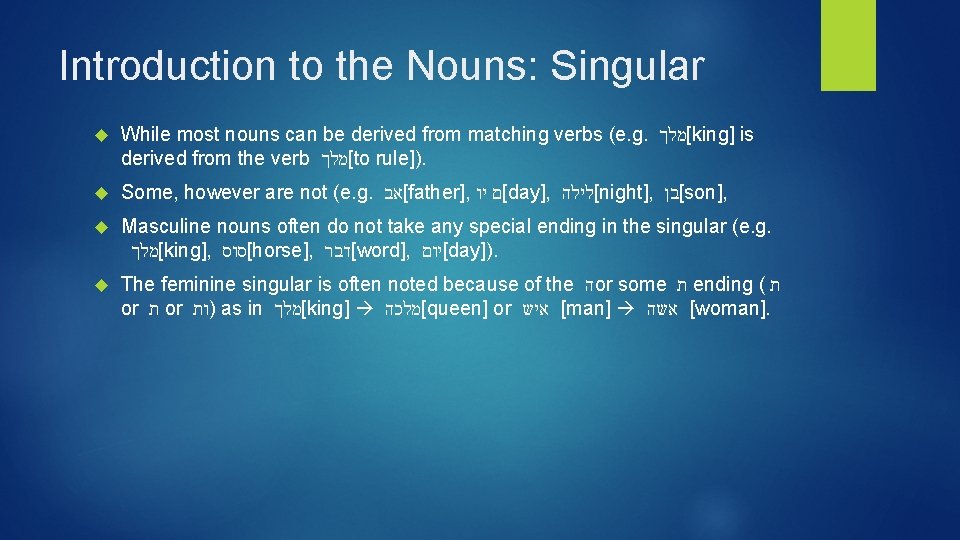
Introduction to the Nouns: Singular While most nouns can be derived from matching verbs (e. g. [מלך king] is derived from the verb [מלך to rule]). Some, however are not (e. g. [אב father], יו [ם day], [לילה night], [בן son], Masculine nouns often do not take any special ending in the singular (e. g. [מלך king], [סוס horse], [דבר word], [יום day]). The feminine singular is often noted because of the ה or some ת ending ( ת or ת or )ות as in [מלך king] [מלכה queen] or [ איש man] [ אשה woman].
![Nouns: Plural The usual endings for the masculine plural is (ים [מלך king] [מלכים](http://slidetodoc.com/presentation_image_h/ec743714aa605f87d2fb6925c3eba2ef/image-10.jpg "Nouns: Plural The usual endings for the masculine plural is (ים [מלך king] [מלכים")
Nouns: Plural The usual endings for the masculine plural is (ים [מלך king] [מלכים kings]) and the feminine תורה(ות [law] [תורות laws]). Masculine Sing. (מלך king) (מלכים kings) (מלכה queen) Endings: --- ה סוס [horse] (סוסים horses) Masc. Plural ים Feminine Sing. (מלכות queens) ות [סוסה mare] (סוסות mares) Fem. Plural
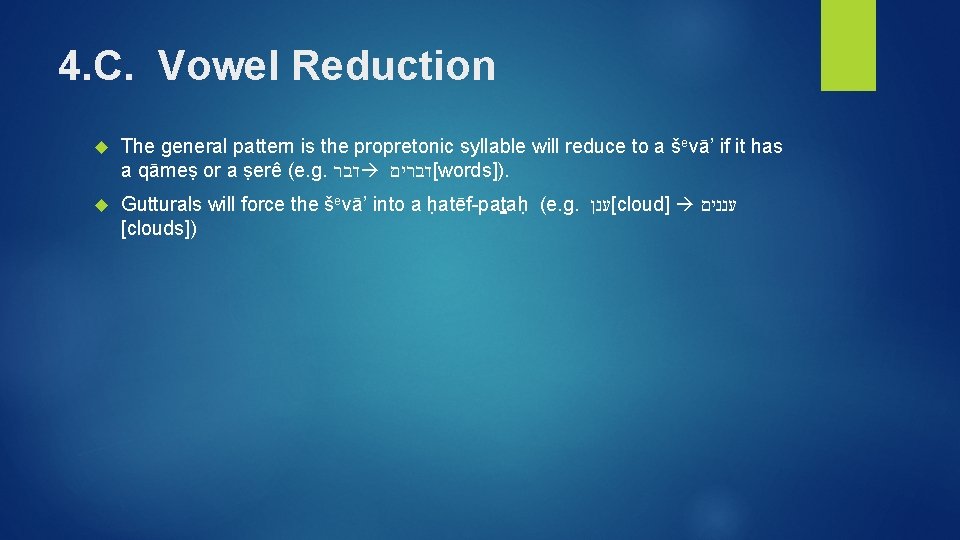
4. C. Vowel Reduction The general pattern is the propretonic syllable will reduce to a ševā’ if it has a qāmeṣ or a ṣerê (e. g. דבר [דברים words]). Gutturals will force the ševā’ into a ḥatēf-pataḥ (e. g. [ענן cloud] עננים [clouds])
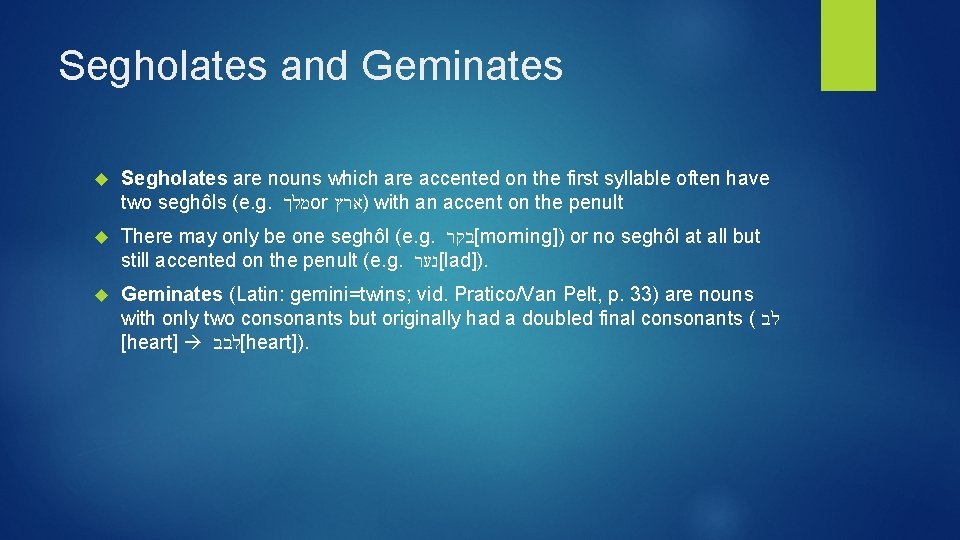
Segholates and Geminates Segholates are nouns which are accented on the first syllable often have two seghôls (e. g. מלך or )ארץ with an accent on the penult There may only be one seghôl (e. g. [בקר morning]) or no seghôl at all but still accented on the penult (e. g. [נער lad]). Geminates (Latin: gemini=twins; vid. Pratico/Van Pelt, p. 33) are nouns with only two consonants but originally had a doubled final consonants ( לב [heart] [לבב heart]).
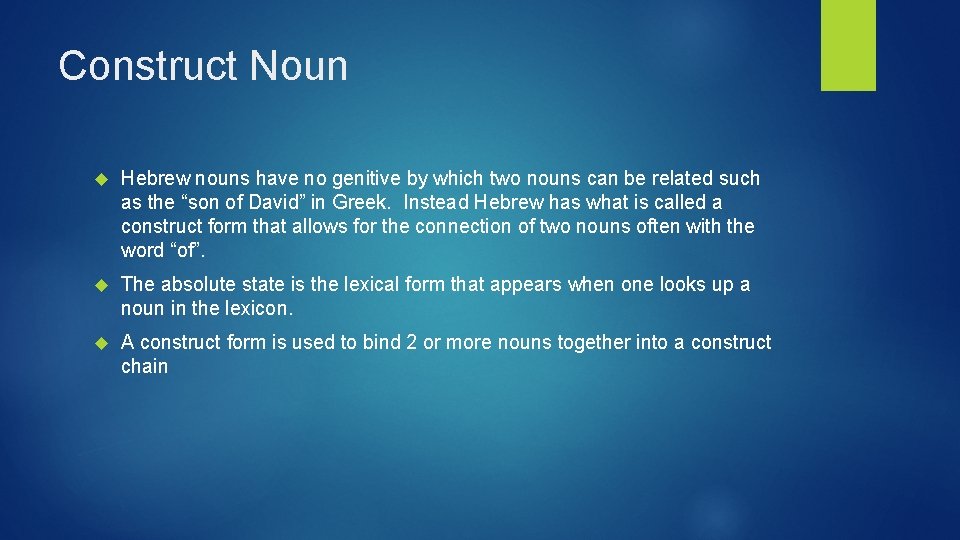
Construct Noun Hebrew nouns have no genitive by which two nouns can be related such as the “son of David” in Greek. Instead Hebrew has what is called a construct form that allows for the connection of two nouns often with the word “of”. The absolute state is the lexical form that appears when one looks up a noun in the lexicon. A construct form is used to bind 2 or more nouns together into a construct chain
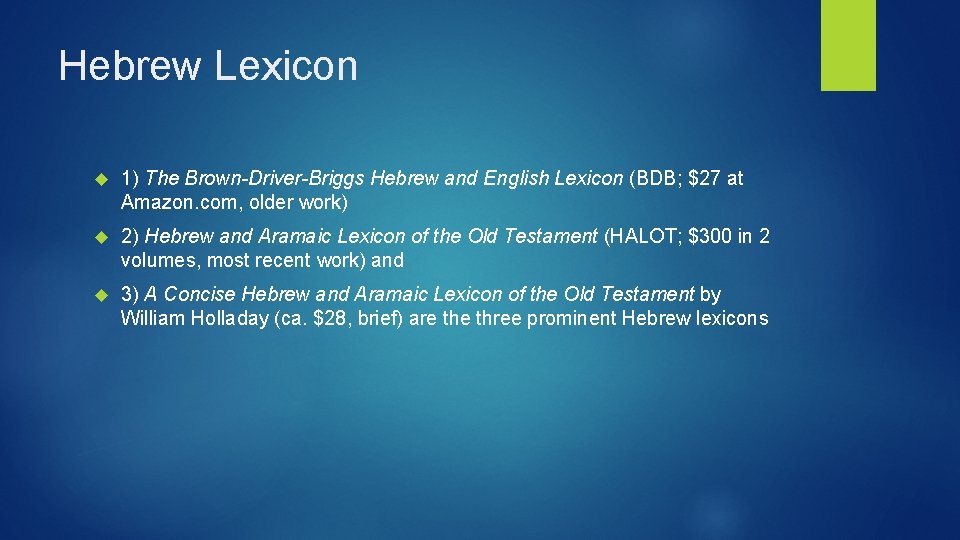
Hebrew Lexicon 1) The Brown-Driver-Briggs Hebrew and English Lexicon (BDB; $27 at Amazon. com, older work) 2) Hebrew and Aramaic Lexicon of the Old Testament (HALOT; $300 in 2 volumes, most recent work) and 3) A Concise Hebrew and Aramaic Lexicon of the Old Testament by William Holladay (ca. $28, brief) are three prominent Hebrew lexicons
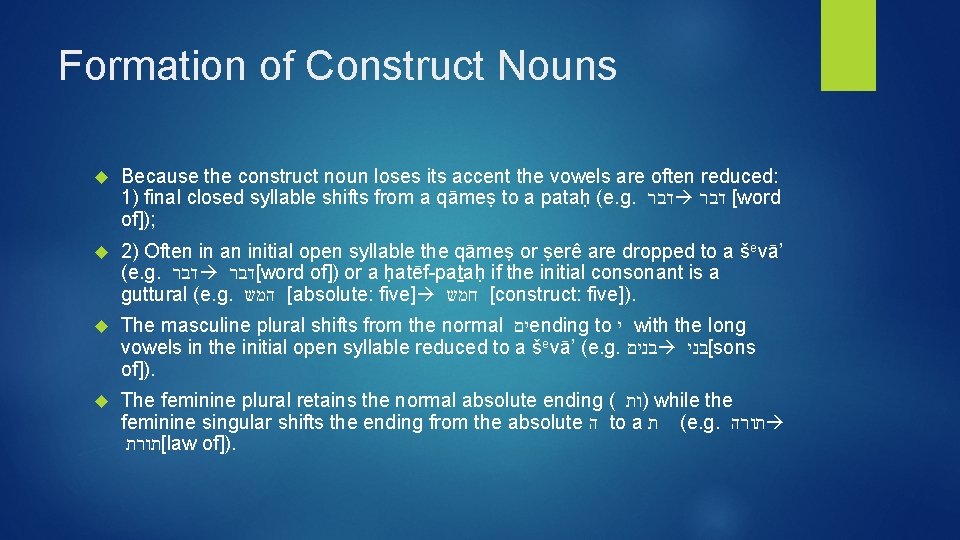
Formation of Construct Nouns Because the construct noun loses its accent the vowels are often reduced: 1) final closed syllable shifts from a qāmeṣ to a pataḥ (e. g. דבר [word of]); 2) Often in an initial open syllable the qāmeṣ or ṣerê are dropped to a ševā’ (e. g. דבר [דבר word of]) or a ḥatēf-pataḥ if the initial consonant is a guttural (e. g. [ המש absolute: five] [ חמש construct: five]). The masculine plural shifts from the normal ים ending to י with the long vowels in the initial open syllable reduced to a ševā’ (e. g. בנים [בני sons of]). The feminine plural retains the normal absolute ending ( )ות while the feminine singular shifts the ending from the absolute ה to a ת (e. g. תורה [תורת law of]).
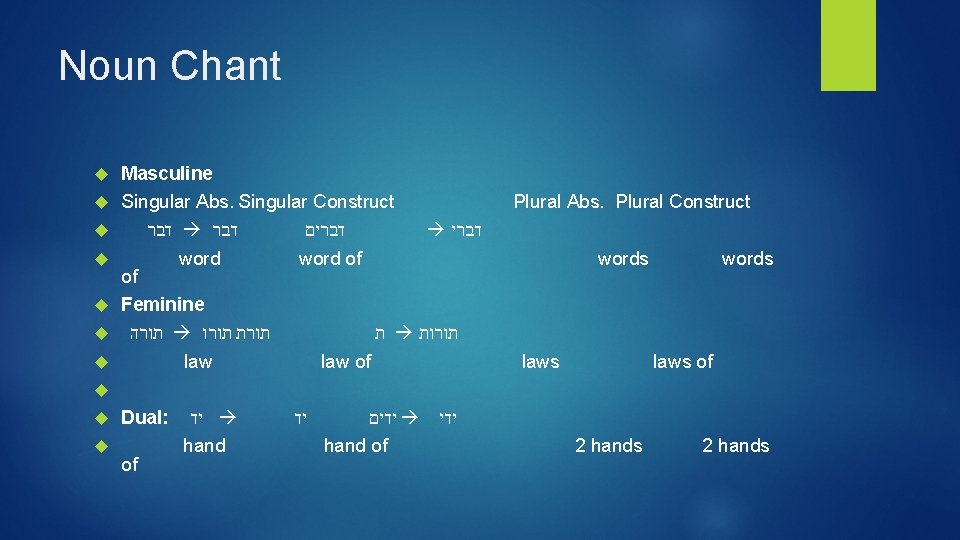
Noun Chant Masculine Singular Abs. Singular Construct Plural Abs. Plural Construct דברים דברי word of words of Feminine תורה תורו תורת ת תורות law of laws of Dual: יד ידים ידי hand of 2 hands of

4. G. Partial List of Nouns patterns for the Absolute (sing. /plural) and Construct (sing. / plural) –(vid. Kelly 60 -62 for a more complete listing). Sing. Absolute איש (man) איש (man of) אנשים (men) ( אנשי men of) יום (day) יום (day of) (ימים days) (ימי days of) בן (son) (בן son of ) (בנים sons) בני (sons of) (בת daughter) בת (daughter of) (בנות daughters) (בנות daughters of) (אב father) (אבי father of) (אבות fathers) (אבות fathers of) (דבר word) (דבר word of) (דברים words) (דברי words of) (מקום place) (מקום place of) (מקומות places) (מקומות places of) ( משפט judgment) ( משפט judgment of) ( משפטים judgments) משפטי (ארץ land) ארץ (land of ) (ארצות lands) (ארצות lands of) (מלך king) (מלך king of) (מלכים kings) (מלכי kings of) (דרך way) (דרך way of) (דרכים ways) (דרכי ways of) (עבד servant) (עבד servant of) (עבדים servants) (עבדי servants of) (תורה law) (תורת law of) (תורות laws) (תורות laws of) ( אשה woman) ( אשת woman of) ( נשים women) ( נשי women of) (בית house) (בית house of) (בתים houses) (בתי houses of) (עם people) (עם people of) ( נפש soul) ( נפש soul of) Singular Construct Plural Absolute Plural Construct (עמים peoples) (עמי peoples of) נפשות (souls) ( נפשות souls of)
![Declining Nouns דברי Noun MPC [Masculine Plural Construct] from דבר meaning “words of” אשת](http://slidetodoc.com/presentation_image_h/ec743714aa605f87d2fb6925c3eba2ef/image-18.jpg "Declining Nouns דברי Noun MPC [Masculine Plural Construct] from דבר meaning “words of” אשת")
Declining Nouns דברי Noun MPC [Masculine Plural Construct] from דבר meaning “words of” אשת Noun FSC [Feminine Singular Construct] from אשה meaning “woman of” ארץ Noun FSA/C [Feminine Singular Absolute or Construct] from ארץ meaning “land”
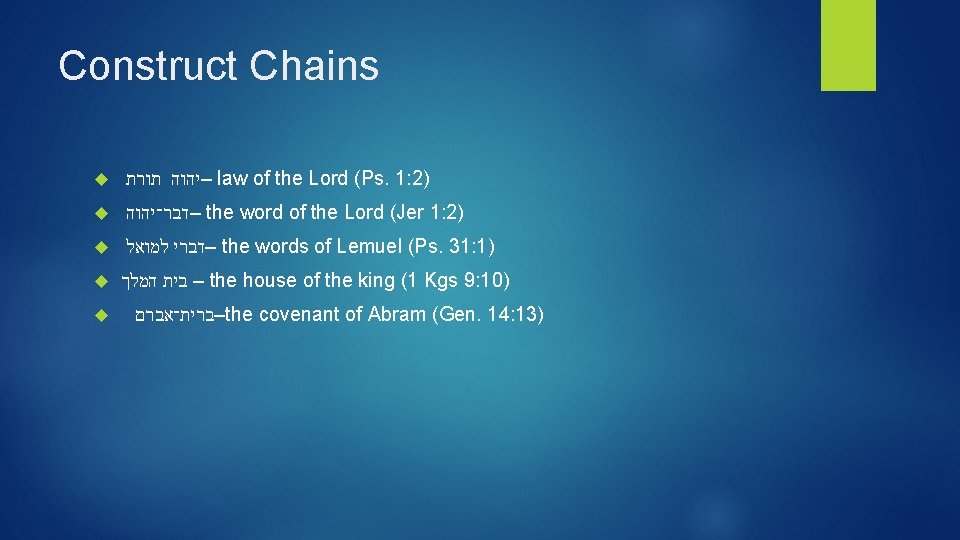
Construct Chains תורת –יהוה law of the Lord (Ps. 1: 2) –דבר־יהוה the word of the Lord (Jer 1: 2) למואל –דברי the words of Lemuel (Ps. 31: 1) המלך בית – the house of the king (1 Kgs 9: 10) –ברית־אברם the covenant of Abram (Gen. 14: 13)
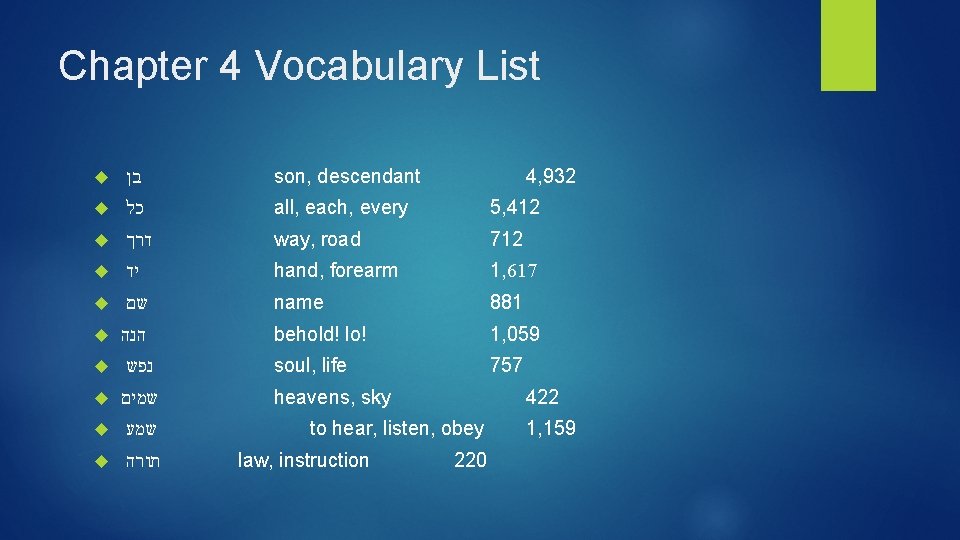
Chapter 4 Vocabulary List בן son, descendant כל all, each, every 5, 412 דרך way, road 712 יד hand, forearm 1, 617 שם name 881 הנה behold! lo! 1, 059 נפש soul, life 757 שמים שמע תורה 4, 932 heavens, sky 422 to hear, listen, obey law, instruction 220 1, 159
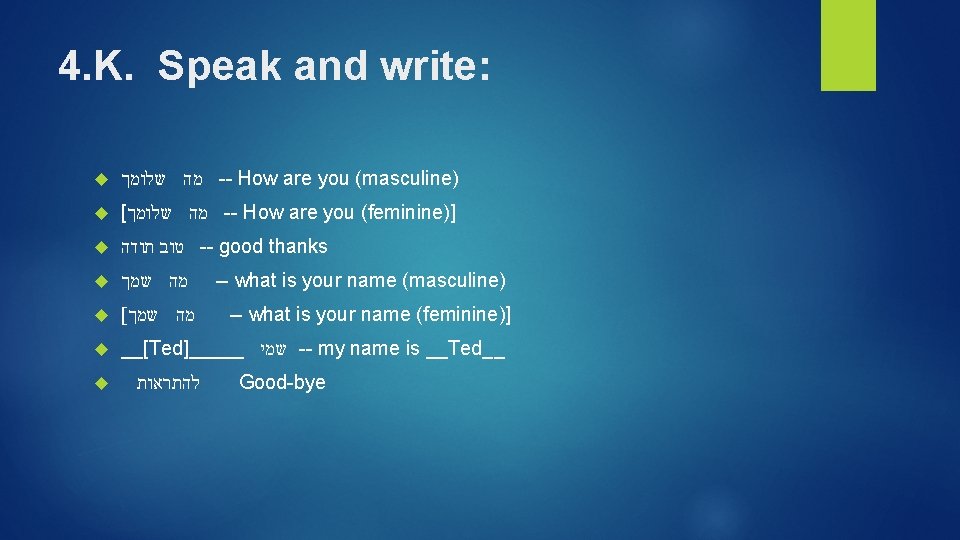
4. K. Speak and write: שלומך מה -- How are you (masculine) [ שלומך מה -- How are you (feminine)] תודה טוב -- good thanks שמך מה -- what is your name (masculine) [ שמך מה -- what is your name (feminine)] __[Ted]_____ שמי -- my name is __Ted__ להתראות Good-bye
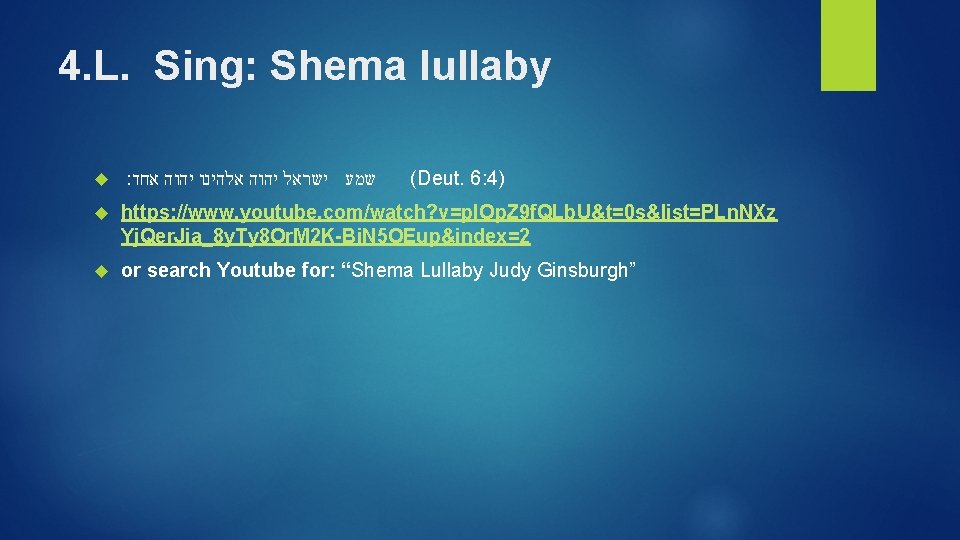
4. L. Sing: Shema lullaby אחד׃ יהוה אלהינו יהוה ישראל שמע (Deut. 6: 4) https: //www. youtube. com/watch? v=p. IOp. Z 9 f. QLb. U&t=0 s&list=PLn. NXz Yj. Qer. Jia_8 y. Ty 8 Or. M 2 K-Bi. N 5 OEup&index=2 or search Youtube for: “Shema Lullaby Judy Ginsburgh”
- Slides: 22