
Chapter 4 Normal and Exceptional Development CC 2015
- Slides: 13
Chapter 4 Normal and Exceptional Development CC © 2015 Cengage Learning. All Rights Reserved.
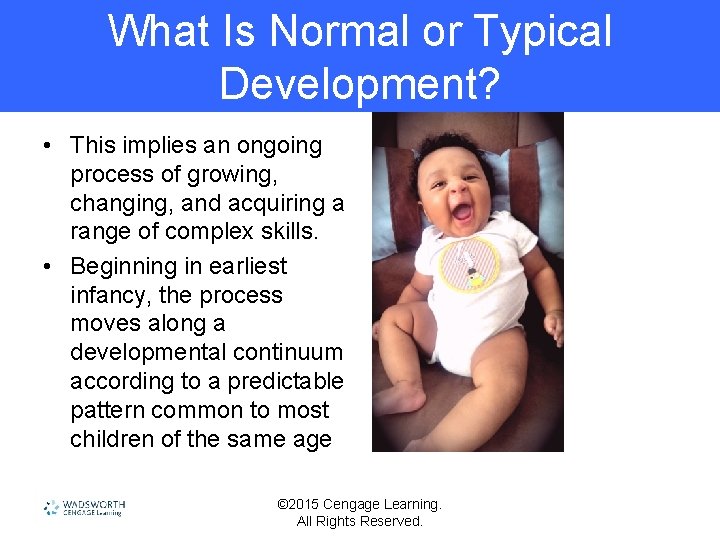
What Is Normal or Typical Development? • This implies an ongoing process of growing, changing, and acquiring a range of complex skills. • Beginning in earliest infancy, the process moves along a developmental continuum according to a predictable pattern common to most children of the same age © 2015 Cengage Learning. All Rights Reserved.
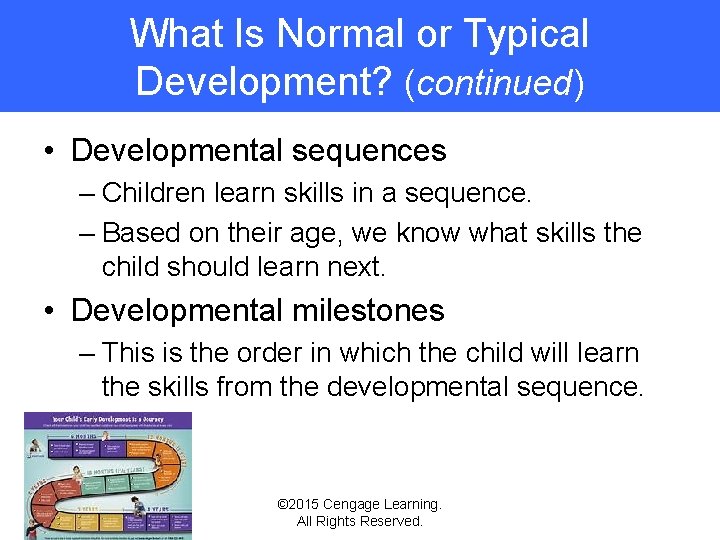
What Is Normal or Typical Development? (continued) • Developmental sequences – Children learn skills in a sequence. – Based on their age, we know what skills the child should learn next. • Developmental milestones – This is the order in which the child will learn the skills from the developmental sequence. © 2015 Cengage Learning. All Rights Reserved.
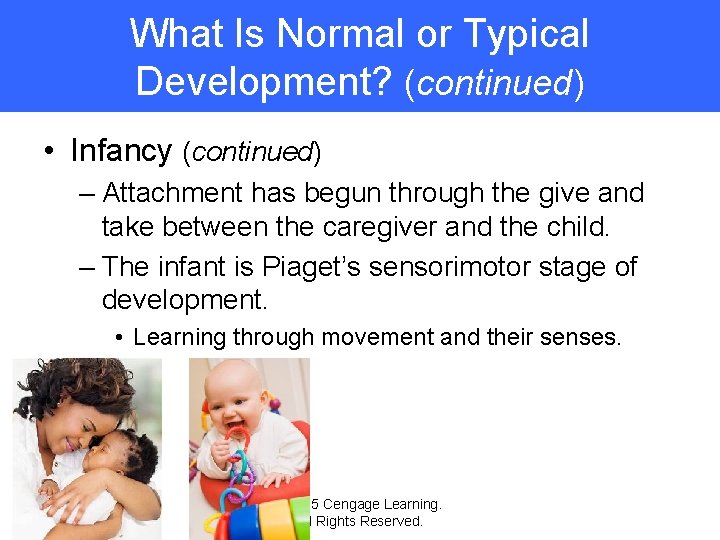
What Is Normal or Typical Development? (continued) – Infancy • Brain research has greatly improved. • Many studies have been done on early brain stimulation and the lasting effects. • Infants need caregivers and parents to offer activities, materials, and communication to enhance brain development. © 2015 Cengage Learning. All Rights Reserved.
What Is Normal or Typical Development? (continued) • Infancy (continued) – Attachment has begun through the give and take between the caregiver and the child. – The infant is Piaget’s sensorimotor stage of development. • Learning through movement and their senses. © 2015 Cengage Learning. All Rights Reserved.
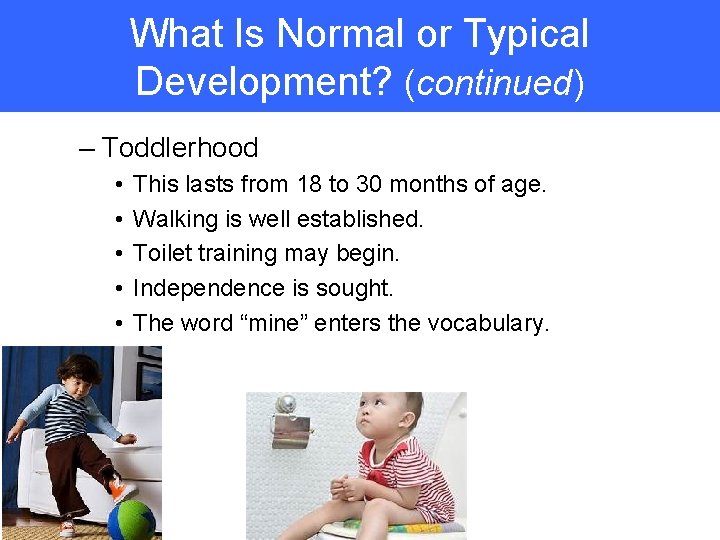
What Is Normal or Typical Development? (continued) – Toddlerhood • • • This lasts from 18 to 30 months of age. Walking is well established. Toilet training may begin. Independence is sought. The word “mine” enters the vocabulary. © 2015 Cengage Learning. All Rights Reserved.
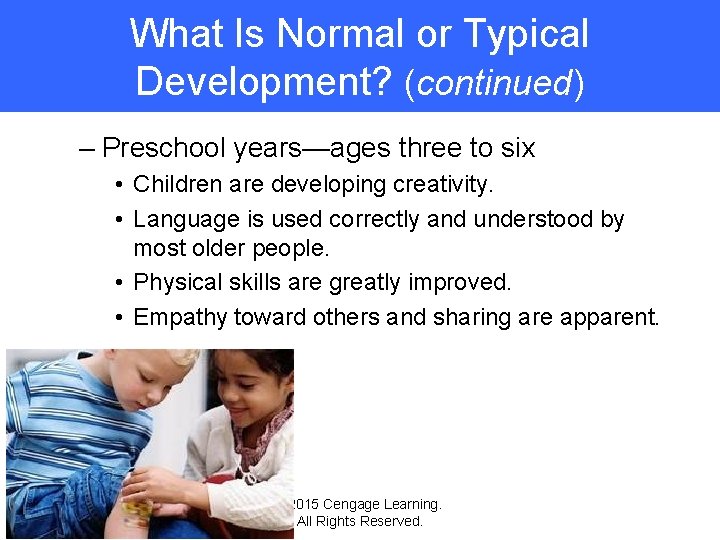
What Is Normal or Typical Development? (continued) – Preschool years—ages three to six • Children are developing creativity. • Language is used correctly and understood by most older people. • Physical skills are greatly improved. • Empathy toward others and sharing are apparent. © 2015 Cengage Learning. All Rights Reserved.
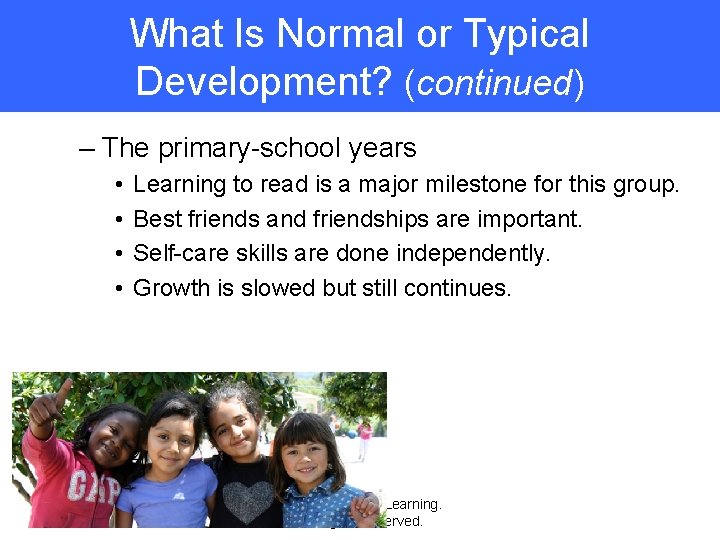
What Is Normal or Typical Development? (continued) – The primary-school years • • Learning to read is a major milestone for this group. Best friends and friendships are important. Self-care skills are done independently. Growth is slowed but still continues. © 2015 Cengage Learning. All Rights Reserved.
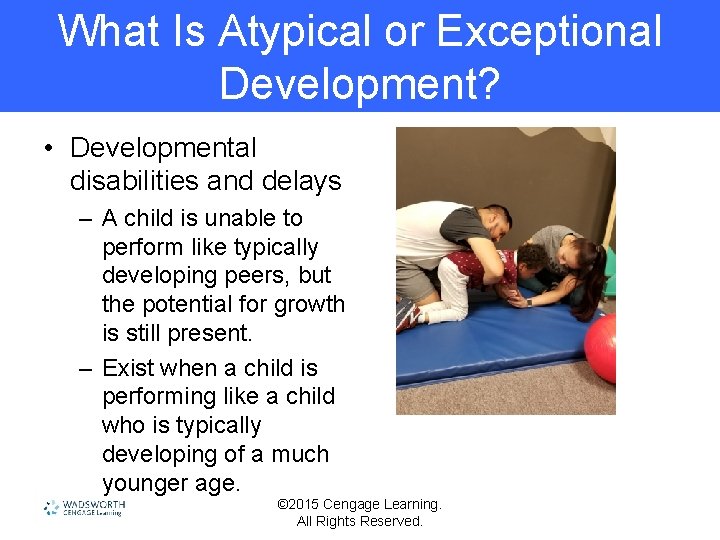
What Is Atypical or Exceptional Development? • Developmental disabilities and delays – A child is unable to perform like typically developing peers, but the potential for growth is still present. – Exist when a child is performing like a child who is typically developing of a much younger age. © 2015 Cengage Learning. All Rights Reserved.
Children at Developmental Risk • Biological risks – Birth defects – Chromosomal abnormalities – Heart defects • Environmental risks – Poverty – Child abuse and neglect © 2015 Cengage Learning. All Rights Reserved.
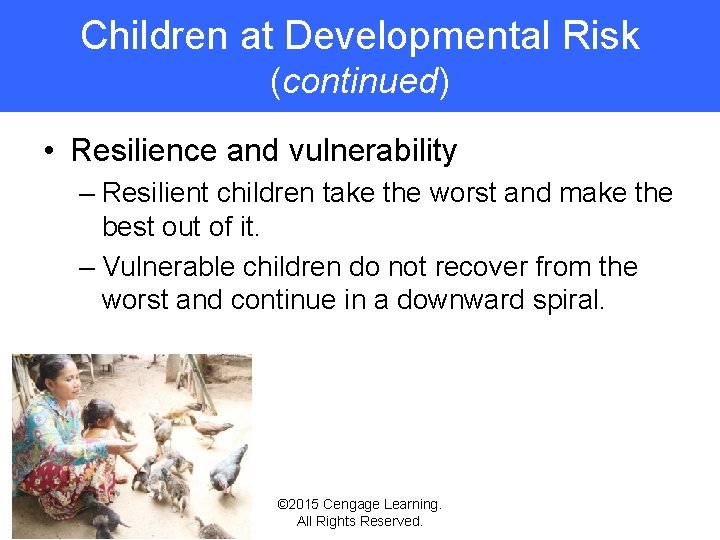
Children at Developmental Risk (continued) • Resilience and vulnerability – Resilient children take the worst and make the best out of it. – Vulnerable children do not recover from the worst and continue in a downward spiral. © 2015 Cengage Learning. All Rights Reserved.
Children at Developmental Risk (continued) • Children with special gifts and talents – Theory of multiple intelligences • Gardner says there are eight. Everyone has one intelligence that is stronger than the others. – Characteristics of young gifted and children • • Have advanced vocabulary Learn quickly Are curious Find and solve difficult and unusual problems © 2015 Cengage Learning. All Rights Reserved.
Children and Developmental Risk (continued) • Children with developmental disabilities who are gifted – Yes, you can have a disability and be gifted at the same time—sometimes even in the same developmental domain. – Children with disabilities still need to be considered for gifted programs. – Identification needs to come from classroom observations, not purely test scores. © 2015 Cengage Learning. All Rights Reserved.