
Chapter 4 Neuromotor Basis for Motor Control Concept
Chapter 4 Neuromotor Basis for Motor Control Concept: _________________________________________ © 2011 Mc. Graw-Hill Higher Education. All rights reserved
Introduction n ________________ • Components of the central nervous system (CNS) and peripheral nervous system (PNS) involved in the control of coordinated movement © 2011 Mc. Graw-Hill Higher Education. All rights reserved
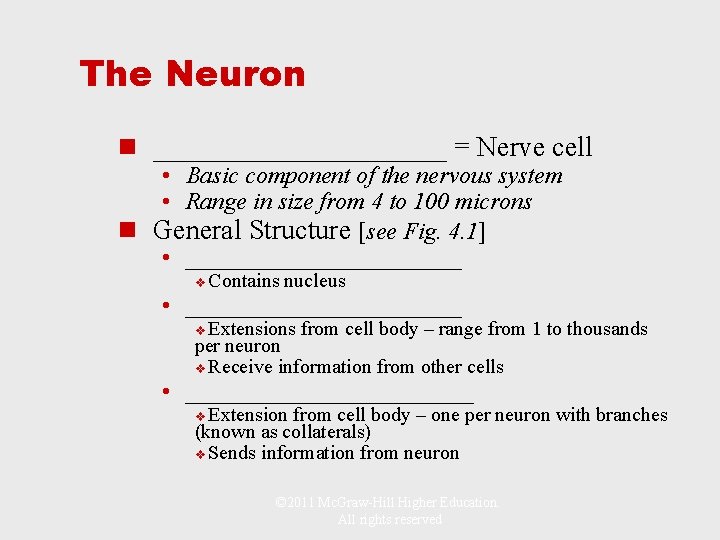
The Neuron n ___________ = Nerve cell • Basic component of the nervous system • Range in size from 4 to 100 microns n General Structure [see Fig. 4. 1] • ____________ v Contains nucleus • ____________ Extensions from cell body – range from 1 to thousands per neuron v Receive information from other cells v • ____________ Extension from cell body – one per neuron with branches (known as collaterals) v Sends information from neuron v © 2011 Mc. Graw-Hill Higher Education. All rights reserved

Types and Functions of Neurons Three Types of Neurons 1. _____________Also known as “afferent” neurons • Send information to CNS from sensory receptors • Unipolar – ___________ • Cell body and most of the axon located in PNS; only axon central process enters CNS © 2011 Mc. Graw-Hill Higher Education. All rights reserved
![Types and Functions of Neurons, cont’d 2. ___________[see Fig. 4. 2] Also known as](http://slidetodoc.com/presentation_image/cb5ba6f1bf7316fff6493cf933315234/image-5.jpg "Types and Functions of Neurons, cont’d 2. ___________[see Fig. 4. 2] Also known as")
Types and Functions of Neurons, cont’d 2. ___________[see Fig. 4. 2] Also known as “efferent” neurons • Two types influence voluntary movement: 1. ______________ • Predominantly in spinal cord – axons synapse on skeletal muscles v 2. ______________ v In intrafusal fibers of skeletal muscles © 2011 Mc. Graw-Hill Higher Education. All rights reserved
![Types and Functions of Neurons, cont’d 3. _________ [see Fig. 4. 2] • ________________________________](http://slidetodoc.com/presentation_image/cb5ba6f1bf7316fff6493cf933315234/image-6.jpg "Types and Functions of Neurons, cont’d 3. _________ [see Fig. 4. 2] • ________________________________")
Types and Functions of Neurons, cont’d 3. _________ [see Fig. 4. 2] • ________________________________ • Function as connections between: Axons from the brain and synapse on motor neurons v Axons from sensory nerves and the spinal nerves ascending to the brain v © 2011 Mc. Graw-Hill Higher Education. All rights reserved
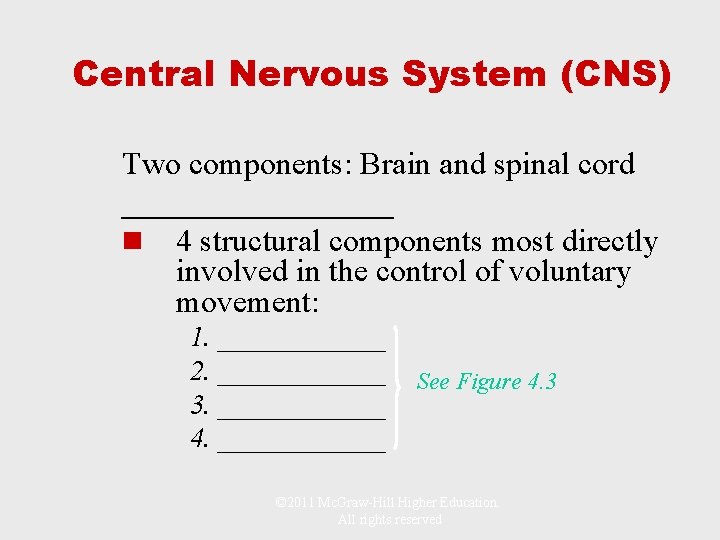
Central Nervous System (CNS) Two components: Brain and spinal cord _________ n 4 structural components most directly involved in the control of voluntary movement: 1. ______ 2. ______ 3. ______ 4. ______ See Figure 4. 3 © 2011 Mc. Graw-Hill Higher Education. All rights reserved
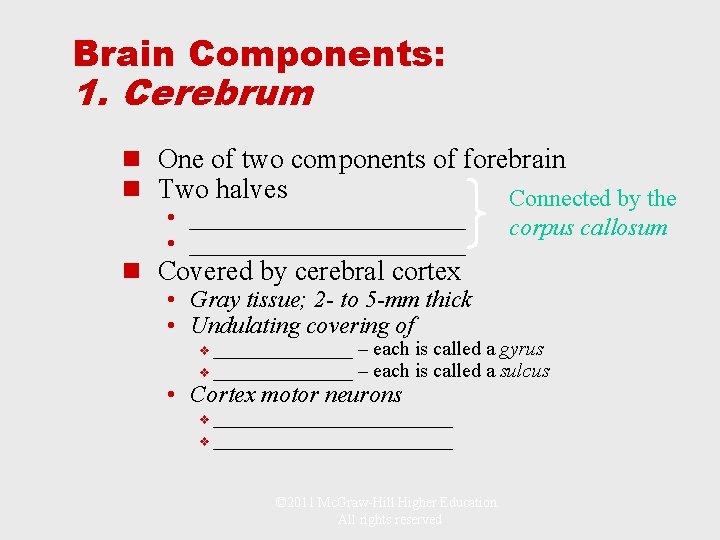
Brain Components: 1. Cerebrum n One of two components of forebrain n Two halves Connected by the • ____________ corpus callosum • ____________ n Covered by cerebral cortex • Gray tissue; 2 - to 5 -mm thick • Undulating covering of _______ – each is called a gyrus v _______ – each is called a sulcus v • Cortex motor neurons ________________________ v © 2011 Mc. Graw-Hill Higher Education. All rights reserved
![_____________ n Four lobes [see Fig. 4. 3] • __________ Named according to •](http://slidetodoc.com/presentation_image/cb5ba6f1bf7316fff6493cf933315234/image-9.jpg "_____________ n Four lobes [see Fig. 4. 3] • __________ Named according to •")
_____________ n Four lobes [see Fig. 4. 3] • __________ Named according to • _____ nearest skull bone • _____ n ___________[see Fig. 4. 4] • Posterior to central sulcus • Receives neuron axons specific to type of sensory information © 2011 Mc. Graw-Hill Higher Education. All rights reserved
![Cerebral Cortex, cont’d n ____________[see Fig. 4. 4] n Location • Adjacent to specific](http://slidetodoc.com/presentation_image/cb5ba6f1bf7316fff6493cf933315234/image-10.jpg "Cerebral Cortex, cont’d n ____________[see Fig. 4. 4] n Location • Adjacent to specific")
Cerebral Cortex, cont’d n ____________[see Fig. 4. 4] n Location • Adjacent to specific sensory areas of sensory cortex n Function • To “associate” information from the several different sensory cortex areas • ____________________________________________ v e. g. , selection of the correct response in a choice. RT situation • Possible locations for transition between perception and action © 2011 Mc. Graw-Hill Higher Education. All rights reserved
![Cerebral Cortex, cont’d § Primary motor cortex [see Fig. 4. 4] Location & Structure](http://slidetodoc.com/presentation_image/cb5ba6f1bf7316fff6493cf933315234/image-11.jpg "Cerebral Cortex, cont’d § Primary motor cortex [see Fig. 4. 4] Location & Structure")
Cerebral Cortex, cont’d § Primary motor cortex [see Fig. 4. 4] Location & Structure • Frontal lobe just anterior to central sulcus • _______________ Function Involved in control of: • Initiation and coordination of movements for fine motor skills • _______________ © 2011 Mc. Graw-Hill Higher Education. All rights reserved
![Cerebral Cortex, cont’d n ___________[see Fig. 4. 4] • Location: Anterior to the primary](http://slidetodoc.com/presentation_image/cb5ba6f1bf7316fff6493cf933315234/image-12.jpg "Cerebral Cortex, cont’d n ___________[see Fig. 4. 4] • Location: Anterior to the primary")
Cerebral Cortex, cont’d n ___________[see Fig. 4. 4] • Location: Anterior to the primary motor cortex • Functions include Organization of movements before they are initiated v v _ __________________ -- enables transitions between sequential movements of a serial motor skill (e. g. keyboard typing, piano playing) v _ __________________ © 2011 Mc. Graw-Hill Higher Education. All rights reserved
Cerebral Cortex, cont’d n _______________(SMA) • Location: Medial surface of frontal lobe adjacent to portions of the primary motor cortex • Functions include involvement in the control of v __________________________________ © 2011 Mc. Graw-Hill Higher Education. All rights reserved
![Cerebral Cortex, cont’d n ____________[see Fig. 4. 3] n Location • One of the](http://slidetodoc.com/presentation_image/cb5ba6f1bf7316fff6493cf933315234/image-14.jpg "Cerebral Cortex, cont’d n ____________[see Fig. 4. 3] n Location • One of the")
Cerebral Cortex, cont’d n ____________[see Fig. 4. 3] n Location • One of the 4 lobes of the cerebral cortex n Function • ________________________________ Interacts with the premotor cortex, primary motor cortex, and SMA before and during movement v © 2011 Mc. Graw-Hill Higher Education. All rights reserved
Subcortical Brain Area Important in Motor Control n ______________ • Buried within cerebral hemispheres • Consist of 4 large nuclei _________________ v - Receive info from cerebral cortex and brainstem - Send info to brainstem • Function involves control of ____________________________________ v © 2011 Mc. Graw-Hill Higher Education. All rights reserved
Basal Ganglia, cont’d n ______________ • Common disease associated with basal ganglia dysfunction Lack of dopamine production by substantia nigra v • Motor control problems [BART] Bradykinesia (___________) v. Akinesia (____________) v. Rigidity of muscles © 2011 Mc. Graw-Hill Higher Education. v. Tremor v All rights reserved
![Brain Components: 2. _____________ n 2 nd component of forebrain [See Fig. 4. 3]](http://slidetodoc.com/presentation_image/cb5ba6f1bf7316fff6493cf933315234/image-17.jpg "Brain Components: 2. _____________ n 2 nd component of forebrain [See Fig. 4. 3]")
Brain Components: 2. _____________ n 2 nd component of forebrain [See Fig. 4. 3] n Contains two groups of nuclei • ___________ v Functions: • A type of relay station - receives and integrates sensory info from spinal cord and brainstem; sends info to cerebral cortex • ________________________________________ • ____________ Critical center for the control of the endocrine system and body homeostasis v © 2011 Mc. Graw-Hill Higher Education. All rights reserved
Brain Components: 3. _____________ n Location: Behind cerebrum and attached to brainstem [See Fig. 4. 3] n Structure includes • ____________________________________ Red nucleus – Where cerebellum’s motor neural pathways connect to spinal cord v Oculomotor nucleus v © 2011 Mc. Graw-Hill Higher Education. All rights reserved
Brain Components: 3. Cerebellum , cont’d n Functions • ____________________________________ v Clumsy movement results from dysfunction • ____________________________________ • Serves as a type of movement error detection and correction system Receives copy of motor neural signals sent from motor cortex to muscles (efference copy) v • _________________ © 2011 Mc. Graw-Hill Higher Education. All rights reserved
Brain Components: 4. Brainstem Location n Beneath cerebrum; Functions n _______ • Involved in control of various body functions (e. g. chewing) and balance connected to spinal cord [See Fig. 4. 3] n _______ n 3 components involved • Regulatory center for internal physiologic in motor control processes (e. g. breathing) • ________ n _________ • Integrator of sensory and motor info • ________ • Inhibits / Activates neural signals to skeletal muscles © 2011 Mc. Graw-Hill Higher Education. All rights reserved
_____________ n A complex neural system vitally involved in motor control n Structure [See Fig. 4. 5] • _______– H-shaped central portion Consists of cell bodies and axons of neurons v Two pairs of “horns” • ____________– Cells transmit sensory info • ____________– Contains alpha motor neurons with axons terminating on skeletal muscle v Interneurons (Renshaw cells) – In ventral horn v © 2011 Mc. Graw-Hill Higher Education. All rights reserved
________________ n Several neural tracts (called _________) • Pass through spinal cord and brainstem • Connect to sensory areas of cerebral cortex and cerebellum n 2 tracts to sensory cortex especially important for motor control • _____________________________ n Tract to cerebellum important for motor control • _______________– Primary pathway for proprioceptive info © 2011 Mc. Graw-Hill Higher Education. All rights reserved
________________ n Called _______________ • Travel from brain through spinal cord n __________(corticospinal tracts) • 60% from motor cortex • Most fibers cross to other side body (decussation) in medulla of brainstem • Involved in control of fine motor skill performance n __________(brainstem pathways) • Fibers do not cross to other side of body • Involved in postural control and control of hand finger flexion – extension © 2011 Mc. Graw-Hill Higher Education. All rights reserved
______________ n An alpha motor neuron and all the skeletal muscle fibers it innervates [See Figure 4. 6] • When a motor neuron activates (fires) all its connected muscle fibers contract n The ultimate end of the motor neural information n ~ 200, 000 alpha motor neurons in spinal cord • Number of muscle fibers served by a motor unit depends on type of movement associated with the muscle v Fine movements e. g. eye muscles = 1 fiber / motor unit v Gross movements e. g. posture control = many fibers (up to ~ 700) / motor unit © 2011 Mc. Graw-Hill Higher Education. All rights reserved
________________ n Amount of force generated by muscle contraction depends on number of muscle fibers activated • To increase force, need more motor units n _____________________________________ n Recruitment follows “size principle” • Size = __________________ • ___________= recruit smallest motor units first (i. e. , weakest force produced) then systematically increase size recruited until achieve desired force © 2011 Mc. Graw-Hill Higher Education. All rights reserved
From Intent to Action: The Neural Control of Voluntary Movement n Think about the entire process of deciding to perform a skill and actually performing it n The neural activity involved in this process typically follows a hierarchical organization pattern • From higher to lower levels of the neuromuscular system n This process is described conceptually in Figure 4. 7 and Table 4. 1 • Discuss this figure and table for the performance of a specific motor skill © 2011 Mc. Graw-Hill Higher Education. All rights reserved
From Intent to Action: Brain Structures Associated with Movement Research by Carson and Kelso (2004) n Demonstrated: More involved in knowing how we control voluntary coordinated movement than knowing which brain structures involved in which type of movements • Cognitive intention is a critical component Experiment n Participants performed finger-flexion movement to a metronome • On the beat (synchronize) • Between beats (syncopate) n Task involved exactly the same movement but two different cognitive intentions n f. MRI results showed • Different brain regions active for the two movement intentions © 2011 Mc. Graw-Hill Higher Education. All rights reserved
- Slides: 27