
Chapter 4 Network Layer The Data Plane A


- Slides: 21
Chapter 4 Network Layer: The Data Plane A note on the use of these Powerpoint slides: We’re making these slides freely available to all (faculty, students, readers). They’re in Power. Point form so you see the animations; and can add, modify, and delete slides (including this one) and slide content to suit your needs. They obviously represent a lot of work on our part. In return for use, we only ask the following: § If you use these slides (e. g. , in a class) that you mention their source (after all, we’d like people to use our book!) § If you post any slides on a www site, that you note that they are adapted from (or perhaps identical to) our slides, and note our copyright of this material. Thanks and enjoy! JFK/KWR All material copyright 1996 -2016 J. F Kurose and K. W. Ross, All Rights Reserved Computer Networking: A Top Down Approach 7 th edition Jim Kurose, Keith Ross Pearson/Addison Wesley April 2016 Network Layer: Data Plane 4 -1
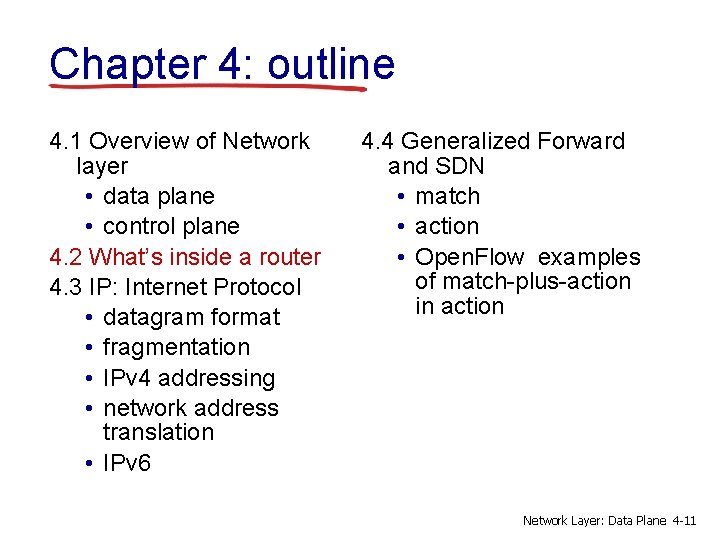
Chapter 4: outline 4. 1 Overview of Network layer • data plane • control plane 4. 2 What’s inside a router 4. 3 IP: Internet Protocol • datagram format • fragmentation • IPv 4 addressing • network address translation • IPv 6 4. 4 Generalized Forward and SDN • match • action • Open. Flow examples of match-plus-action in action Network Layer: Data Plane 4 -2
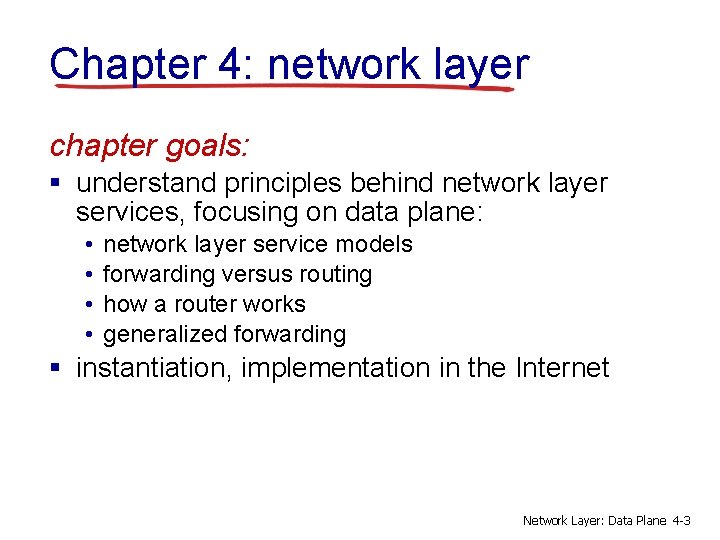
Chapter 4: network layer chapter goals: § understand principles behind network layer services, focusing on data plane: • • network layer service models forwarding versus routing how a router works generalized forwarding § instantiation, implementation in the Internet Network Layer: Data Plane 4 -3
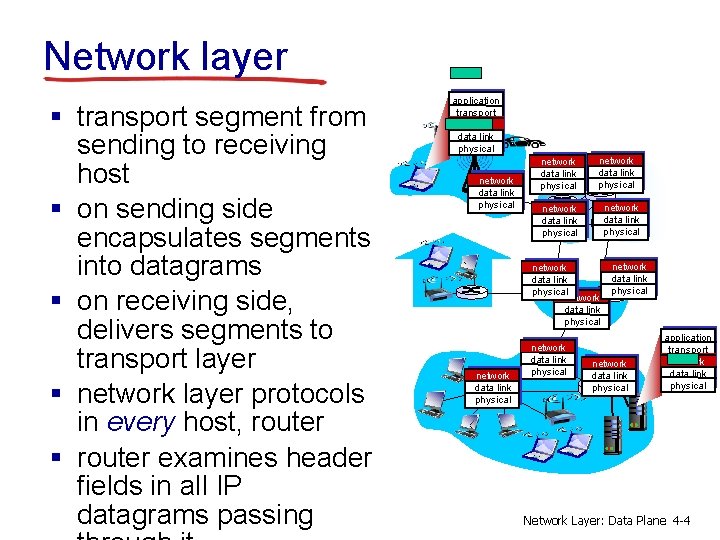
Network layer § transport segment from sending to receiving host § on sending side encapsulates segments into datagrams § on receiving side, delivers segments to transport layer § network layer protocols in every host, router § router examines header fields in all IP datagrams passing application transport network data link physical network data link physical network data link physical application transport network data link physical Network Layer: Data Plane 4 -4
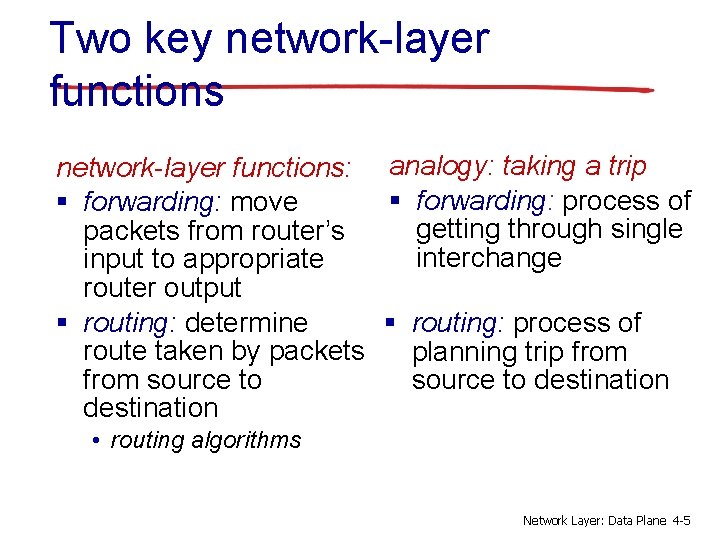
Two key network-layer functions: analogy: taking a trip § forwarding: process of § forwarding: move getting through single packets from router’s interchange input to appropriate router output § routing: determine § routing: process of route taken by packets planning trip from source to destination • routing algorithms Network Layer: Data Plane 4 -5
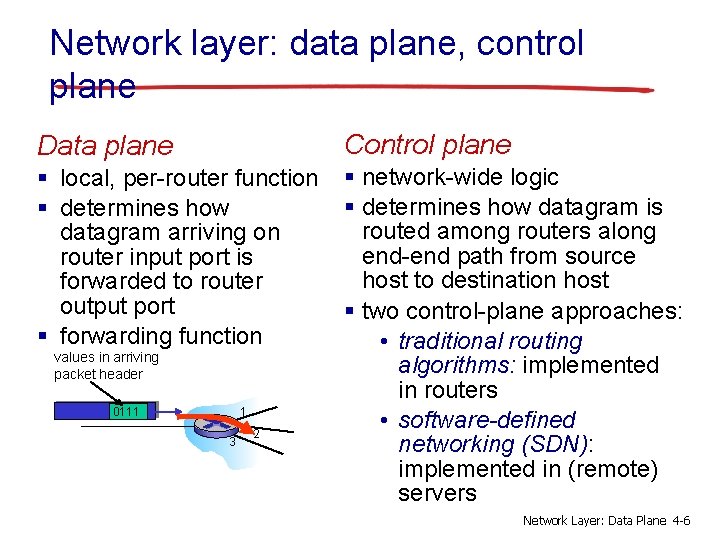
Network layer: data plane, control plane Data plane Control plane § local, per-router function § determines how datagram arriving on router input port is forwarded to router output port § forwarding function § network-wide logic § determines how datagram is routed among routers along end-end path from source host to destination host § two control-plane approaches: • traditional routing algorithms: implemented in routers • software-defined networking (SDN): implemented in (remote) servers values in arriving packet header 1 0111 3 2 Network Layer: Data Plane 4 -6
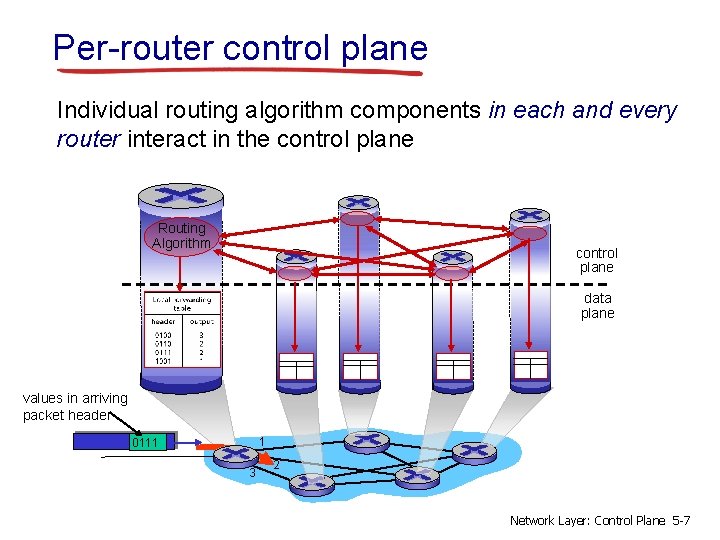
Per-router control plane Individual routing algorithm components in each and every router interact in the control plane Routing Algorithm control plane data plane values in arriving packet header 1 0111 3 2 Network Layer: Control Plane 5 -7
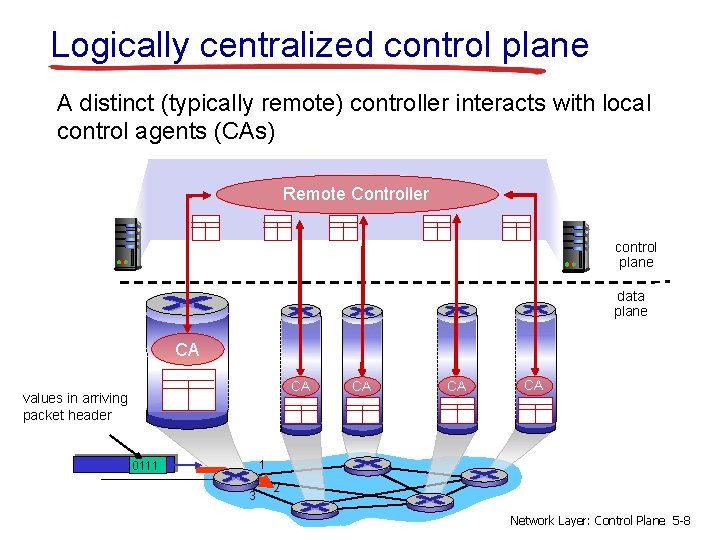
Logically centralized control plane A distinct (typically remote) controller interacts with local control agents (CAs) Remote Controller control plane data plane CA CA values in arriving packet header CA CA CA 1 0111 3 2 Network Layer: Control Plane 5 -8
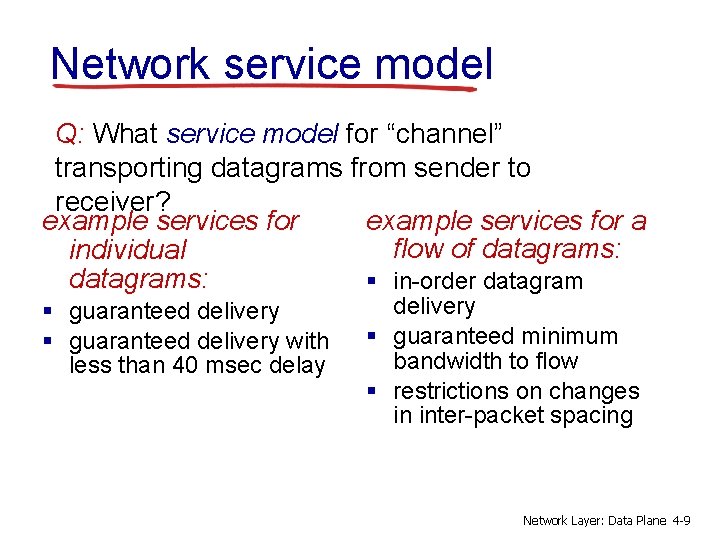
Network service model Q: What service model for “channel” transporting datagrams from sender to receiver? example services for a example services for flow of datagrams: individual datagrams: § in-order datagram § guaranteed delivery with less than 40 msec delay delivery § guaranteed minimum bandwidth to flow § restrictions on changes in inter-packet spacing Network Layer: Data Plane 4 -9
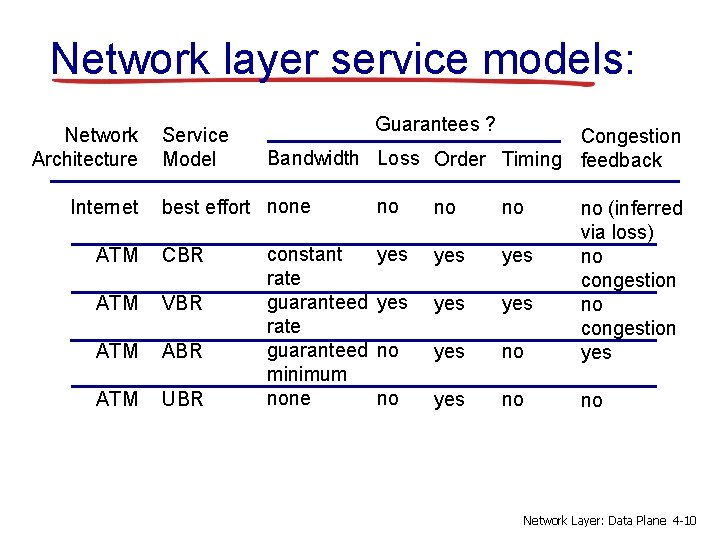
Network layer service models: Network Architecture Internet Service Model Guarantees ? Congestion Bandwidth Loss Order Timing feedback best effort none ATM CBR ATM VBR ATM ABR ATM UBR constant rate guaranteed minimum none no no no yes yes yes no no (inferred via loss) no congestion yes no no Network Layer: Data Plane 4 -10
Chapter 4: outline 4. 1 Overview of Network layer • data plane • control plane 4. 2 What’s inside a router 4. 3 IP: Internet Protocol • datagram format • fragmentation • IPv 4 addressing • network address translation • IPv 6 4. 4 Generalized Forward and SDN • match • action • Open. Flow examples of match-plus-action in action Network Layer: Data Plane 4 -11
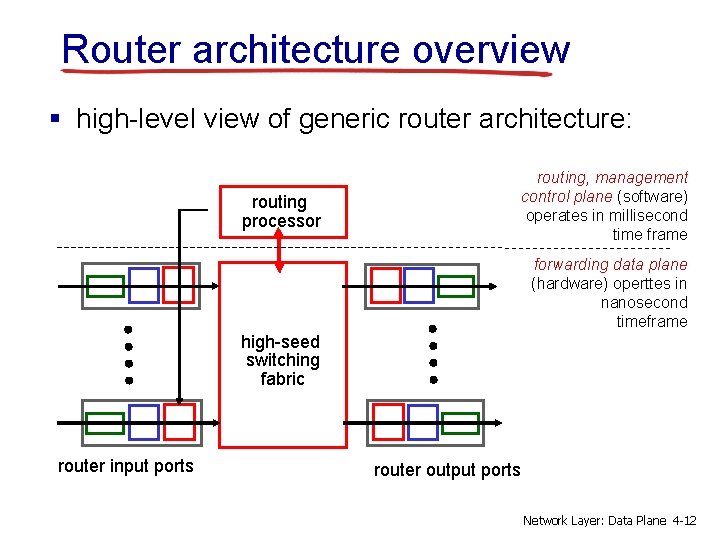
Router architecture overview § high-level view of generic router architecture: routing processor routing, management control plane (software) operates in millisecond time frame forwarding data plane (hardware) operttes in nanosecond timeframe high-seed switching fabric router input ports router output ports Network Layer: Data Plane 4 -12
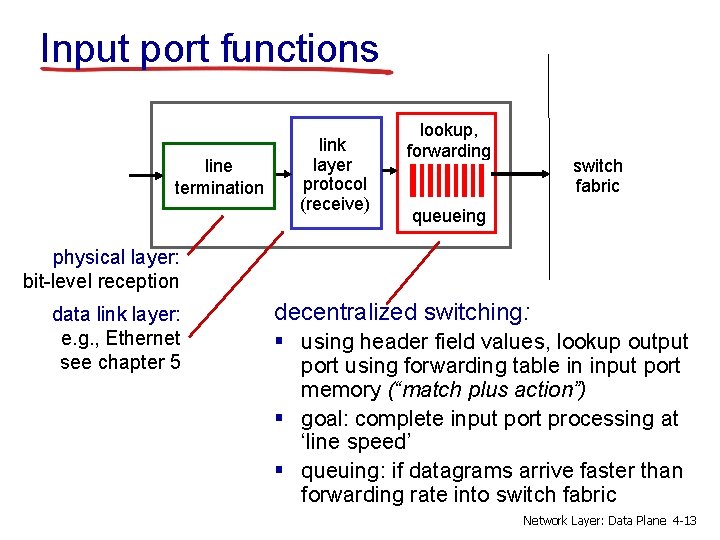
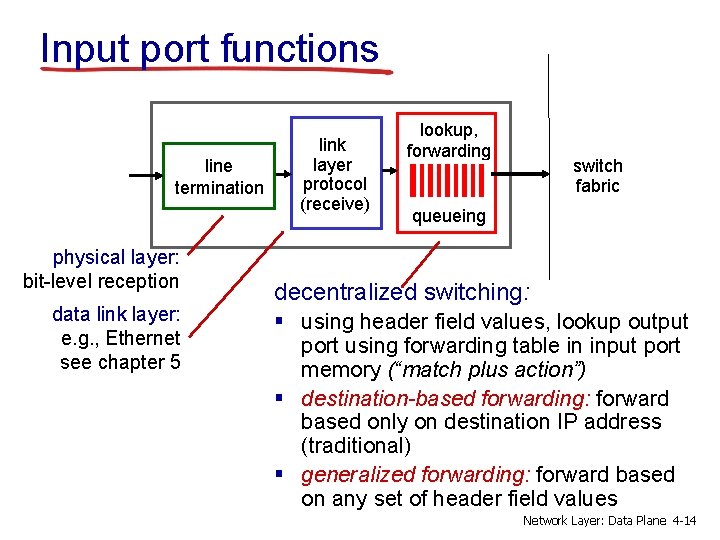
Input port functions line termination link layer protocol (receive) lookup, forwarding switch fabric queueing physical layer: bit-level reception data link layer: e. g. , Ethernet see chapter 5 decentralized switching: § using header field values, lookup output port using forwarding table in input port memory (“match plus action”) § goal: complete input port processing at ‘line speed’ § queuing: if datagrams arrive faster than forwarding rate into switch fabric Network Layer: Data Plane 4 -13
Input port functions line termination physical layer: bit-level reception data link layer: e. g. , Ethernet see chapter 5 link layer protocol (receive) lookup, forwarding switch fabric queueing decentralized switching: § using header field values, lookup output port using forwarding table in input port memory (“match plus action”) § destination-based forwarding: forward based only on destination IP address (traditional) § generalized forwarding: forward based on any set of header field values Network Layer: Data Plane 4 -14
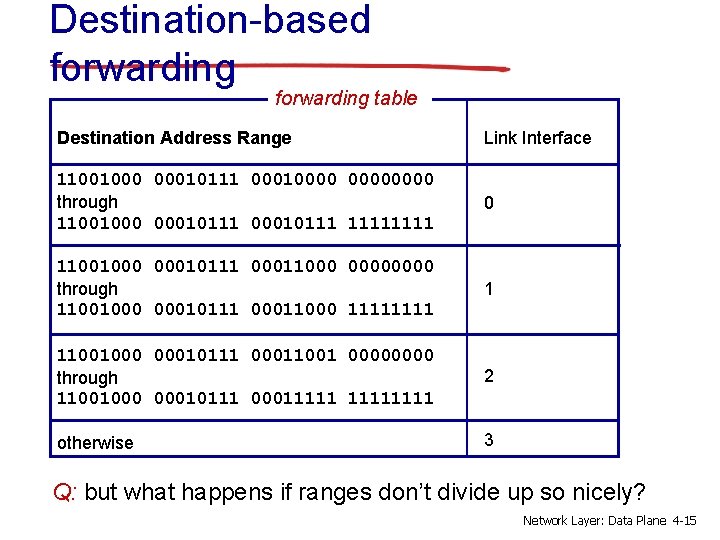
Destination-based forwarding table Destination Address Range Link Interface 11001000 00010111 00010000 through 11001000 00010111 1111 0 11001000 00010111 00011000 0000 through 11001000 00010111 00011000 1111 1 11001000 00010111 00011001 0000 through 11001000 00010111 00011111 2 otherwise 3 Q: but what happens if ranges don’t divide up so nicely? Network Layer: Data Plane 4 -15
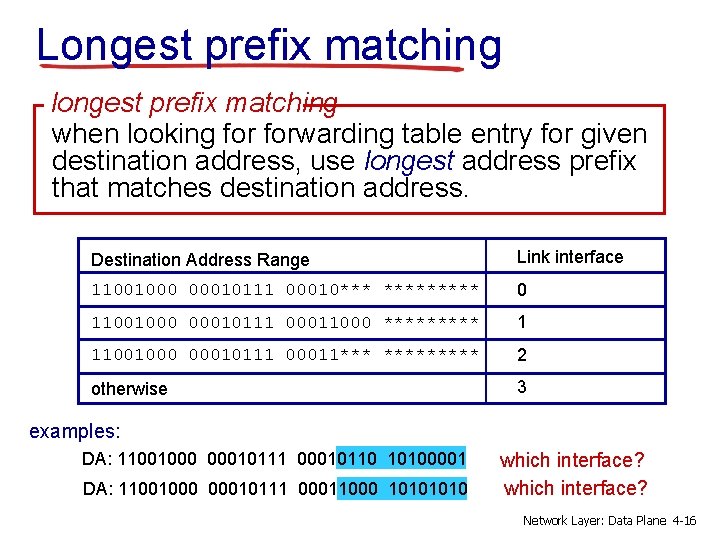
Longest prefix matching longest prefix matching when looking forwarding table entry for given destination address, use longest address prefix that matches destination address. Destination Address Range Link interface 11001000 00010111 00010*** ***** 0 11001000 00010111 00011000 ***** 1 11001000 00010111 00011*** ***** 2 otherwise 3 examples: DA: 11001000 00010111 00010110 10100001 DA: 11001000 00010111 00011000 1010 which interface? Network Layer: Data Plane 4 -16
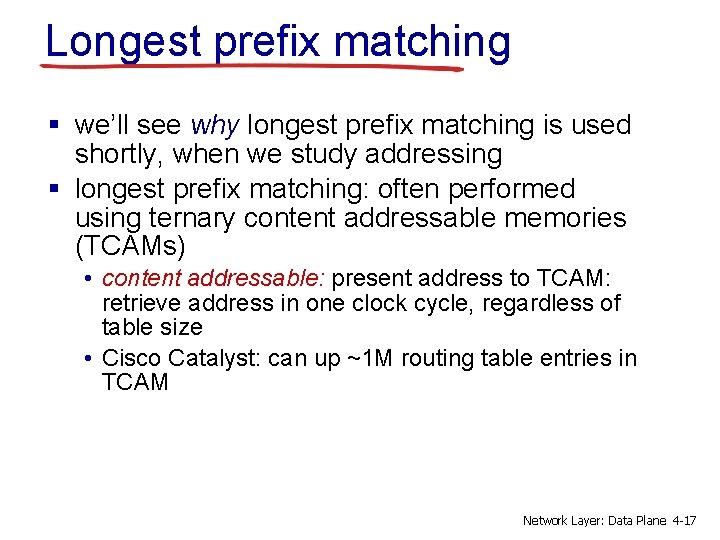
Longest prefix matching § we’ll see why longest prefix matching is used shortly, when we study addressing § longest prefix matching: often performed using ternary content addressable memories (TCAMs) • content addressable: present address to TCAM: retrieve address in one clock cycle, regardless of table size • Cisco Catalyst: can up ~1 M routing table entries in TCAM Network Layer: Data Plane 4 -17
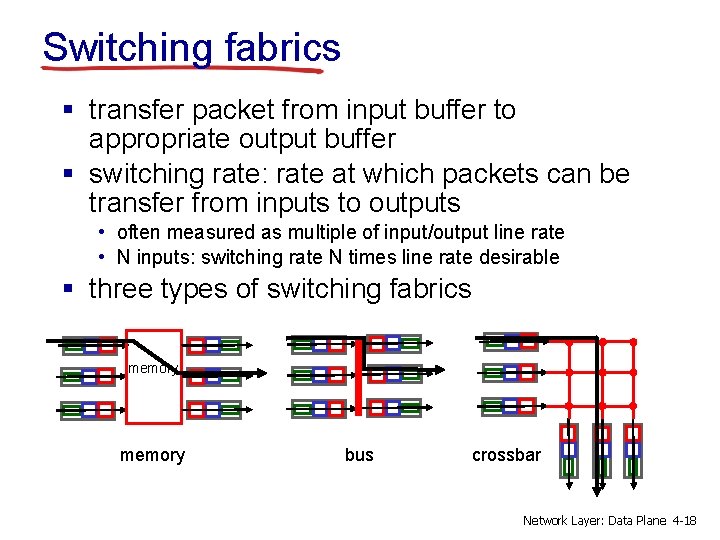
Switching fabrics § transfer packet from input buffer to appropriate output buffer § switching rate: rate at which packets can be transfer from inputs to outputs • often measured as multiple of input/output line rate • N inputs: switching rate N times line rate desirable § three types of switching fabrics memory bus crossbar Network Layer: Data Plane 4 -18
Switching via memory first generation routers: § traditional computers with switching under direct control of CPU § packet copied to system’s memory § speed limited by memory bandwidth (2 bus crossings per datagram) input port (e. g. , Ethernet) memory output port (e. g. , Ethernet) system bus Network Layer: Data Plane 4 -19
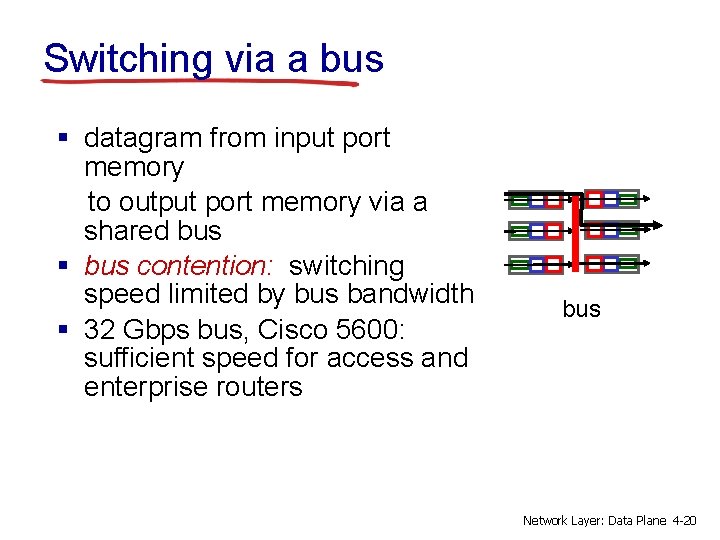
Switching via a bus § datagram from input port memory to output port memory via a shared bus § bus contention: switching speed limited by bus bandwidth § 32 Gbps bus, Cisco 5600: sufficient speed for access and enterprise routers bus Network Layer: Data Plane 4 -20
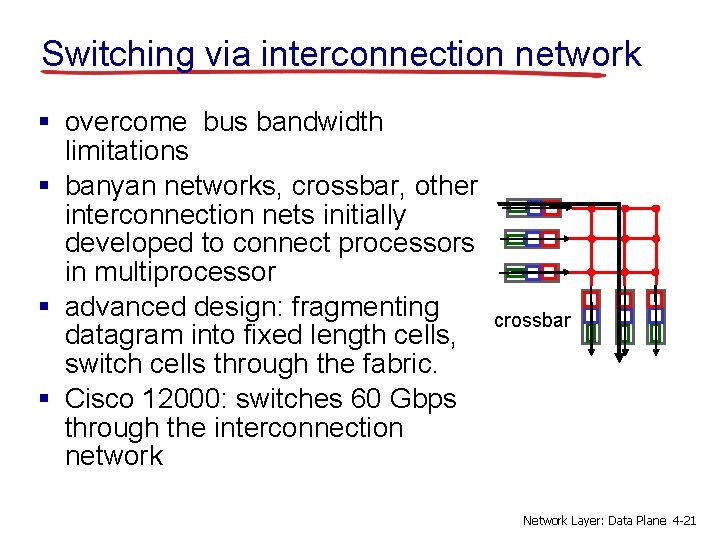
Switching via interconnection network § overcome bus bandwidth limitations § banyan networks, crossbar, other interconnection nets initially developed to connect processors in multiprocessor § advanced design: fragmenting datagram into fixed length cells, switch cells through the fabric. § Cisco 12000: switches 60 Gbps through the interconnection network crossbar Network Layer: Data Plane 4 -21