
Chapter 4 Network Layer r 4 1 Introduction
- Slides: 33
Chapter 4: Network Layer r 4. 1 Introduction r 4. 2 Virtual circuit and datagram networks r 4. 3 What’s inside a router r 4. 4 IP: Internet Protocol m m Datagram format IPv 4 addressing ICMP IPv 6 r 4. 5 Routing algorithms m Link state m Distance Vector m Hierarchical routing r 4. 6 Routing in the Internet m m m RIP OSPF BGP r 4. 7 Broadcast and multicast routing Network Layer 4 -1
Internet inter-AS routing: BGP r BGP (Border Gateway Protocol): the de facto standard r BGP provides each AS a means to: 1. 2. 3. Obtain subnet reachability information from neighboring ASs. Propagate reachability information to all ASinternal routers. Determine “good” routes to subnets based on reachability information and policy. r allows subnet to advertise its existence to rest of Internet: “I am here” Network Layer 4 -2
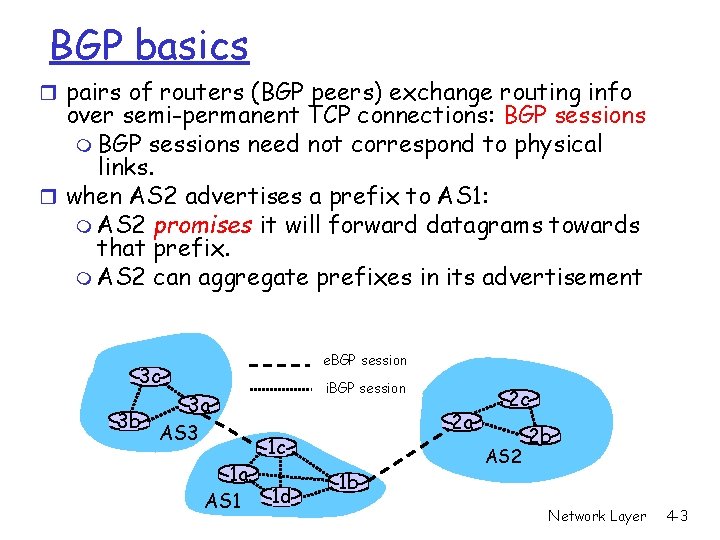
BGP basics r pairs of routers (BGP peers) exchange routing info over semi-permanent TCP connections: BGP sessions m BGP sessions need not correspond to physical links. r when AS 2 advertises a prefix to AS 1: m AS 2 promises it will forward datagrams towards that prefix. m AS 2 can aggregate prefixes in its advertisement e. BGP session 3 c 3 a 3 b AS 3 1 a AS 1 i. BGP session 2 a 1 c 1 d 1 b 2 c AS 2 2 b Network Layer 4 -3
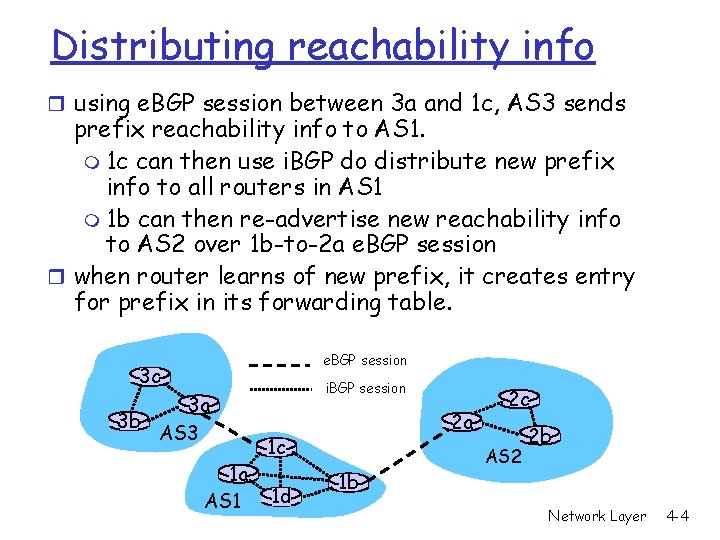
Distributing reachability info r using e. BGP session between 3 a and 1 c, AS 3 sends prefix reachability info to AS 1. m 1 c can then use i. BGP do distribute new prefix info to all routers in AS 1 m 1 b can then re-advertise new reachability info to AS 2 over 1 b-to-2 a e. BGP session r when router learns of new prefix, it creates entry for prefix in its forwarding table. e. BGP session 3 c 3 a 3 b AS 3 1 a AS 1 i. BGP session 2 a 1 c 1 d 1 b 2 c AS 2 2 b Network Layer 4 -4
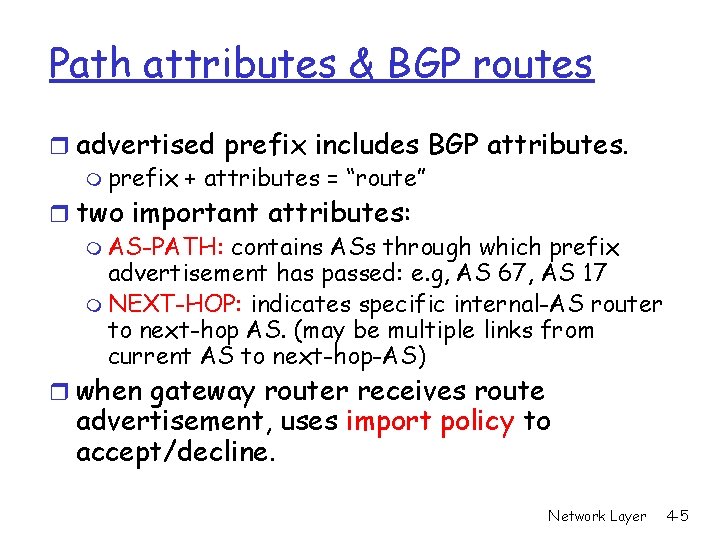
Path attributes & BGP routes r advertised prefix includes BGP attributes. m prefix + attributes = “route” r two important attributes: m AS-PATH: contains ASs through which prefix advertisement has passed: e. g, AS 67, AS 17 m NEXT-HOP: indicates specific internal-AS router to next-hop AS. (may be multiple links from current AS to next-hop-AS) r when gateway router receives route advertisement, uses import policy to accept/decline. Network Layer 4 -5
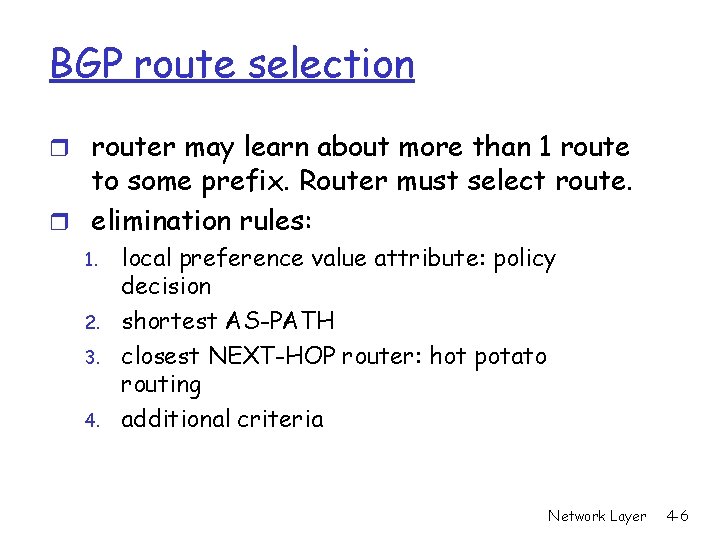
BGP route selection r router may learn about more than 1 route to some prefix. Router must select route. r elimination rules: 1. 2. 3. 4. local preference value attribute: policy decision shortest AS-PATH closest NEXT-HOP router: hot potato routing additional criteria Network Layer 4 -6
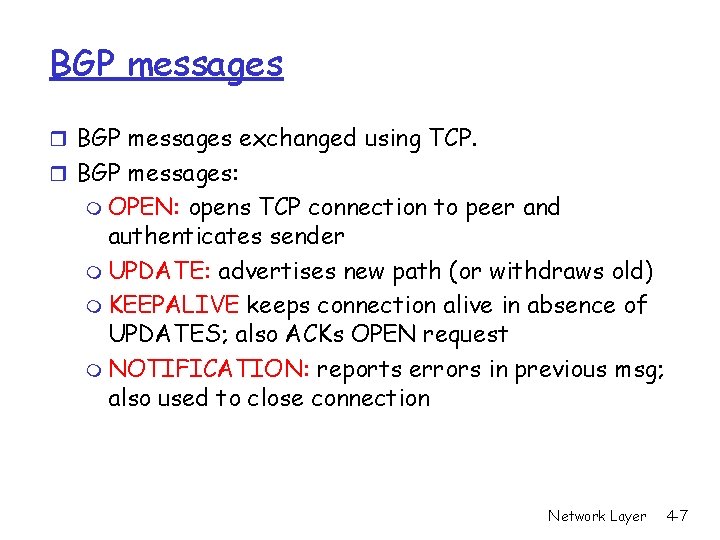
BGP messages r BGP messages exchanged using TCP. r BGP messages: m OPEN: opens TCP connection to peer and authenticates sender m UPDATE: advertises new path (or withdraws old) m KEEPALIVE keeps connection alive in absence of UPDATES; also ACKs OPEN request m NOTIFICATION: reports errors in previous msg; also used to close connection Network Layer 4 -7
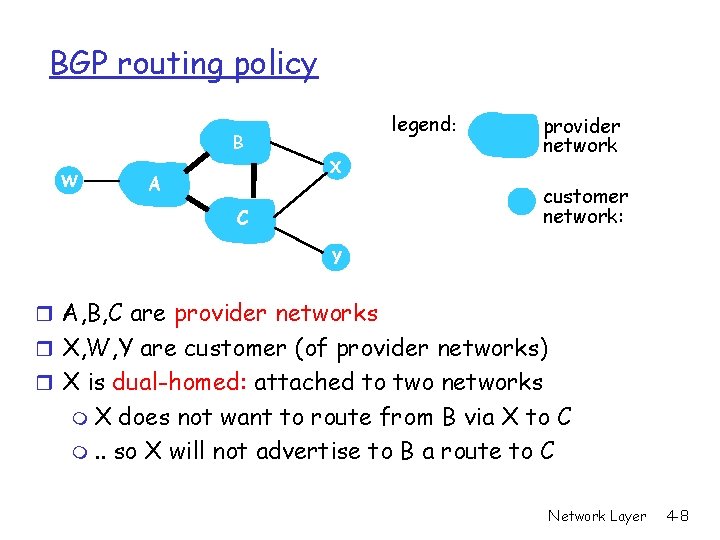
BGP routing policy legend: B W X A provider network customer network: C Y r A, B, C are provider networks r X, W, Y are customer (of provider networks) r X is dual-homed: attached to two networks m. X does not want to route from B via X to C m. . so X will not advertise to B a route to C Network Layer 4 -8
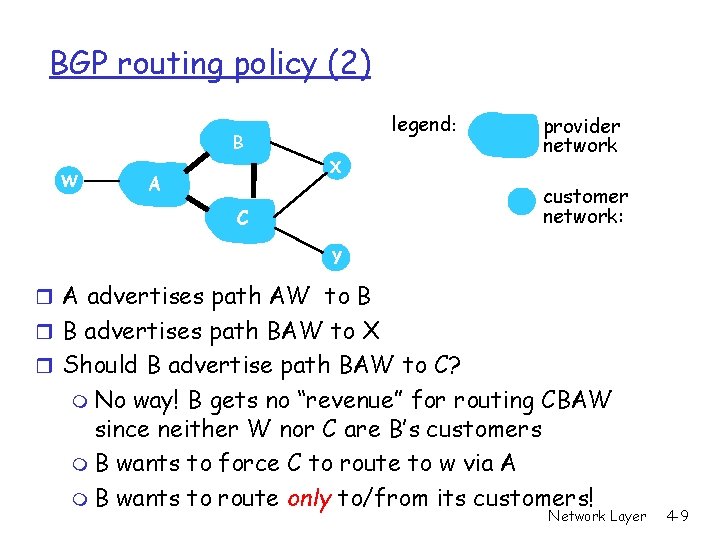
BGP routing policy (2) legend: B W X A provider network customer network: C Y r A advertises path AW to B r B advertises path BAW to X r Should B advertise path BAW to C? m No way! B gets no “revenue” for routing CBAW since neither W nor C are B’s customers m B wants to force C to route to w via A m B wants to route only to/from its customers! Network Layer 4 -9
Why different Intra- and Inter-AS routing ? Policy: r Inter-AS: admin wants control over how its traffic routed, who routes through its net. r Intra-AS: single admin, so no policy decisions needed Scale: r hierarchical routing saves table size, reduced update traffic Performance: r Intra-AS: can focus on performance r Inter-AS: policy may dominate over performance Network Layer 4 -10
Chapter 4: Network Layer r 4. 1 Introduction r 4. 2 Virtual circuit and datagram networks r 4. 3 What’s inside a router r 4. 4 IP: Internet Protocol m m Datagram format IPv 4 addressing ICMP IPv 6 r 4. 5 Routing algorithms m Link state m Distance Vector m Hierarchical routing r 4. 6 Routing in the Internet m m m RIP OSPF BGP r 4. 7 Broadcast and multicast routing Network Layer 4 -11
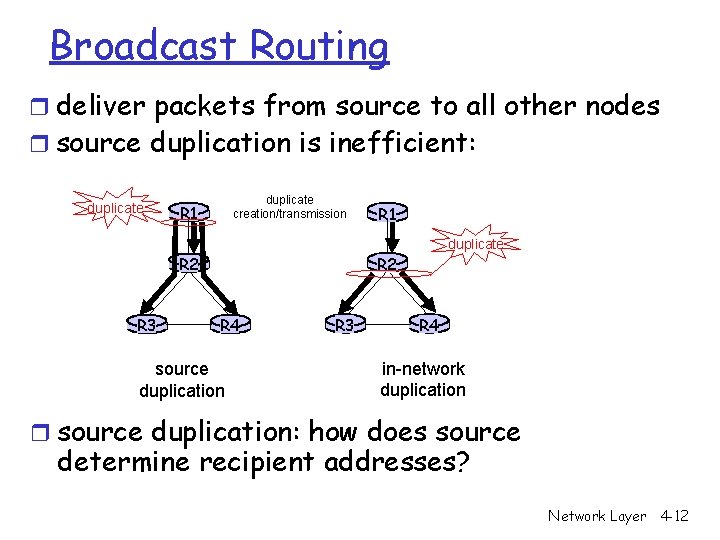
Broadcast Routing r deliver packets from source to all other nodes r source duplication is inefficient: duplicate creation/transmission R 1 duplicate R 2 R 3 R 1 R 4 source duplication R 3 R 4 in-network duplication r source duplication: how does source determine recipient addresses? Network Layer 4 -12
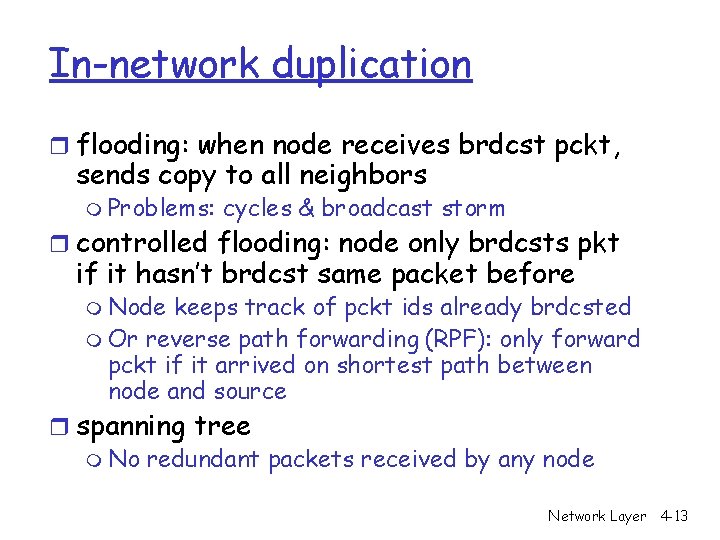
In-network duplication r flooding: when node receives brdcst pckt, sends copy to all neighbors m Problems: cycles & broadcast storm r controlled flooding: node only brdcsts pkt if it hasn’t brdcst same packet before m Node keeps track of pckt ids already brdcsted m Or reverse path forwarding (RPF): only forward pckt if it arrived on shortest path between node and source r spanning tree m No redundant packets received by any node Network Layer 4 -13
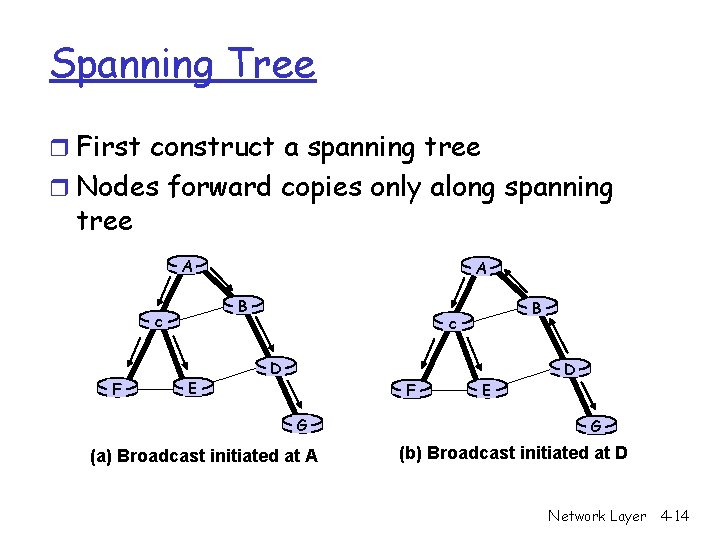
Spanning Tree r First construct a spanning tree r Nodes forward copies only along spanning tree A B c F A E B c D F G (a) Broadcast initiated at A E D G (b) Broadcast initiated at D Network Layer 4 -14
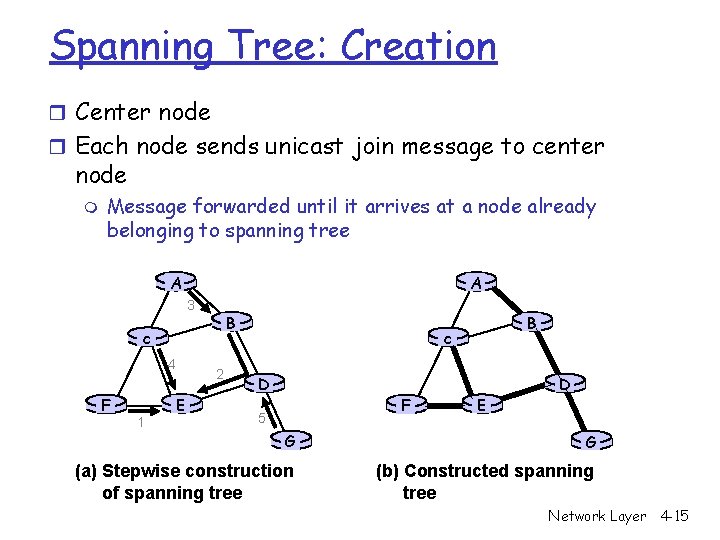
Spanning Tree: Creation r Center node r Each node sends unicast join message to center node m Message forwarded until it arrives at a node already belonging to spanning tree A A 3 B c 4 F 1 2 E B c D F 5 E D G G (a) Stepwise construction of spanning tree (b) Constructed spanning tree Network Layer 4 -15
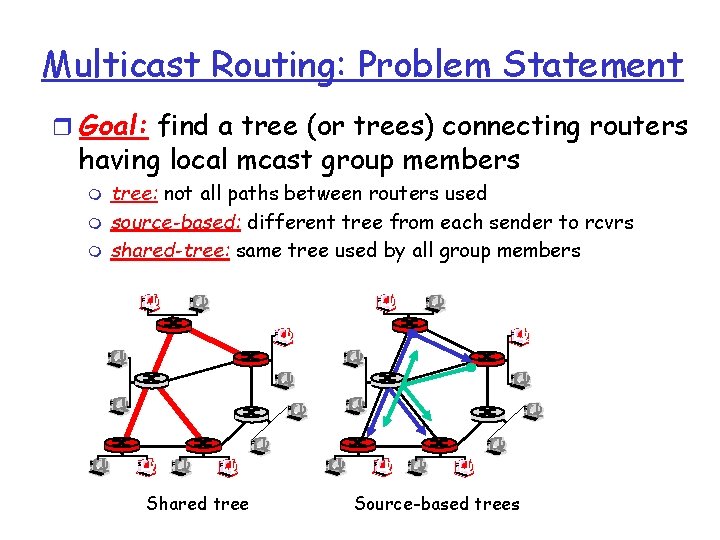
Multicast Routing: Problem Statement r Goal: find a tree (or trees) connecting routers having local mcast group members m m m tree: not all paths between routers used source-based: different tree from each sender to rcvrs shared-tree: same tree used by all group members Shared tree Source-based trees
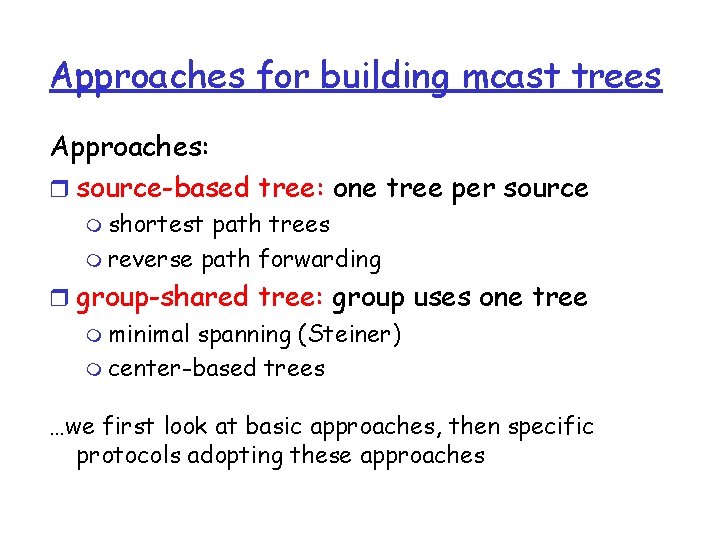
Approaches for building mcast trees Approaches: r source-based tree: one tree per source m shortest path trees m reverse path forwarding r group-shared tree: group uses one tree m minimal spanning (Steiner) m center-based trees …we first look at basic approaches, then specific protocols adopting these approaches
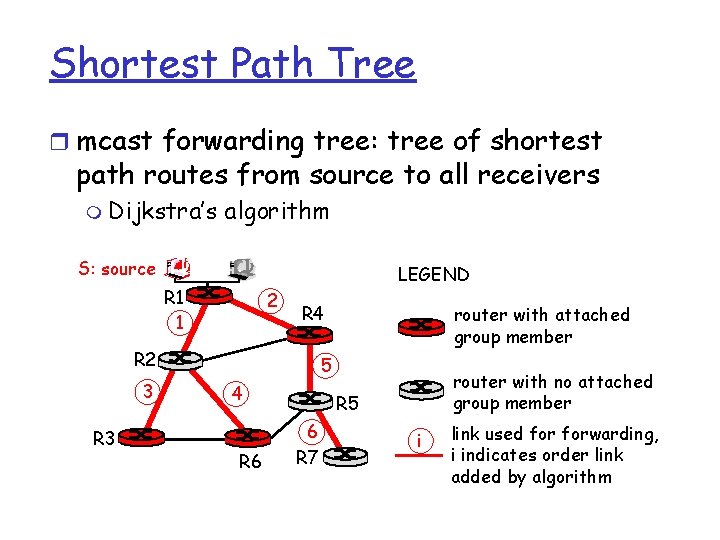
Shortest Path Tree r mcast forwarding tree: tree of shortest path routes from source to all receivers m Dijkstra’s algorithm S: source LEGEND R 1 1 2 R 4 R 2 3 R 3 router with attached group member 5 4 R 6 router with no attached group member R 5 6 R 7 i link used forwarding, i indicates order link added by algorithm
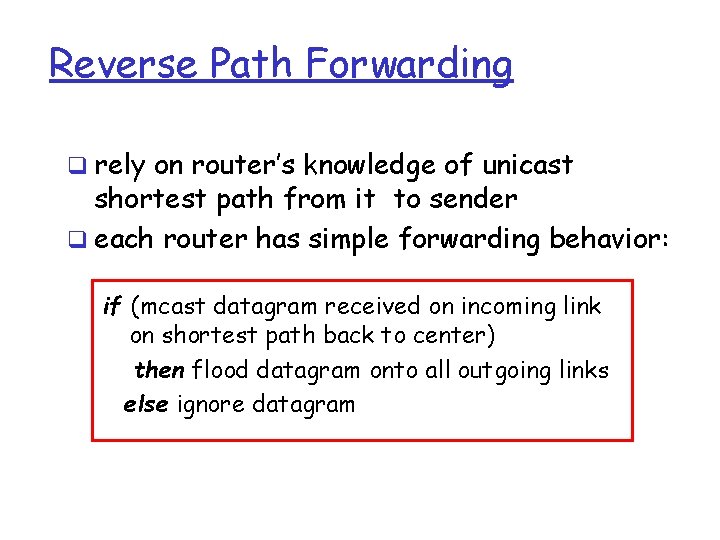
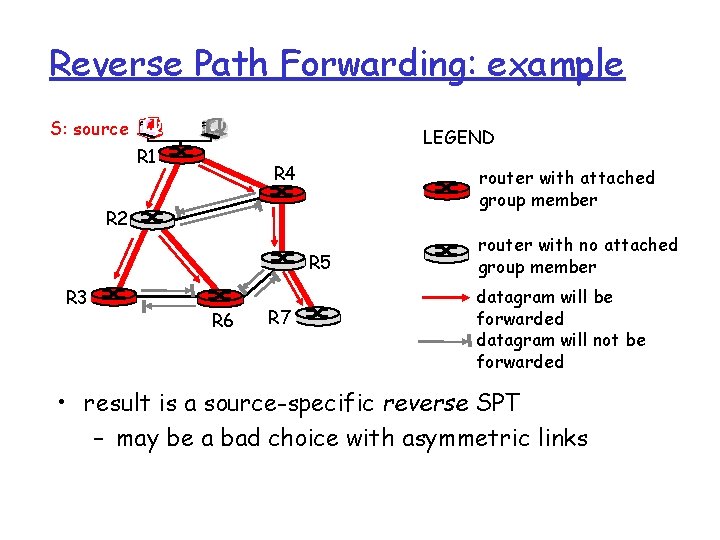
Reverse Path Forwarding q rely on router’s knowledge of unicast shortest path from it to sender q each router has simple forwarding behavior: if (mcast datagram received on incoming link on shortest path back to center) then flood datagram onto all outgoing links else ignore datagram
Reverse Path Forwarding: example S: source LEGEND R 1 R 4 router with attached group member R 2 R 5 R 3 R 6 R 7 router with no attached group member datagram will be forwarded datagram will not be forwarded • result is a source-specific reverse SPT – may be a bad choice with asymmetric links
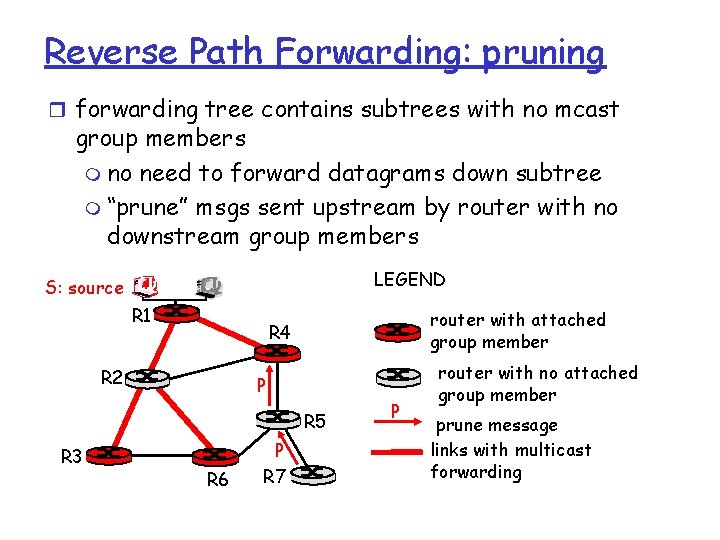
Reverse Path Forwarding: pruning r forwarding tree contains subtrees with no mcast group members m no need to forward datagrams down subtree m “prune” msgs sent upstream by router with no downstream group members LEGEND S: source R 1 router with attached group member R 4 R 2 P R 5 R 3 R 6 P R 7 P router with no attached group member prune message links with multicast forwarding
Shared-Tree: Steiner Tree r Steiner Tree: minimum cost tree connecting all routers with attached group members r problem is NP-complete r excellent heuristics exists r not used in practice: m computational complexity m information about entire network needed m monolithic: rerun whenever a router needs to join/leave
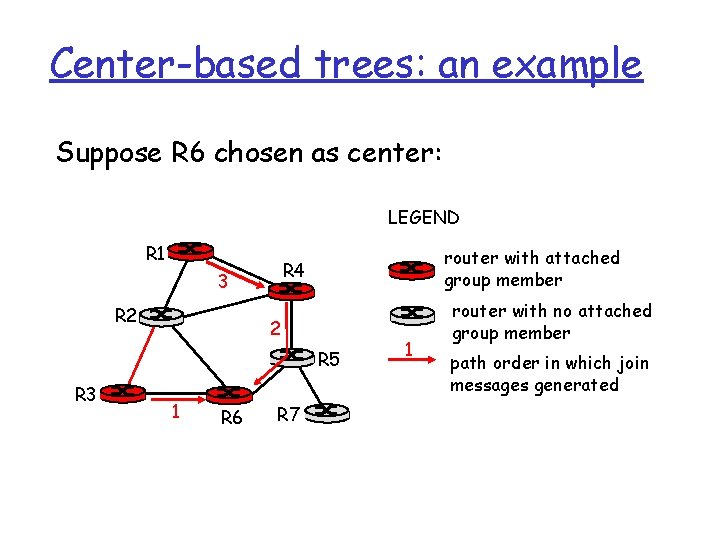
Center-based trees r single delivery tree shared by all r one router identified as “center” of tree r to join: m edge router sends unicast join-msg addressed to center router m join-msg “processed” by intermediate routers and forwarded towards center m join-msg either hits existing tree branch for this center, or arrives at center m path taken by join-msg becomes new branch of tree for this router
Center-based trees: an example Suppose R 6 chosen as center: LEGEND R 1 3 R 2 router with attached group member R 4 2 R 5 R 3 1 R 6 R 7 1 router with no attached group member path order in which join messages generated
Internet Multicasting Routing: DVMRP r DVMRP: distance vector multicast routing protocol, RFC 1075 r flood and prune: reverse path forwarding, source-based tree m RPF tree based on DVMRP’s own routing tables constructed by communicating DVMRP routers m no assumptions about underlying unicast m initial datagram to mcast group flooded everywhere via RPF m routers not wanting group: send upstream prune msgs
DVMRP: continued… r soft state: DVMRP router periodically (1 min. ) “forgets” branches are pruned: m mcast data again flows down unpruned branch m downstream router: reprune or else continue to receive data r routers can quickly regraft to tree m following IGMP join at leaf r odds and ends m commonly implemented in commercial routers m Mbone routing done using DVMRP
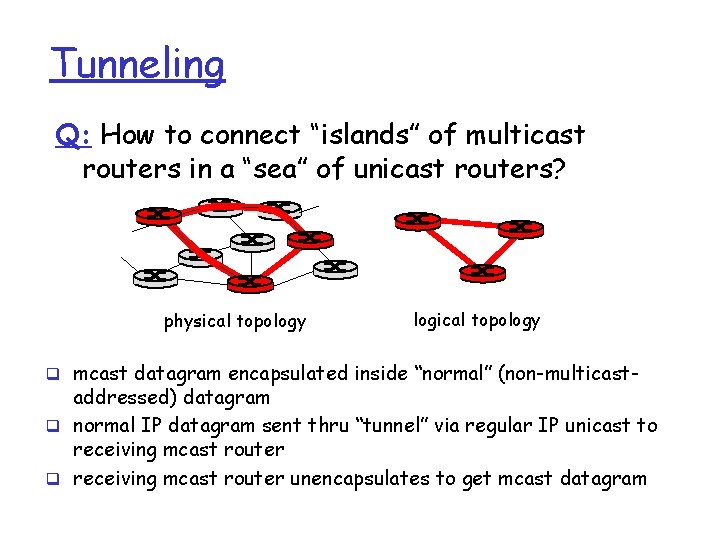
Tunneling Q: How to connect “islands” of multicast routers in a “sea” of unicast routers? physical topology logical topology q mcast datagram encapsulated inside “normal” (non-multicast- addressed) datagram q normal IP datagram sent thru “tunnel” via regular IP unicast to receiving mcast router q receiving mcast router unencapsulates to get mcast datagram
PIM: Protocol Independent Multicast r not dependent on any specific underlying unicast routing algorithm (works with all) r two different multicast distribution scenarios : Dense: Sparse: q group members q # networks with group densely packed, in “close” proximity. q bandwidth more plentiful members small wrt # interconnected networks q group members “widely dispersed” q bandwidth not plentiful
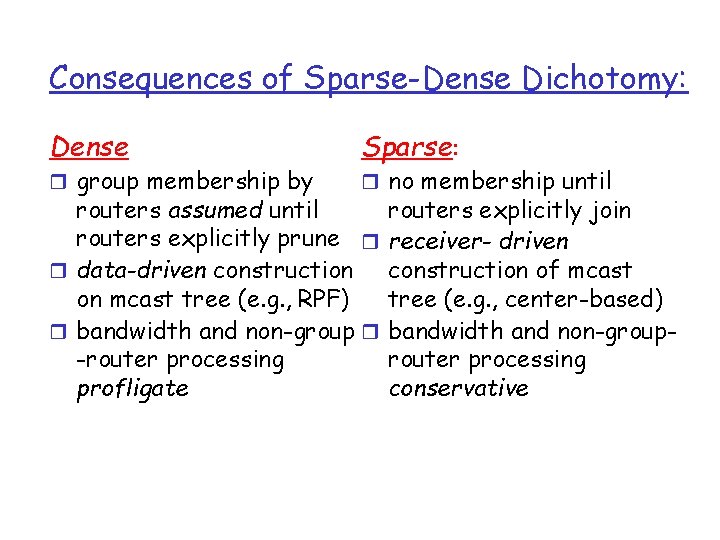
Consequences of Sparse-Dense Dichotomy: Dense r group membership by Sparse: r no membership until routers assumed until routers explicitly prune r r data-driven construction on mcast tree (e. g. , RPF) r bandwidth and non-group r -router processing profligate routers explicitly join receiver- driven construction of mcast tree (e. g. , center-based) bandwidth and non-grouprouter processing conservative
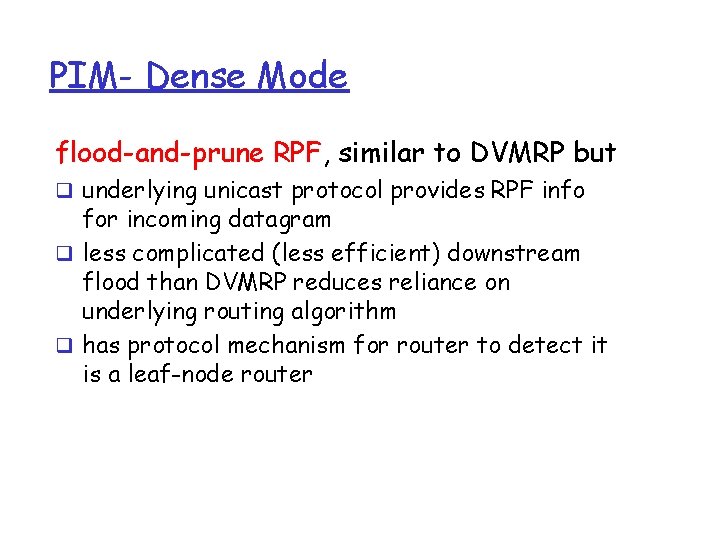
PIM- Dense Mode flood-and-prune RPF, similar to DVMRP but q underlying unicast protocol provides RPF info for incoming datagram q less complicated (less efficient) downstream flood than DVMRP reduces reliance on underlying routing algorithm q has protocol mechanism for router to detect it is a leaf-node router
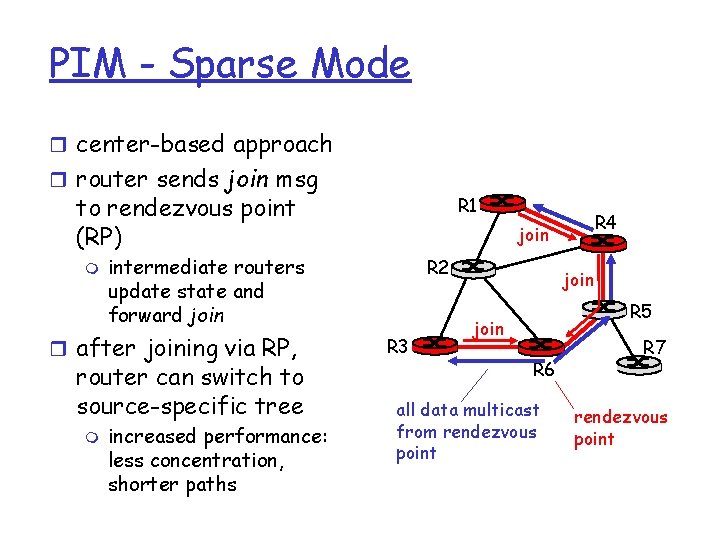
PIM - Sparse Mode r center-based approach r router sends join msg to rendezvous point (RP) m router can switch to source-specific tree increased performance: less concentration, shorter paths R 4 join intermediate routers update state and forward join r after joining via RP, m R 1 R 2 R 3 join R 5 join R 6 all data multicast from rendezvous point R 7 rendezvous point
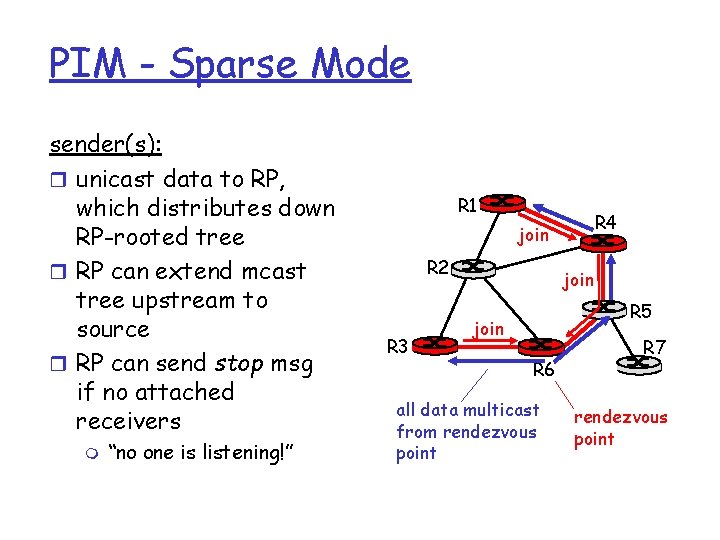
PIM - Sparse Mode sender(s): r unicast data to RP, which distributes down RP-rooted tree r RP can extend mcast tree upstream to source r RP can send stop msg if no attached receivers m “no one is listening!” R 1 R 4 join R 2 R 3 join R 5 join R 6 all data multicast from rendezvous point R 7 rendezvous point
Chapter 4: summary r 4. 1 Introduction r 4. 2 Virtual circuit and datagram networks r 4. 3 What’s inside a router r 4. 4 IP: Internet Protocol m m Datagram format IPv 4 addressing ICMP IPv 6 r 4. 5 Routing algorithms m Link state m Distance Vector m Hierarchical routing r 4. 6 Routing in the Internet m m m RIP OSPF BGP r 4. 7 Broadcast and multicast routing Network Layer 4 -33