
CHAPTER 4 Mutual Funds Chapter Sections Advantages and




- Slides: 78
CHAPTER 4 Mutual Funds Chapter Sections: Advantages and Drawbacks of Mutual Fund Investing Investment Companies and Fund Types Mutual Funds Operations Mutual Funds Costs and Fees Short-Term Funds Long-Term Funds Mutual Fund Performance Closed-End Funds, Exchange Traded Funds, and Hedge Funds Mutual Funds: Investments for the Masses 1
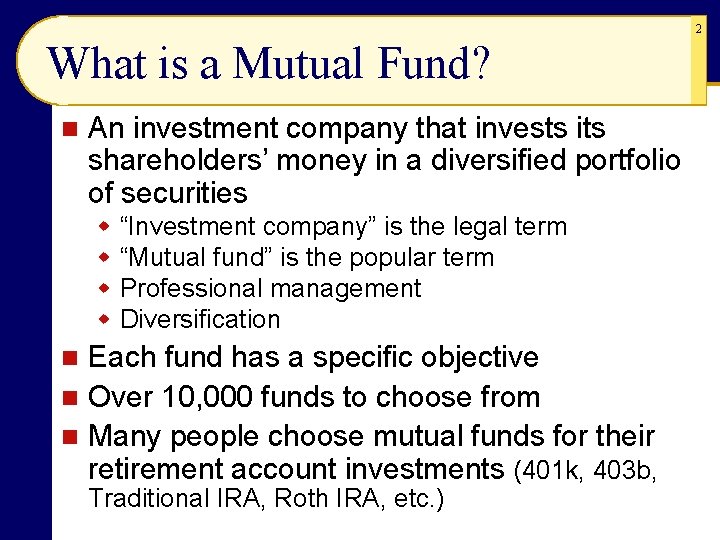
2 What is a Mutual Fund? n An investment company that invests its shareholders’ money in a diversified portfolio of securities w w “Investment company” is the legal term “Mutual fund” is the popular term Professional management Diversification Each fund has a specific objective n Over 10, 000 funds to choose from n Many people choose mutual funds for their retirement account investments (401 k, 403 b, n Traditional IRA, Roth IRA, etc. )
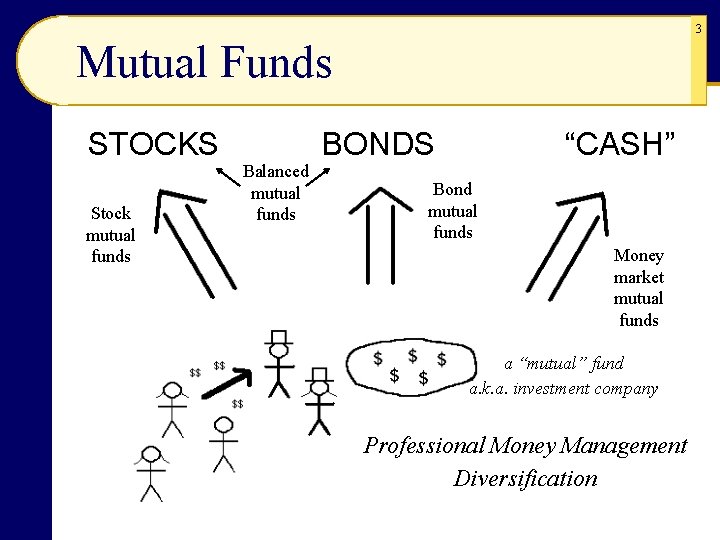
3 Mutual Funds STOCKS Stock mutual funds Balanced mutual funds BONDS “CASH” Bond mutual funds Money market mutual funds a “mutual” fund a. k. a. investment company Professional Money Management Diversification
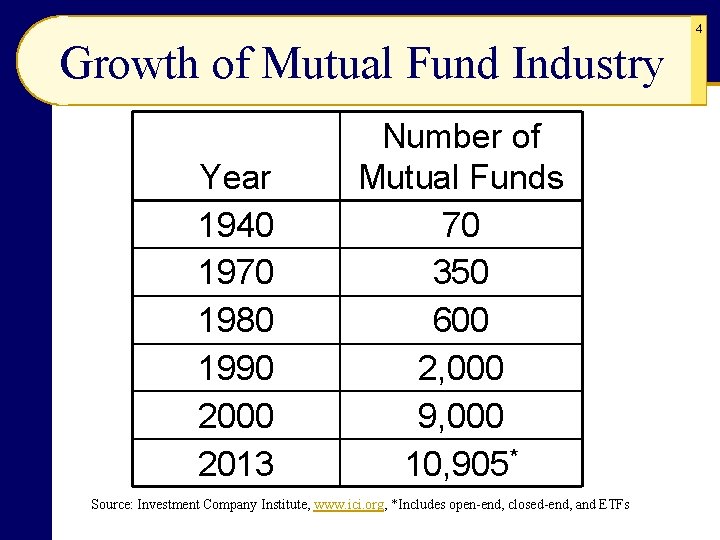
4 Growth of Mutual Fund Industry Year 1940 1970 1980 1990 2000 2013 Number of Mutual Funds 70 350 600 2, 000 9, 000 10, 905* Source: Investment Company Institute, www. ici. org, *Includes open-end, closed-end, and ETFs
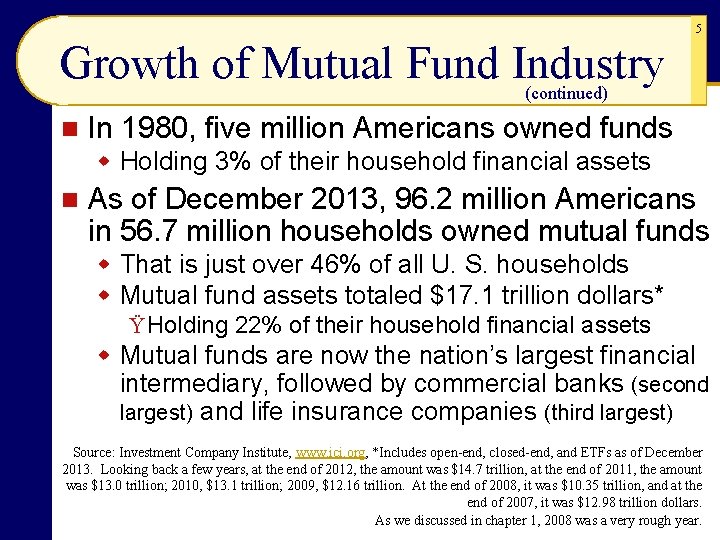
5 Growth of Mutual Fund Industry (continued) n In 1980, five million Americans owned funds w Holding 3% of their household financial assets n As of December 2013, 96. 2 million Americans in 56. 7 million households owned mutual funds w That is just over 46% of all U. S. households w Mutual fund assets totaled $17. 1 trillion dollars* Ÿ Holding 22% of their household financial assets w Mutual funds are now the nation’s largest financial intermediary, followed by commercial banks (second largest) and life insurance companies (third largest) Source: Investment Company Institute, www. ici. org, *Includes open-end, closed-end, and ETFs as of December 2013. Looking back a few years, at the end of 2012, the amount was $14. 7 trillion, at the end of 2011, the amount was $13. 0 trillion; 2010, $13. 1 trillion; 2009, $12. 16 trillion. At the end of 2008, it was $10. 35 trillion, and at the end of 2007, it was $12. 98 trillion dollars. As we discussed in chapter 1, 2008 was a very rough year.
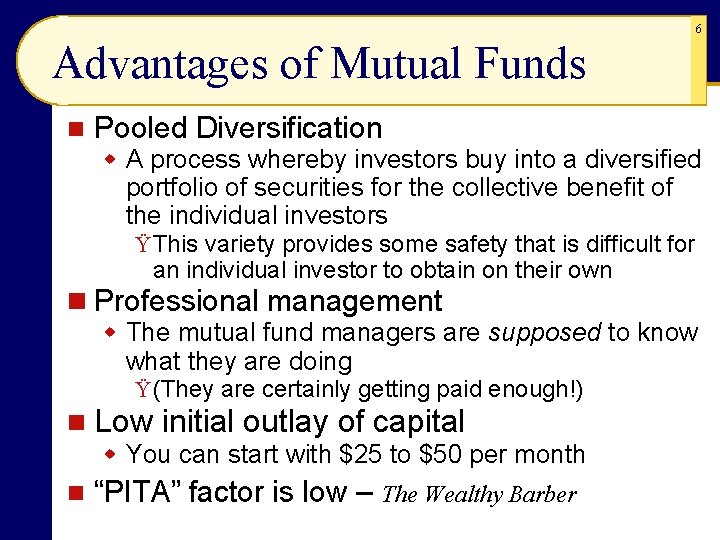
6 Advantages of Mutual Funds n Pooled Diversification w A process whereby investors buy into a diversified portfolio of securities for the collective benefit of the individual investors Ÿ This variety provides some safety that is difficult for an individual investor to obtain on their own n Professional management w The mutual fund managers are supposed to know what they are doing Ÿ (They are certainly getting paid enough!) n Low initial outlay of capital w You can start with $25 to $50 per month n “PITA” factor is low – The Wealthy Barber
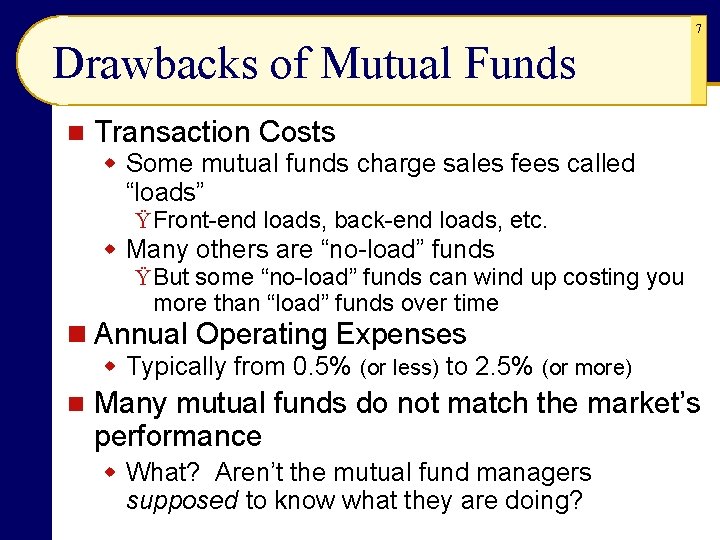
7 Drawbacks of Mutual Funds n Transaction Costs w Some mutual funds charge sales fees called “loads” Ÿ Front-end loads, back-end loads, etc. w Many others are “no-load” funds Ÿ But some “no-load” funds can wind up costing you more than “load” funds over time n Annual Operating Expenses w Typically from 0. 5% (or less) to 2. 5% (or more) n Many mutual funds do not match the market’s performance w What? Aren’t the mutual fund managers supposed to know what they are doing?
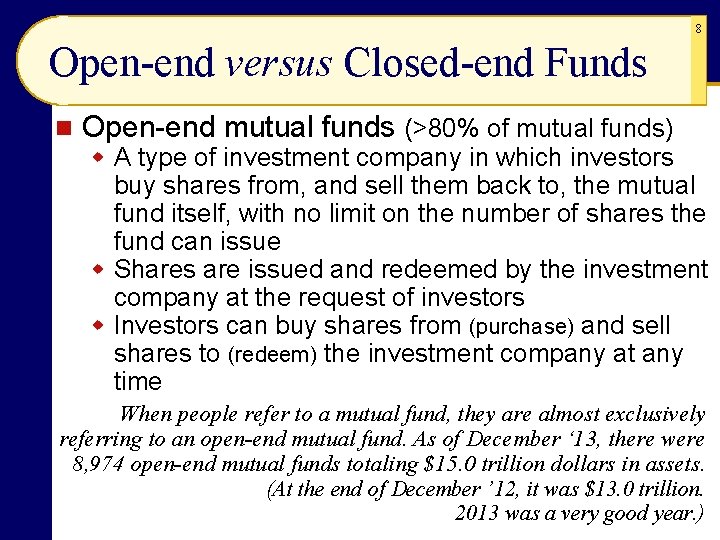
8 Open-end versus Closed-end Funds n Open-end mutual funds (>80% of mutual funds) w A type of investment company in which investors buy shares from, and sell them back to, the mutual fund itself, with no limit on the number of shares the fund can issue w Shares are issued and redeemed by the investment company at the request of investors w Investors can buy shares from (purchase) and sell shares to (redeem) the investment company at any time When people refer to a mutual fund, they are almost exclusively referring to an open-end mutual fund. As of December ‘ 13, there were 8, 974 open-end mutual funds totaling $15. 0 trillion dollars in assets. (At the end of December ’ 12, it was $13. 0 trillion. 2013 was a very good year. )
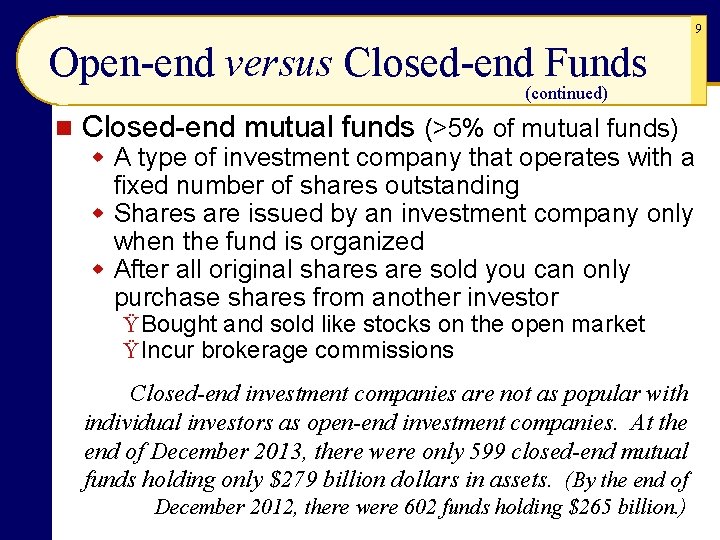
9 Open-end versus Closed-end Funds (continued) n Closed-end mutual funds (>5% of mutual funds) w A type of investment company that operates with a fixed number of shares outstanding w Shares are issued by an investment company only when the fund is organized w After all original shares are sold you can only purchase shares from another investor Ÿ Bought and sold like stocks on the open market Ÿ Incur brokerage commissions Closed-end investment companies are not as popular with individual investors as open-end investment companies. At the end of December 2013, there were only 599 closed-end mutual funds holding only $279 billion dollars in assets. (By the end of December 2012, there were 602 funds holding $265 billion. )
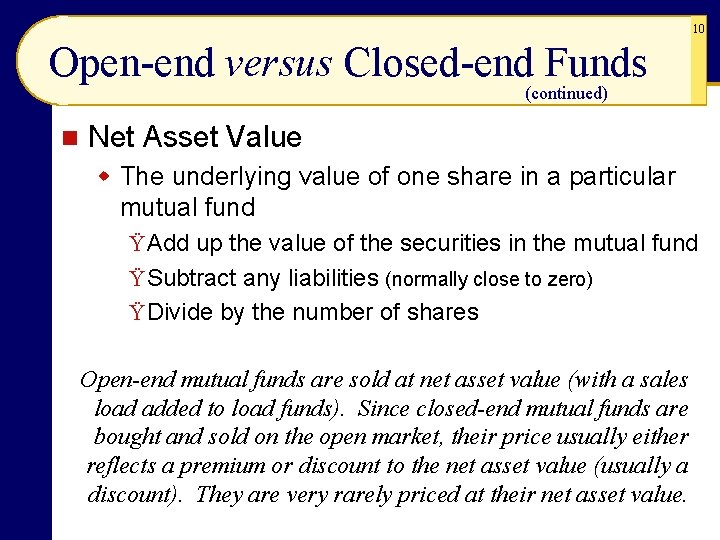
10 Open-end versus Closed-end Funds (continued) n Net Asset Value w The underlying value of one share in a particular mutual fund Ÿ Add up the value of the securities in the mutual fund Ÿ Subtract any liabilities (normally close to zero) Ÿ Divide by the number of shares Open-end mutual funds are sold at net asset value (with a sales load added to load funds). Since closed-end mutual funds are bought and sold on the open market, their price usually either reflects a premium or discount to the net asset value (usually a discount). They are very rarely priced at their net asset value.
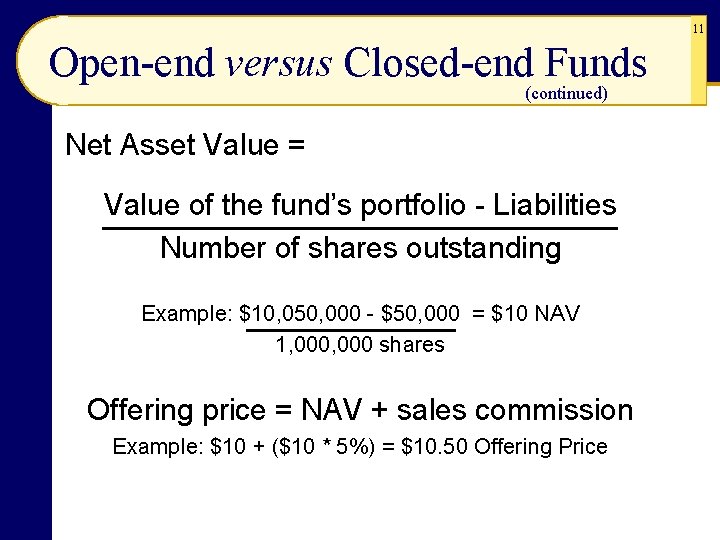
11 Open-end versus Closed-end Funds (continued) Net Asset Value = Value of the fund’s portfolio - Liabilities Number of shares outstanding Example: $10, 050, 000 - $50, 000 = $10 NAV 1, 000 shares Offering price = NAV + sales commission Example: $10 + ($10 * 5%) = $10. 50 Offering Price
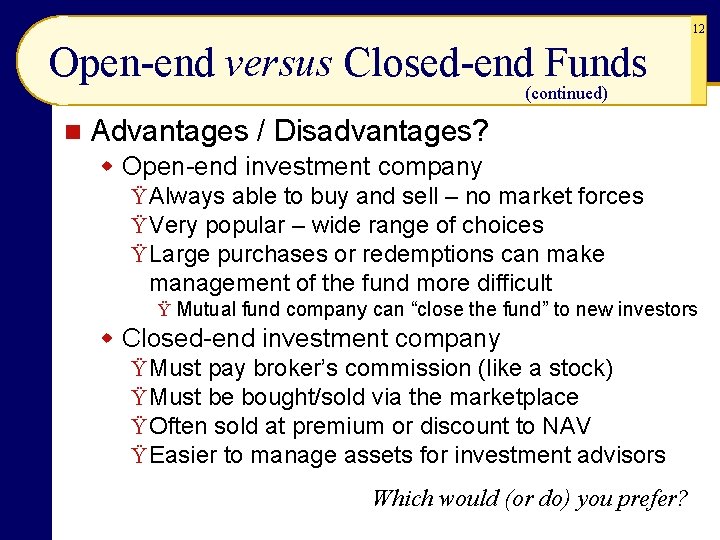
12 Open-end versus Closed-end Funds (continued) n Advantages / Disadvantages? w Open-end investment company Ÿ Always able to buy and sell – no market forces Ÿ Very popular – wide range of choices Ÿ Large purchases or redemptions can make management of the fund more difficult Ÿ Mutual fund company can “close the fund” to new investors w Closed-end investment company Ÿ Must pay broker’s commission (like a stock) Ÿ Must be bought/sold via the marketplace Ÿ Often sold at premium or discount to NAV Ÿ Easier to manage assets for investment advisors Which would (or do) you prefer?
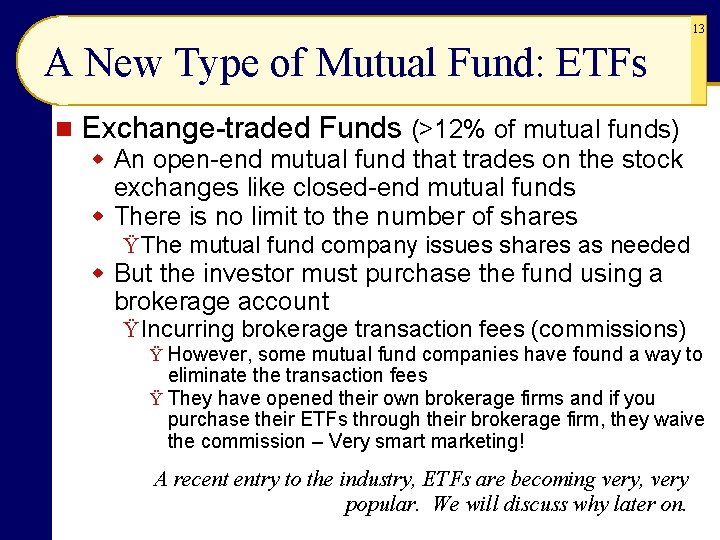
13 A New Type of Mutual Fund: ETFs n Exchange-traded Funds (>12% of mutual funds) w An open-end mutual fund that trades on the stock exchanges like closed-end mutual funds w There is no limit to the number of shares Ÿ The mutual fund company issues shares as needed w But the investor must purchase the fund using a brokerage account Ÿ Incurring brokerage transaction fees (commissions) Ÿ However, some mutual fund companies have found a way to eliminate the transaction fees Ÿ They have opened their own brokerage firms and if you purchase their ETFs through their brokerage firm, they waive the commission – Very smart marketing! A recent entry to the industry, ETFs are becoming very, very popular. We will discuss why later on.
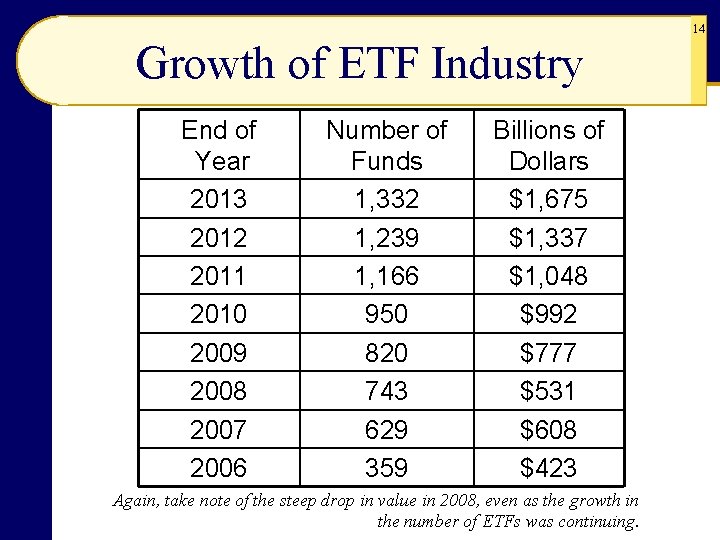
14 Growth of ETF Industry End of Year 2013 2012 2011 2010 2009 2008 2007 2006 Number of Funds 1, 332 1, 239 1, 166 950 820 743 629 359 Billions of Dollars $1, 675 $1, 337 $1, 048 $992 $777 $531 $608 $423 Again, take note of the steep drop in value in 2008, even as the growth in the number of ETFs was continuing.
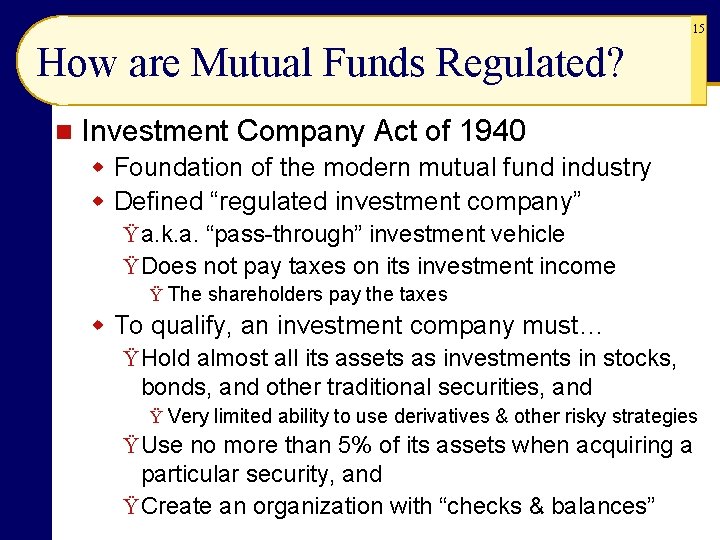
15 How are Mutual Funds Regulated? n Investment Company Act of 1940 w Foundation of the modern mutual fund industry w Defined “regulated investment company” Ÿ a. k. a. “pass-through” investment vehicle Ÿ Does not pay taxes on its investment income Ÿ The shareholders pay the taxes w To qualify, an investment company must… Ÿ Hold almost all its assets as investments in stocks, bonds, and other traditional securities, and Ÿ Very limited ability to use derivatives & other risky strategies Ÿ Use no more than 5% of its assets when acquiring a particular security, and Ÿ Create an organization with “checks & balances”
16 (continued)
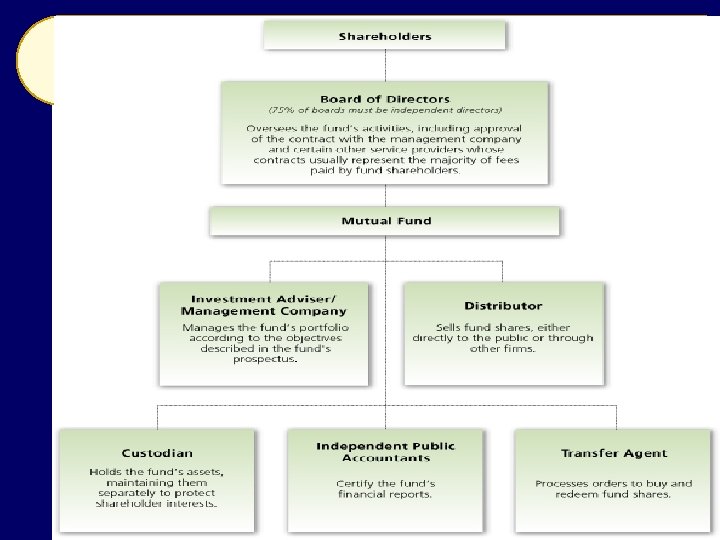
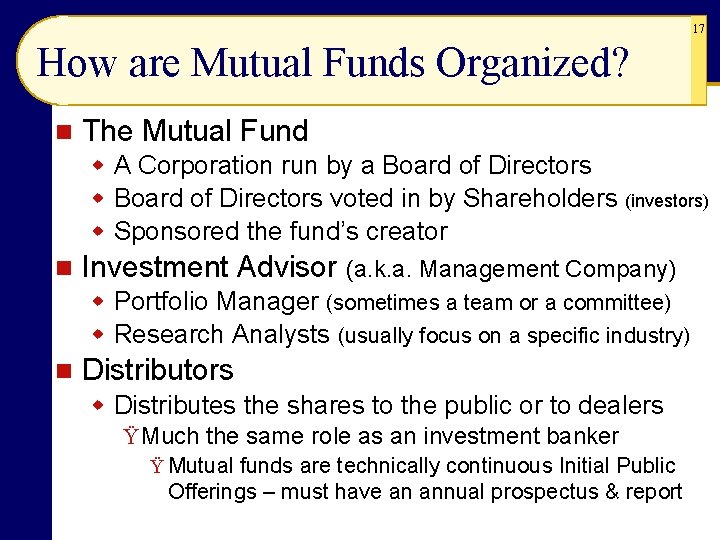
17 How are Mutual Funds Organized? n The Mutual Fund w A Corporation run by a Board of Directors w Board of Directors voted in by Shareholders w Sponsored the fund’s creator n (investors) Investment Advisor (a. k. a. Management Company) w Portfolio Manager (sometimes a team or a committee) w Research Analysts (usually focus on a specific industry) n Distributors w Distributes the shares to the public or to dealers Ÿ Much the same role as an investment banker Ÿ Mutual funds are technically continuous Initial Public Offerings – must have an annual prospectus & report
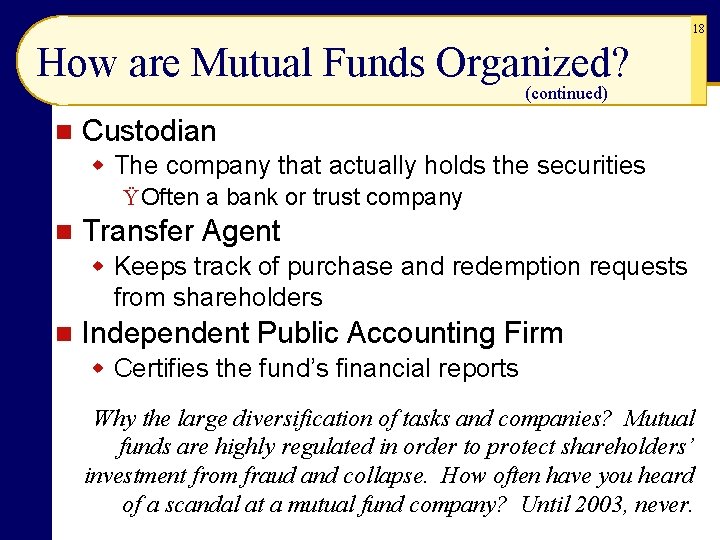
18 How are Mutual Funds Organized? (continued) n Custodian w The company that actually holds the securities Ÿ Often a bank or trust company n Transfer Agent w Keeps track of purchase and redemption requests from shareholders n Independent Public Accounting Firm w Certifies the fund’s financial reports Why the large diversification of tasks and companies? Mutual funds are highly regulated in order to protect shareholders’ investment from fraud and collapse. How often have you heard of a scandal at a mutual fund company? Until 2003, never.
Wait a minute, Paiano! Did you just say, “Mutual Fund Scandals? !” n “You want me to invest in an industry that is plagued with scandal? !” w Since 1940, the mutual fund industry has been regulated and escaped any hint of impropriety w In 2003, some practices that were not quite illegal but obviously unethical were uncovered Ÿ Only a handful of funds and people were affected Ÿ Strong, Janus, Bank of America, Putnum, Alliance w The vast majority of companies never engaged in any of the shenanigans Instead of losing $99, 999. 99 on a $100, 000 account (example: Enron or World. Com), investors lost $0. 01 on a $100, 000 account. 19
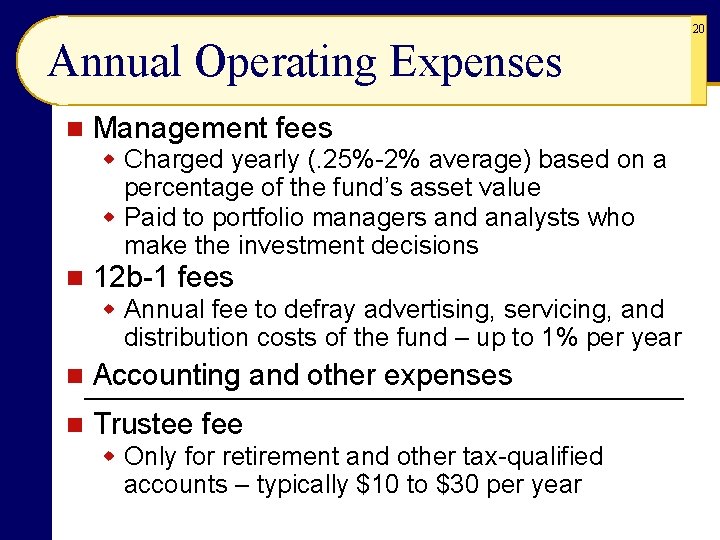
Annual Operating Expenses n Management fees w Charged yearly (. 25%-2% average) based on a percentage of the fund’s asset value w Paid to portfolio managers and analysts who make the investment decisions n 12 b-1 fees w Annual fee to defray advertising, servicing, and distribution costs of the fund – up to 1% per year n Accounting and other expenses n Trustee fee w Only for retirement and other tax-qualified accounts – typically $10 to $30 per year 20
Annual Operating Expenses (continued) n Trading Costs w Not disclosed in the annual prospectus w So how does an investor know how much the trading costs are? Ÿ You can ask the mutual fund or just look at the… w Annual Turnover Ÿ Measure of how much trading a mutual fund does Ÿ Measured in percentage of the amount a portfolio “turns over” each year Ÿ 100% turnover, 50% turnover, etc. Ÿ The higher the turnover, the higher the trading costs Ÿ Also gives you an idea how long they hold investments Ÿ 100% turnover: They hold on average one year Ÿ 50% turnover: They hold on average two years 21
22 Load versus No-load Funds n Load Fund w A mutual fund that charges a commission when shares are bought w Typically 3% to 5% w Used to compensate the financial representative Ÿ Along with the fund distributor n No-load Fund w A mutual fund that does not charge a commission when shares are bought Ÿ Traditionally sold directly to shareholders The endless debate: Should you purchase a Load Fund or No-load Fund?
23 Load versus No-load Funds n (continued) Types of Load Funds w Front-end Load – a. k. a. Class A Ÿ Commission is paid when shares are purchased Ÿ Normally have lower annual operating expenses w Back-end Load – a. k. a. Class B Ÿ Commission is paid when shares are redeemed Ÿ Most back-end load funds have a Contingent Deferred Sales Charge (CDSC) Ÿ The CDSC declines to zero over a period of 3 to 6 years Ÿ 5% first year, 4% second year, 3% third year, etc. Ÿ Normally, the back-end load pay higher annual operating expenses (12 b-1 fees) until the CDSC declines to zero Ÿ Eventually, the Class B shares revert to Class A shares
24 Load versus No-load Funds n (continued) Types of Load Funds (continued) w No-load Funds (Huh? ) – a. k. a. Class C Ÿ No front-end nor back-end commissions Ÿ Except 1% back-end charge if redeemed within one year Ÿ However, many Class C funds have higher annual operating expenses in perpetuity (or for a long time) Ÿ There are those 12 b-1 fees again Ÿ Hence, they can wind up costing more than the Class A or Class B shares over time Ÿ The SEC now says you can not call a mutual fund a “no-load” fund if the 12 b-1 fee is greater than 0. 25% Ÿ So, Class C shares are now not allowed to be called “no- load” funds even though many in the industry still do
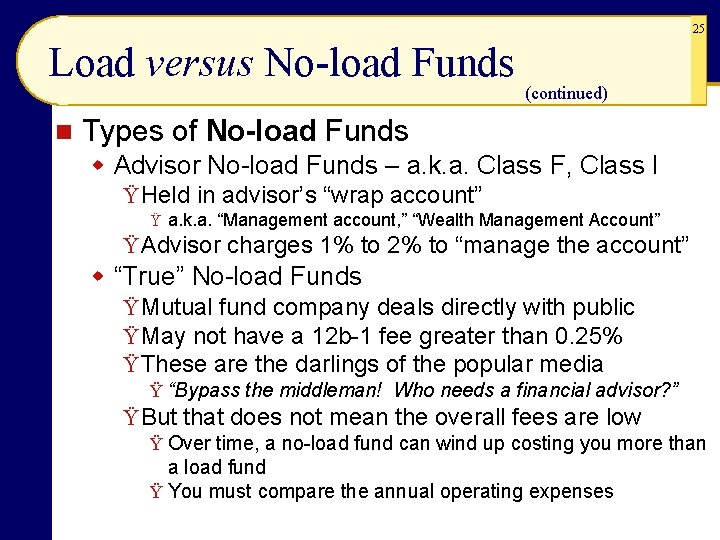
25 Load versus No-load Funds n (continued) Types of No-load Funds w Advisor No-load Funds – a. k. a. Class F, Class I Ÿ Held in advisor’s “wrap account” Ÿ a. k. a. “Management account, ” “Wealth Management Account” Ÿ Advisor charges 1% to 2% to “manage the account” w “True” No-load Funds Ÿ Mutual fund company deals directly with public Ÿ May not have a 12 b-1 fee greater than 0. 25% Ÿ These are the darlings of the popular media Ÿ “Bypass the middleman! Who needs a financial advisor? ” Ÿ But that does not mean the overall fees are low Ÿ Over time, a no-load fund can wind up costing you more than a load fund Ÿ You must compare the annual operating expenses
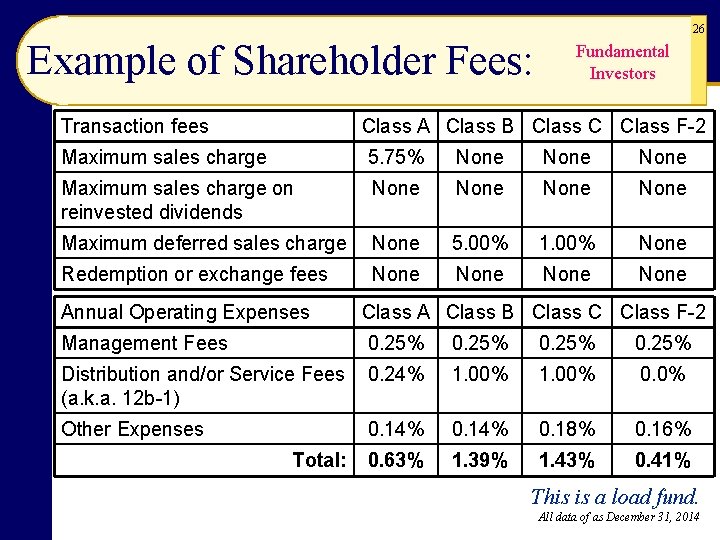
26 Example of Shareholder Fees: Transaction fees Fundamental Investors Class A Class B Class C Class F-2 Maximum sales charge 5. 75% None Maximum sales charge on reinvested dividends None Maximum deferred sales charge None 5. 00% 1. 00% None Redemption or exchange fees None Annual Operating Expenses Class A Class B Class C Class F-2 Management Fees 0. 25% Distribution and/or Service Fees (a. k. a. 12 b-1) 0. 24% 1. 00% 0. 0% Other Expenses 0. 14% 0. 18% 0. 16% 0. 63% 1. 39% 1. 43% 0. 41% Total: This is a load fund. All data of as December 31, 2014
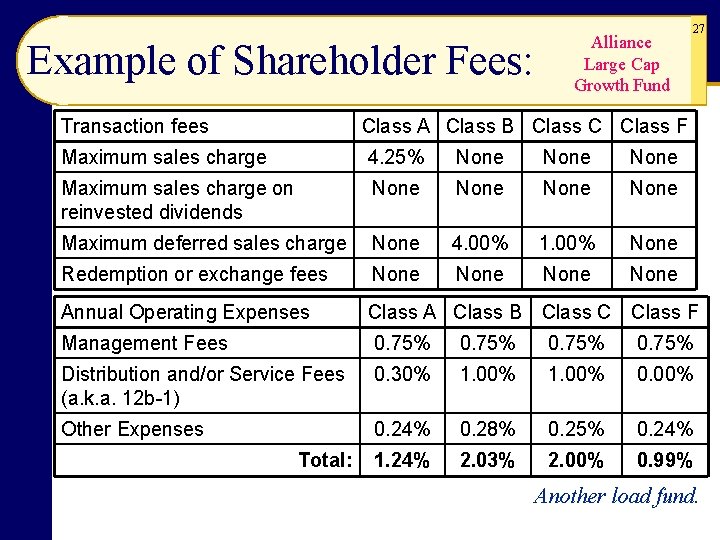
Example of Shareholder Fees: Transaction fees Alliance Large Cap Growth Fund 27 Class A Class B Class C Class F Maximum sales charge 4. 25% None Maximum sales charge on reinvested dividends None Maximum deferred sales charge None 4. 00% 1. 00% None Redemption or exchange fees None Annual Operating Expenses Class A Class B Class C Class F Management Fees 0. 75% Distribution and/or Service Fees (a. k. a. 12 b-1) 0. 30% 1. 00% 0. 00% Other Expenses 0. 24% 0. 28% 0. 25% 0. 24% 1. 24% 2. 03% 2. 00% 0. 99% Total: Another load fund.
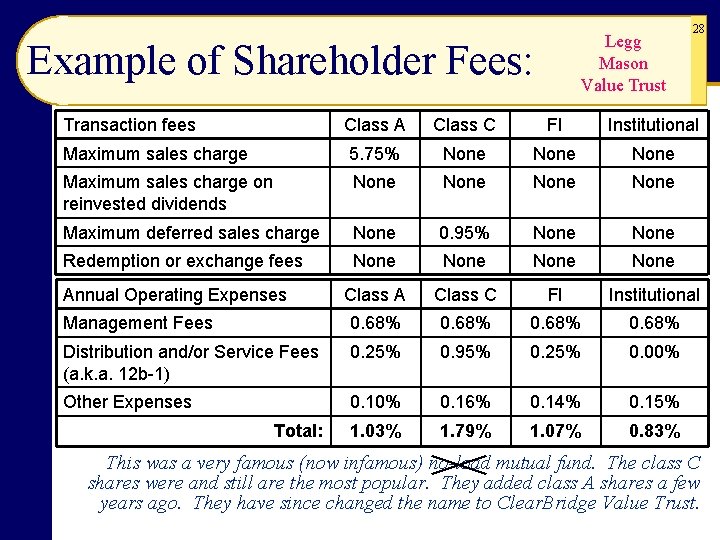
Legg Mason Value Trust Example of Shareholder Fees: Transaction fees 28 Class A Class C FI Institutional Maximum sales charge 5. 75% None Maximum sales charge on reinvested dividends None Maximum deferred sales charge None 0. 95% None Redemption or exchange fees None Class A Class C FI Institutional Management Fees 0. 68% Distribution and/or Service Fees (a. k. a. 12 b-1) 0. 25% 0. 95% 0. 25% 0. 00% Other Expenses 0. 10% 0. 16% 0. 14% 0. 15% 1. 03% 1. 79% 1. 07% 0. 83% Annual Operating Expenses Total: This was a very famous (now infamous) no-load mutual fund. The class C shares were and still are the most popular. They added class A shares a few years ago. They have since changed the name to Clear. Bridge Value Trust.
Example of Shareholder Fees: Vanguard 500 Index Fund 29 Transaction fees This is an index fund. This Maximum sales charge None fund does no research. They Maximum sales charge on None simply buy all the 500 stocks in the S&P 500 Index. The reinvested dividends term for this is “passive Maximum deferred sales charge None management. ” (More later) Redemption or exchange fees None Index funds are usually “true” no-load mutual funds Annual Operating Expenses Class A and usually (but not always) Management Fees 0. 15% have very low fees. Distribution and/or Service Fees (a. k. a. 12 b-1) Other Expenses 0. 02% Total: 0. 17% There is a $20 annual fee if your account value is less than $10, 000 unless you enroll in electronic delivery of financial communications.
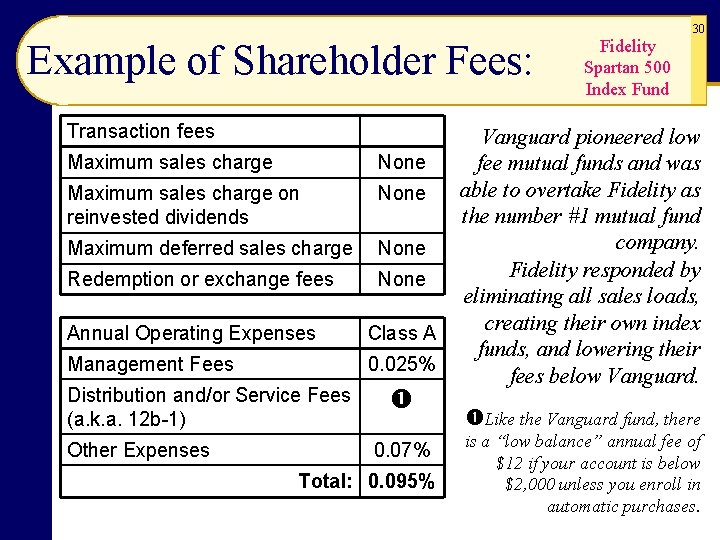
Example of Shareholder Fees: Transaction fees Maximum sales charge None Maximum sales charge on reinvested dividends None Maximum deferred sales charge None Redemption or exchange fees None Annual Operating Expenses Class A Management Fees 0. 025% Distribution and/or Service Fees (a. k. a. 12 b-1) Other Expenses 0. 07% Total: 0. 095% Fidelity Spartan 500 Index Fund 30 Vanguard pioneered low fee mutual funds and was able to overtake Fidelity as the number #1 mutual fund company. Fidelity responded by eliminating all sales loads, creating their own index funds, and lowering their fees below Vanguard. Like the Vanguard fund, there is a “low balance” annual fee of $12 if your account is below $2, 000 unless you enroll in automatic purchases.
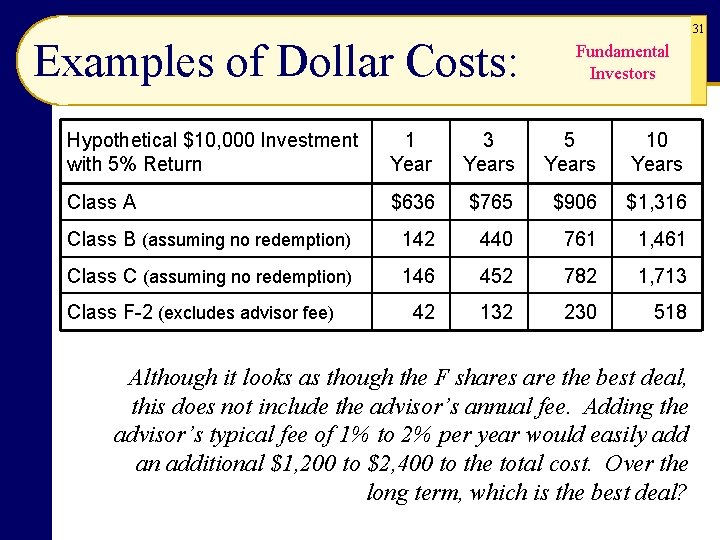
Examples of Dollar Costs: 31 Fundamental Investors Hypothetical $10, 000 Investment with 5% Return 1 Year 3 Years 5 Years 10 Years Class A $636 $765 $906 $1, 316 Class B (assuming no redemption) 142 440 761 1, 461 Class C (assuming no redemption) 146 452 782 1, 713 42 132 230 518 Class F-2 (excludes advisor fee) Although it looks as though the F shares are the best deal, this does not include the advisor’s annual fee. Adding the advisor’s typical fee of 1% to 2% per year would easily add an additional $1, 200 to $2, 400 to the total cost. Over the long term, which is the best deal?
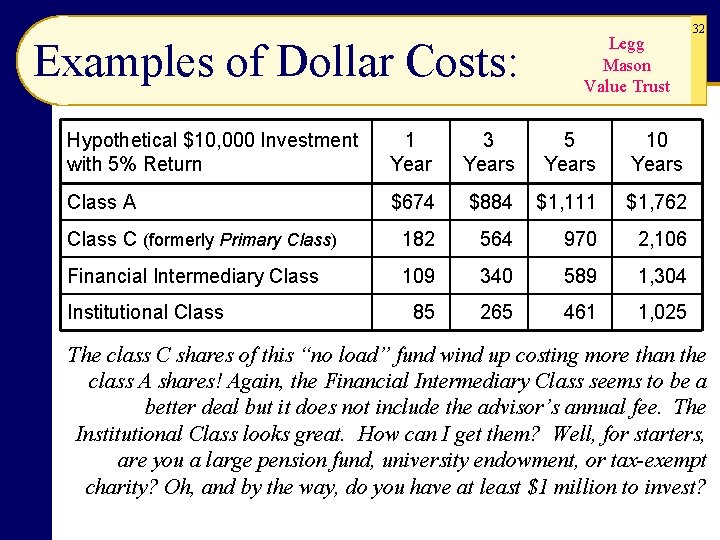
Examples of Dollar Costs: Legg Mason Value Trust Hypothetical $10, 000 Investment with 5% Return 1 Year 3 Years 5 Years 10 Years Class A $674 $884 $1, 111 $1, 762 Class C (formerly Primary Class) 182 564 970 2, 106 Financial Intermediary Class 109 340 589 1, 304 85 265 461 1, 025 Institutional Class 32 The class C shares of this “no load” fund wind up costing more than the class A shares! Again, the Financial Intermediary Class seems to be a better deal but it does not include the advisor’s annual fee. The Institutional Class looks great. How can I get them? Well, for starters, are you a large pension fund, university endowment, or tax-exempt charity? Oh, and by the way, do you have at least $1 million to invest?
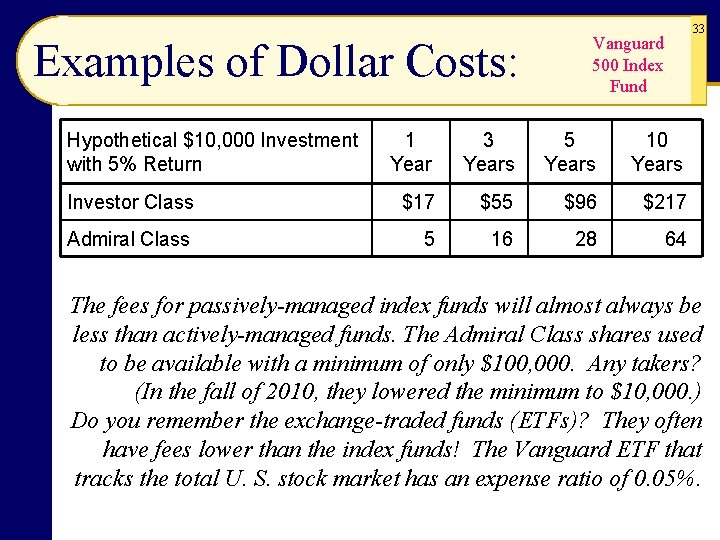
Examples of Dollar Costs: Hypothetical $10, 000 Investment with 5% Return 33 Vanguard 500 Index Fund 1 Year 3 Years 5 Years 10 Years Investor Class $17 $55 $96 $217 Admiral Class 5 16 28 64 The fees for passively-managed index funds will almost always be less than actively-managed funds. The Admiral Class shares used to be available with a minimum of only $100, 000. Any takers? (In the fall of 2010, they lowered the minimum to $10, 000. ) Do you remember the exchange-traded funds (ETFs)? They often have fees lower than the index funds! The Vanguard ETF that tracks the total U. S. stock market has an expense ratio of 0. 05%.
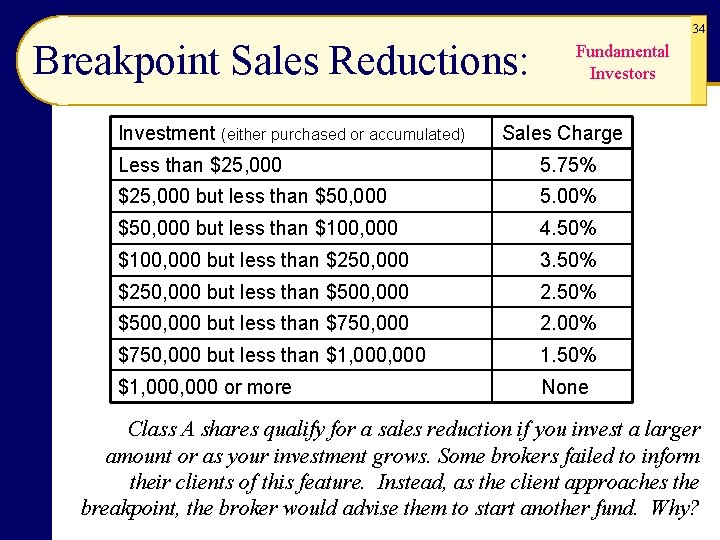
34 Breakpoint Sales Reductions: Investment (either purchased or accumulated) Fundamental Investors Sales Charge Less than $25, 000 5. 75% $25, 000 but less than $50, 000 5. 00% $50, 000 but less than $100, 000 4. 50% $100, 000 but less than $250, 000 3. 50% $250, 000 but less than $500, 000 2. 50% $500, 000 but less than $750, 000 2. 00% $750, 000 but less than $1, 000 1. 50% $1, 000 or more None Class A shares qualify for a sales reduction if you invest a larger amount or as your investment grows. Some brokers failed to inform their clients of this feature. Instead, as the client approaches the breakpoint, the broker would advise them to start another fund. Why?
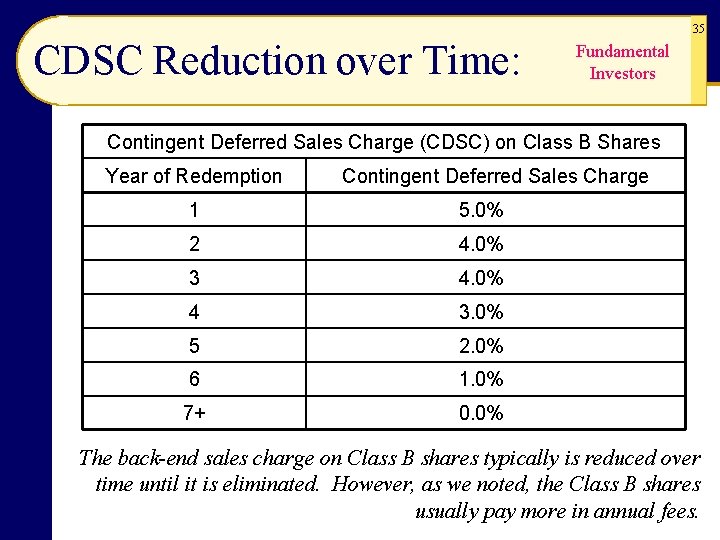
35 CDSC Reduction over Time: Fundamental Investors Contingent Deferred Sales Charge (CDSC) on Class B Shares Year of Redemption Contingent Deferred Sales Charge 1 5. 0% 2 4. 0% 3 4. 0% 4 3. 0% 5 2. 0% 6 1. 0% 7+ 0. 0% The back-end sales charge on Class B shares typically is reduced over time until it is eliminated. However, as we noted, the Class B shares usually pay more in annual fees.
10 -Year Rates of Return: as of December 31, 2014 Investment So, Which One Would You Pick? 10 -Year Return Growth of $10, 000 A Fundamental Investors, Class A 7. 97%* $21, 529 B Alliance Large Cap Growth Fund, Class A 8. 99%* $24, 715 C Legg Mason Value Trust, Class C 1. 84% $12, 000 D Vanguard Index 500 Fund 7. 55% $20, 711 Standard & Poor’s 500 Index 7. 67% $20, 947 formerly Primary Class 36 Fees are important, but they certainly do not tell you the whole story. When comparing mutual funds, you must look at many attributes, not the least of which are the rates of return, preferably over longer periods of time. *8. 61% and 9. 47%, respectively, without sales charge (a. k. a. NAV, net asset value)
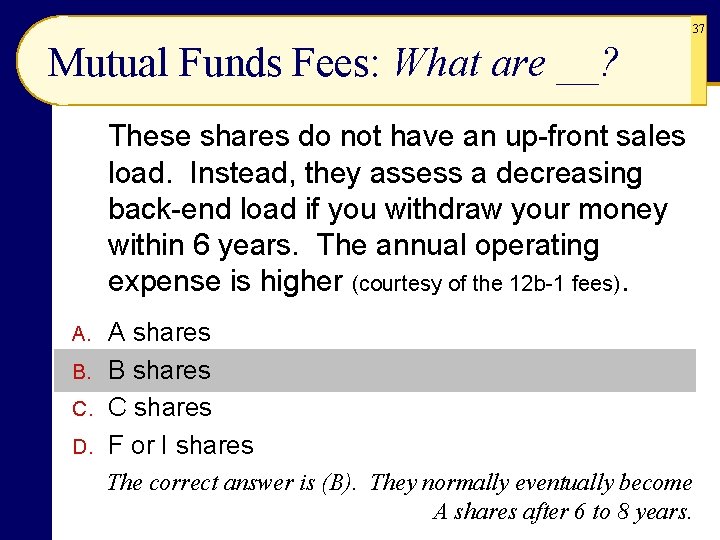
37 Mutual Funds Fees: What are __? These shares do not have an up-front sales load. Instead, they assess a decreasing back-end load if you withdraw your money within 6 years. The annual operating expense is higher (courtesy of the 12 b-1 fees). A shares B. B shares C. C shares D. F or I shares A. The correct answer is (B). They normally eventually become A shares after 6 to 8 years.
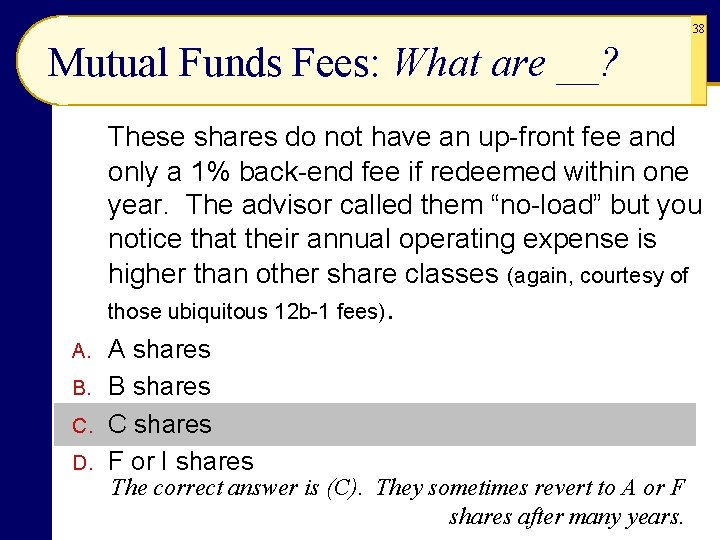
38 Mutual Funds Fees: What are __? These shares do not have an up-front fee and only a 1% back-end fee if redeemed within one year. The advisor called them “no-load” but you notice that their annual operating expense is higher than other share classes (again, courtesy of those ubiquitous 12 b-1 fees). A shares B. B shares C. C shares D. F or I shares A. The correct answer is (C). They sometimes revert to A or F shares after many years.
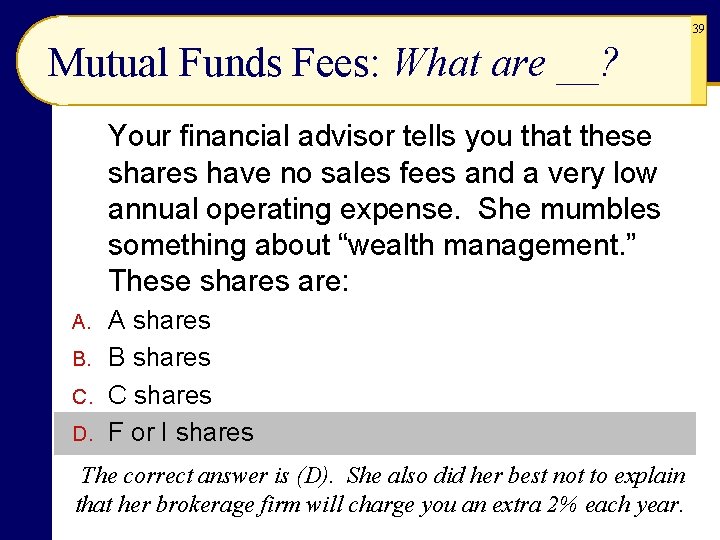
39 Mutual Funds Fees: What are __? Your financial advisor tells you that these shares have no sales fees and a very low annual operating expense. She mumbles something about “wealth management. ” These shares are: A shares B. B shares C. C shares D. F or I shares A. The correct answer is (D). She also did her best not to explain that her brokerage firm will charge you an extra 2% each year.
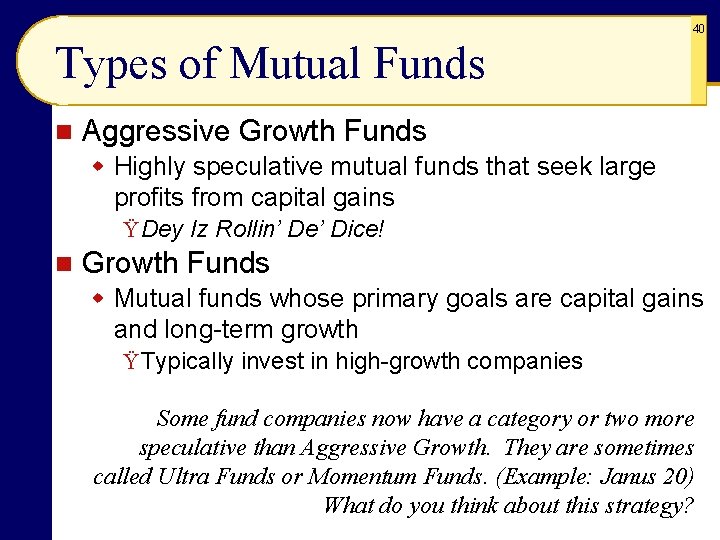
40 Types of Mutual Funds n Aggressive Growth Funds w Highly speculative mutual funds that seek large profits from capital gains Ÿ Dey Iz Rollin’ De’ Dice! n Growth Funds w Mutual funds whose primary goals are capital gains and long-term growth Ÿ Typically invest in high-growth companies Some fund companies now have a category or two more speculative than Aggressive Growth. They are sometimes called Ultra Funds or Momentum Funds. (Example: Janus 20) What do you think about this strategy?
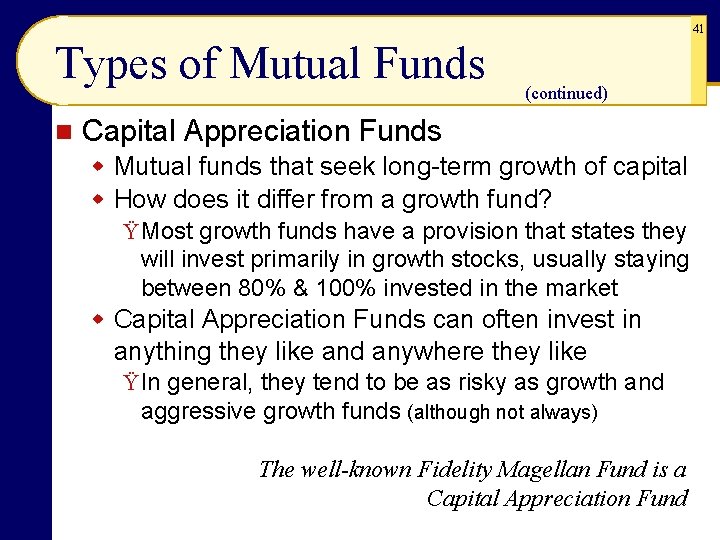
41 Types of Mutual Funds n (continued) Capital Appreciation Funds w Mutual funds that seek long-term growth of capital w How does it differ from a growth fund? Ÿ Most growth funds have a provision that states they will invest primarily in growth stocks, usually staying between 80% & 100% invested in the market w Capital Appreciation Funds can often invest in anything they like and anywhere they like Ÿ In general, they tend to be as risky as growth and aggressive growth funds (although not always) The well-known Fidelity Magellan Fund is a Capital Appreciation Fund
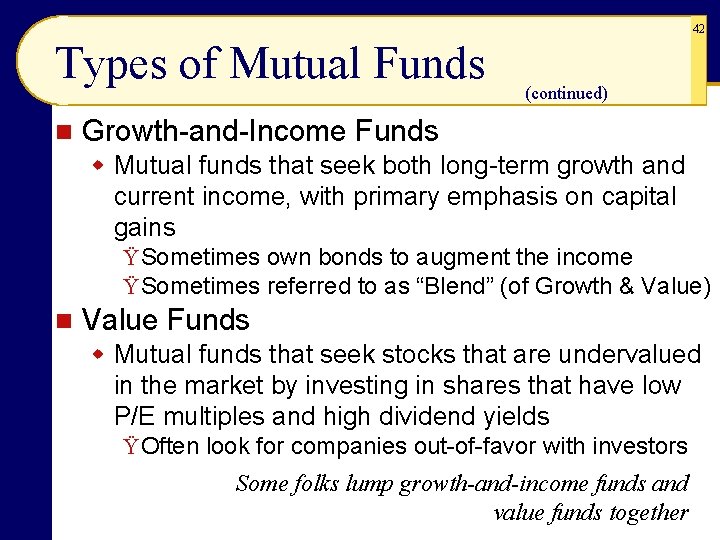
42 Types of Mutual Funds n (continued) Growth-and-Income Funds w Mutual funds that seek both long-term growth and current income, with primary emphasis on capital gains Ÿ Sometimes own bonds to augment the income Ÿ Sometimes referred to as “Blend” (of Growth & Value) n Value Funds w Mutual funds that seek stocks that are undervalued in the market by investing in shares that have low P/E multiples and high dividend yields Ÿ Often look for companies out-of-favor with investors Some folks lump growth-and-income funds and value funds together
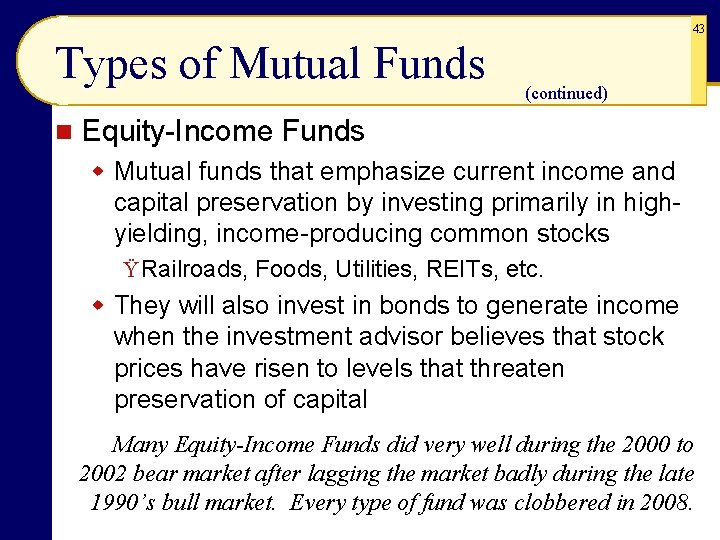
43 Types of Mutual Funds n (continued) Equity-Income Funds w Mutual funds that emphasize current income and capital preservation by investing primarily in highyielding, income-producing common stocks Ÿ Railroads, Foods, Utilities, REITs, etc. w They will also invest in bonds to generate income when the investment advisor believes that stock prices have risen to levels that threaten preservation of capital Many Equity-Income Funds did very well during the 2000 to 2002 bear market after lagging the market badly during the late 1990’s bull market. Every type of fund was clobbered in 2008.
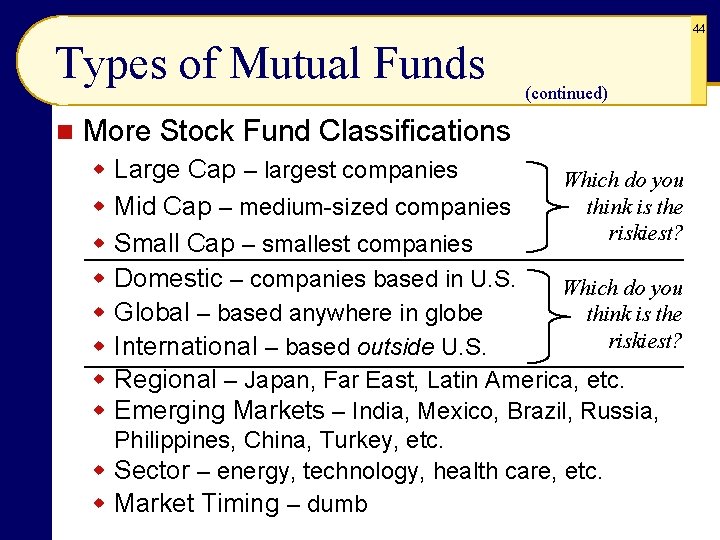
44 Types of Mutual Funds n (continued) More Stock Fund Classifications w Large Cap – largest companies w Mid Cap – medium-sized companies w w w Which do you think is the riskiest? Small Cap – smallest companies Domestic – companies based in U. S. Which do you Global – based anywhere in globe think is the riskiest? International – based outside U. S. Regional – Japan, Far East, Latin America, etc. Emerging Markets – India, Mexico, Brazil, Russia, Philippines, China, Turkey, etc. w Sector – energy, technology, health care, etc. w Market Timing – dumb
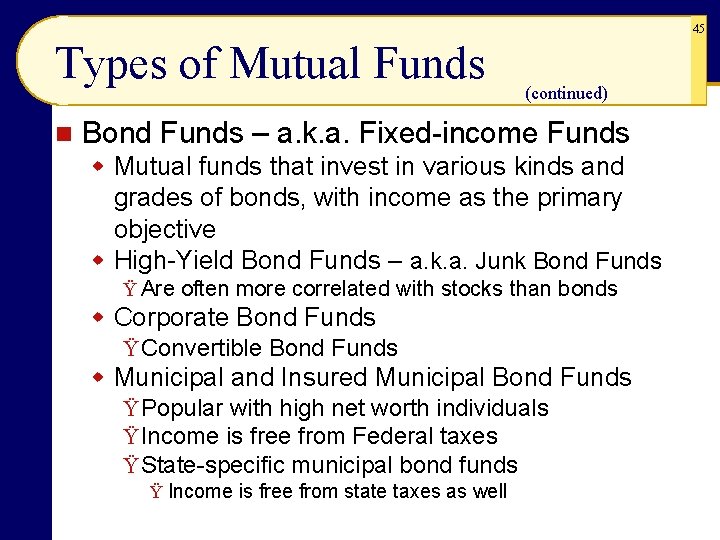
45 Types of Mutual Funds n (continued) Bond Funds – a. k. a. Fixed-income Funds w Mutual funds that invest in various kinds and grades of bonds, with income as the primary objective w High-Yield Bond Funds – a. k. a. Junk Bond Funds Ÿ Are often more correlated with stocks than bonds w Corporate Bond Funds Ÿ Convertible Bond Funds w Municipal and Insured Municipal Bond Funds Ÿ Popular with high net worth individuals Ÿ Income is free from Federal taxes Ÿ State-specific municipal bond funds Ÿ Income is free from state taxes as well
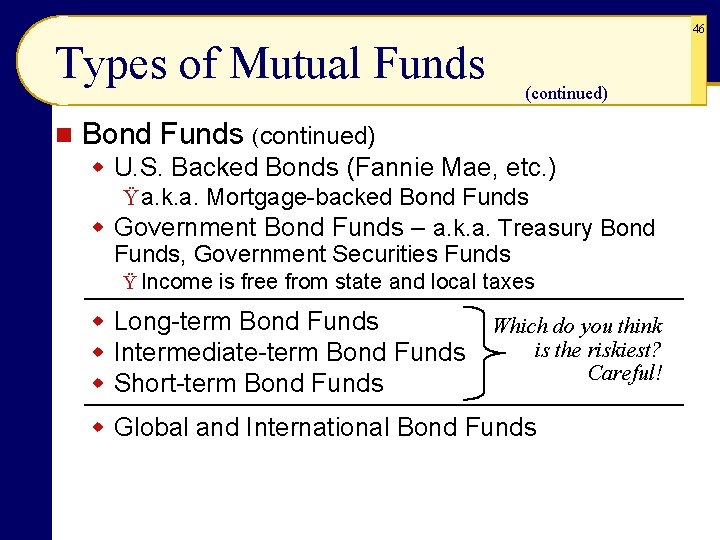
46 Types of Mutual Funds n (continued) Bond Funds (continued) w U. S. Backed Bonds (Fannie Mae, etc. ) Ÿ a. k. a. Mortgage-backed Bond Funds w Government Bond Funds – a. k. a. Treasury Bond Funds, Government Securities Funds Ÿ Income is free from state and local taxes w Long-term Bond Funds w Intermediate-term Bond Funds w Short-term Bond Funds Which do you think is the riskiest? Careful! w Global and International Bond Funds
47 Types of Mutual Funds n (continued) Balanced Funds w Mutual funds whose objective is to generate a balanced return of both current income and longterm capital gains w Invest in both stocks and bonds w Normally 60% stocks and 40% bonds Ÿ But allocation can change as the investment environment changes Example: The prospectus of the American Balanced Fund states that the fund is “managed as the complete U. S. investment program of a prudent investor. ” They can never be more than 75% stocks, 25% bonds or less than 50% stocks, 50% bonds.
48 Types of Mutual Funds n (continued) Asset Allocation Funds w Mutual funds that spread investors’ money across stocks, bonds, and money market securities w Very similar to Balanced Funds w However, the investment advisor often more diligently tries to “fine-tune” the allocation as market conditions change Ÿ Whereas a Balanced Fund usually stays around 60% stocks / 40% bonds, Ÿ An Asset-Allocation Fund might try to move money into cash when they thought the market might fall For all their hype, the returns of many Asset Allocation Funds are very close to Balanced Funds. Some trail Balanced Funds considerably because they “timed the market” badly.
49 Types of Mutual Funds n (continued) Money Market Mutual Funds (review) w Mutual funds that invest in short-term money market instruments Ÿ Much the same as money market accounts at banks and credit unions EXCEPT money market mutual funds are not guaranteed Ÿ General Purpose – Treasury bills, commercial paper Ÿ Government Securities – Only Treasury bills Ÿ Tax-exempt – very short-term municipal securities They are essentially as safe as guaranteed money market accounts since they invest in exactly the same securities but they are not guaranteed! (Did we already mention that? ) “Breaking the Buck”
50 Types of Mutual Funds n (continued) Mutual Funds of Mutual Funds w a. k. a. Lifestyle Funds, Target-Date Funds w Choose the fund that matches your time horizon … Ÿ College 2020, Retirement 2035, etc. w The company will populate the mutual fund with other mutual funds to match the time horizon Ÿ Often from the same company’s mutual fund choices w As the time horizon shortens, the mutual fund will change the mix of mutual funds w Some are “Target-Risk” Funds Ÿ Choose your risk tolerance & they choose the funds “A mutual fund of mutual funds? You are kidding, right? ” No. These are very popular now because of employer-sponsored retirement plans such as 401(k) and 403(b) plans.
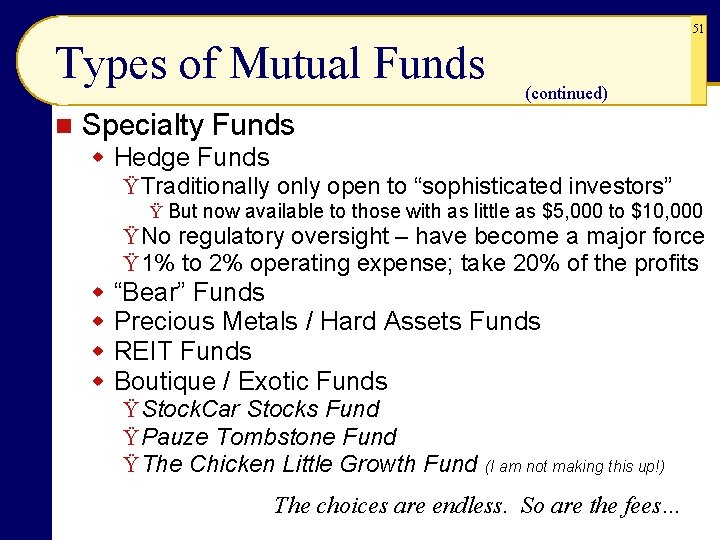
51 Types of Mutual Funds n (continued) Specialty Funds w Hedge Funds Ÿ Traditionally only open to “sophisticated investors” Ÿ But now available to those with as little as $5, 000 to $10, 000 Ÿ No regulatory oversight – have become a major force Ÿ 1% to 2% operating expense; take 20% of the profits w w “Bear” Funds Precious Metals / Hard Assets Funds REIT Funds Boutique / Exotic Funds Ÿ Stock. Car Stocks Fund Ÿ Pauze Tombstone Fund Ÿ The Chicken Little Growth Fund (I am not making this up!) The choices are endless. So are the fees…
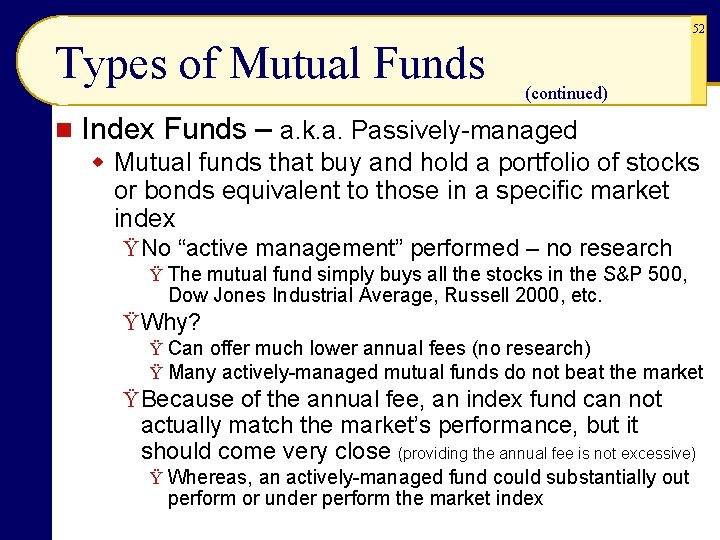
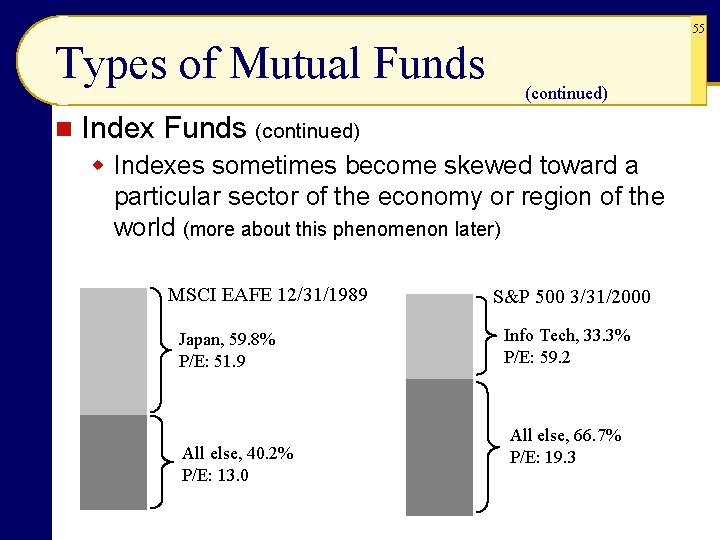
52 Types of Mutual Funds n (continued) Index Funds – a. k. a. Passively-managed w Mutual funds that buy and hold a portfolio of stocks or bonds equivalent to those in a specific market index Ÿ No “active management” performed – no research Ÿ The mutual fund simply buys all the stocks in the S&P 500, Dow Jones Industrial Average, Russell 2000, etc. Ÿ Why? Ÿ Can offer much lower annual fees (no research) Ÿ Many actively-managed mutual funds do not beat the market Ÿ Because of the annual fee, an index fund can not actually match the market’s performance, but it should come very close (providing the annual fee is not excessive) Ÿ Whereas, an actively-managed fund could substantially out perform or under perform the market index
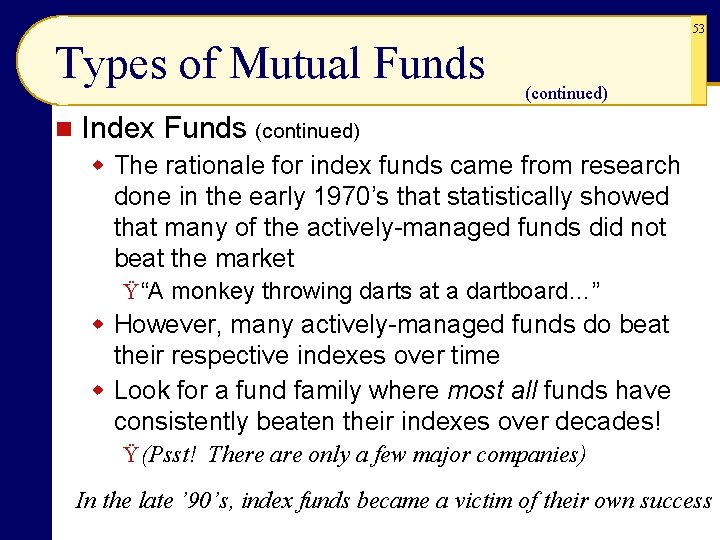
53 Types of Mutual Funds n (continued) Index Funds (continued) w The rationale for index funds came from research done in the early 1970’s that statistically showed that many of the actively-managed funds did not beat the market Ÿ “A monkey throwing darts at a dartboard…” w However, many actively-managed funds do beat their respective indexes over time w Look for a fund family where most all funds have consistently beaten their indexes over decades! Ÿ (Psst! There are only a few major companies) In the late ’ 90’s, index funds became a victim of their own success
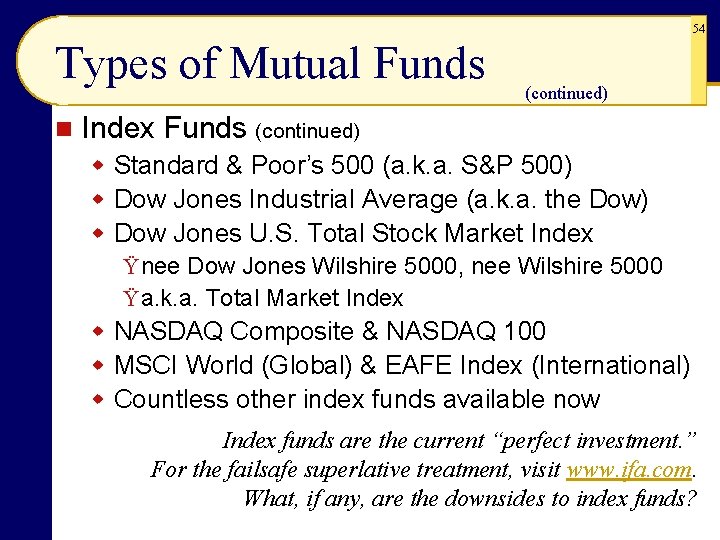
54 Types of Mutual Funds n (continued) Index Funds (continued) w Standard & Poor’s 500 (a. k. a. S&P 500) w Dow Jones Industrial Average (a. k. a. the Dow) w Dow Jones U. S. Total Stock Market Index Ÿ nee Dow Jones Wilshire 5000, nee Wilshire 5000 Ÿ a. k. a. Total Market Index w NASDAQ Composite & NASDAQ 100 w MSCI World (Global) & EAFE Index (International) w Countless other index funds available now Index funds are the current “perfect investment. ” For the failsafe superlative treatment, visit www. ifa. com. What, if any, are the downsides to index funds?
55 Types of Mutual Funds n (continued) Index Funds (continued) w Indexes sometimes become skewed toward a particular sector of the economy or region of the world (more about this phenomenon later) MSCI EAFE 12/31/1989 Japan, 59. 8% P/E: 51. 9 All else, 40. 2% P/E: 13. 0 S&P 500 3/31/2000 Info Tech, 33. 3% P/E: 59. 2 All else, 66. 7% P/E: 19. 3
56 Types of Mutual Funds n (continued) Exchange-Traded Funds – a. k. a. ETFs w An open-end mutual fund that trades as a listed security on a stock exchange Ÿ Trades like a stock as does a closed-end fund Ÿ But there is no limit on the number of shares w Becoming very popular because they can be bought and sold throughout the day like stocks Ÿ Unlike open-end mutual funds, which always trade at the end-of-day net asset value w Most all ETFs are passively-managed index funds Ÿ But there now are also some actively-managed ETFs And they have cool names like “Spider, ” “Diamond, ” and “Cube”
57 Types of Mutual Funds n (continued) Socially Responsible Funds w Mutual funds that actively and directly incorporate ethics and morality into the investment decisions Ÿ Started out with some funds refusing to invest in companies that sold alcohol or tobacco Ÿ Moved to companies that pollute, build weapons or nuclear power plants, destroy the rain forests, etc. Ÿ And then to companies that exploit labor Ÿ It is surprising that there any companies left to invest in … Silliness aside, many Socially Responsible Funds have done quite well for their investors
58 Types of Mutual Funds n (continued) Socially Irresponsible Funds (? ? ? ) w Possibly as a backlash to socially responsible funds (and their perceived political overtones) w There is a mutual fund called The Vice Fund Ÿ Yep! You guessed it! Ÿ It invests in tobacco and alcohol … Ÿ (The manager says he simply loves Philip Morris!) Ÿ And all the other corporate nasties you can think of Ÿ Gambling, Defense firms And although it is still a very small fund with high annual fees, it has done very well for its investors (www. vicefund. com)
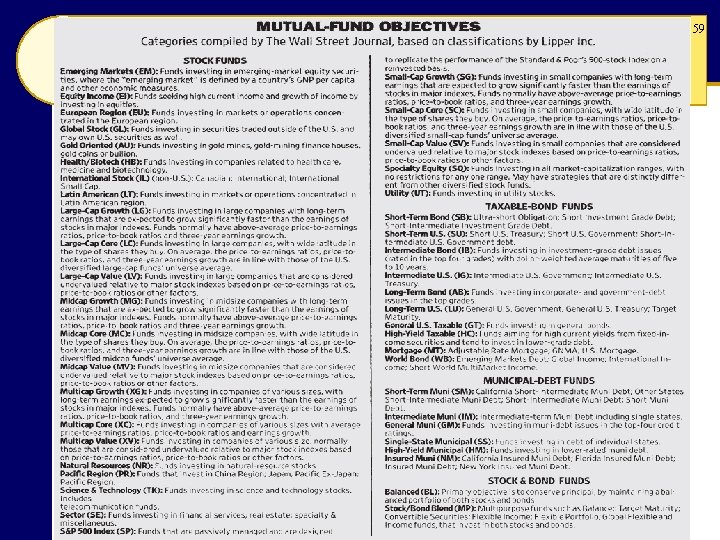
59
60 Types of Mutual Funds (continued) Style Value Blend Growth Size Large Medium Small Morningstar, a company that analyzes mutual funds, designed the “style box” to help investors identify investment alternatives. They say they are fabulous. No one I know uses them; neither do I. Now they have “ownership zones. ” They say they are even better.
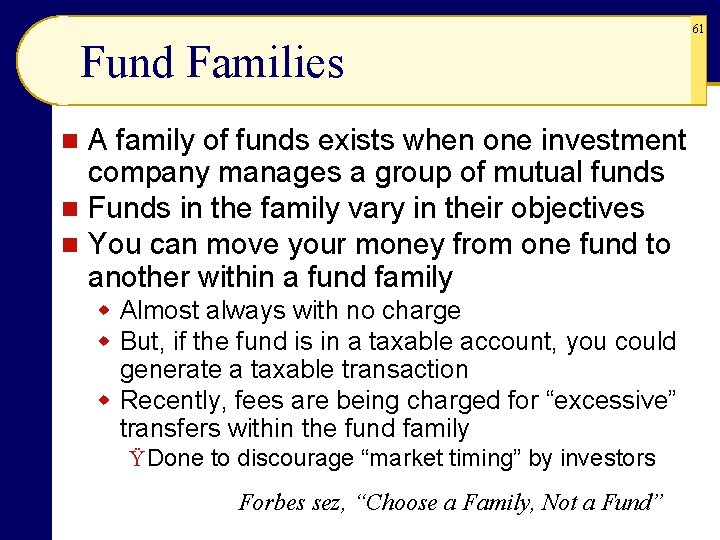
Fund Families A family of funds exists when one investment company manages a group of mutual funds n Funds in the family vary in their objectives n You can move your money from one fund to another within a fund family n w Almost always with no charge w But, if the fund is in a taxable account, you could generate a taxable transaction w Recently, fees are being charged for “excessive” transfers within the fund family Ÿ Done to discourage “market timing” by investors Forbes sez, “Choose a Family, Not a Fund” 61
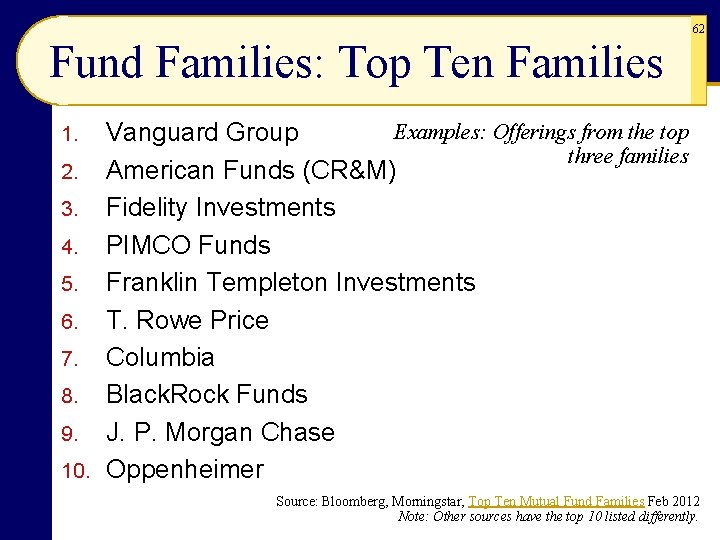
Fund Families: Top Ten Families 62 Examples: Offerings from the top Vanguard Group three families 2. American Funds (CR&M) 3. Fidelity Investments 4. PIMCO Funds 5. Franklin Templeton Investments 6. T. Rowe Price 7. Columbia 8. Black. Rock Funds 9. J. P. Morgan Chase 10. Oppenheimer 1. Source: Bloomberg, Morningstar, Top Ten Mutual Fund Families Feb 2012 Note: Other sources have the top 10 listed differently.
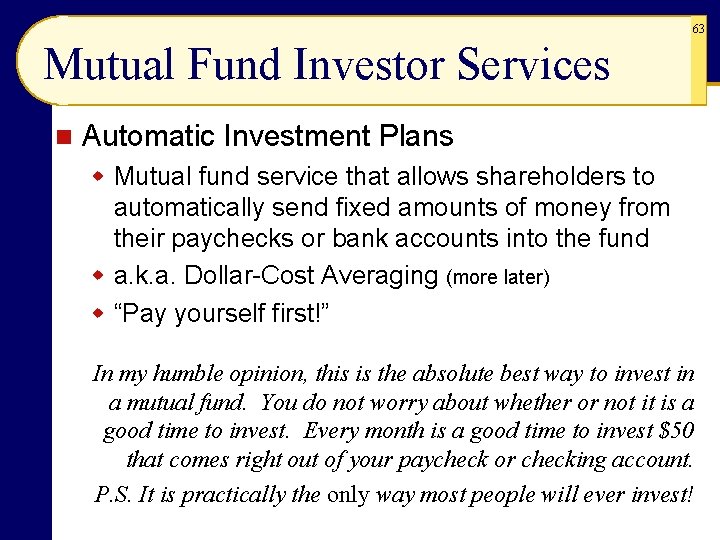
63 Mutual Fund Investor Services n Automatic Investment Plans w Mutual fund service that allows shareholders to automatically send fixed amounts of money from their paychecks or bank accounts into the fund w a. k. a. Dollar-Cost Averaging (more later) w “Pay yourself first!” In my humble opinion, this is the absolute best way to invest in a mutual fund. You do not worry about whether or not it is a good time to invest. Every month is a good time to invest $50 that comes right out of your paycheck or checking account. P. S. It is practically the only way most people will ever invest!
64 Mutual Fund Investor Services (continued) n Automatic Reinvestment Plan w Mutual fund service that enables shareholders to automatically buy additional shares in the fund through the reinvestment of dividends, interest, and capital gains Automatic Reinvestment Plans allow an investor to earn fully compounded rates of return. Unless an investor needs the income, it is always a good idea to reinvest dividends and capital gains received from a mutual fund. By the way, automatic reinvestment of dividends, interest, and capital gains is the default when you open a new mutual fund account.
65 Mutual Fund Investor Services (continued) n Systematic Withdrawal Plan w Mutual fund service that enables shareholders to automatically receive a predetermined amount of money monthly or quarterly Ÿ Sometimes annually w Normally electronically transferred directly to your checking account n Conversion Privilege – a. k. a. Exchange Privilege w Allows shareholders to move money from one fund to another within the same family of funds w May trigger tax consequences if not in a retirement account
66 Mutual Fund Transactions n Purchase options w Closed-end & ETFs through the stock exchange w Open-end Ÿ Through a broker Ÿ Directly from the investment company Ÿ Best way is auto-contributions (payroll, checking) n Sell options w Closed-end & ETFs through the stock exchange w Open-end Ÿ Through a broker or through the mutual fund Ÿ Best way is auto-withdrawals (into your checking)
67 Taxes and Mutual Funds n Two types of taxes for Regular Accounts w Income dividends Ÿ Taxed as income (20% max, 15% typical, 5% min) w Capital gains distributions w Taxed as capital gains (20% max, 15%, 5% min) w Reinvested dividends and capital gains are still taxable transactions Ÿ Save your year-end statements Ÿ Congress may change this someday (doubtful!) Ÿ Unrealized capital gains (a. k. a. paper profits) would not be taxed until you sell your mutual fund shares (forget it!) n Tax-deferred Retirement Accounts (401(k), etc. ) w Pay no taxes until retirement w All proceeds taxed as income (except Roth tax-free)
68 Sources of Mutual Fund Information n Mutual Fund Prospectus w A statement describing the risk factors w A description of the fund’s past performance w A statement describing the type of investments in the fund’s portfolio w Information about dividends, distributions & taxes w Information about the fund’s management w No one reads them! Ÿ Unless they have taken BUS-123 Ÿ It is not that hard, is it? (Check out a few on the web site) n Mutual Fund Annual Report w Performance, investments, assets and liabilities
69 Sources of Mutual Fund Information (continued) n Financial publications w Morningstar, Lipper, etc. w Business Week, Forbes, Kiplinger's Personal Finance, and Money are sources of information on mutual funds w Mutual fund surveys usually include: Ÿ Fund’s overall rating compared to other funds Ÿ Fund’s rating compared to funds in the same category Ÿ Fund size, sales charge and expense ratio Ÿ Risk of loss factor and toll-free number Ÿ History for past three, five, and ten years
70 Sources of Mutual Fund Information (continued) n Financial web sites w www. morningstar. com w www. businessweek. com w finance. yahoo. com (Used to be really good, now really bad) n Mutual fund companies’ Internet sites w w w n www. fidelity. com www. troweprice. com Hurray! The mutual www. vanguard. com fund web sites are again promoting education. www. americanfunds. com www. dodgeandcox. com www. franklintempleton. com Investment Company Institute web site w www. ici. org
71 “So, How Do I Pick a Mutual Fund? ” n Pick a Mutual Fund that… w Invests in high-quality stocks or bonds w Is well-diversified across several industries and sectors of the economy w Has a long-term perspective and a manager or (better yet) a management team with many years of experience Ÿ Avoid companies that “shuffle” their managers every few years (which is virtually all of them!) w Has been around for decades and performed consistently well in both good and bad markets
A Sample Stock Mutual Fund 72 Is 80+ years “long-term” enough for you? n 6%, 8%, 9%, 10%? How about 12%? n “But stocks are very risky” n w Short-term, Yes. Long-term, No! n “But now is not a good time to invest” w “Excuse me, when is it ever a good time to invest? ” w Okay, so what if you had invested on the worst day of the year for the past 20 years? How did you do? n “But what about market downturns? ” w Keep a long-term perspective, and w Dollar Cost Average…
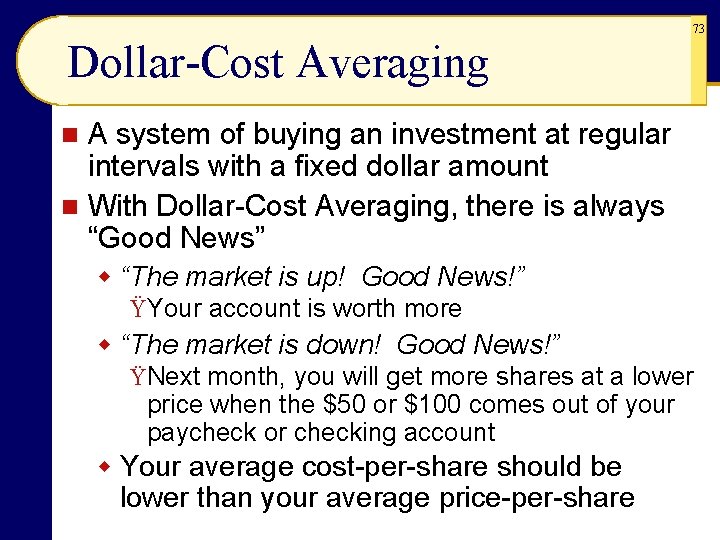
Dollar-Cost Averaging 73 A system of buying an investment at regular intervals with a fixed dollar amount n With Dollar-Cost Averaging, there is always “Good News” n w “The market is up! Good News!” ŸYour account is worth more w “The market is down! Good News!” Ÿ Next month, you will get more shares at a lower price when the $50 or $100 comes out of your paycheck or checking account w Your average cost-per-share should be lower than your average price-per-share
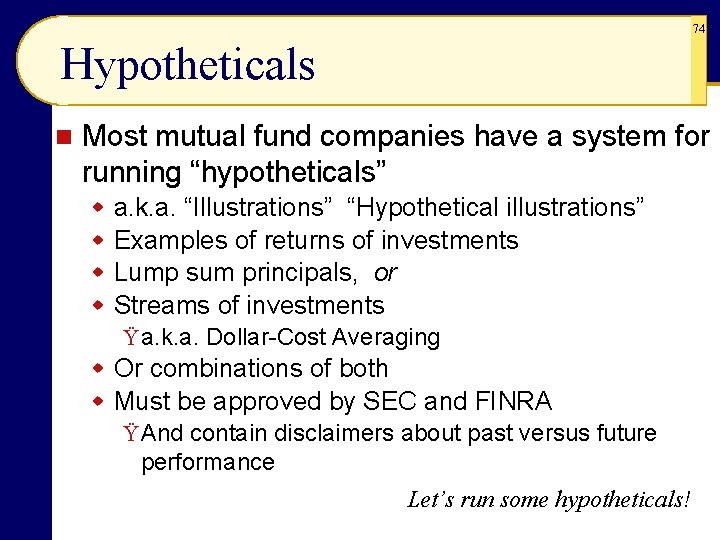
74 Hypotheticals n Most mutual fund companies have a system for running “hypotheticals” w w a. k. a. “Illustrations” “Hypothetical illustrations” Examples of returns of investments Lump sum principals, or Streams of investments Ÿ a. k. a. Dollar-Cost Averaging w Or combinations of both w Must be approved by SEC and FINRA Ÿ And contain disclaimers about past versus future performance Let’s run some hypotheticals!
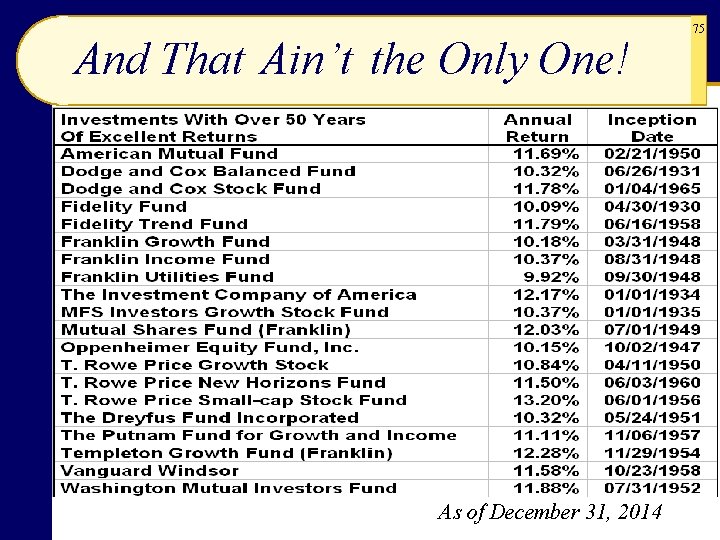
And That Ain’t the Only One! As of December 31, 2014 75
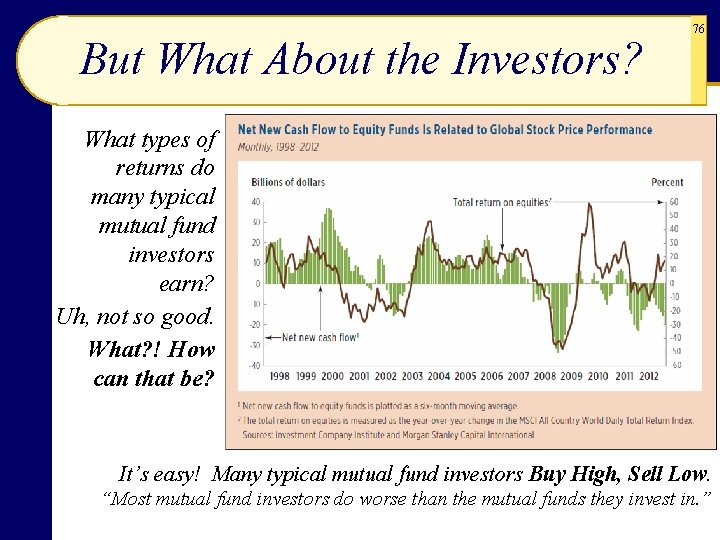
But What About the Investors? 76 What types of returns do many typical mutual fund investors earn? Uh, not so good. What? ! How can that be? It’s easy! Many typical mutual fund investors Buy High, Sell Low. “Most mutual fund investors do worse than the mutual funds they invest in. ”
Bottom Line on Mutual Funds n Choose a fund family and stick with them w Re-evaluate them periodically (once or twice a year? ) Ÿ But make changes judiciously and sparingly Ÿ As you approach retirement, migrate from stock funds to bond funds Ÿ But do not give up on stocks entirely w Dollar-Cost Average Ÿ $50 a month, $100 a month, whatever is affordable… Ÿ For the most part, Forget About Them! Do not be one of the mutual fund investors that does worse than your mutual funds! 77
CHAPTER 4 – REVIEW 78 Mutual Funds Chapter Sections: Advantages and Drawbacks of Mutual Fund Investing Investment Companies and Fund Types Mutual Funds Operations Mutual Funds Costs and Fees Short-Term Funds Long-Term Funds Mutual Fund Performance Closed-End Funds, Exchange Traded Funds, and Hedge Funds Next week: Chapter 5, Introduction to Stocks