
Chapter 4 Muscular Strength and Endurance Copyright 2017



- Slides: 37
Chapter 4 Muscular Strength and Endurance Copyright © 2017 Mc. Graw-Hill Education. All rights reserved. No reproduction or distribution without the prior written consent of Mc. Graw-Hill Education. 1
Muscular Strength and Endurance ¡ Ahead: Basic Muscle Physiology and the Effects of Strength Training Assessing Muscular Strength and Endurance Creating a Successful Strength Training Program Weight Training Exercises Copyright © 2017 Mc. Graw-Hill Education. All rights reserved. No reproduction or distribution without the prior written consent of Mc. Graw-Hill Education. 2
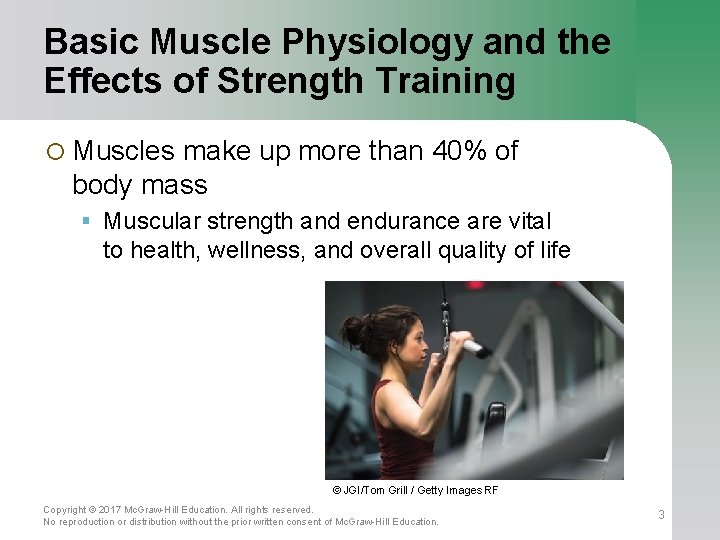
Basic Muscle Physiology and the Effects of Strength Training ¡ Muscles make up more than 40% of body mass Muscular strength and endurance are vital to health, wellness, and overall quality of life © JGI/Tom Grill / Getty Images RF Copyright © 2017 Mc. Graw-Hill Education. All rights reserved. No reproduction or distribution without the prior written consent of Mc. Graw-Hill Education. 3
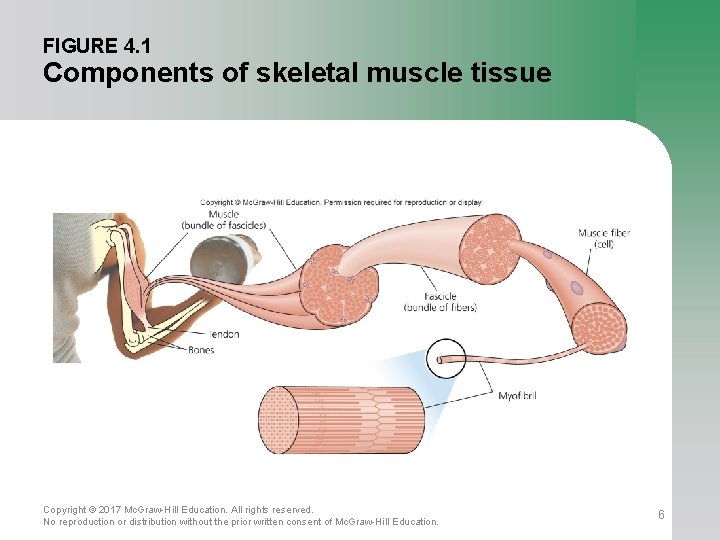
Muscle Fibers (1) ¡ Muscle fiber: single muscle cell, usually classified according to strength, speed of contraction, and energy source Myofibrils: protein structures that make up muscle fibers Hypertrophy: increased size of muscle fiber Atrophy: decrease in size of muscle fiber Hyperplasia: increase in number of muscle fibers Copyright © 2017 Mc. Graw-Hill Education. All rights reserved. No reproduction or distribution without the prior written consent of Mc. Graw-Hill Education. 4
Muscle Fibers (2) ¡ Slow-twitch fibers: red muscle fibers that are fatigue-resistant but have a slow contraction speed and a lower capacity for tension ¡ Fast-twitch fibers: white muscle fibers that contract rapidly and forcefully but fatigue quickly ¡ Power: ability to exert force rapidly ¡ https: //www. youtube. com/watch? v=Uxwh 2 IIg_Z 0 Copyright © 2017 Mc. Graw-Hill Education. All rights reserved. No reproduction or distribution without the prior written consent of Mc. Graw-Hill Education. 5
FIGURE 4. 1 Components of skeletal muscle tissue Copyright © 2017 Mc. Graw-Hill Education. All rights reserved. No reproduction or distribution without the prior written consent of Mc. Graw-Hill Education. 6
Motor Units ¡ Motor unit: a motor nerve (one that initiates movement) connected to one or more muscle fibers ¡ Muscle learning: improvement in the body’s ability to recruit motor units, brought about through strength training Copyright © 2017 Mc. Graw-Hill Education. All rights reserved. No reproduction or distribution without the prior written consent of Mc. Graw-Hill Education. 7
Metabolic and Heart Health ¡ Strength training helps prevent and manage cardiovascular disease (CVD) and diabetes Improves glucose metabolism Increases maximal oxygen consumption Reduces blood pressure Increases HDL cholesterol and reduces LDL cholesterol Improves blood vessel health Copyright © 2017 Mc. Graw-Hill Education. All rights reserved. No reproduction or distribution without the prior written consent of Mc. Graw-Hill Education. 8
Assessing Muscular Strength and Endurance ¡ Repetition maximum (RM): maximum amount of resistance that can be moved a specified number of times 1 -RM is the maximum amount of weight that can be lifted one time; 5 -RM is the maximum weight that can be lifted five times ¡ Repetitions: number of times an exercise is performed during one set Copyright © 2017 Mc. Graw-Hill Education. All rights reserved. No reproduction or distribution without the prior written consent of Mc. Graw-Hill Education. 9
Benefits of Muscular Strength and Endurance ¡ Key terms: Tendon: tough band of fibrous tissue; connects a muscle to a bone or other body part and transmits force exerted by muscle Ligament: tough band of tissue; connects ends of bones or supports organs Cartilage: tough, resilient tissue that acts as a cushion between the bones in a joint Testosterone: principal male hormone responsible for secondary sex characteristics and increasing muscle size Copyright © 2017 Mc. Graw-Hill Education. All rights reserved. No reproduction or distribution without the prior written consent of Mc. Graw-Hill Education. 10
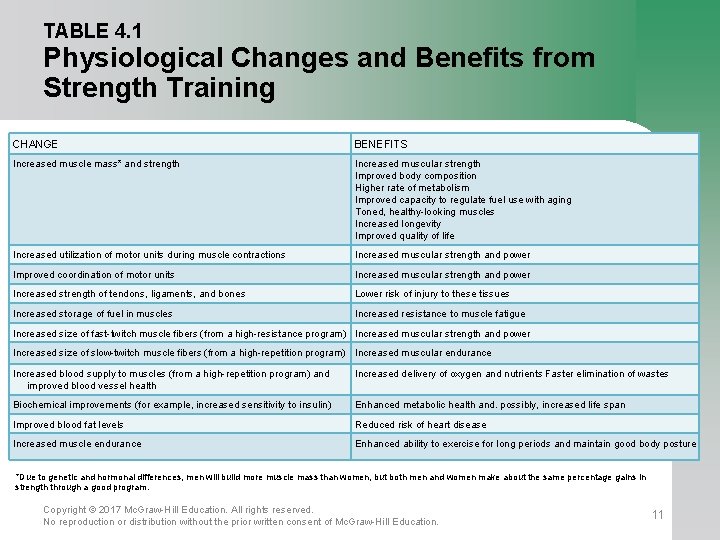
TABLE 4. 1 Physiological Changes and Benefits from Strength Training CHANGE BENEFITS Increased muscle mass* and strength Increased muscular strength Improved body composition Higher rate of metabolism Improved capacity to regulate fuel use with aging Toned, healthy-looking muscles Increased longevity Improved quality of life Increased utilization of motor units during muscle contractions Increased muscular strength and power Improved coordination of motor units Increased muscular strength and power Increased strength of tendons, ligaments, and bones Lower risk of injury to these tissues Increased storage of fuel in muscles Increased resistance to muscle fatigue Increased size of fast-twitch muscle fibers (from a high-resistance program) Increased muscular strength and power Increased size of slow-twitch muscle fibers (from a high-repetition program) Increased muscular endurance Increased blood supply to muscles (from a high-repetition program) and improved blood vessel health Increased delivery of oxygen and nutrients Faster elimination of wastes Biochemical improvements (for example, increased sensitivity to insulin) Enhanced metabolic health and. possibly, increased life span Improved blood fat levels Reduced risk of heart disease Increased muscle endurance Enhanced ability to exercise for long periods and maintain good body posture *Due to genetic and hormonal differences, men will build more muscle mass than women, but both men and women make about the same percentage gains in strength through a good program. Copyright © 2017 Mc. Graw-Hill Education. All rights reserved. No reproduction or distribution without the prior written consent of Mc. Graw-Hill Education. 11
Creating a Successful Strength Training Program ¡ Stressed muscles adapt and improve ¡ The type of adaptation depends on the type of stress Copyright © 2017 Mc. Graw-Hill Education. All rights reserved. No reproduction or distribution without the prior written consent of Mc. Graw-Hill Education. 12
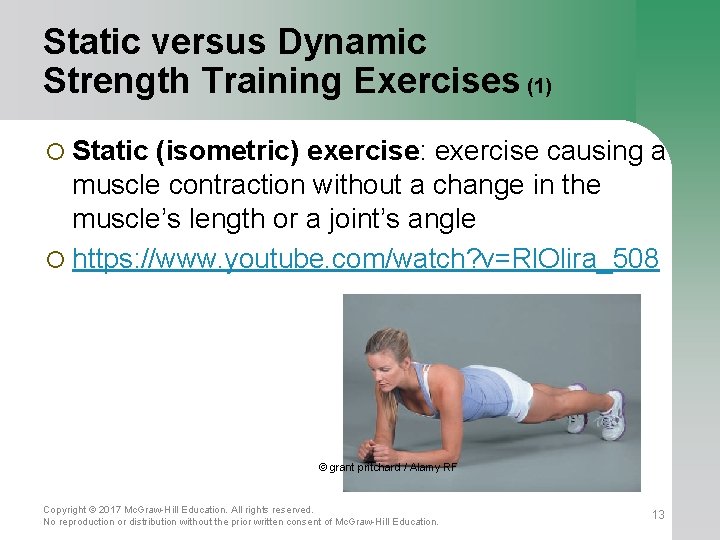
Static versus Dynamic Strength Training Exercises (1) ¡ Static (isometric) exercise: exercise causing a muscle contraction without a change in the muscle’s length or a joint’s angle ¡ https: //www. youtube. com/watch? v=Rl. Olira_508 © grant pritchard / Alamy RF Copyright © 2017 Mc. Graw-Hill Education. All rights reserved. No reproduction or distribution without the prior written consent of Mc. Graw-Hill Education. 13
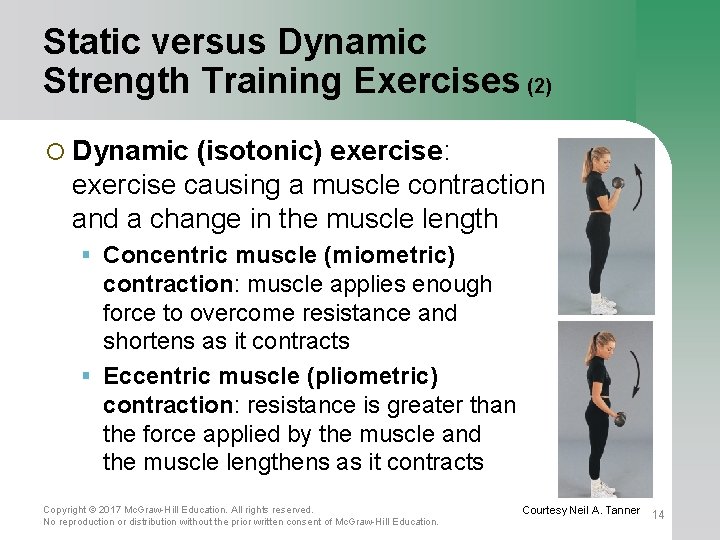
Static versus Dynamic Strength Training Exercises (2) ¡ Dynamic (isotonic) exercise: exercise causing a muscle contraction and a change in the muscle length Concentric muscle (miometric) contraction: muscle applies enough force to overcome resistance and shortens as it contracts Eccentric muscle (pliometric) contraction: resistance is greater than the force applied by the muscle and the muscle lengthens as it contracts Copyright © 2017 Mc. Graw-Hill Education. All rights reserved. No reproduction or distribution without the prior written consent of Mc. Graw-Hill Education. Courtesy Neil A. Tanner 14
Static versus Dynamic Strength Training Exercises (3) ¡ Constant and variable resistance Constant resistance exercise: type of dynamic exercise that uses a constant load throughout a joint’s entire range of motion Variable resistance exercise: type of dynamic exercise that uses a changing load, providing a maximum load throughout the joint’s entire range of motion Copyright © 2017 Mc. Graw-Hill Education. All rights reserved. No reproduction or distribution without the prior written consent of Mc. Graw-Hill Education. 15
Static versus Dynamic Strength Training Exercises (4) ¡ Other dynamic exercise techniques Eccentric (pliometric) loading: placing load on the muscle while it is lengthening Plyometrics: rapid stretching of a muscle group undergoing eccentric stress (the muscle is exerting force while it lengthens), followed by a rapid concentric contraction Copyright © 2017 Mc. Graw-Hill Education. All rights reserved. No reproduction or distribution without the prior written consent of Mc. Graw-Hill Education. 16
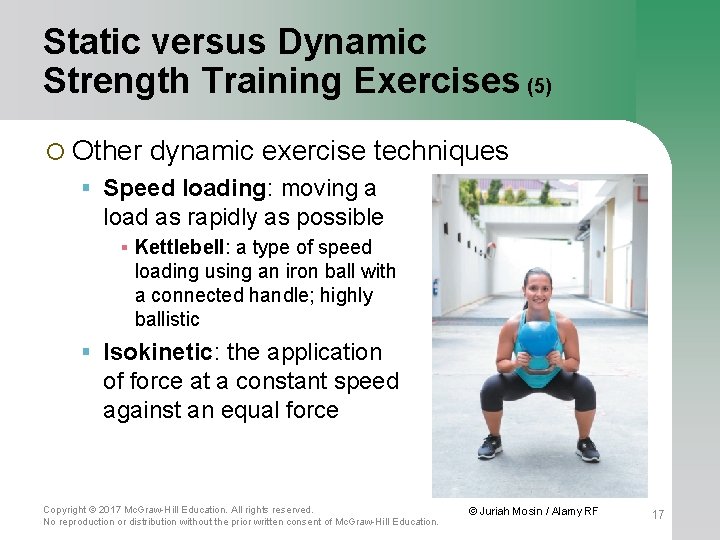
Static versus Dynamic Strength Training Exercises (5) ¡ Other dynamic exercise techniques Speed loading: moving a load as rapidly as possible ▪ Kettlebell: a type of speed loading using an iron ball with a connected handle; highly ballistic Isokinetic: the application of force at a constant speed against an equal force Copyright © 2017 Mc. Graw-Hill Education. All rights reserved. No reproduction or distribution without the prior written consent of Mc. Graw-Hill Education. © Juriah Mosin / Alamy RF 17
Static versus Dynamic Strength Training Exercises (6) ¡ Static exercises require no equipment, build strength rapidly, and are useful for rehabilitating joints ¡ Dynamic exercises can be performed with or without equipment ¡ The type of exercise will depend upon individual goals, preferences, and access to equipment Copyright © 2017 Mc. Graw-Hill Education. All rights reserved. No reproduction or distribution without the prior written consent of Mc. Graw-Hill Education. 18
Weight Machines, Free Weights, and Body Weight Exercises ¡ Machines are safe, convenient, and easy to use Many machines provide support for the back ¡ Free weights require more care; strengthen the body for life and sports Spotter: a person who assists with a weight training exercise done with free weights ¡ Body weight exercise: “train movement and not muscles” Copyright © 2017 Mc. Graw-Hill Education. All rights reserved. No reproduction or distribution without the prior written consent of Mc. Graw-Hill Education. 19
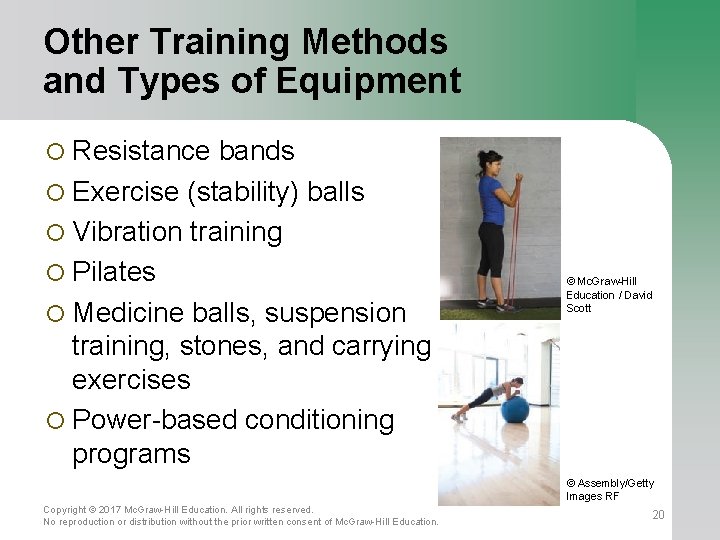
Other Training Methods and Types of Equipment ¡ Resistance bands ¡ Exercise (stability) balls ¡ Vibration training ¡ Pilates ¡ Medicine balls, suspension training, stones, and carrying exercises ¡ Power-based conditioning programs © Mc. Graw-Hill Education / David Scott © Assembly/Getty Images RF Copyright © 2017 Mc. Graw-Hill Education. All rights reserved. No reproduction or distribution without the prior written consent of Mc. Graw-Hill Education. 20
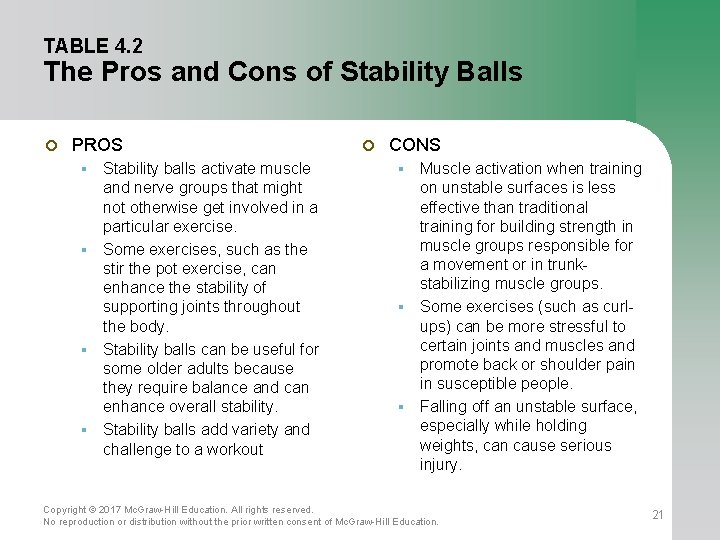
TABLE 4. 2 The Pros and Cons of Stability Balls ¡ PROS Stability balls activate muscle and nerve groups that might not otherwise get involved in a particular exercise. Some exercises, such as the stir the pot exercise, can enhance the stability of supporting joints throughout the body. Stability balls can be useful for some older adults because they require balance and can enhance overall stability. Stability balls add variety and challenge to a workout ¡ CONS Muscle activation when training on unstable surfaces is less effective than traditional training for building strength in muscle groups responsible for a movement or in trunkstabilizing muscle groups. Some exercises (such as curlups) can be more stressful to certain joints and muscles and promote back or shoulder pain in susceptible people. Falling off an unstable surface, especially while holding weights, can cause serious injury. Copyright © 2017 Mc. Graw-Hill Education. All rights reserved. No reproduction or distribution without the prior written consent of Mc. Graw-Hill Education. 21
Applying the FITT Principle: Selecting Exercises and Putting Together a Program (1) ¡ Frequency of exercise ACSM recommends two or more non-consecutive days a week for weight training Allow at least one day of rest ¡ Intensity of exercise: amount of resistance Resistance: amount of weight lifted determines the way the body adapts For endurance, choose 40– 60% of your maximum 1 RM to perform more reps Copyright © 2017 Mc. Graw-Hill Education. All rights reserved. No reproduction or distribution without the prior written consent of Mc. Graw-Hill Education. 22
Applying the FITT Principle: Selecting Exercises and Putting Together a Program (2) ¡ Time of exercise: repetitions and sets To improve fitness, you must perform enough repetitions to fatigue your muscles Set: group of repetitions followed by rest The length of a rest interval depends on the amount of resistance Possible signs of overtraining include a lack of progress, chronic fatigue, decreased coordination, and chronic muscle soreness Copyright © 2017 Mc. Graw-Hill Education. All rights reserved. No reproduction or distribution without the prior written consent of Mc. Graw-Hill Education. 23
Applying the FITT Principle: Selecting Exercises and Putting Together a Program (3) ¡ Type or mode of exercise A complete weight training program works all the major muscle groups Important to balance exercises between antagonistic muscle groups Exercise the large-muscle groups first and then the small-muscle groups Order exercises to work opposing muscle groups in sequence Copyright © 2017 Mc. Graw-Hill Education. All rights reserved. No reproduction or distribution without the prior written consent of Mc. Graw-Hill Education. 24
The Warm-Up and Cool-Down ¡ Do a general warm-up and a specific warm-up for the exercises by doing repetitions with lighter weights ¡ For cool-down, relax for 5 to 10 minutes after exercising Post-exercise stretching may prevent post-exercise soreness Copyright © 2017 Mc. Graw-Hill Education. All rights reserved. No reproduction or distribution without the prior written consent of Mc. Graw-Hill Education. 25
Getting Started and Making Progress ¡ Begin training by choosing a weight you can easily move through 8 to 12 repetitions for one set Gradually add weight and sets until you can perform 1 to 3 sets of 8 to 12 repetitions for each exercise ▪ As you progress, add weight according to the “two-for-two” rule ▪ Expect to improve rapidly during the first 6– 10 weeks ▪ After that, gains come more slowly Copyright © 2017 Mc. Graw-Hill Education. All rights reserved. No reproduction or distribution without the prior written consent of Mc. Graw-Hill Education. 26
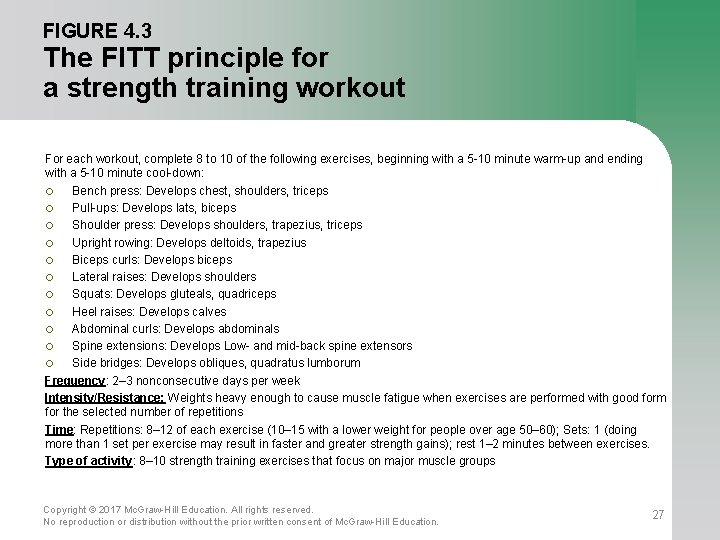
FIGURE 4. 3 The FITT principle for a strength training workout For each workout, complete 8 to 10 of the following exercises, beginning with a 5 -10 minute warm-up and ending with a 5 -10 minute cool-down: ¡ Bench press: Develops chest, shoulders, triceps ¡ Pull-ups: Develops lats, biceps ¡ Shoulder press: Develops shoulders, trapezius, triceps ¡ Upright rowing: Develops deltoids, trapezius ¡ Biceps curls: Develops biceps ¡ Lateral raises: Develops shoulders ¡ Squats: Develops gluteals, quadriceps ¡ Heel raises: Develops calves ¡ Abdominal curls: Develops abdominals ¡ Spine extensions: Develops Low- and mid-back spine extensors ¡ Side bridges: Develops obliques, quadratus lumborum Frequency: 2– 3 nonconsecutive days per week Intensity/Resistance: Weights heavy enough to cause muscle fatigue when exercises are performed with good form for the selected number of repetitions Time: Repetitions: 8– 12 of each exercise (10– 15 with a lower weight for people over age 50– 60); Sets: 1 (doing more than 1 set per exercise may result in faster and greater strength gains); rest 1– 2 minutes between exercises. Type of activity: 8– 10 strength training exercises that focus on major muscle groups Copyright © 2017 Mc. Graw-Hill Education. All rights reserved. No reproduction or distribution without the prior written consent of Mc. Graw-Hill Education. 27
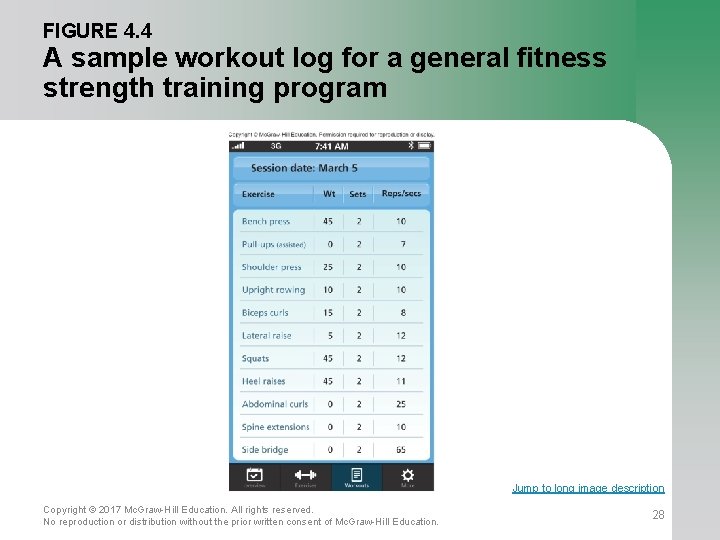
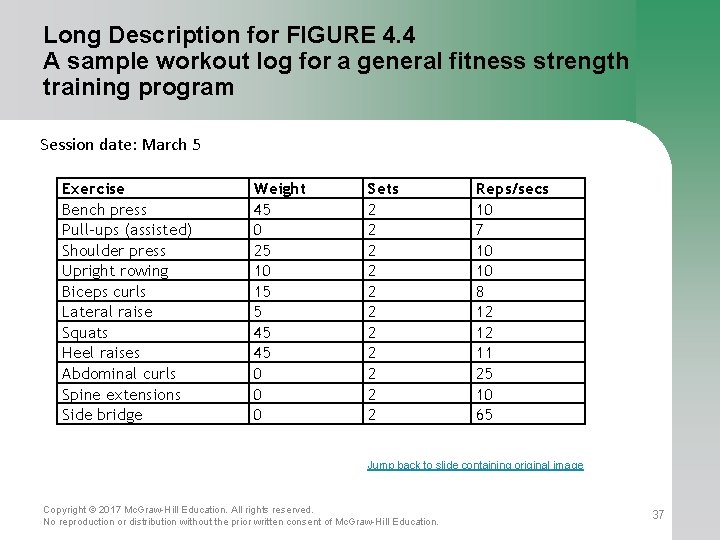
FIGURE 4. 4 A sample workout log for a general fitness strength training program Jump to long image description Copyright © 2017 Mc. Graw-Hill Education. All rights reserved. No reproduction or distribution without the prior written consent of Mc. Graw-Hill Education. 28
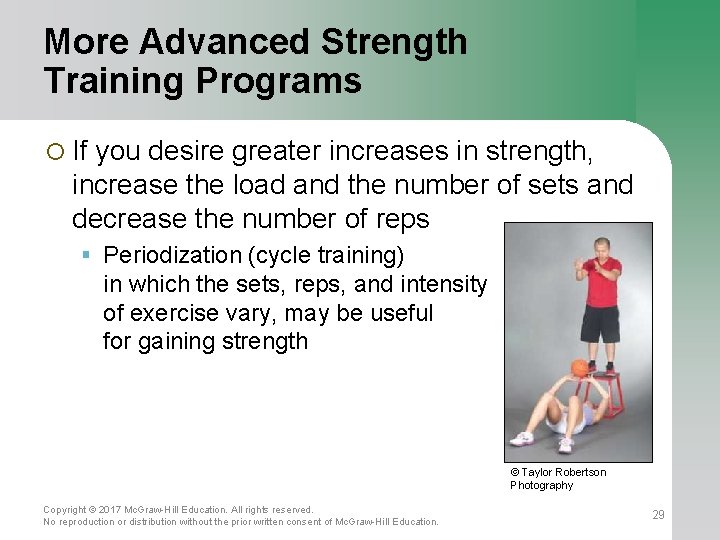
More Advanced Strength Training Programs ¡ If you desire greater increases in strength, increase the load and the number of sets and decrease the number of reps Periodization (cycle training) in which the sets, reps, and intensity of exercise vary, may be useful for gaining strength © Taylor Robertson Photography Copyright © 2017 Mc. Graw-Hill Education. All rights reserved. No reproduction or distribution without the prior written consent of Mc. Graw-Hill Education. 29
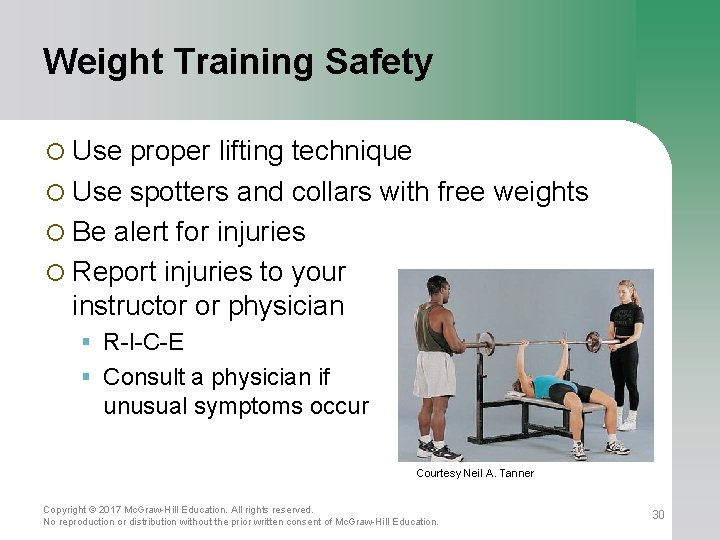
Weight Training Safety ¡ Use proper lifting technique ¡ Use spotters and collars with free weights ¡ Be alert for injuries ¡ Report injuries to your instructor or physician R-I-C-E Consult a physician if unusual symptoms occur Courtesy Neil A. Tanner Copyright © 2017 Mc. Graw-Hill Education. All rights reserved. No reproduction or distribution without the prior written consent of Mc. Graw-Hill Education. 30
A Caution about Supplements and Drugs (1) ¡ Most substances are ineffective, and many are dangerous ¡ A balanced diet is the best nutritional strategy Copyright © 2017 Mc. Graw-Hill Education. All rights reserved. No reproduction or distribution without the prior written consent of Mc. Graw-Hill Education. 31
A Caution about Supplements and Drugs (2) ¡ Performance aids: Adrenal androgens Ginseng Amino acids Growth hormone Amphetamines Beta-hydroxy beta-methyl Anabolic steroids Caffeine Creatine monohydrate Diuretics Energy drinks Erythropoietin butyrate (HMB) Insulin “Metabolic optimizing” meals Nitric acid boosters Protein, amino acids, polypeptide supplements Copyright © 2017 Mc. Graw-Hill Education. All rights reserved. No reproduction or distribution without the prior written consent of Mc. Graw-Hill Education. 32
Weight Training Exercises (1) ¡ Body weight Air squats Lunges Burpees with a push-up Curl-up or crunch Spine extension (“Bird Dog”) Isometric side bridge Thrusters Overhead squats Front plank Push-ups Copyright © 2017 Mc. Graw-Hill Education. All rights reserved. No reproduction or distribution without the prior written consent of Mc. Graw-Hill Education. 33
Weight Training Exercises (2) ¡ Free weights Bench press Pull-up Shoulder press (overhead or military press) Upright rowing Biceps curl Lateral raise Squat Heel raise Kettlebell swing Kettlebell one-arm snatch Kettlebell or dumbbell carry (suitcase carry) Copyright © 2017 Mc. Graw-Hill Education. All rights reserved. No reproduction or distribution without the prior written consent of Mc. Graw-Hill Education. 34
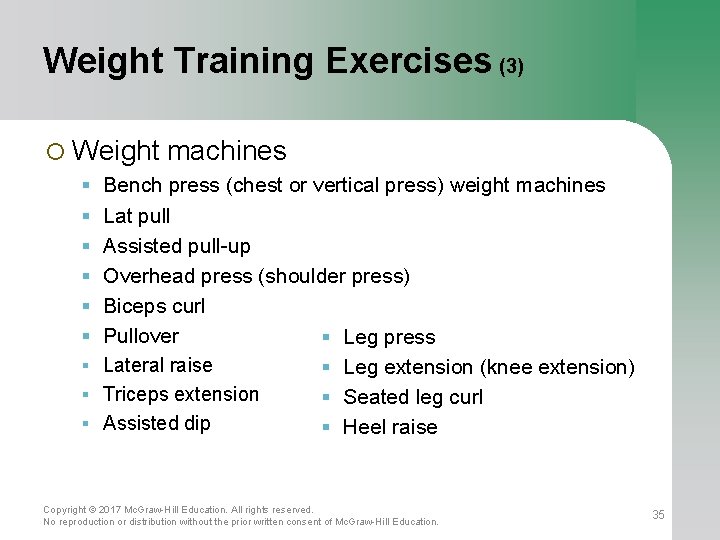
Weight Training Exercises (3) ¡ Weight machines Bench press (chest or vertical press) weight machines Lat pull Assisted pull-up Overhead press (shoulder press) Biceps curl Pullover Lateral raise Triceps extension Assisted dip Leg press Leg extension (knee extension) Seated leg curl Heel raise Copyright © 2017 Mc. Graw-Hill Education. All rights reserved. No reproduction or distribution without the prior written consent of Mc. Graw-Hill Education. 35
Appendix: Long Descriptions for Visuals Copyright © 2017 Mc. Graw-Hill Education. All rights reserved. No reproduction or distribution without the prior written consent of Mc. Graw-Hill Education. 36
Long Description for FIGURE 4. 4 A sample workout log for a general fitness strength training program Session date: March 5 Exercise Bench press Pull-ups (assisted) Shoulder press Upright rowing Biceps curls Lateral raise Squats Heel raises Abdominal curls Spine extensions Side bridge Weight 45 0 25 10 15 5 45 45 0 0 0 Sets 2 2 2 Reps/secs 10 7 10 10 8 12 12 11 25 10 65 Jump back to slide containing original image Copyright © 2017 Mc. Graw-Hill Education. All rights reserved. No reproduction or distribution without the prior written consent of Mc. Graw-Hill Education. 37