
Chapter 4 Motivation in Sport 1 Why do

- Slides: 34
Chapter 4 Motivation in Sport 1
Why do we play sports? n https: //www. youtube. com/watch? v=V 6 x. LYt 265 ZM n https: //www. youtube. com/watch? v=AKr. A 8 Qtp. Bfo 2
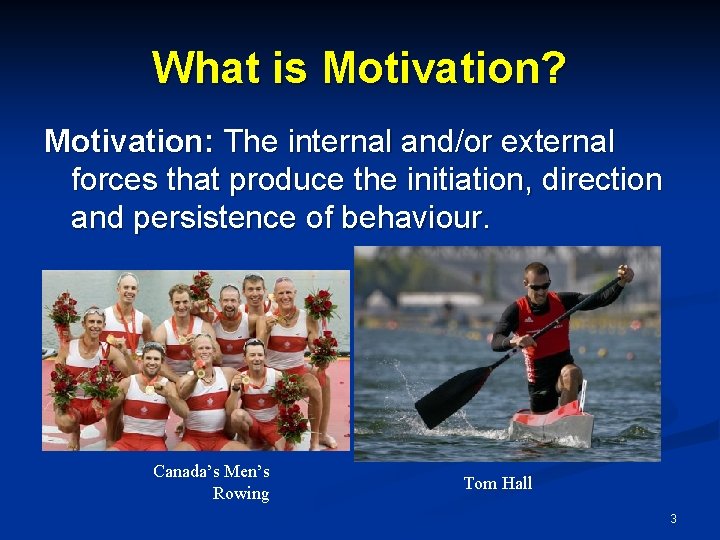
What is Motivation? Motivation: The internal and/or external forces that produce the initiation, direction and persistence of behaviour. Canada’s Men’s Rowing Tom Hall 3
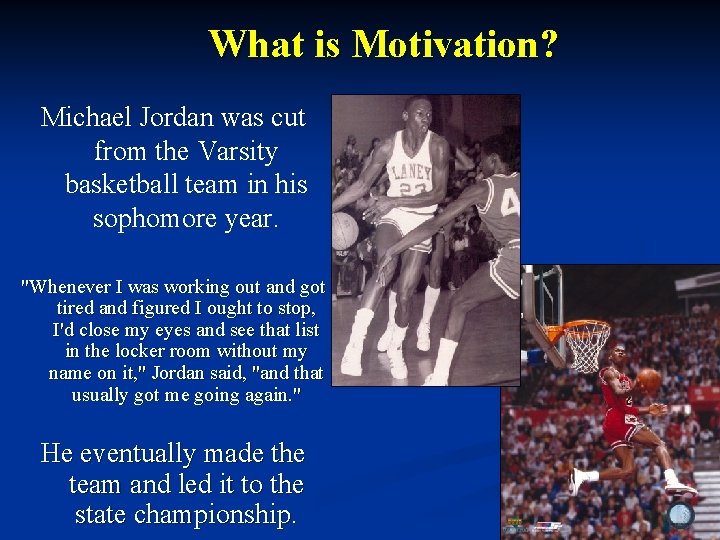
What is Motivation? Michael Jordan was cut from the Varsity basketball team in his sophomore year. "Whenever I was working out and got tired and figured I ought to stop, I'd close my eyes and see that list in the locker room without my name on it, " Jordan said, "and that usually got me going again. " He eventually made the team and led it to the state championship. 4
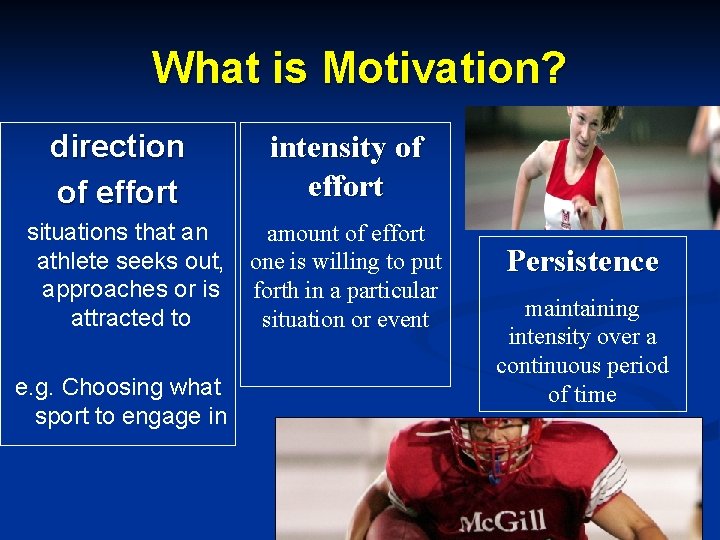
What is Motivation? direction of effort situations that an athlete seeks out, approaches or is attracted to e. g. Choosing what sport to engage in intensity of effort amount of effort one is willing to put forth in a particular situation or event Persistence maintaining intensity over a continuous period of time 5
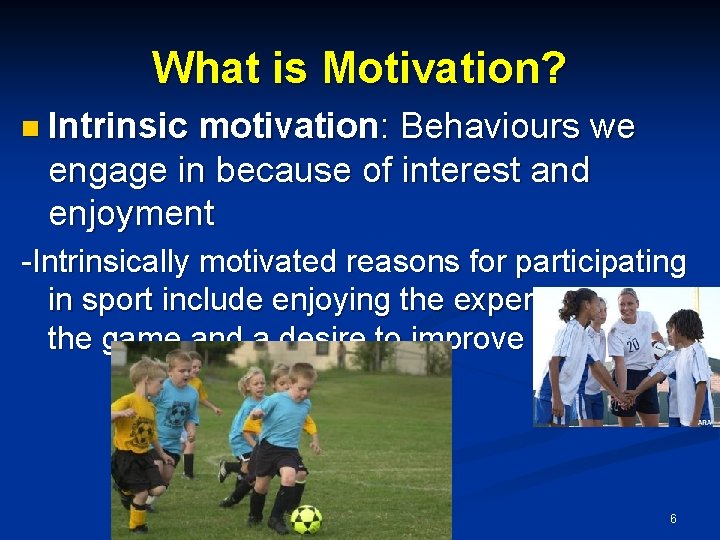
What is Motivation? n Intrinsic motivation: Behaviours we engage in because of interest and enjoyment -Intrinsically motivated reasons for participating in sport include enjoying the experience of the game and a desire to improve your skills 6
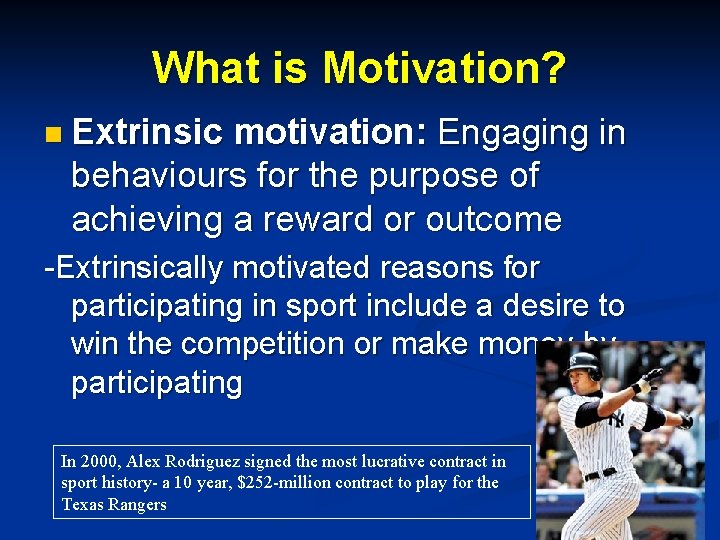
What is Motivation? n Extrinsic motivation: Engaging in behaviours for the purpose of achieving a reward or outcome -Extrinsically motivated reasons for participating in sport include a desire to win the competition or make money by participating In 2000, Alex Rodriguez signed the most lucrative contract in sport history- a 10 year, $252 -million contract to play for the Texas Rangers 7
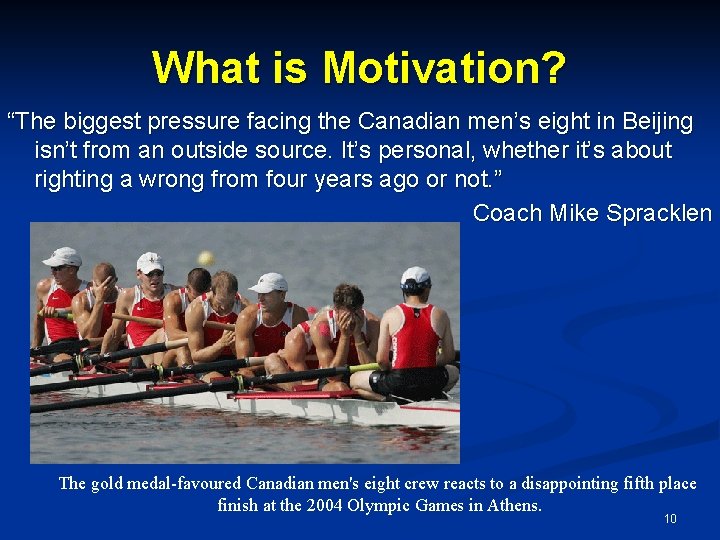
What is Motivation? Excellent example of motivation: Men’s Olympic 8 rowing team. n Ranked 1 st internationally prior to Athens n Finished a “disappointing 5 th place” n In Beijing, team vowed to “finish the job they started” n Won every race for two years prior to 2008 Olympics, and won gold in Beijing 8
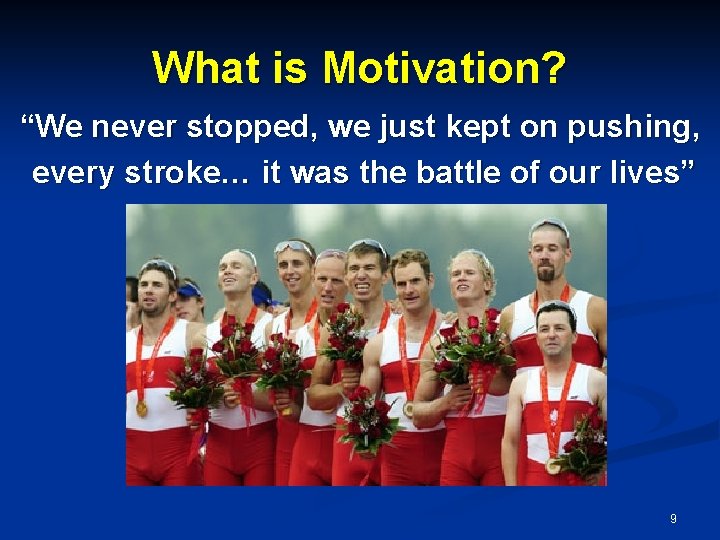
What is Motivation? “We never stopped, we just kept on pushing, every stroke… it was the battle of our lives” 9
What is Motivation? “The biggest pressure facing the Canadian men’s eight in Beijing isn’t from an outside source. It’s personal, whether it’s about righting a wrong from four years ago or not. ” Coach Mike Spracklen The gold medal-favoured Canadian men's eight crew reacts to a disappointing fifth place finish at the 2004 Olympic Games in Athens. 10
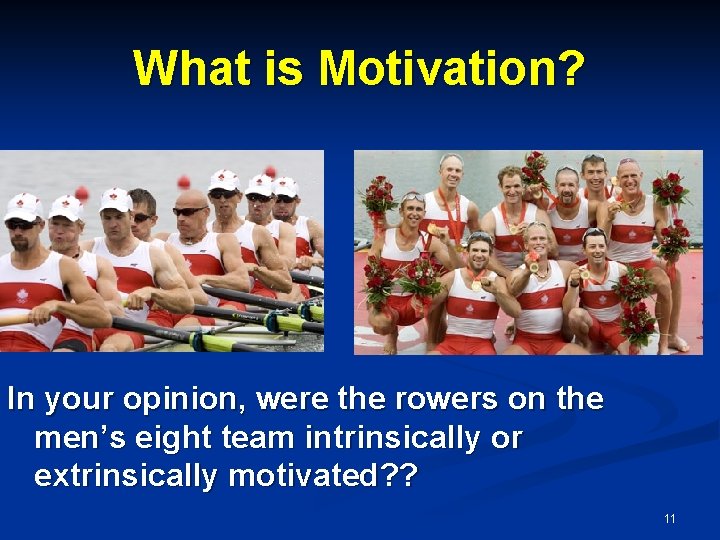
What is Motivation? In your opinion, were the rowers on the men’s eight team intrinsically or extrinsically motivated? ? 11
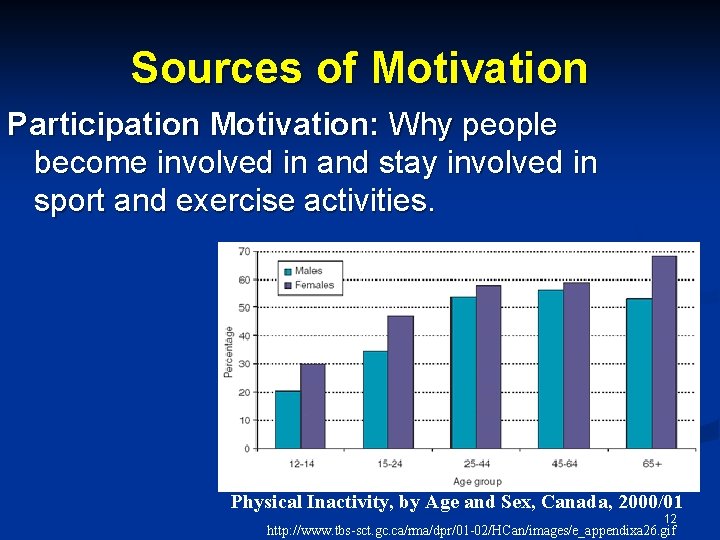
Sources of Motivation Participation Motivation: Why people become involved in and stay involved in sport and exercise activities. Physical Inactivity, by Age and Sex, Canada, 2000/01 12 http: //www. tbs-sct. gc. ca/rma/dpr/01 -02/HCan/images/e_appendixa 26. gif
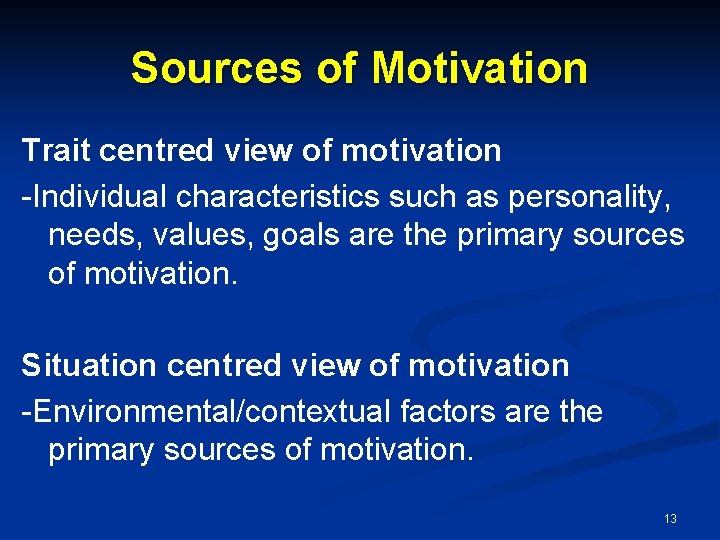
Sources of Motivation Trait centred view of motivation -Individual characteristics such as personality, needs, values, goals are the primary sources of motivation. Situation centred view of motivation -Environmental/contextual factors are the primary sources of motivation. 13
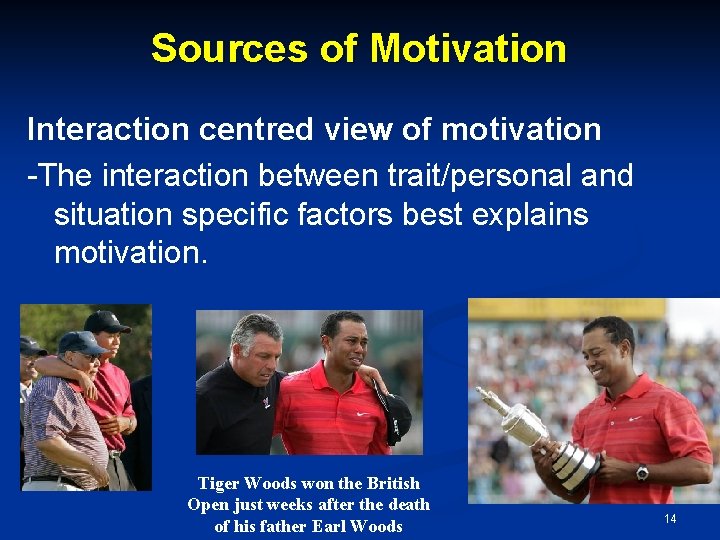
Sources of Motivation Interaction centred view of motivation -The interaction between trait/personal and situation specific factors best explains motivation. Tiger Woods won the British Open just weeks after the death of his father Earl Woods 14
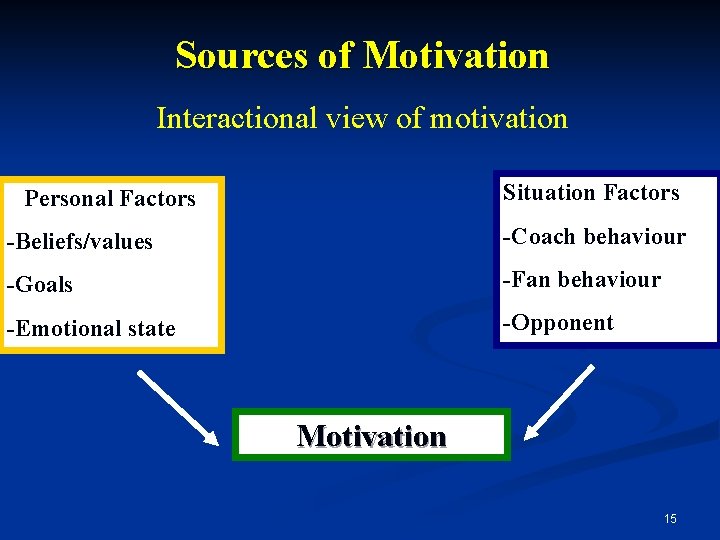
Sources of Motivation Interactional view of motivation Situation Factors Personal Factors -Beliefs/values -Coach behaviour -Goals -Fan behaviour -Emotional state -Opponent Motivation 15
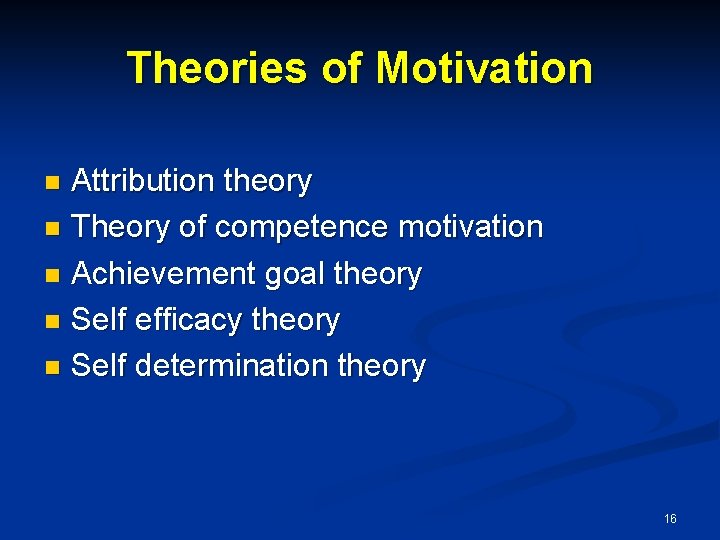
Theories of Motivation Attribution theory n Theory of competence motivation n Achievement goal theory n Self efficacy theory n Self determination theory n 16
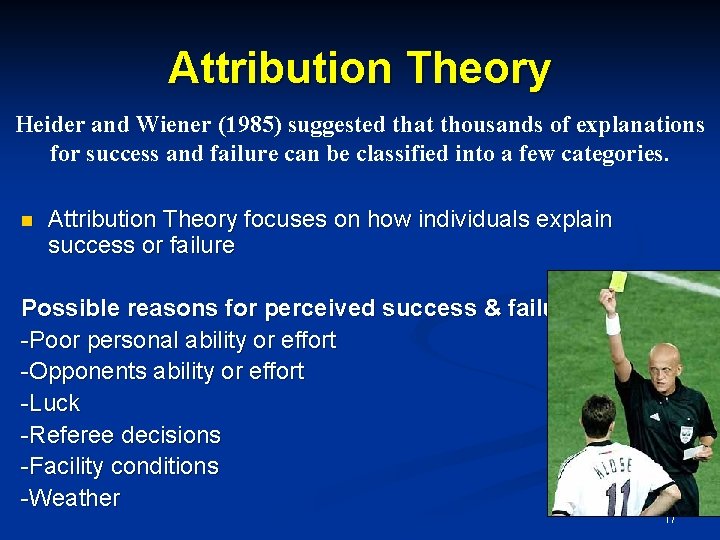
Attribution Theory Heider and Wiener (1985) suggested that thousands of explanations for success and failure can be classified into a few categories. n Attribution Theory focuses on how individuals explain success or failure Possible reasons for perceived success & failure -Poor personal ability or effort -Opponents ability or effort -Luck -Referee decisions -Facility conditions -Weather 17
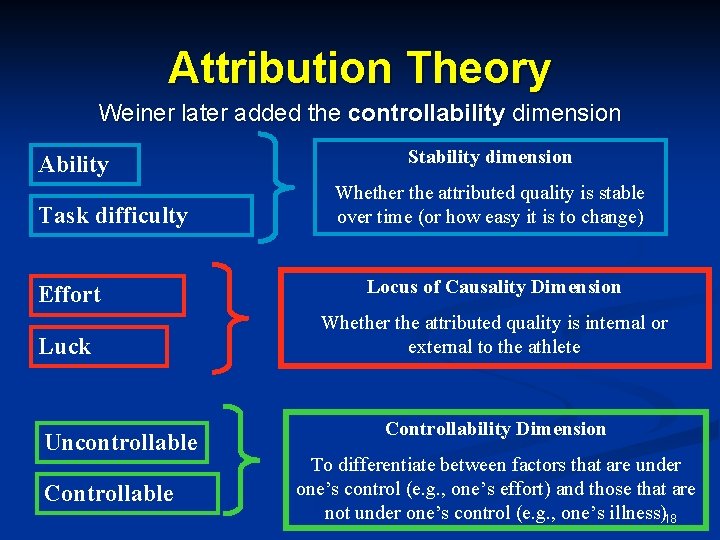
Attribution Theory Weiner later added the controllability dimension Ability Task difficulty Effort Luck Uncontrollable Controllable Stability dimension Whether the attributed quality is stable over time (or how easy it is to change) Locus of Causality Dimension Whether the attributed quality is internal or external to the athlete Controllability Dimension To differentiate between factors that are under one’s control (e. g. , one’s effort) and those that are not under one’s control (e. g. , one’s illness)18
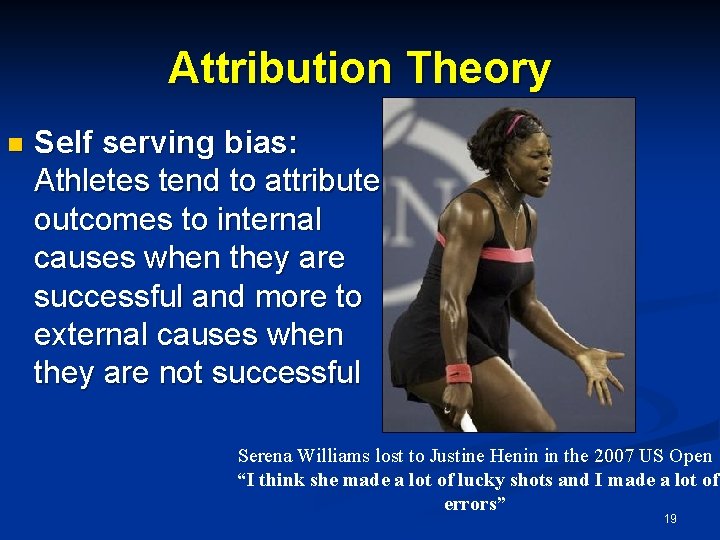
Attribution Theory n Self serving bias: Athletes tend to attribute outcomes to internal causes when they are successful and more to external causes when they are not successful Serena Williams lost to Justine Henin in the 2007 US Open “I think she made a lot of lucky shots and I made a lot of errors” 19
Achievement Goal Theory Nicholls and Roberts (1989, 2001) accounted for individual differences and their effects on motivation There are two antecedents that contribute to achievement goal theory: n n How people evaluate their competence How people define success and failure Success and failure are subjective psychological states 20
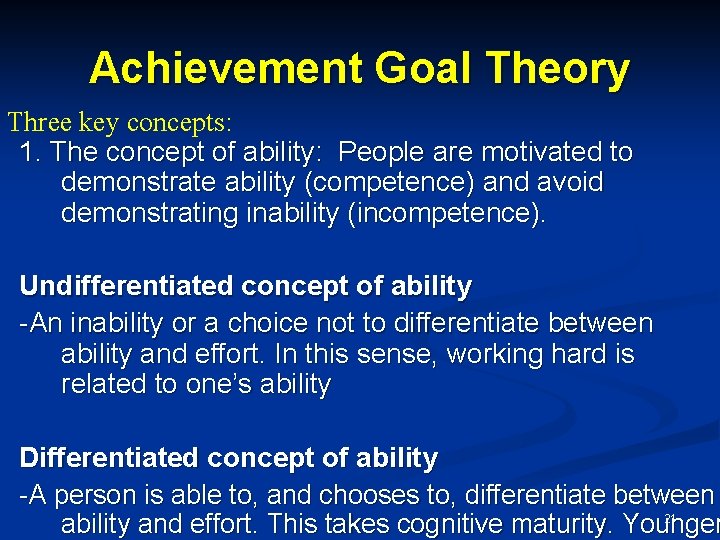
Achievement Goal Theory Three key concepts: 1. The concept of ability: People are motivated to demonstrate ability (competence) and avoid demonstrating inability (incompetence). Undifferentiated concept of ability -An inability or a choice not to differentiate between ability and effort. In this sense, working hard is related to one’s ability Differentiated concept of ability -A person is able to, and chooses to, differentiate between 21 ability and effort. This takes cognitive maturity. Younger
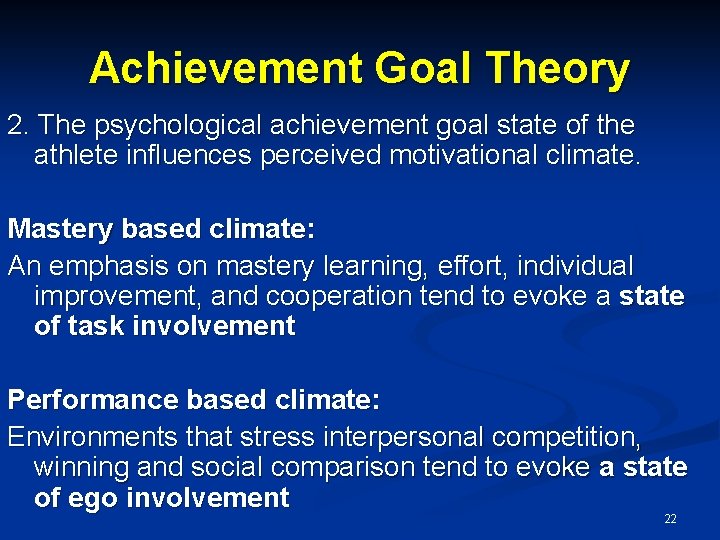
Achievement Goal Theory 2. The psychological achievement goal state of the athlete influences perceived motivational climate. Mastery based climate: An emphasis on mastery learning, effort, individual improvement, and cooperation tend to evoke a state of task involvement Performance based climate: Environments that stress interpersonal competition, winning and social comparison tend to evoke a state of ego involvement 22
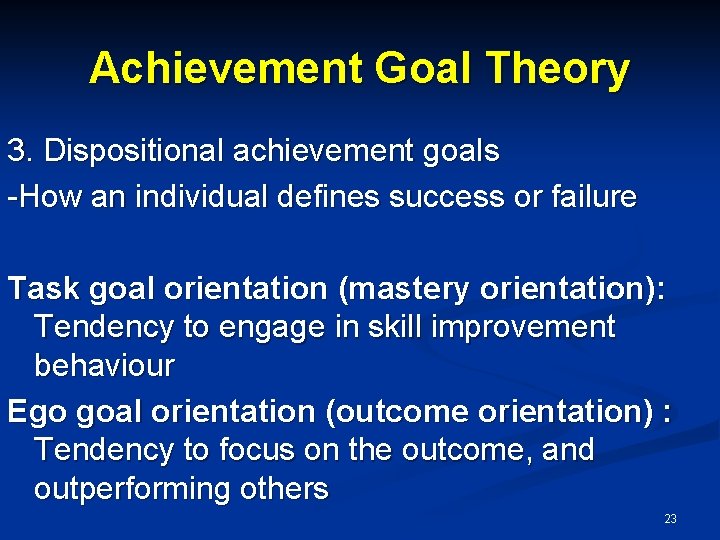
Achievement Goal Theory 3. Dispositional achievement goals -How an individual defines success or failure Task goal orientation (mastery orientation): Tendency to engage in skill improvement behaviour Ego goal orientation (outcome orientation) : Tendency to focus on the outcome, and outperforming others 23
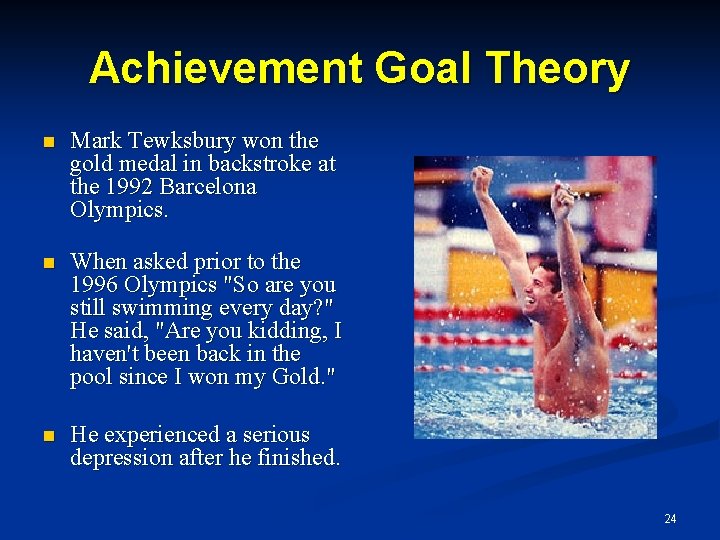
Achievement Goal Theory n n n Mark Tewksbury won the gold medal in backstroke at the 1992 Barcelona Olympics. When asked prior to the 1996 Olympics "So are you still swimming every day? " He said, "Are you kidding, I haven't been back in the pool since I won my Gold. " He experienced a serious depression after he finished. 24
Achievement Goal Theory “I prepared myself mentally to win, but I didn’t prepare myself at all for the minutes, weeks, and months that would follow after the competition. I found myself asking why I was here on earth. My life no longer had any interest to me. I should have been happy. I had attained my goal of winning an Olympic gold medal. I had plenty of money. But I found myself in a profound depression. ” (Tewksbury after winning 25
Achievement Goal Theory (Leah Pells after 4 th place finish) “My coach is really big on process. He taught me to enjoy the process so that the end result is a bonus. No matter what, you have a really great life. In order to get something done, you have to enjoy the doing. For awhile I don’t think I enjoyed the doing because I was constantly comparing myself to other runners and putting too much pressure on the outcome. ” 26
Achievement Goal Theory Tewksbury vs. Pells: Did their motivation differ before their Olympic performances? How did this lead to differences in consequences? 27
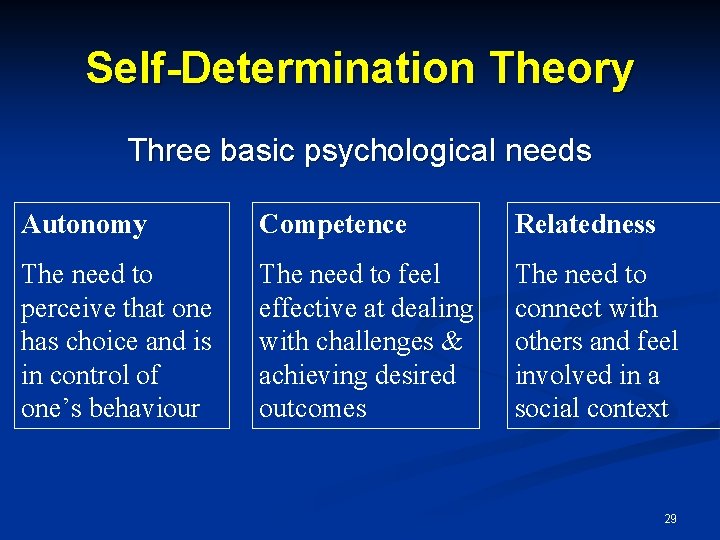
Self-Determination Theory Deci and Ryan (1985) stated that two main concepts work together to explain motivated behaviour: 1. Motivation is a multidimensional construct 2. The type of motivation an athlete experiences in a specific sporting situation will be determined by how well the situation meets that person’s basic needs for autonomy, competence and relatedness. 28
Self-Determination Theory Three basic psychological needs Autonomy Competence Relatedness The need to perceive that one has choice and is in control of one’s behaviour The need to feel effective at dealing with challenges & achieving desired outcomes The need to connect with others and feel involved in a social context 29
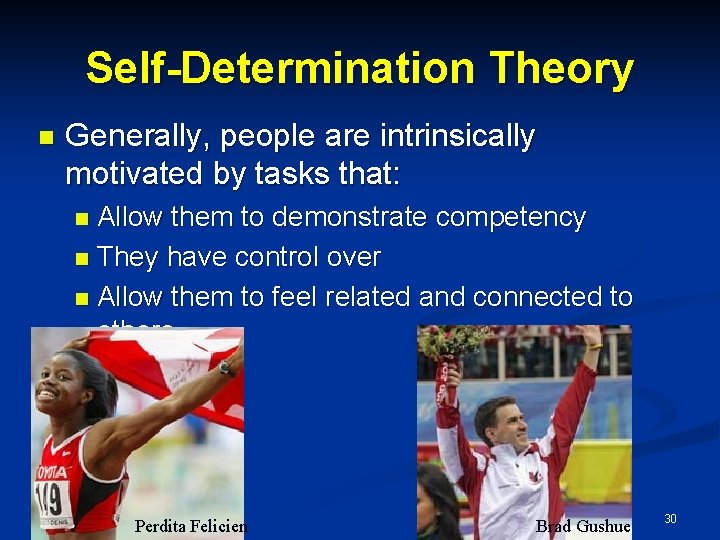
Self-Determination Theory n Generally, people are intrinsically motivated by tasks that: Allow them to demonstrate competency n They have control over n Allow them to feel related and connected to others n Perdita Felicien Brad Gushue 30
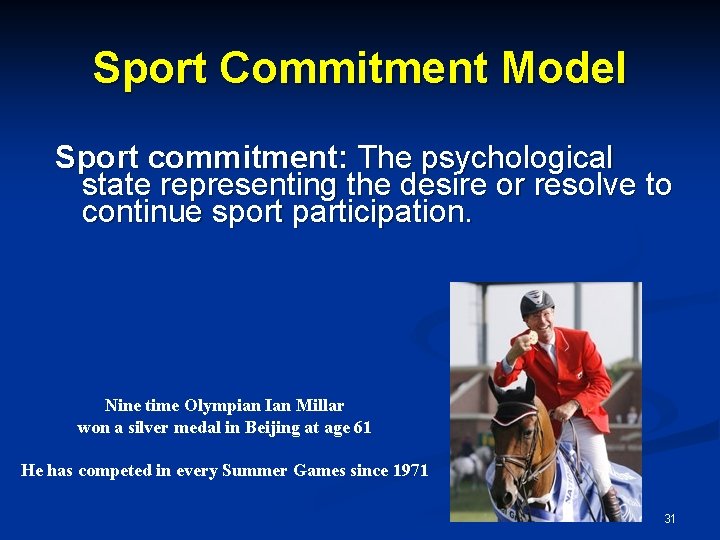
Sport Commitment Model Sport commitment: The psychological state representing the desire or resolve to continue sport participation. Nine time Olympian Ian Millar won a silver medal in Beijing at age 61 He has competed in every Summer Games since 1971 31
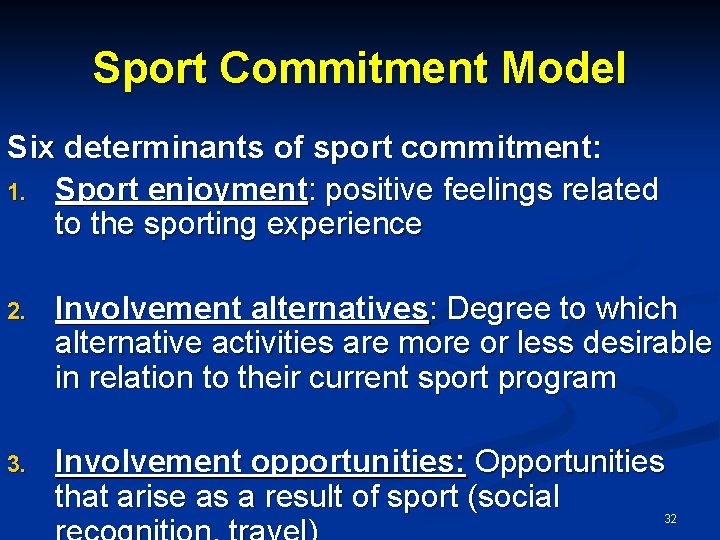
Sport Commitment Model Six determinants of sport commitment: 1. Sport enjoyment: positive feelings related to the sporting experience 2. Involvement alternatives: Degree to which alternative activities are more or less desirable in relation to their current sport program 3. Involvement opportunities: Opportunities that arise as a result of sport (social 32
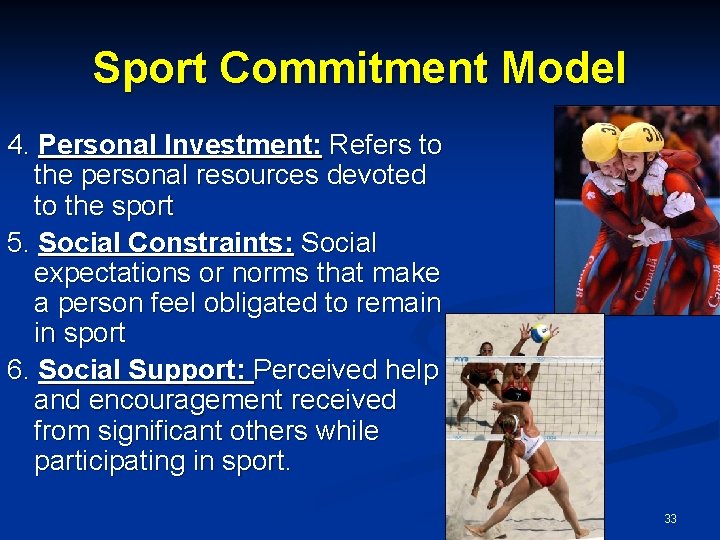
Sport Commitment Model 4. Personal Investment: Refers to the personal resources devoted to the sport 5. Social Constraints: Social expectations or norms that make a person feel obligated to remain in sport 6. Social Support: Perceived help and encouragement received from significant others while participating in sport. 33
Sport Commitment Model Conclusions: n Has provided insight into factors related to why athletes continue to participate in sport at youth and adult levels n However, there exists little information about its effectiveness in predicting aspects of motivation (e. g. , intensity and persistence). 34