
Chapter 4 Motion in Two Dimensions 1 Motion
- Slides: 55
Chapter 4 Motion in Two Dimensions 1
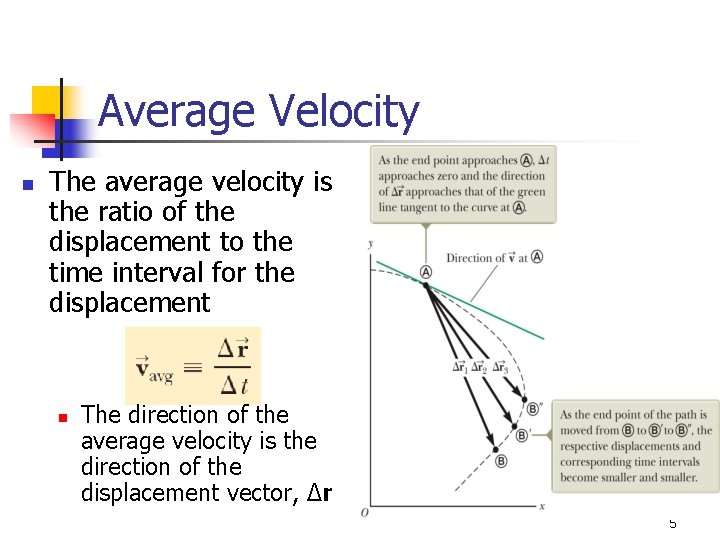
Motion in Two Dimensions n Using + or – signs is not always sufficient to fully describe motion in more than one dimension n Vectors can be used to more fully describe motion Still interested in displacement, velocity, and acceleration Serve as the basis of multiple types of motion in future chapters 2
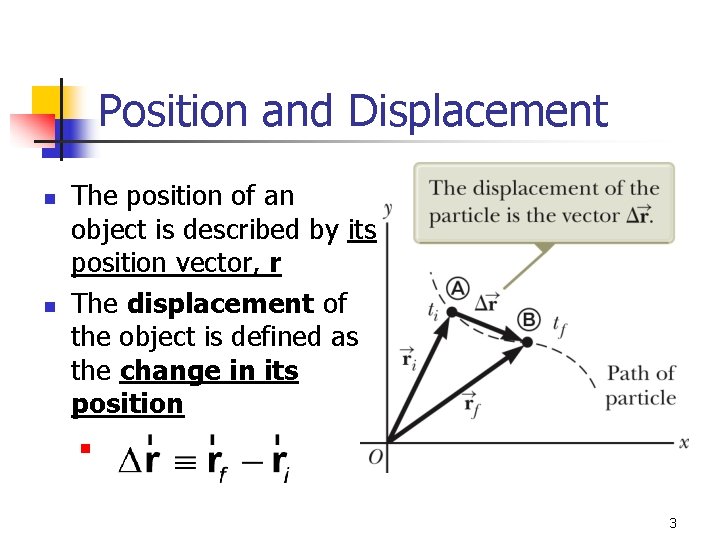
Position and Displacement n n The position of an object is described by its position vector, r The displacement of the object is defined as the change in its position n 3
General Motion Ideas n In two- or three-dimensional kinematics, everything is the same as in onedimensional motion except that we must now use full vector notation n Positive and negative signs are no longer sufficient to determine the direction 4
Average Velocity n The average velocity is the ratio of the displacement to the time interval for the displacement n The direction of the average velocity is the direction of the displacement vector, Δr 5
Average Velocity, cont n The average velocity between points is independent of the path taken n This is because it is dependent on the displacement, and independent of the path 6
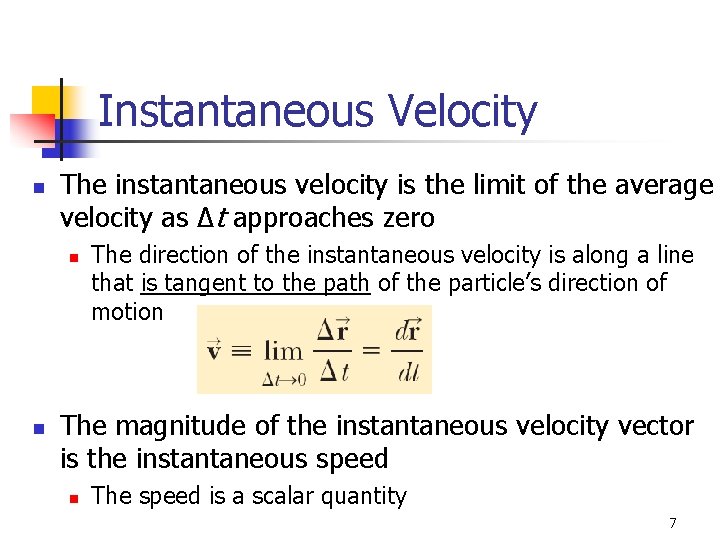
Instantaneous Velocity n The instantaneous velocity is the limit of the average velocity as Δt approaches zero n n The direction of the instantaneous velocity is along a line that is tangent to the path of the particle’s direction of motion The magnitude of the instantaneous velocity vector is the instantaneous speed n The speed is a scalar quantity 7
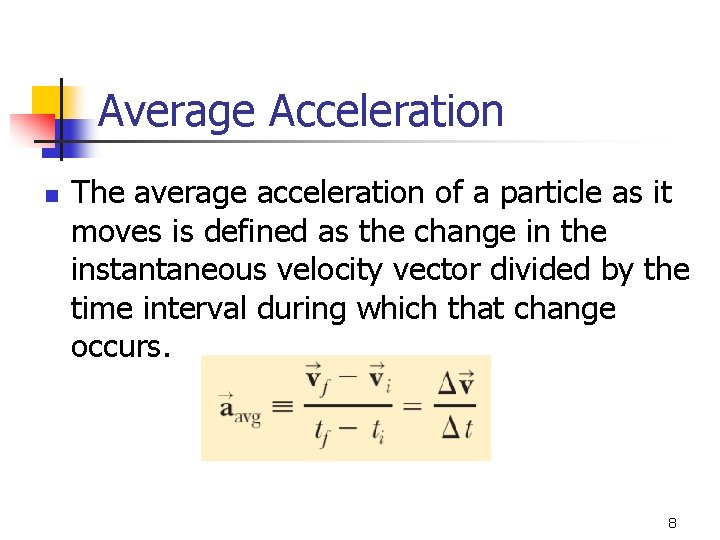
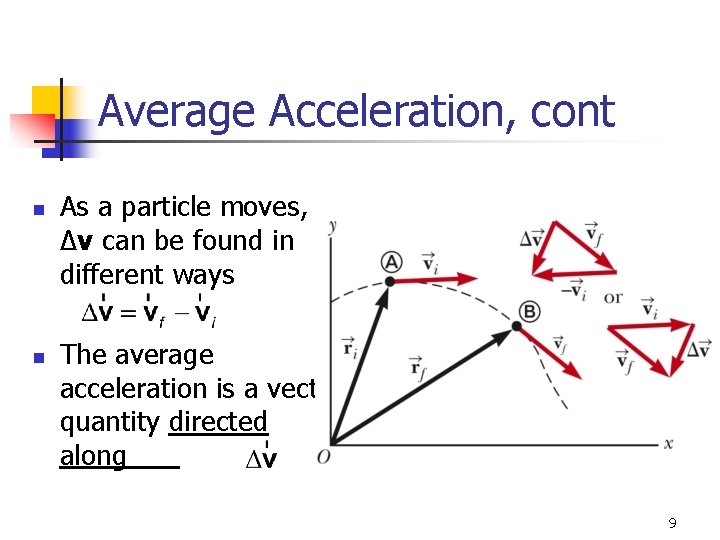
Average Acceleration n The average acceleration of a particle as it moves is defined as the change in the instantaneous velocity vector divided by the time interval during which that change occurs. 8
Average Acceleration, cont n n As a particle moves, Δv can be found in different ways The average acceleration is a vector quantity directed along 9
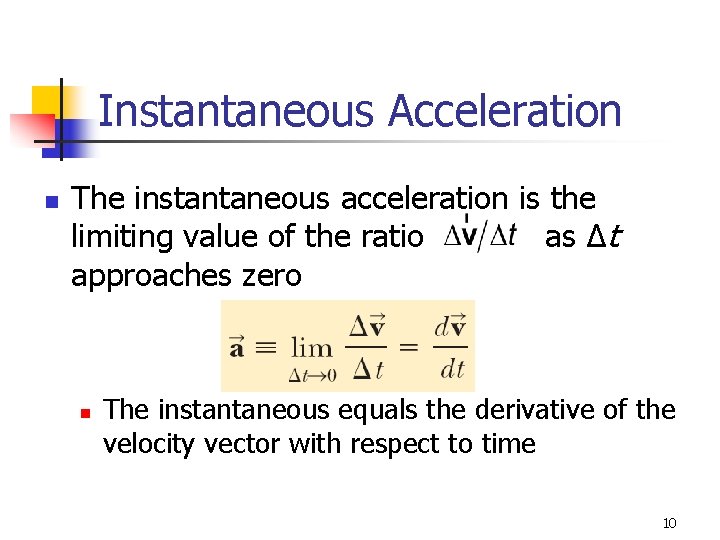
Instantaneous Acceleration n The instantaneous acceleration is the limiting value of the ratio as Δt approaches zero n The instantaneous equals the derivative of the velocity vector with respect to time 10
Producing An Acceleration n Various changes in a particle’s motion may produce an acceleration n n The magnitude of the velocity vector may change The direction of the velocity vector may change n n Even if the magnitude remains constant Both may change simultaneously 11
Kinematic Equations for Two. Dimensional Motion n When the two-dimensional motion has a constant acceleration, a series of equations can be developed that describe the motion These equations will be similar to those of onedimensional kinematics Motion in two dimensions can be modeled as two independent motions in each of the two perpendicular directions associated with the x and y axes 12
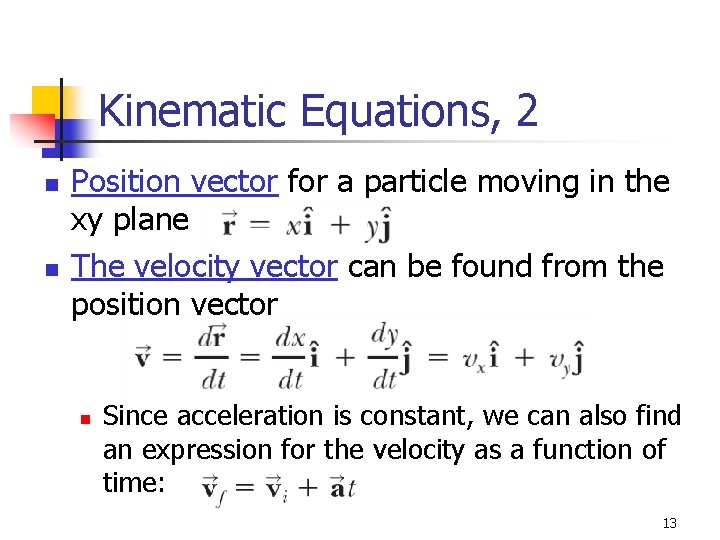
Kinematic Equations, 2 n n Position vector for a particle moving in the xy plane The velocity vector can be found from the position vector n Since acceleration is constant, we can also find an expression for the velocity as a function of time: 13
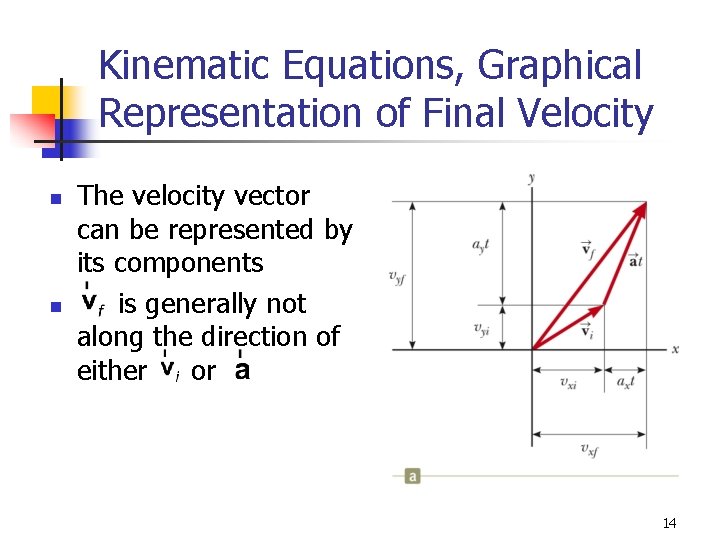
Kinematic Equations, Graphical Representation of Final Velocity n n The velocity vector can be represented by its components is generally not along the direction of either or 14
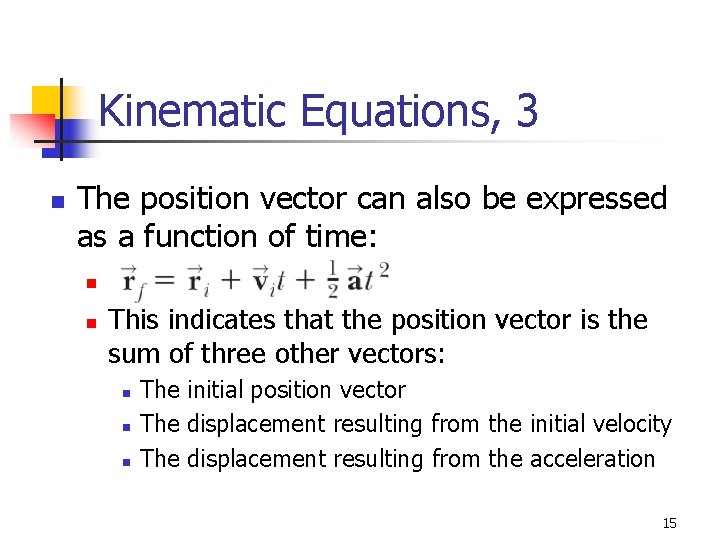
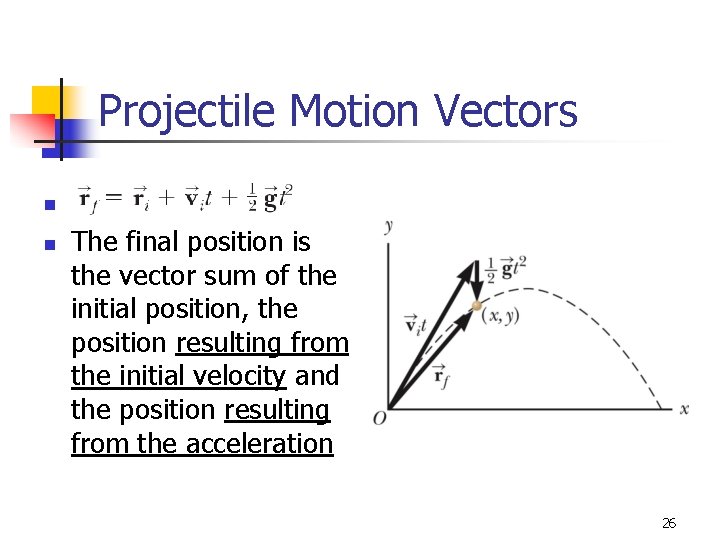
Kinematic Equations, 3 n The position vector can also be expressed as a function of time: n n This indicates that the position vector is the sum of three other vectors: n n n The initial position vector The displacement resulting from the initial velocity The displacement resulting from the acceleration 15
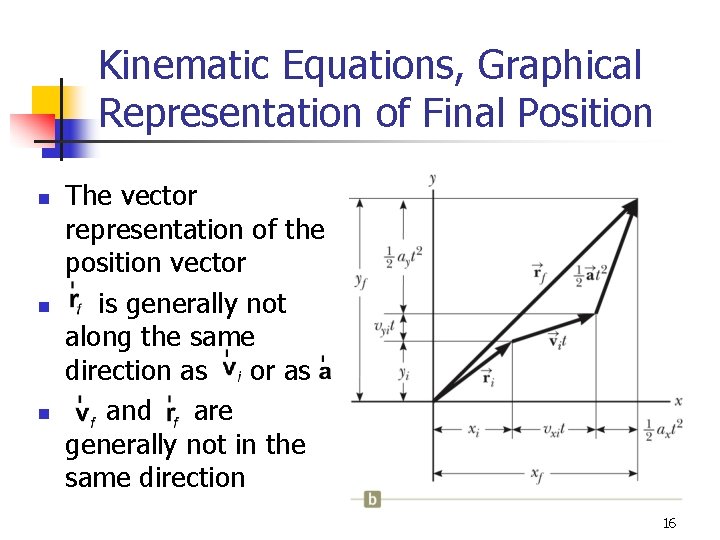
Kinematic Equations, Graphical Representation of Final Position n The vector representation of the position vector is generally not along the same direction as or as and are generally not in the same direction 16
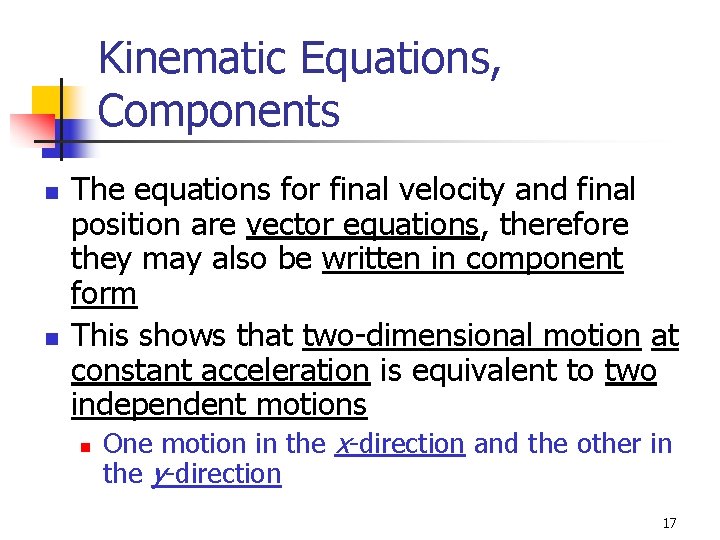
Kinematic Equations, Components n n The equations for final velocity and final position are vector equations, therefore they may also be written in component form This shows that two-dimensional motion at constant acceleration is equivalent to two independent motions n One motion in the x-direction and the other in the y-direction 17
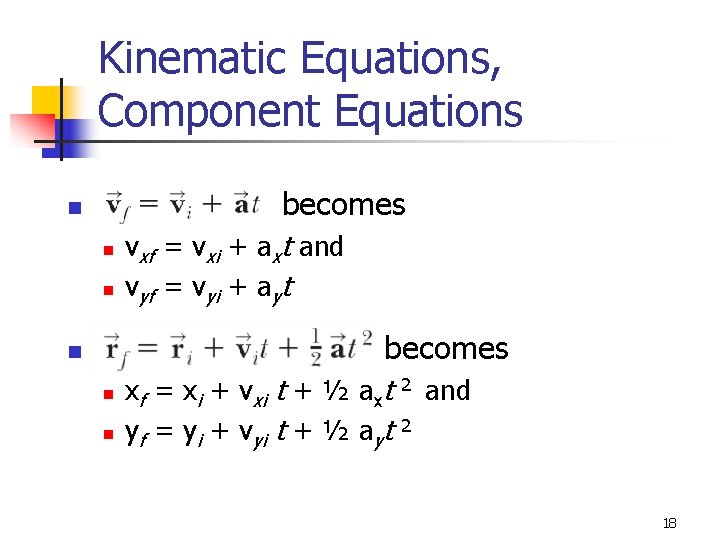
Kinematic Equations, Component Equations becomes n n n vxf = vxi + axt and vyf = vyi + ayt becomes n n n xf = xi + vxi t + ½ axt yf = yi + vyi t + ½ ayt 2 and 2 18
Projectile Motion n n An object may move in both the x and y directions simultaneously The form of two-dimensional motion we will deal with is called projectile motion 19
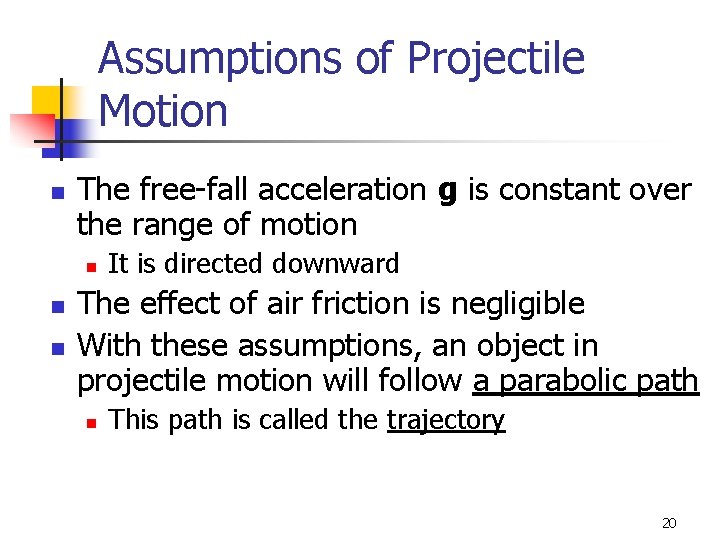
Assumptions of Projectile Motion n The free-fall acceleration g is constant over the range of motion n It is directed downward The effect of air friction is negligible With these assumptions, an object in projectile motion will follow a parabolic path n This path is called the trajectory 20
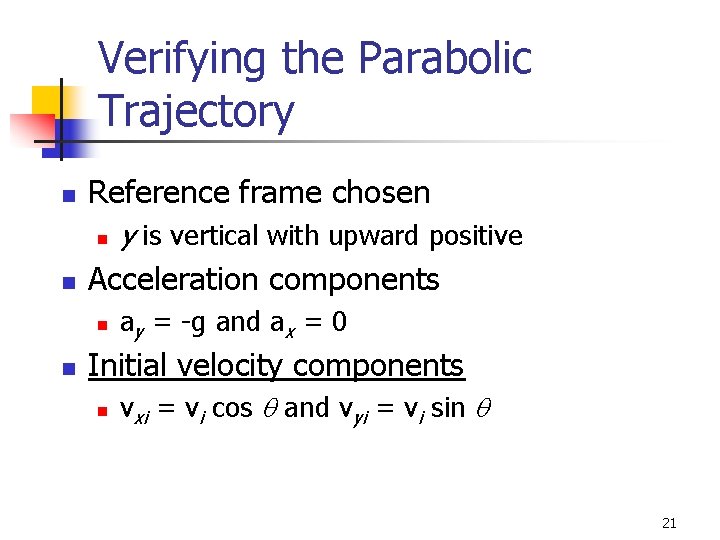
Verifying the Parabolic Trajectory n Reference frame chosen n n Acceleration components n n y is vertical with upward positive ay = -g and ax = 0 Initial velocity components n vxi = vi cos q and vyi = vi sin q 21
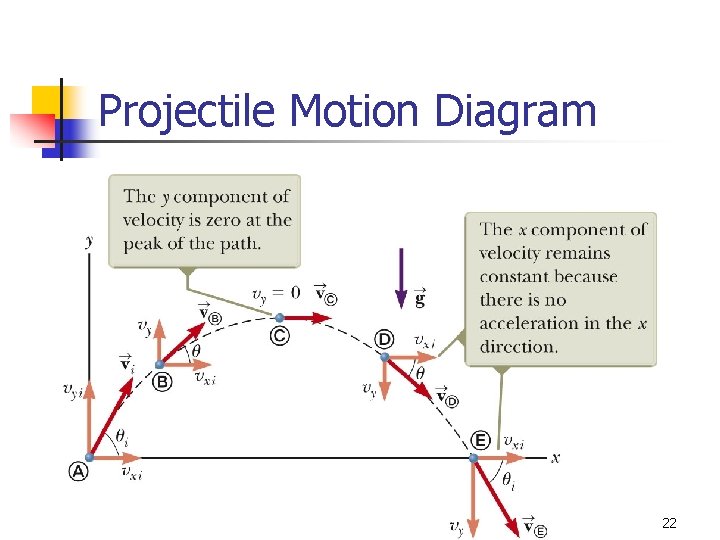
Projectile Motion Diagram 22
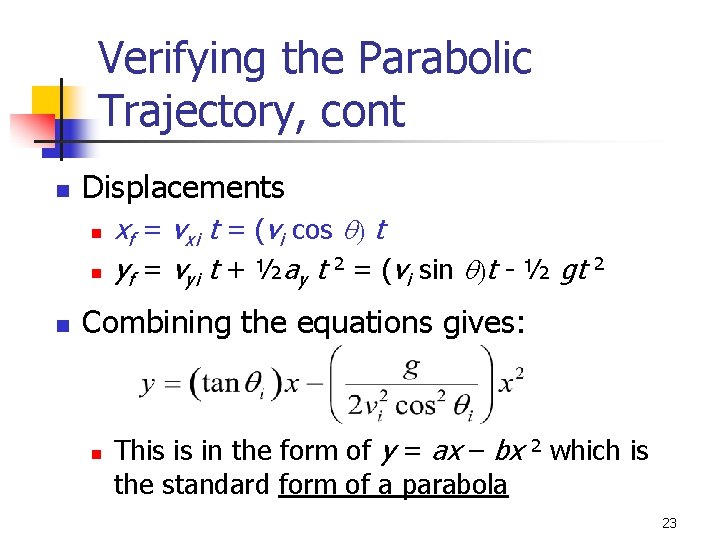
Verifying the Parabolic Trajectory, cont n Displacements n n n xf = vxi t = (vi cos q) t yf = vyi t + ½ay t 2 = (vi sin q)t - ½ gt 2 Combining the equations gives: n This is in the form of y = ax – bx 2 which is the standard form of a parabola 23
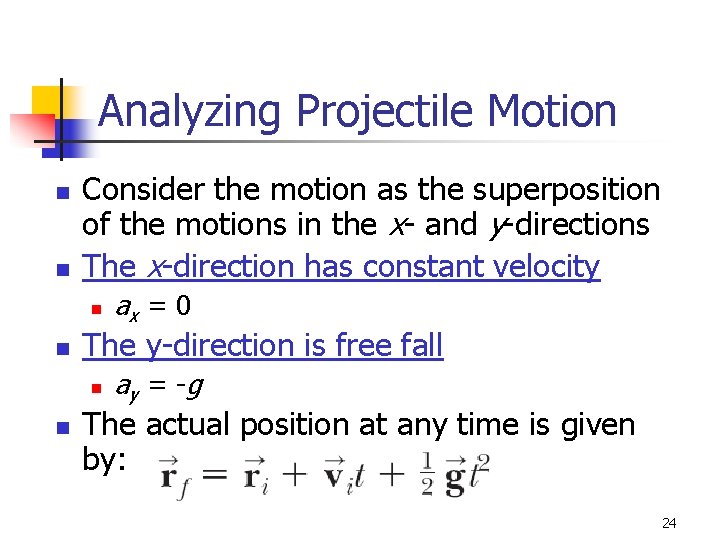
Analyzing Projectile Motion n n Consider the motion as the superposition of the motions in the x- and y-directions The x-direction has constant velocity n n The y-direction is free fall n n ax = 0 ay = - g The actual position at any time is given by: 24
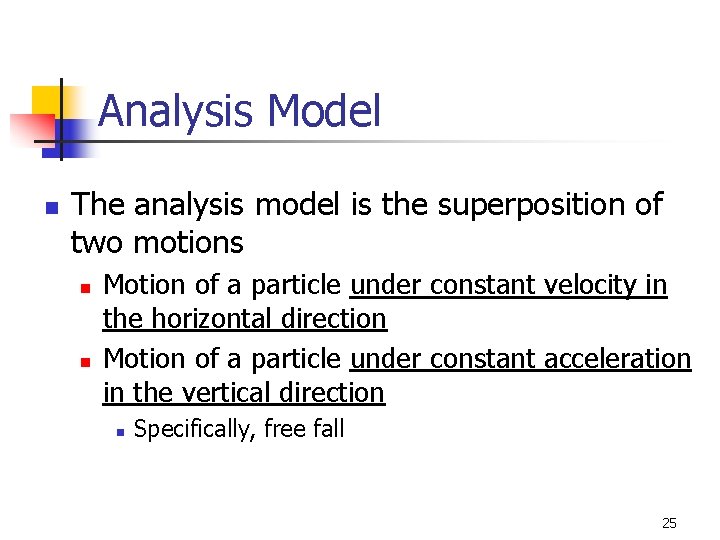
Analysis Model n The analysis model is the superposition of two motions n n Motion of a particle under constant velocity in the horizontal direction Motion of a particle under constant acceleration in the vertical direction n Specifically, free fall 25
Projectile Motion Vectors n n The final position is the vector sum of the initial position, the position resulting from the initial velocity and the position resulting from the acceleration 26
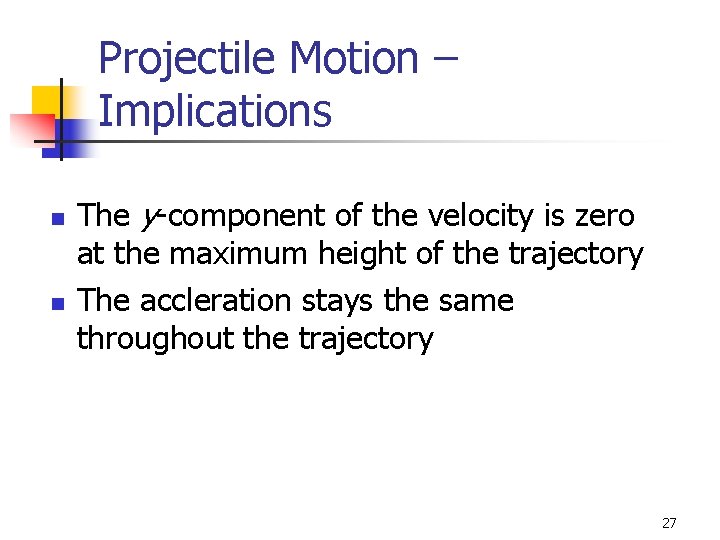
Projectile Motion – Implications n n The y-component of the velocity is zero at the maximum height of the trajectory The accleration stays the same throughout the trajectory 27
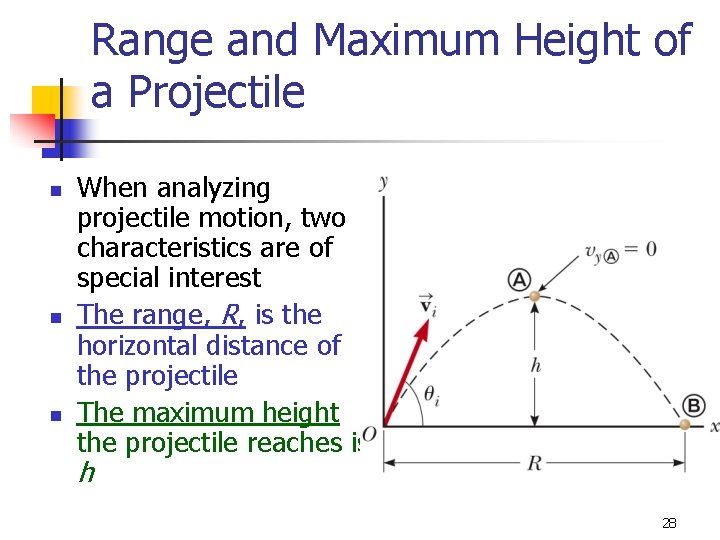
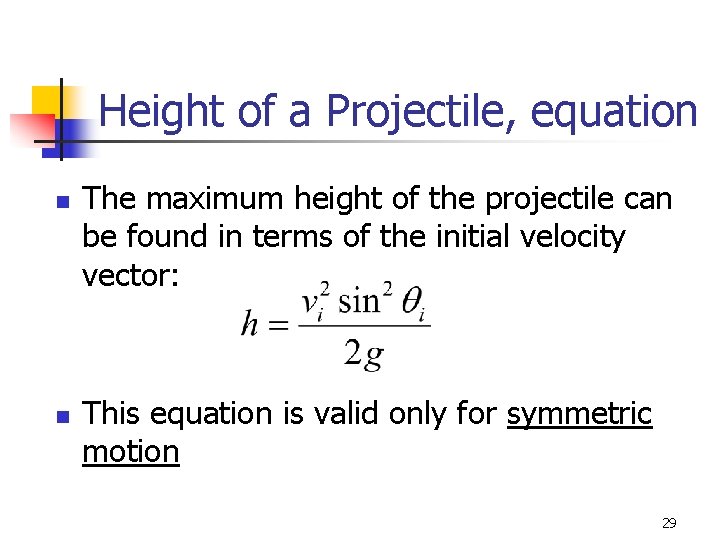
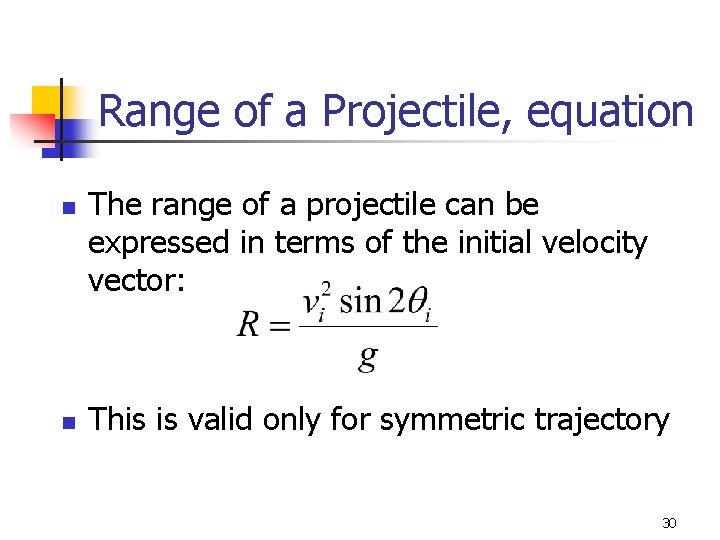
Range and Maximum Height of a Projectile n n n When analyzing projectile motion, two characteristics are of special interest The range, R, is the horizontal distance of the projectile The maximum height the projectile reaches is h 28
Height of a Projectile, equation n n The maximum height of the projectile can be found in terms of the initial velocity vector: This equation is valid only for symmetric motion 29
Range of a Projectile, equation n n The range of a projectile can be expressed in terms of the initial velocity vector: This is valid only for symmetric trajectory 30
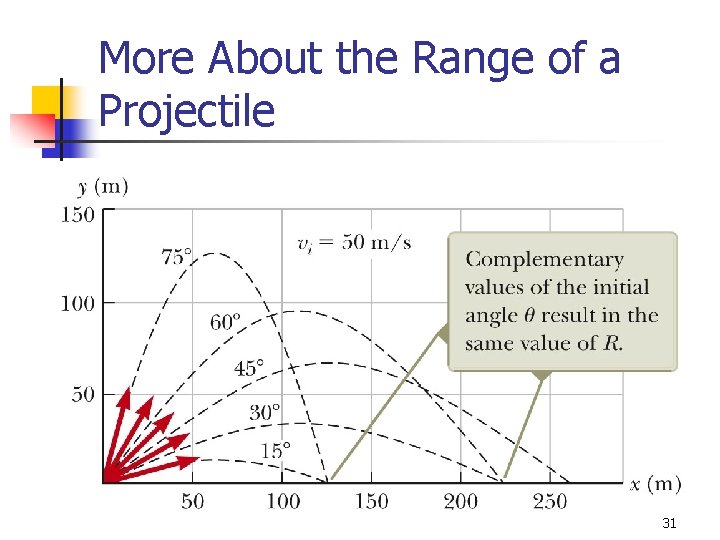
More About the Range of a Projectile 31
Range of a Projectile, final n n The maximum range occurs at qi = 45 o Complementary angles will produce the same range n n The maximum height will be different for the two angles The times of the flight will be different for the two angles 32
Projectile Motion – Problem Solving Hints n n n Select a coordinate system Resolve the initial velocity into x and y components Analyze the horizontal motion using constant velocity techniques Analyze the vertical motion using constant acceleration techniques Remember that both directions share the same time 33
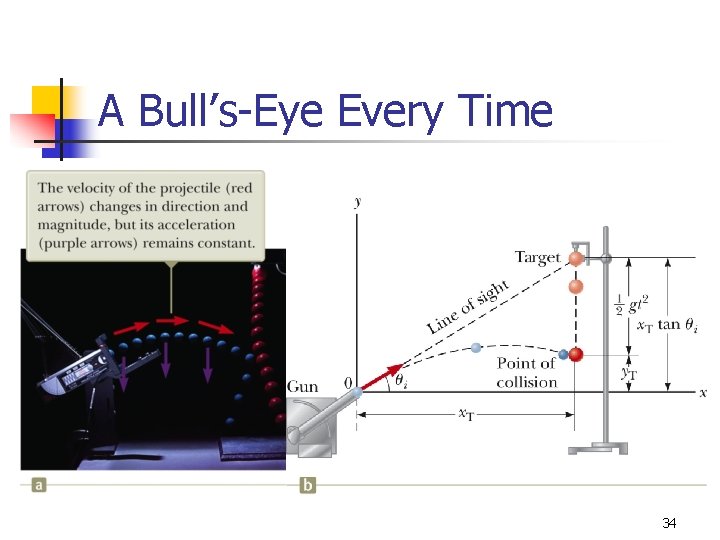
A Bull’s-Eye Every Time 34
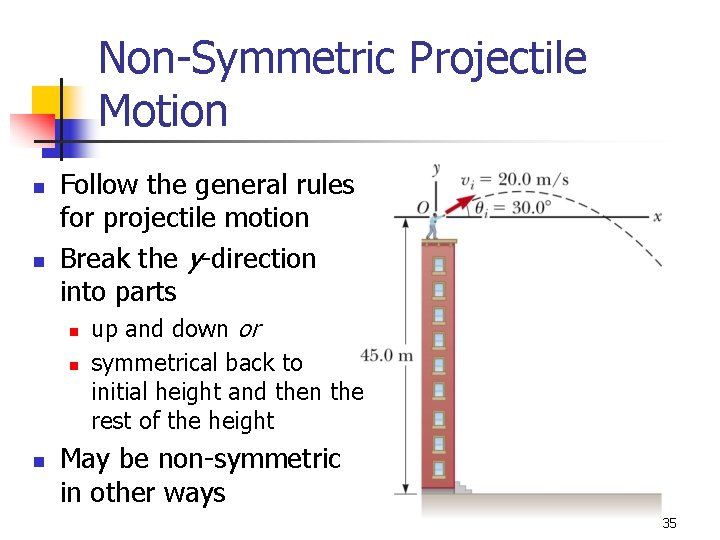
Non-Symmetric Projectile Motion n n Follow the general rules for projectile motion Break the y-direction into parts n n n up and down or symmetrical back to initial height and then the rest of the height May be non-symmetric in other ways 35
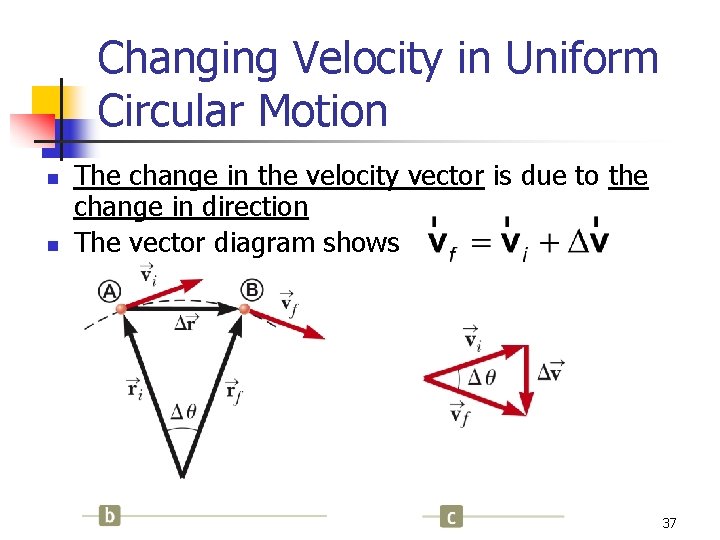
Uniform Circular Motion n n Uniform circular motion occurs when an object moves in a circular path with a constant speed An acceleration exists since the direction of the motion is changing n n This change in velocity is related to an acceleration The velocity vector is always tangent to the path of the object 36
Changing Velocity in Uniform Circular Motion n n The change in the velocity vector is due to the change in direction The vector diagram shows 37
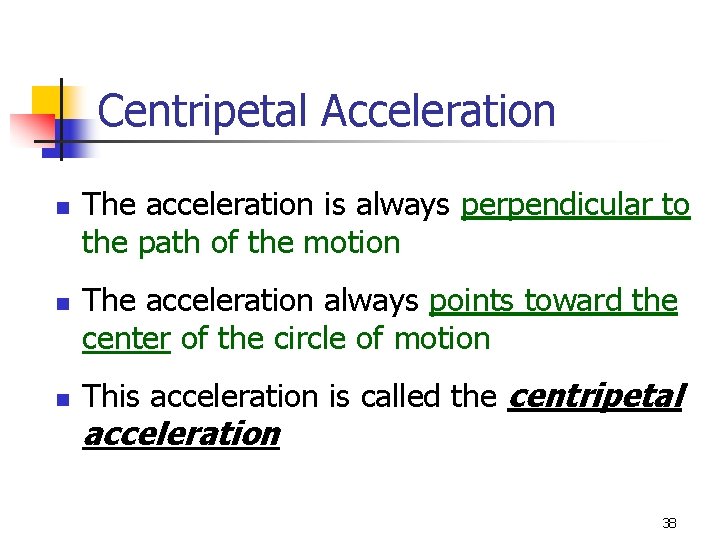
Centripetal Acceleration n The acceleration is always perpendicular to the path of the motion The acceleration always points toward the center of the circle of motion This acceleration is called the centripetal acceleration 38
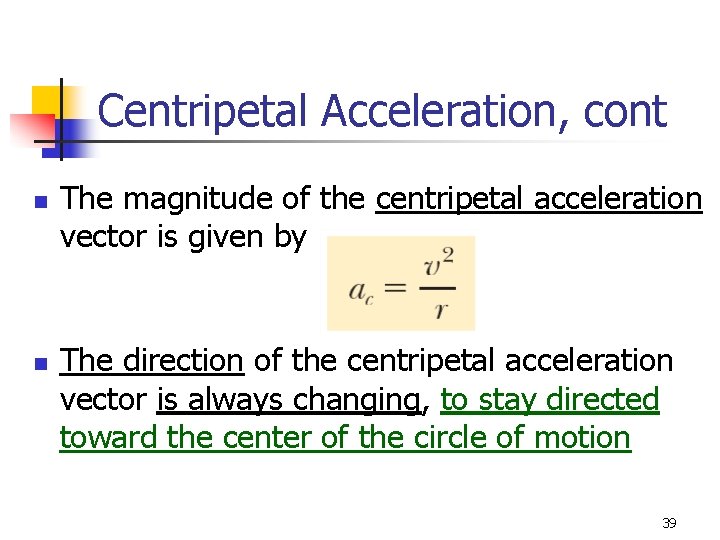
Centripetal Acceleration, cont n n The magnitude of the centripetal acceleration vector is given by The direction of the centripetal acceleration vector is always changing, to stay directed toward the center of the circle of motion 39
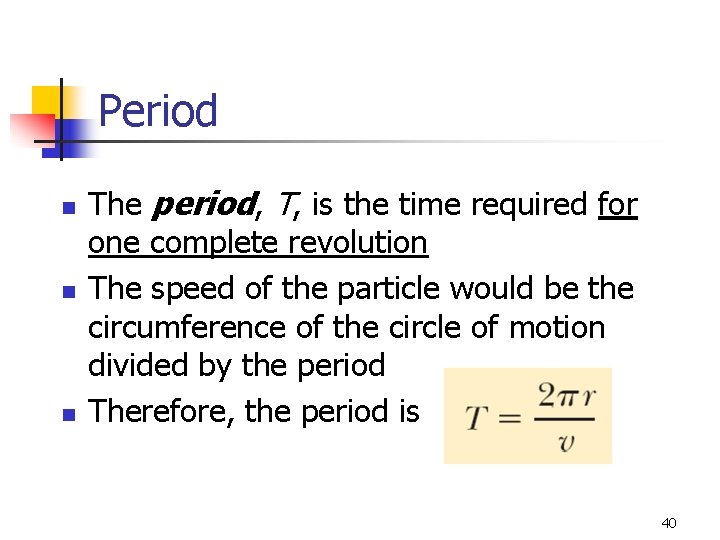
Period n n n The period, T, is the time required for one complete revolution The speed of the particle would be the circumference of the circle of motion divided by the period Therefore, the period is 40
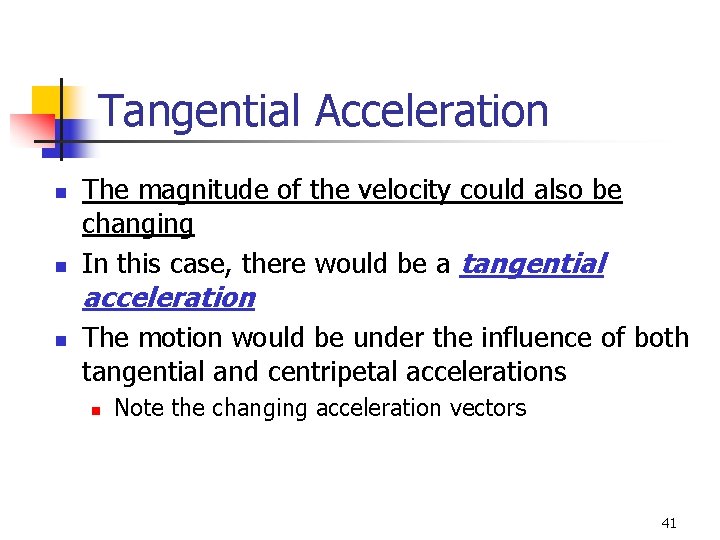
Tangential Acceleration n n The magnitude of the velocity could also be changing In this case, there would be a tangential acceleration n The motion would be under the influence of both tangential and centripetal accelerations n Note the changing acceleration vectors 41
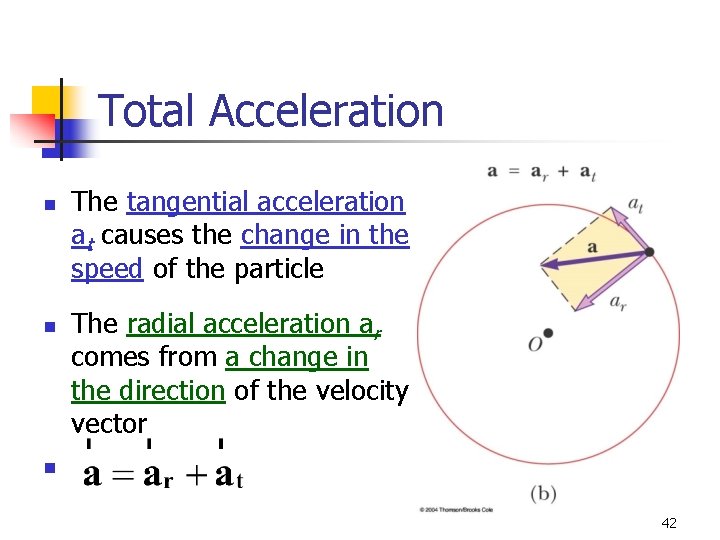
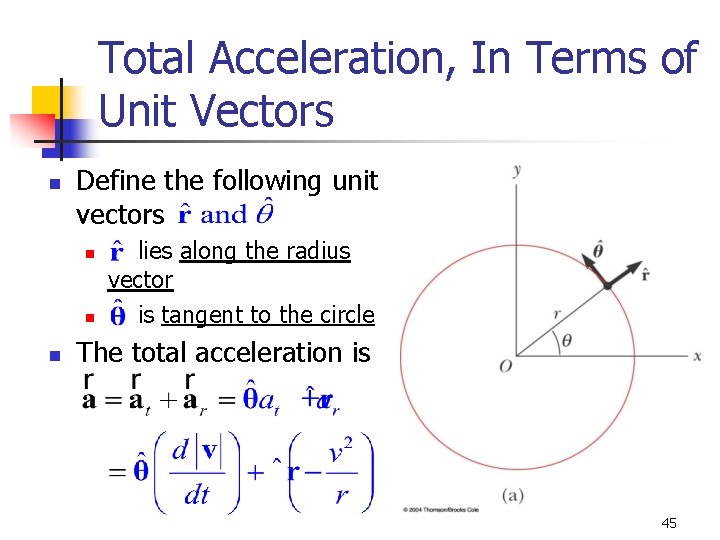
Total Acceleration n n The tangential acceleration at causes the change in the speed of the particle The radial acceleration ar comes from a change in the direction of the velocity vector n 42
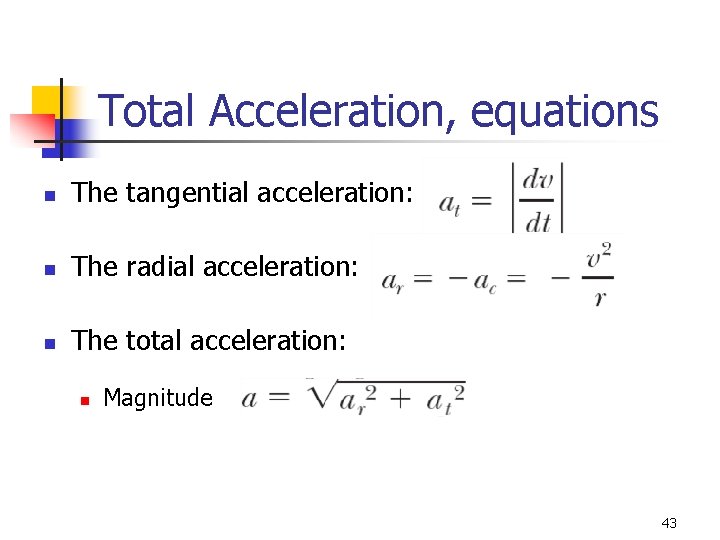
Total Acceleration, equations n The tangential acceleration: n The radial acceleration: n The total acceleration: n Magnitude 43
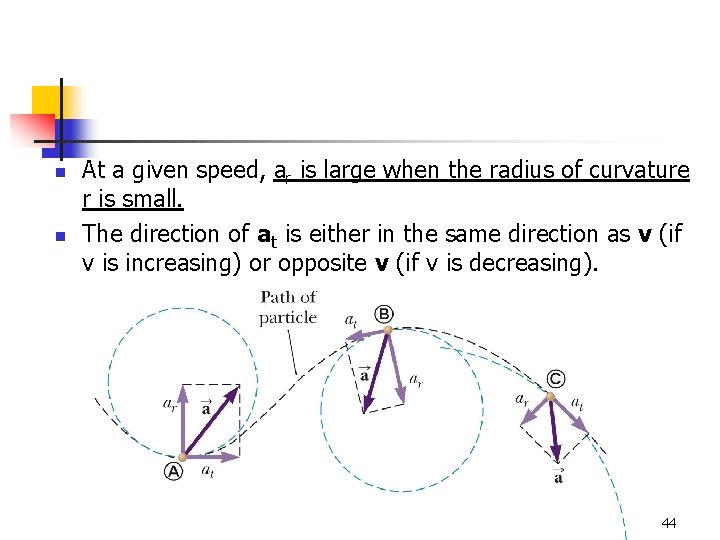
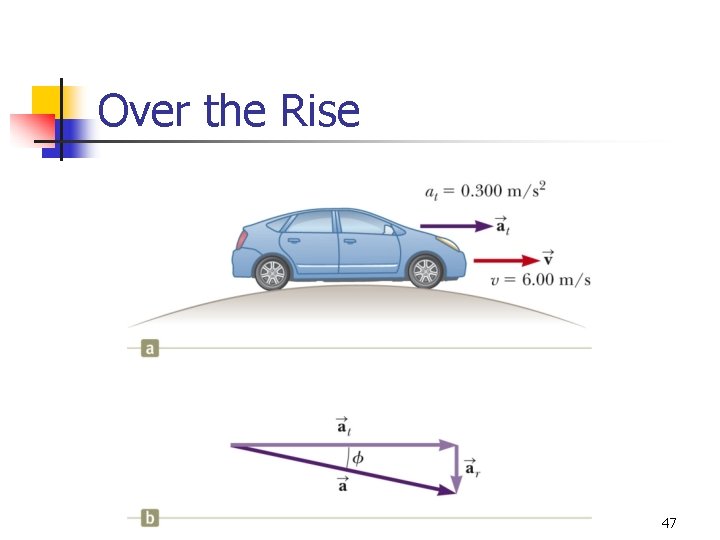
n n At a given speed, ar is large when the radius of curvature r is small. The direction of at is either in the same direction as v (if v is increasing) or opposite v (if v is decreasing). 44
Total Acceleration, In Terms of Unit Vectors n Define the following unit vectors n n n lies along the radius vector is tangent to the circle The total acceleration is 45
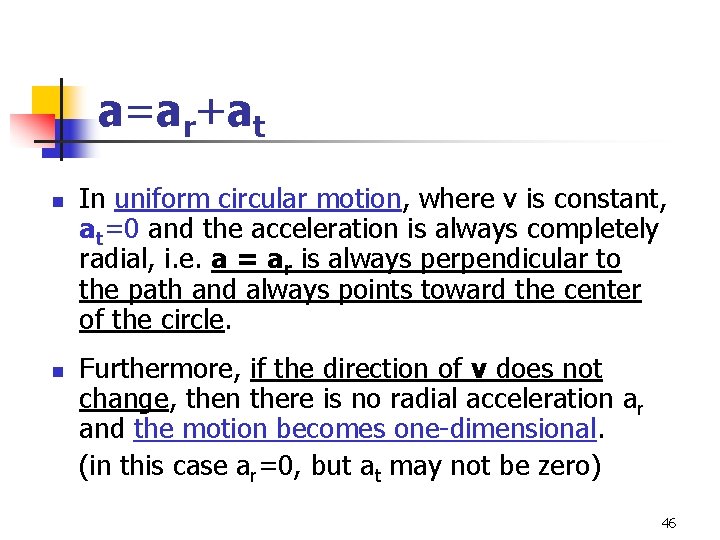
a=ar+at n n In uniform circular motion, where v is constant, at=0 and the acceleration is always completely radial, i. e. a = ar is always perpendicular to the path and always points toward the center of the circle. Furthermore, if the direction of v does not change, then there is no radial acceleration ar and the motion becomes one-dimensional. (in this case ar=0, but at may not be zero) 46
Over the Rise 47
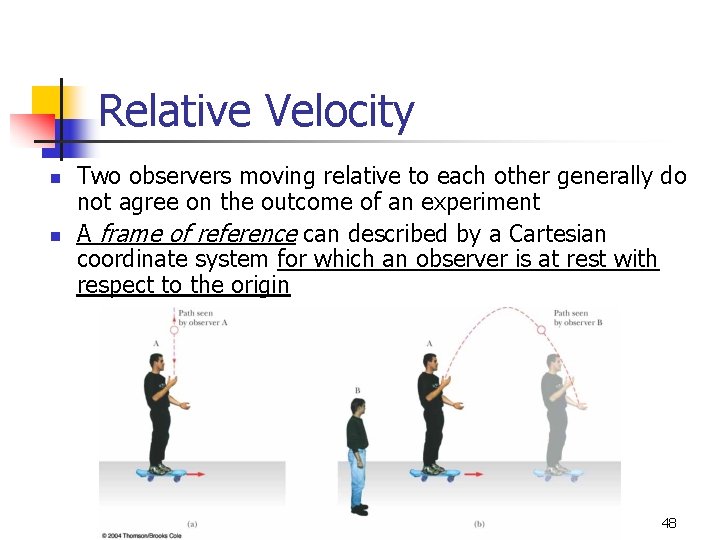
Relative Velocity n n Two observers moving relative to each other generally do not agree on the outcome of an experiment A frame of reference can described by a Cartesian coordinate system for which an observer is at rest with respect to the origin 48
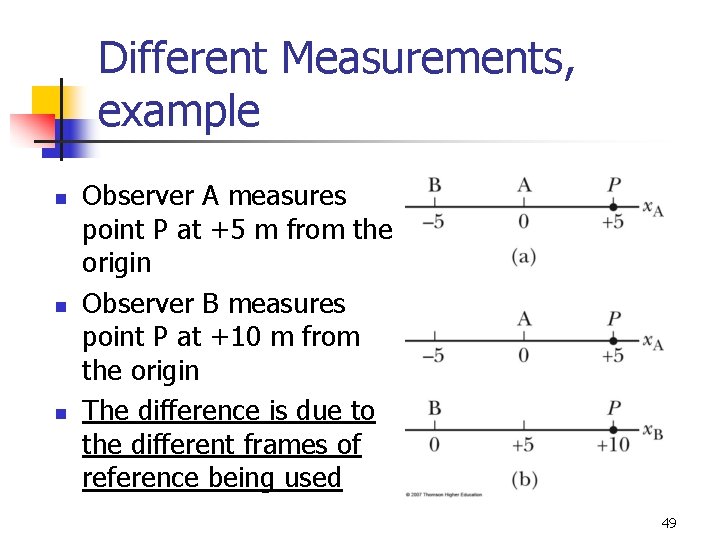
Different Measurements, example n n n Observer A measures point P at +5 m from the origin Observer B measures point P at +10 m from the origin The difference is due to the different frames of reference being used 49
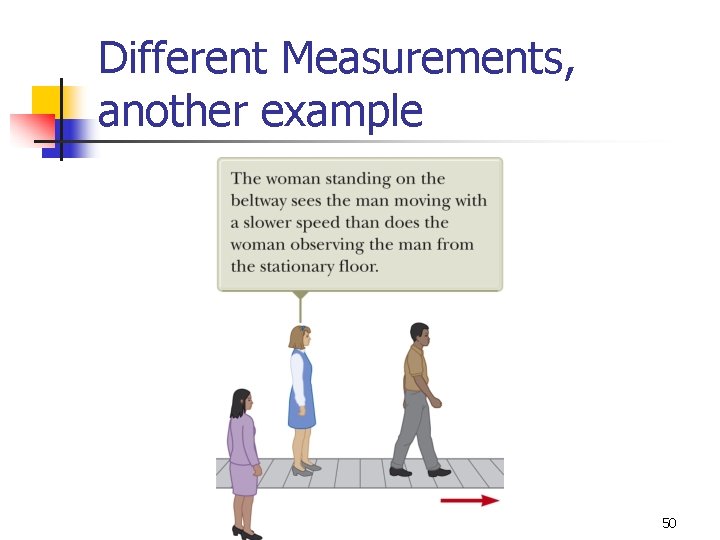
Different Measurements, another example 50
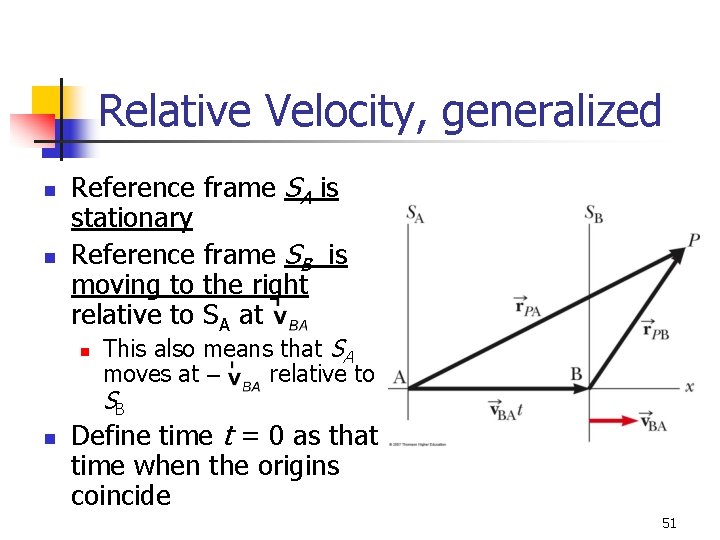
Relative Velocity, generalized n n Reference frame SA is stationary Reference frame SB is moving to the right relative to SA at n This also means that SA moves at – relative to SB n Define time t = 0 as that time when the origins coincide 51
Notation n The first subscript represents what is being observed The second subscript represents who is doing the observing Example n The velocity of A as measured by observer B 52
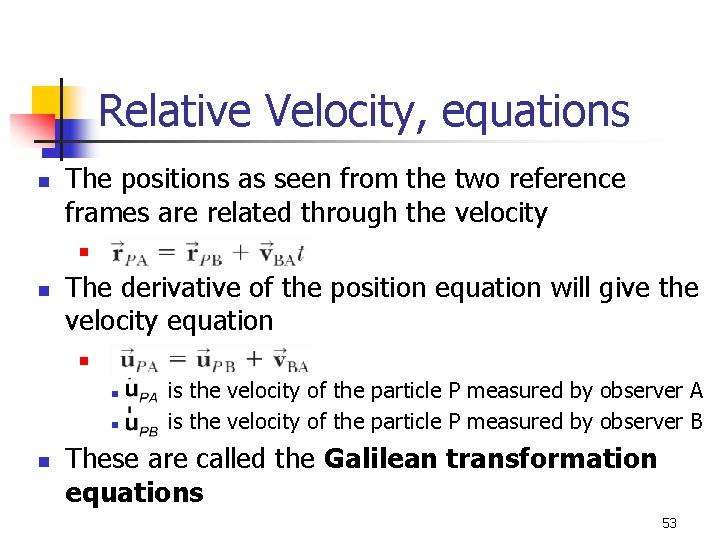
Relative Velocity, equations n The positions as seen from the two reference frames are related through the velocity n n The derivative of the position equation will give the velocity equation n n is the velocity of the particle P measured by observer A is the velocity of the particle P measured by observer B These are called the Galilean transformation equations 53
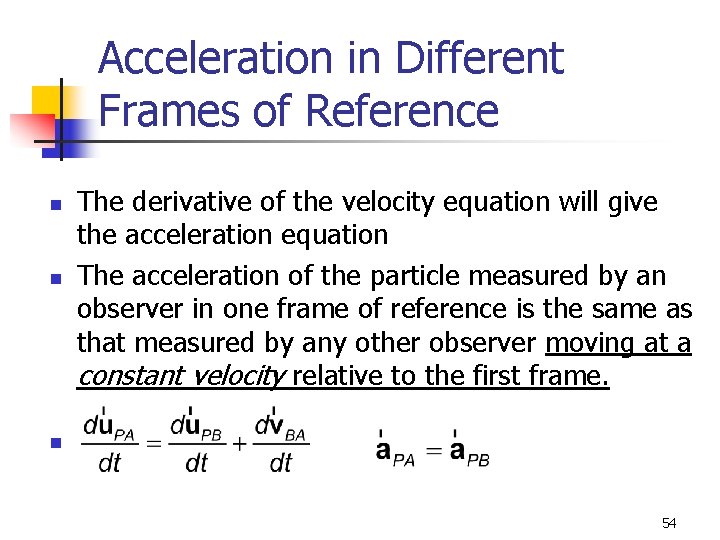
Acceleration in Different Frames of Reference n n The derivative of the velocity equation will give the acceleration equation The acceleration of the particle measured by an observer in one frame of reference is the same as that measured by any other observer moving at a constant velocity relative to the first frame. n 54
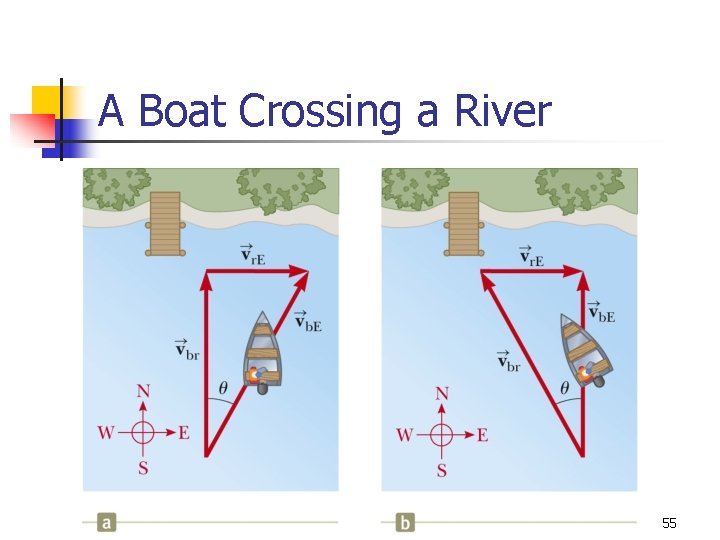
A Boat Crossing a River 55