
chapter 4 Minimizing OffTask Behavior and Discipline Problems
chapter 4 Minimizing Off-Task Behavior and Discipline Problems
Strategies for Minimizing Off-Task Behavior • Back-to-the-wall—being in position to observe the whole class • Proximity control—positioning near students who may be off task • With-it-ness – “Having eyes in the back of your head” (Kounin, 1970) – Using strategies to quickly and effectively prevent or stop off-task behavior (continued)
Strategies for Minimizing Off-Task Behavior (continued) • Selective ignoring – Monitor, not intervene – Behavior lasts a short duration or is a minor deviation, or reacting would cause interruption • Overlapping – Handling many situations simultaneously while still maintaining the flow of the lesson (continued)
Strategies for Minimizing Off-Task Behavior (continued) • Learning names • Positive pinpointing—identifying one or more children who are modeling the appropriate behavior or skill
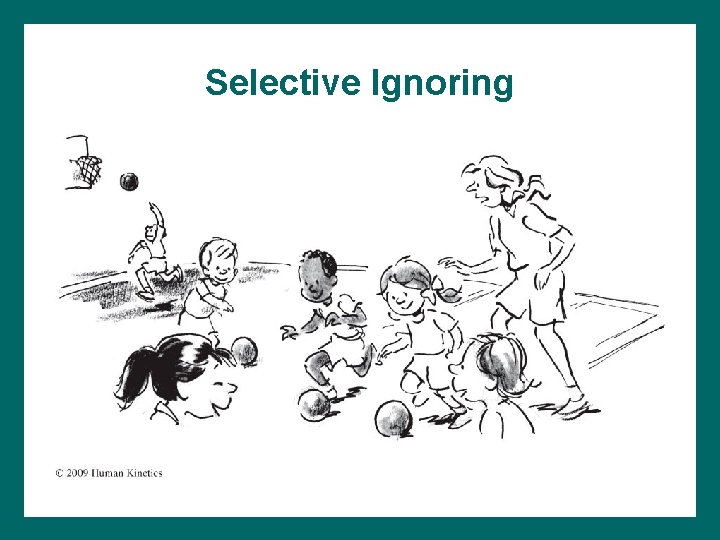
Selective Ignoring
Discipline Systems • Canter’s Assertive Discipline Model – Extrinsic motivation system – Based on specific rules with rewards and consequences – Schoolwide for greatest impact • Hellison’s Personal and Social Responsibility Model – Intrinsic motivation system – Based on helping children understand practice getting along with others and learning how to take responsibility for their own behavior
Canter’s Assertive Discipline Model Major Concepts • All students can behave responsibly, and appropriate behavior is expected. • Communicate firmly but warmly and fairly with eye contact. • Clearly communicate reasonable expectations. • Reinforce appropriate behavior. • Communicate logical consequences for inappropriate behavior. • Consistently reinforce consequences for all students equally. • Mentally rehearse expectations and consequences for consistent use with students. Reprinted from A. N. Sander, 1989, “Class management skills, ” Strategies 2(3): 15.
Desirable Rewards • Motivated to achieve the rewards • Less effective rewards – Popcorn or food – Free time • More effective rewards – – Creative objects—“golden sneaker” Class certificate Stickers or stamps Enjoyable special activity
Undesirable Consequences • Motivated to avoid the consequences • Effective consequences – Loss of time to participate in PE—time-outs for individuals or the whole class – Losing privilege to participate in enjoyable special activities
Canter’s Assertive Discipline Model Sample Consequences for Misbehavior • • • First offense—child is warned Second offense— 5 -minute time-out Third offense— 10 -minute time-out Fourth offense—teacher calls parents Fifth offense—meeting with parents and principal • Good behavior all week— 10 minutes of free -choice time or a tangible reward
Personal Social Responsibility Model • Intrinsic motivation system developed by Don Hellison (2003) • Levels of responsibility – – – Level 0: Irresponsibility Level 1: Self-control Level 2: Involvement Level 3: Self-responsibility Level 4: Caring
Characteristics of Effective Discipline Systems • Developing a clear understanding of the discipline system (rules, expectations, and consequences) at the start of the school year • Consistent enforcement by the teacher • Support from the principal, classroom teachers, and parents
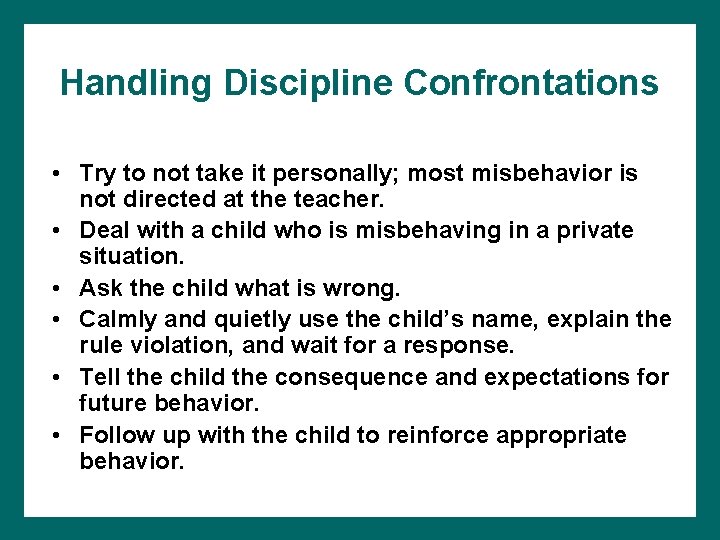
Handling Discipline Confrontations • Try to not take it personally; most misbehavior is not directed at the teacher. • Deal with a child who is misbehaving in a private situation. • Ask the child what is wrong. • Calmly and quietly use the child’s name, explain the rule violation, and wait for a response. • Tell the child the consequence and expectations for future behavior. • Follow up with the child to reinforce appropriate behavior.
- Slides: 13