
Chapter 4 Minerals Section 2 How Minerals Form

- Slides: 14
Chapter 4 – Minerals Section 2 – How Minerals Form
Key Concepts l How do minerals form from magma and lava? l How do minerals form from water solutions?
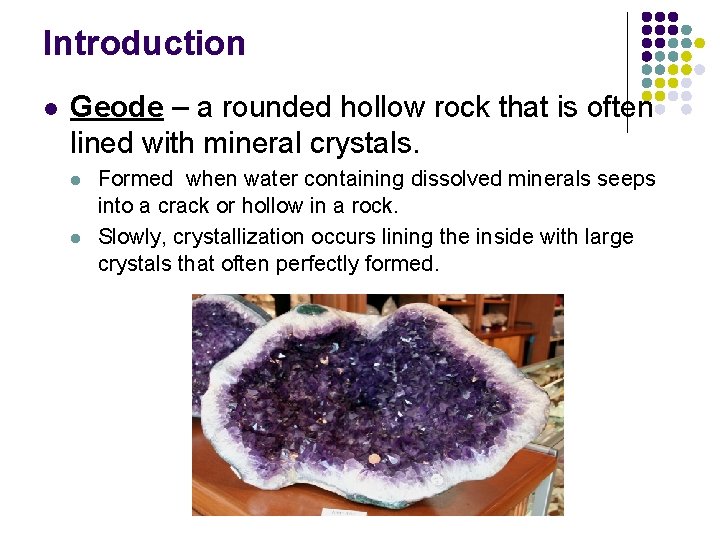
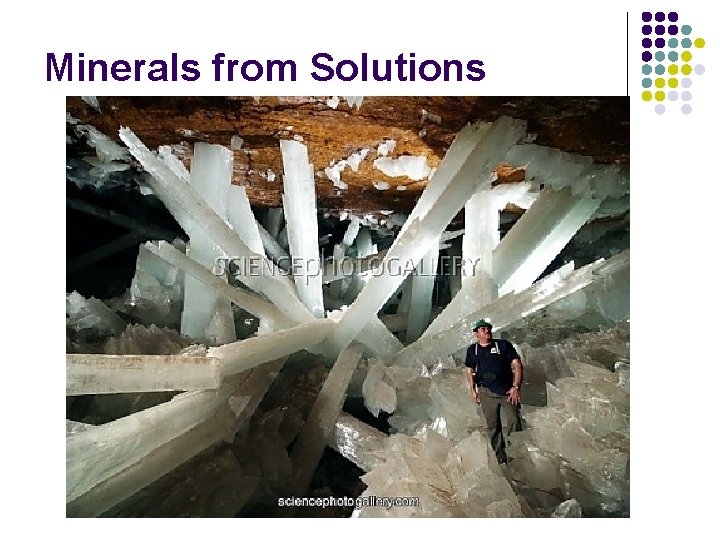
Introduction l Geode – a rounded hollow rock that is often lined with mineral crystals. l l Formed when water containing dissolved minerals seeps into a crack or hollow in a rock. Slowly, crystallization occurs lining the inside with large crystals that often perfectly formed.
Introduction l Crystallization – the process by which atoms are arranged to form a material with a crystal structure. l Minerals can form 2 ways l Crystallization of magma and lava l Crystallization of materials dissolved in water.
Minerals from Magma and Lava l Minerals form as hot magma cools inside the crust. l Minerals form as lava hardens on the surface l When these liquids cool to a solid state, crystals form.
Minerals from Magma and Lava l The size of the crystals depend on several factors: Rate of cooling. l Amount of gas contained in magma. l Chemical composition of the magma. l
Minerals from Magma and Lava l Magma deep below the Earths surface l l Cools over thousands of years Slow cooling leads to formation of large crystals l l Ex. Amethyst crystals in geode If undisturbed, growth continues in a regular pattern.
Minerals from Magma and Lava l Magma closer to the surface l l l Cools much faster than deep magma Rapid cooling leads to small crystal formation Magma erupting to surface, becoming lava – cools quickly forms minerals with small crystals.
STOP and THINK… What is the definition of a solution? Give an example of a solution.
Minerals from Solutions l Quick review: l l Solution: a mixture in which one substance is dissolved in another. When elements or compounds that are dissolved in water leave a solution, crystallization occurs. l Minerals can form in this way underground and in bodies of water.
Minerals from Solutions
Minerals from Solutions l Minerals formed from evaporation l l Dissolve salt into water = solution Allow the water to evaporate = salt crystals left behind. Deposits of halite in ancient seas that evaporated – left crystals behind. Deposits found in Midwest, southwest, along the Gulf Coast.
Minerals from Solutions l Minerals from Hot Water solutions l l Underground magma can heat water to high temps. Elements and compounds that form a mineral dissolve in this hot water. Water solution cools – crystals form Pure metals that cool form veins l Vein – a narrow channel or slab of a mineral that is different from the surrounding rock example - Streaks of fudge in vanilla ice cream
What did we learn? l What is crystallization? l What affects the size of the crystals that form as magma cools? l What are two ways that minerals form from solutions?