
Chapter 4 Matter Chemistry The study of Matter

- Slides: 31
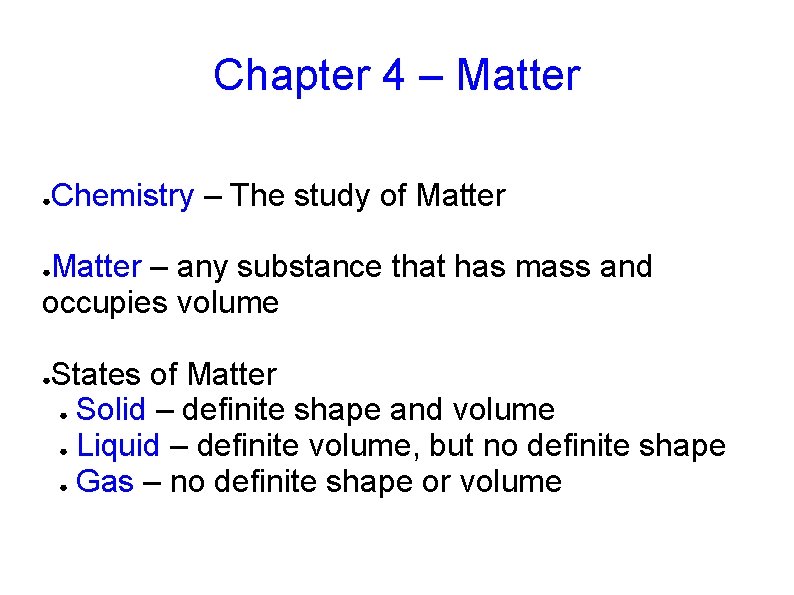
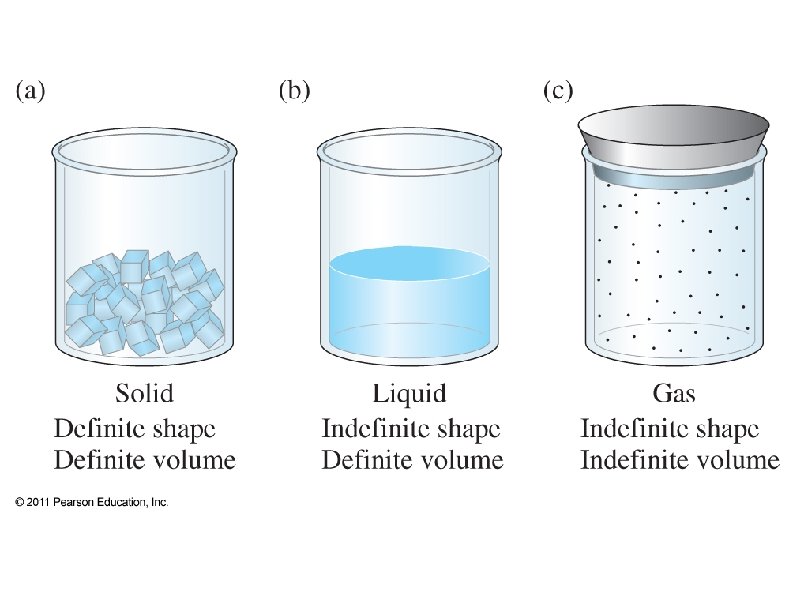
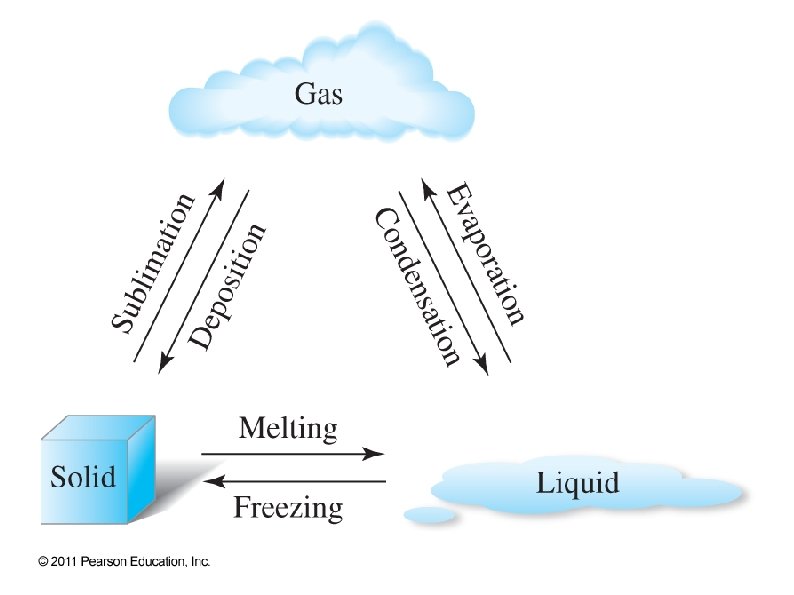
Chapter 4 – Matter ● Chemistry – The study of Matter – any substance that has mass and occupies volume ● ● States of Matter ● Solid – definite shape and volume ● Liquid – definite volume, but no definite shape ● Gas – no definite shape or volume
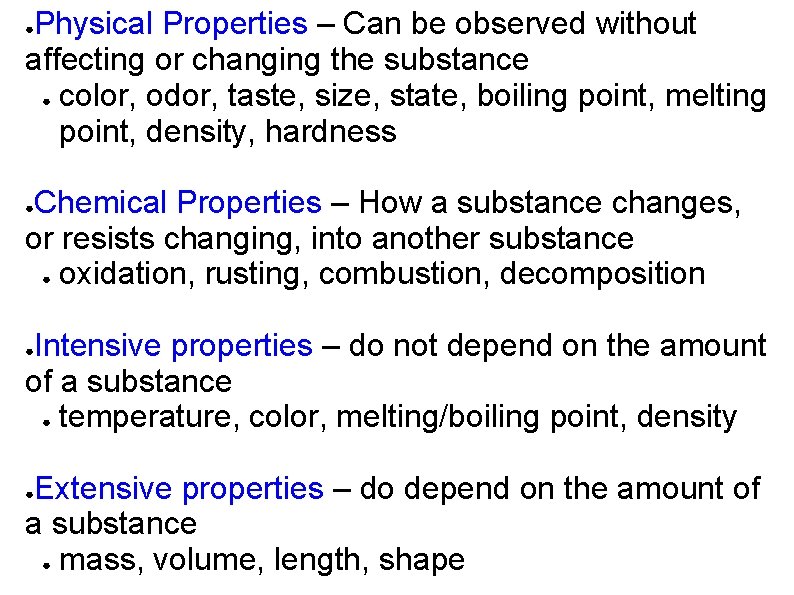
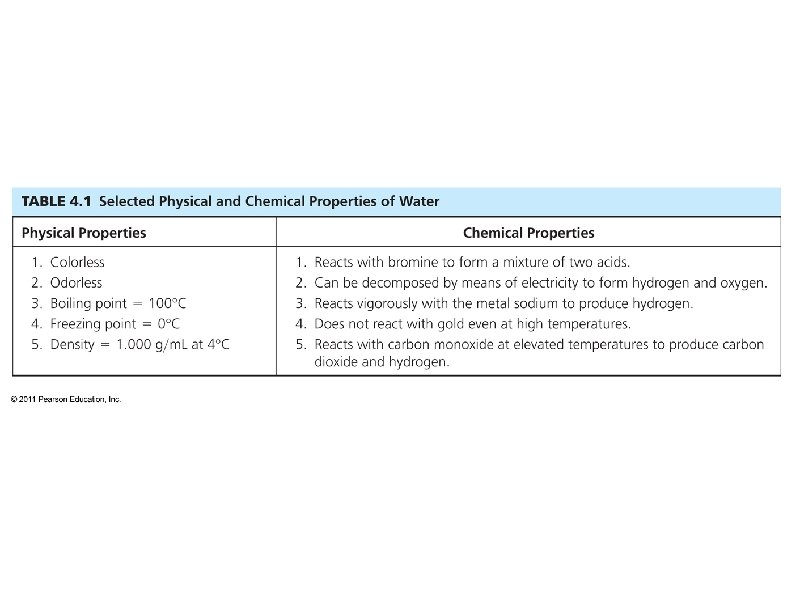
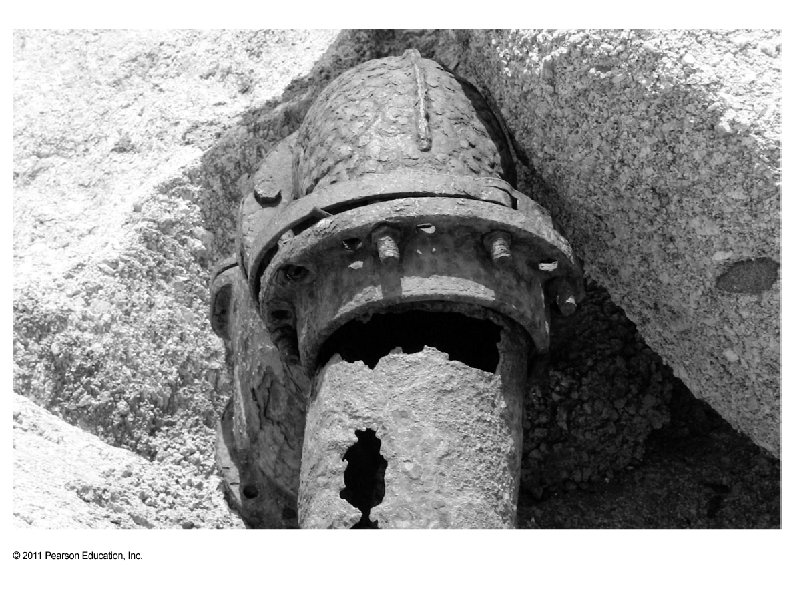
Physical Properties – Can be observed without affecting or changing the substance ● color, odor, taste, size, state, boiling point, melting point, density, hardness ● Chemical Properties – How a substance changes, or resists changing, into another substance ● oxidation, rusting, combustion, decomposition ● Intensive properties – do not depend on the amount of a substance ● temperature, color, melting/boiling point, density ● Extensive properties – do depend on the amount of a substance ● mass, volume, length, shape ●
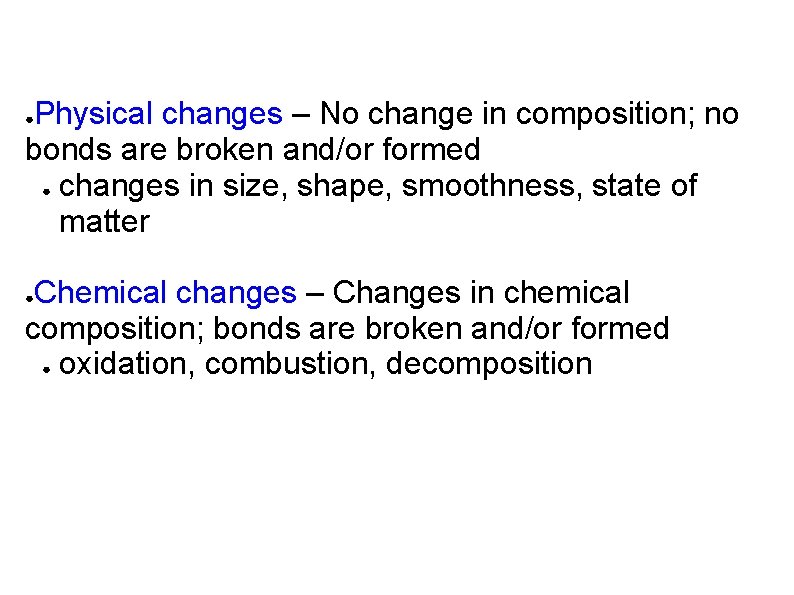
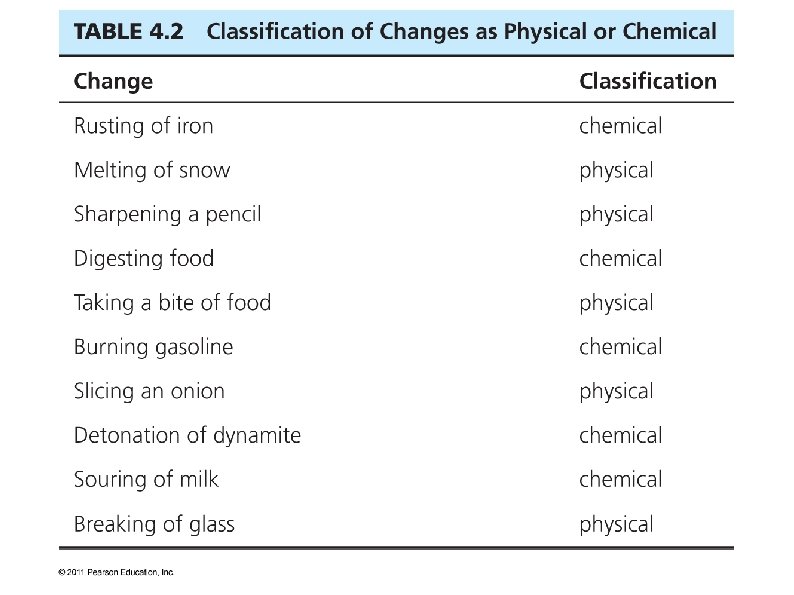
Physical changes – No change in composition; no bonds are broken and/or formed ● changes in size, shape, smoothness, state of matter ● Chemical changes – Changes in chemical composition; bonds are broken and/or formed ● oxidation, combustion, decomposition ●
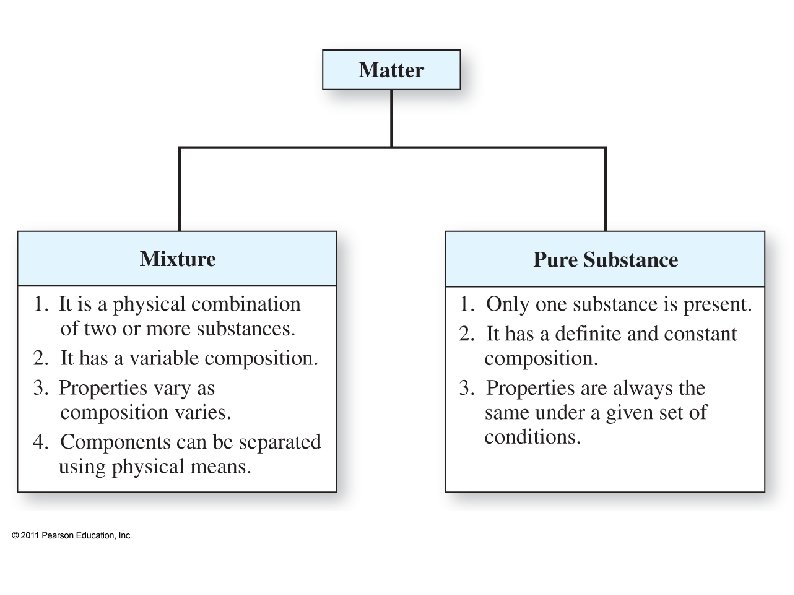
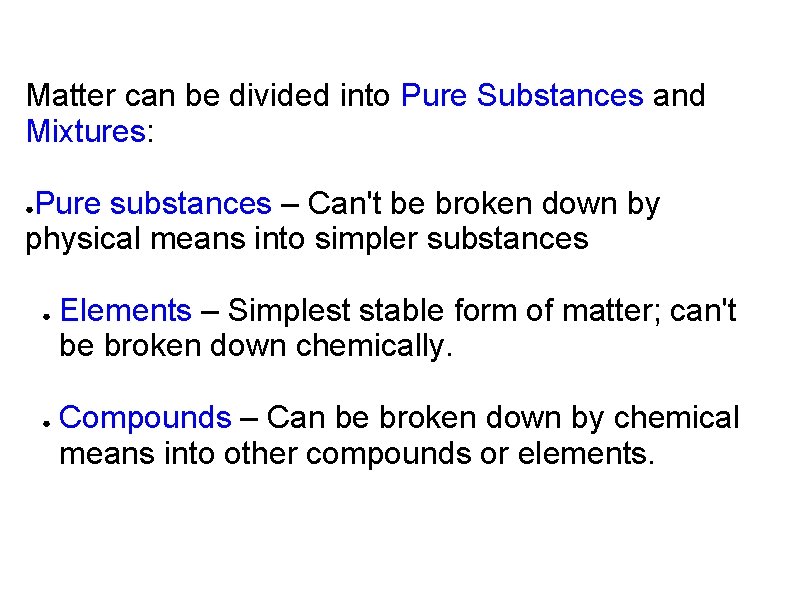
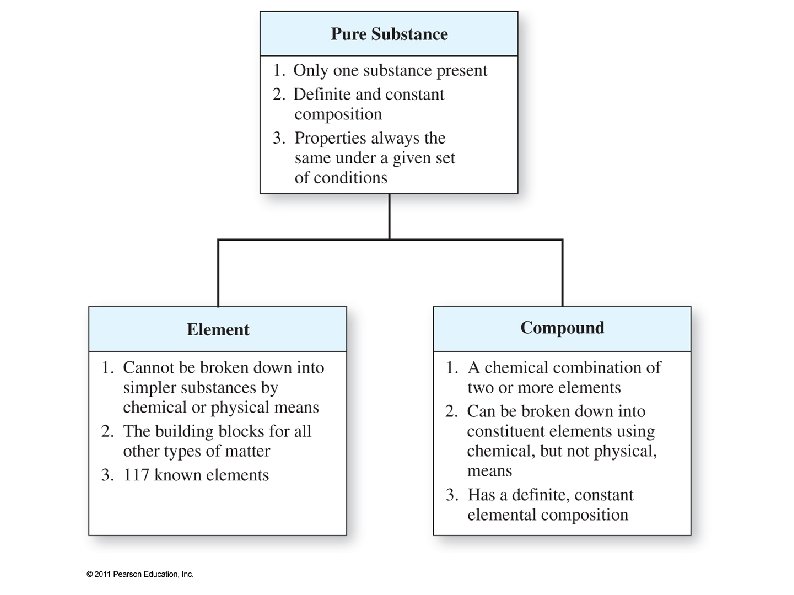
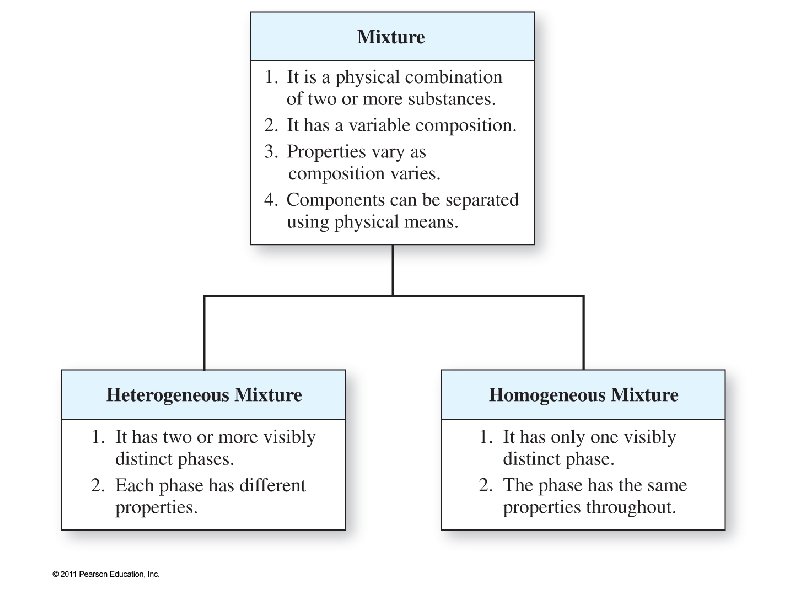
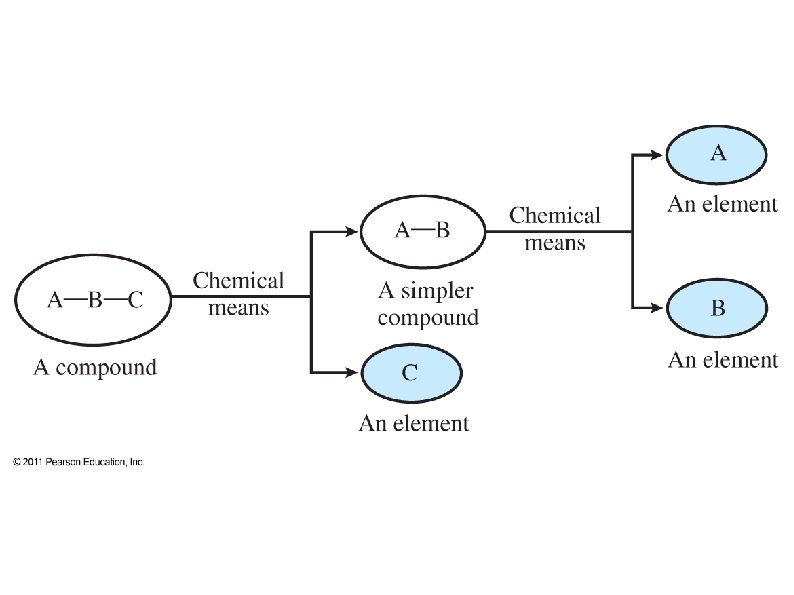
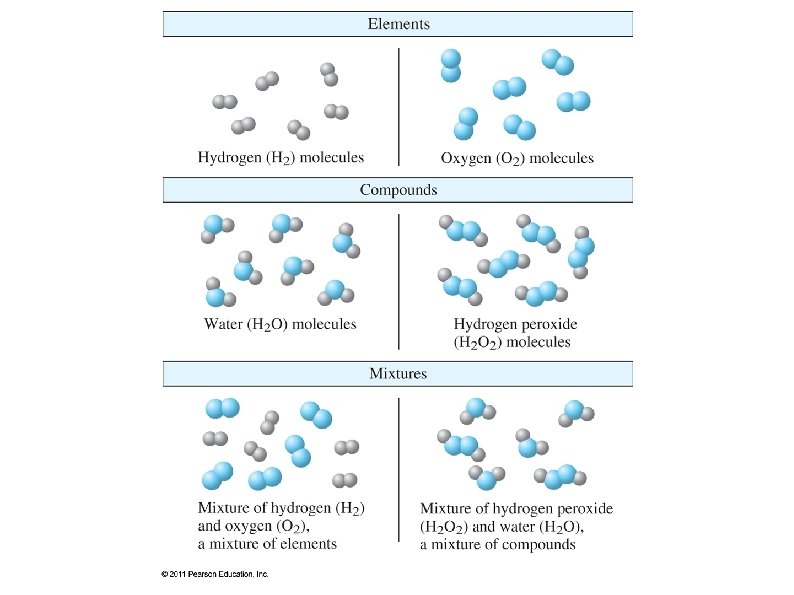
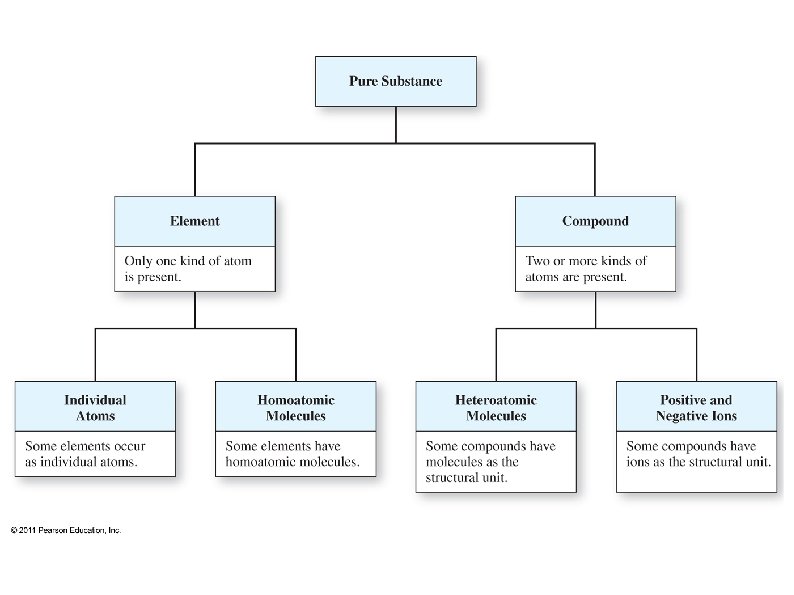
Matter can be divided into Pure Substances and Mixtures: Pure substances – Can't be broken down by physical means into simpler substances ● ● ● Elements – Simplest stable form of matter; can't be broken down chemically. Compounds – Can be broken down by chemical means into other compounds or elements.
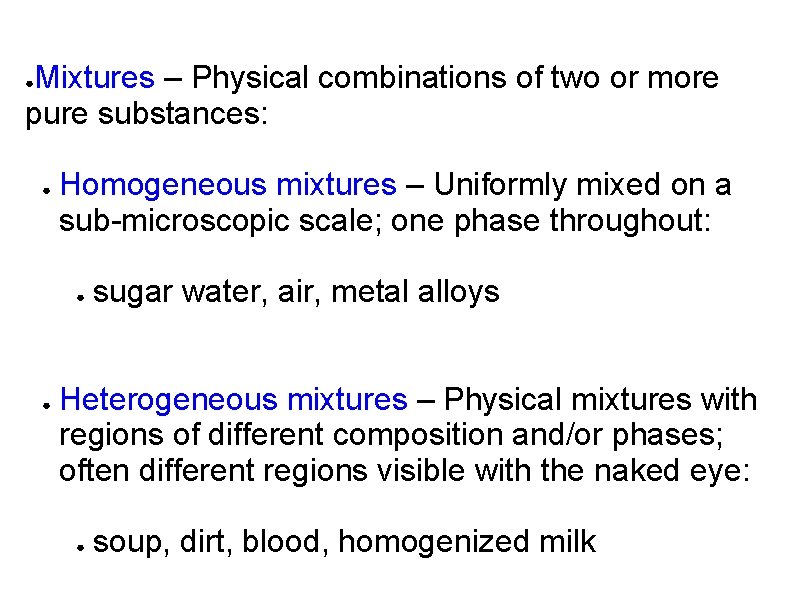
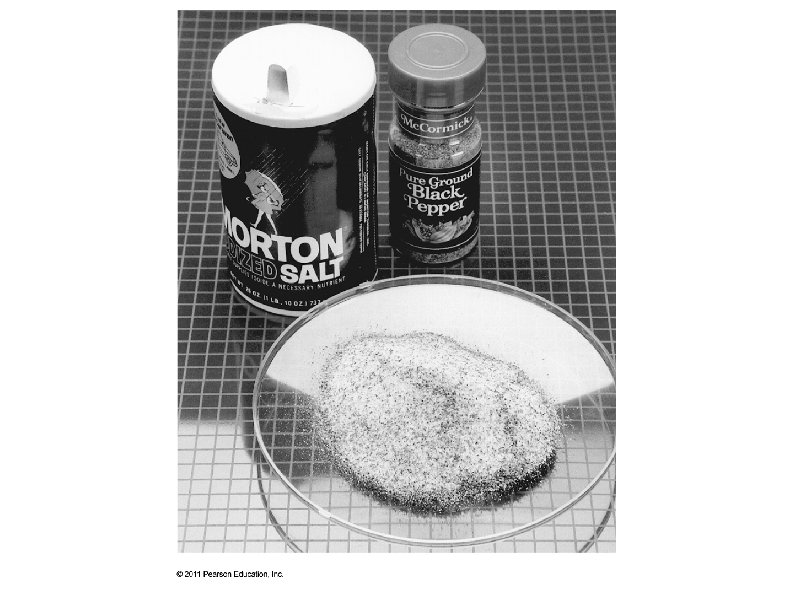
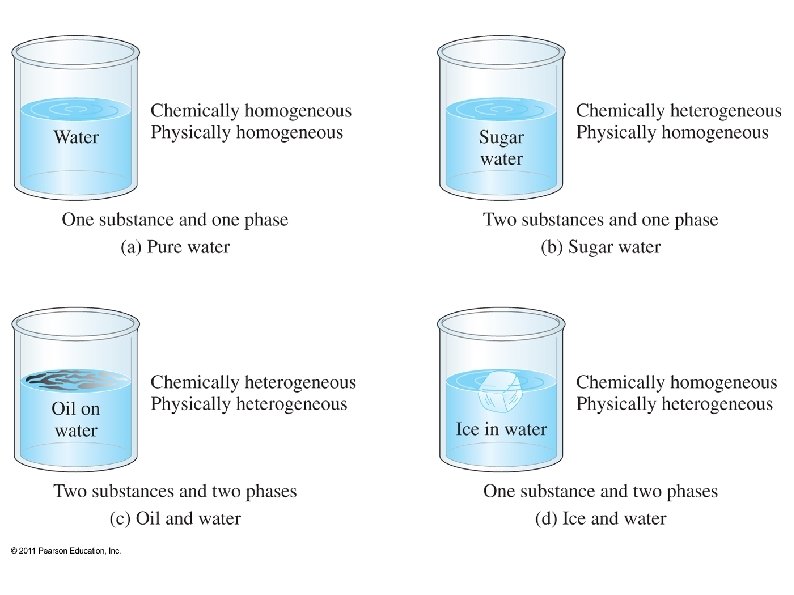
Mixtures – Physical combinations of two or more pure substances: ● ● Homogeneous mixtures – Uniformly mixed on a sub-microscopic scale; one phase throughout: ● ● sugar water, air, metal alloys Heterogeneous mixtures – Physical mixtures with regions of different composition and/or phases; often different regions visible with the naked eye: ● soup, dirt, blood, homogenized milk
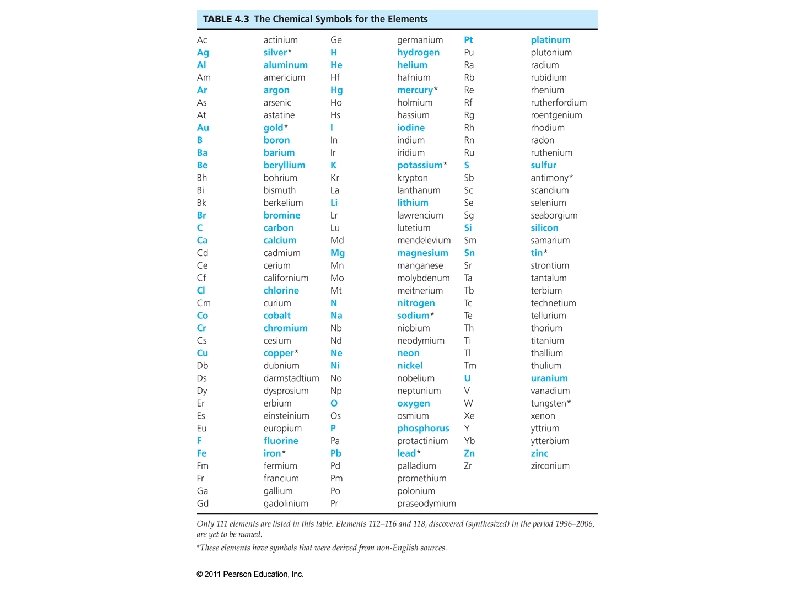
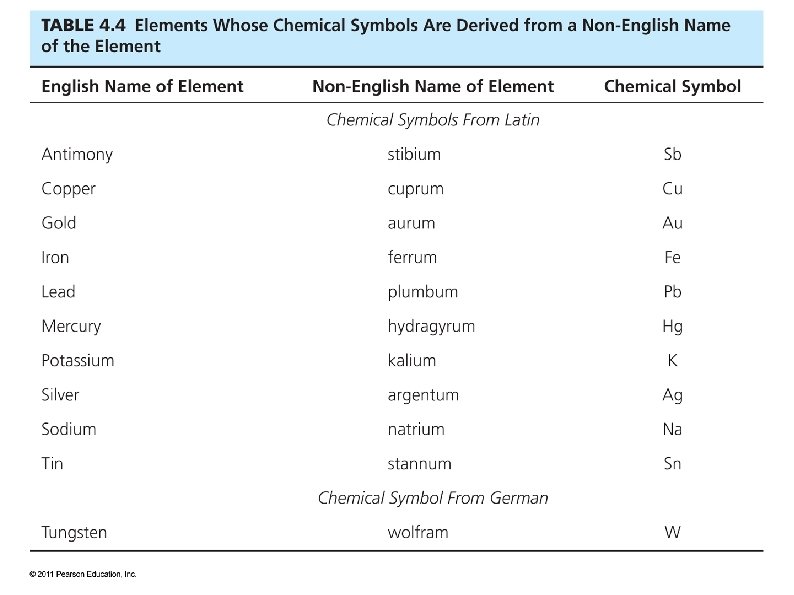
Elements ● ● Chemical symbols – used to represent elements - One or two letters, first is capitalized Atom ● Smallest particle of an element that has the properties of that element ● Cannot be broken down by chemical means -10 m in diameter ● ~10 -21 -10 -23 grams mass ● ~10 21 atoms in a single drop ● There about 5 x 10 of water
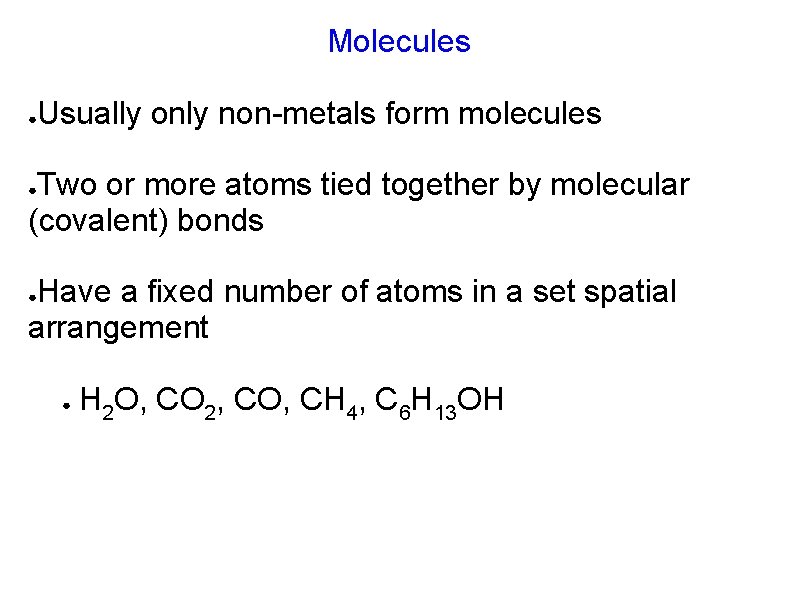
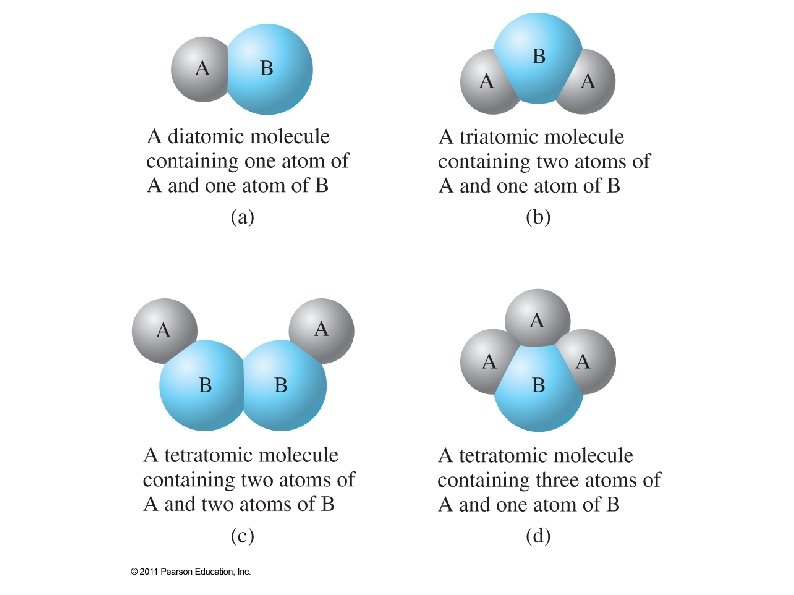
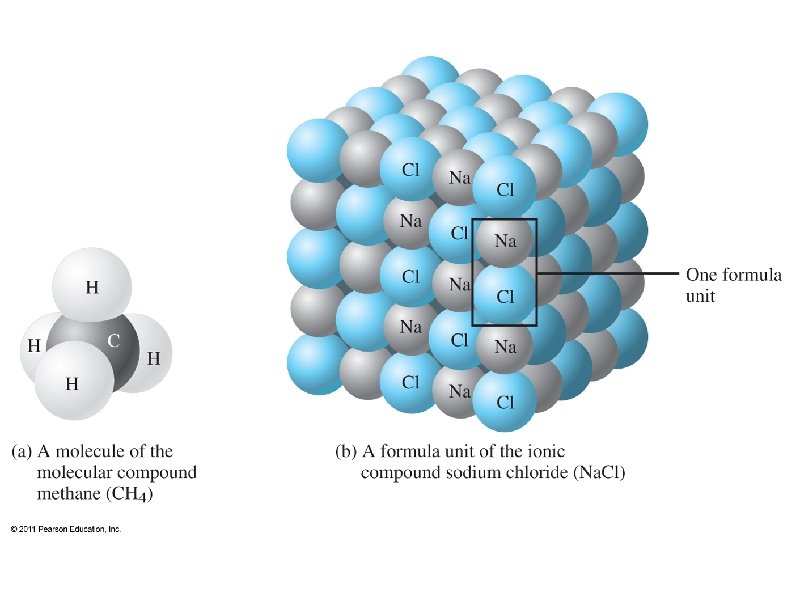
Molecules ● Usually only non-metals form molecules Two or more atoms tied together by molecular (covalent) bonds ● Have a fixed number of atoms in a set spatial arrangement ● ● H 2 O, CO 2, CO, CH 4, C 6 H 13 OH
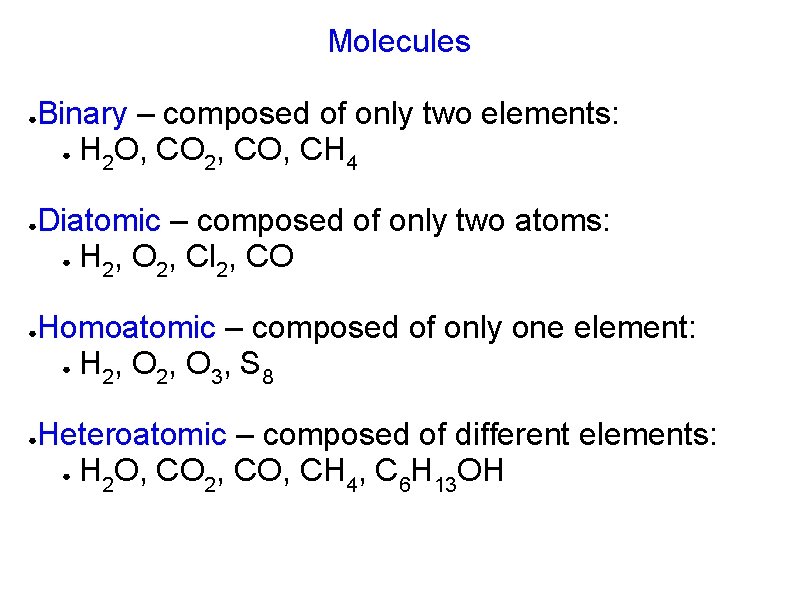
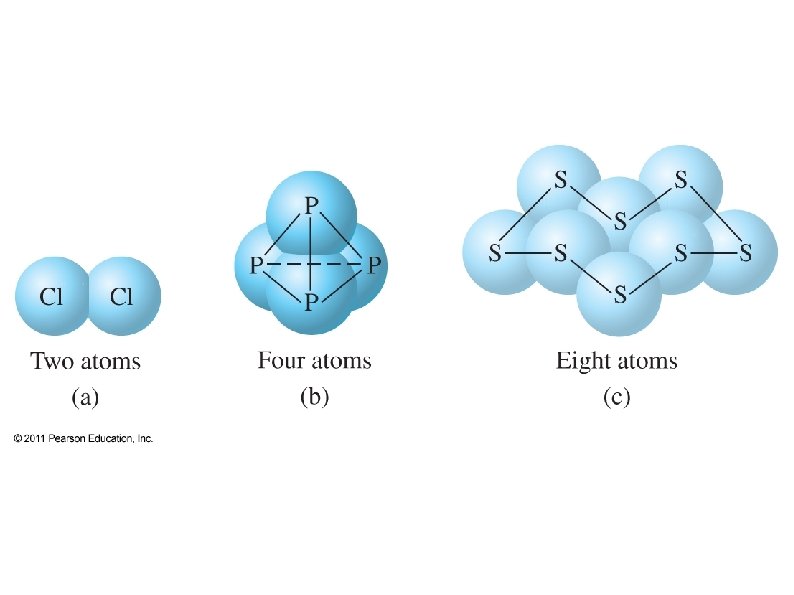
Molecules ● ● Binary – composed of only two elements: ● H O, CO, CH 2 2 4 Diatomic – composed of only two atoms: ● H , O , Cl , CO 2 2 2 Homoatomic – composed of only one element: ● H , O , S 2 2 3 8 Heteroatomic – composed of different elements: ● H O, CO, CH , C H 2 2 4 6 13 OH
Ionic Compounds Formed between metals and non-metals, and also with polyatomic ions (electrically charged molecules) ● ● Have fixed ratios of positive to negative ions ● Overall electrically neutral ● Solid structure is a stacked array of ions
Chemical Formulas ● Shows how many of each atom are in a compound: ● For molecules, the formula shows the exact number in a molecule, and sometimes give structural information ● ● ● For ionic compounds, the formula shows the lowest whole number ratios of one ion to the others in the compound Parenthesis – groups atoms, gives structural information Subscripts – show many of each element/group are in the formula
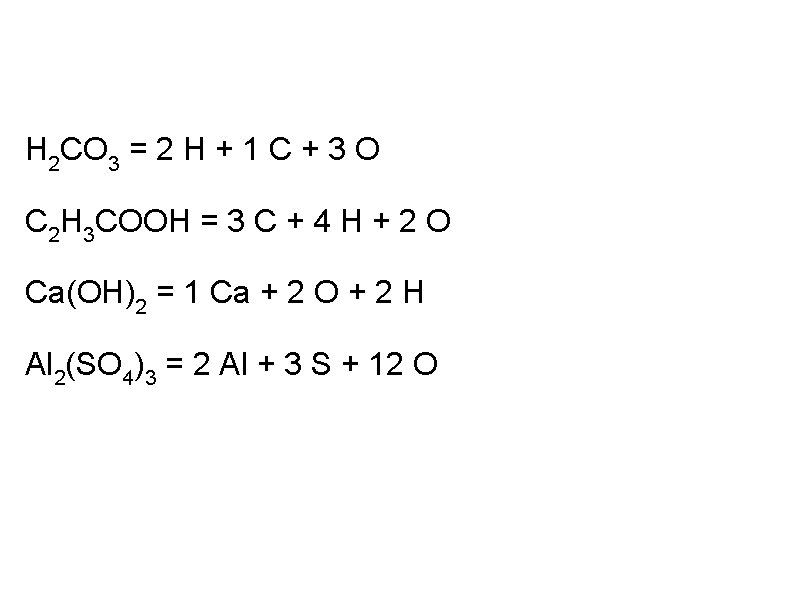
H 2 CO 3 = 2 H + 1 C + 3 O C 2 H 3 COOH = 3 C + 4 H + 2 O Ca(OH)2 = 1 Ca + 2 O + 2 H Al 2(SO 4)3 = 2 Al + 3 S + 12 O