
Chapter 4 MANAGING EMPLOYEE PERFORMANCE AND PERFORMANCE APPRAISAL


- Slides: 22
Chapter 4 MANAGING EMPLOYEE PERFORMANCE AND PERFORMANCE APPRAISAL
PREVIEW q q q The main components in a performance management system. The benefits of having an effective performance appraisal system. The factors to consider when designing an appraisal system. The requirements for implementing an appraisal system. The types of follow-up action which may be taken after an employee’s performance has been appraised. HRM Principles and Practices Third Edition © Oxford Fajar Sdn. Bhd. (008974 -T), 2014 All Rights Reserved 1– 3
WHAT IS PERFORMANCE MANAGEMENT SYSTEM? An employee performance management system is a means to ensure that every employee works in a manner which is aligned with organizational goals and which ensures that the employee reaches his maximum potential on the job. HRM Principles and Practices Third Edition © Oxford Fajar Sdn. Bhd. (008974 -T), 2014 All Rights Reserved 1– 4
HR SYSTEMS RELATED TO PERFORMANCE MANAGEMENT q Recruitment of workers q Training q Compensation and reward systems q Managing the performance of individual employees HRM Principles and Practices Third Edition © Oxford Fajar Sdn. Bhd. (008974 -T), 2014 All Rights Reserved 1– 5
PERFORMANCE MANAGEMENT SYSTEMS q An organization’s performance management system is designed by HR specialists. q The performance management system is implemented by heads of departments and all managers. HRM Principles and Practices Third Edition © Oxford Fajar Sdn. Bhd. (008974 -T), 2014 All Rights Reserved 1– 6
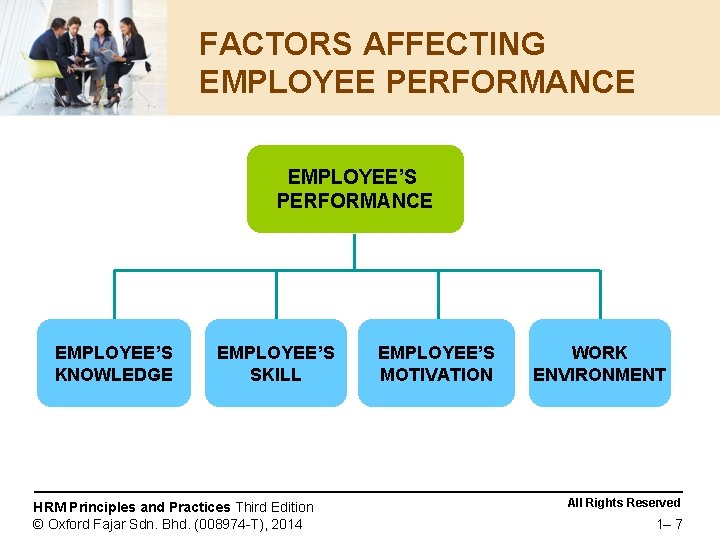
FACTORS AFFECTING EMPLOYEE PERFORMANCE EMPLOYEE’S KNOWLEDGE EMPLOYEE’S SKILL HRM Principles and Practices Third Edition © Oxford Fajar Sdn. Bhd. (008974 -T), 2014 EMPLOYEE’S MOTIVATION WORK ENVIRONMENT All Rights Reserved 1– 7
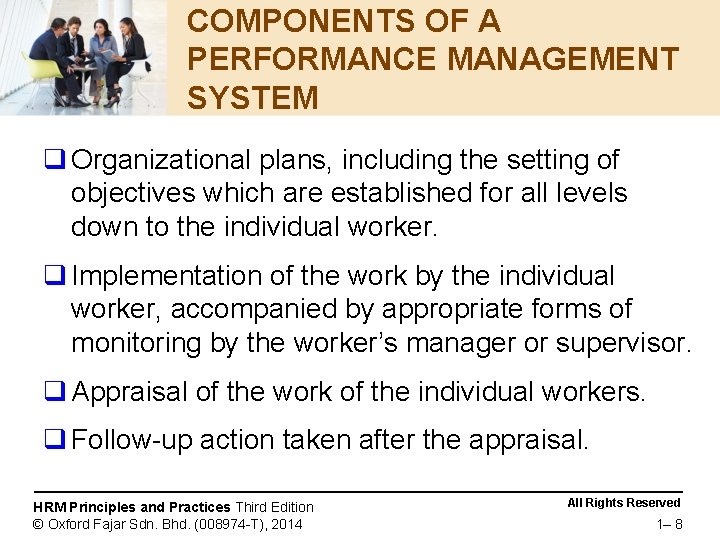
COMPONENTS OF A PERFORMANCE MANAGEMENT SYSTEM q Organizational plans, including the setting of objectives which are established for all levels down to the individual worker. q Implementation of the work by the individual worker, accompanied by appropriate forms of monitoring by the worker’s manager or supervisor. q Appraisal of the work of the individual workers. q Follow-up action taken after the appraisal. HRM Principles and Practices Third Edition © Oxford Fajar Sdn. Bhd. (008974 -T), 2014 All Rights Reserved 1– 8
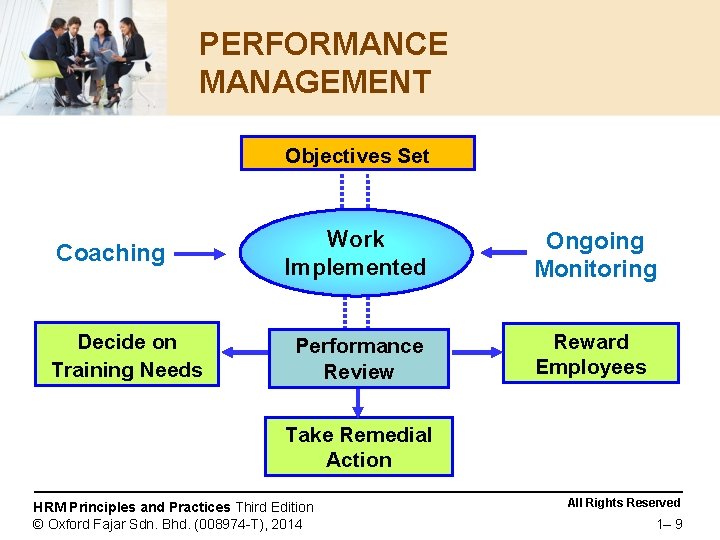
PERFORMANCE MANAGEMENT Objectives Set Coaching Decide on Training Needs Work Implemented Ongoing Monitoring Performance Review Reward Employees Take Remedial Action HRM Principles and Practices Third Edition © Oxford Fajar Sdn. Bhd. (008974 -T), 2014 All Rights Reserved 1– 9
OBJECTIVES If employees are to perform well, they must: KNOW WHAT they are supposed to do, and KNOW HOW to do the work. HRM Principles and Practices Third Edition © Oxford Fajar Sdn. Bhd. (008974 -T), 2014 All Rights Reserved 1– 10
OBJECTIVES (cont. ) The objectives/targets/key result areas/key performance indicators established for each employee must be: q Capable of achievement by the employee q Measurable q Accepted by the employee q Time-bound HRM Principles and Practices Third Edition © Oxford Fajar Sdn. Bhd. (008974 -T), 2014 All Rights Reserved 1– 11
OBJECTIVES (cont. ) Performance objectives may relate to: q Quantity of output q Quality of output q Behaviour of employee q Development of employee HRM Principles and Practices Third Edition © Oxford Fajar Sdn. Bhd. (008974 -T), 2014 All Rights Reserved 1– 12
IMPLEMENTATION OF WORK BY THE EMPLOYEE While the work is being carried out by the employee, the manager must: q Monitor; q Give feedback regularly; and q Coach, if necessary. HRM Principles and Practices Third Edition © Oxford Fajar Sdn. Bhd. (008974 -T), 2014 All Rights Reserved 1– 13
BENEFITS OF A PERFORMANCE APPRAISAL SYSTEM q Encourages quality performance by rewarding those who do well. q Improves current performance by giving workers feedback. q Assists in identifying training needs. q Provides documentation if disciplinary proceedings are needed. q Provides a channel of communication between managers and their subordinates. HRM Principles and Practices Third Edition © Oxford Fajar Sdn. Bhd. (008974 -T), 2014 All Rights Reserved 1– 14
EFFECTIVE APPRAISAL SYSTEMS q Are integrated into a performance management system. q Receive top management support. q Are customized to the needs of the organization. q Are acceptable and understandable. q Are reliable and unbiased as far as possible. HRM Principles and Practices Third Edition © Oxford Fajar Sdn. Bhd. (008974 -T), 2014 All Rights Reserved 1– 15
POTENTIAL BIAS IN PERFORMANCE APPRAISAL q Recency effect q Halo effect q Central tendency q Prejudice and stereotyping q Fatigue HRM Principles and Practices Third Edition © Oxford Fajar Sdn. Bhd. (008974 -T), 2014 All Rights Reserved 1– 16
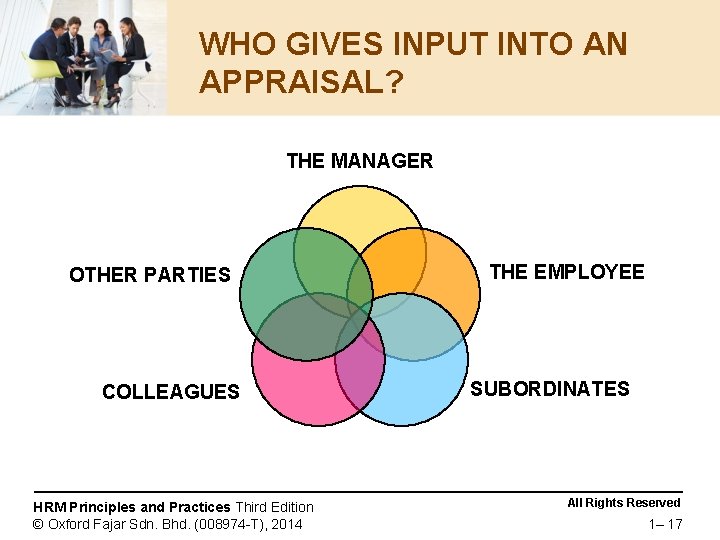
WHO GIVES INPUT INTO AN APPRAISAL? THE MANAGER OTHER PARTIES COLLEAGUES HRM Principles and Practices Third Edition © Oxford Fajar Sdn. Bhd. (008974 -T), 2014 THE EMPLOYEE SUBORDINATES All Rights Reserved 1– 17
APPRAISAL METHODS q Comparative methods q Trait rating scales q Essay technique HRM Principles and Practices Third Edition © Oxford Fajar Sdn. Bhd. (008974 -T), 2014 All Rights Reserved 1– 18
SKILLS NEEDED FOR EFFECTIVE PERFORMANCE MANAGEMENT q Observation of performance q Coaching q Counselling HRM Principles and Practices Third Edition © Oxford Fajar Sdn. Bhd. (008974 -T), 2014 All Rights Reserved 1– 19
AFTER THE APPRAISAL DISCUSSION Follow-up? ? ? q Set objectives for next time period q Give rewards q Provide retraining q Institute disciplinary action HRM Principles and Practices Third Edition © Oxford Fajar Sdn. Bhd. (008974 -T), 2014 All Rights Reserved 1– 20
DISMISSAL FOR POOR PERFORMANCE Prior to dismissing an employee for poor performance, an employer must: q Give warnings to the employee q Provide assistance so that he or she can improve q Give sufficient time for the employee to improve HRM Principles and Practices Third Edition © Oxford Fajar Sdn. Bhd. (008974 -T), 2014 All Rights Reserved 1– 21
REVIEW q q q The main components in a performance management system. The benefits of having an effective performance appraisal system. The factors to consider when designing an appraisal system. The requirements for implementing an appraisal system. The types of follow-up action which may be taken after an employee’s performance has been appraised. HRM Principles and Practices Third Edition © Oxford Fajar Sdn. Bhd. (008974 -T), 2014 All Rights Reserved 1– 22