
Chapter 4 Main Idea Breaking Through College Reading
Chapter 4: Main Idea Breaking Through: College Reading, 7/e Brenda Smith © 2005 Pearson Education, Inc. publishing as Longman Publishers.

What is a Main Idea? • • • Thesis Main point Central focus Gist Controlling idea Central thought © 2005 Pearson Education, Inc. publishing as Longman Publishers.

General and Specific Words The general term categorizes the key ideas and is considered the topic of the list. • satin • wool • fabric • silk Explanation: Satin, wool, and silk are different types of fabric. Thus, fabric is the general term. © 2005 Pearson Education, Inc. publishing as Longman Publishers.

General and Specific Phrases Topics of passages are usually stated as phrases: • Turn on the ignition. • Press the accelerator. • Insert the key. • Start the car. Explanation: The first three details are involved in starting a car. The last phrase is the general topic. © 2005 Pearson Education, Inc. publishing as Longman Publishers.
General Topic in Sentences Paragraphs are composed of sentences that develop a single general topic. © 2005 Pearson Education, Inc. publishing as Longman Publishers.
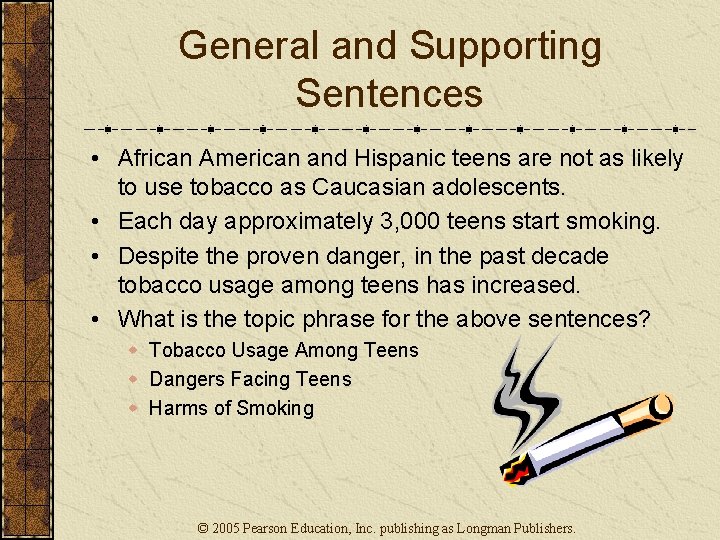
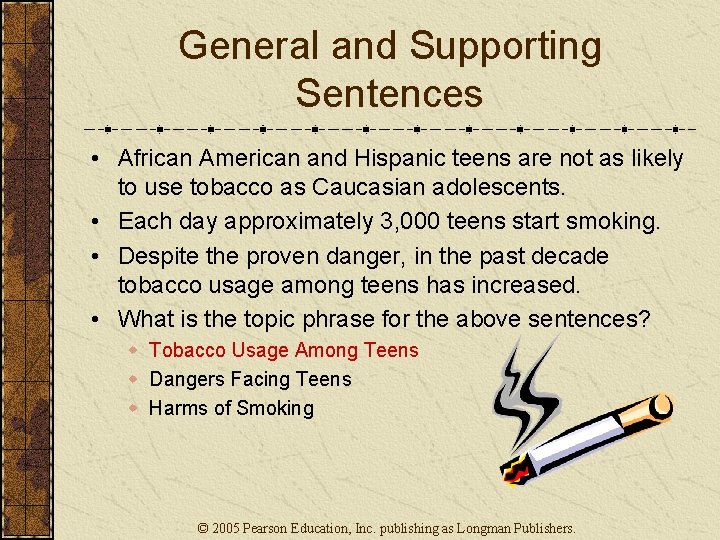
General and Supporting Sentences • African American and Hispanic teens are not as likely to use tobacco as Caucasian adolescents. • Each day approximately 3, 000 teens start smoking. • Despite the proven danger, in the past decade tobacco usage among teens has increased. • What is the topic phrase for the above sentences? w Tobacco Usage Among Teens w Dangers Facing Teens w Harms of Smoking © 2005 Pearson Education, Inc. publishing as Longman Publishers.
General and Supporting Sentences • African American and Hispanic teens are not as likely to use tobacco as Caucasian adolescents. • Each day approximately 3, 000 teens start smoking. • Despite the proven danger, in the past decade tobacco usage among teens has increased. • What is the topic phrase for the above sentences? w Tobacco Usage Among Teens w Dangers Facing Teens w Harms of Smoking © 2005 Pearson Education, Inc. publishing as Longman Publishers.

Topic, Main Idea, & Supporting Details Example: Topic: The Body Signaling Feeling Main Idea: Some signals of body language, like some facial expressions, seem to be “spoken” universally. Detail: When people are depressed, it shows in their walk, stance, and head position. © 2005 Pearson Education, Inc. publishing as Longman Publishers.

Questioning for the Main Idea q. Establish the topic. w Who or what is this about? q. Identify the key supporting terms. w What are the important details? q. Focus on the message of the topic w What is the main idea the author is trying to convey about the topic? © 2005 Pearson Education, Inc. publishing as Longman Publishers.

Stated Main Ideas 3 Thesis statement 3 Topic sentence 3 Overviews the author’s message 3 Connects the supporting details © 2005 Pearson Education, Inc. publishing as Longman Publishers.

The Unstated Main Idea When the main idea is not directly stated, it is said to be implied, which means that it is suggested from the thoughts that are revealed. © 2005 Pearson Education, Inc. publishing as Longman Publishers.
Differentiating Distractors A phrase that is too broad is too general and thus would suggest the inclusion of much more than is actually stated in the passage. A phrase that is too narrow is a detail within the passage. It may be an interesting and eye-catching detail, but is is not the subject of the passage. © 2005 Pearson Education, Inc. publishing as Longman Publishers.
Getting the Main Idea of Longer Selections • What does the title suggest? • What do the first paragraphs suggest about the topic? • Under what subsections can the paragraphs and ideas be grouped? • How do the subsections support the whole? • What is the overall topic? • What is the author’s point? © 2005 Pearson Education, Inc. publishing as Longman Publishers.
Reading and Studying a Short Story • Who are the main characters and can you describe them? • What is the main conflict? Climax? Plot? • What is theme of the story? • What is the setting? • Who is telling the story? (point of view) • What is the tone of the author? • What symbols are used for images? • What is your evaluation of the author’s work? © 2005 Pearson Education, Inc. publishing as Longman Publishers.
Reading and Studying History • • • Know: who, what, when, where, and why. Understand the cause/effect relationships. Use timelines. Learn significant dates. Look at maps. Distinguish between fact and opinion. © 2005 Pearson Education, Inc. publishing as Longman Publishers.
Selecting a Book • Read the book jacket. • Read the first page and at least one other page. • If nonfiction, look at the illustrations & read the captions. • If nonfiction, review the table of contents and scan the index. • Consult best-seller lists. • Sample a variety of fiction and nonfiction. © 2005 Pearson Education, Inc. publishing as Longman Publishers.
Summary Questions • What words are typically used to name the main idea? • How do topics and details differ? • What questions do you ask to find the topic of a passage? • What questions do you ask to find the main idea of a passage? • How do stated and unstated main ideas differ? • How do you get the main idea • of longer selections? © 2005 Pearson Education, Inc. publishing as Longman Publishers.
Visit the Companion Website http: //www. ablongman. com/smith © 2005 Pearson Education, Inc. publishing as Longman Publishers.
- Slides: 18