
Chapter 4 Lipids Fats and Oils 1 Lipids
- Slides: 30
Chapter 4 Lipids: Fats and Oils 1
Lipids n Fats n Oils n Cholesterol n Lecithin 2
Functions of Lipids n Insulation n Cushion around critical organs n Provides energy (adipose cells = compact energy storage) n n Protein-sparing Part of all cell membranes Transport of fat-soluble vitamins Essential fatty acids 3
In food, fat enhances: n Taste n Smooth texture n Flavor n Creamy feeling n Aroma n Feeling full n Crispness n Juiciness n Tenderness 4
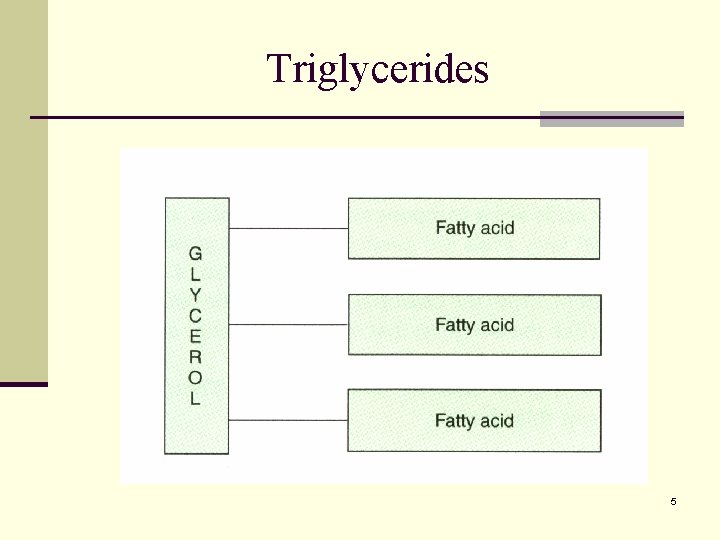
Triglycerides 5
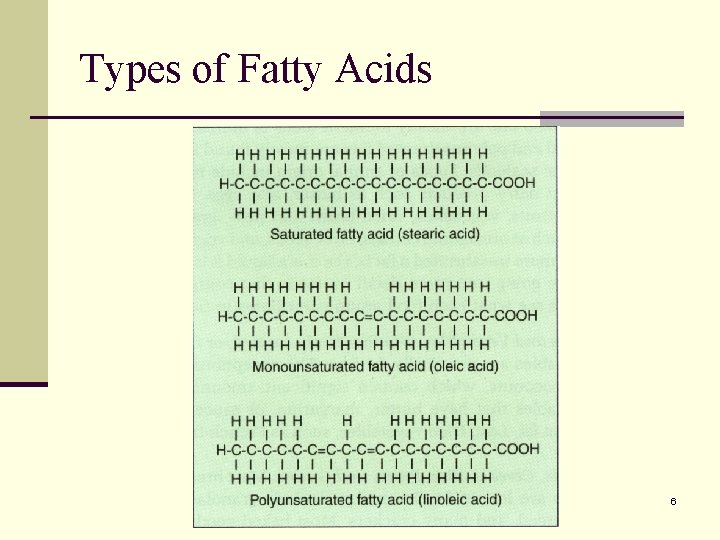
Types of Fatty Acids 6
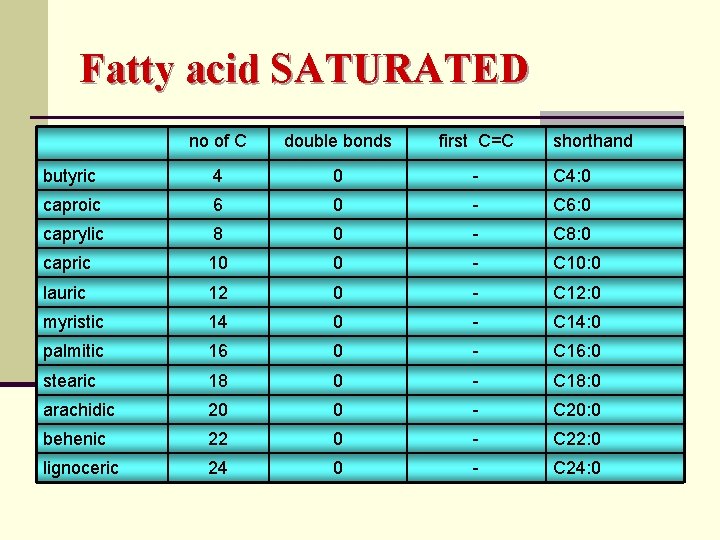
Fatty acid SATURATED no of C double bonds first C=C shorthand butyric 4 0 - C 4: 0 caproic 6 0 - C 6: 0 caprylic 8 0 - C 8: 0 capric 10 0 - C 10: 0 lauric 12 0 - C 12: 0 myristic 14 0 - C 14: 0 palmitic 16 0 - C 16: 0 stearic 18 0 - C 18: 0 arachidic 20 0 - C 20: 0 behenic 22 0 - C 22: 0 lignoceric 24 0 - C 24: 0
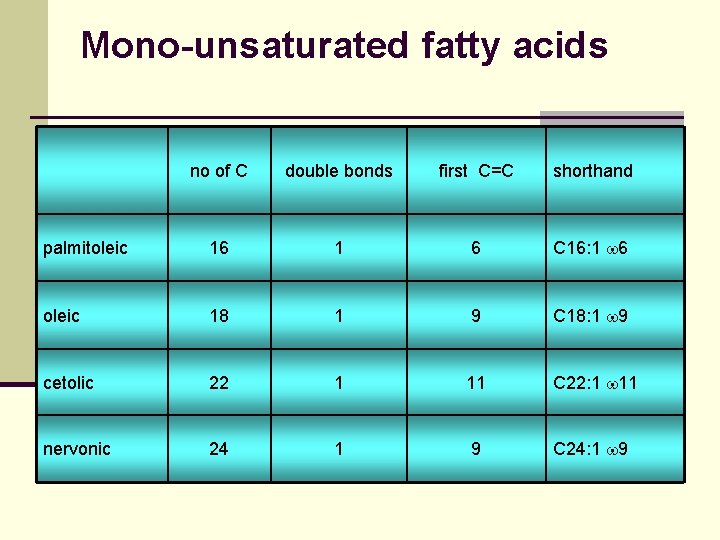
Mono-unsaturated fatty acids no of C double bonds first C=C shorthand palmitoleic 16 1 6 C 16: 1 w 6 oleic 18 1 9 C 18: 1 w 9 cetolic 22 1 11 C 22: 1 w 11 nervonic 24 1 9 C 24: 1 w 9
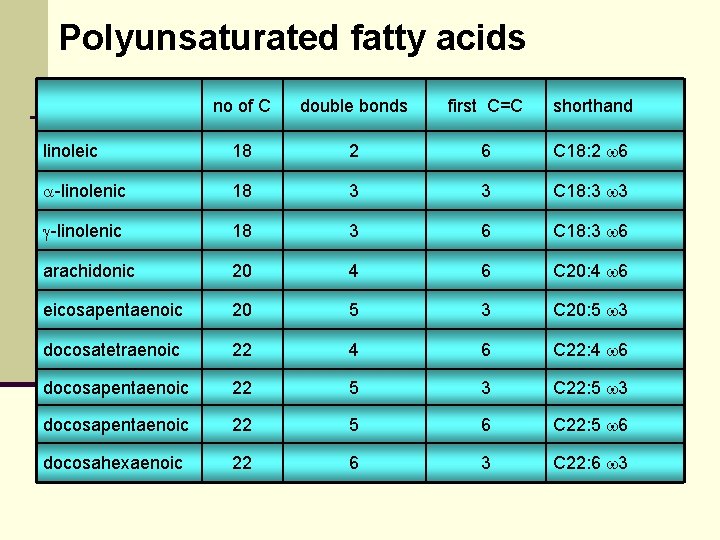
Polyunsaturated fatty acids no of C double bonds first C=C shorthand linoleic 18 2 6 C 18: 2 w 6 a-linolenic 18 3 3 C 18: 3 w 3 g-linolenic 18 3 6 C 18: 3 w 6 arachidonic 20 4 6 C 20: 4 w 6 eicosapentaenoic 20 5 3 C 20: 5 w 3 docosatetraenoic 22 4 6 C 22: 4 w 6 docosapentaenoic 22 5 3 C 22: 5 w 3 docosapentaenoic 22 5 6 C 22: 5 w 6 docosahexaenoic 22 6 3 C 22: 6 w 3
Triglycerides in Food n Fruits and vegetables n Breads, cereals, rice, pasta, and grains n Dry beans and peas, nuts and seeds n Meat, poultry, fish n Dairy foods n Fats, oils, and condiments 10
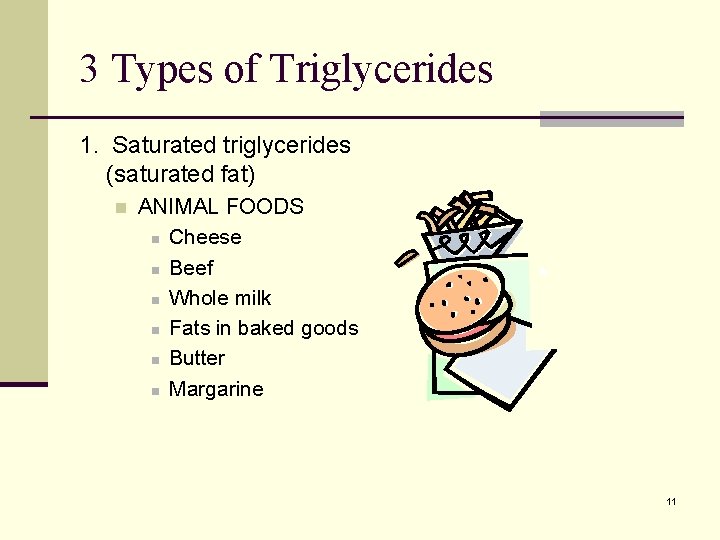
3 Types of Triglycerides 1. Saturated triglycerides (saturated fat) n ANIMAL FOODS n Cheese n Beef n Whole milk n Fats in baked goods n Butter n Margarine 11
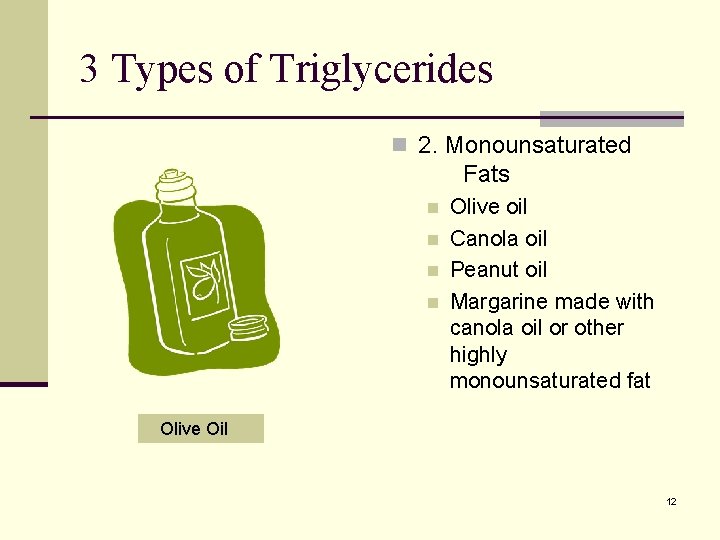
3 Types of Triglycerides n 2. Monounsaturated Fats n n Olive oil Canola oil Peanut oil Margarine made with canola oil or other highly monounsaturated fat Olive Oil 12
3 Types of Triglycerides 3. Polyunsaturated Fats n n n Safflower oil Corn oil Soybean oil Sesame oil Sunflower oil Nuts and seeds 13
Trans Fatty Acids n Occur naturally at low levels in meat and dairy foods. n Trans fats we eat are often due to hydrogenation of vegetable oils to make shortening, margarine, and fats for frying. n Trans fats raise blood cholesterol levels as much as saturated fat. 14
Main Contributors to Trans Fats in Diet n Cakes, cookies, pies, bread, etc. 40% of trans fats eaten n Animal products 21% n Margarine 17% n Fried potatoes 8% n Potato chips, corn chips, popcorn 5% n Household shortening 4% 15
Essential Fatty Acids n Linoleic acid is an omega-6 fatty acid found in vegetable oils, whole grains, and vegetables. n Alpha-linolenic acid is the leading omega-3 fatty acid found in food, and it is found in canola, flaxseed, soybean, walnut, and wheat germ oils. Other good sources include ground flaxseed, walnuts, and soy products. n The body converts alpha-linolenic into DHA and EPA (also omega-3 s). DHA and EPA are found in fatty fish such as salmon and mackerel. n Americans get more than enough linoleic, but not enough alpha-linolenic. 16
Essential Fatty Acids (cont’d) n Both EFAs: n Are vital to normal growth and development in infants and children, n Maintain the structural parts of cell membranes n Have a role in the proper functioning of the immune system n Are used to make eicosanoids. n Eicosanoids made from linoleic acid tend to increase blood pressure, blood clotting, and inflammation. n Eicosanoids made from alpha-linolenic acid dilate blood vessels and reduce blood clotting and inflammation. 17
Rancidity n Deterioration of fat, resulting in undesirable flavors and odors. n Saturated fats are more resistant to rancidity than unsaturated fats. n Rancidity is hastened by heat and ultraviolet light. n To prevent rancidity, store fats and oils tightly sealed in cool, dark places. 18
Cholesterol n An odorless, white, waxy, powdery substance. n Cholesterol is present in every cell in your body. It is needed to make bile acids, to make cell membranes, many hormones (such as sex hormones), and vitamin D. 19
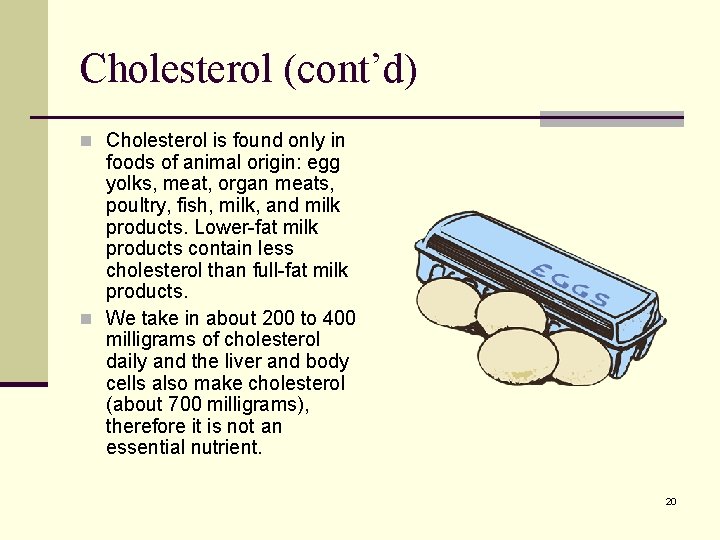
Cholesterol (cont’d) n Cholesterol is found only in foods of animal origin: egg yolks, meat, organ meats, poultry, fish, milk, and milk products. Lower-fat milk products contain less cholesterol than full-fat milk products. n We take in about 200 to 400 milligrams of cholesterol daily and the liver and body cells also make cholesterol (about 700 milligrams), therefore it is not an essential nutrient. 20
Lecithin n A phospholipid. n Functions as a vital component of cell membranes. n Also acts as an emulsifier. 21
Digestion, Absorption, & Metabolism n Mouth – Lingual lipase. n Stomach – Gastric lipase. n Intestine n Bile acids n Pancreatic lipase n Intestinal lipase n Once absorbed, triglycerides are reformed. 22
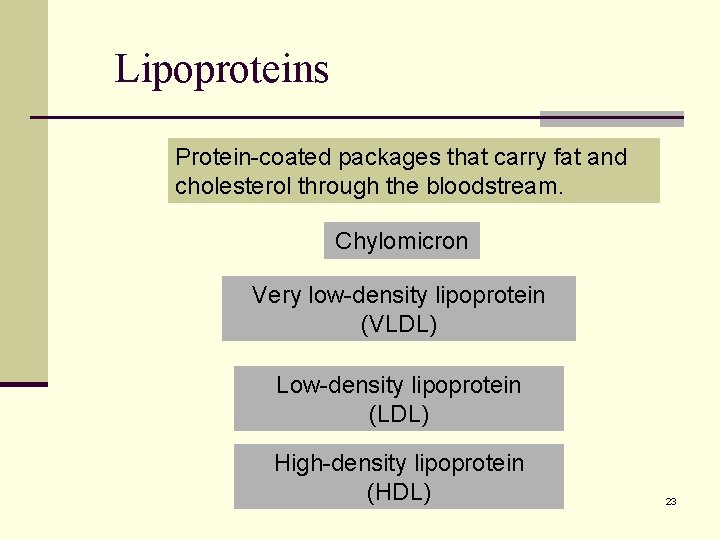
Lipoproteins Protein-coated packages that carry fat and cholesterol through the bloodstream. Chylomicron Very low-density lipoprotein (VLDL) Low-density lipoprotein (LDL) High-density lipoprotein (HDL) 23
Lipids and Health n Heart disease n Too much circulating cholesterol leads to plaque and atherosclerosis n Angina n Myocardial infarction n Stroke n Main source of cholesterol buildup: LDL 24
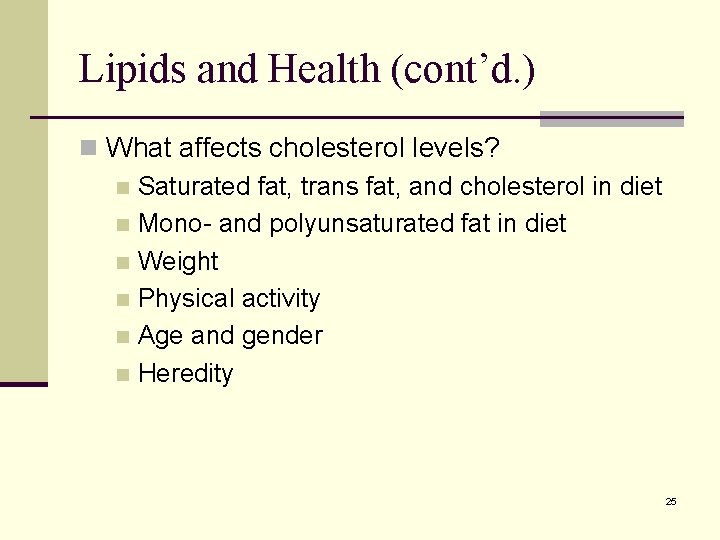
Lipids and Health (cont’d. ) n What affects cholesterol levels? n Saturated fat, trans fat, and cholesterol in diet n Mono- and polyunsaturated fat in diet n Weight n Physical activity n Age and gender n Heredity 25
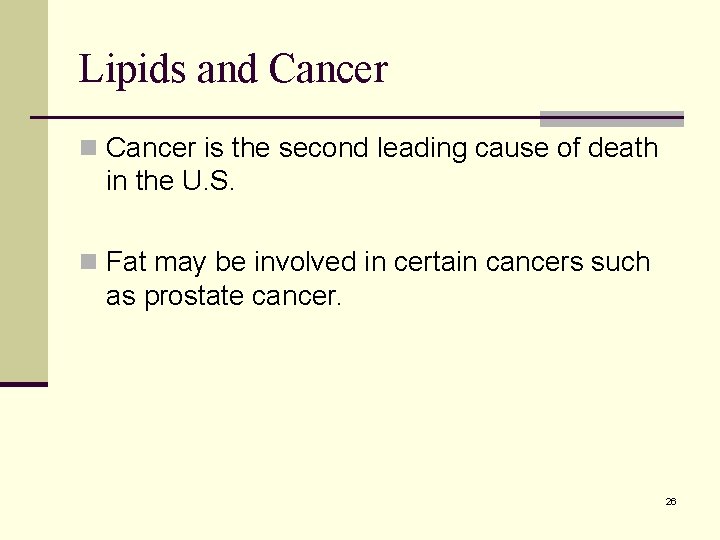
Lipids and Cancer n Cancer is the second leading cause of death in the U. S. n Fat may be involved in certain cancers such as prostate cancer. 26
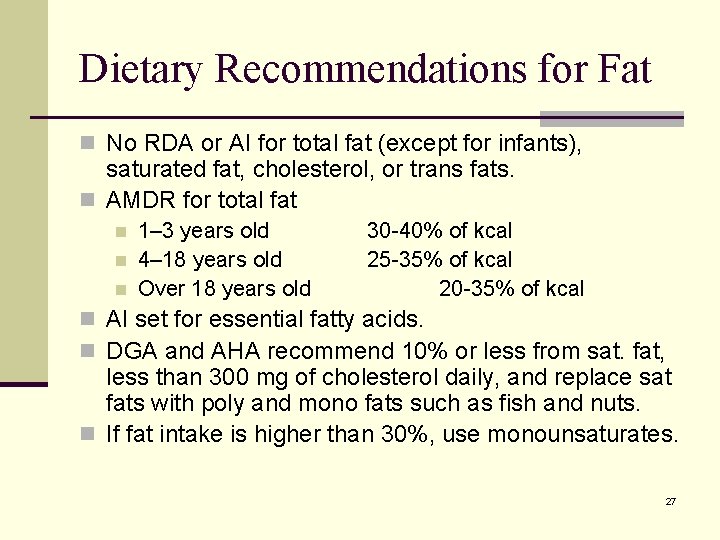
Dietary Recommendations for Fat n No RDA or AI for total fat (except for infants), saturated fat, cholesterol, or trans fats. n AMDR for total fat n n n 1– 3 years old 4– 18 years old Over 18 years old 30 -40% of kcal 25 -35% of kcal 20 -35% of kcal n AI set for essential fatty acids. n DGA and AHA recommend 10% or less from sat. fat, less than 300 mg of cholesterol daily, and replace sat fats with poly and mono fats such as fish and nuts. n If fat intake is higher than 30%, use monounsaturates. 27
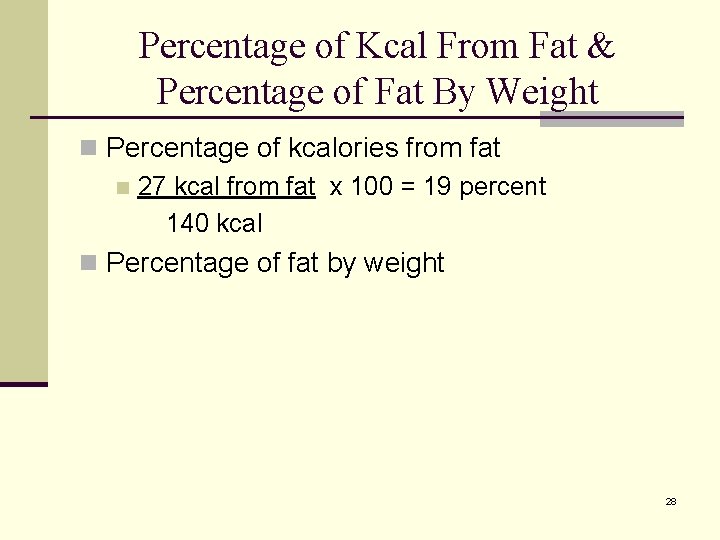
Percentage of Kcal From Fat & Percentage of Fat By Weight n Percentage of kcalories from fat n 27 kcal from fat x 100 = 19 percent 140 kcal n Percentage of fat by weight 28
Ingredient Focus: Milk, Dairy & Eggs n Milk n Cheese n Eggs 29
Fat Substitutes n Water n Carbohydrate-based n n n n Cellulose gel Carrageenan Polydextrose Starch Modified food starch Dextrins and maltodextrins Gums n Protein-based – Simplesse n Fat-based – Olestra 30