
Chapter 4 Linear Models for Classification 4 1

- Slides: 34
• • • Chapter 4 Linear Models for Classification 4. 1 Introduction 4. 2 Linear Regression 4. 3 Linear Discriminant Analysis 4. 4 Logistic Regression 4. 5 Separating Hyperplanes
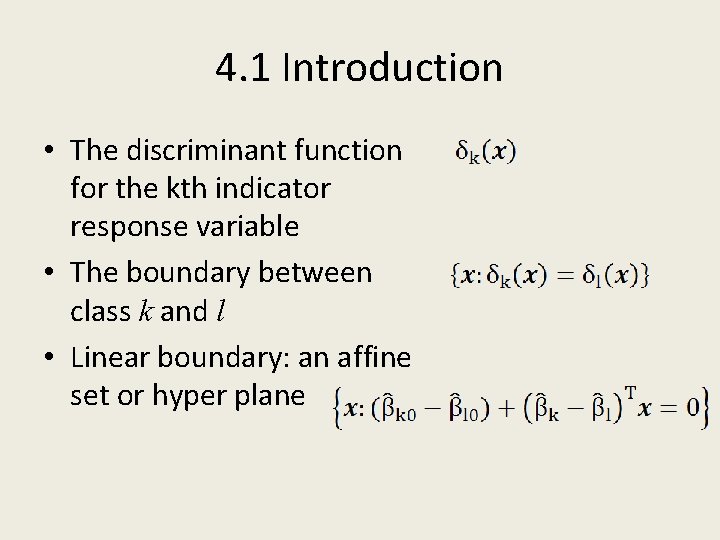
4. 1 Introduction • The discriminant function for the kth indicator response variable • The boundary between class k and l • Linear boundary: an affine set or hyper plane
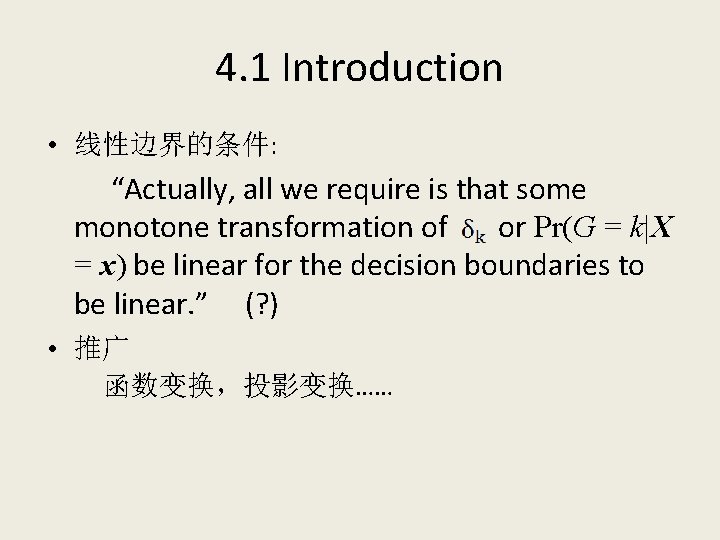
4. 1 Introduction • 线性边界的条件: “Actually, all we require is that some monotone transformation of or Pr(G = k|X = x) be linear for the decision boundaries to be linear. ” (? ) • 推广 函数变换,投影变换……
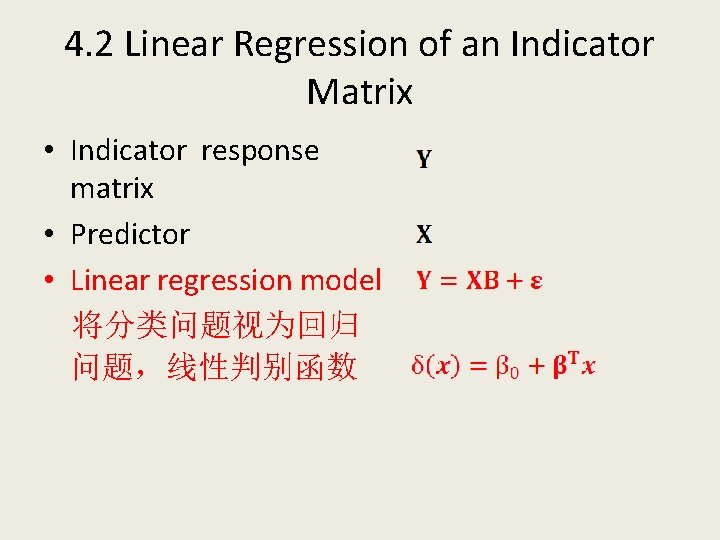
4. 2 Linear Regression of an Indicator Matrix • Indicator response matrix • Predictor • Linear regression model 将分类问题视为回归 问题,线性判别函数
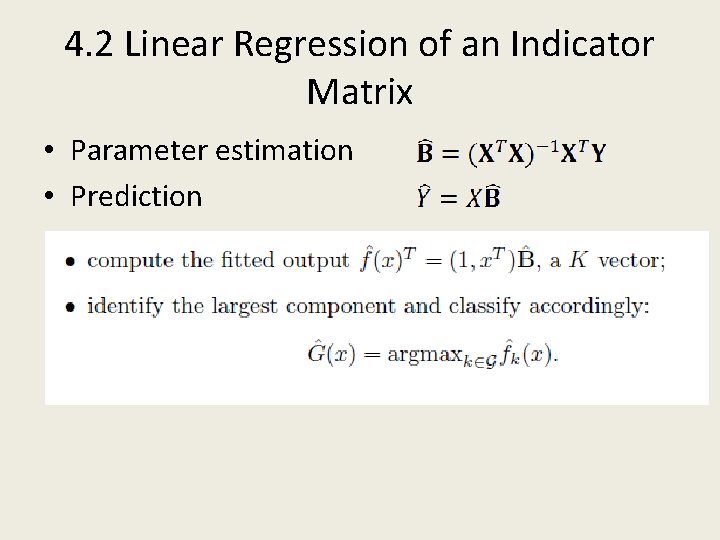
4. 2 Linear Regression of an Indicator Matrix • Parameter estimation • Prediction
4. 2 Linear Regression of an Indicator Matrix • 合理性(? ) Rationale: an estimate of conditional probability (? ) 线性函数无界(Does this matter? )
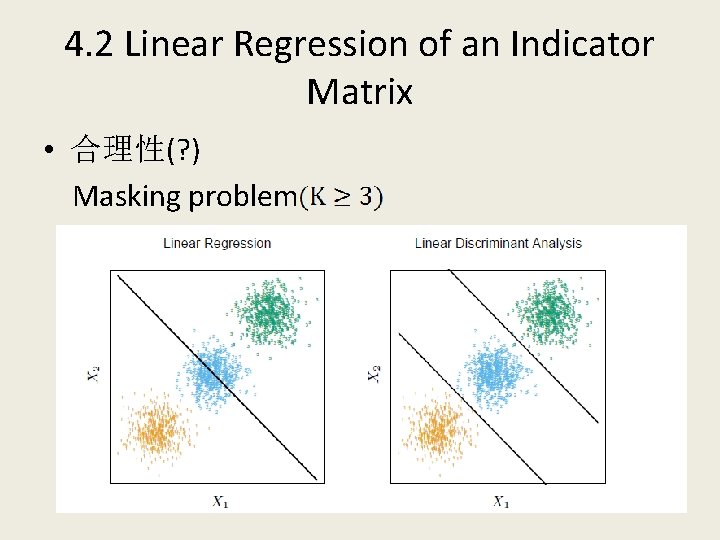
4. 2 Linear Regression of an Indicator Matrix • 合理性(? ) Masking problem
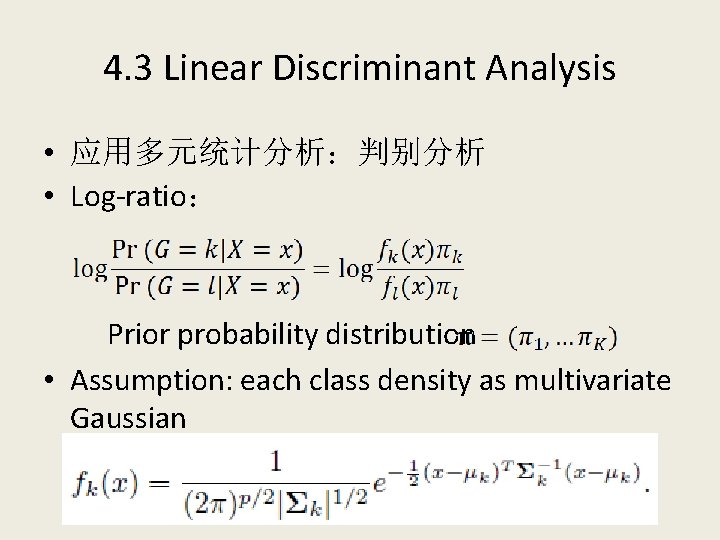
4. 3 Linear Discriminant Analysis • 应用多元统计分析:判别分析 • Log-ratio: Prior probability distribution • Assumption: each class density as multivariate Gaussian
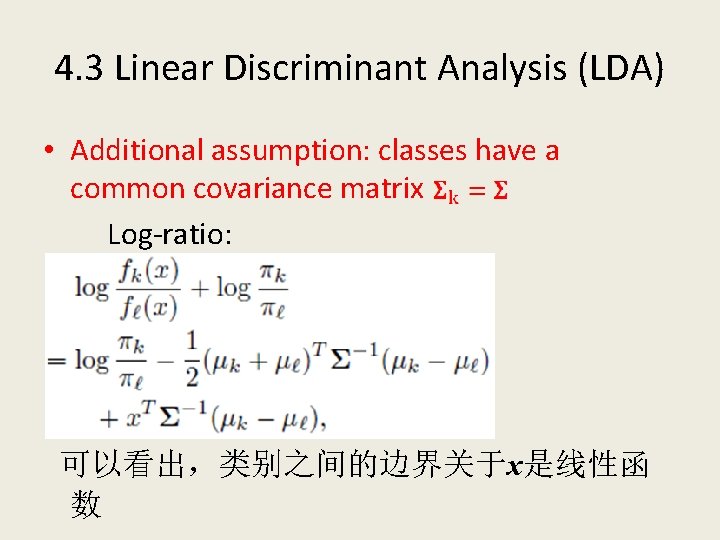
4. 3 Linear Discriminant Analysis (LDA) • Additional assumption: classes have a common covariance matrix Log-ratio: 可以看出,类别之间的边界关于x是线性函 数
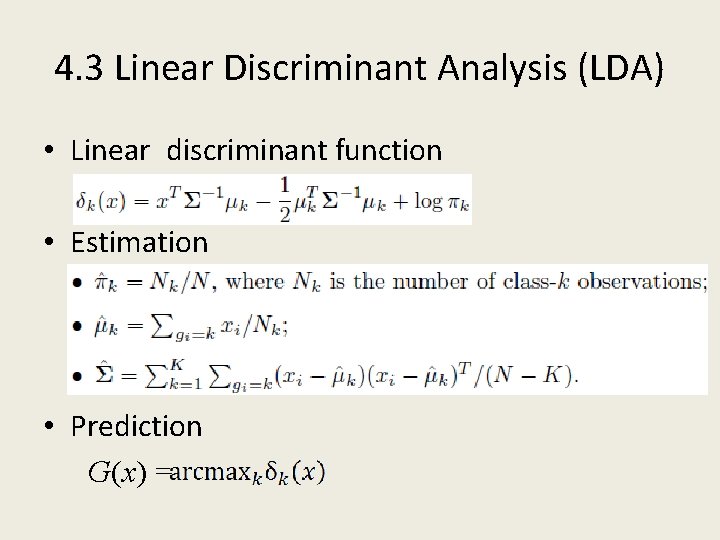
4. 3 Linear Discriminant Analysis (LDA) • Linear discriminant function • Estimation • Prediction G(x) =
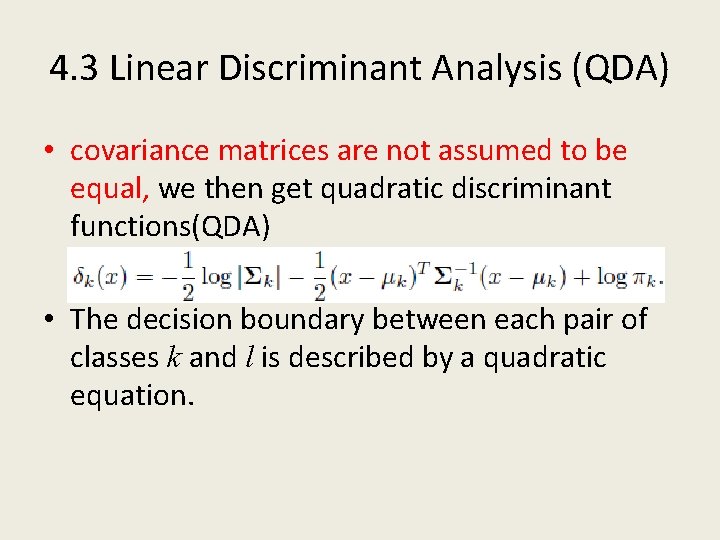
4. 3 Linear Discriminant Analysis (QDA) • covariance matrices are not assumed to be equal, we then get quadratic discriminant functions(QDA) • The decision boundary between each pair of classes k and l is described by a quadratic equation.
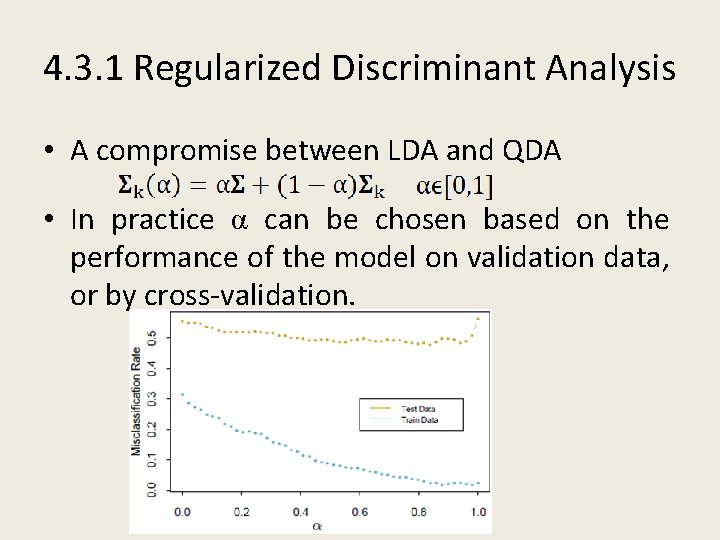
4. 3. 1 Regularized Discriminant Analysis • A compromise between LDA and QDA • In practice α can be chosen based on the performance of the model on validation data, or by cross-validation.
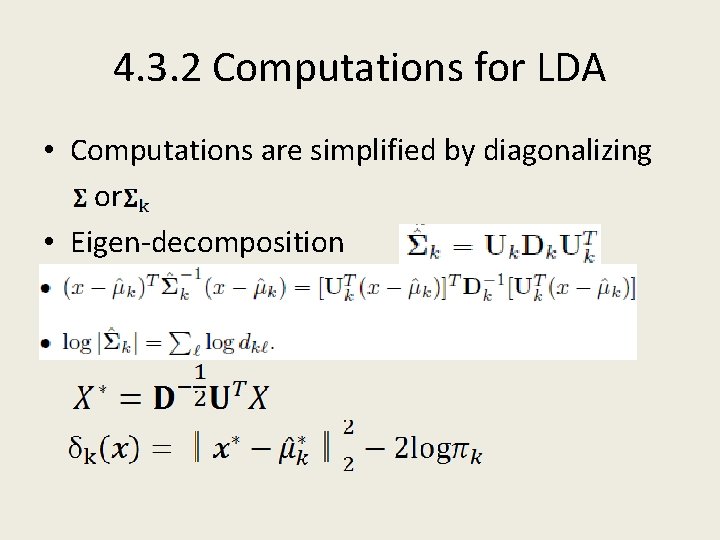
4. 3. 2 Computations for LDA • Computations are simplified by diagonalizing or • Eigen-decomposition
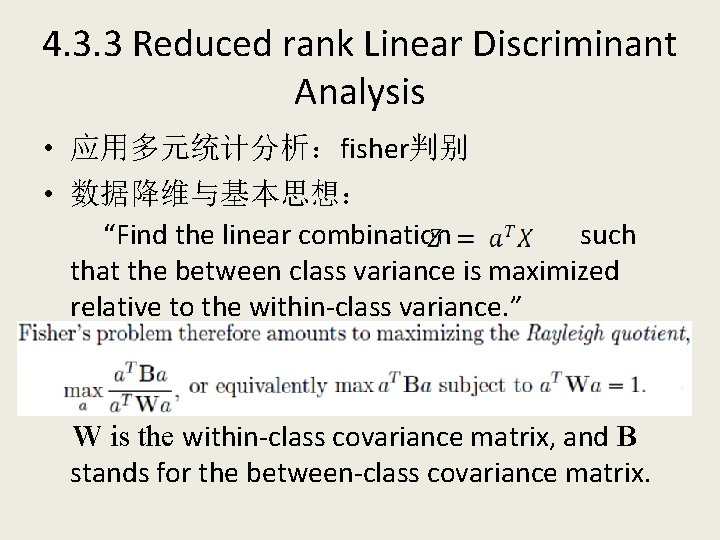
4. 3. 3 Reduced rank Linear Discriminant Analysis • 应用多元统计分析:fisher判别 • 数据降维与基本思想: “Find the linear combination such that the between class variance is maximized relative to the within-class variance. ” W is the within-class covariance matrix, and B stands for the between-class covariance matrix.
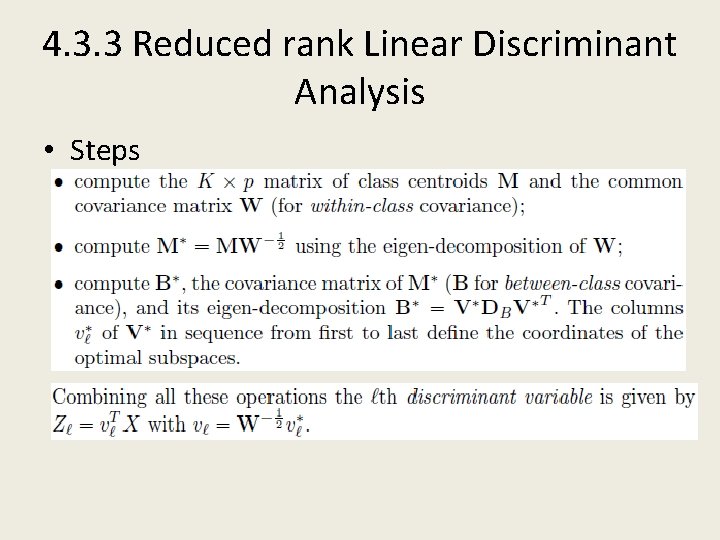
4. 3. 3 Reduced rank Linear Discriminant Analysis • Steps
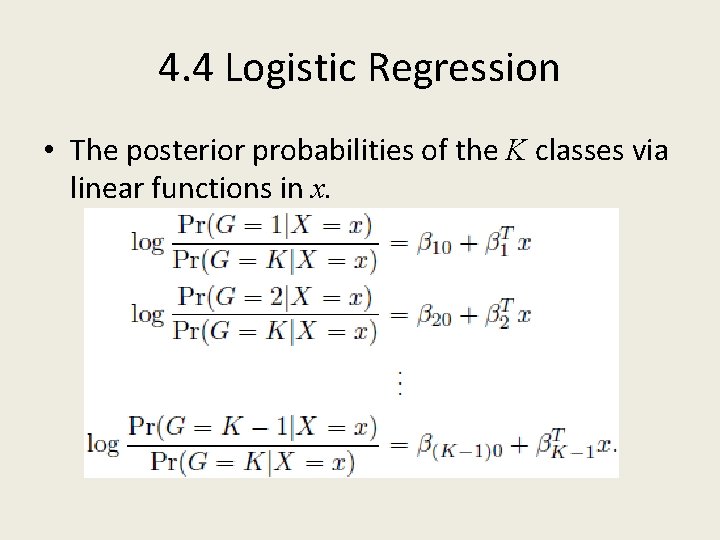
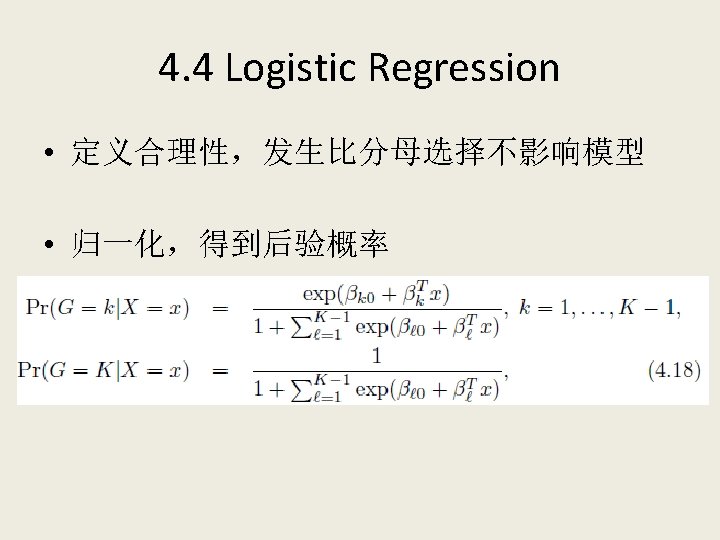
4. 4 Logistic Regression • The posterior probabilities of the K classes via linear functions in x.
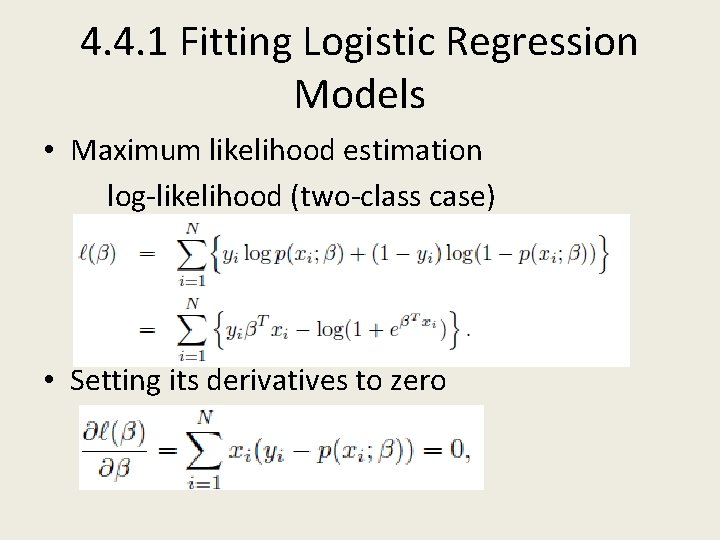
4. 4. 1 Fitting Logistic Regression Models • Maximum likelihood estimation log-likelihood (two-class case) • Setting its derivatives to zero
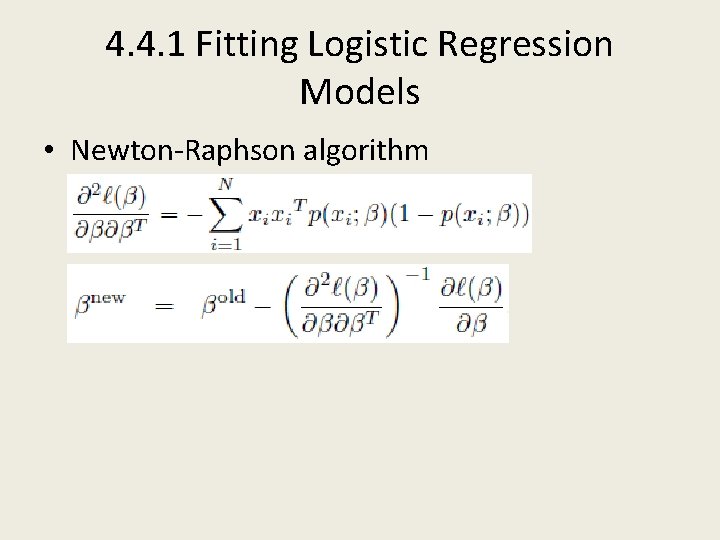
4. 4. 1 Fitting Logistic Regression Models • Newton-Raphson algorithm
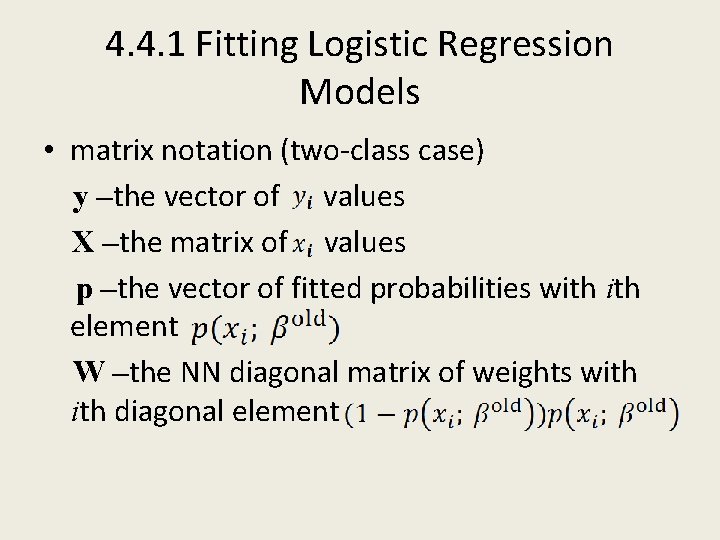
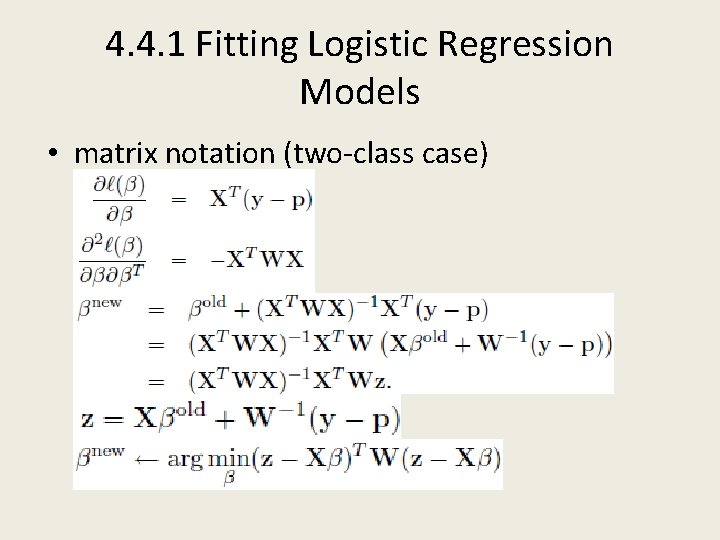
4. 4. 1 Fitting Logistic Regression Models • matrix notation (two-class case) y –the vector of values X –the matrix of values p –the vector of fitted probabilities with element W –the NN diagonal matrix of weights with diagonal element
4. 4. 1 Fitting Logistic Regression Models • matrix notation (two-class case)
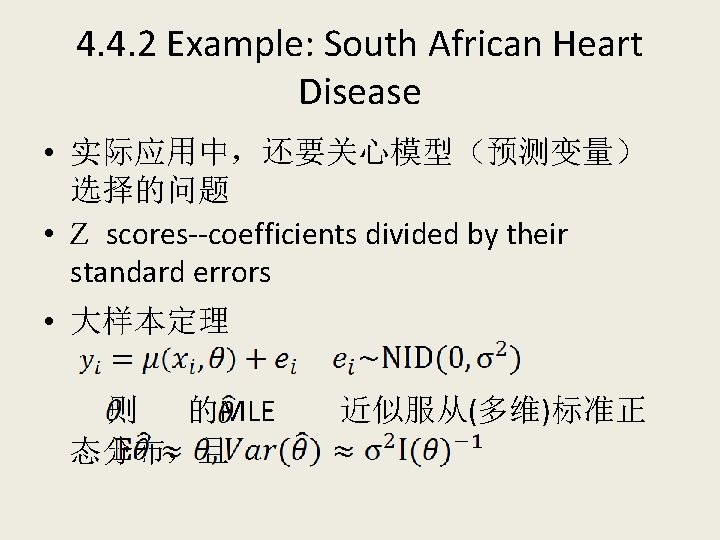
4. 4. 2 Example: South African Heart Disease • 实际应用中,还要关心模型(预测变量) 选择的问题 • Z scores--coefficients divided by their standard errors • 大样本定理 则 的MLE 态分布,且 近似服从(多维)标准正
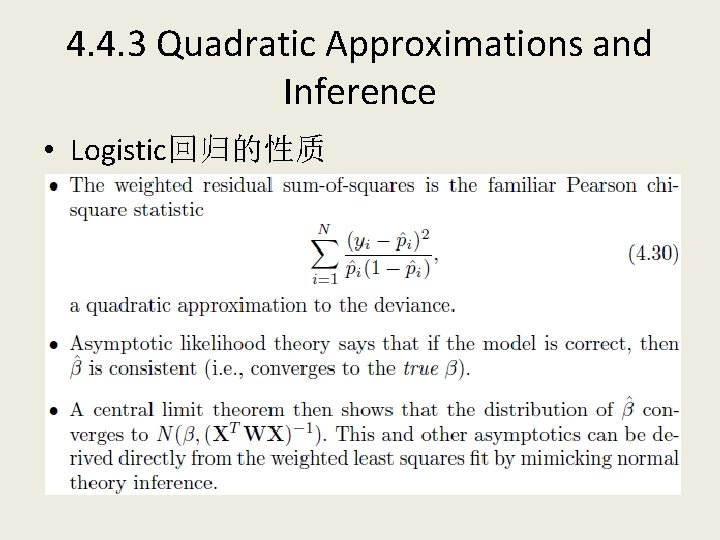
4. 4. 3 Quadratic Approximations and Inference • Logistic回归的性质
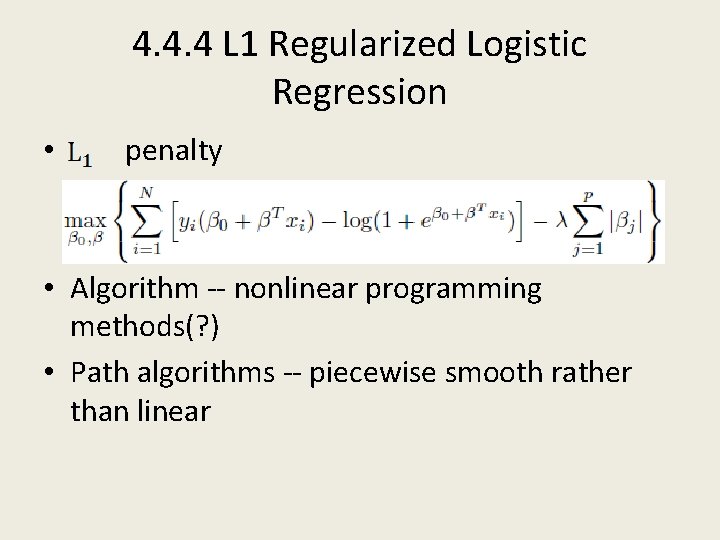
4. 4. 4 L 1 Regularized Logistic Regression • penalty • Algorithm -- nonlinear programming methods(? ) • Path algorithms -- piecewise smooth rather than linear
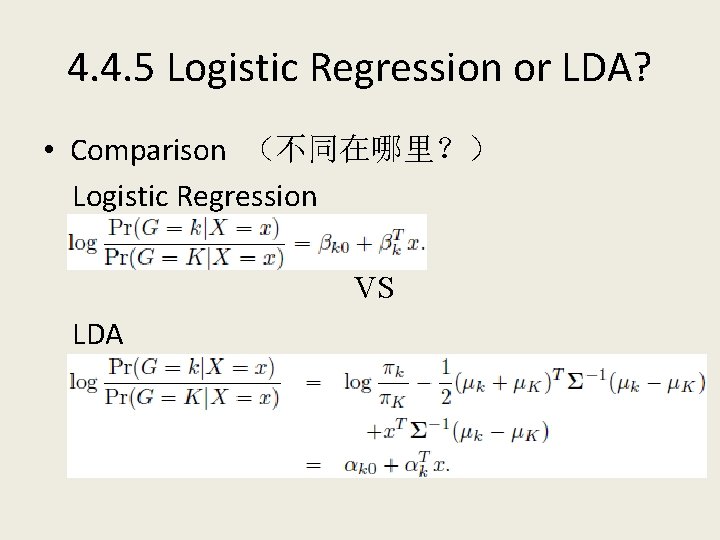
4. 4. 5 Logistic Regression or LDA? • Comparison (不同在哪里?) Logistic Regression VS LDA
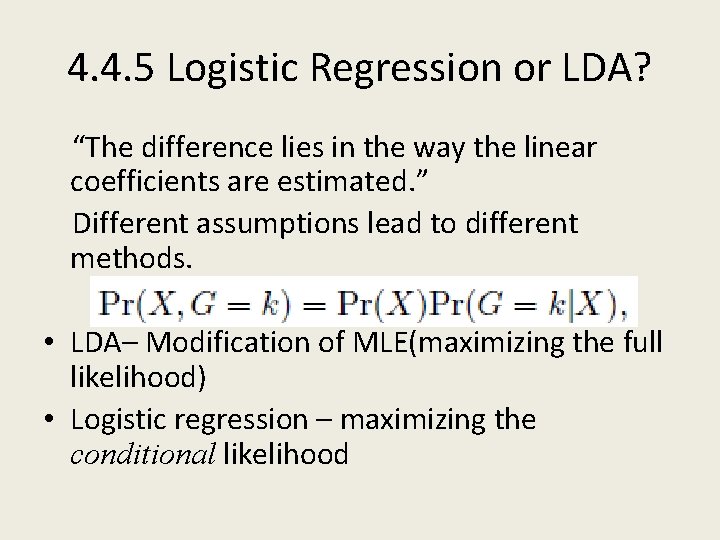
4. 4. 5 Logistic Regression or LDA? “The difference lies in the way the linear coefficients are estimated. ” Different assumptions lead to different methods. • LDA– Modification of MLE(maximizing the full likelihood) • Logistic regression – maximizing the conditional likelihood
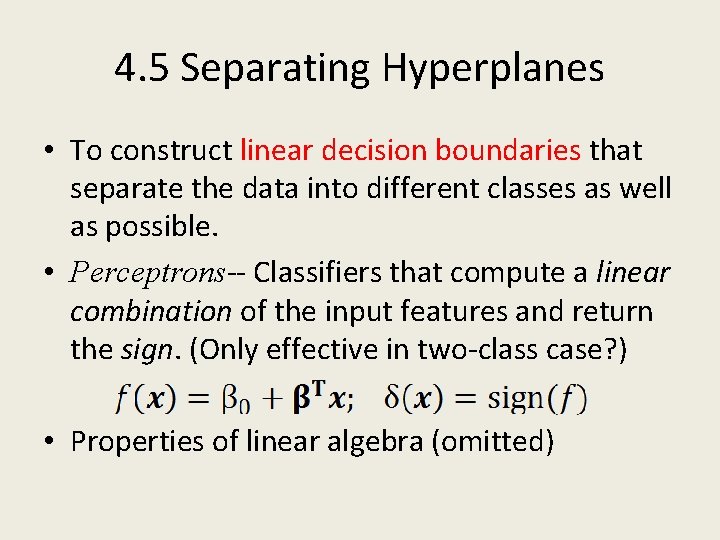
4. 5 Separating Hyperplanes • To construct linear decision boundaries that separate the data into different classes as well as possible. • Perceptrons-- Classifiers that compute a linear combination of the input features and return the sign. (Only effective in two-class case? ) • Properties of linear algebra (omitted)
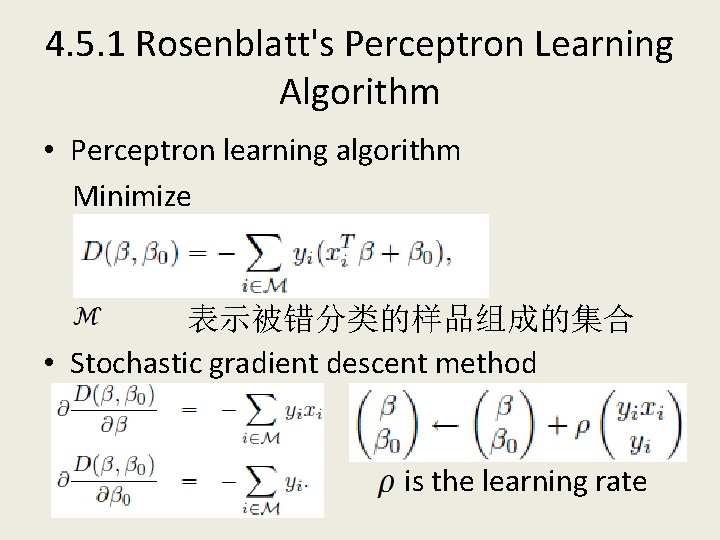
4. 5. 1 Rosenblatt's Perceptron Learning Algorithm • Perceptron learning algorithm Minimize 表示被错分类的样品组成的集合 • Stochastic gradient descent method is the learning rate
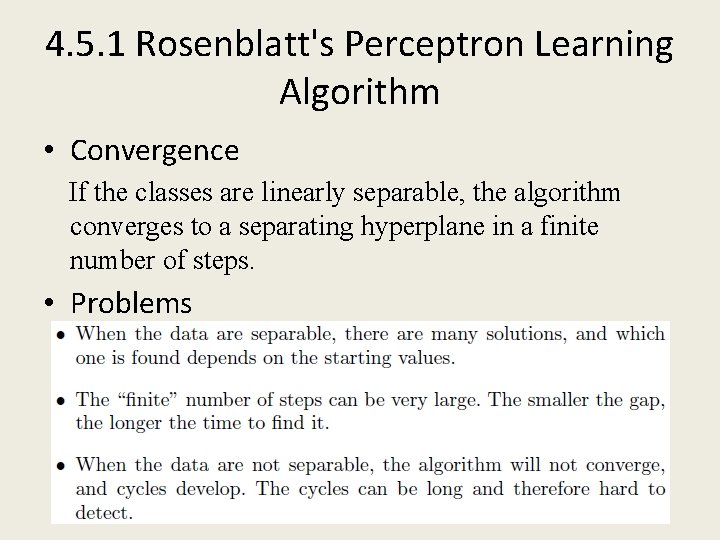
4. 5. 1 Rosenblatt's Perceptron Learning Algorithm • Convergence If the classes are linearly separable, the algorithm converges to a separating hyperplane in a finite number of steps. • Problems
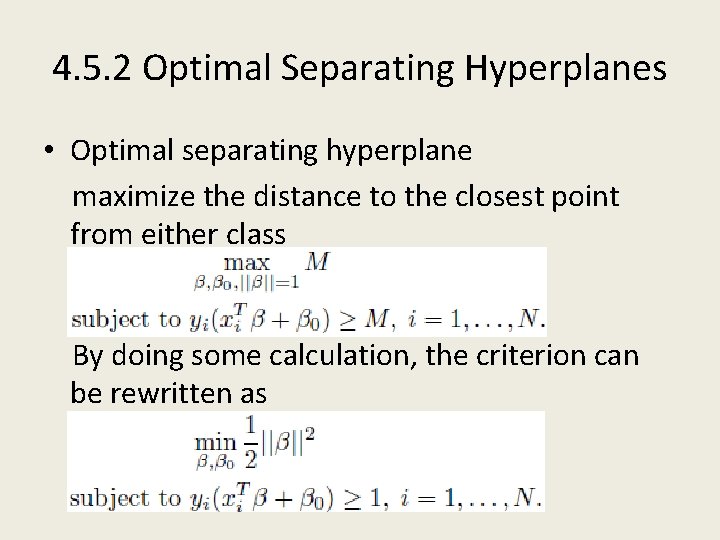
4. 5. 2 Optimal Separating Hyperplanes • Optimal separating hyperplane maximize the distance to the closest point from either class By doing some calculation, the criterion can be rewritten as
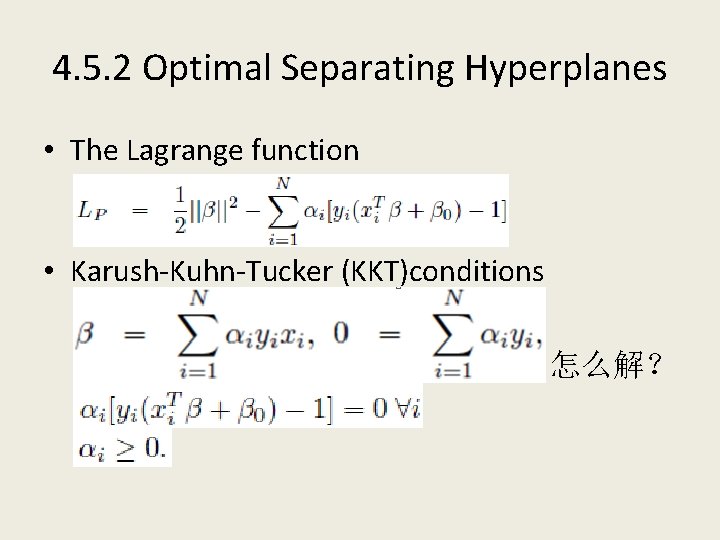
4. 5. 2 Optimal Separating Hyperplanes • The Lagrange function • Karush-Kuhn-Tucker (KKT)conditions • 怎么解?
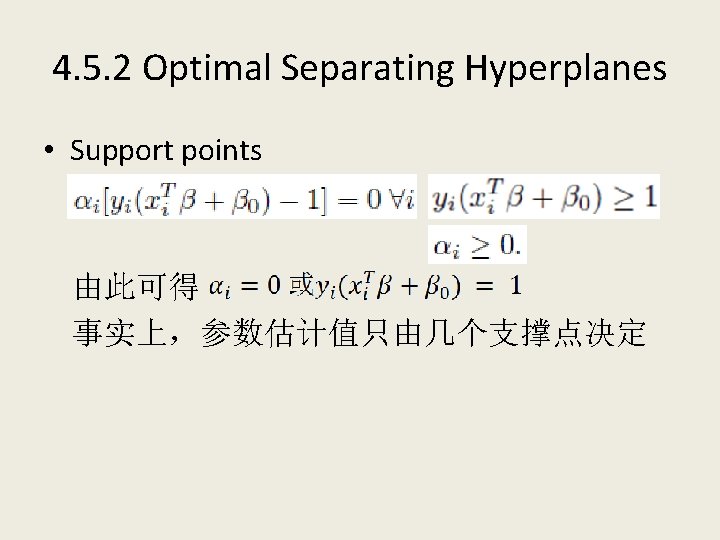
4. 5. 2 Optimal Separating Hyperplanes • Support points 由此可得 事实上,参数估计值只由几个支撑点决定
4. 5. 2 Optimal Separating Hyperplanes • Some discussion Separating Hyperplane vs LDA Separating Hyperplane vs Logistic Regression When the data are not separable, there will be no feasible solution to this problem SVM