
Chapter 4 Life In The Colonies L 1
- Slides: 6
Chapter 4 – Life In The Colonies
L 1: Colonial Economy Colonial America began as a society based on agriculture. Colonists learned to adapt to climate and terrain. NEW ENGLAND MIDDLE COLONIES • In New England, farmers adapted to long winters and poor soil by practicing subsistence farming. • In the Middle Colonies, fertile soil and a milder climate permitted large-scale farming. • New England commercial enterprises included small businesses, shipbuilding, shipping, and fishing. • New England had many port cities and developed as centers of shipping and trade. • Farmers grew large quantities of wheat and other cash crops. • Industry in the Middle Colonies included home-based crafts like carpentry and businesses such as lumber mills and manufacturing. • By 1760, the cities New York & Philadelphia had the largest populations in the colonies – over 15, 000 people in each. These colonies had a very diverse population.
L 1: CONTINUED … SOUTHERN COLONIES • In the Southern Colonies, rich soil and warm climate was well suited to large farms, called plantations. • Each plantation was like a small village, able to meet most of its own needs. • The principal cash crops were tobacco and rice. • In the backcountry of the Southern Colonies, settlers grew corn and tobacco on small family farms. • All of the hard labor needed to run the plantations led to the growth of the slave trade in the south. • Southern farmers, especially plantation owners, relied on slave labor. • Enslaved Africans were shipped to America from West Africa on the voyage called the Middle Passage (the middle leg of a three-part route called the triangular trade). • Life as an enslaved person was difficult. Most worked in the fields, although some learned trades. • Slave codes were rules controlling the behavior and punishment of enslaved people. • Critics of slavery included Puritans, Quakers, and Mennonites – most
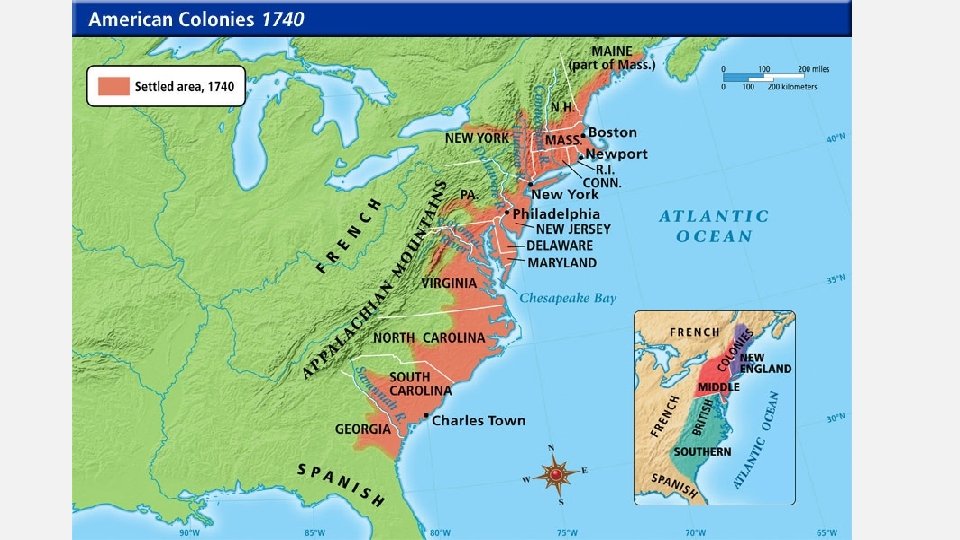
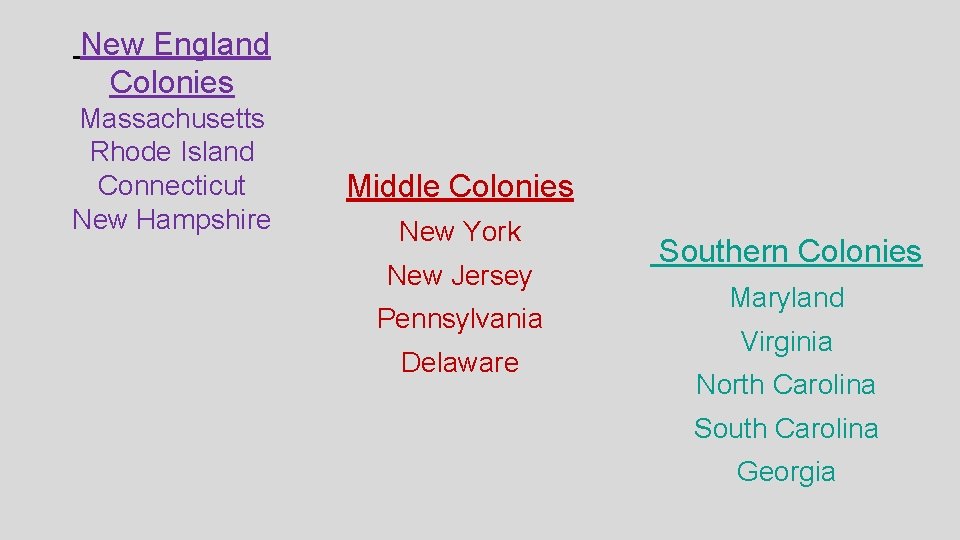
New England Colonies Massachusetts Rhode Island Connecticut New Hampshire Middle Colonies New York New Jersey Pennsylvania Delaware Southern Colonies Maryland Virginia North Carolina South Carolina Georgia
L 2: Colonial Government