
Chapter 4 Lesson 2 URBANIZATION OBJECTIVES 1 STUDENTS
Chapter 4 Lesson 2 URBANIZATION OBJECTIVES: 1) STUDENTS WILL ANALYZE THE CAUSES OF URBAN GROWTH IN THE LATE 1800 S 2) STUDENTS WILL BE ABLE TO IDENTIFY VARIOUS PROBLEMS THAT DEVELOPED WITH RAPID URBAN GROWTH 3) STUDENTS WILL BE ABLE TO IDENTIFY SOLUTIONS CITY DWELLERS HAD FOR URBAN PROBLEMS
Urbanization THE GROWTH OF CITIES Essential Question: What types of problems developed due to the rapid growth of urban areas during the late 19 th century? 1) What areas are considered “Urban”? 2) What factors led to urban growth? 3) What kind of challenges do you think city dwellers faced? How did they meet them?
Urbanization America Becomes a Nation of Cities USA began as agrarian (nation of farmers) 19 th century Industrialization led to a nation of city dwellers Shift from “rural” to “urban” in late 1800 s Urban= population Of 2, 500 � 1860 20% of U. S. pop. Lived in urban areas 131 cities w/ pop. Greater than 2, 500 9 U. S. cities had pop. Greater than 100, 000 � 1900 1, 700 cities w/ pop. Greater than 2, 500 38 cities w/ pop. Greater than 100, 000 � 1920 majority of U. S. citizens live in URBAN areas � Today=more than 80% URBAN

Urban Growth

Urbanization �Cities Offer Advantages Job Opportunities Higher standard of living – earning wages & paying low rent, allowed many city workers to save; move into middle class? Connected – Churches, theatres, social clubs, museums, parks �Immigrants Move to Seize Opportunities Some cities had 40% foreign-born workforce Neighborhoods, cities, & industries often had a majority of workers from one locale (Polish steel workers in Pennsylvania) �Farmers Migrate from Country to City Rural – to – urban migrants found wages paid for hourly labor; did not have to rely on crop harvest Large numbers of migrants moved to cities

Technology Improves City Life Broadway 1909 �Engineers Build Skyward Skyscrapers solved the problem of how to make the best use of limited expensive space. �Technology factors: Invention of Elevators and Steal Internal Skeletons. �The combination of steel and cement make an extremely strong building material. �Architecture = professional Louis Sullivan designed the ten-story Wainwright building in St. Louis in 1890.
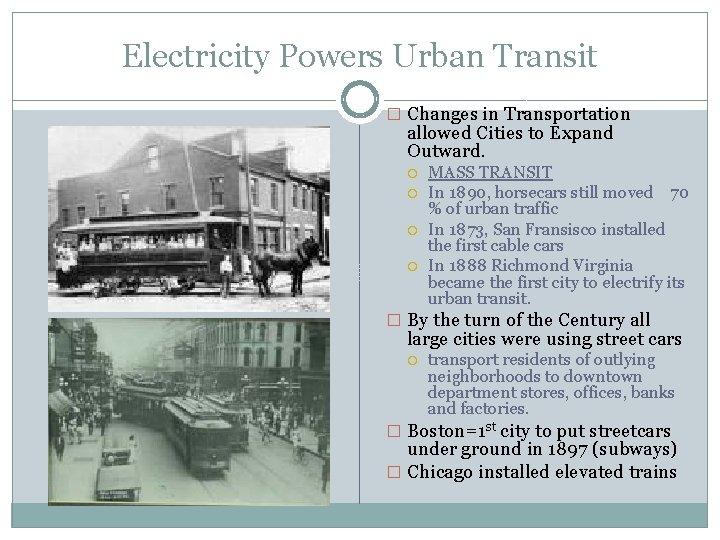
Electricity Powers Urban Transit � Changes in Transportation allowed Cities to Expand Outward. MASS TRANSIT In 1890, horsecars still moved 70 % of urban traffic In 1873, San Fransisco installed the first cable cars In 1888 Richmond Virginia became the first city to electrify its urban transit. � By the turn of the Century all large cities were using street cars transport residents of outlying neighborhoods to downtown department stores, offices, banks and factories. � Boston=1 st city to put streetcars under ground in 1897 (subways) � Chicago installed elevated trains
City Planners Control Growth � City Planners designed cities to be more functional & beautiful Allowed city planners to designate certain areas for specific functions separate areas for industry, retail business, & residential neighborhoods � In 1858 Frederick Olmsted developed “Greensward” which later became Central Park in New York. The park was set in a natural setting trees and ascetic landscapes. boating, tennis, bicycle paths and a zoo. � Parks allowed people to get away from the busy city. � Many people were not adjusted to city life and parks helped to establish serenity in the urban environment.
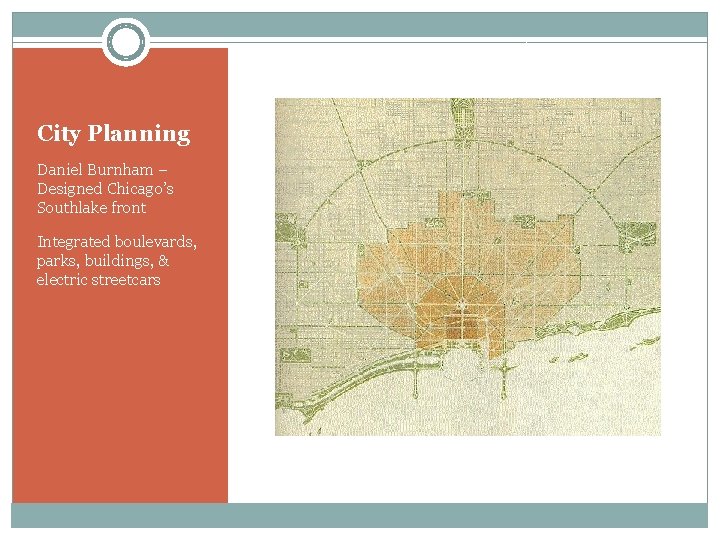
City Planning Daniel Burnham – Designed Chicago’s Southlake front Integrated boulevards, parks, buildings, & electric streetcars
Urbanization �Urban Growth Creates Problems Housing Water Sanitation Fire Crime
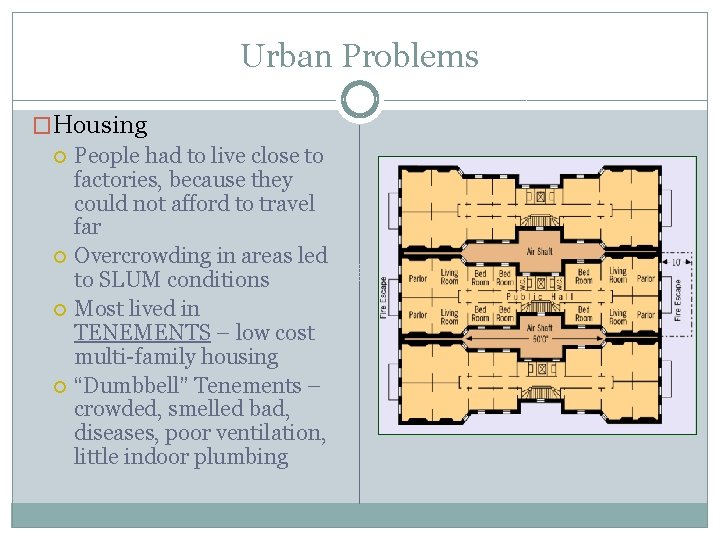
Urban Problems �Housing People had to live close to factories, because they could not afford to travel far Overcrowding in areas led to SLUM conditions Most lived in TENEMENTS – low cost multi-family housing “Dumbbell” Tenements – crowded, smelled bad, diseases, poor ventilation, little indoor plumbing

TENEMENTS
Tenements �Journalist Jacob Riis documented tenement & slum conditions – He wrote, How the Other Half Lives “"Long ago it was said that 'one half of the world does not know how the other half lives. ' That was true then. It did not know because it did not care. The half that was on top cared little for the struggles, and less for the fate, of those who were underneath, so long as it was able to hold them there and keep its own seat” How did Jacob Riis attempt to change conditions for the urban poor? Did he succeed? If so, how?
Urban Problems What types of problems developed due to the rapid growth of urban areas? �Water – indoor plumbing/sprinklers �Crime – local police force not always reliable; corrupted by local politicians �Fire – poor construction methods led to daily fires; Great Fire of Chicag 0 – October 8 -10, 1871 �Sanitation – Those without plumbing disposed of waste in streets; sewage dumped to rivers; Horses were major problems Who cleaned up manure? Piled up in streets Philadelphia, 1872 – 2, 500 horses died in a two week period; who cleans them up? Left dead in streets
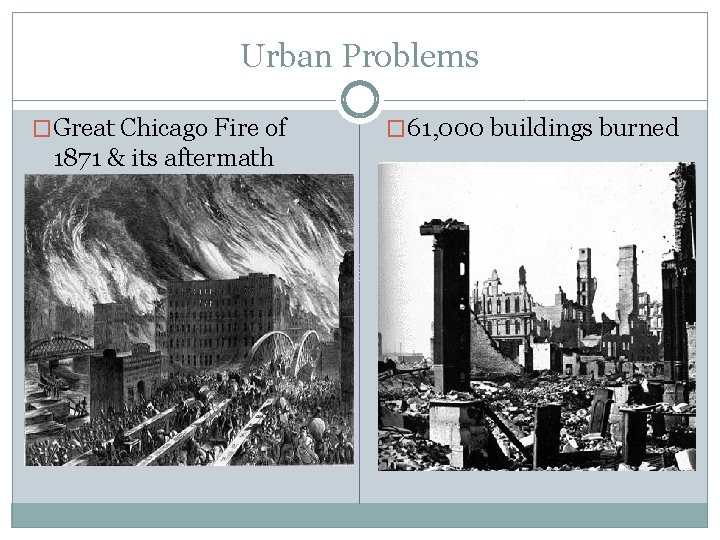
Urban Problems �Great Chicago Fire of 1871 & its aftermath � 61, 000 buildings burned
Urban Problems Eventually, cities adapted to the growth & the problems associated with massive populations Cities developed: organized municipal police & fire departments � Building codes – outlawed tenements; required building inspections � Health Codes – to prevent disease from poor sanitation � Sewage Systems – to deal with human waste � Mass Transit – decreased the need for horses in cities �
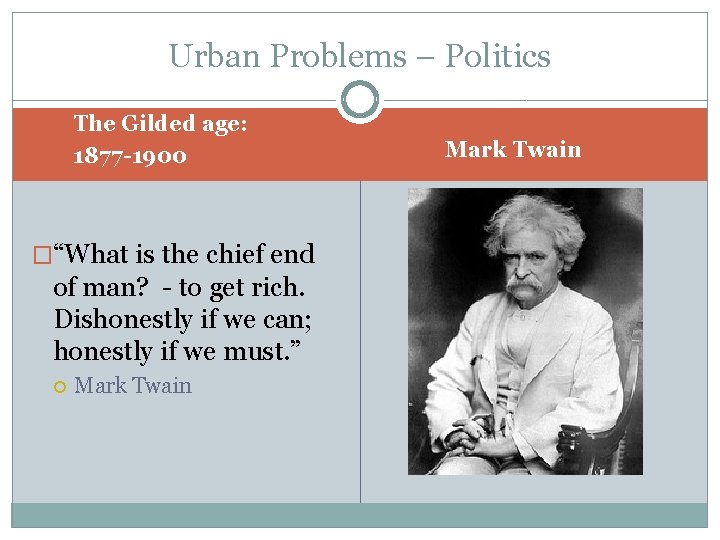
Urban Problems – Politics The Gilded age: 1877 -1900 �“What is the chief end of man? - to get rich. Dishonestly if we can; honestly if we must. ” Mark Twain
The Gilded Age “ Unless you can get the ear of a Senator…and persuade him to use his “influence” in your behalf, you cannot get an employment of the most trivial nature in Washington. Mere merit, fitness and capability, are useless baggage to you without ‘influence’…It would be an odd circumstance to see a girl get employment…merely because she was worthy and a competent, and a good citizen of a free country that ‘treats all persons alike” Mark Twain
Corruption Plagues Politics �Political Machine: What is the function of a “machine”? Local political party organization capable of mobilizing or “manufacturing” large numbers of votes on behalf of candidates for political office Political machines dominated in most American cities between the Civil War (1865) and the Great Depression (1930 s) Most famous = “Tammany Hall” – NYC political machine
Political Machines �Why did this work? Political Machine met the NEEDS/WANTS of many different groups (constituents) Urban poor needed jobs, food, money, housing, schools, etc… Immigrants needed help: learn English, find housing, food, medical attention, naturalization Local Businesses: government contracts, favorable tax treatment, municipal services �Party BOSSES delivered Used municipal graft, voter fraud, & business corruption to secure votes & make money for themselves
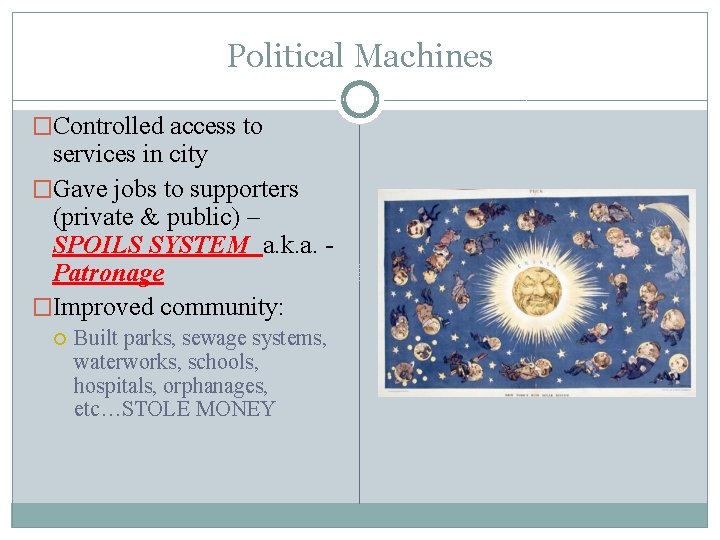
Political Machines �Controlled access to services in city �Gave jobs to supporters (private & public) – SPOILS SYSTEM a. k. a. Patronage �Improved community: Built parks, sewage systems, waterworks, schools, hospitals, orphanages, etc…STOLE MONEY
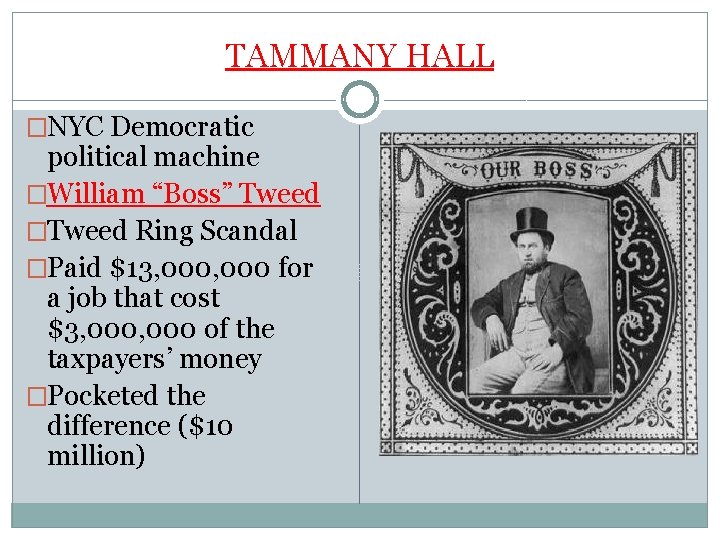
TAMMANY HALL �NYC Democratic political machine �William “Boss” Tweed �Tweed Ring Scandal �Paid $13, 000 for a job that cost $3, 000 of the taxpayers’ money �Pocketed the difference ($10 million)
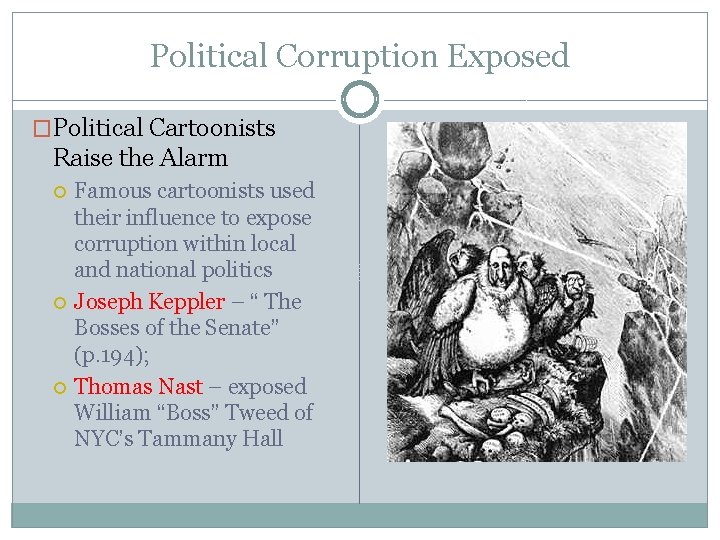
Political Corruption Exposed �Political Cartoonists Raise the Alarm Famous cartoonists used their influence to expose corruption within local and national politics Joseph Keppler – “ The Bosses of the Senate” (p. 194); Thomas Nast – exposed William “Boss” Tweed of NYC’s Tammany Hall
- Slides: 23