
Chapter 4 Labor Demand Elasticities Major points Measuring
Chapter 4. Labor Demand Elasticities. Major points. • Measuring elasticity of labor demand. • Determinants of the elasticity of labor demand • Consequences of inelastic or elastic labor demand • Measuring cross elasticity of labor demand • Consequences of a positive or negative cross elasticity of demand
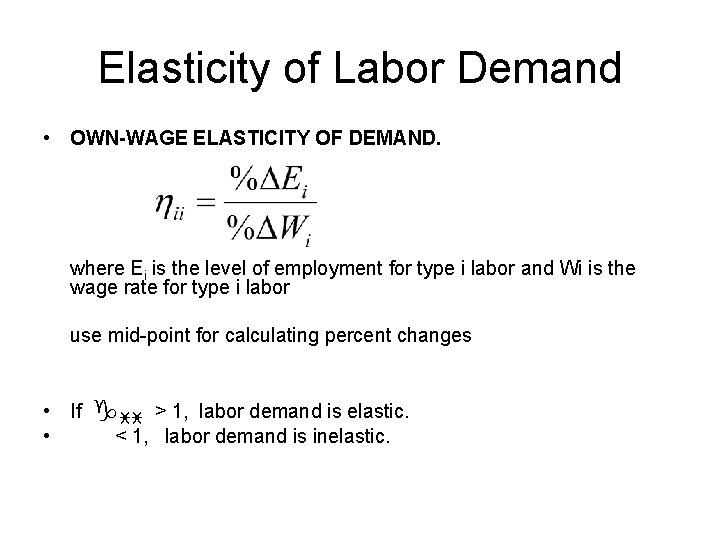
Elasticity of Labor Demand • OWN-WAGE ELASTICITY OF DEMAND. where Ei is the level of employment for type i labor and Wi is the wage rate for type i labor use mid-point for calculating percent changes • If gii > 1, labor demand is elastic. • < 1, labor demand is inelastic.
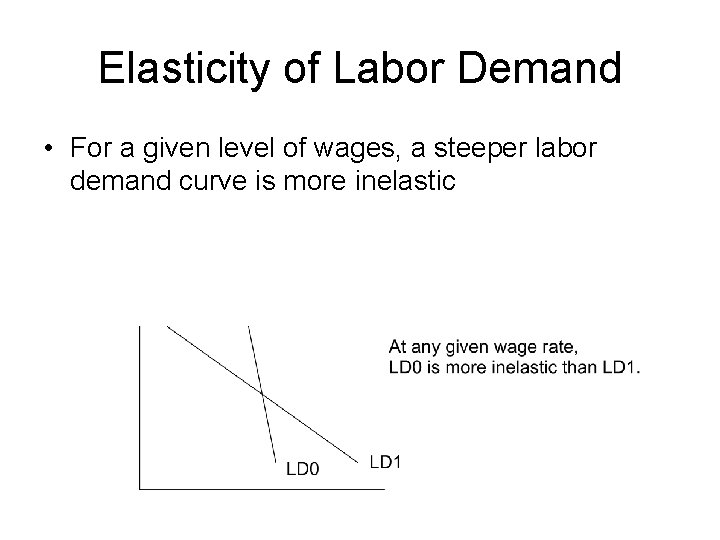
Elasticity of Labor Demand • For a given level of wages, a steeper labor demand curve is more inelastic
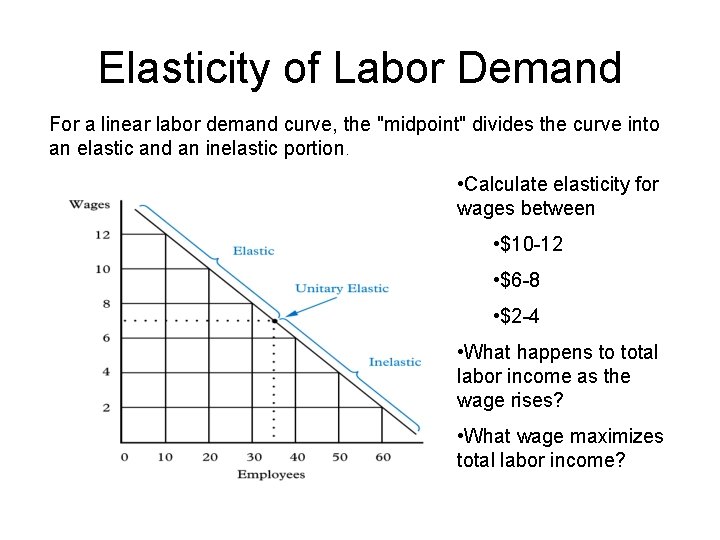
Elasticity of Labor Demand For a linear labor demand curve, the "midpoint" divides the curve into an elastic and an inelastic portion. • Calculate elasticity for wages between • $10 -12 • $6 -8 • $2 -4 • What happens to total labor income as the wage rises? • What wage maximizes total labor income?
HICKS-MARSHALL LAWS OF DERIVED DEMAND Based on scale or substitution effects, why is labor demand more elastic when: 1) product demand is more elastic 2) other inputs can be easily substituted for labor 3) the supply of substitutes is more elastic 4) labor is a larger share of total cost
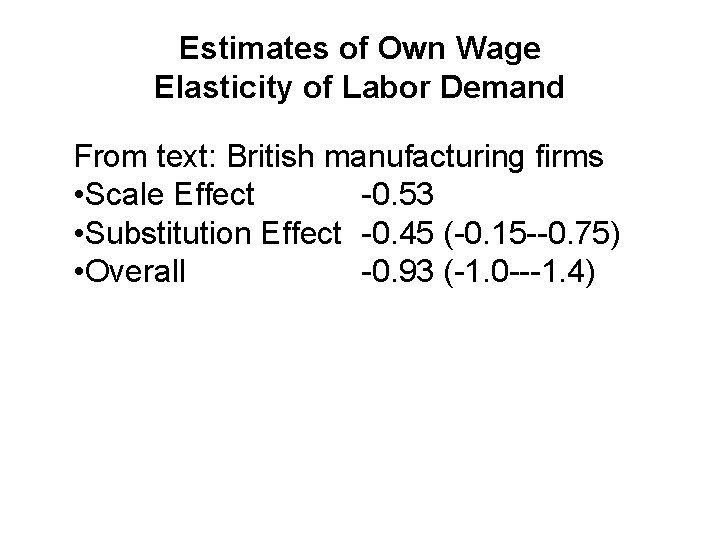
Estimates of Own Wage Elasticity of Labor Demand From text: British manufacturing firms • Scale Effect -0. 53 • Substitution Effect -0. 45 (-0. 15 --0. 75) • Overall -0. 93 (-1. 0 ---1. 4)
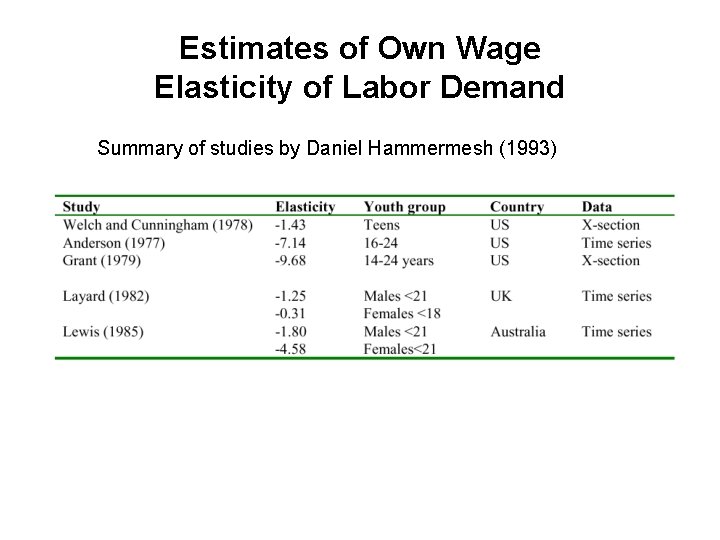
Estimates of Own Wage Elasticity of Labor Demand Summary of studies by Daniel Hammermesh (1993)
Application: Unions & Elasticity • Unions wish to raise wages while preserving employment. • How does elasticity of labor demand affect union “bargaining power”?
Application: Unions & Elasticity • Truckload (TL) and Less than Truckload (LTL) – TL: hauling grain from one part of country to another. – LTL: UPS, FEDEX • Where is product demand more elastic? • Where is labor demand more elastic? • Where should unions have greater bargaining power?
Application: Unions & Elasticity • TL: Average union rate 28. 4 cents. mile; unionnon-union ratio of 1. 23 • LTL: average union rate 35. 8 cents/mile; unionnon-union ratio 1. 34
Application: Unions & Elasticity • Unions will be most successful at raising wages in industries with inelastic labor demand. – Labor versus capital intensive – Monopolistic versus competitive • Unions will pursue & promote policies that make labor demand more inelastic. – Trade restrictions – Minimum wage – Immigration • Unions might first seek to organize workers in markets where labor demand is inelastic.
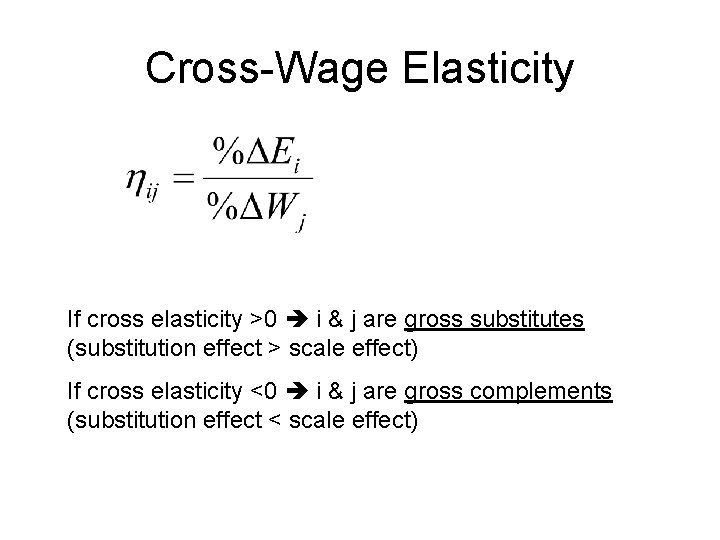
Cross-Wage Elasticity If cross elasticity >0 i & j are gross substitutes (substitution effect > scale effect) If cross elasticity <0 i & j are gross complements (substitution effect < scale effect)
Cross-Wage Elasticity Determinants of cross-elasticity: • As type k labor's share of total cost increases, the scale effect of an increase in Wk grows, making it more likely that Ej drops (i. e. more likely gross complements). • As product demand becomes more elastic, the scale effect of an increase in Wk grows, making it more likely that Ej drops (i. e. more likely gross complements). • As the substitutability between the two types of labor increases, the substitution effect of an increase in Wk on Ej grows (i. e. more likely gross substitutes).
Cross-Wage Elasticity Some empirical evidence: • labor and energy are substitutes in production, but the degree of substitutability is small. • labor and materials are probably substitutes in production, with the degree of substitutability being small • skilled labor is more likely to be complementary with capital than unskilled labor.
Application: Minimum Wage Laws History of minimum wages. • Fair Labor Standards Act of 1938: – minimum wage – requirements for overtime pay premium – restrictions on use of child labor • Minimum wage provisions in 1938 – $. 25 per hour – covered 43 percent of all nonsupervisory wage and salary workers – coverage limited primarily to large firms involved in interstate commerce. – minimum wage is stated in nominal terms and is not indexed. – changes in the minimum wage currently require legislative action.
Application: Minimum Wage Laws • • Historical values of minimum wage. Minimum wage variation across states. Who Earns the Minimum Wage? Is Minimum Wage Employment Long Lasting?
Application: Minimum Wage Laws • The debate over the desirability of a minimum wage hike turns on: – Elasticity of labor demand – Who earns the minimum wage (effect on family poverty rates) – Would a minimum wage hike hurt training and reduce future wage growth? – Monopsony power.
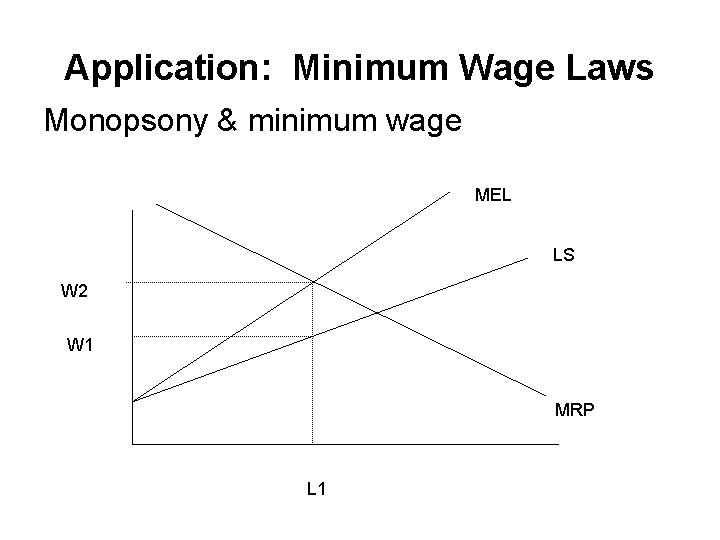
Application: Minimum Wage Laws Monopsony & minimum wage MEL LS W 2 W 1 MRP L 1
Application: Minimum Wage Laws Monopsony & minimum wage • With monopsony, what is – Level of employment – Wage? • With minimum wage between W 1 & W 2, what happens to employment? • With minimum wage above W 2, what happens to employment? • How does elasticity of LD affect employment response?
- Slides: 19