
Chapter 4 Kinematics in Two Dimensions Chapter Goal


- Slides: 37
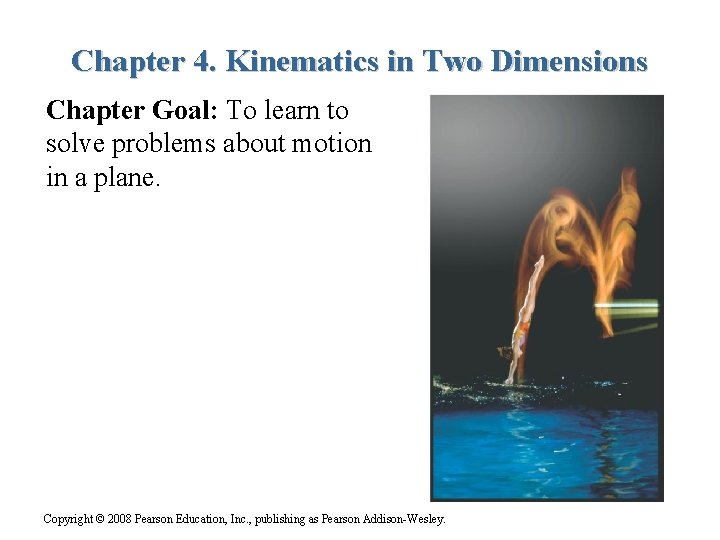
Chapter 4. Kinematics in Two Dimensions Chapter Goal: To learn to solve problems about motion in a plane. Copyright © 2008 Pearson Education, Inc. , publishing as Pearson Addison-Wesley.
Ch. 4 - Student Learning Objectives • To identify the acceleration vector for curvilinear motion. • To compute two-dimensional trajectories. • To read and interpret graphs of projectile motion. • To solve problems of projectile motion using kinematics equations. • To understand the kinematics of uniform and nonuniform circular motion. Copyright © 2008 Pearson Education, Inc. , publishing as Pearson Addison-Wesley.
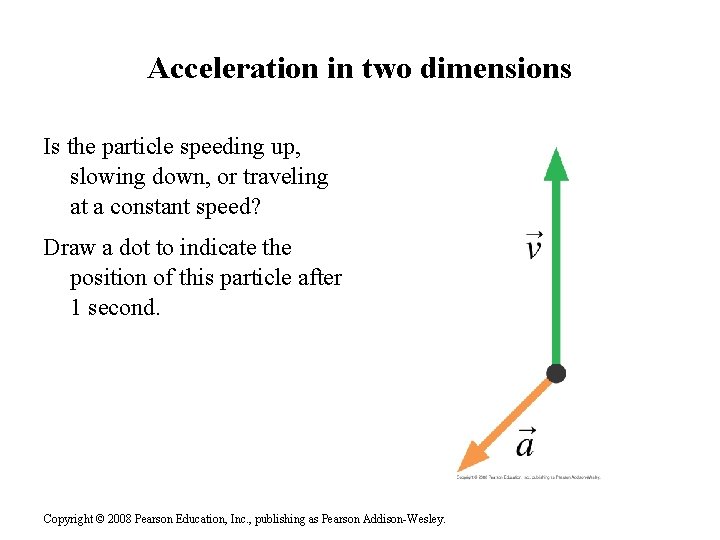
Acceleration in two dimensions Is the particle speeding up, slowing down, or traveling at a constant speed? Draw a dot to indicate the position of this particle after 1 second. Copyright © 2008 Pearson Education, Inc. , publishing as Pearson Addison-Wesley.
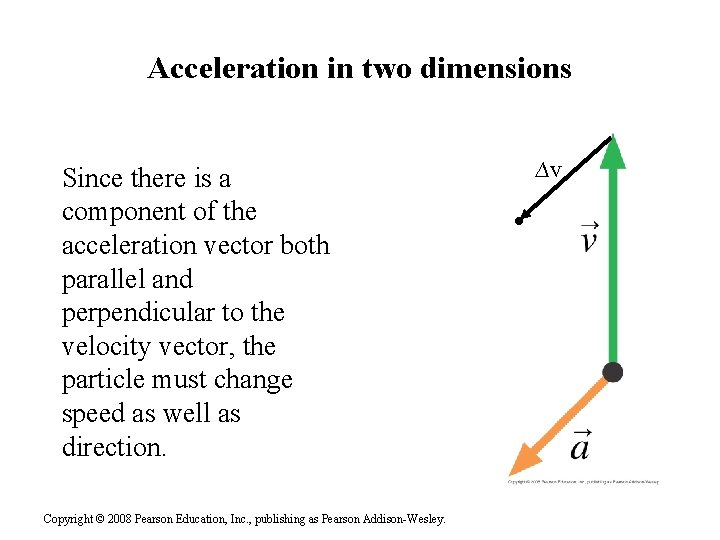
Acceleration in two dimensions Since there is a component of the acceleration vector both parallel and perpendicular to the velocity vector, the particle must change speed as well as direction. Copyright © 2008 Pearson Education, Inc. , publishing as Pearson Addison-Wesley. ∆v •
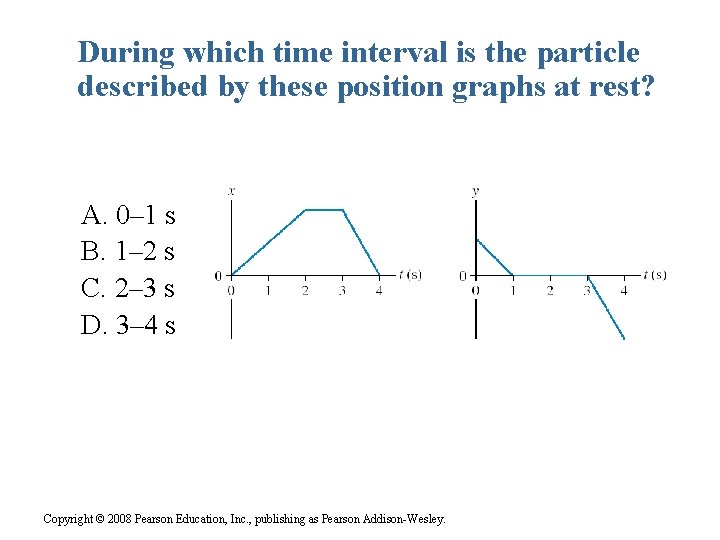
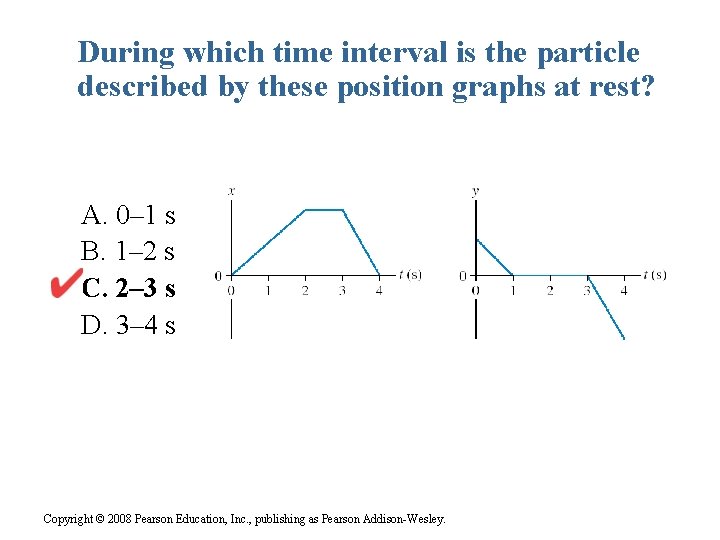
During which time interval is the particle described by these position graphs at rest? A. 0– 1 s B. 1– 2 s C. 2– 3 s D. 3– 4 s Copyright © 2008 Pearson Education, Inc. , publishing as Pearson Addison-Wesley.
During which time interval is the particle described by these position graphs at rest? A. 0– 1 s B. 1– 2 s C. 2– 3 s D. 3– 4 s Copyright © 2008 Pearson Education, Inc. , publishing as Pearson Addison-Wesley.
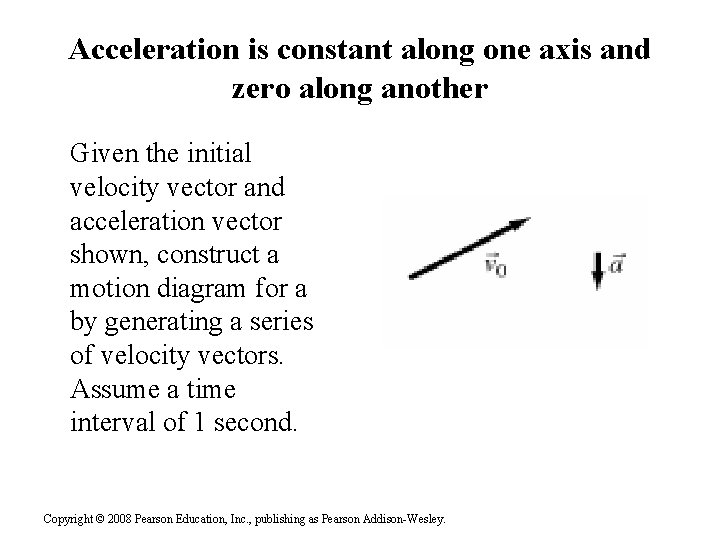
Acceleration is constant along one axis and zero along another Given the initial velocity vector and acceleration vector shown, construct a motion diagram for a by generating a series of velocity vectors. Assume a time interval of 1 second. Copyright © 2008 Pearson Education, Inc. , publishing as Pearson Addison-Wesley.
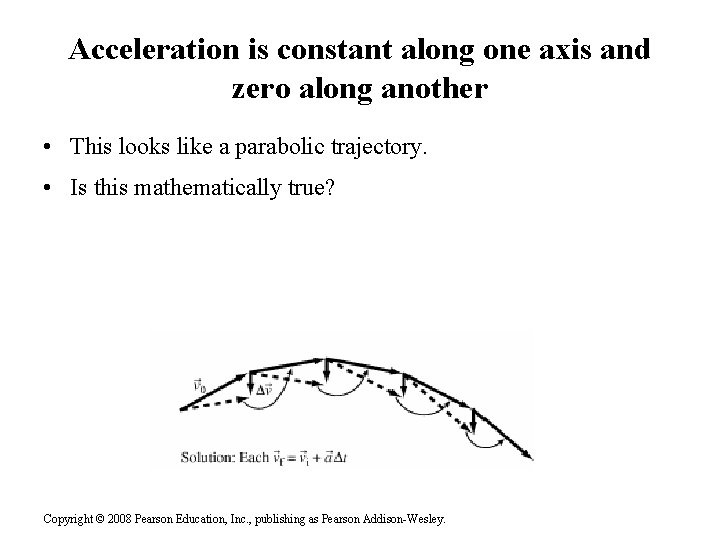
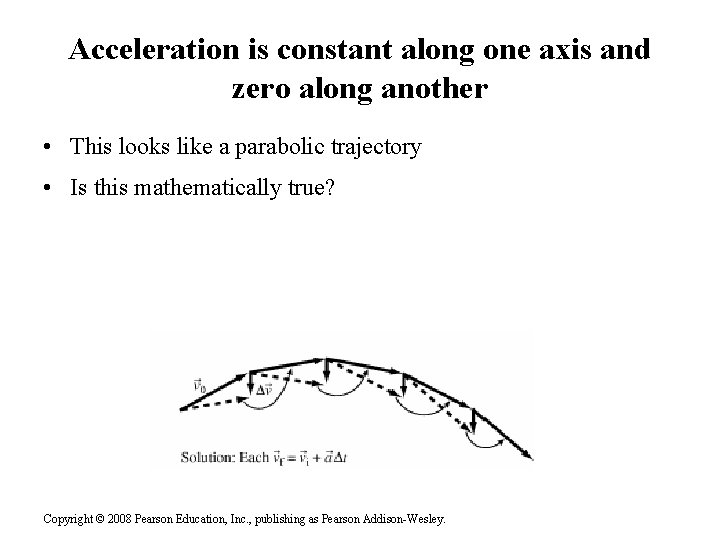
Acceleration is constant along one axis and zero along another • This looks like a parabolic trajectory. • Is this mathematically true? Copyright © 2008 Pearson Education, Inc. , publishing as Pearson Addison-Wesley.
Acceleration is constant along one axis and zero along another • This looks like a parabolic trajectory • Is this mathematically true? Copyright © 2008 Pearson Education, Inc. , publishing as Pearson Addison-Wesley.
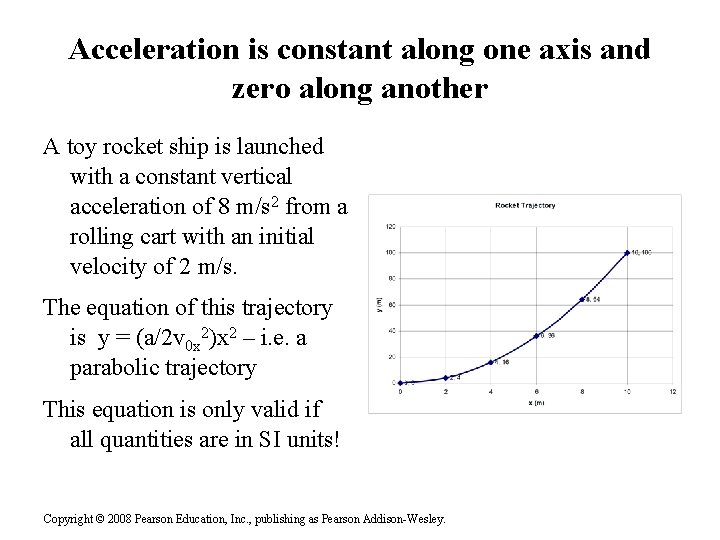
Acceleration is constant along one axis and zero along another A toy rocket ship is launched with a constant vertical acceleration of 8 m/s 2 from a rolling cart with an initial velocity of 2 m/s. Draw a graph of this particle’s trajectory for t = 0, 1, 2, 3, 4 and 5 s. Label the x, y coordinates of each point. Is this a parabolic trajectory? How do you know? Copyright © 2008 Pearson Education, Inc. , publishing as Pearson Addison-Wesley.
Acceleration is constant along one axis and zero along another A toy rocket ship is launched with a constant vertical acceleration of 8 m/s 2 from a rolling cart with an initial velocity of 2 m/s. The equation of this trajectory is y = (a/2 v 0 x 2)x 2 – i. e. a parabolic trajectory This equation is only valid if all quantities are in SI units! Copyright © 2008 Pearson Education, Inc. , publishing as Pearson Addison-Wesley.
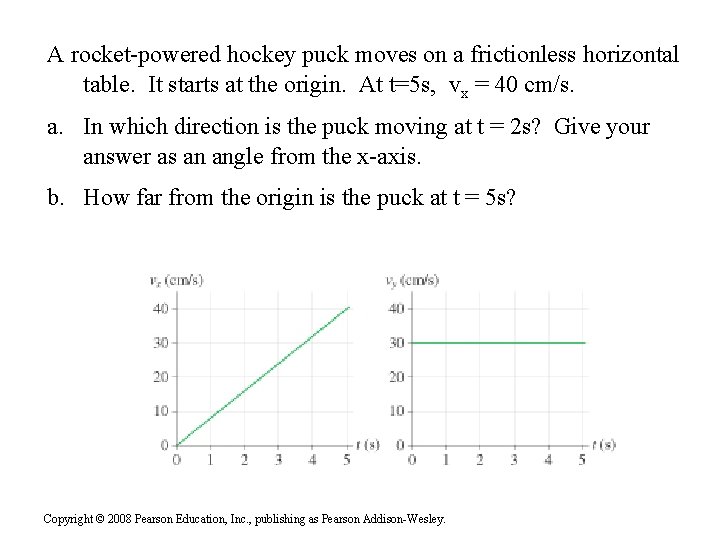
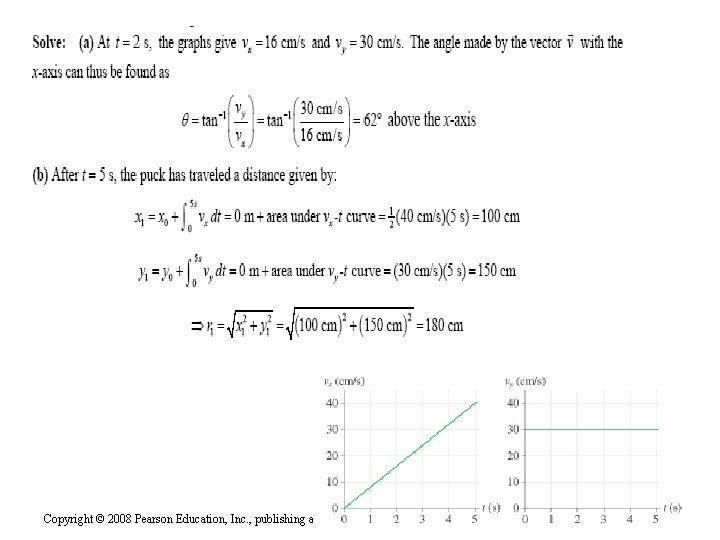
A rocket-powered hockey puck moves on a frictionless horizontal table. It starts at the origin. At t=5 s, vx = 40 cm/s. a. In which direction is the puck moving at t = 2 s? Give your answer as an angle from the x-axis. b. How far from the origin is the puck at t = 5 s? Copyright © 2008 Pearson Education, Inc. , publishing as Pearson Addison-Wesley.
Copyright © 2008 Pearson Education, Inc. , publishing as Pearson Addison-Wesley.
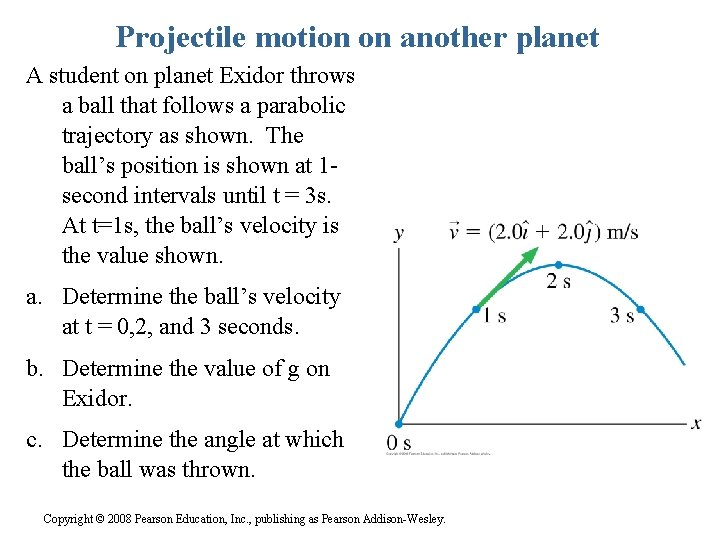
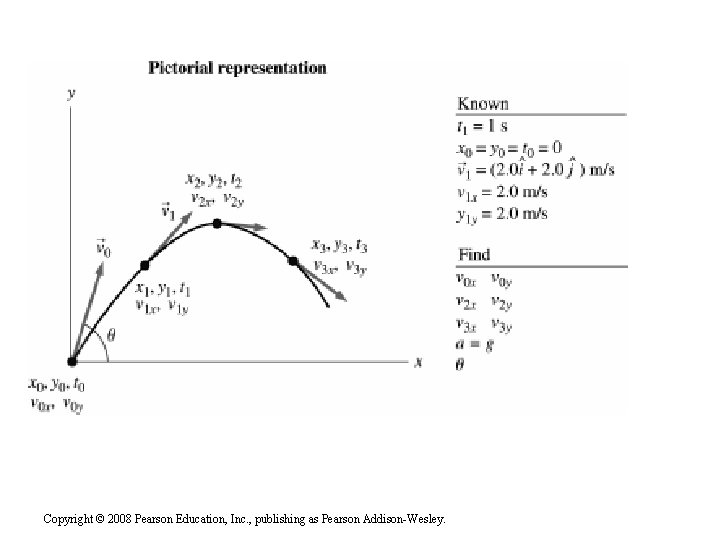
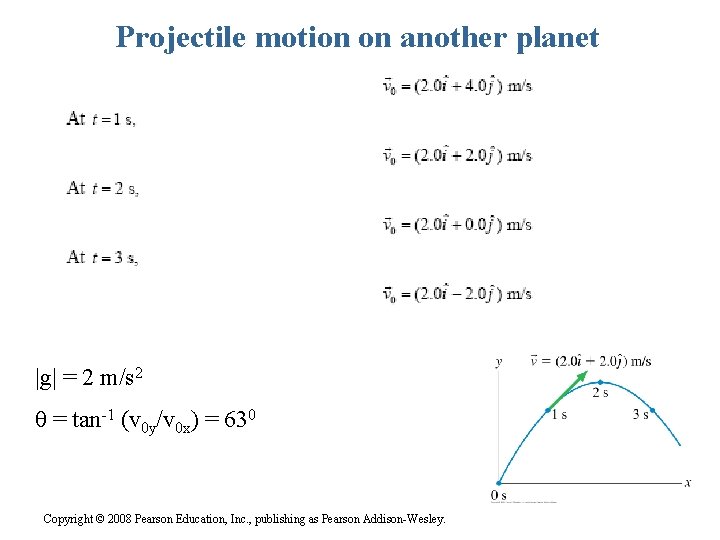
Projectile motion on another planet A student on planet Exidor throws a ball that follows a parabolic trajectory as shown. The ball’s position is shown at 1 second intervals until t = 3 s. At t=1 s, the ball’s velocity is the value shown. a. Determine the ball’s velocity at t = 0, 2, and 3 seconds. b. Determine the value of g on Exidor. c. Determine the angle at which the ball was thrown. Copyright © 2008 Pearson Education, Inc. , publishing as Pearson Addison-Wesley.
Copyright © 2008 Pearson Education, Inc. , publishing as Pearson Addison-Wesley.
Projectile motion on another planet |g| = 2 m/s 2 θ = tan-1 (v 0 y/v 0 x) = 630 Copyright © 2008 Pearson Education, Inc. , publishing as Pearson Addison-Wesley.
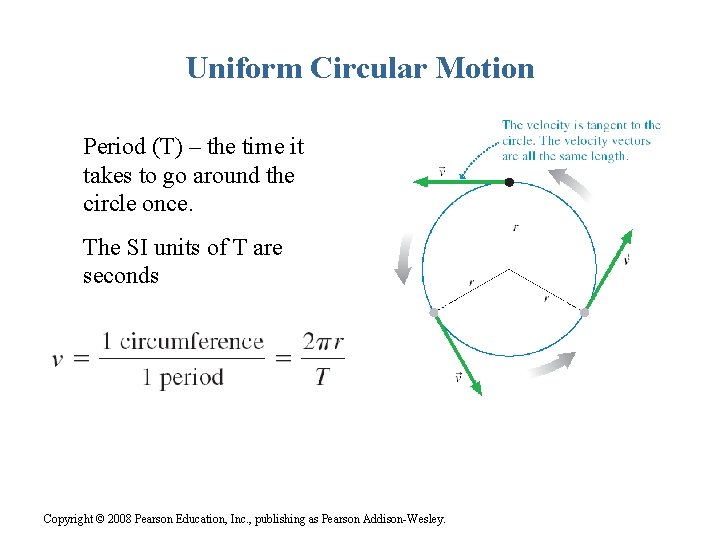
Uniform Circular Motion Period (T) – the time it takes to go around the circle once. The SI units of T are seconds Copyright © 2008 Pearson Education, Inc. , publishing as Pearson Addison-Wesley.
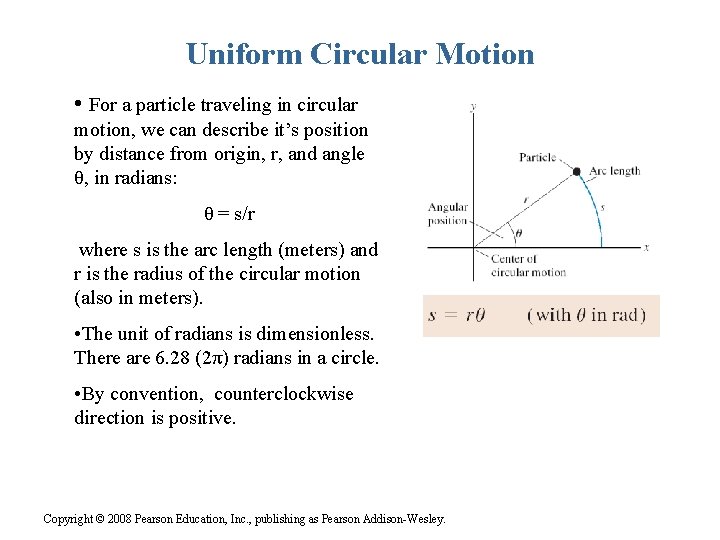
Uniform Circular Motion • For a particle traveling in circular motion, we can describe it’s position by distance from origin, r, and angle θ, in radians: θ = s/r where s is the arc length (meters) and r is the radius of the circular motion (also in meters). • The unit of radians is dimensionless. There are 6. 28 (2π) radians in a circle. • By convention, counterclockwise direction is positive. Copyright © 2008 Pearson Education, Inc. , publishing as Pearson Addison-Wesley.
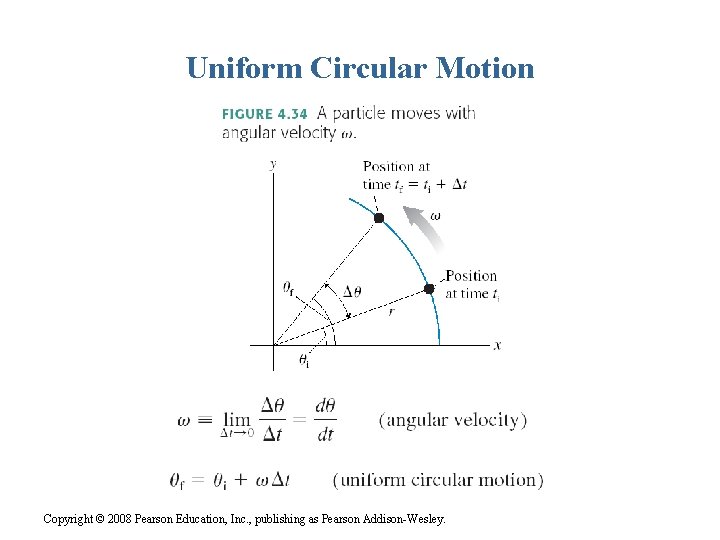
Uniform Circular Motion Copyright © 2008 Pearson Education, Inc. , publishing as Pearson Addison-Wesley.
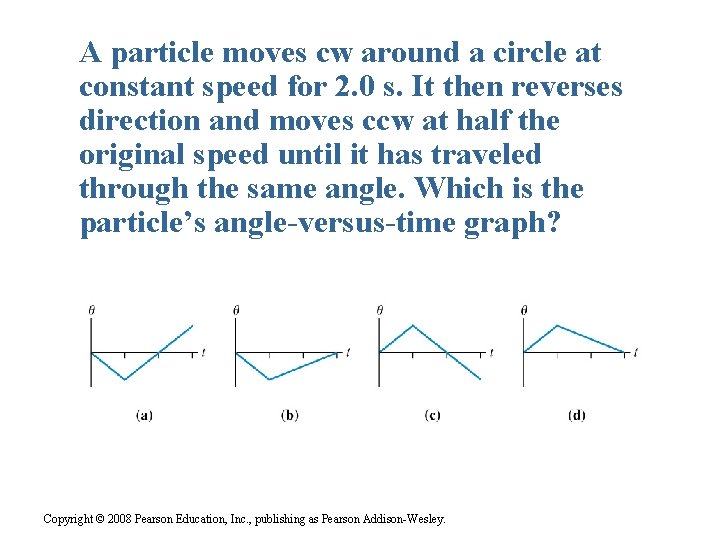
A particle moves cw around a circle at constant speed for 2. 0 s. It then reverses direction and moves ccw at half the original speed until it has traveled through the same angle. Which is the particle’s angle-versus-time graph? Copyright © 2008 Pearson Education, Inc. , publishing as Pearson Addison-Wesley.
A particle moves cw around a circle at constant speed for 2. 0 s. It then reverses direction and moves ccw at half the original speed until it has traveled through the same angle. Which is the particle’s angle-versus-time graph? Copyright © 2008 Pearson Education, Inc. , publishing as Pearson Addison-Wesley.
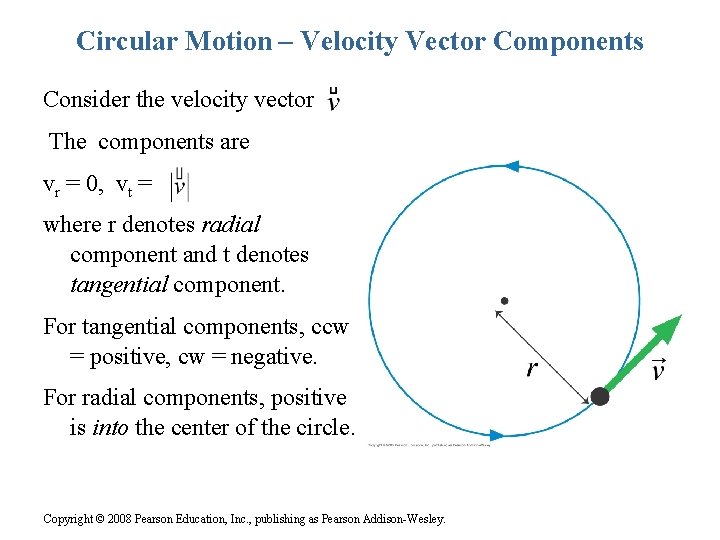
Circular Motion – Velocity Vector Components Consider the velocity vector The components are vr = 0, vt = where r denotes radial component and t denotes tangential component. For tangential components, ccw = positive, cw = negative. For radial components, positive is into the center of the circle. Copyright © 2008 Pearson Education, Inc. , publishing as Pearson Addison-Wesley.
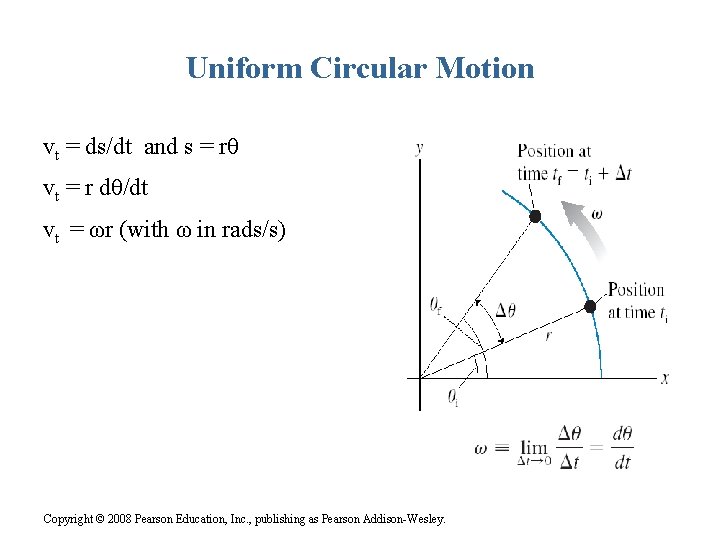
Uniform Circular Motion vt = ds/dt and s = rθ vt = r dθ/dt vt = ωr (with ω in rads/s) Copyright © 2008 Pearson Education, Inc. , publishing as Pearson Addison-Wesley.
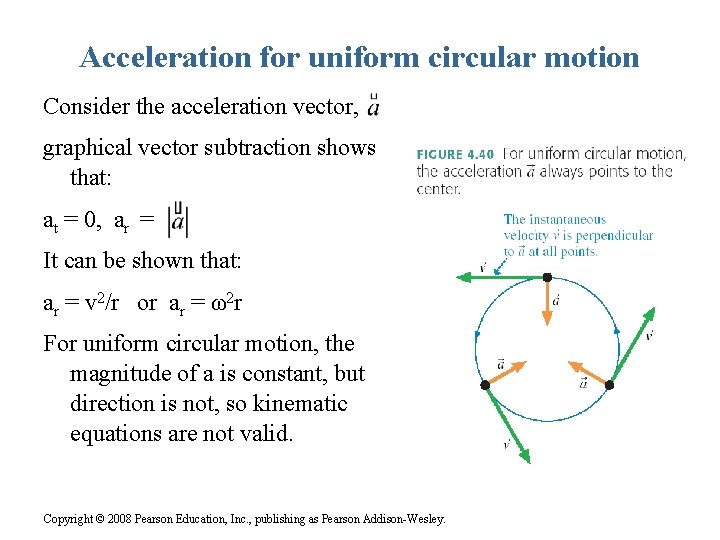
Acceleration for uniform circular motion Consider the acceleration vector, graphical vector subtraction shows that: at = 0, ar = It can be shown that: ar = v 2/r or ar = ω2 r For uniform circular motion, the magnitude of a is constant, but direction is not, so kinematic equations are not valid. Copyright © 2008 Pearson Education, Inc. , publishing as Pearson Addison-Wesley.
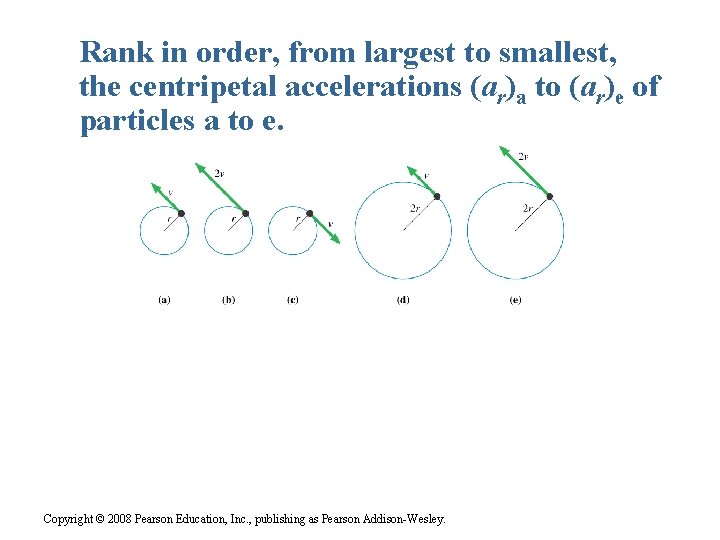
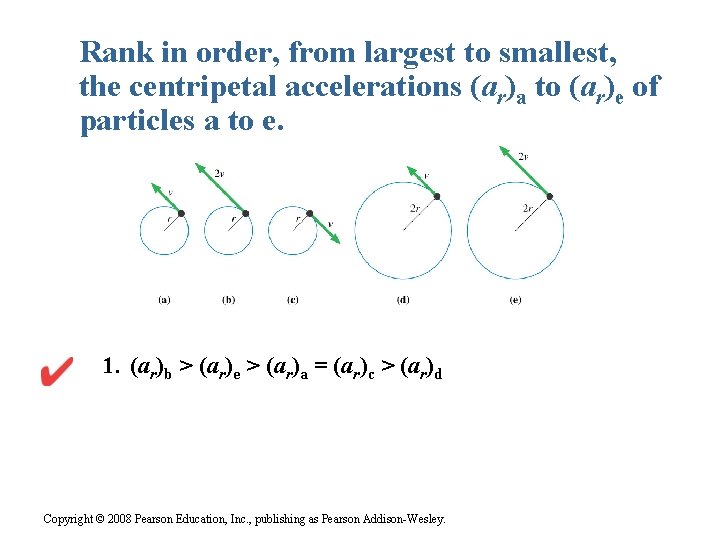
Rank in order, from largest to smallest, the centripetal accelerations (ar)a to (ar)e of particles a to e. Copyright © 2008 Pearson Education, Inc. , publishing as Pearson Addison-Wesley.
Rank in order, from largest to smallest, the centripetal accelerations (ar)a to (ar)e of particles a to e. 1. (ar)b > (ar)e > (ar)a = (ar)c > (ar)d Copyright © 2008 Pearson Education, Inc. , publishing as Pearson Addison-Wesley.
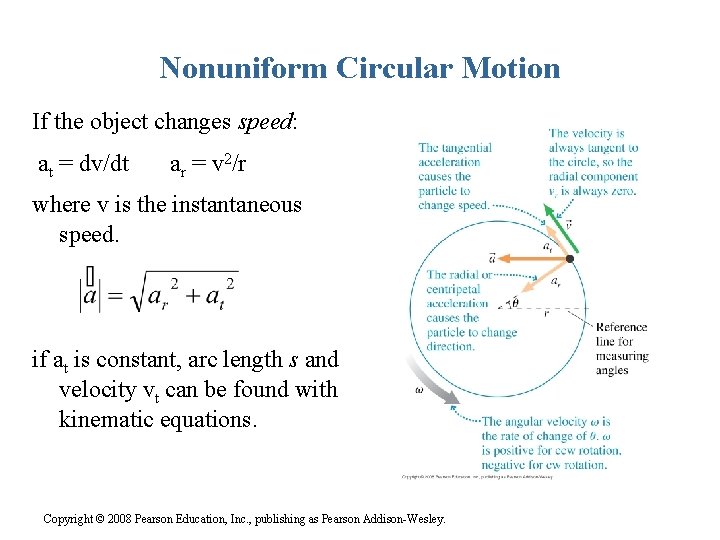
Nonuniform Circular Motion If the object changes speed: at = dv/dt ar = v 2/r where v is the instantaneous speed. if at is constant, arc length s and velocity vt can be found with kinematic equations. Copyright © 2008 Pearson Education, Inc. , publishing as Pearson Addison-Wesley.
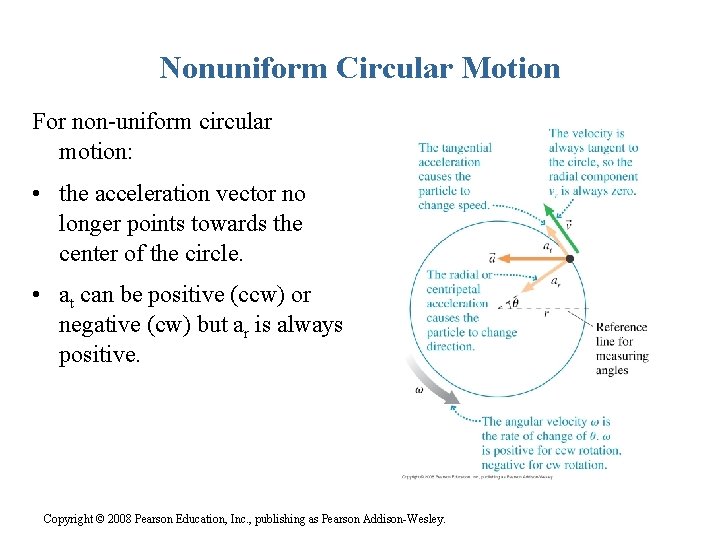
Nonuniform Circular Motion For non-uniform circular motion: • the acceleration vector no longer points towards the center of the circle. • at can be positive (ccw) or negative (cw) but ar is always positive. Copyright © 2008 Pearson Education, Inc. , publishing as Pearson Addison-Wesley.
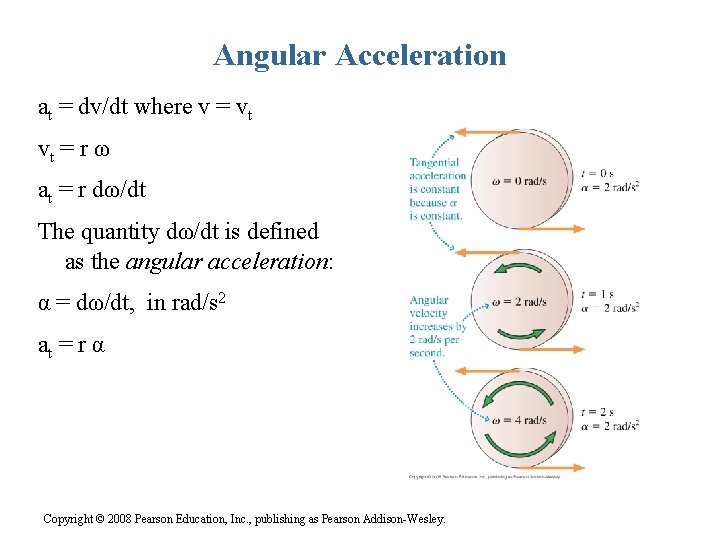
Angular Acceleration at = dv/dt where v = vt vt = r ω at = r dω/dt The quantity dω/dt is defined as the angular acceleration: α = dω/dt, in rad/s 2 at = r α Copyright © 2008 Pearson Education, Inc. , publishing as Pearson Addison-Wesley.
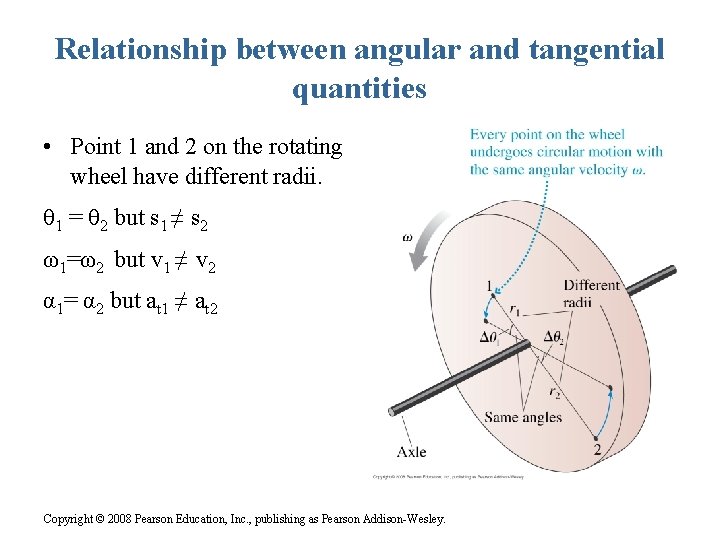
Relationship between angular and tangential quantities • Point 1 and 2 on the rotating wheel have different radii. θ 1 = θ 2 but s 1 ≠ s 2 ω1=ω2 but v 1 ≠ v 2 α 1= α 2 but at 1 ≠ at 2 Copyright © 2008 Pearson Education, Inc. , publishing as Pearson Addison-Wesley.
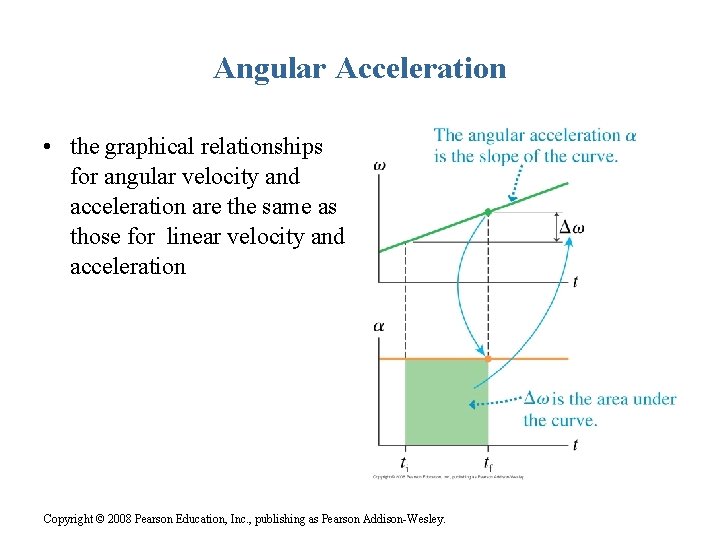
Angular Acceleration • the graphical relationships for angular velocity and acceleration are the same as those for linear velocity and acceleration Copyright © 2008 Pearson Education, Inc. , publishing as Pearson Addison-Wesley.
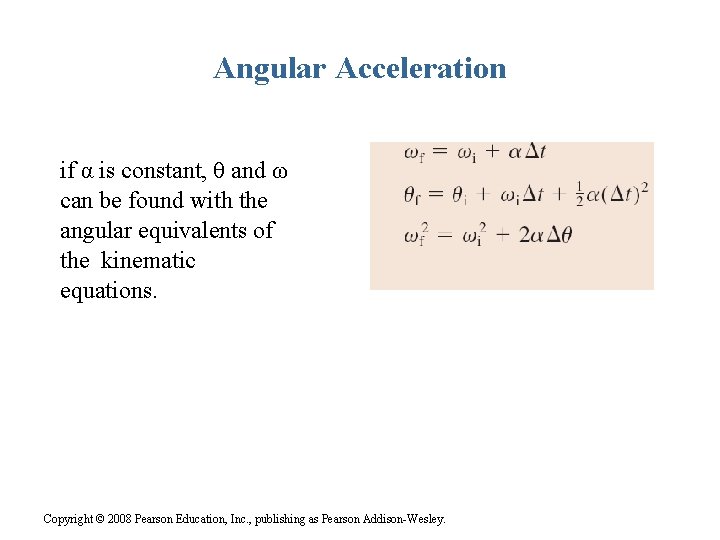
Angular Acceleration if α is constant, θ and ω can be found with the angular equivalents of the kinematic equations. Copyright © 2008 Pearson Education, Inc. , publishing as Pearson Addison-Wesley.
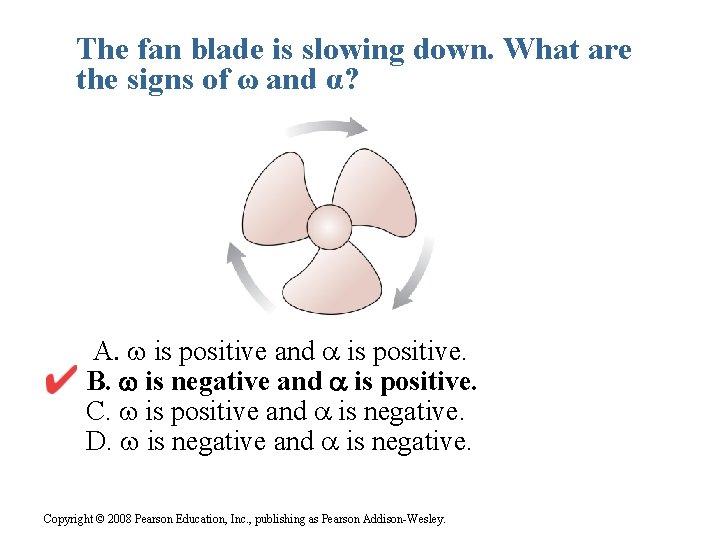
The fan blade is slowing down. What are the signs of ω and α? is positive and is positive. B. is negative and is positive. C. is positive and is negative. D. is negative and is negative. Copyright © 2008 Pearson Education, Inc. , publishing as Pearson Addison-Wesley.
The fan blade is slowing down. What are the signs of ω and α? is positive and is positive. B. is negative and is positive. C. is positive and is negative. D. is negative and is negative. Copyright © 2008 Pearson Education, Inc. , publishing as Pearson Addison-Wesley.
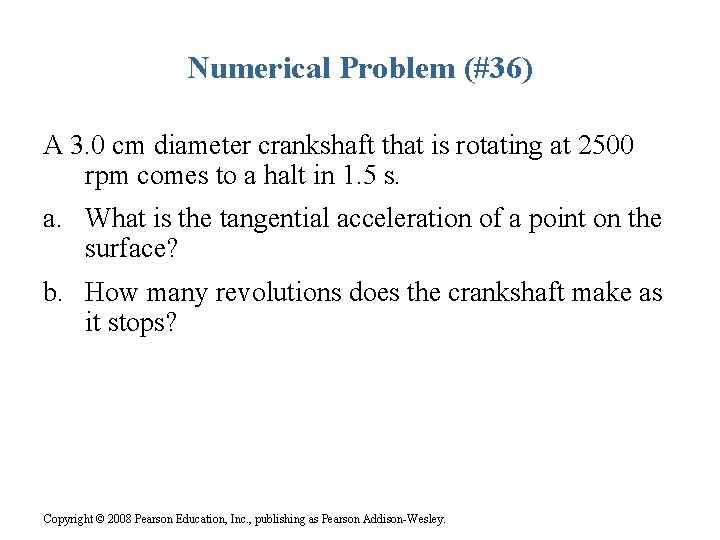
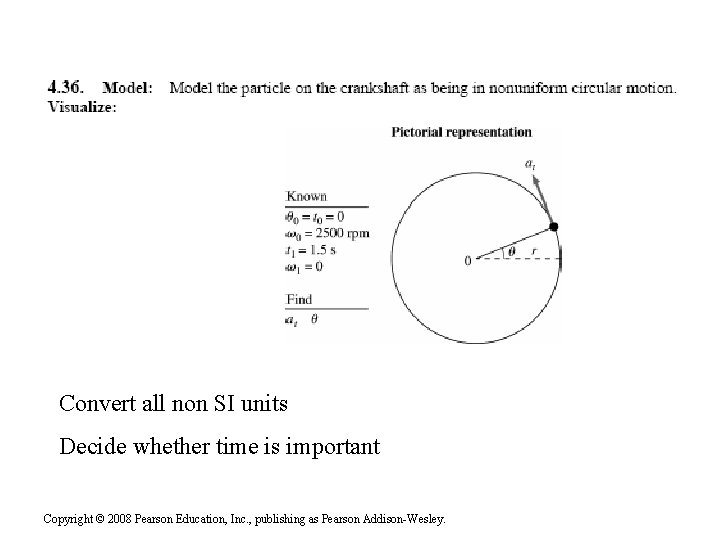
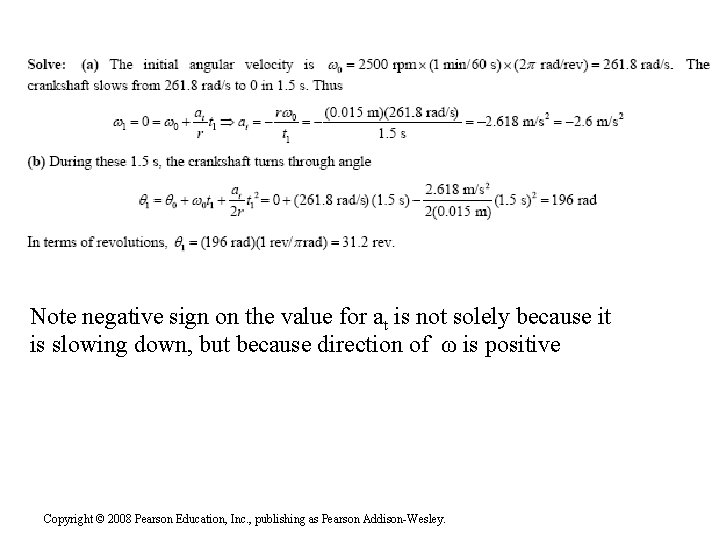
Numerical Problem (#36) A 3. 0 cm diameter crankshaft that is rotating at 2500 rpm comes to a halt in 1. 5 s. a. What is the tangential acceleration of a point on the surface? b. How many revolutions does the crankshaft make as it stops? Copyright © 2008 Pearson Education, Inc. , publishing as Pearson Addison-Wesley.
Convert all non SI units Decide whether time is important Copyright © 2008 Pearson Education, Inc. , publishing as Pearson Addison-Wesley.
Note negative sign on the value for at is not solely because it is slowing down, but because direction of ω is positive Copyright © 2008 Pearson Education, Inc. , publishing as Pearson Addison-Wesley.