
Chapter 4 Job Analysis SHRM Nature of Job
Chapter 4: Job Analysis SHRM (學分班)
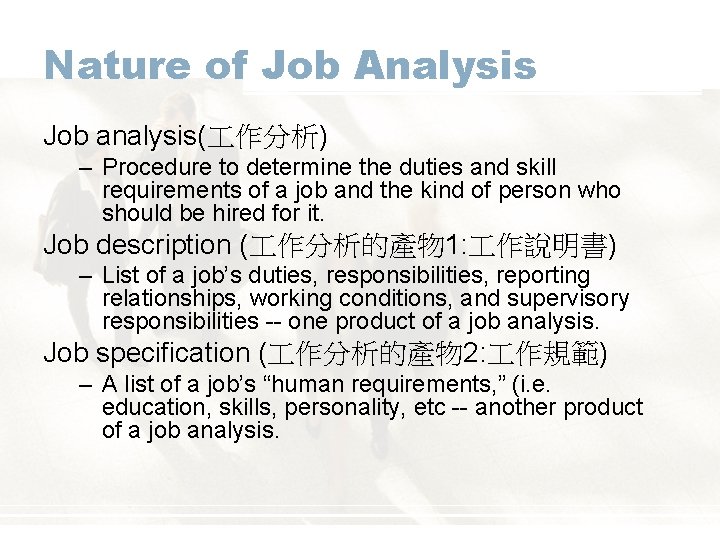
Nature of Job Analysis Job analysis( 作分析) – Procedure to determine the duties and skill requirements of a job and the kind of person who should be hired for it. Job description ( 作分析的產物 1: 作說明書) – List of a job’s duties, responsibilities, reporting relationships, working conditions, and supervisory responsibilities -- one product of a job analysis. Job specification ( 作分析的產物 2: 作規範) – A list of a job’s “human requirements, ” (i. e. education, skills, personality, etc -- another product of a job analysis.
Types of Information Collected • Work activities 作活動 • Human behaviors • Machines, tools, equipment, and work aids • Performance standards • Job context 作內涵 • Human requirements
Uses of Job Analysis Information • • • Recruitment and selection Compensation Performance appraisal Training Career Development
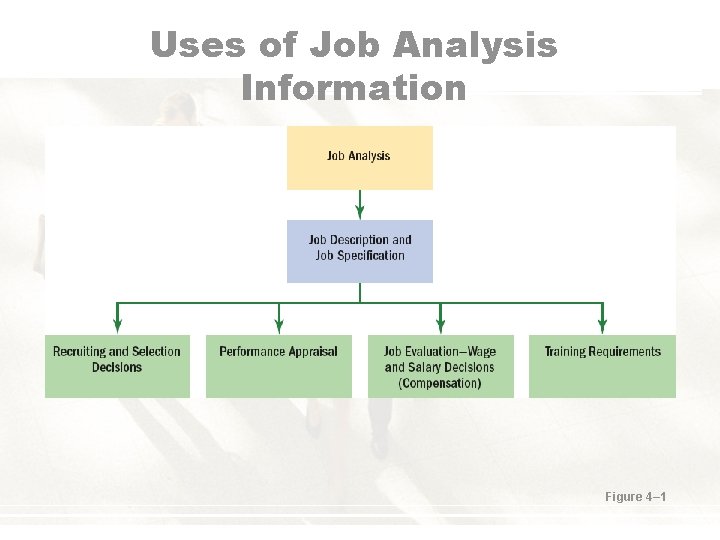
Uses of Job Analysis Information Figure 4– 1

Steps in Job Analysis Step 1: Decide how you will use the information - for writing JD, Qualitative approach - for compensation, quantitative approach Step 2: Review relevant background information - Org. chart, process chart, old job description Step 3: Select representative positions. -? Select the average one, or the exemplar? Step 4: Actually analyze the job.

Charting the Organization chart 組織圖 – A chart that shows the organizationwide distribution of work, with titles of each position and interconnecting lines that show who reports to and communicates to whom. Process chart 作流程圖 – More detailed picture of the work flow. – A work flow chart that shows the flow of inputs to and outputs from a particular job.
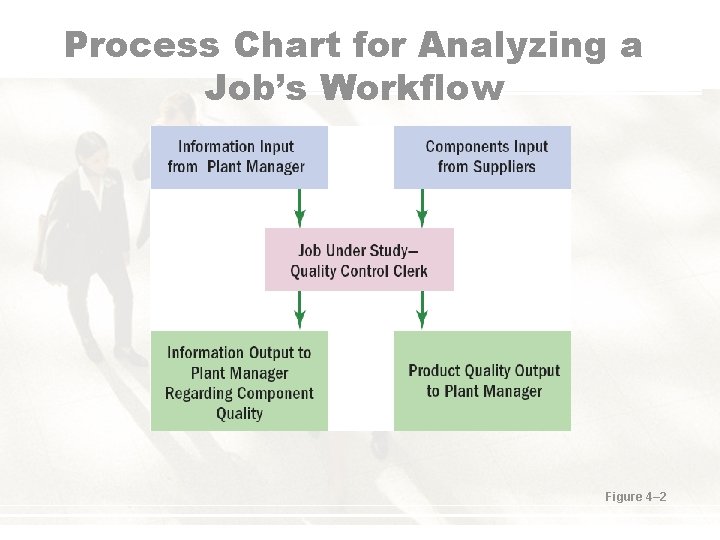
Process Chart for Analyzing a Job’s Workflow Figure 4– 2

Steps in Job Analysis Step 5: Verify the job analysis information. - With the worker & the immediate supervisor. Step 6: Develop a job description and job specification.
Methods of Collecting Job Analysis Information: The Interview 使用得最廣 • Information sources – Individual employees – Groups of employees – Supervisors with knowledge of the job • Advantages – Quick, direct way to find overlooked information. • Disadvantages – Distorted information – (資訊扭曲) • Interview formats – Structured (Checklist) – Unstructured (Fig. 4 -3)
Methods of Collecting Job Analysis Information: Questionnaires • Information source – Have employees fill out questionnaires to describe their jobrelated duties and responsibilities. • Questionnaire formats – Structured checklists – Opened-ended questions • Advantages – Quick and efficient way to gather information from large numbers of employees • Disadvantages – Expense and time consumed in preparing and testing the questionnaire
Methods of Collecting Job Analysis Information: Observation • Information source – Observing and noting the physical activities of employees as they go about their jobs. • Advantages – Provides first-hand information – Reduces distortion of information • Disadvantages – Time consuming – Difficulty in capturing entire job cycle – Of little use if job involves a high level of mental activity.
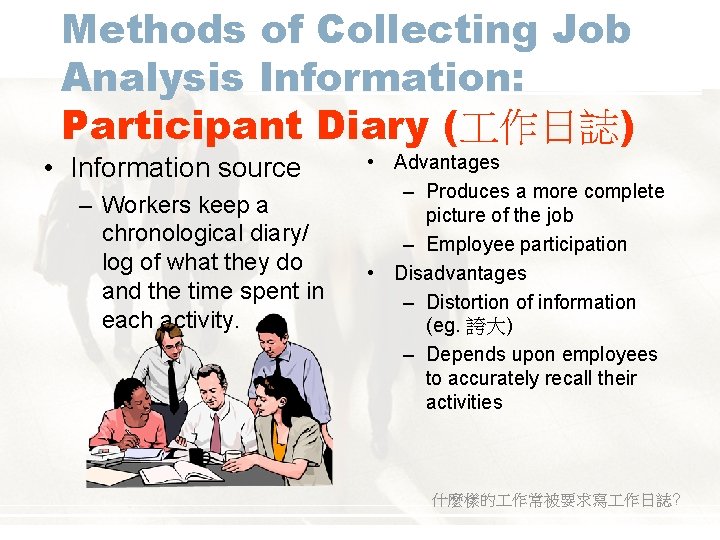
Methods of Collecting Job Analysis Information: Participant Diary ( 作日誌) • Information source – Workers keep a chronological diary/ log of what they do and the time spent in each activity. • Advantages – Produces a more complete picture of the job – Employee participation • Disadvantages – Distortion of information (eg. 誇大) – Depends upon employees to accurately recall their activities 什麼樣的 作常被要求寫 作日誌?

Quantitative Job Analysis Techniques • Position analysis questionnaire (PAQ) – A questionnaire used to collect quantifiable data concerning the duties and responsibilities of various jobs. – Fig. 4 -4 – 194 items, 5 basic activities, www. paq. com – 量化後比較以決定每項 作之薪给水準
Quantitative Job Analysis Techniques • Functional Job Analysis (FJA) 加上以下四個層面分級 – 執行任務所需特定指示(specific instruction)的 程度 – 執行任務所需推論與判斷 (reasoning and judgment)的程度 – 執行任務所需的數理程度(math ability) – 執行任務所需的表達與語言能力(verbal and language)
Writing Job Descriptions Job description – A statement of what the worker actually does, how he or she does it, and what the job’s working conditions are. Sections of a typical job description – Job identification – Job summary – Responsibilities and duties – Authority of incumbent – Standards of performance – Working conditions – Job specifications
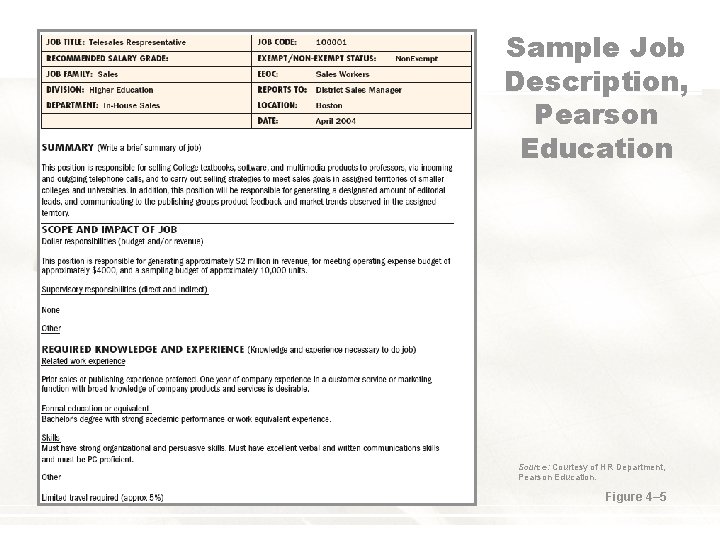
Sample Job Description, Pearson Education Source: Courtesy of HR Department, Pearson Education. Figure 4– 5
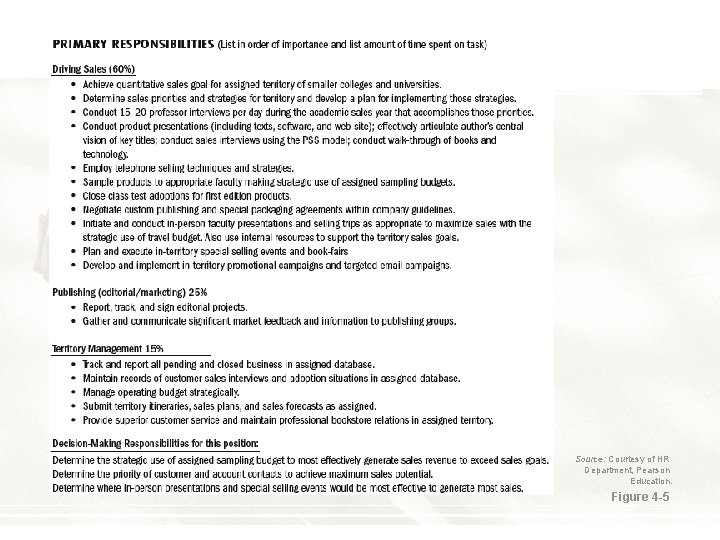
Source: Courtesy of HR Department, Pearson Education. Figure 4 -5
The Job Description (cont) Relationships (chain of command) – Reports to: employee’s immediate supervisor – Supervises: employees that the job incumbent directly supervises – Works with: others with whom the job holder will be expected to work and come into contact with internally. – Outside the company: others with whom the job holder is expected to work and come into contact with externally.
Job Analysis in a “Jobless” World Job – defined as “a set of closely related activities carried out for pay. ”
From Specialized to Enlarged Jobs Job enlargement 作擴大化 – Assign workers additional same level activities, thus increasing the number of activities they perform. Job enrichment 作豐富化 – Redesign jobs in a way that increases the opportunities for the worker to experience feelings of responsibility, achievement, growth, and recognition.
From Specialized to Enlarged Jobs (cont) Job rotation 作輪調 – Move trainees from department to broaden their experience and identify strong and weak points to prepare the person for an enhanced role with the company – Systematically move workers from one job to another to enhance work team performance.
Why Managers Are Dejobbing Their Companies • Dejobbing – Broadening the responsibilities of the company’s jobs – Encouraging employee initiative. • Internal factors leading to dejobbing – Flatter organizations – Work teams • External factors leading to dejobbing. – Rapid product and technological change – Global competition – Deregulation, – Political instability, – Demographic changes – Rise of a service economy.
Competency-Based Job Analysis Competencies – Demonstrable characteristics of a person that enable performance of a job. Competency-based job analysis – Describing a job in terms of the measurable, observable, behavioral competencies (knowledge, skills, and/or behaviors) an employee must exhibit to do a job well.
- Slides: 26