
Chapter 4 Inverse Kinematics ROBOTICS Outline Introduction Solvability
Chapter 4: Inverse Kinematics • • • ROBOTICS Outline: Introduction Solvability Manipulator subspace when n<6 Algebraic vs. Geometric Example: Kinematics of PUMA Robot 1 Faculty of Engineering - Mechanical Engineering Department
Chapter 4: Inverse Kinematics ROBOTICS Introduction: • Direct kinematics: Given the joint angles calculate the position and orientation of the tool {T} relative to the station {S} • Inverse kinematics: Given the desired position and orientation of the tool {T} joint angles that give the desired result? – Find {W} from {T}; Find {B} from {S}; – Solve for joint angles Faculty of Engineering - Mechanical Engineering Department 2
Chapter 4: Inverse Kinematics Solvability: • Nonlinear problem: solve values of • Linear and nonlinear problems? • Ex. : Puma manipulator ROBOTICS to find the 12 values find 12 equations and 6 unknowns, rotation part (r 11 … r 33), only 3 independent Faculty of Engineering - Mechanical Engineering Department 3
Chapter 4: Inverse Kinematics Solvability: • Nonlinear problem: solve values of • Linear and nonlinear problems? • Ex. : Puma manipulator ROBOTICS to find the 12 values find 12 equations and 6 unknowns, rotation part (r 11 … r 33), only 3 independent Faculty of Engineering - Mechanical Engineering Department 4
Chapter 4: Inverse Kinematics ROBOTICS Solvability: 3 independent equations for the orientation and 3 independent equations for the position Nonlinear equations that are difficult to solve. – Note that these were for simple links α = 0, 90, -90, … and many (d & a) = 0. – General case (α, d, & a) have other nonzero values More complex case. We must concern on – Existence of solution? – Multiple solutions? – Method of solution? Faculty of Engineering - Mechanical Engineering Department 5
Chapter 4: Inverse Kinematics ROBOTICS Solvability: (Existence of solution) • Existence of solution Existence or nonexistence of a solution defines the workspace of the manipulator. • Workspace (W. S. ): (Figure) – The volume of the space that the E. E. of the robot can reach. – A solution to exist the desired position & orientation (goal) must lie in the W. S. • Two types of workspaces: – Dextrous W. S. : volume of the W. S. in which the E. E. can reach with all the orientations. – Reachable W. S. : volume of the W. S. in which the E. E. can reach in 6 at least one orientation. Dextrous W. S. is a subset of the reachable W. S. Faculty of Engineering - Mechanical Engineering Department
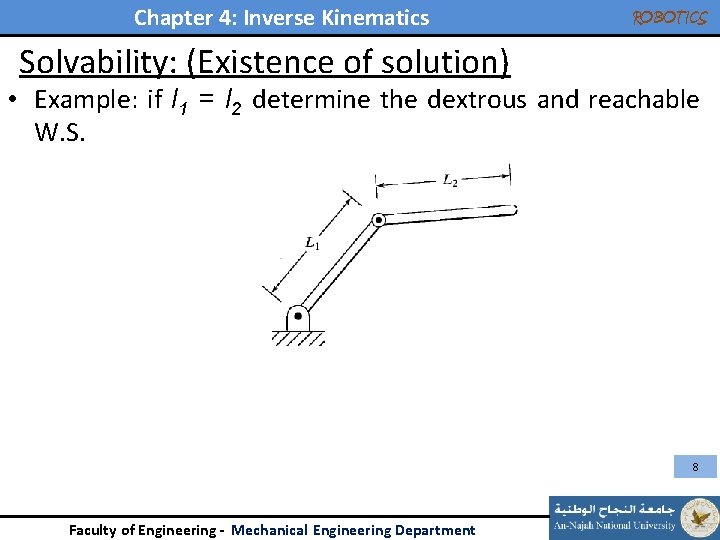
Chapter 4: Inverse Kinematics ROBOTICS Solvability: (Existence of solution) • Example: if l 1 = l 2 determine the dextrous and reachable W. S. 8 Faculty of Engineering - Mechanical Engineering Department
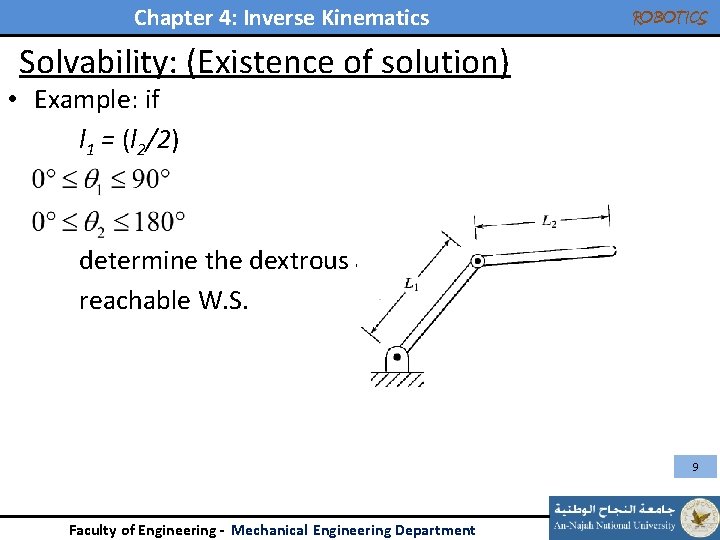
Chapter 4: Inverse Kinematics ROBOTICS Solvability: (Existence of solution) • Example: if l 1 = (l 2/2) determine the dextrous and reachable W. S. 9 Faculty of Engineering - Mechanical Engineering Department

Chapter 4: Inverse Kinematics ROBOTICS Solvability: (Existence of solution) • Factors that affect the W. S. of a robot: – Limitations on joint angles 10 Faculty of Engineering - Mechanical Engineering Department
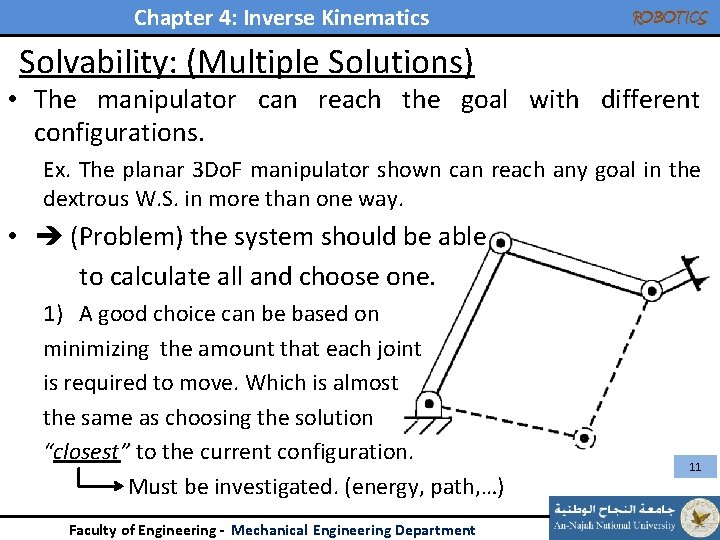
Chapter 4: Inverse Kinematics ROBOTICS Solvability: (Multiple Solutions) • The manipulator can reach the goal with different configurations. Ex. The planar 3 Do. F manipulator shown can reach any goal in the dextrous W. S. in more than one way. • (Problem) the system should be able to calculate all and choose one. 1) A good choice can be based on minimizing the amount that each joint is required to move. Which is almost the same as choosing the solution “closest” to the current configuration. Must be investigated. (energy, path, …) Faculty of Engineering - Mechanical Engineering Department 11
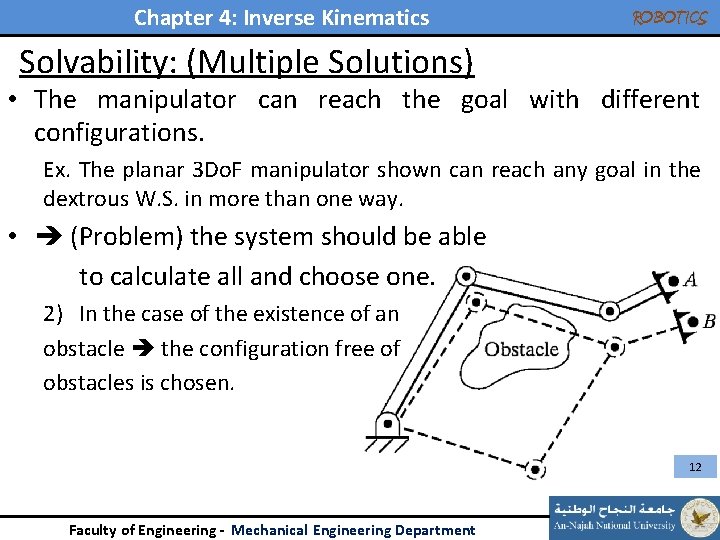
Chapter 4: Inverse Kinematics ROBOTICS Solvability: (Multiple Solutions) • The manipulator can reach the goal with different configurations. Ex. The planar 3 Do. F manipulator shown can reach any goal in the dextrous W. S. in more than one way. • (Problem) the system should be able to calculate all and choose one. 2) In the case of the existence of an obstacle the configuration free of obstacles is chosen. 12 Faculty of Engineering - Mechanical Engineering Department
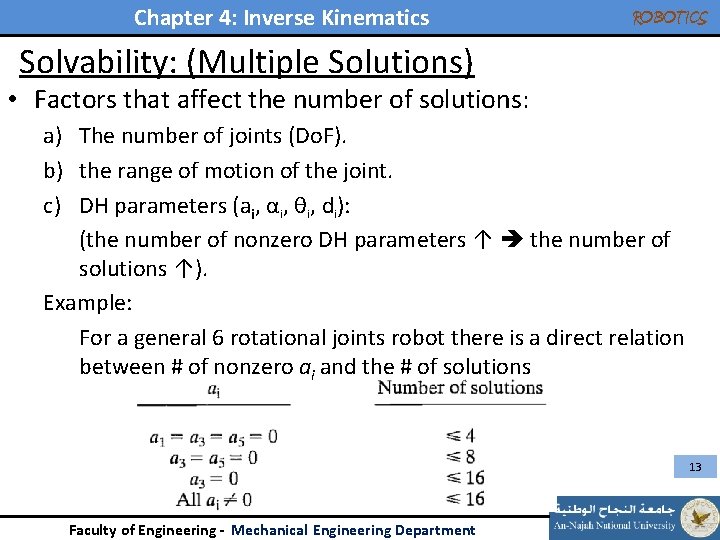
Chapter 4: Inverse Kinematics ROBOTICS Solvability: (Multiple Solutions) • Factors that affect the number of solutions: a) The number of joints (Do. F). b) the range of motion of the joint. c) DH parameters (ai, αi, θi, di): (the number of nonzero DH parameters ↑ the number of solutions ↑). Example: For a general 6 rotational joints robot there is a direct relation between # of nonzero ai and the # of solutions 13 Faculty of Engineering - Mechanical Engineering Department
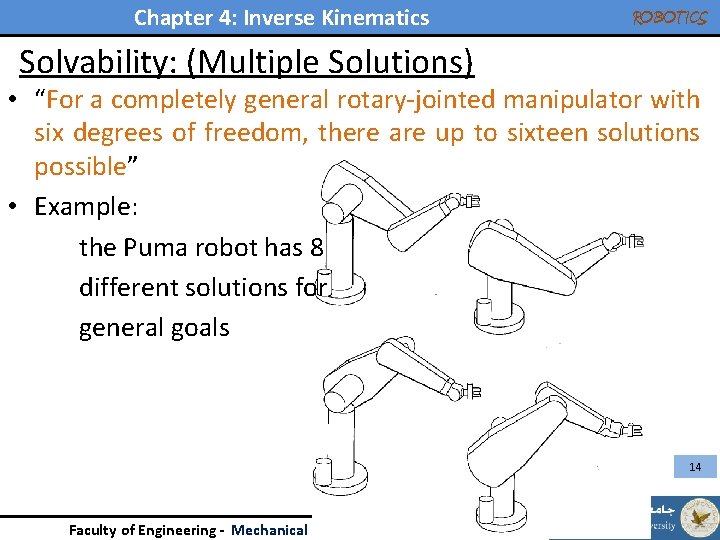
Chapter 4: Inverse Kinematics ROBOTICS Solvability: (Multiple Solutions) • “For a completely general rotary-jointed manipulator with six degrees of freedom, there are up to sixteen solutions possible” • Example: the Puma robot has 8 different solutions for general goals 14 Faculty of Engineering - Mechanical Engineering Department
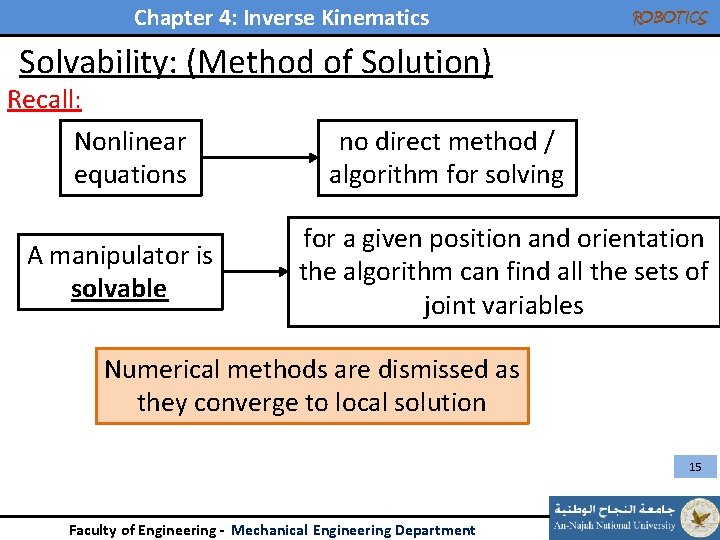
Chapter 4: Inverse Kinematics ROBOTICS Solvability: (Method of Solution) Recall: Nonlinear equations A manipulator is solvable no direct method / algorithm for solving for a given position and orientation the algorithm can find all the sets of joint variables Numerical methods are dismissed as they converge to local solution 15 Faculty of Engineering - Mechanical Engineering Department
Chapter 4: Inverse Kinematics ROBOTICS Solvability: (Method of Solution) • Two types of solutions: – Closed form solutions – Numerical solutions: 16 Faculty of Engineering - Mechanical Engineering Department
Chapter 4: Inverse Kinematics ROBOTICS Solvability: (Method of Solution) • Two types of solutions: – Closed form solutions – Numerical solutions: • Iterative much slower • Need initial guess • Converge to local solutions 17 Faculty of Engineering - Mechanical Engineering Department
Chapter 4: Inverse Kinematics ROBOTICS Solvability: (Method of Solution) • Two types of solutions: – Closed form solutions – Numerical solutions: • Iterative much slower • Need initial guess • Converge to local solutions Out of our scope 18 Faculty of Engineering - Mechanical Engineering Department
Chapter 4: Inverse Kinematics ROBOTICS Solvability: (Method of Solution) • Two types of solutions: – Closed form solutions: Solution method based on analytic expressions or on the solution of four degrees polynomial or less (no need for iterative methods to reach a solution). – all systems with revolute and prismatic joints having a total of a six Do. F in a single series chain are now solvable (numerically). – Analytical solution is for special cases only: • Several intersecting joint axes • Many i equal to zero or 90 – Closed form solution for the robot is a very important designer objective! 19 Faculty of Engineering - Mechanical Engineering Department
Chapter 4: Inverse Kinematics ROBOTICS Solvability: (Method of Solution) • Two types of solutions: – Closed form solutions: A condition for closed form solution of a six rev. joints robot is that three consecutive joint axes intersect at a point (most of the new robots). Pieper presented an approach for solving the inverse kinematic of a robot of such condition. See the book for more information. 20 Faculty of Engineering - Mechanical Engineering Department
- Slides: 19