
Chapter 4 Introduction to Automation Kanchala Sudtachat Contents
- Slides: 33
Chapter 4 Introduction to Automation Kanchala Sudtachat
Contents l l l Basic elements of an automated system Advanced automation function Levels of automation
Defining l l l Automation is the technology by which a process or procedure is accomplished without human assistance. It is implemented using a program of instructions combined with a control system that executes the instructions. ����������� “power” �������������
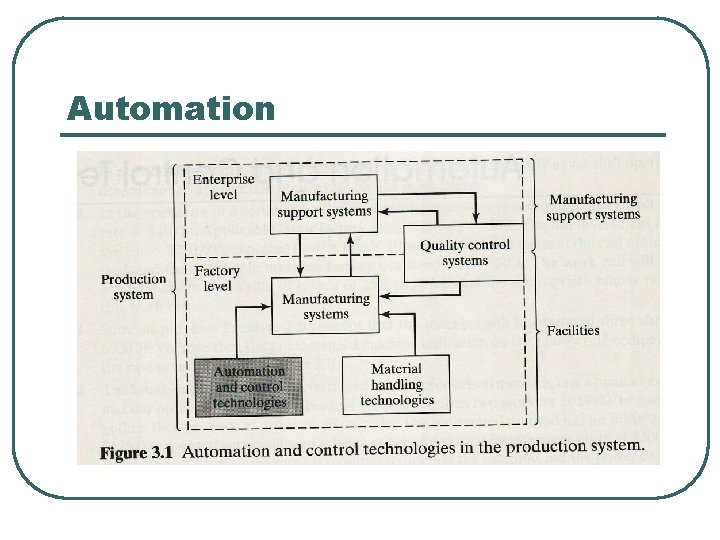
Automation
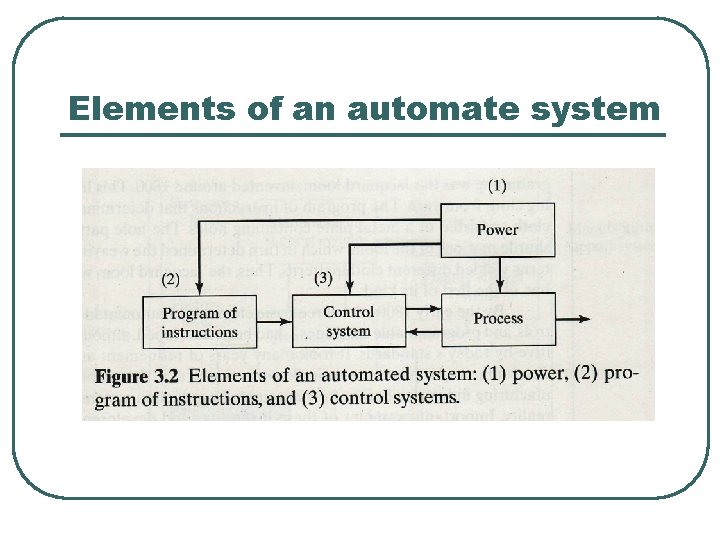
Basic elements of an automated system 1. 2. 3. Power to accomplish the process and operate the system. A program of instructions to direct the process. A control system to actuate the instruction
Elements of an automate system
Power to accomplish the automated process l l l Power for the process: the power source for each operation is usually converted from electricity. Other power for automation: fossil fuels, solar energy, water and wind. Power sources are used to drive the process itself, electrical power is used for the controls that automate the operation.
Power to accomplish the automated process l l Process �������������� work unit Power is required for the following material handling function • Loading and unloading the work unit. • Material transport between operation.
Power to accomplish the automated process (cont(. l Power for Automation: power is used for the following functions: • Controller unit • Power to actuate the control signals • Data acquisition and information processing: ���������� (process) ��������������������
Program of Instruction l l Work cycle program: Ex. single process parameter: Maintain the temperature of a furnace at designated value for the duration of a heat treatment cycle. The single-step process is defined by more than one process parameter. Ex. Both temperature and atmosphere are controlled.
Ex 4. 1 An Automated Turning Operation l The work cycle consists of the following steps: (1) load starting workpiece, (2) position cutting tool prior to turning, (3) turn, (4) reposition tool to a safe location at end of turning, and (5) unload finished workpiece. Identify the activity and process parameter in each step of the operation.
Decision-Making l Decision-Making in the programmed work cycle • Operator interaction • Ex ��������������� • Different part or product styles processed by the system • Ex �������� robot ����� body ��� car ����������
Work cycle l ��������������������� ����� • Number of steps in work cycle • ����������� work cycle �������� • ����������� discrete production ���� (1) load (2) process (3) unload • Manual participation in the work cycle
Work cycle • Manual participation in the work cycle ���������� work cycle • Process parameters • ������� process parameter ������������������� parameter • ������� continuous ���� discrete • ����������
Work cycle • Operator interaction • �������������� work cycle ������� • Variations in part or product styles • ������������� work cycle ������� • ������� mass production (fix automation), batch production (programmable automation) ���� different part / product styles (flexible automation)
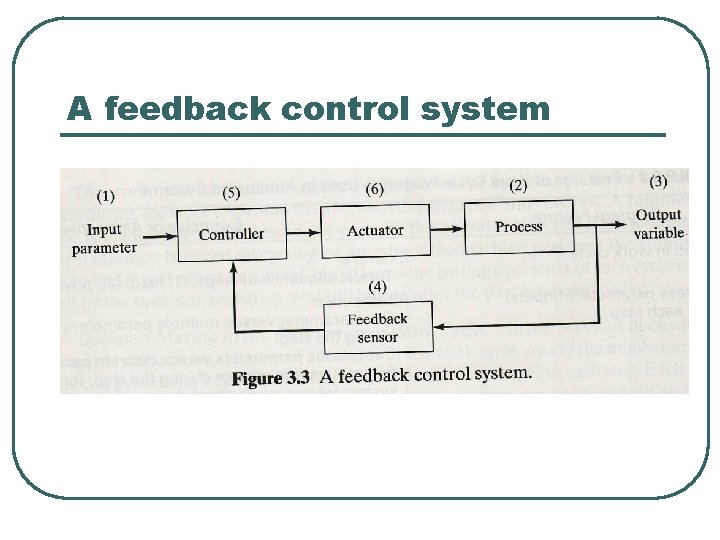
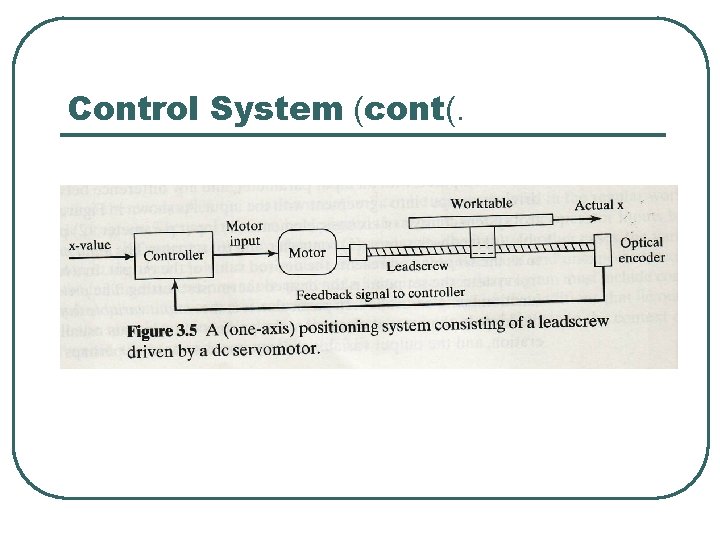
Control System l l l A closed loop control system, also know as a feedback control system, is one in which the output variable is compared with an input parameter. Consists of six basic elements (1) input parameter, (2) process, (3) output variable, (4) feedback sensor, (5) controller and (6) actuator
A feedback control system
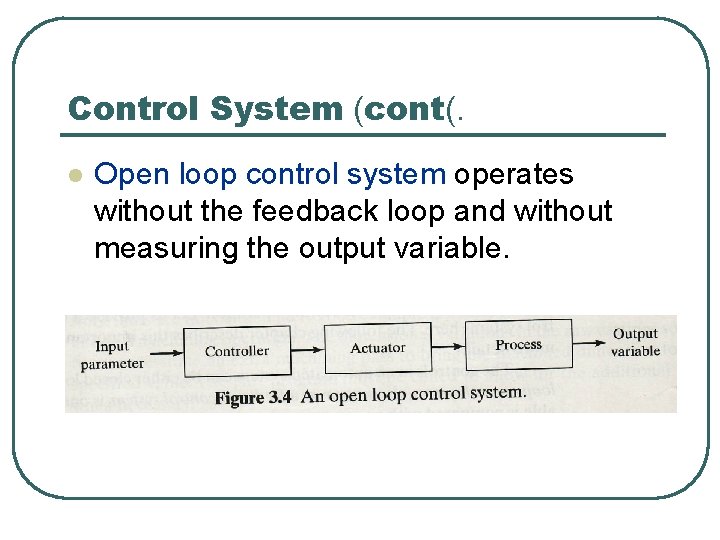
Control System (cont(. l Open loop control system operates without the feedback loop and without measuring the output variable.
Control System (cont(. l Open loop control system usually appropriate when the following conditions apply: 1. The actions per formed by control system are simple. 2. The actuating function is very reliable 3. Any reaction force opposing the actuation are small enough to have no effect on the actuation
Control System (cont(.
Advanced Automation Functions l l �������������������� work cycle �������������������� safety, performance of equipment ���������� • • • Safety Monitoring Maintenance and repair diagnostics Error detecting and recovery
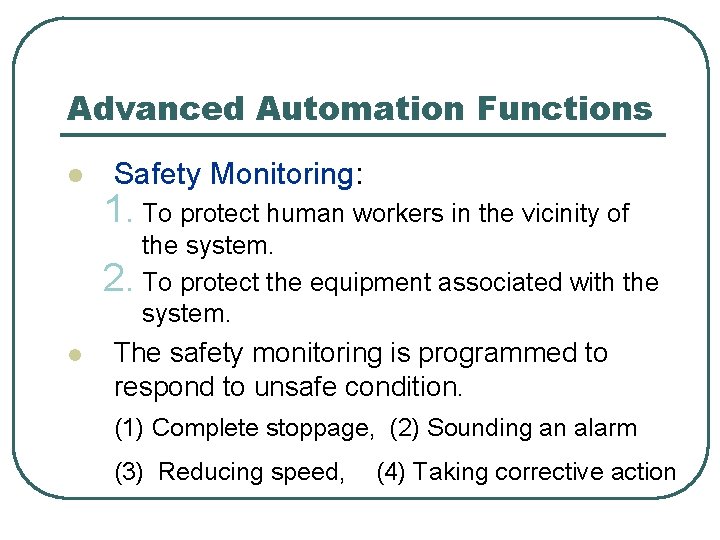
Advanced Automation Functions l Safety Monitoring: 1. To protect human workers in the vicinity of the system. 2. To protect the equipment associated with the system. l The safety monitoring is programmed to respond to unsafe condition. (1) Complete stoppage, (2) Sounding an alarm (3) Reducing speed, (4) Taking corrective action
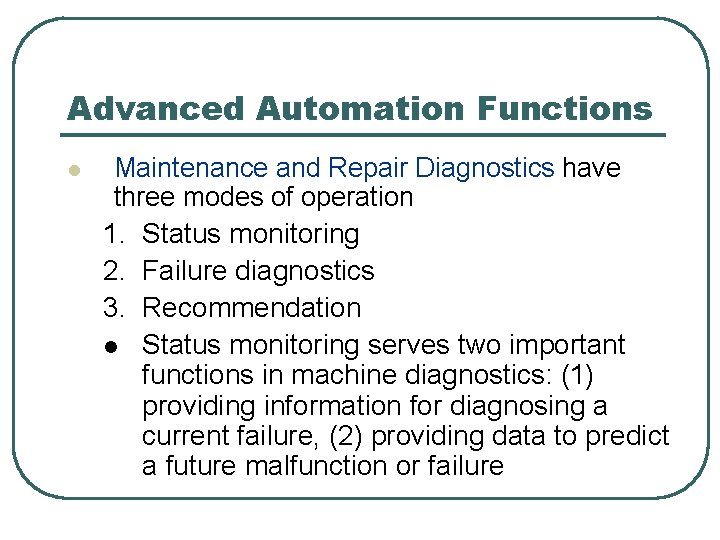
Advanced Automation Functions l Maintenance and Repair Diagnostics have three modes of operation 1. Status monitoring 2. Failure diagnostics 3. Recommendation l Status monitoring serves two important functions in machine diagnostics: (1) providing information for diagnosing a current failure, (2) providing data to predict a future malfunction or failure
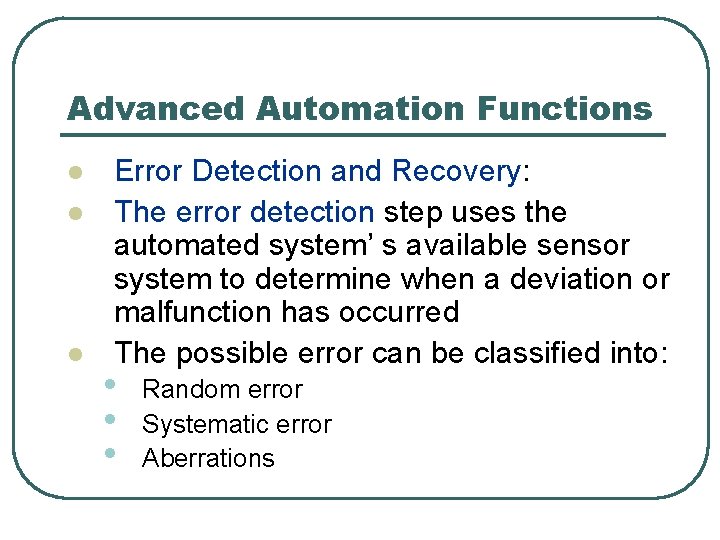
Advanced Automation Functions l l l Error Detection and Recovery: The error detection step uses the automated system’ s available sensor system to determine when a deviation or malfunction has occurred The possible error can be classified into: • • • Random error Systematic error Aberrations
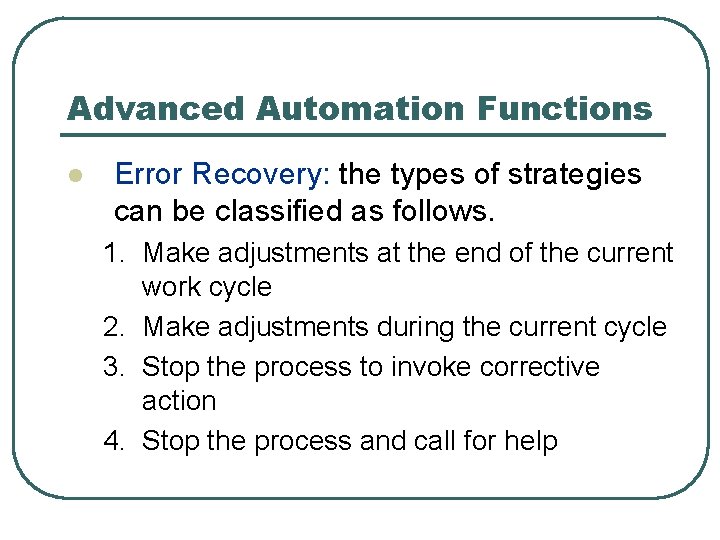
Advanced Automation Functions l Error Recovery: the types of strategies can be classified as follows. 1. Make adjustments at the end of the current work cycle 2. Make adjustments during the current cycle 3. Stop the process to invoke corrective action 4. Stop the process and call for help
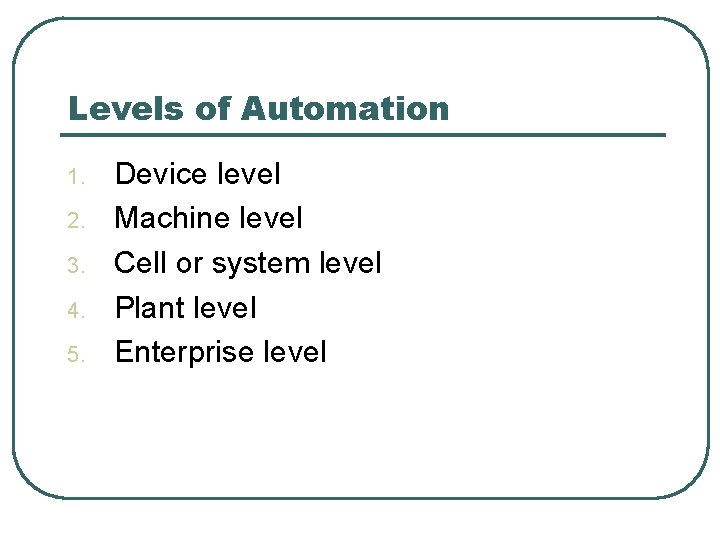
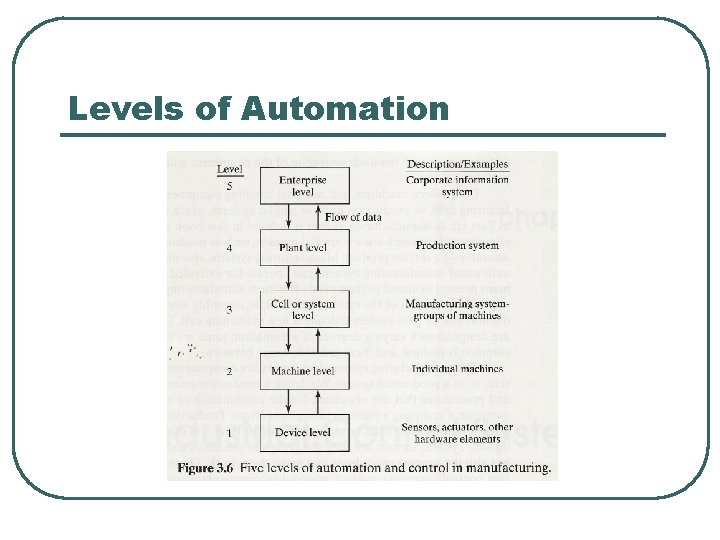
Levels of Automation 1. 2. 3. 4. 5. Device level Machine level Cell or system level Plant level Enterprise level
Levels of Automation