
Chapter 4 Internal Scanning Organizational Analysis Prentice Hall
- Slides: 34
Chapter 4 Internal Scanning: Organizational Analysis Prentice Hall, 2002 Chapter 4 Wheelen/Hunger 1
Resource-Based Approach Internal strategic factors: Critical strengths and weaknesses that are likely to determine if the firm will be able to take advantage of opportunities while avoiding threats. Prentice Hall, 2002 Chapter 4 Wheelen/Hunger 2
Resource-Based Approach Resource: An asset, competency, process, skill, or knowledge controlled by the corporation. Prentice Hall, 2002 Chapter 4 Wheelen/Hunger 3
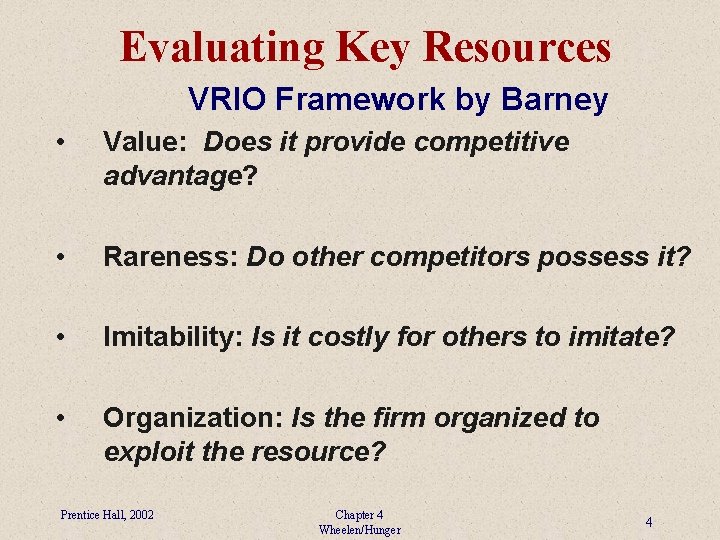
Evaluating Key Resources VRIO Framework by Barney • Value: Does it provide competitive advantage? • Rareness: Do other competitors possess it? • Imitability: Is it costly for others to imitate? • Organization: Is the firm organized to exploit the resource? Prentice Hall, 2002 Chapter 4 Wheelen/Hunger 4
Resource-Based Approach 5 -Step approach by Grant to strategy analysis: • Identify & classify firm’s resources • Strengths & weaknesses • Combine firm’s strengths into capabilities • Core competencies • Distinctive competencies Prentice Hall, 2002 Chapter 4 Wheelen/Hunger 5
Resource-Based Approach 5 -Step approach to strategy analysis: • Profit potential of resources • Sustainable competitive advantage • Select strategy • Exploits firm’s resources relative to external opportunities • Identify resource gaps • Invest in upgrading weaknesses Prentice Hall, 2002 Chapter 4 Wheelen/Hunger 6
Sustainability of an Advantage Durability: Rate at which a firm’s underlying resources and capabilities (core competencies) depreciate or become obsolete. Prentice Hall, 2002 Chapter 4 Wheelen/Hunger 7
Sustainability of an Advantage Imitability: Rate at which a firm’s underlying resources and capabilities (core competencies) can be duplicated by others. Prentice Hall, 2002 Chapter 4 Wheelen/Hunger 8
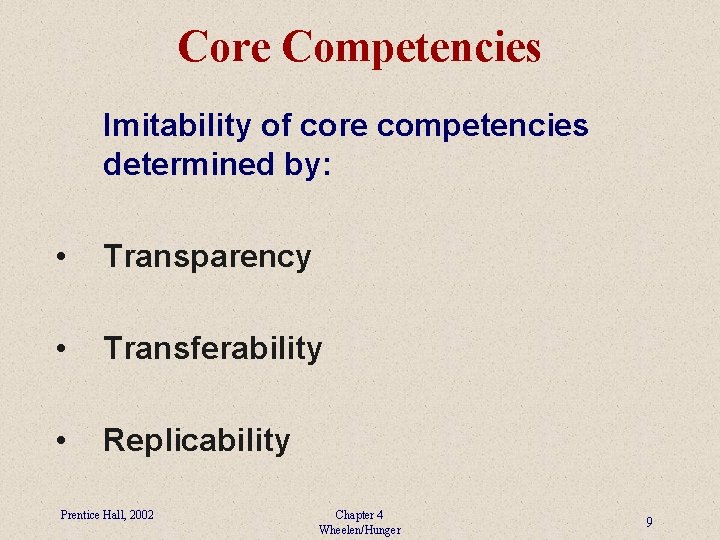
Core Competencies Imitability of core competencies determined by: • Transparency • Transferability • Replicability Prentice Hall, 2002 Chapter 4 Wheelen/Hunger 9
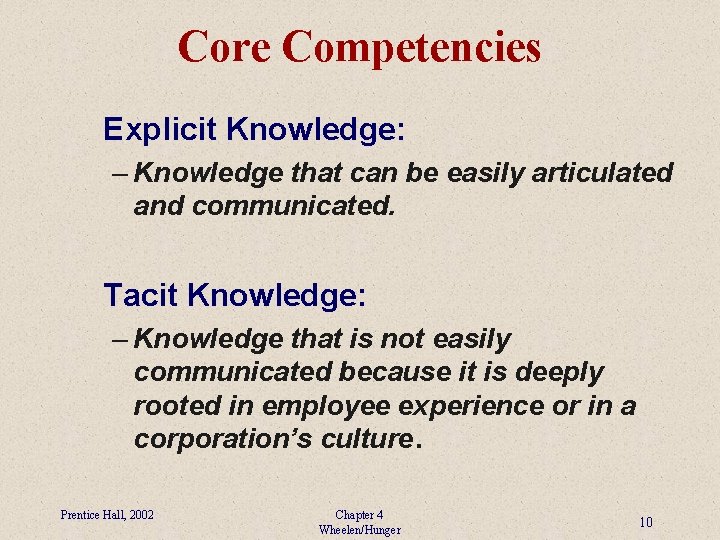
Core Competencies Explicit Knowledge: – Knowledge that can be easily articulated and communicated. Tacit Knowledge: – Knowledge that is not easily communicated because it is deeply rooted in employee experience or in a corporation’s culture. Prentice Hall, 2002 Chapter 4 Wheelen/Hunger 10
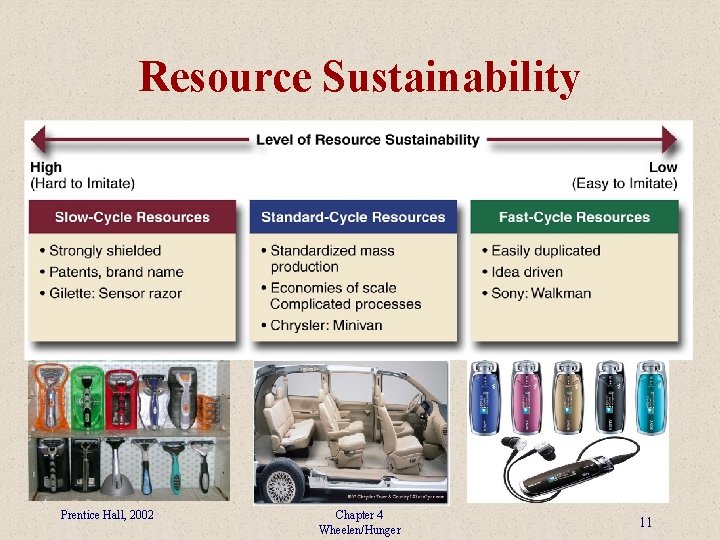
Resource Sustainability Prentice Hall, 2002 Chapter 4 Wheelen/Hunger 11
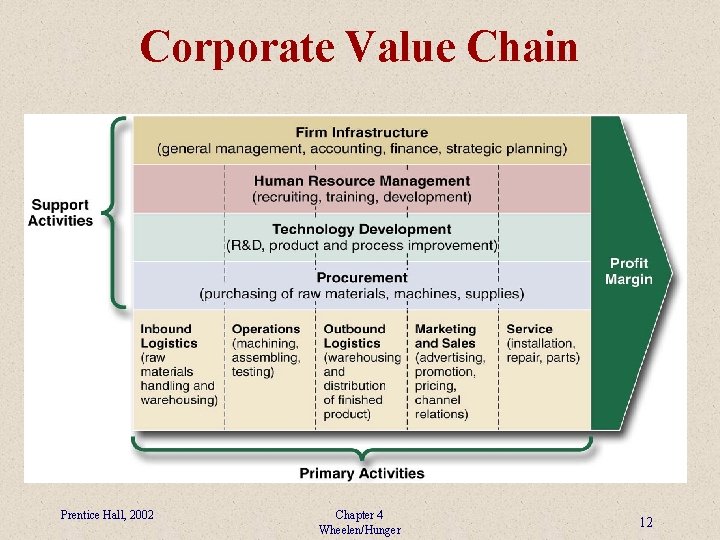
Corporate Value Chain Prentice Hall, 2002 Chapter 4 Wheelen/Hunger 12
Corporate Value Chain Analysis • Value Chain: is a linked set of value creating activities beginning with basic raw materials coming from suppliers, moving onto a series of value-added activities involved in producing and marketing a product or service , and ending with distributors getting the final goods into the hands of the ultimate consumer. Prentice Hall, 2002 Chapter 4 Wheelen/Hunger 13
Corporate Value Chain Analysis • Examine each product line’s value chain • Core competencies & core deficiencies • Examine the “linkages” within each product line’s value chain • Connections between the way one value activity is performed and the cost of performance of another activity • Examine the synergies among the value chains of different product lines or business units • Economies of scope Prentice Hall, 2002 Chapter 4 Wheelen/Hunger 14
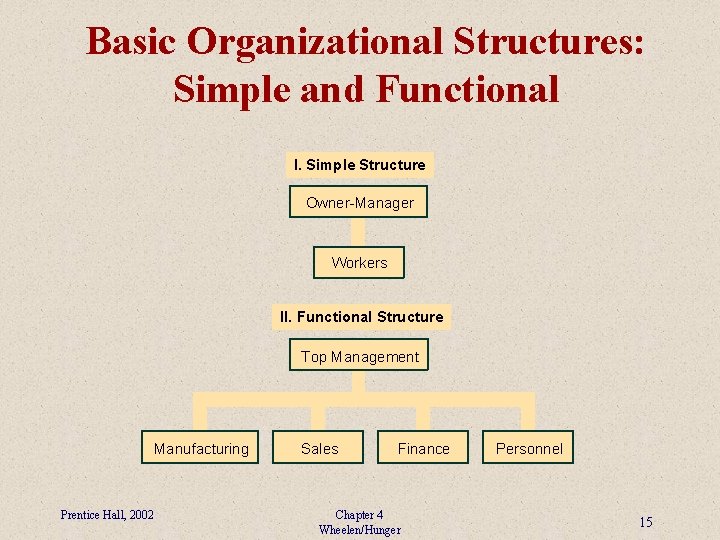
Basic Organizational Structures: Simple and Functional I. Simple Structure Owner-Manager Workers II. Functional Structure Top Management Manufacturing Prentice Hall, 2002 Sales Finance Chapter 4 Wheelen/Hunger Personnel 15
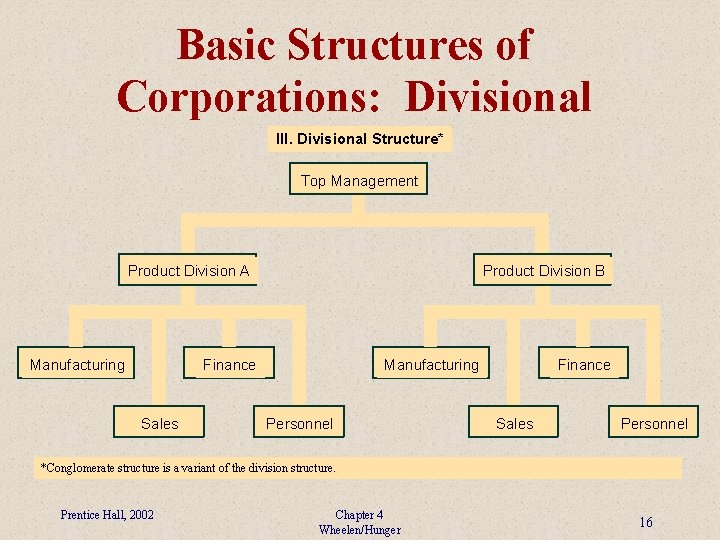
Basic Structures of Corporations: Divisional III. Divisional Structure* Top Management Product Division A Manufacturing Product Division B Finance Sales Manufacturing Personnel Finance Sales Personnel *Conglomerate structure is a variant of the division structure. Prentice Hall, 2002 Chapter 4 Wheelen/Hunger 16
Corporate Culture Defined: Collection of beliefs, expectations, and values learned and shared by a corporation’s members and transmitted from one generation of employees to another. Prentice Hall, 2002 Chapter 4 Wheelen/Hunger 17
Corporate Culture Distinct Attributes 1. Cultural intensity – Degree to which members of a unit accept the norms, values, or other culture content associated with the unit. 2. Cultural integration – Extent to which units throughout an organization share a common culture. Prentice Hall, 2002 Chapter 4 Wheelen/Hunger 18
Corporate Culture Important Functions • • Sense of identity for employees Generate employee commitment Stability of organization Guide for appropriate behavior Prentice Hall, 2002 Chapter 4 Wheelen/Hunger 19
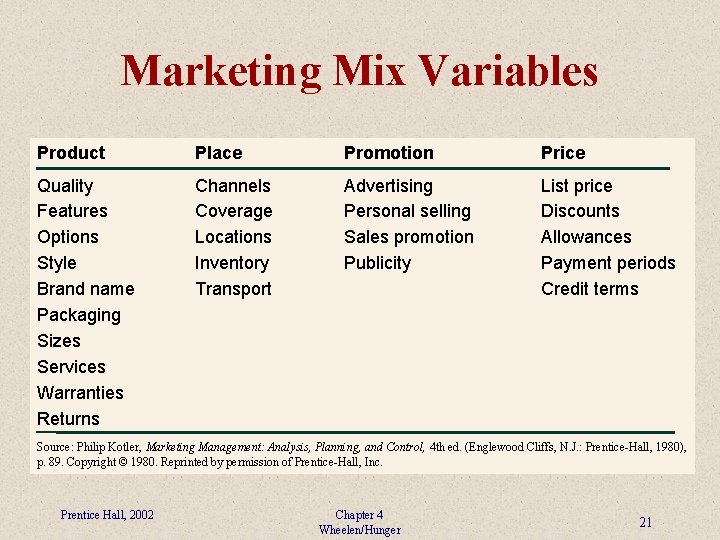
Strategic Marketing Issues Market Position: – “Who are our customers? ” Market Segmentation: – Niches, new product development Marketing Mix: – Combination of key variables under the corporation’s control used to affect demand gain competitive advantage. Prentice Hall, 2002 Chapter 4 Wheelen/Hunger 20
Marketing Mix Variables Product Place Promotion Price Quality Features Options Style Brand name Packaging Sizes Services Warranties Returns Channels Coverage Locations Inventory Transport Advertising Personal selling Sales promotion Publicity List price Discounts Allowances Payment periods Credit terms Source: Philip Kotler, Marketing Management: Analysis, Planning, and Control, 4 th ed. (Englewood Cliffs, N. J. : Prentice-Hall, 1980), p. 89. Copyright © 1980. Reprinted by permission of Prentice-Hall, Inc. Prentice Hall, 2002 Chapter 4 Wheelen/Hunger 21
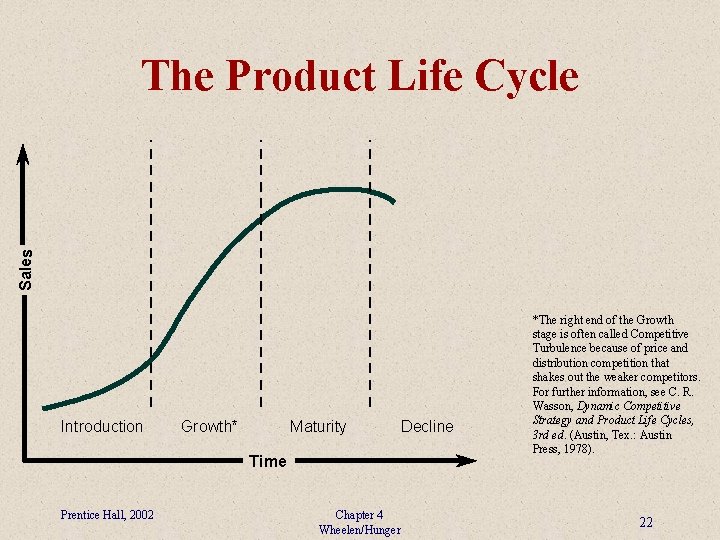
Sales The Product Life Cycle Introduction Growth* Maturity Time Prentice Hall, 2002 Chapter 4 Wheelen/Hunger Decline *The right end of the Growth stage is often called Competitive Turbulence because of price and distribution competition that shakes out the weaker competitors. For further information, see C. R. Wasson, Dynamic Competitive Strategy and Product Life Cycles, 3 rd ed. (Austin, Tex. : Austin Press, 1978). 22
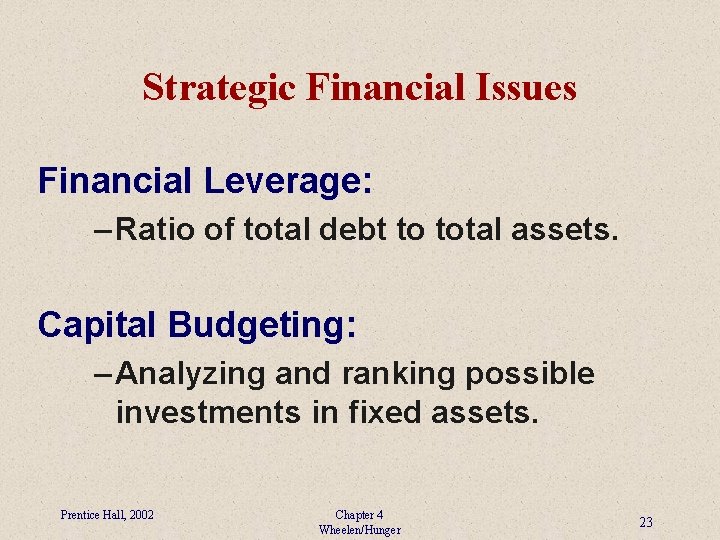
Strategic Financial Issues Financial Leverage: – Ratio of total debt to total assets. Capital Budgeting: – Analyzing and ranking possible investments in fixed assets. Prentice Hall, 2002 Chapter 4 Wheelen/Hunger 23
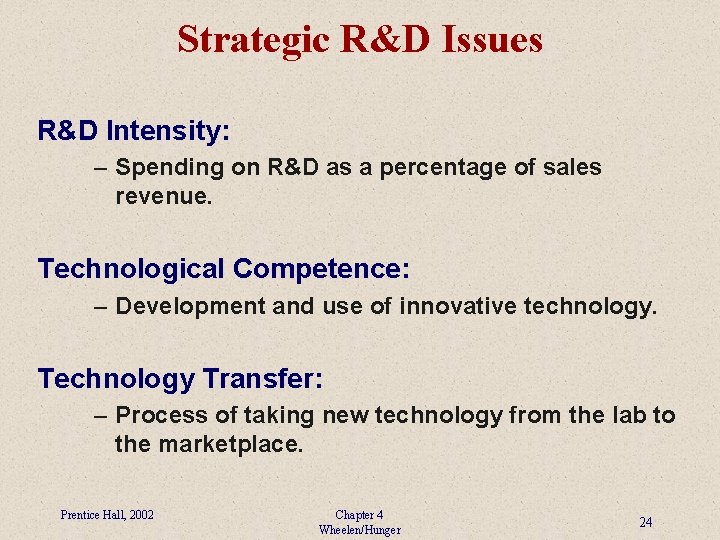
Strategic R&D Issues R&D Intensity: – Spending on R&D as a percentage of sales revenue. Technological Competence: – Development and use of innovative technology. Technology Transfer: – Process of taking new technology from the lab to the marketplace. Prentice Hall, 2002 Chapter 4 Wheelen/Hunger 24
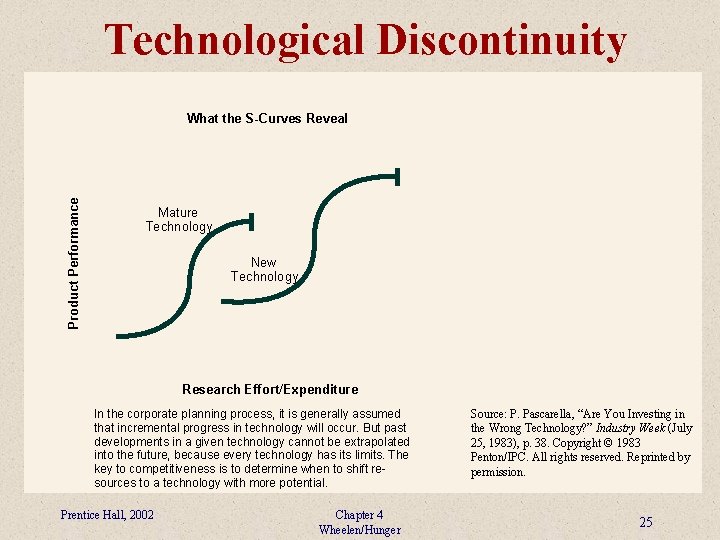
Technological Discontinuity Product Performance What the S-Curves Reveal Mature Technology New Technology Research Effort/Expenditure In the corporate planning process, it is generally assumed that incremental progress in technology will occur. But past developments in a given technology cannot be extrapolated into the future, because every technology has its limits. The key to competitiveness is to determine when to shift resources to a technology with more potential. Prentice Hall, 2002 Chapter 4 Wheelen/Hunger Source: P. Pascarella, “Are You Investing in the Wrong Technology? ” Industry Week (July 25, 1983), p. 38. Copyright © 1983 Penton/IPC. All rights reserved. Reprinted by permission. 25
Strategic Operations Issues Intermittent systems: – Manufacturing systems where items are normally processed sequentially but the work and sequence of the process vary. Continuous systems: – Laid out as lines where products are continuously assembled or processed. Prentice Hall, 2002 Chapter 4 Wheelen/Hunger 26
Strategic HRM Issues Teams – Autonomous (self-managing) – Cross-functional – Concurrent engineering Unionization – 13. 9% of labor force overall – 12% of private labor force Temporary Workers – Increase flexibility; avoid layoffs Prentice Hall, 2002 Chapter 4 Wheelen/Hunger 27
Strategic HRM Issues Quality of Worklife – Participative problem solving – Restructuring work – Innovative reward systems – Improvements in work environment Human Diversity – Different races, cultures and backgrounds in the workplace. Prentice Hall, 2002 Chapter 4 Wheelen/Hunger 28
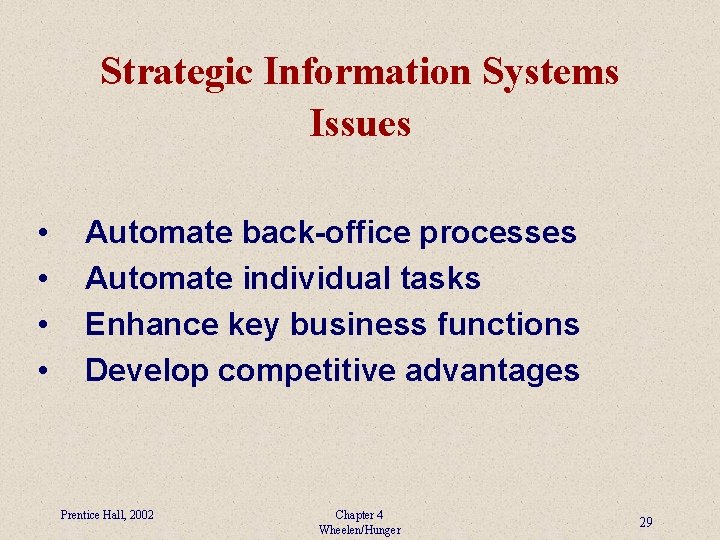
Strategic Information Systems Issues • • Automate back-office processes Automate individual tasks Enhance key business functions Develop competitive advantages Prentice Hall, 2002 Chapter 4 Wheelen/Hunger 29
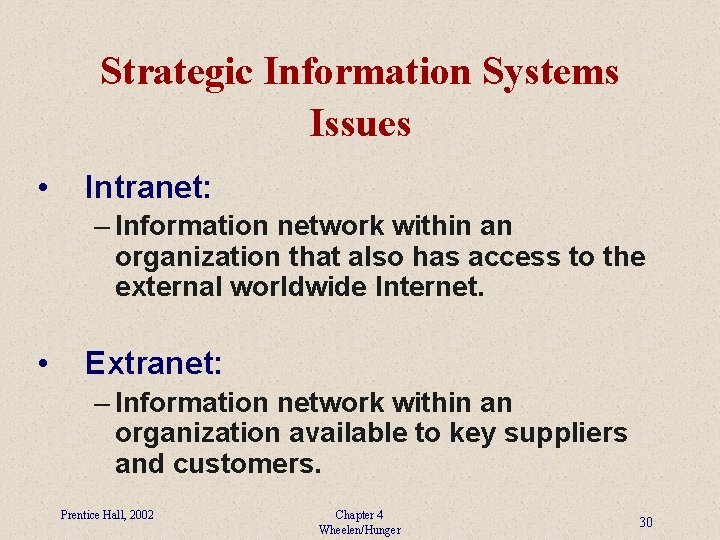
Strategic Information Systems Issues • Intranet: – Information network within an organization that also has access to the external worldwide Internet. • Extranet: – Information network within an organization available to key suppliers and customers. Prentice Hall, 2002 Chapter 4 Wheelen/Hunger 30
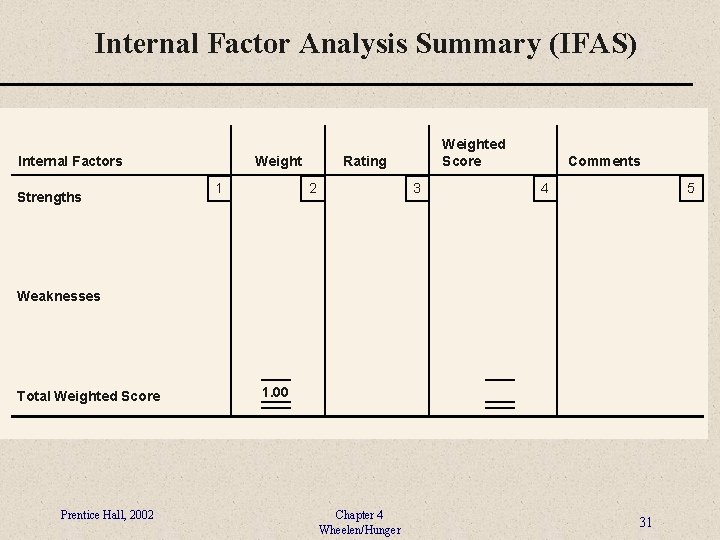
Internal Factor Analysis Summary (IFAS) Strengths Rating Weight Internal Factors 1 Weighted Score 2 3 Comments 4 5 Weaknesses Total Weighted Score Prentice Hall, 2002 1. 00 Chapter 4 Wheelen/Hunger 31
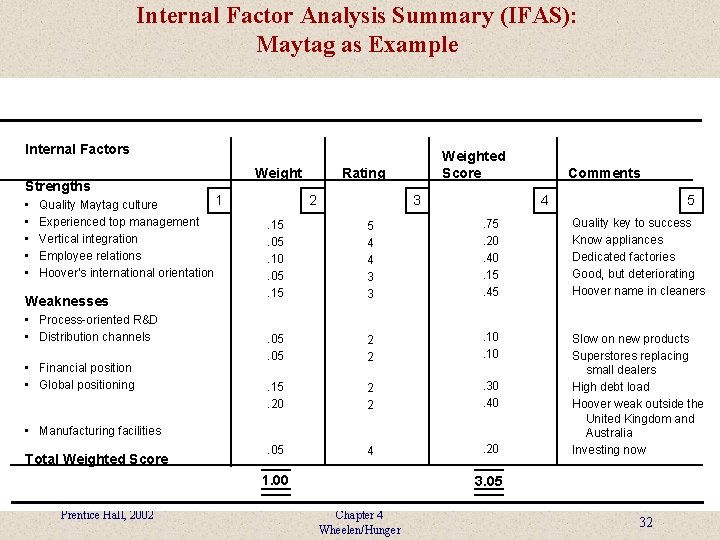
Internal Factor Analysis Summary (IFAS): Maytag as Example Internal Factors Strengths • • • 1 Quality Maytag culture Experienced top management Vertical integration Employee relations Hoover’s international orientation Weaknesses • Process-oriented R&D • Distribution channels • Financial position • Global positioning Weighted Score Rating 2 3 4 5 4 4 3 3 . 75. 20. 40. 15. 45 Quality key to success Know appliances Dedicated factories Good, but deteriorating Hoover name in cleaners . 05 2 2 . 10 . 15. 20 2 2 . 30. 40 . 05 4 . 20 Slow on new products Superstores replacing small dealers High debt load Hoover weak outside the United Kingdom and Australia Investing now 1. 00 Prentice Hall, 2002 5 . 15. 05. 10. 05. 15 • Manufacturing facilities Total Weighted Score Comments 3. 05 Chapter 4 Wheelen/Hunger 32
Impact of the Internet • Virtual Teams: – Groups of geographically and/or organizationally dispersed coworkers that are assembled using a combination of telecommunications and information technologies to accomplish an organizational task. Prentice Hall, 2002 Chapter 4 Wheelen/Hunger 33
Impact of the Internet Virtual Teams • • • Flatter organizational structures Turbulent environments Employee autonomy Higher knowledge requirements Globalization of trade Prentice Hall, 2002 Chapter 4 Wheelen/Hunger 34