
Chapter 4 Internal Loadings Developed in Structural Members
Chapter 4: Internal Loadings Developed in Structural Members Structural Analysis 7 th Edition in SI Units Russell C. Hibbeler
Internal loadings at a specified point • The internal load at a specified point in a member can be determined by using the method of sections • This consists of: • N, normal force • V, shear force • M, bending moment Chapter 4: Internal Loadings Developed in Structural Members © 2009 Pearson Education South Asia Pte Ltd Structural Analysis 7 th Edition
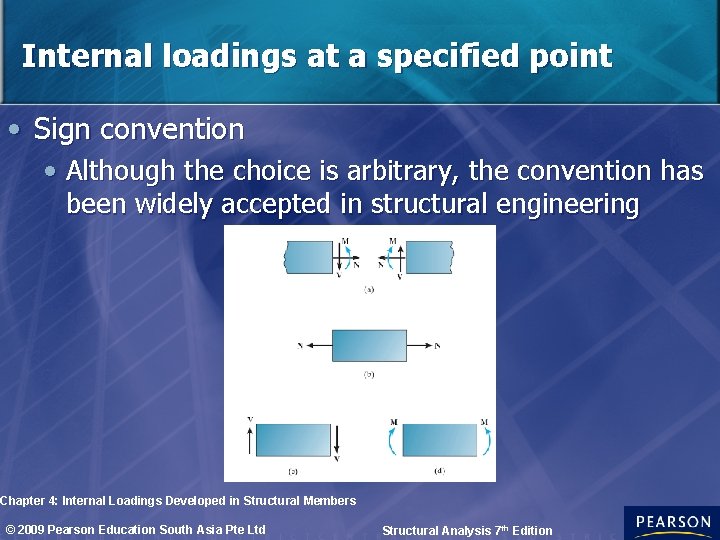
Internal loadings at a specified point • Sign convention • Although the choice is arbitrary, the convention has been widely accepted in structural engineering Chapter 4: Internal Loadings Developed in Structural Members © 2009 Pearson Education South Asia Pte Ltd Structural Analysis 7 th Edition
Internal loadings at a specified point • Procedure for analysis • Determine the support reactions before the member is “cut” • If the member is part of a pin-connected structure, the pin reactions can be determine using the methods of section • Keep all distributed loadings, couple moments & forces acting on the member in their exact location Chapter 4: Internal Loadings Developed in Structural Members © 2009 Pearson Education South Asia Pte Ltd Structural Analysis 7 th Edition
Internal loadings at a specified point • Pass an imaginary section through the member, perpendicular to its axis at the point where the internal loading is to be determined • Then draw a free-body diagram of the segment that has the least no. of loads on it • Indicate the unknown resultants N, V & M acting in their positive directions Chapter 4: Internal Loadings Developed in Structural Members © 2009 Pearson Education South Asia Pte Ltd Structural Analysis 7 th Edition
Internal loadings at a specified point • Moments should be summed at the section about axes that pass through the centroid of the member’s x-sectional area in order to eliminate N & V, thereby solving M • If the solution of the equilibrium eqn yields a quantity having a –ve magnitude, then the assumed directional sense of the quantity is opposite to that shown on the free-body diagram Chapter 4: Internal Loadings Developed in Structural Members © 2009 Pearson Education South Asia Pte Ltd Structural Analysis 7 th Edition
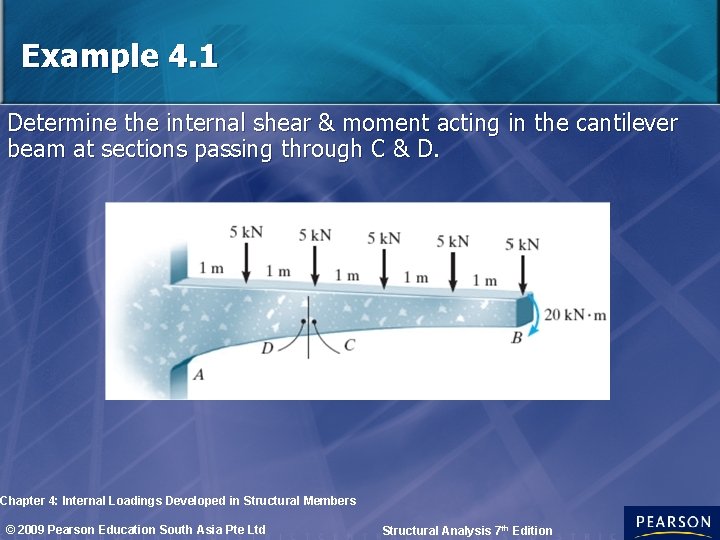
Example 4. 1 Determine the internal shear & moment acting in the cantilever beam at sections passing through C & D. Chapter 4: Internal Loadings Developed in Structural Members © 2009 Pearson Education South Asia Pte Ltd Structural Analysis 7 th Edition
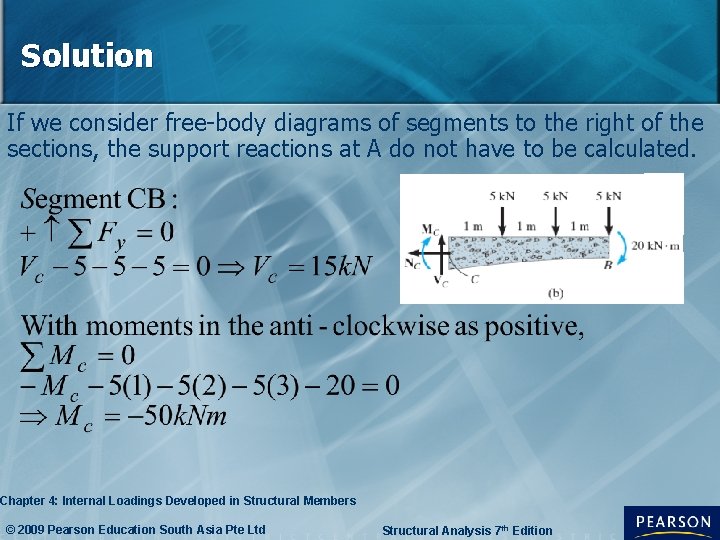
Solution If we consider free-body diagrams of segments to the right of the sections, the support reactions at A do not have to be calculated. Chapter 4: Internal Loadings Developed in Structural Members © 2009 Pearson Education South Asia Pte Ltd Structural Analysis 7 th Edition
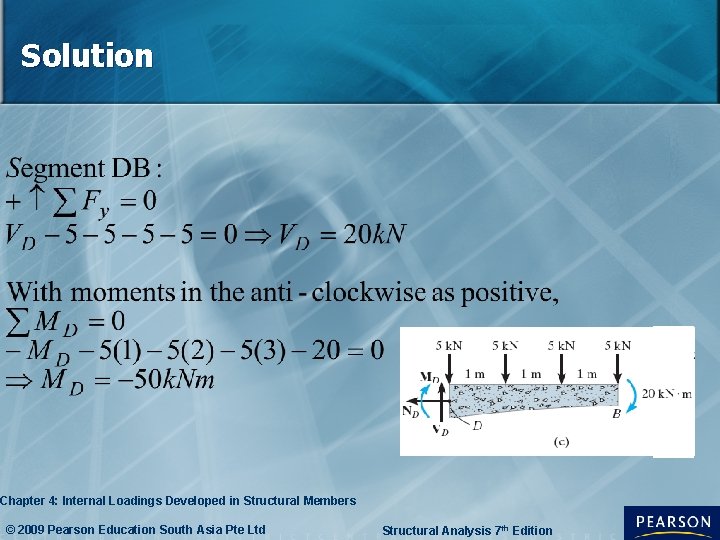
Solution Chapter 4: Internal Loadings Developed in Structural Members © 2009 Pearson Education South Asia Pte Ltd Structural Analysis 7 th Edition
Shear & Moment Functions • Design of beam requires detailed knowledge of the variations of V & M • Internal N is generally not considered as: • The loads applied to a beam act perpendicular to the beam’s axis • For design purpose, a beam’s resistance to shear & bending is more important than its ability to resist normal force • An exception is when it is subjected to compressive axial force where buckling may occur Chapter 4: Internal Loadings Developed in Structural Members © 2009 Pearson Education South Asia Pte Ltd Structural Analysis 7 th Edition
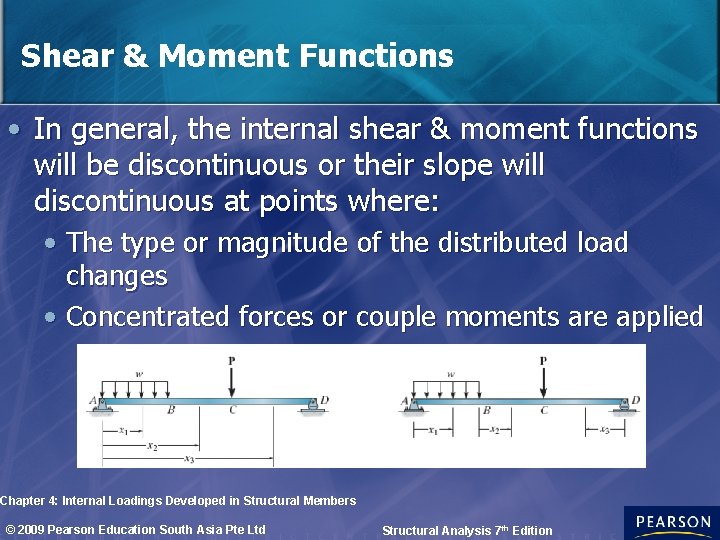
Shear & Moment Functions • In general, the internal shear & moment functions will be discontinuous or their slope will discontinuous at points where: • The type or magnitude of the distributed load changes • Concentrated forces or couple moments are applied Chapter 4: Internal Loadings Developed in Structural Members © 2009 Pearson Education South Asia Pte Ltd Structural Analysis 7 th Edition
Shear & Moment Functions • Procedure for Analysis • Determine the support reactions on the beam • Resolve all the external forces into components acting perpendicular & parallel to beam’s axis • Specify separate coordinates x and associated origins, extending into: • Regions of the beam between concentrated forces and/or couple moments • Discontinuity of distributed loading Chapter 4: Internal Loadings Developed in Structural Members © 2009 Pearson Education South Asia Pte Ltd Structural Analysis 7 th Edition
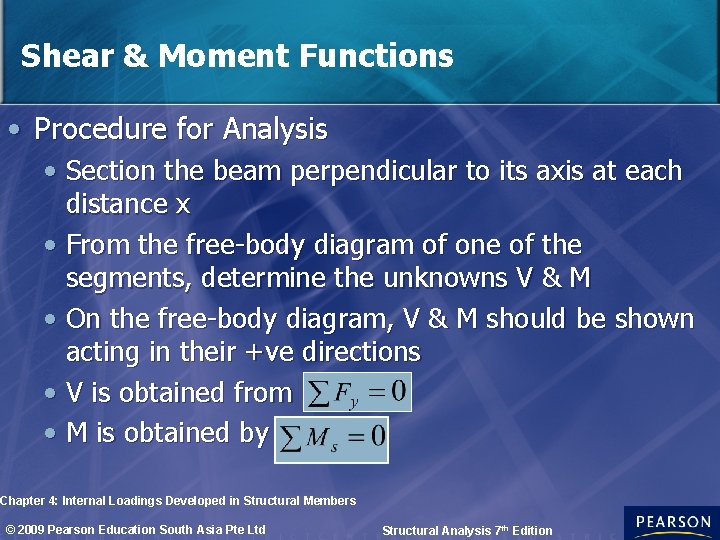
Shear & Moment Functions • Procedure for Analysis • Section the beam perpendicular to its axis at each distance x • From the free-body diagram of one of the segments, determine the unknowns V & M • On the free-body diagram, V & M should be shown acting in their +ve directions • V is obtained from • M is obtained by Chapter 4: Internal Loadings Developed in Structural Members © 2009 Pearson Education South Asia Pte Ltd Structural Analysis 7 th Edition
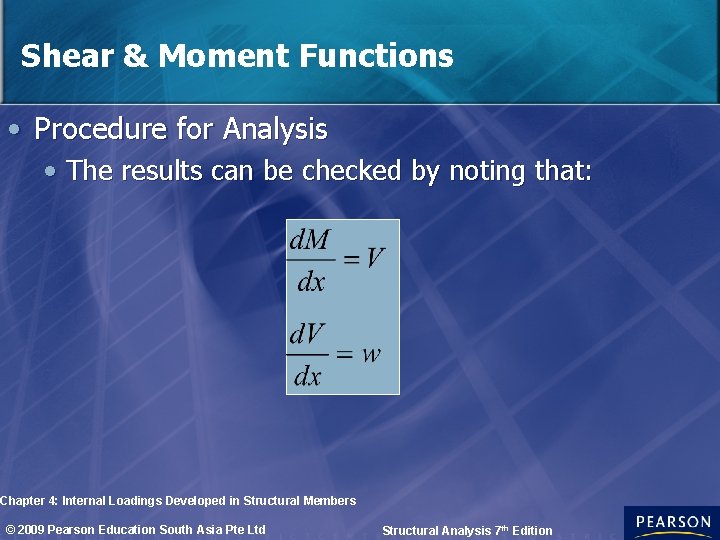
Shear & Moment Functions • Procedure for Analysis • The results can be checked by noting that: Chapter 4: Internal Loadings Developed in Structural Members © 2009 Pearson Education South Asia Pte Ltd Structural Analysis 7 th Edition
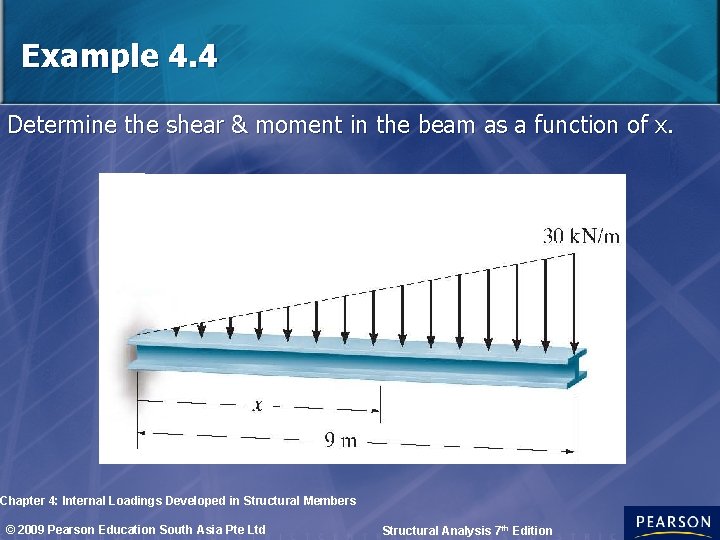
Example 4. 4 Determine the shear & moment in the beam as a function of x. Chapter 4: Internal Loadings Developed in Structural Members © 2009 Pearson Education South Asia Pte Ltd Structural Analysis 7 th Edition
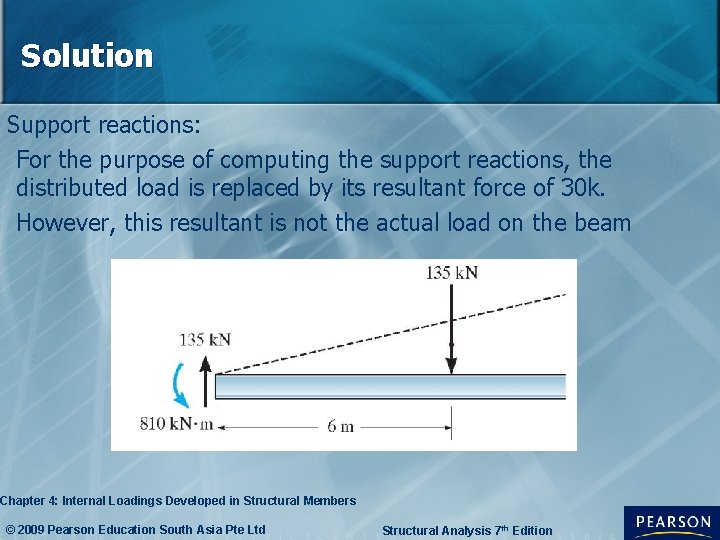
Solution Support reactions: For the purpose of computing the support reactions, the distributed load is replaced by its resultant force of 30 k. However, this resultant is not the actual load on the beam Chapter 4: Internal Loadings Developed in Structural Members © 2009 Pearson Education South Asia Pte Ltd Structural Analysis 7 th Edition
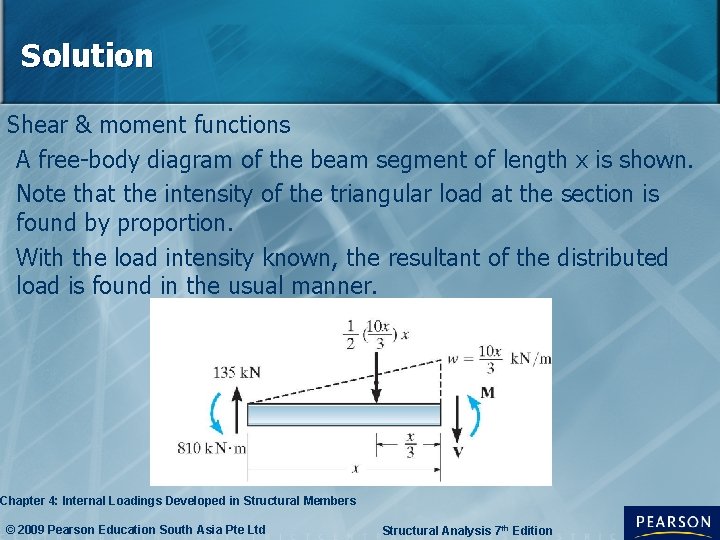
Solution Shear & moment functions A free-body diagram of the beam segment of length x is shown. Note that the intensity of the triangular load at the section is found by proportion. With the load intensity known, the resultant of the distributed load is found in the usual manner. Chapter 4: Internal Loadings Developed in Structural Members © 2009 Pearson Education South Asia Pte Ltd Structural Analysis 7 th Edition
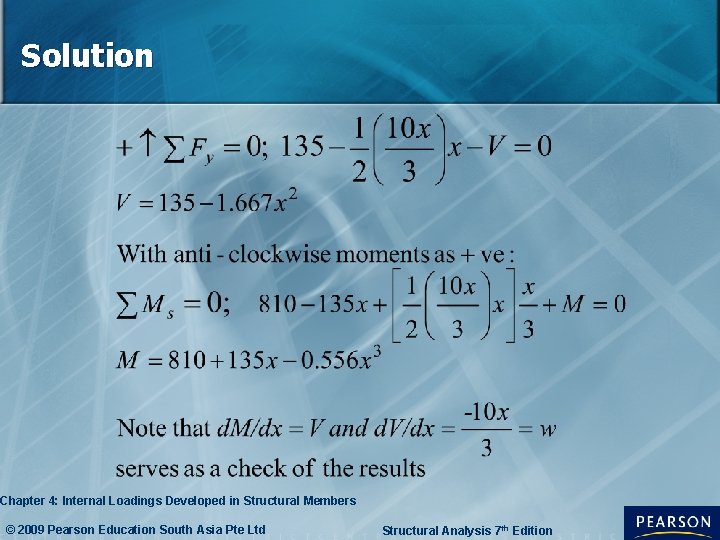
Solution Chapter 4: Internal Loadings Developed in Structural Members © 2009 Pearson Education South Asia Pte Ltd Structural Analysis 7 th Edition
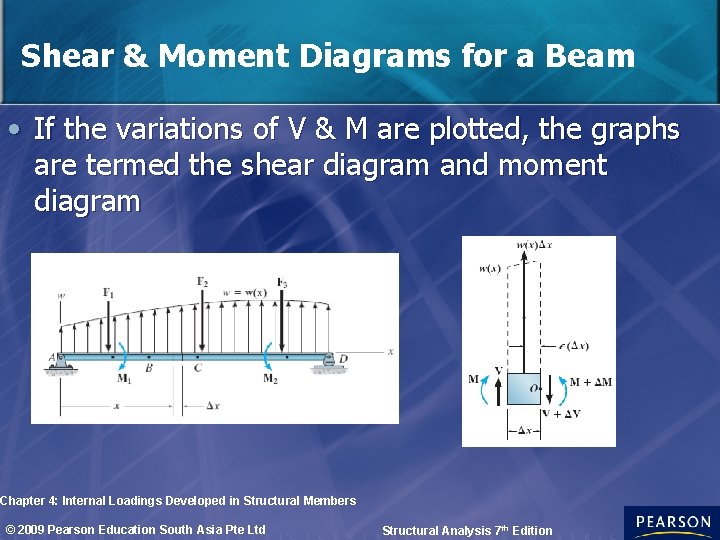
Shear & Moment Diagrams for a Beam • If the variations of V & M are plotted, the graphs are termed the shear diagram and moment diagram Chapter 4: Internal Loadings Developed in Structural Members © 2009 Pearson Education South Asia Pte Ltd Structural Analysis 7 th Edition
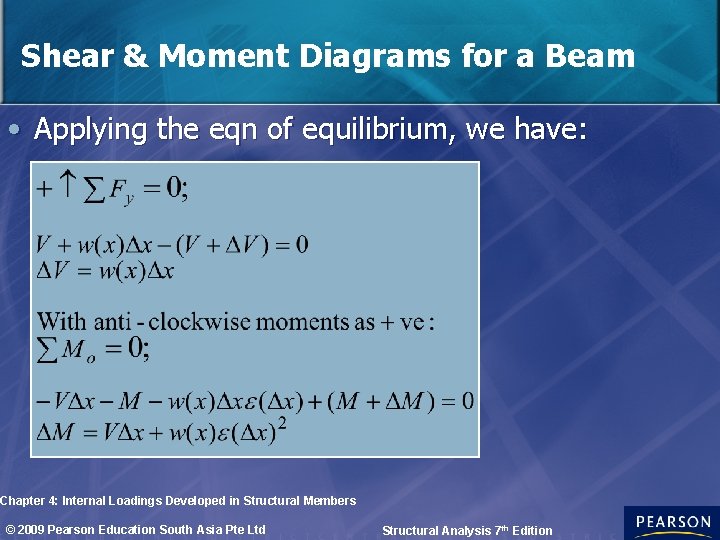
Shear & Moment Diagrams for a Beam • Applying the eqn of equilibrium, we have: Chapter 4: Internal Loadings Developed in Structural Members © 2009 Pearson Education South Asia Pte Ltd Structural Analysis 7 th Edition
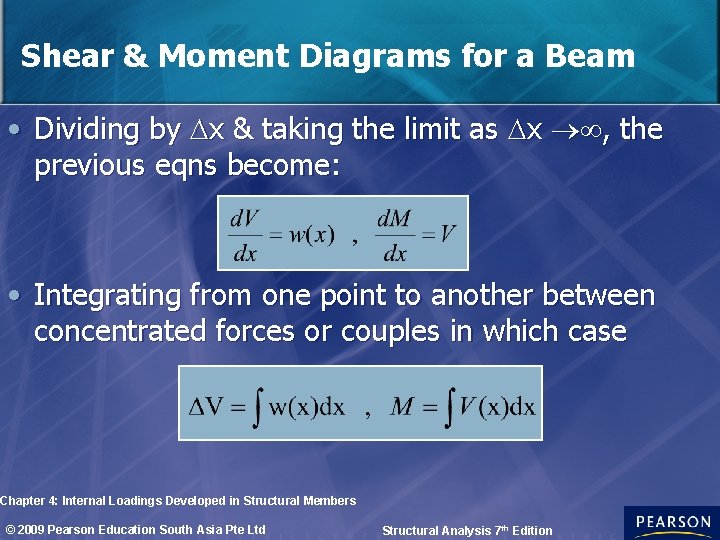
Shear & Moment Diagrams for a Beam • Dividing by x & taking the limit as x , the previous eqns become: • Integrating from one point to another between concentrated forces or couples in which case Chapter 4: Internal Loadings Developed in Structural Members © 2009 Pearson Education South Asia Pte Ltd Structural Analysis 7 th Edition
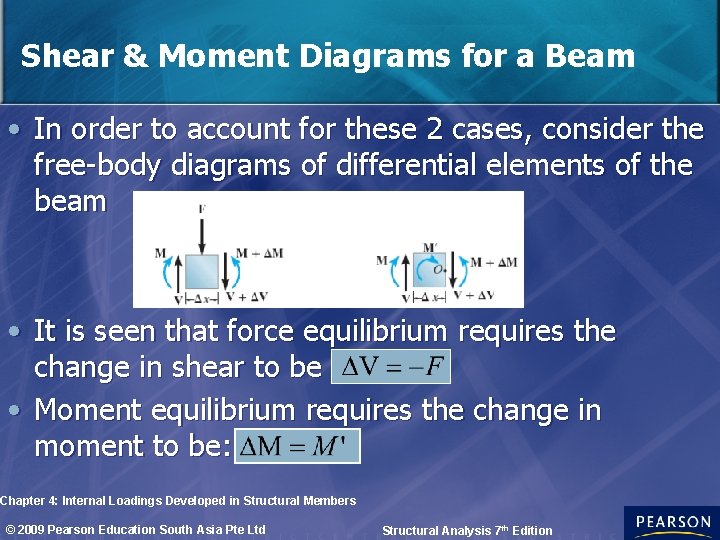
Shear & Moment Diagrams for a Beam • In order to account for these 2 cases, consider the free-body diagrams of differential elements of the beam • It is seen that force equilibrium requires the change in shear to be • Moment equilibrium requires the change in moment to be: Chapter 4: Internal Loadings Developed in Structural Members © 2009 Pearson Education South Asia Pte Ltd Structural Analysis 7 th Edition
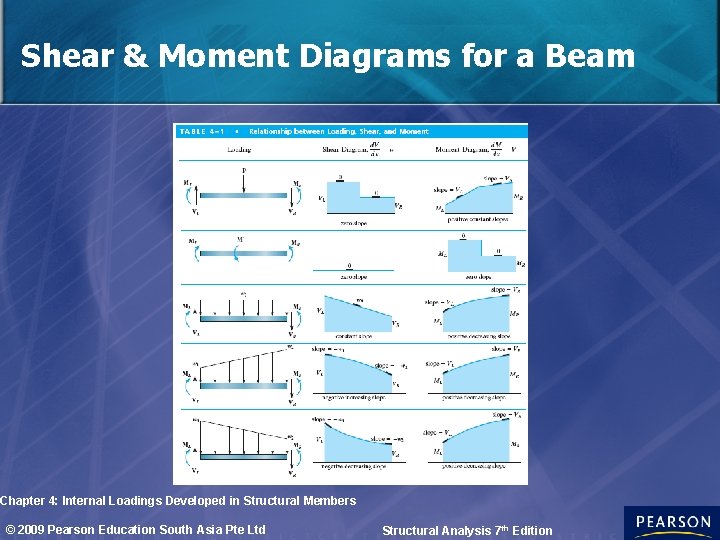
Shear & Moment Diagrams for a Beam Chapter 4: Internal Loadings Developed in Structural Members © 2009 Pearson Education South Asia Pte Ltd Structural Analysis 7 th Edition
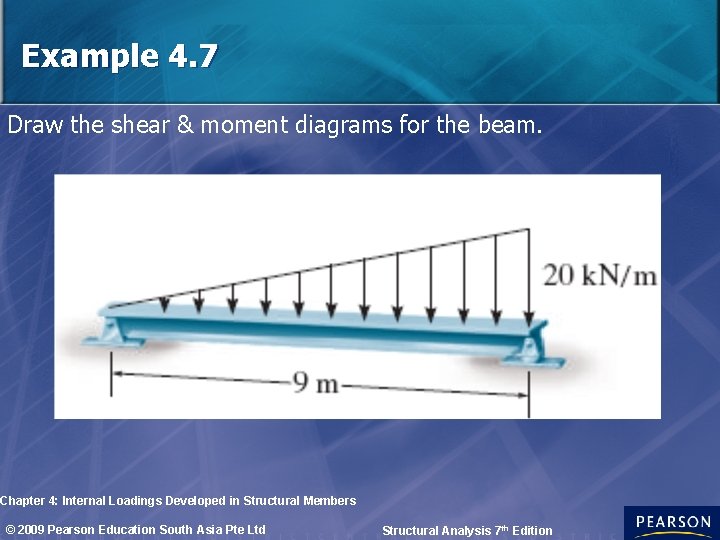
Example 4. 7 Draw the shear & moment diagrams for the beam. Chapter 4: Internal Loadings Developed in Structural Members © 2009 Pearson Education South Asia Pte Ltd Structural Analysis 7 th Edition
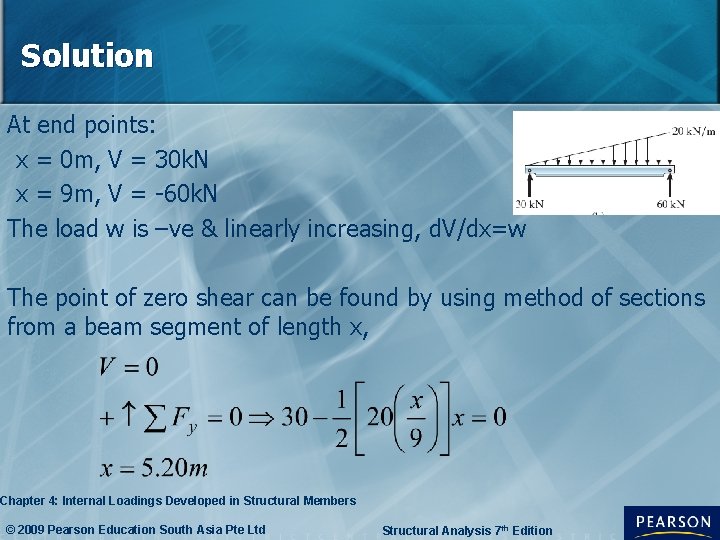
Solution At end points: x = 0 m, V = 30 k. N x = 9 m, V = -60 k. N The load w is –ve & linearly increasing, d. V/dx=w The point of zero shear can be found by using method of sections from a beam segment of length x, Chapter 4: Internal Loadings Developed in Structural Members © 2009 Pearson Education South Asia Pte Ltd Structural Analysis 7 th Edition
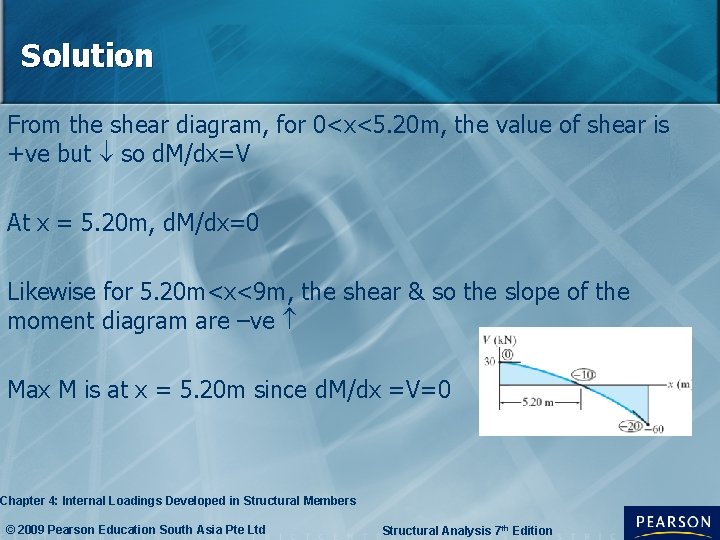
Solution From the shear diagram, for 0<x<5. 20 m, the value of shear is +ve but so d. M/dx=V At x = 5. 20 m, d. M/dx=0 Likewise for 5. 20 m<x<9 m, the shear & so the slope of the moment diagram are –ve Max M is at x = 5. 20 m since d. M/dx =V=0 Chapter 4: Internal Loadings Developed in Structural Members © 2009 Pearson Education South Asia Pte Ltd Structural Analysis 7 th Edition
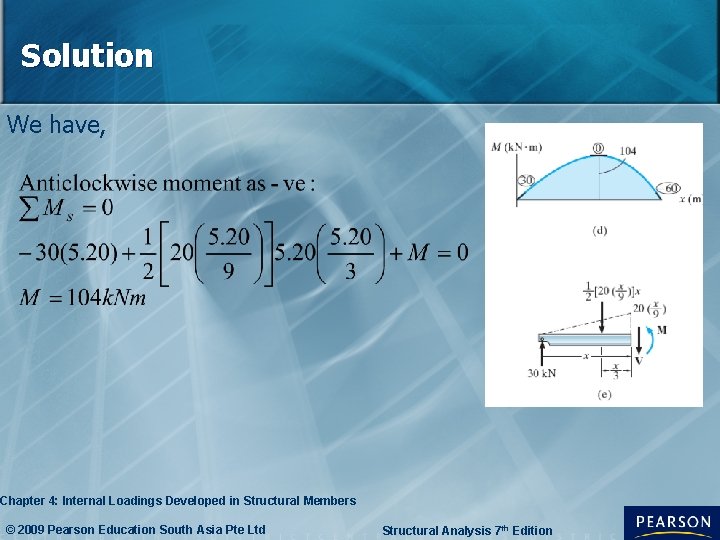
Solution We have, Chapter 4: Internal Loadings Developed in Structural Members © 2009 Pearson Education South Asia Pte Ltd Structural Analysis 7 th Edition
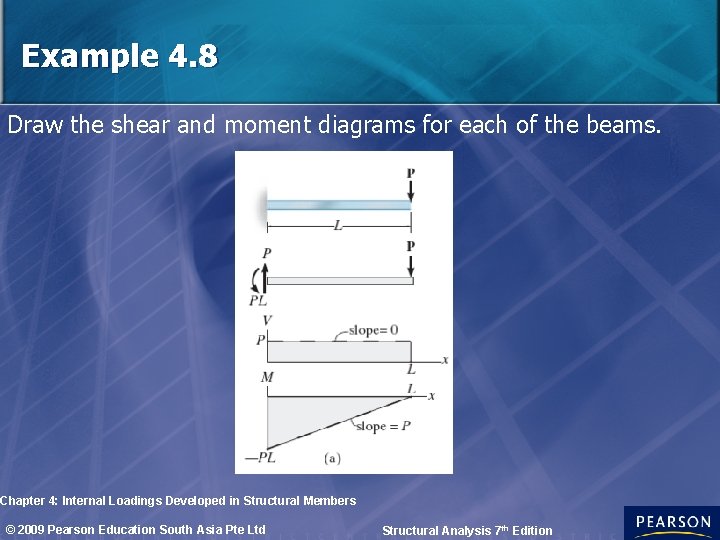
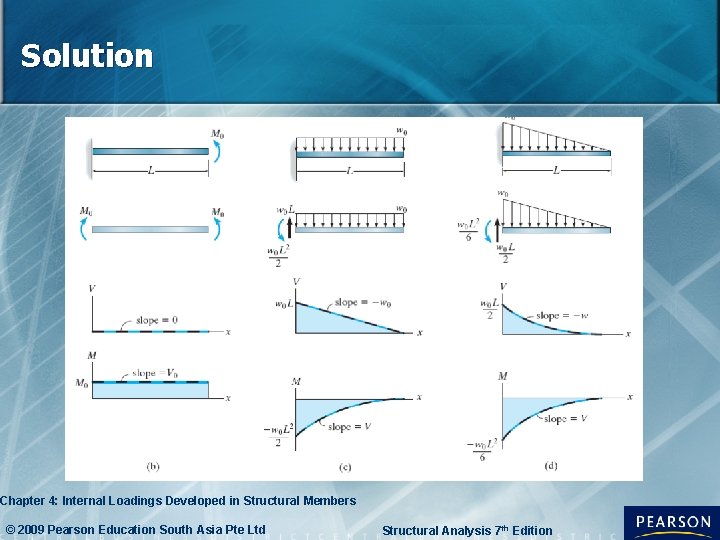
Example 4. 8 Draw the shear and moment diagrams for each of the beams. Chapter 4: Internal Loadings Developed in Structural Members © 2009 Pearson Education South Asia Pte Ltd Structural Analysis 7 th Edition
Solution The support reactions are calculated & shown on a free-body diagram of each beam. From the sign convention, V at the ends of each beam is plotted first. Since d. V/dx = w, the slope of the shear between these 2 ends can be determined. V versus x can be sketched. Chapter 4: Internal Loadings Developed in Structural Members © 2009 Pearson Education South Asia Pte Ltd Structural Analysis 7 th Edition
Solution From the sign convention, M at the ends of each beam is plotted first. Since d. M/dx = V, the trend of the slope of the moment diagram between these 2 ends can be determined. M versus x can be sketched. Chapter 4: Internal Loadings Developed in Structural Members © 2009 Pearson Education South Asia Pte Ltd Structural Analysis 7 th Edition
Solution Chapter 4: Internal Loadings Developed in Structural Members © 2009 Pearson Education South Asia Pte Ltd Structural Analysis 7 th Edition
- Slides: 31